Logistics Management/
Supply Chain Management
Judith Molka-Danielsen
j.molka-danielsen@himolde.no
http://home.himolde.no/~molka
Overview
Global value model for B2B systems (all)
Logistics management/supply chain (ch10)
Human Resource/support services (+ch10)
Customer Relations Management (ch11)
Manufacturing and process management
(ch12)
Financial management/EDI (+ch12)
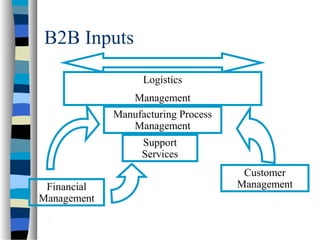
B2B Inputs
Manufacturing Process
Management
Logistics
Management
Customer
Management
Support
Services
Financial
Management
Logistics Management
Supply Chain Management
Supply Chain Management (SCM) is an outgrowth of
“traditional” logistics management and Enterprise
Resource Planning (ERP)
It extends the management function outside the
organization to both the supplier organizations and
the distribution channels
Good ERP/SCM can increase net revenues 4-6%
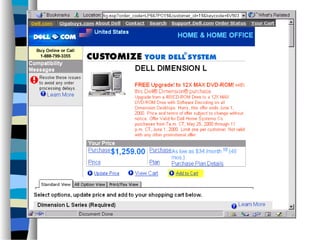
SCM has become an expectation for industry
LM-SCM
Firms are moving from an process-efficiency driven
focus
to a customer value-benefit focus.
This involves understanding Customer Needs.
Costs are coorelated to uncertainty in the Supply
Chain (enterprise integration SCM software is to
address this).
SCM modules address: logistics, manufacturing,
finance, etc.
LM-SCM
Approaches
The best-in-practice approaches have been
incorporated in various systems
Major vendors include
– SAP
– PeopleSoft
– Baan
Often, organizations find adoption of full
blown ERP/SCM systems require significant
organizational change
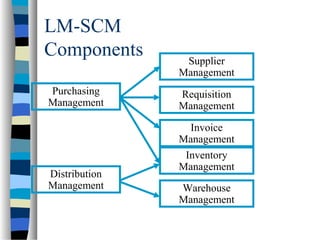
LM-SCM
Components
Purchasing
Management
Distribution
Management
Requisition
Management
Supplier
Management
Invoice
Management
Inventory
Management
Warehouse
Management
LM-SCM
Purchasing/Supplier
Management
The goal is to simplify routine transactions
and reduce paperwork
Trend is to reduce supplier steering and
partner with the selected suppliers so that
both organizations win
Purchase orders can be issued by DBMS
triggers on inventory
Suppliers can be allowed to replenish
inventory based on agreed upon parameters
LM-SCM
Distribution Management
The distribution or demand chain is
concerned with:
– Speeding data acquisition
– Controlling inventory, warehousing and
shipping
– Reducing paperwork
It also includes invoice auditing and order
tracking
LM-SCM Fundamentals
What is a Supply Chain? Steps to meet customer
needs. Global competition makes the customer in
control of production, not the manufacturer.
What is SC-management? Coordination of tasks
(order generate, taking, filling, distribution of
products, services and information). Key players
create an extended enterprise.
Is SCM a new concept? No, 25 years. Focus
progresses: efficiency, integration of enterprise,
product made to customer expectations. The last
means more information integration between
organizations.
LM-SCM Fundamentals
Pull (build to order) versus Push (build to stock)
models.
Pull model requires: support product varients,
reduced lead times, improved quality, lower unit cost,
operational excellence, performance measures.
Pull implementation requires: gather customer
demands, make right choices to meet demand, make
informed decisions on materials, deliver goods,
collect payments.
Managers need: unified plan, communication,
coordination to all involved.
LM-SCM
Elements of SCM
Planning System for Purchasing Management: right
product, right place, right time. Consumer demand
triggers order up the supply chain. Begin with POS
terminal. Then use information to determine inventory
investment, saftey stock, inventory turns,
replenishment frequency.
System: 1. Order generation and forecast planning,
2. Order taking and entry for replenishment.
LM-SCM
Elements of SCM
Execution System for Distribution
Management: facilitate the physical
movement of goods and services. Focus on
operational efficiency.
Ensure order fulfillment, procurement,
manufacturing, and distribution management
are integrated. .
LM-SCM
Elements of SCM
Performance Measurement Systems to study the
health of the approach: accounting and financial
management systems are focus. Electronic
commerce tools such as datawarehousing used to
analyse data without impacting performance of
operational systems.
Use of software agents to let different users set
different criteria for sifting through data. ( ie.
Salespersons, accountants, material planners,
purchasing agents).
LM-SCM
Integrating Functions
Customer Asset Management: manage proactively,
better understand market and needs.
Integrated Logistics: production planning,
procurement, inventory management.
Financial Management: manage flows through
financial intermediaries.
Supply Chain coordination is also know as Integrated
Workflow Management.
LM-SCM
Merchandise management
1 Million stockkeeping units (SKUs), every
product style, size, color.
On-trend, in-stock execution strategies
(optimize selection, minimize inventory)
best price per unit, minimize markdowns.
LM-SCM
Order Management Cycle
(OMC)
1. order planning and generation - make sure the
inventory is there.
2. online cost estimation and pricing - find prices,
understand price elasticity of market, yield
management
3. order receipt and entry - how to interact with
customers, receive requests, what to do with
soldouts.
LM-SCM
Order Management Cycle
(OMC)
4. order selection and prioritization - which
customers get served first, better, which orders filled.
5. order scheduling - coordination between
departments needed.
6. order fulfillment and distribution - bringing parts
together, ie. FedEx ships parts to assembly place, not
warehouse. Retailing is not just selling but order
fulfillment.
7. order billing and payment management - can the
customer understand the bill.
LM-SCM
Software Interfaces
1. CRI - Store operations and customer service. UPC
- mark, track, exchange product information.
2. RSI - where to keep stock. Partnerships with few
key suppliers
– purchasing - from suppliers
– inventory mgmt - how much in stock, where
– stock control - track movement
– stock movement - receiving, checking, storing, pick-ups,
dispatching
– distribution operations - ops of warehouse, transport fleet
3. RMI -
– merchandise planning (profitability analysis, markdowns),
– mircomarketing (advertising, targeting customers),
– brand management (package and design).
LM-SCM
Application Software
Horizontal: common functions across industries, ie.
financial and manufacturing. See applications in
Table 10.1
Vertical: automate tasks that are specific to a market
segment.
Dominate players: SAP, Oracle, PeopleSoft, Baan.
Three-tier software and Intranets become technology
to support enterprise business processes and
philosophy. Use of ubiquitous Web interface.
LM-SCM
Application Software
Packages are good: they include the best practises of
many businesses. They include distilled knowledge.
Important Characteristics of Software for SCM:
– total costs
– access to expanded distribution channels
– ability to integrate new technology
– security is addressed
– tailor to customer from the pre-packaged software with
selective options.
LM-SCM
Ultimate Goals
When a sophisticated SCM system is coupled
with agile manufacturing system, customer
driven manufacturing is possible
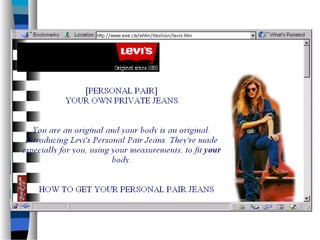
A first experiment in this direction is the Levi-
Strauss custom jeans
Most of the computer vendors offer similar
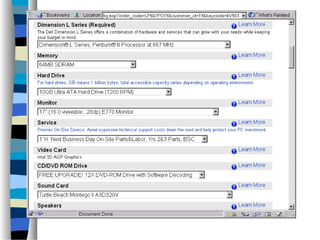
capabilities
Human Resource and Other
Support Services
Any other support service in the organization
can also be enhanced by distributed
electronic processing
Human resources management is frequently
addressed as a part of the effort because of
the complexity of modern benefits packages
HRM
Functions
Recruiting, training, salary administration
Payroll functions including time reporting,
payroll calculation and tax computation
Benefits administration including flexible
spending accounts, pension programs and
defined benefits
Health care benefits management
HRM
Information Dissemination
A big part of the human resources function
involves making information available to
employees
Policies, procedures, options can be
maintained and updated efficiently using
intranet technology
Employee queries related to options and
enrollments can be distributed by intranet
HRM
Workflow
Benefits claims and queries can be submitted
electronically and processed using workflow
systems
Standard queries can be processed and
returned securely by email to the appropriate
person
Relationships with external agencies can be
facilitated by email and EDI processing

Lmscm

  • 1.
    Logistics Management/ Supply ChainManagement Judith Molka-Danielsen j.molka-danielsen@himolde.no http://home.himolde.no/~molka
  • 2.
    Overview Global value modelfor B2B systems (all) Logistics management/supply chain (ch10) Human Resource/support services (+ch10) Customer Relations Management (ch11) Manufacturing and process management (ch12) Financial management/EDI (+ch12)
  • 3.
  • 4.
    Logistics Management Supply ChainManagement Supply Chain Management (SCM) is an outgrowth of “traditional” logistics management and Enterprise Resource Planning (ERP) It extends the management function outside the organization to both the supplier organizations and the distribution channels Good ERP/SCM can increase net revenues 4-6% SCM has become an expectation for industry
  • 5.
    LM-SCM Firms are movingfrom an process-efficiency driven focus to a customer value-benefit focus. This involves understanding Customer Needs. Costs are coorelated to uncertainty in the Supply Chain (enterprise integration SCM software is to address this). SCM modules address: logistics, manufacturing, finance, etc.
  • 6.
    LM-SCM Approaches The best-in-practice approacheshave been incorporated in various systems Major vendors include – SAP – PeopleSoft – Baan Often, organizations find adoption of full blown ERP/SCM systems require significant organizational change
  • 7.
  • 8.
    LM-SCM Purchasing/Supplier Management The goal isto simplify routine transactions and reduce paperwork Trend is to reduce supplier steering and partner with the selected suppliers so that both organizations win Purchase orders can be issued by DBMS triggers on inventory Suppliers can be allowed to replenish inventory based on agreed upon parameters
  • 9.
    LM-SCM Distribution Management The distributionor demand chain is concerned with: – Speeding data acquisition – Controlling inventory, warehousing and shipping – Reducing paperwork It also includes invoice auditing and order tracking
  • 10.
    LM-SCM Fundamentals What isa Supply Chain? Steps to meet customer needs. Global competition makes the customer in control of production, not the manufacturer. What is SC-management? Coordination of tasks (order generate, taking, filling, distribution of products, services and information). Key players create an extended enterprise. Is SCM a new concept? No, 25 years. Focus progresses: efficiency, integration of enterprise, product made to customer expectations. The last means more information integration between organizations.
  • 11.
    LM-SCM Fundamentals Pull (buildto order) versus Push (build to stock) models. Pull model requires: support product varients, reduced lead times, improved quality, lower unit cost, operational excellence, performance measures. Pull implementation requires: gather customer demands, make right choices to meet demand, make informed decisions on materials, deliver goods, collect payments. Managers need: unified plan, communication, coordination to all involved.
  • 12.
    LM-SCM Elements of SCM PlanningSystem for Purchasing Management: right product, right place, right time. Consumer demand triggers order up the supply chain. Begin with POS terminal. Then use information to determine inventory investment, saftey stock, inventory turns, replenishment frequency. System: 1. Order generation and forecast planning, 2. Order taking and entry for replenishment.
  • 13.
    LM-SCM Elements of SCM ExecutionSystem for Distribution Management: facilitate the physical movement of goods and services. Focus on operational efficiency. Ensure order fulfillment, procurement, manufacturing, and distribution management are integrated. .
  • 14.
    LM-SCM Elements of SCM PerformanceMeasurement Systems to study the health of the approach: accounting and financial management systems are focus. Electronic commerce tools such as datawarehousing used to analyse data without impacting performance of operational systems. Use of software agents to let different users set different criteria for sifting through data. ( ie. Salespersons, accountants, material planners, purchasing agents).
  • 15.
    LM-SCM Integrating Functions Customer AssetManagement: manage proactively, better understand market and needs. Integrated Logistics: production planning, procurement, inventory management. Financial Management: manage flows through financial intermediaries. Supply Chain coordination is also know as Integrated Workflow Management.
  • 16.
    LM-SCM Merchandise management 1 Millionstockkeeping units (SKUs), every product style, size, color. On-trend, in-stock execution strategies (optimize selection, minimize inventory) best price per unit, minimize markdowns.
  • 17.
    LM-SCM Order Management Cycle (OMC) 1.order planning and generation - make sure the inventory is there. 2. online cost estimation and pricing - find prices, understand price elasticity of market, yield management 3. order receipt and entry - how to interact with customers, receive requests, what to do with soldouts.
  • 18.
    LM-SCM Order Management Cycle (OMC) 4.order selection and prioritization - which customers get served first, better, which orders filled. 5. order scheduling - coordination between departments needed. 6. order fulfillment and distribution - bringing parts together, ie. FedEx ships parts to assembly place, not warehouse. Retailing is not just selling but order fulfillment. 7. order billing and payment management - can the customer understand the bill.
  • 19.
    LM-SCM Software Interfaces 1. CRI- Store operations and customer service. UPC - mark, track, exchange product information. 2. RSI - where to keep stock. Partnerships with few key suppliers – purchasing - from suppliers – inventory mgmt - how much in stock, where – stock control - track movement – stock movement - receiving, checking, storing, pick-ups, dispatching – distribution operations - ops of warehouse, transport fleet 3. RMI - – merchandise planning (profitability analysis, markdowns), – mircomarketing (advertising, targeting customers), – brand management (package and design).
  • 20.
    LM-SCM Application Software Horizontal: commonfunctions across industries, ie. financial and manufacturing. See applications in Table 10.1 Vertical: automate tasks that are specific to a market segment. Dominate players: SAP, Oracle, PeopleSoft, Baan. Three-tier software and Intranets become technology to support enterprise business processes and philosophy. Use of ubiquitous Web interface.
  • 21.
    LM-SCM Application Software Packages aregood: they include the best practises of many businesses. They include distilled knowledge. Important Characteristics of Software for SCM: – total costs – access to expanded distribution channels – ability to integrate new technology – security is addressed – tailor to customer from the pre-packaged software with selective options.
  • 22.
    LM-SCM Ultimate Goals When asophisticated SCM system is coupled with agile manufacturing system, customer driven manufacturing is possible A first experiment in this direction is the Levi- Strauss custom jeans Most of the computer vendors offer similar capabilities
  • 26.
    Human Resource andOther Support Services Any other support service in the organization can also be enhanced by distributed electronic processing Human resources management is frequently addressed as a part of the effort because of the complexity of modern benefits packages
  • 27.
    HRM Functions Recruiting, training, salaryadministration Payroll functions including time reporting, payroll calculation and tax computation Benefits administration including flexible spending accounts, pension programs and defined benefits Health care benefits management
  • 28.
    HRM Information Dissemination A bigpart of the human resources function involves making information available to employees Policies, procedures, options can be maintained and updated efficiently using intranet technology Employee queries related to options and enrollments can be distributed by intranet
  • 29.
    HRM Workflow Benefits claims andqueries can be submitted electronically and processed using workflow systems Standard queries can be processed and returned securely by email to the appropriate person Relationships with external agencies can be facilitated by email and EDI processing