Production & Operations Management:
Supply Chain Management
Ravindra Ojha
15th Mar’ 2023
Supply Chain Management
Supply Chain - https://www.youtube.com/watch?v=J0Omt8BnWpc
Why SCM ? - The changing world
• Proliferation of product lines
- Every time you walk into a neighborhood store, do not be surprised to find that even a simple product like toilet
soap has 50 odd varieties
• Life Cycles
• Cell phone, Laptop, Automobile. It is shrinking rapidly.
• Outsourcing
• Dell computers, net work design, information system to connect and coordinate. Era of specialization.
• Globalization
• Automotive parts, Impact of tariff structure, facility location & capacity management.
Farther…Faster…Flatter…Fewer
 Competition & Price
- Product innovation/brand equity no longer trigger price. Reduce cost through efficient value chain (VMI, new
services, RFID, collaboration)
• Collaboration
- Collaboration between stakeholders in the extended supply chain for decreasing value chain costs through better
management decisions.
 Technology
- Food industry. Application of ERP, RFID, AI, IOT and inventory/logistics optimization, sales &operations planning,
Business intelligence etc.
 Shift in power structure in the chain-
- In every industry entities closer to customer are becoming more powerful.
• Supply Chain:
• the sequence of organizations - their facilities, functions, and activities - that
are involved in procuring, producing and delivering a product or service
• Logistics:
• the part of a supply chain involved with the forward and reverse flow of
goods, services, cash, and information.
Supply Chain Vs Logistics
15-5
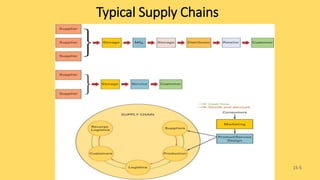
Typical Supply Chains
• Supply chain functions and activities
• Forecasting
• Purchasing
• Inventory management
• Information management
• Quality assurance
• Scheduling
• Production and delivery
• Customer service
Functions and Activities
• The goal of SCM is to match supply to demand as effectively and
efficiently as possible
• Key issues:
1. Determining appropriate levels of outsourcing
2. Managing procurement and suppliers
3. Managing customer relationships
4. Being able to quickly identify problems and respond to them
Key Aspects of SCM
• Three types of flow management
• Product and service flow
• Involves movement of goods and services from suppliers to customers
as well as handling customer service needs and product returns
• Information flow
• Involves sharing forecasts and sales data, transmitting orders, tracking
shipments, and updating order status
• Financial flow
• involves credit terms, payments, and consignment and title ownership
arrangements
Flow Management in SCM
• Trends affecting supply chain design and management:
• Measuring supply chain ROI
• “Greening” the supply chain
• Re-evaluating outsourcing
• Integrating IT, automation, technology to move towards I4.0
• Adopting lean principles and Managing risks
Trends in SCM
GST?
• Global supply chains
• Product design often uses inputs from around the world
• Some manufacturing and service activities are outsourced to
countries where labor and / or materials costs are lower
• Products are sold globally
• Complexities
• Language and cultural differences
• Currency fluctuations
• Political instability
• Increasing transportation costs and lead times
• Increased need for trust amongst supply chain partners
Global Supply Chains
15-11
Vendor Analysis, Supplier Audits & Supplier Certification
• Vendor analysis
• Evaluating the sources of supply in terms of price, quality, reputation, and
service
• Supplier audit
• A means of keeping current on suppliers’ production (or service) capabilities,
quality and delivery problems and resolutions, and performance on other
criteria
• Supplier certification
• Involves a detailed examination of a supplier’s policies and capabilities
• The process verifies the supplier meets or exceeds the requirements of a buyer
• Radio frequency identification (RFID)
• A technology that uses radio waves to identify objects, such as goods in
supply chains
• Similar to barcodes but
• Are able to convey much more information
• Do not require line-of-sight for reading
• Do not need to be read one at a time
• Has the ability to:
• Increase supply chain visibility
• Improve inventory management
• Improve quality control
• Enhance relationships with suppliers and customers
Tracking Goods: RFID
Logistics vs Supply Chain Management
Logistics is the management of the flow of resources between the point of origin and the point
of consumption in order to meet some requirements, for example, of customers or corporations.
• The logistics of physical items usually involves the integration of information
flow, material handling, packaging, inventory, transportation, warehousing, and
often security.
Customers
Suppliers Intra- organizational
Movement
Reverse
Logistics
Inbound
Logistics
Outbound
Logistics
Logistics Transportation Links
Reverse Logistics
• Need to find innovative ways of recovering and recycling
of products to minimize environmental impact
• May also include shipment of repairable items for
refurbishment
• Often not a priority
25
• Customer returns
– Warranty failures
– Incorrect or damaged orders
• Repair and remanufacture process support
• Recycling (increasing importance!)
15-15
Third Part Logistics : 3-PL
• Third-party logistics (3-PL)
• The outsourcing of logistics management
• Includes
• Warehousing and distribution
• Potential benefits include taking advantage of:
• The specialists’ knowledge
• Their well-developed information system
• Their ability to obtain more favorable shipping rates
Third Party Logistics
• “Third-party Logistics is simply the use of an outside company
to perform all or part of the firm’s materials management and
product distribution function.” -- Simchi-Levi (2000)
• “A relationship between a shipper and third party which,
compared with the basic services, has more customized
offerings, encompasses a broad number of service functions and
is characterized by a long-term, more mutually
beneficial relationship” --- Murphy & Poist (1998)
Third Party Characteristics
• Perform outsourced logistics activities
• Process management / Multiple activities
• More customized services
• Mutually beneficial and risk-sharing relationship
• Long-term commitments (1~ 3 years)
Why is it needed?
• Advantages
o Cost reduction
o Focus on core competency
o Improved efficiency, service and flexibility
Disadvantages
o Impact on in-house workforce
• It begins with strategic sourcing
• Analyzing the procurement process to lower costs by reducing waste and
non-value-added activities, increase profits, reduce risks, and improve
supplier performance
• There must be
• Trust
• Effective communication
• Information velocity
• Supply chain visibility
• Event management capability
• Performance metrics
Creating an Effective Supply Chain
15-18
Challenges
• Barriers to integration of organizations
• Getting top management on board
• Dealing with trade-offs
• Small businesses
• Variability and uncertainty
• Response time
Mumbai Dabbawala
Six sigma
Learnings?
THANKS

Session 19- Supply Chain management.pptx

  • 1.
    Production & OperationsManagement: Supply Chain Management Ravindra Ojha 15th Mar’ 2023
  • 2.
    Supply Chain Management SupplyChain - https://www.youtube.com/watch?v=J0Omt8BnWpc
  • 3.
    Why SCM ?- The changing world • Proliferation of product lines - Every time you walk into a neighborhood store, do not be surprised to find that even a simple product like toilet soap has 50 odd varieties • Life Cycles • Cell phone, Laptop, Automobile. It is shrinking rapidly. • Outsourcing • Dell computers, net work design, information system to connect and coordinate. Era of specialization. • Globalization • Automotive parts, Impact of tariff structure, facility location & capacity management. Farther…Faster…Flatter…Fewer  Competition & Price - Product innovation/brand equity no longer trigger price. Reduce cost through efficient value chain (VMI, new services, RFID, collaboration) • Collaboration - Collaboration between stakeholders in the extended supply chain for decreasing value chain costs through better management decisions.  Technology - Food industry. Application of ERP, RFID, AI, IOT and inventory/logistics optimization, sales &operations planning, Business intelligence etc.  Shift in power structure in the chain- - In every industry entities closer to customer are becoming more powerful.
  • 4.
    • Supply Chain: •the sequence of organizations - their facilities, functions, and activities - that are involved in procuring, producing and delivering a product or service • Logistics: • the part of a supply chain involved with the forward and reverse flow of goods, services, cash, and information. Supply Chain Vs Logistics
  • 5.
  • 6.
    • Supply chainfunctions and activities • Forecasting • Purchasing • Inventory management • Information management • Quality assurance • Scheduling • Production and delivery • Customer service Functions and Activities
  • 7.
    • The goalof SCM is to match supply to demand as effectively and efficiently as possible • Key issues: 1. Determining appropriate levels of outsourcing 2. Managing procurement and suppliers 3. Managing customer relationships 4. Being able to quickly identify problems and respond to them Key Aspects of SCM
  • 8.
    • Three typesof flow management • Product and service flow • Involves movement of goods and services from suppliers to customers as well as handling customer service needs and product returns • Information flow • Involves sharing forecasts and sales data, transmitting orders, tracking shipments, and updating order status • Financial flow • involves credit terms, payments, and consignment and title ownership arrangements Flow Management in SCM
  • 9.
    • Trends affectingsupply chain design and management: • Measuring supply chain ROI • “Greening” the supply chain • Re-evaluating outsourcing • Integrating IT, automation, technology to move towards I4.0 • Adopting lean principles and Managing risks Trends in SCM GST?
  • 10.
    • Global supplychains • Product design often uses inputs from around the world • Some manufacturing and service activities are outsourced to countries where labor and / or materials costs are lower • Products are sold globally • Complexities • Language and cultural differences • Currency fluctuations • Political instability • Increasing transportation costs and lead times • Increased need for trust amongst supply chain partners Global Supply Chains
  • 11.
    15-11 Vendor Analysis, SupplierAudits & Supplier Certification • Vendor analysis • Evaluating the sources of supply in terms of price, quality, reputation, and service • Supplier audit • A means of keeping current on suppliers’ production (or service) capabilities, quality and delivery problems and resolutions, and performance on other criteria • Supplier certification • Involves a detailed examination of a supplier’s policies and capabilities • The process verifies the supplier meets or exceeds the requirements of a buyer
  • 12.
    • Radio frequencyidentification (RFID) • A technology that uses radio waves to identify objects, such as goods in supply chains • Similar to barcodes but • Are able to convey much more information • Do not require line-of-sight for reading • Do not need to be read one at a time • Has the ability to: • Increase supply chain visibility • Improve inventory management • Improve quality control • Enhance relationships with suppliers and customers Tracking Goods: RFID
  • 13.
    Logistics vs SupplyChain Management Logistics is the management of the flow of resources between the point of origin and the point of consumption in order to meet some requirements, for example, of customers or corporations. • The logistics of physical items usually involves the integration of information flow, material handling, packaging, inventory, transportation, warehousing, and often security. Customers Suppliers Intra- organizational Movement Reverse Logistics Inbound Logistics Outbound Logistics Logistics Transportation Links
  • 14.
    Reverse Logistics • Needto find innovative ways of recovering and recycling of products to minimize environmental impact • May also include shipment of repairable items for refurbishment • Often not a priority 25 • Customer returns – Warranty failures – Incorrect or damaged orders • Repair and remanufacture process support • Recycling (increasing importance!)
  • 15.
    15-15 Third Part Logistics: 3-PL • Third-party logistics (3-PL) • The outsourcing of logistics management • Includes • Warehousing and distribution • Potential benefits include taking advantage of: • The specialists’ knowledge • Their well-developed information system • Their ability to obtain more favorable shipping rates
  • 16.
    Third Party Logistics •“Third-party Logistics is simply the use of an outside company to perform all or part of the firm’s materials management and product distribution function.” -- Simchi-Levi (2000) • “A relationship between a shipper and third party which, compared with the basic services, has more customized offerings, encompasses a broad number of service functions and is characterized by a long-term, more mutually beneficial relationship” --- Murphy & Poist (1998) Third Party Characteristics • Perform outsourced logistics activities • Process management / Multiple activities • More customized services • Mutually beneficial and risk-sharing relationship • Long-term commitments (1~ 3 years) Why is it needed? • Advantages o Cost reduction o Focus on core competency o Improved efficiency, service and flexibility Disadvantages o Impact on in-house workforce
  • 17.
    • It beginswith strategic sourcing • Analyzing the procurement process to lower costs by reducing waste and non-value-added activities, increase profits, reduce risks, and improve supplier performance • There must be • Trust • Effective communication • Information velocity • Supply chain visibility • Event management capability • Performance metrics Creating an Effective Supply Chain
  • 18.
    15-18 Challenges • Barriers tointegration of organizations • Getting top management on board • Dealing with trade-offs • Small businesses • Variability and uncertainty • Response time
  • 19.
  • 20.