Presentation on Children's wear
Presented
By

To

▪ Name with ID:

▪ Ms. Nusrat Jahan

▪
▪
▪
▪

Nasim Ali (11122107006)
Md. Enzamul Haque (11122107022)
Shawan Roy (11122107023)
Pankaj Roy (11122107025)

▪ Textile 5th Intake
▪ Section 1
▪ BUBT

▪ Lecturer in Garments
Manufacturing Technology

▪ Department of Textile
▪ BUBT
History of Garment Industry
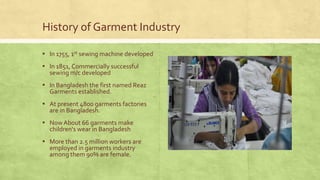
▪ In 1755, 1st sewing machine developed

▪ In 1851, Commercially successful
sewing m/c developed

▪ In Bangladesh the first named Reaz
Garments established.

▪ At present 4800 garments factories
are in Bangladesh.

▪ Now About 66 garments make
children's wear in Bangladesh

▪ More than 2.5 million workers are
employed in garments industry
among them 90% are female.
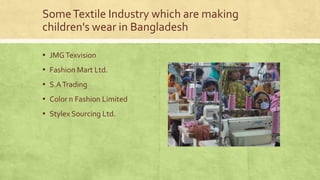
Some Textile Industry which are making
children's wear in Bangladesh
▪ JMG Texvision

▪ Fashion Mart Ltd.
▪ S.A Trading
▪ Color n Fashion Limited
▪ Stylex Sourcing Ltd.
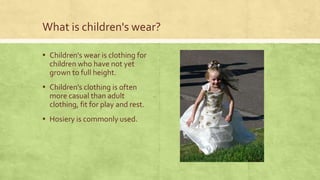
What is children's wear?
▪ Children's wear is clothing for
children who have not yet
grown to full height.

▪ Children's clothing is often
more casual than adult
clothing, fit for play and rest.

▪ Hosiery is commonly used.
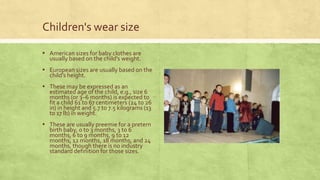
Children's wear size
▪ American sizes for baby clothes are
usually based on the child's weight.

▪ European sizes are usually based on the
child's height.

▪ These may be expressed as an

estimated age of the child, e.g., size 6
months (or 3–6 months) is expected to
fit a child 61 to 67 centimeters (24 to 26
in) in height and 5.7 to 7.5 kilograms (13
to 17 lb) in weight.

▪ These are usually preemie for a pretern
birth baby, 0 to 3 months, 3 to 6
months, 6 to 9 months, 9 to 12
months, 12 months, 18 months, and 24
months, though there is no industry
standard definition for those sizes.
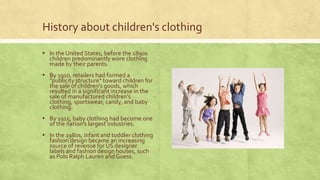
History about children's clothing
▪ In the United States, before the 1890s
children predominantly wore clothing
made by their parents.

▪ By 1910, retailers had formed a

"publicity structure" toward children for
the sale of children's goods, which
resulted in a significant increase in the
sale of manufactured children's
clothing, sportswear, candy, and baby
clothing.

▪ By 1915, baby clothing had become one
of the nation's largest industries.

▪ In the 1980s, infant and toddler clothing
fashion design became an increasing
source of revenue for US designer
labels and fashion design houses, such
as Polo Ralph Lauren and Guess.
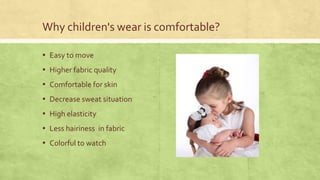
Why children's wear is comfortable?
▪ Easy to move

▪ Higher fabric quality
▪ Comfortable for skin
▪ Decrease sweat situation
▪ High elasticity
▪ Less hairiness in fabric
▪ Colorful to watch
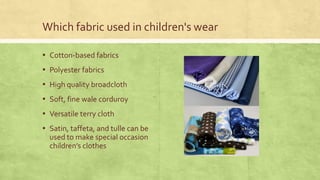
Which fabric used in children's wear
▪ Cotton-based fabrics

▪ Polyester fabrics
▪ High quality broadcloth
▪ Soft, fine wale corduroy
▪ Versatile terry cloth
▪ Satin, taffeta, and tulle can be
used to make special occasion
children’s clothes
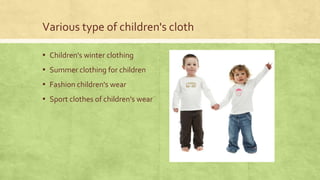
Various type of children's cloth
▪ Children's winter clothing

▪ Summer clothing for children
▪ Fashion children's wear
▪ Sport clothes of children's wear
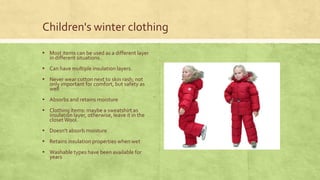
Children's winter clothing
▪ Most items can be used as a different layer
in different situations .

▪ Can have multiple insulation layers.
▪ Never wear cotton next to skin rash; not

only important for comfort, but safety as
well

▪ Absorbs and retains moisture
▪ Clothing items: maybe a sweatshirt as

insulation layer, otherwise, leave it in the
closet Wool.

▪ Doesn't absorb moisture
▪ Retains insulation properties when wet
▪ Washable types have been available for
years
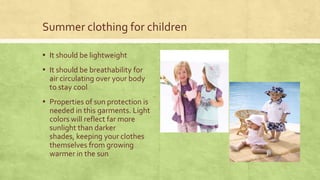
Summer clothing for children
▪ It should be lightweight

▪ It should be breathability for
air circulating over your body
to stay cool

▪ Properties of sun protection is
needed in this garments. Light
colors will reflect far more
sunlight than darker
shades, keeping your clothes
themselves from growing
warmer in the sun
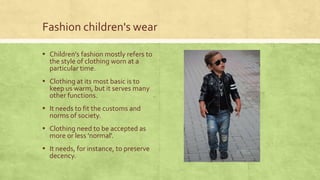
Fashion children's wear
▪ Children’s fashion mostly refers to
the style of clothing worn at a
particular time.

▪ Clothing at its most basic is to

keep us warm, but it serves many
other functions.

▪ It needs to fit the customs and
norms of society.

▪ Clothing need to be accepted as
more or less 'normal'.

▪ It needs, for instance, to preserve
decency.
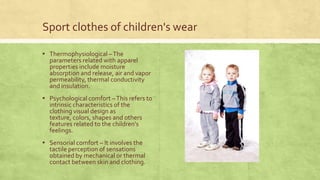
Sport clothes of children's wear
▪ Thermophysiological – The

parameters related with apparel
properties include moisture
absorption and release, air and vapor
permeability, thermal conductivity
and insulation.

▪ Psychological comfort – This refers to
intrinsic characteristics of the
clothing visual design as
texture, colors, shapes and others
features related to the children's
feelings.

▪ Sensorial comfort – It involves the

tactile perception of sensations
obtained by mechanical or thermal
contact between skin and clothing.
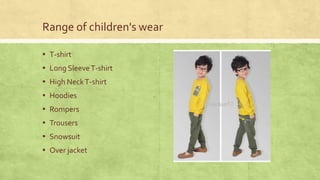
Range of children's wear
▪ T-shirt

▪ Long Sleeve T-shirt
▪ High Neck T-shirt
▪ Hoodies

▪ Rompers
▪ Trousers
▪ Snowsuit

▪ Over jacket
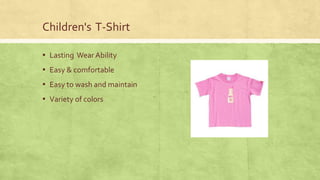
Children's T-Shirt
▪ Lasting Wear Ability

▪ Easy & comfortable
▪ Easy to wash and maintain
▪ Variety of colors
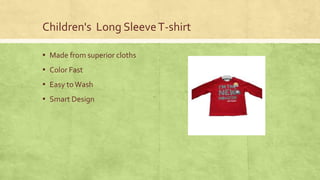
Children's Long Sleeve T-shirt
▪ Made from superior cloths

▪ Color Fast
▪ Easy to Wash
▪ Smart Design
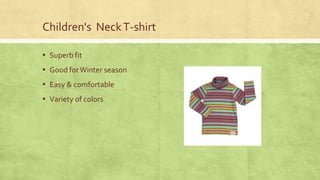
Children's Neck T-shirt
▪ Superb fit

▪ Good for Winter season
▪ Easy & comfortable
▪ Variety of colors
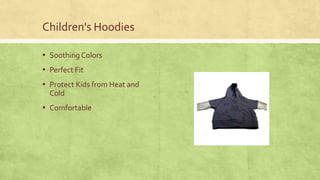
Children's Hoodies
▪ Soothing Colors

▪ Perfect Fit
▪ Protect Kids from Heat and
Cold

▪ Comfortable
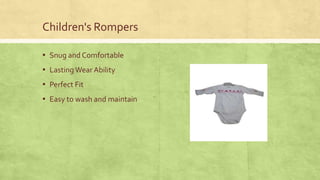
Children's Rompers
▪ Snug and Comfortable

▪ Lasting Wear Ability
▪ Perfect Fit
▪ Easy to wash and maintain
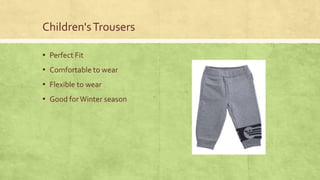
Children's Trousers
▪ Perfect Fit

▪ Comfortable to wear
▪ Flexible to wear
▪ Good for Winter season
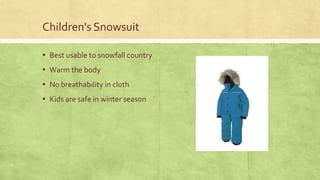
Children's Snowsuit
▪ Best usable to snowfall country

▪ Warm the body
▪ No breathability in cloth
▪ Kids are safe in winter season
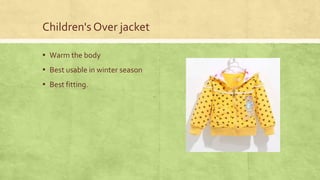
Children's Over jacket
▪ Warm the body

▪ Best usable in winter season
▪ Best fitting.
Thanks to everyone to viewing this
presentation

Presentation on children's wear

  • 1.
  • 2.
    Presented By To ▪ Name withID: ▪ Ms. Nusrat Jahan ▪ ▪ ▪ ▪ Nasim Ali (11122107006) Md. Enzamul Haque (11122107022) Shawan Roy (11122107023) Pankaj Roy (11122107025) ▪ Textile 5th Intake ▪ Section 1 ▪ BUBT ▪ Lecturer in Garments Manufacturing Technology ▪ Department of Textile ▪ BUBT
  • 3.
    History of GarmentIndustry ▪ In 1755, 1st sewing machine developed ▪ In 1851, Commercially successful sewing m/c developed ▪ In Bangladesh the first named Reaz Garments established. ▪ At present 4800 garments factories are in Bangladesh. ▪ Now About 66 garments make children's wear in Bangladesh ▪ More than 2.5 million workers are employed in garments industry among them 90% are female.
  • 4.
    Some Textile Industrywhich are making children's wear in Bangladesh ▪ JMG Texvision ▪ Fashion Mart Ltd. ▪ S.A Trading ▪ Color n Fashion Limited ▪ Stylex Sourcing Ltd.
  • 5.
    What is children'swear? ▪ Children's wear is clothing for children who have not yet grown to full height. ▪ Children's clothing is often more casual than adult clothing, fit for play and rest. ▪ Hosiery is commonly used.
  • 6.
    Children's wear size ▪American sizes for baby clothes are usually based on the child's weight. ▪ European sizes are usually based on the child's height. ▪ These may be expressed as an estimated age of the child, e.g., size 6 months (or 3–6 months) is expected to fit a child 61 to 67 centimeters (24 to 26 in) in height and 5.7 to 7.5 kilograms (13 to 17 lb) in weight. ▪ These are usually preemie for a pretern birth baby, 0 to 3 months, 3 to 6 months, 6 to 9 months, 9 to 12 months, 12 months, 18 months, and 24 months, though there is no industry standard definition for those sizes.
  • 7.
    History about children'sclothing ▪ In the United States, before the 1890s children predominantly wore clothing made by their parents. ▪ By 1910, retailers had formed a "publicity structure" toward children for the sale of children's goods, which resulted in a significant increase in the sale of manufactured children's clothing, sportswear, candy, and baby clothing. ▪ By 1915, baby clothing had become one of the nation's largest industries. ▪ In the 1980s, infant and toddler clothing fashion design became an increasing source of revenue for US designer labels and fashion design houses, such as Polo Ralph Lauren and Guess.
  • 8.
    Why children's wearis comfortable? ▪ Easy to move ▪ Higher fabric quality ▪ Comfortable for skin ▪ Decrease sweat situation ▪ High elasticity ▪ Less hairiness in fabric ▪ Colorful to watch
  • 9.
    Which fabric usedin children's wear ▪ Cotton-based fabrics ▪ Polyester fabrics ▪ High quality broadcloth ▪ Soft, fine wale corduroy ▪ Versatile terry cloth ▪ Satin, taffeta, and tulle can be used to make special occasion children’s clothes
  • 10.
    Various type ofchildren's cloth ▪ Children's winter clothing ▪ Summer clothing for children ▪ Fashion children's wear ▪ Sport clothes of children's wear
  • 11.
    Children's winter clothing ▪Most items can be used as a different layer in different situations . ▪ Can have multiple insulation layers. ▪ Never wear cotton next to skin rash; not only important for comfort, but safety as well ▪ Absorbs and retains moisture ▪ Clothing items: maybe a sweatshirt as insulation layer, otherwise, leave it in the closet Wool. ▪ Doesn't absorb moisture ▪ Retains insulation properties when wet ▪ Washable types have been available for years
  • 12.
    Summer clothing forchildren ▪ It should be lightweight ▪ It should be breathability for air circulating over your body to stay cool ▪ Properties of sun protection is needed in this garments. Light colors will reflect far more sunlight than darker shades, keeping your clothes themselves from growing warmer in the sun
  • 13.
    Fashion children's wear ▪Children’s fashion mostly refers to the style of clothing worn at a particular time. ▪ Clothing at its most basic is to keep us warm, but it serves many other functions. ▪ It needs to fit the customs and norms of society. ▪ Clothing need to be accepted as more or less 'normal'. ▪ It needs, for instance, to preserve decency.
  • 14.
    Sport clothes ofchildren's wear ▪ Thermophysiological – The parameters related with apparel properties include moisture absorption and release, air and vapor permeability, thermal conductivity and insulation. ▪ Psychological comfort – This refers to intrinsic characteristics of the clothing visual design as texture, colors, shapes and others features related to the children's feelings. ▪ Sensorial comfort – It involves the tactile perception of sensations obtained by mechanical or thermal contact between skin and clothing.
  • 15.
    Range of children'swear ▪ T-shirt ▪ Long Sleeve T-shirt ▪ High Neck T-shirt ▪ Hoodies ▪ Rompers ▪ Trousers ▪ Snowsuit ▪ Over jacket
  • 16.
    Children's T-Shirt ▪ LastingWear Ability ▪ Easy & comfortable ▪ Easy to wash and maintain ▪ Variety of colors
  • 17.
    Children's Long SleeveT-shirt ▪ Made from superior cloths ▪ Color Fast ▪ Easy to Wash ▪ Smart Design
  • 18.
    Children's Neck T-shirt ▪Superb fit ▪ Good for Winter season ▪ Easy & comfortable ▪ Variety of colors
  • 19.
    Children's Hoodies ▪ SoothingColors ▪ Perfect Fit ▪ Protect Kids from Heat and Cold ▪ Comfortable
  • 20.
    Children's Rompers ▪ Snugand Comfortable ▪ Lasting Wear Ability ▪ Perfect Fit ▪ Easy to wash and maintain
  • 21.
    Children's Trousers ▪ PerfectFit ▪ Comfortable to wear ▪ Flexible to wear ▪ Good for Winter season
  • 22.
    Children's Snowsuit ▪ Bestusable to snowfall country ▪ Warm the body ▪ No breathability in cloth ▪ Kids are safe in winter season
  • 23.
    Children's Over jacket ▪Warm the body ▪ Best usable in winter season ▪ Best fitting.
  • 24.
    Thanks to everyoneto viewing this presentation