WEFT KNIT FABRIC GEOMETRY
PRESENTATION ON
PRESENTED BY
• Name with ID:
• Md. Enzamul Haque (022)
• Shawan Roy (023)
• Ahmmed Sharjin Sharif (024)
• Pankaj Roy (025)
• Kohinur (027)
• Saiful Hasan Sakib (030)
• Textile 5th Intake
• Section 1
• Bangladesh University of Business & Technology
DIMENSIONAL STABILITY
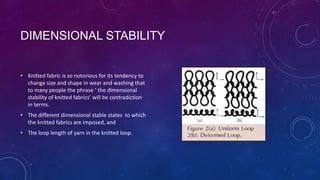
• Knitted fabric is so notorious for its tendency to
change size and shape in wear and washing that
to many people the phrase ‘ the dimensional
stability of knitted fabrics’ will be contradiction
in terms.
• The different dimensional stable states to which
the knitted fabrics are imposed, and
• The loop length of yarn in the knitted loop.
DIMENSIONAL CHARACTERISTICS
•
DIMENSIONAL CHARACTERISTICS
•
DIMENSIONAL CHARACTERISTICS
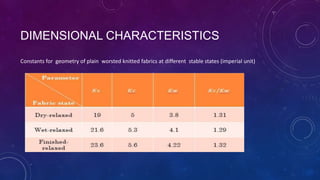
Constants for geometry of plain worsted knitted fabrics at different stable states (imperial unit)
DIMENSIONAL CHARACTERISTICS
Constants for geometry of plain worsted knitted fabrics at different stable states (SI unit)
AREAL DENSITY
•
FABRIC COVER
•
TIGHTNESS FACTOR
•
SPIRALITY
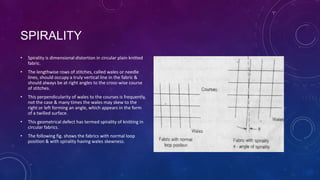
• Spirality is dimensional distortion in circular plain knitted
fabric.
• The lengthwise rows of stitches, called wales or needle
lines, should occupy a truly vertical line in the fabric &
should always be at right angles to the cross-wise course
of stitches.
• This perpendicularity of wales to the courses is frequently,
not the case & many times the wales may skew to the
right or left forming an angle, which appears in the form
of a twilled surface.
• This geometrical defect has termed spirality of knitting in
circular fabrics.
• The following fig. shows the fabrics with normal loop
position & with spirality having wales skewness.
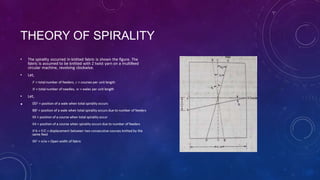
THEORY OF SPIRALITY
•
THEORY OF SPIRALITY
•
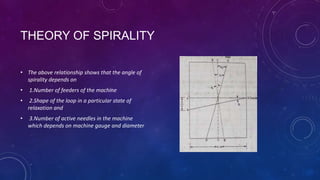
THEORY OF SPIRALITY
• The above relationship shows that the angle of
spirality depends on
• 1.Number of feeders of the machine
• 2.Shape of the loop in a particular state of
relaxation and
• 3.Number of active needles in the machine
which depends on machine gauge and diameter
MEASUREMENT OF SPIRALITY
•

Weft knit fabric geometry

  • 1.
    WEFT KNIT FABRICGEOMETRY PRESENTATION ON
  • 2.
    PRESENTED BY • Namewith ID: • Md. Enzamul Haque (022) • Shawan Roy (023) • Ahmmed Sharjin Sharif (024) • Pankaj Roy (025) • Kohinur (027) • Saiful Hasan Sakib (030) • Textile 5th Intake • Section 1 • Bangladesh University of Business & Technology
  • 3.
    DIMENSIONAL STABILITY • Knittedfabric is so notorious for its tendency to change size and shape in wear and washing that to many people the phrase ‘ the dimensional stability of knitted fabrics’ will be contradiction in terms. • The different dimensional stable states to which the knitted fabrics are imposed, and • The loop length of yarn in the knitted loop.
  • 4.
  • 5.
  • 6.
    DIMENSIONAL CHARACTERISTICS Constants forgeometry of plain worsted knitted fabrics at different stable states (imperial unit)
  • 7.
    DIMENSIONAL CHARACTERISTICS Constants forgeometry of plain worsted knitted fabrics at different stable states (SI unit)
  • 8.
  • 9.
  • 10.
  • 11.
    SPIRALITY • Spirality isdimensional distortion in circular plain knitted fabric. • The lengthwise rows of stitches, called wales or needle lines, should occupy a truly vertical line in the fabric & should always be at right angles to the cross-wise course of stitches. • This perpendicularity of wales to the courses is frequently, not the case & many times the wales may skew to the right or left forming an angle, which appears in the form of a twilled surface. • This geometrical defect has termed spirality of knitting in circular fabrics. • The following fig. shows the fabrics with normal loop position & with spirality having wales skewness.
  • 12.
  • 13.
  • 14.
    THEORY OF SPIRALITY •The above relationship shows that the angle of spirality depends on • 1.Number of feeders of the machine • 2.Shape of the loop in a particular state of relaxation and • 3.Number of active needles in the machine which depends on machine gauge and diameter
  • 15.