Raviraj Kour
( BLOCK DIAGRAM DESCRIPTION )
INDEX
 Question?
 What is PPC?
 POWER Architecture
 PPC
 PPC Generations
 Features
 Pipelining
 Block Diagram and description
 PPC Vs. Pentium
Sunday, March 12, 2017 Thapar University, Patiala 2
QUESTION???
What do the world’s fastest supercomputer, network
and communication equipments such as Internet
routers and switches, the Mars Rover, consumer
electronics such as set top boxes, and the game
consoles all have in common?
Sunday, March 12, 2017 Thapar University, Patiala 3
ANSWER
They are powered by microprocessors based on
IBM’s POWER Architecture Instruction Set.
What is POWER??
POWER is an old RISC instruction set architecture
designed by IBM. The name is a backronym for :
Performance Optimization With Enhanced RISC
Sunday, March 12, 2017 Thapar University, Patiala 4
POWER ARCHITECTURE
 Designed by IBM in the late 1980s when that company wanted a
high-performance RISC architecture for their mid-range
workstations and servers.
 First implementation featured in the RS/6000 computers.
 This was the 10-chip RIOS-1 processor, later called POWER1.
 The RISC Single Chip (RSC) processor was developed from
RIOS-1.
 The First RISC Chip Design was 801 CPU.
 Two problems of 801 CPU design :
 No floating point instructions.
 No superscalar architecture used
Sunday, March 12, 2017 Thapar University, Patiala 5
POWERPC
 Based on IBM's POWER architecture.
 Acronym of POWER Performance Computing.
 Designed by AIM alliance i.e.. Apple, IBM and
Motorola.
 A 32/64-bit instruction set of microprocessors derived
from POWER ISA, including some new elements.
Sunday, March 12, 2017 Thapar University, Patiala 6
POWERPC GENERATIONS
 G1 - The 601, 500 and 800 family processors.
 G2 - The 602, 603, 604, 620, 8200 and 5000 families.
 G3 - The 750 and 8300 families.
 G4 - The 7400 and 8400* families.
 G5 - The 7500* and 8500 families.
 G6- The 7600*.
Sunday, March 12, 2017 Thapar University, Patiala 7
FEATURES OF POWERPC
 Superscalar processor.
 Support for operation in both big-endian and little-
endian modes.
 Can switch from one mode to the other at run-time.
 Paged memory management architecture.
 Simple processor design and multiprocessor features.
 64-bit architecture.
 Separate set of FPRs for floating-point instructions.
Sunday, March 12, 2017 Thapar University, Patiala 8
TOUR TO PPC 750
 Modified version of the POWER architecture.
 High-performance and superscalar microprocessor.
 As many as four instructions can be fetched from the instruction
cache per clock cycle.
 As many as two instructions can be dispatched per clock.
 As many as six instructions can be executed per clock (including
two integer instructions).
 Single-clock-cycle execution for most instructions.
 Six independent execution units and two register files.
 Two integer units (IUs) that share thirty-two GPRs for integer
operands.
Sunday, March 12, 2017 Thapar University, Patiala 9
Contd…
 Three-stage FPU.
 Two-stage LSU.
 Rename buffers.
 Six GPR rename buffers.
 Six FPR rename buffers.
 Condition register buffering supports two CR writes per
clock.
 Completion unit.
 Guarantees sequential programming model and a
precise exception model.
Sunday, March 12, 2017 Thapar University, Patiala 10
Contd…
 Power and thermal management :
 Three static modes :
 Doze : All the functional units are disabled except for the time
base/decrementer registers and the bus snooping logic.
 Nap : The nap mode further reduces power consumption by
disabling bus snooping, leaving only the time base register and
the PLL in a powered state.
 Sleep: All internal functional units are disabled, after which
external system logic may disable the PLL and SYSCLK.
Sunday, March 12, 2017 Thapar University, Patiala 11
PIPELINING
 PowerPC 750 is a pipelined, superscalar processor.
 The FPU and LSU are also multiple-stage pipelines.
 Execution units operate independently and in parallel :
Branch processing unit (BPU).
Integer unit 1 (IU1)—executes all integer instructions
Integer unit 2 (IU2)—executes all integer instructions except
multiplies and divides.
64-bit floating-point unit (FPU).
Load/store unit (LSU).
System register unit (SRU).
PowerPC 750 can execute two instructions on every
clock cycle.
Sunday, March 12, 2017
Thapar University, Patiala 12
Sunday, March 12, 2017 Thapar University, Patiala 13
FIG 1. Pipelining in PowerPC 750
Contd…
 In general, it processes instructions in four stages: fetch,
decode/dispatch, execute, and complete.
 PowerPC 750 has six independent execution units, two
for integer instructions, and one each for floating-point
instructions, branch instructions, load/store instructions,
and system register instructions.
 Having separate GPRs and FPRs allows integer,
floating-point calculations, and load and store
operations to occur simultaneously without interference.
Sunday, March 12, 2017 Thapar University, Patiala 14
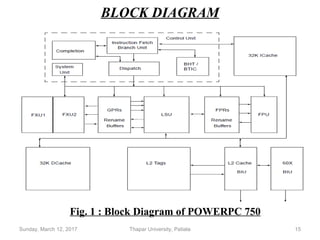
BLOCK DIAGRAM
Sunday, March 12, 2017 Thapar University, Patiala 15
Fig. 1 : Block Diagram of POWERPC 750
DESCRIPTION OF BLOCKS
 Branch processing unit:
 Four instructions fetched per clock.
 One branch processed per cycle.
 Up to 1 speculative stream in execution, 1 additional
speculative stream in fetch.
 512-entry Branch History Table (BHT) for dynamic
prediction.
 64-entry, 4-way set associative Branch Target Instruction
Cache (BTIC) for eliminating branch delay slots.
Sunday, March 12, 2017 Thapar University, Patiala 16
Contd…
 Dispatch unit:
 Holds as many as six instructions and dispatch two
instructions to six independent units (system, branch,
load/store, fixed-point unit 1, fixed-point unit 2, or floating-
point).
 It continuously attempts to load as many instructions as there
were vacancies created in IQ.
All instructions except branches are dispatched to their
respective EUs.
 Checks for source and destination register dependencies,
allocates rename buffers, determines whether a position is
available in the completion queue, and inhibits subsequent
instruction dispatching if these resources are not available.
Sunday, March 12, 2017 Thapar University, Patiala 17
Contd…
 Load/store unit :
 One cycle load or store cache access.
 Effective address generation.
 Alignment, zero padding, sign extend for integer register file.
 Floating-point internal format conversion.
 Sequencing for load/store multiples and string operations.
 Store gathering.
 Cache and TLB instructions.
 System unit :
 Logical instructions and miscellaneous system instructions.
Special register transfer instructions.
Sunday, March 12, 2017 Thapar University, Patiala 18
Contd…
 Fixed-point units :
 Fixed-point unit 1 (FXU1) : multiply, divide, shift, rotate,
arithmetic, logical.
 Fixed-point unit 2 (FXU2) : shift, rotate, arithmetic, logical.
 Single-cycle arithmetic, shift, rotate, logical.
 Multiply and divide support (multi-cycle).
 Early out multiply.
 Floating-point unit :
Support single- and double-precision floating-point arithmetic.
Sunday, March 12, 2017 Thapar University, Patiala 19
Contd…
 Integrated power management :
Low-power 2.0/3.3V design.
Three static power saving modes: doze, nap, and sleep.
Automatic dynamic power reduction when internal functional units
are idle.
 Cache structure :
32K, 32-byte line, 8-way set associative instruction and data cache.
Single-cycle cache access.
Pseudo-LRU replacement.
Copy-back or write-through data cache.
Supports all PowerPC memory coherency modes.
Non-blocking instruction and data cache.
Sunday, March 12, 2017 Thapar University, Patiala
20
Contd…
 Bus interface Unit :
Compatible with 60x processor interface.
32-bit address bus with parity checking.
64-bit data bus with parity checking.
Bus-to-core frequency multipliers from 2x to 10x.
 Integrated Thermal Management Assist Unit :
On-chip thermal sensor and control logic.
Thermal Management Interrupts for software regulation of
junction temperature.
Sunday, March 12, 2017 Thapar University, Patiala 21
Contd…
 Level 2 (L2) cache interface :
 Internal L2 cache controller and 4K-entry tags.
 External data SRAMs.
 256K, 512K, and 1 MB 2-way set associative L2 cache support.
 Copy-back or write-through data cache.
 Supports register-buffer and register-register pipelining.
 Supports Core-to-L2 frequency divisors of ÷1, ÷1.5, ÷2, ÷2.5
and ÷3.
Sunday, March 12, 2017 Thapar University, Patiala 22
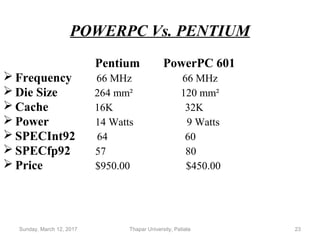
POWERPC Vs. PENTIUM
Pentium PowerPC 601
 Frequency 66 MHz 66 MHz
 Die Size 264 mm² 120 mm²
 Cache 16K 32K
 Power 14 Watts 9 Watts
 SPECInt92 64 60
 SPECfp92 57 80
 Price $950.00 $450.00
Sunday, March 12, 2017 Thapar University, Patiala 23
REFERENCES
 http://www.mactech.com/articles/mactech/Vol.10/10.02/ThePowerPC
/index.html
 http://www-03.ibm.com/chips/products/powerpc/
 http://en.wikipedia.org/wiki/PowerPC
 http://nptel.ac.in/courses/Webcourse-contents/IIT-
KANPUR/microcontrollers/micro/ui/Course_home4_36.htm
 Fact Sheet - Motorola PowerPC Processor
 International Business Machines Corporation 2001, 2002 (Printed in
the United States of America 9/02)
Sunday, March 12, 2017 Thapar University, Patiala 24
Sunday, March 12, 2017 Thapar University, Patiala 25

PPC 750

  • 1.
    Raviraj Kour ( BLOCKDIAGRAM DESCRIPTION )
  • 2.
    INDEX  Question?  Whatis PPC?  POWER Architecture  PPC  PPC Generations  Features  Pipelining  Block Diagram and description  PPC Vs. Pentium Sunday, March 12, 2017 Thapar University, Patiala 2
  • 3.
    QUESTION??? What do theworld’s fastest supercomputer, network and communication equipments such as Internet routers and switches, the Mars Rover, consumer electronics such as set top boxes, and the game consoles all have in common? Sunday, March 12, 2017 Thapar University, Patiala 3 ANSWER They are powered by microprocessors based on IBM’s POWER Architecture Instruction Set.
  • 4.
    What is POWER?? POWERis an old RISC instruction set architecture designed by IBM. The name is a backronym for : Performance Optimization With Enhanced RISC Sunday, March 12, 2017 Thapar University, Patiala 4
  • 5.
    POWER ARCHITECTURE  Designedby IBM in the late 1980s when that company wanted a high-performance RISC architecture for their mid-range workstations and servers.  First implementation featured in the RS/6000 computers.  This was the 10-chip RIOS-1 processor, later called POWER1.  The RISC Single Chip (RSC) processor was developed from RIOS-1.  The First RISC Chip Design was 801 CPU.  Two problems of 801 CPU design :  No floating point instructions.  No superscalar architecture used Sunday, March 12, 2017 Thapar University, Patiala 5
  • 6.
    POWERPC  Based onIBM's POWER architecture.  Acronym of POWER Performance Computing.  Designed by AIM alliance i.e.. Apple, IBM and Motorola.  A 32/64-bit instruction set of microprocessors derived from POWER ISA, including some new elements. Sunday, March 12, 2017 Thapar University, Patiala 6
  • 7.
    POWERPC GENERATIONS  G1- The 601, 500 and 800 family processors.  G2 - The 602, 603, 604, 620, 8200 and 5000 families.  G3 - The 750 and 8300 families.  G4 - The 7400 and 8400* families.  G5 - The 7500* and 8500 families.  G6- The 7600*. Sunday, March 12, 2017 Thapar University, Patiala 7
  • 8.
    FEATURES OF POWERPC Superscalar processor.  Support for operation in both big-endian and little- endian modes.  Can switch from one mode to the other at run-time.  Paged memory management architecture.  Simple processor design and multiprocessor features.  64-bit architecture.  Separate set of FPRs for floating-point instructions. Sunday, March 12, 2017 Thapar University, Patiala 8
  • 9.
    TOUR TO PPC750  Modified version of the POWER architecture.  High-performance and superscalar microprocessor.  As many as four instructions can be fetched from the instruction cache per clock cycle.  As many as two instructions can be dispatched per clock.  As many as six instructions can be executed per clock (including two integer instructions).  Single-clock-cycle execution for most instructions.  Six independent execution units and two register files.  Two integer units (IUs) that share thirty-two GPRs for integer operands. Sunday, March 12, 2017 Thapar University, Patiala 9
  • 10.
    Contd…  Three-stage FPU. Two-stage LSU.  Rename buffers.  Six GPR rename buffers.  Six FPR rename buffers.  Condition register buffering supports two CR writes per clock.  Completion unit.  Guarantees sequential programming model and a precise exception model. Sunday, March 12, 2017 Thapar University, Patiala 10
  • 11.
    Contd…  Power andthermal management :  Three static modes :  Doze : All the functional units are disabled except for the time base/decrementer registers and the bus snooping logic.  Nap : The nap mode further reduces power consumption by disabling bus snooping, leaving only the time base register and the PLL in a powered state.  Sleep: All internal functional units are disabled, after which external system logic may disable the PLL and SYSCLK. Sunday, March 12, 2017 Thapar University, Patiala 11
  • 12.
    PIPELINING  PowerPC 750is a pipelined, superscalar processor.  The FPU and LSU are also multiple-stage pipelines.  Execution units operate independently and in parallel : Branch processing unit (BPU). Integer unit 1 (IU1)—executes all integer instructions Integer unit 2 (IU2)—executes all integer instructions except multiplies and divides. 64-bit floating-point unit (FPU). Load/store unit (LSU). System register unit (SRU). PowerPC 750 can execute two instructions on every clock cycle. Sunday, March 12, 2017 Thapar University, Patiala 12
  • 13.
    Sunday, March 12,2017 Thapar University, Patiala 13 FIG 1. Pipelining in PowerPC 750
  • 14.
    Contd…  In general,it processes instructions in four stages: fetch, decode/dispatch, execute, and complete.  PowerPC 750 has six independent execution units, two for integer instructions, and one each for floating-point instructions, branch instructions, load/store instructions, and system register instructions.  Having separate GPRs and FPRs allows integer, floating-point calculations, and load and store operations to occur simultaneously without interference. Sunday, March 12, 2017 Thapar University, Patiala 14
  • 15.
    BLOCK DIAGRAM Sunday, March12, 2017 Thapar University, Patiala 15 Fig. 1 : Block Diagram of POWERPC 750
  • 16.
    DESCRIPTION OF BLOCKS Branch processing unit:  Four instructions fetched per clock.  One branch processed per cycle.  Up to 1 speculative stream in execution, 1 additional speculative stream in fetch.  512-entry Branch History Table (BHT) for dynamic prediction.  64-entry, 4-way set associative Branch Target Instruction Cache (BTIC) for eliminating branch delay slots. Sunday, March 12, 2017 Thapar University, Patiala 16
  • 17.
    Contd…  Dispatch unit: Holds as many as six instructions and dispatch two instructions to six independent units (system, branch, load/store, fixed-point unit 1, fixed-point unit 2, or floating- point).  It continuously attempts to load as many instructions as there were vacancies created in IQ. All instructions except branches are dispatched to their respective EUs.  Checks for source and destination register dependencies, allocates rename buffers, determines whether a position is available in the completion queue, and inhibits subsequent instruction dispatching if these resources are not available. Sunday, March 12, 2017 Thapar University, Patiala 17
  • 18.
    Contd…  Load/store unit:  One cycle load or store cache access.  Effective address generation.  Alignment, zero padding, sign extend for integer register file.  Floating-point internal format conversion.  Sequencing for load/store multiples and string operations.  Store gathering.  Cache and TLB instructions.  System unit :  Logical instructions and miscellaneous system instructions. Special register transfer instructions. Sunday, March 12, 2017 Thapar University, Patiala 18
  • 19.
    Contd…  Fixed-point units:  Fixed-point unit 1 (FXU1) : multiply, divide, shift, rotate, arithmetic, logical.  Fixed-point unit 2 (FXU2) : shift, rotate, arithmetic, logical.  Single-cycle arithmetic, shift, rotate, logical.  Multiply and divide support (multi-cycle).  Early out multiply.  Floating-point unit : Support single- and double-precision floating-point arithmetic. Sunday, March 12, 2017 Thapar University, Patiala 19
  • 20.
    Contd…  Integrated powermanagement : Low-power 2.0/3.3V design. Three static power saving modes: doze, nap, and sleep. Automatic dynamic power reduction when internal functional units are idle.  Cache structure : 32K, 32-byte line, 8-way set associative instruction and data cache. Single-cycle cache access. Pseudo-LRU replacement. Copy-back or write-through data cache. Supports all PowerPC memory coherency modes. Non-blocking instruction and data cache. Sunday, March 12, 2017 Thapar University, Patiala 20
  • 21.
    Contd…  Bus interfaceUnit : Compatible with 60x processor interface. 32-bit address bus with parity checking. 64-bit data bus with parity checking. Bus-to-core frequency multipliers from 2x to 10x.  Integrated Thermal Management Assist Unit : On-chip thermal sensor and control logic. Thermal Management Interrupts for software regulation of junction temperature. Sunday, March 12, 2017 Thapar University, Patiala 21
  • 22.
    Contd…  Level 2(L2) cache interface :  Internal L2 cache controller and 4K-entry tags.  External data SRAMs.  256K, 512K, and 1 MB 2-way set associative L2 cache support.  Copy-back or write-through data cache.  Supports register-buffer and register-register pipelining.  Supports Core-to-L2 frequency divisors of ÷1, ÷1.5, ÷2, ÷2.5 and ÷3. Sunday, March 12, 2017 Thapar University, Patiala 22
  • 23.
    POWERPC Vs. PENTIUM PentiumPowerPC 601  Frequency 66 MHz 66 MHz  Die Size 264 mm² 120 mm²  Cache 16K 32K  Power 14 Watts 9 Watts  SPECInt92 64 60  SPECfp92 57 80  Price $950.00 $450.00 Sunday, March 12, 2017 Thapar University, Patiala 23
  • 24.
    REFERENCES  http://www.mactech.com/articles/mactech/Vol.10/10.02/ThePowerPC /index.html  http://www-03.ibm.com/chips/products/powerpc/ http://en.wikipedia.org/wiki/PowerPC  http://nptel.ac.in/courses/Webcourse-contents/IIT- KANPUR/microcontrollers/micro/ui/Course_home4_36.htm  Fact Sheet - Motorola PowerPC Processor  International Business Machines Corporation 2001, 2002 (Printed in the United States of America 9/02) Sunday, March 12, 2017 Thapar University, Patiala 24
  • 25.
    Sunday, March 12,2017 Thapar University, Patiala 25