JUNAID BHAT
M.TECH [17MMA007]
DEPARTMENT OF MECHANICAL ENG.
content
 Introduction
 Process
 Mechanism
 Process parameters
 Applications
 Advantages
 Disadvantages
Introduction
• Abrasive Water Jet Machining (AWJM) is non -
traditional or non - conventional machining process.
• This belong to mechanical group of non -conventional
processes like Ultrasonic Machining (USM) and
Abrasive Jet Machining (AJM).
• In these processes (WJM and AJWM), the mechanical
energy of water and abrasive phases are used to
achieve material removal or machining.
Process
 Fine, high pressure(1500 - 4000 MN/cm2), high
velocity (twice the speed of sound)of water jet is
bombarded onto the work surface.
 High velocity water jet is directed at a target in such
a way that the velocity is reduced to zero on striking
the work piece .
 K.E. of jet is converted into the high pressure.
 Erosion if pressure> strength of material.
Mechanism
 Given amount of energy is concentrated onto a very
small point to cause the material removal.
 Energy is of order – 10’10 watt/mm2.
 On striking the K.E is converted into the pressure
energy (stagnation pressure).
 Mechanism is erosion – localized compressive failure
which occurs when the local fluid pressure exceeds the
strength of the target material.
 Ductile – erosion due to shearing action.
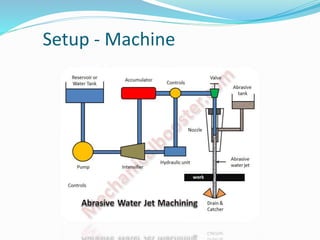
Setup - Machine
Pump
 Water is pumped at sufficiently high pressure ,200-400
MPA(2000-4000 bar) using a intensifier technology.
 Intensifier – pressure amplification using hydraulic
cylinders of different cross sections – “Jute Bell Presses”.
 Water is issued through a suitable orifice (0.2 to 0.4 mm
dia.), the P.E is converted into K.E. resulting in high
velocity jet (1000 m/s).
 Pure WJM – commercial tap water is used, jet entrains
atmospheric air and flares out.
 AWJM – Abrasive particles are entrained in water (silicon
oxide/glass beads etc.) – 800 m/s – can machine almost any
material.
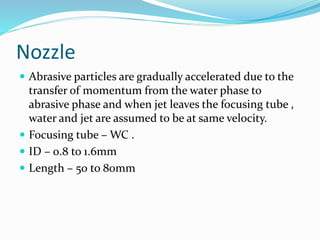
Nozzle
 Abrasive particles are gradually accelerated due to the
transfer of momentum from the water phase to
abrasive phase and when jet leaves the focusing tube ,
water and jet are assumed to be at same velocity.
 Focusing tube – WC .
 ID – 0.8 to 1.6mm
 Length – 50 to 80mm
Nozzle
 Entrained type AJWM - In entrained AWJM, the
abrasive water jet, which finally comes from the
focusing tube or nozzle, can be used to machine
different materials.
 Suspended type AJWM –
Mechanism of metal removal
 Brittle materials – crack initiation and propagation- brittle
failure.
 Process parameters:
 Orifice – Sapphires – 0.1 to 0.3 mm
 Focusing Tube – WC – 0.8 to 2.4 mm
 Pressure – 2500 to 4000 bar
 Abrasive – garnet and olivine - #125 to #60
 Abrasive flow - 0.1 to 1.0 Kg/min
 Stand off distance – 1 to 2 mm
 Machine Impact Angle – 60o to 900
 Traverse Speed – 100 mm/min to 5 m/min
 Depth of Cut – 1 mm to 250 mm 2/
Applications
 Paint removal
 Cutting soft materials
 Cutting frozen meat
 Textile, Leather industry
 Mass Immunization
 Surgery
 Peening
 Cutting
 Pocket Milling
 Drilling
Advantages
 Cheaper than other processes.
 Cut virtually any material. (pre hardened steel, mild steel,
copper, brass, aluminum; brittle materials like glass, ceramic,
quartz, stone)
 Cut thin stuff, or thick stuff.
 Make all sorts of shapes with only one tool.
 No heat generated.
 Leaves a satin smooth finish, thus reducing secondary
operations.
 Clean cutting process without gasses or oils.
 Modern systems are now very easy to learn.
 Are very safe.
 Machine stacks of thin parts all at once
Advantages (contd.)
 Unlike machining or grinding, water jet cutting does not produce
any dust or particles that are harmful if inhaled
 The kerfs width in water jet cutting is very small, and very little
material is wasted.
 Water jet cutting can be easily used to produce prototype parts
very efficiently. An operator can program the dimensions of the
part into the control station, and the water jet will cut the part
out exactly as programmed. This is much faster and cheaper than
drawing detailed prints of a part and then having a machinist cut
the part out.
 Water jets are much lighter than equivalent laser cutters, and
when mounted on an automated robot. This reduces the
problems of accelerating and decelerating the robot head, as well
as taking less energy.
Disadvantages
 One of the main disadvantages of water jet cutting is that a
limited number of materials can be cut economically.
While it is possible to cut tool steels, and other hard
materials, the cutting rate has to be greatly reduced, and
the time to cut a part can be very long. Because of this,
water jet cutting can be very costly and outweigh the
advantages.
 Another disadvantage is that very thick parts can not be cut
with water jet cutting and still hold dimensional accuracy.
If the part is too thick, the jet may dissipate some, and
cause it to cut on a diagonal, or to have a wider cut at the
bottom of the part than the top. It can also cause a rough
wave pattern on the cut surface.
THANKS

Abrasive water jet machining juny

  • 1.
  • 2.
    content  Introduction  Process Mechanism  Process parameters  Applications  Advantages  Disadvantages
  • 3.
    Introduction • Abrasive WaterJet Machining (AWJM) is non - traditional or non - conventional machining process. • This belong to mechanical group of non -conventional processes like Ultrasonic Machining (USM) and Abrasive Jet Machining (AJM). • In these processes (WJM and AJWM), the mechanical energy of water and abrasive phases are used to achieve material removal or machining.
  • 4.
    Process  Fine, highpressure(1500 - 4000 MN/cm2), high velocity (twice the speed of sound)of water jet is bombarded onto the work surface.  High velocity water jet is directed at a target in such a way that the velocity is reduced to zero on striking the work piece .  K.E. of jet is converted into the high pressure.  Erosion if pressure> strength of material.
  • 5.
    Mechanism  Given amountof energy is concentrated onto a very small point to cause the material removal.  Energy is of order – 10’10 watt/mm2.  On striking the K.E is converted into the pressure energy (stagnation pressure).  Mechanism is erosion – localized compressive failure which occurs when the local fluid pressure exceeds the strength of the target material.  Ductile – erosion due to shearing action.
  • 6.
  • 7.
    Pump  Water ispumped at sufficiently high pressure ,200-400 MPA(2000-4000 bar) using a intensifier technology.  Intensifier – pressure amplification using hydraulic cylinders of different cross sections – “Jute Bell Presses”.  Water is issued through a suitable orifice (0.2 to 0.4 mm dia.), the P.E is converted into K.E. resulting in high velocity jet (1000 m/s).  Pure WJM – commercial tap water is used, jet entrains atmospheric air and flares out.  AWJM – Abrasive particles are entrained in water (silicon oxide/glass beads etc.) – 800 m/s – can machine almost any material.
  • 8.
    Nozzle  Abrasive particlesare gradually accelerated due to the transfer of momentum from the water phase to abrasive phase and when jet leaves the focusing tube , water and jet are assumed to be at same velocity.  Focusing tube – WC .  ID – 0.8 to 1.6mm  Length – 50 to 80mm
  • 9.
    Nozzle  Entrained typeAJWM - In entrained AWJM, the abrasive water jet, which finally comes from the focusing tube or nozzle, can be used to machine different materials.  Suspended type AJWM –
  • 10.
    Mechanism of metalremoval  Brittle materials – crack initiation and propagation- brittle failure.  Process parameters:  Orifice – Sapphires – 0.1 to 0.3 mm  Focusing Tube – WC – 0.8 to 2.4 mm  Pressure – 2500 to 4000 bar  Abrasive – garnet and olivine - #125 to #60  Abrasive flow - 0.1 to 1.0 Kg/min  Stand off distance – 1 to 2 mm  Machine Impact Angle – 60o to 900  Traverse Speed – 100 mm/min to 5 m/min  Depth of Cut – 1 mm to 250 mm 2/
  • 11.
    Applications  Paint removal Cutting soft materials  Cutting frozen meat  Textile, Leather industry  Mass Immunization  Surgery  Peening  Cutting  Pocket Milling  Drilling
  • 12.
    Advantages  Cheaper thanother processes.  Cut virtually any material. (pre hardened steel, mild steel, copper, brass, aluminum; brittle materials like glass, ceramic, quartz, stone)  Cut thin stuff, or thick stuff.  Make all sorts of shapes with only one tool.  No heat generated.  Leaves a satin smooth finish, thus reducing secondary operations.  Clean cutting process without gasses or oils.  Modern systems are now very easy to learn.  Are very safe.  Machine stacks of thin parts all at once
  • 13.
    Advantages (contd.)  Unlikemachining or grinding, water jet cutting does not produce any dust or particles that are harmful if inhaled  The kerfs width in water jet cutting is very small, and very little material is wasted.  Water jet cutting can be easily used to produce prototype parts very efficiently. An operator can program the dimensions of the part into the control station, and the water jet will cut the part out exactly as programmed. This is much faster and cheaper than drawing detailed prints of a part and then having a machinist cut the part out.  Water jets are much lighter than equivalent laser cutters, and when mounted on an automated robot. This reduces the problems of accelerating and decelerating the robot head, as well as taking less energy.
  • 14.
    Disadvantages  One ofthe main disadvantages of water jet cutting is that a limited number of materials can be cut economically. While it is possible to cut tool steels, and other hard materials, the cutting rate has to be greatly reduced, and the time to cut a part can be very long. Because of this, water jet cutting can be very costly and outweigh the advantages.  Another disadvantage is that very thick parts can not be cut with water jet cutting and still hold dimensional accuracy. If the part is too thick, the jet may dissipate some, and cause it to cut on a diagonal, or to have a wider cut at the bottom of the part than the top. It can also cause a rough wave pattern on the cut surface.
  • 15.