NON CONVENTIONAL MACHINING PROCESS
INTRODUCTIONINTRODUCTION
Manufacturing processes can be broadly divided into two groups and they are
primary manufacturing processes and secondary manufacturing processes.
The former ones provide basic shape and size to the material as per designer’s
requirement. Casting, forming, powder metallurgy are such processes to name
a few. Secondary manufacturing processes provide the final shape and size
with tighter control on dimension, surface characteristics etc. Material removal
processes are mainly the secondary manufacturing processes.
Material removal processes once again can be divided into mainly two groups
and they are “Conventional Machining Processes” and “Non-Traditional
Manufacturing Processes”.
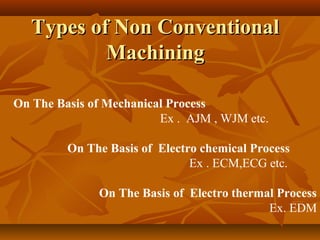
Types of Non ConventionalTypes of Non Conventional
MachiningMachining
On The Basis of Mechanical Process
Ex . AJM , WJM etc.
On The Basis of Electro chemical Process
Ex . ECM,ECG etc.
On The Basis of Electro thermal Process
Ex. EDM
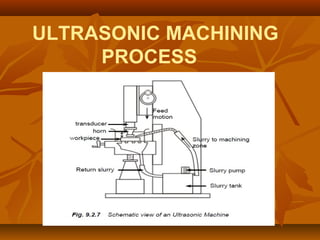
ULTRASONIC MACHINING
PROCESS
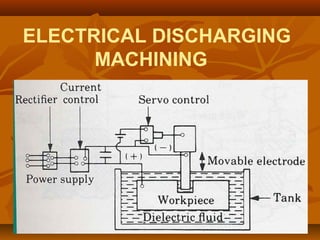
ELECTRICAL DISCHARGING
MACHINING
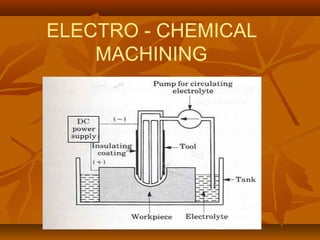
ELECTRO - CHEMICAL
MACHINING
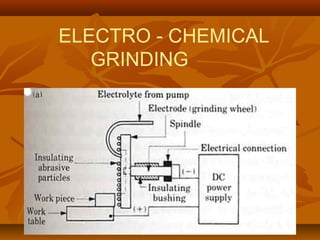
ELECTRO - CHEMICAL
GRINDING
Jet MachiningJet Machining
Consisting of:Consisting of:
Fluid Jet MachiningFluid Jet Machining
Abrasive Jet MachiningAbrasive Jet Machining
Airbrasive Jet MachiningAirbrasive Jet Machining
 Also called MicroBlast Machining is a
process using:
 High pressure air with fine powder, blended
together to form an abrasive mixture.
 This mixture is sent through a small, precisely
machined nozzle.
 The result is a highly accurate abrasive stream
used for cleaning, cutting, drilling, deburring.
Airbrasive Jet MachiningAirbrasive Jet Machining
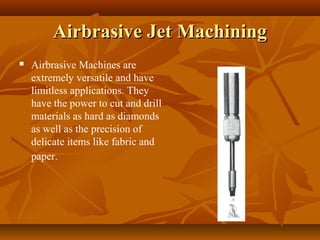
 Airbrasive Machines are
extremely versatile and have
limitless applications. They
have the power to cut and drill
materials as hard as diamonds
as well as the precision of
delicate items like fabric and
paper.
Fluid Jet MachiningFluid Jet Machining
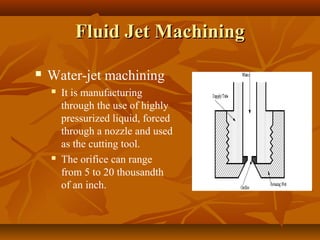
 Water-jet machining
 It is manufacturing
through the use of highly
pressurized liquid, forced
through a nozzle and used
as the cutting tool.
 The orifice can range
from 5 to 20 thousandth
of an inch.
Fluid Jet MachiningFluid Jet Machining
 Water-jet machining
 Water is most common liquid, however alcohol,oil, or
glycerol may be used
 Water jets machining has been in use since 1970.
 Water jets have many applications
 ranging from cutting steels to sheets of candy (using a
sugar water or syrup for cutting).
Fluid Jet MachiningFluid Jet Machining
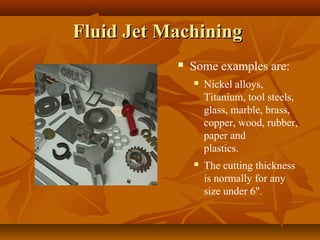
 Some examples are:
 Nickel alloys,
Titanium, tool steels,
glass, marble, brass,
copper, wood, rubber,
paper and
plastics.
 The cutting thickness
is normally for any
size under 6".
Fluid Jet MachiningFluid Jet Machining
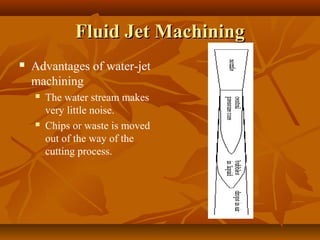
 Advantages of water-jet
machining
 The water stream makes
very little noise.
 Chips or waste is moved
out of the way of the
cutting process.
Fluid Jet MachiningFluid Jet Machining
 Advantages of water-jet machining
 There are no bits or tools touching the material
surface, thus there is no tool
replacement costs.
 Ultrahigh-pressure Water-jets cut to accuracy's of
+/-0.010".
 Low level of mechanical stress (less than a
pound) placed on the work piece preventing
damage and deformations.
Fluid Jet MachiningFluid Jet Machining
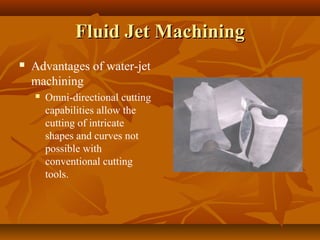
 Advantages of water-jet
machining
 Omni-directional cutting
capabilities allow the
cutting of intricate
shapes and curves not
possible with
conventional cutting
tools.
Fluid Jet MachiningFluid Jet Machining
 Advantages of water-jet
machining
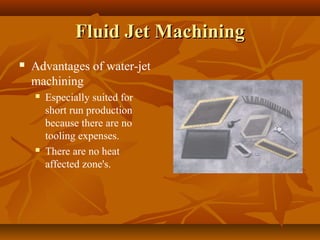
 Especially suited for
short run production
because there are no
tooling expenses.
 There are no heat
affected zone's.
Abrasive Jet MachiningAbrasive Jet Machining
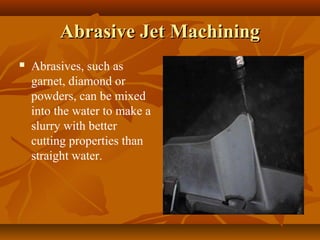
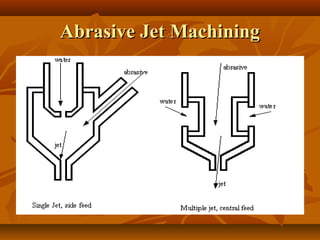
 Abrasives, such as
garnet, diamond or
powders, can be mixed
into the water to make a
slurry with better
cutting properties than
straight water.
Abrasive Jet MachiningAbrasive Jet Machining
Advantages of Abrasive JetsAdvantages of Abrasive Jets
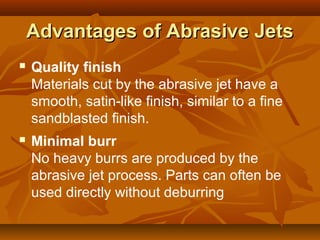
 Quality finish
Materials cut by the abrasive jet have a
smooth, satin-like finish, similar to a fine
sandblasted finish.
 Minimal burr
No heavy burrs are produced by the
abrasive jet process. Parts can often be
used directly without deburring
Advantages of Abrasive JetsAdvantages of Abrasive Jets
over Water Jetsover Water Jets
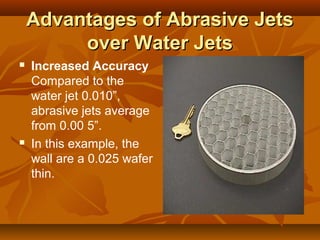
 Increased Accuracy
Compared to the
water jet 0.010”,
abrasive jets average
from 0.00 5”.
 In this example, the
wall are a 0.025 wafer
thin.
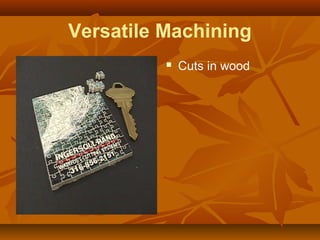
Versatile Machining
 Cuts in wood
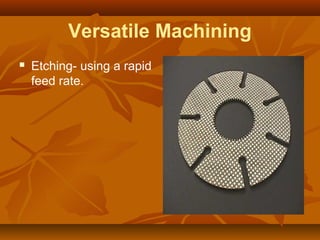
Versatile Machining
 Etching- using a rapid
feed rate.
Conclusion
 Jet Machining is the
right choice of tools
for:
 Heat-sensitive or
Brittle materials
 Glass
 Composites and
Nonmetals
 Burrless Applications
 Produce long tapered
walls in deep cuts

Water Jet Machining

  • 1.
  • 2.
    INTRODUCTIONINTRODUCTION Manufacturing processes canbe broadly divided into two groups and they are primary manufacturing processes and secondary manufacturing processes. The former ones provide basic shape and size to the material as per designer’s requirement. Casting, forming, powder metallurgy are such processes to name a few. Secondary manufacturing processes provide the final shape and size with tighter control on dimension, surface characteristics etc. Material removal processes are mainly the secondary manufacturing processes. Material removal processes once again can be divided into mainly two groups and they are “Conventional Machining Processes” and “Non-Traditional Manufacturing Processes”.
  • 3.
    Types of NonConventionalTypes of Non Conventional MachiningMachining On The Basis of Mechanical Process Ex . AJM , WJM etc. On The Basis of Electro chemical Process Ex . ECM,ECG etc. On The Basis of Electro thermal Process Ex. EDM
  • 4.
  • 5.
  • 6.
  • 7.
  • 8.
    Jet MachiningJet Machining Consistingof:Consisting of: Fluid Jet MachiningFluid Jet Machining Abrasive Jet MachiningAbrasive Jet Machining Airbrasive Jet MachiningAirbrasive Jet Machining
  • 9.
    Airbrasive Jet MachiningAirbrasiveJet Machining  Also called MicroBlast Machining is a process using:  High pressure air with fine powder, blended together to form an abrasive mixture.  This mixture is sent through a small, precisely machined nozzle.  The result is a highly accurate abrasive stream used for cleaning, cutting, drilling, deburring.
  • 10.
    Airbrasive Jet MachiningAirbrasiveJet Machining  Airbrasive Machines are extremely versatile and have limitless applications. They have the power to cut and drill materials as hard as diamonds as well as the precision of delicate items like fabric and paper.
  • 11.
    Fluid Jet MachiningFluidJet Machining  Water-jet machining  It is manufacturing through the use of highly pressurized liquid, forced through a nozzle and used as the cutting tool.  The orifice can range from 5 to 20 thousandth of an inch.
  • 12.
    Fluid Jet MachiningFluidJet Machining  Water-jet machining  Water is most common liquid, however alcohol,oil, or glycerol may be used  Water jets machining has been in use since 1970.  Water jets have many applications  ranging from cutting steels to sheets of candy (using a sugar water or syrup for cutting).
  • 13.
    Fluid Jet MachiningFluidJet Machining  Some examples are:  Nickel alloys, Titanium, tool steels, glass, marble, brass, copper, wood, rubber, paper and plastics.  The cutting thickness is normally for any size under 6".
  • 14.
    Fluid Jet MachiningFluidJet Machining  Advantages of water-jet machining  The water stream makes very little noise.  Chips or waste is moved out of the way of the cutting process.
  • 15.
    Fluid Jet MachiningFluidJet Machining  Advantages of water-jet machining  There are no bits or tools touching the material surface, thus there is no tool replacement costs.  Ultrahigh-pressure Water-jets cut to accuracy's of +/-0.010".  Low level of mechanical stress (less than a pound) placed on the work piece preventing damage and deformations.
  • 16.
    Fluid Jet MachiningFluidJet Machining  Advantages of water-jet machining  Omni-directional cutting capabilities allow the cutting of intricate shapes and curves not possible with conventional cutting tools.
  • 17.
    Fluid Jet MachiningFluidJet Machining  Advantages of water-jet machining  Especially suited for short run production because there are no tooling expenses.  There are no heat affected zone's.
  • 18.
    Abrasive Jet MachiningAbrasiveJet Machining  Abrasives, such as garnet, diamond or powders, can be mixed into the water to make a slurry with better cutting properties than straight water.
  • 19.
  • 20.
    Advantages of AbrasiveJetsAdvantages of Abrasive Jets  Quality finish Materials cut by the abrasive jet have a smooth, satin-like finish, similar to a fine sandblasted finish.  Minimal burr No heavy burrs are produced by the abrasive jet process. Parts can often be used directly without deburring
  • 21.
    Advantages of AbrasiveJetsAdvantages of Abrasive Jets over Water Jetsover Water Jets  Increased Accuracy Compared to the water jet 0.010”, abrasive jets average from 0.00 5”.  In this example, the wall are a 0.025 wafer thin.
  • 22.
  • 23.
    Versatile Machining  Etching-using a rapid feed rate.
  • 24.
    Conclusion  Jet Machiningis the right choice of tools for:  Heat-sensitive or Brittle materials  Glass  Composites and Nonmetals  Burrless Applications  Produce long tapered walls in deep cuts