K L E SOCIETY’S POLYTECHNIC
BAILHONGAL-591 102
A Presentation ON
Submittedby:
Vishwanath S
5th sem
ME Department
Introduction to Water jet
 It is the fastest growing machining process.
 One of the most versatile machining processes.
 Compliments other technologies such as milling,
laser, and plasma.
 True cold cutting process – No HAZ , mechanical
stresses or operator and environmental hazards.
 Not limited to machining – but also used in food
industry applications.
Evolution of Water jet :
 1930s: Mining Industry to remove stones and coal
 1960s : Need to cut advanced materials for
aerospace industry
 1970s : First attempts were to employ WaterJet to
cut advanced composites for aerospace
applications.
 1980s: First commercial AWJ machines
TYPES OF WATER JET CUTTING
 Water jet cut
 Abrasive jet cut
 Abrasive water suspension jets
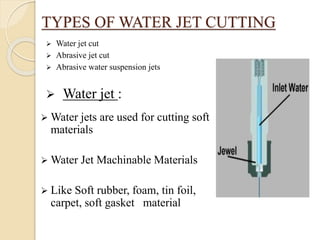
 Water jet :
 Water jets are used for cutting soft
materials
 Water Jet Machinable Materials
 Like Soft rubber, foam, tin foil,
carpet, soft gasket material
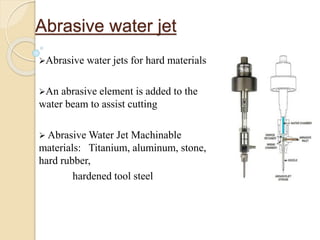
Abrasive water jet
Abrasive water jets for hard materials
An abrasive element is added to the
water beam to assist cutting
 Abrasive Water Jet Machinable
materials: Titanium, aluminum, stone,
hard rubber,
hardened tool steel
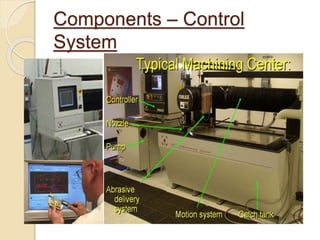
Components
Pump
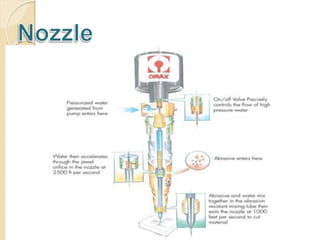
Nozzle
Orifice
Control System
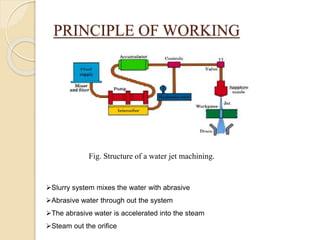
PRINCIPLE OF WORKING
Fig. Structure of a water jet machining.
Slurry system mixes the water with abrasive
Abrasive water through out the system
The abrasive water is accelerated into the steam
Steam out the orifice
8
Components – Control
System
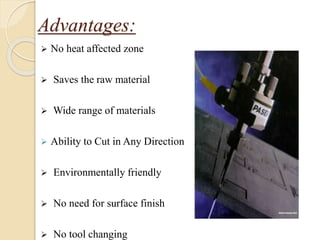
Advantages:
 No heat affected zone
 Saves the raw material
 Wide range of materials
 Ability to Cut in Any Direction
 Environmentally friendly
 No need for surface finish
 No tool changing
Disadvantages:
 Limited number of materials can be cut
economically
 Very thick parts can not be cut with Water Jet
 Cutting and still hold dimensional accuracy
 Slower cutting
 Higher entry cost
WaterJet v/s Laser
 No Heat Affected Zone
 Can Cut Through Reflective
Materials
 Can Cut Uneven Surfaces
Smoothly
 Environmentally friendly
 Can Cut Up to 12” in hard
materials (Ti, SS)& 24” in
Rubber
 Minimal Heat Affected Zone
 Reflects on Shiny Surfaces
 Laser Diffracts and Looses
its Focus
 Produces Toxic Fumes
 Max. Depth 0.5 – 0.75”
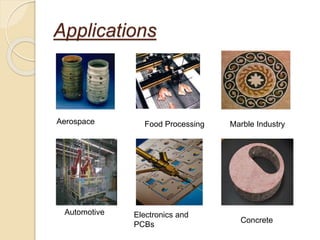
Applications
Aerospace
Automotive
Food Processing
Electronics and
PCBs
Marble Industry
Concrete
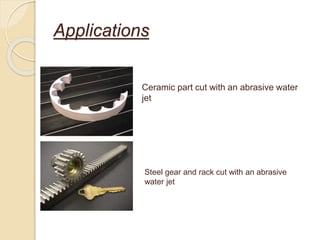
Applications
Ceramic part cut with an abrasive water
jet
Steel gear and rack cut with an abrasive
water jet
Conclusion:
 It is relatively a new technology which has caught on quickly
and is replacing century-old methods used for manufacturing
 Used not only in typical machining applications, but food and
soft-goods industries
 As material and pump technology advances faster cutting rates,
longer component life and tighter tolerances will be achievable
 Paves the way for new machining processes that embrace
simplicity and have a small environmental impact
Questions……?
THANK YOU…  

water jet cutting

  • 1.
    K L ESOCIETY’S POLYTECHNIC BAILHONGAL-591 102 A Presentation ON Submittedby: Vishwanath S 5th sem ME Department
  • 2.
    Introduction to Waterjet  It is the fastest growing machining process.  One of the most versatile machining processes.  Compliments other technologies such as milling, laser, and plasma.  True cold cutting process – No HAZ , mechanical stresses or operator and environmental hazards.  Not limited to machining – but also used in food industry applications.
  • 3.
    Evolution of Waterjet :  1930s: Mining Industry to remove stones and coal  1960s : Need to cut advanced materials for aerospace industry  1970s : First attempts were to employ WaterJet to cut advanced composites for aerospace applications.  1980s: First commercial AWJ machines
  • 4.
    TYPES OF WATERJET CUTTING  Water jet cut  Abrasive jet cut  Abrasive water suspension jets  Water jet :  Water jets are used for cutting soft materials  Water Jet Machinable Materials  Like Soft rubber, foam, tin foil, carpet, soft gasket material
  • 5.
    Abrasive water jet Abrasivewater jets for hard materials An abrasive element is added to the water beam to assist cutting  Abrasive Water Jet Machinable materials: Titanium, aluminum, stone, hard rubber, hardened tool steel
  • 6.
  • 7.
    PRINCIPLE OF WORKING Fig.Structure of a water jet machining. Slurry system mixes the water with abrasive Abrasive water through out the system The abrasive water is accelerated into the steam Steam out the orifice
  • 8.
  • 9.
  • 10.
    Advantages:  No heataffected zone  Saves the raw material  Wide range of materials  Ability to Cut in Any Direction  Environmentally friendly  No need for surface finish  No tool changing
  • 11.
    Disadvantages:  Limited numberof materials can be cut economically  Very thick parts can not be cut with Water Jet  Cutting and still hold dimensional accuracy  Slower cutting  Higher entry cost
  • 12.
    WaterJet v/s Laser No Heat Affected Zone  Can Cut Through Reflective Materials  Can Cut Uneven Surfaces Smoothly  Environmentally friendly  Can Cut Up to 12” in hard materials (Ti, SS)& 24” in Rubber  Minimal Heat Affected Zone  Reflects on Shiny Surfaces  Laser Diffracts and Looses its Focus  Produces Toxic Fumes  Max. Depth 0.5 – 0.75”
  • 13.
  • 14.
    Applications Ceramic part cutwith an abrasive water jet Steel gear and rack cut with an abrasive water jet
  • 15.
    Conclusion:  It isrelatively a new technology which has caught on quickly and is replacing century-old methods used for manufacturing  Used not only in typical machining applications, but food and soft-goods industries  As material and pump technology advances faster cutting rates, longer component life and tighter tolerances will be achievable  Paves the way for new machining processes that embrace simplicity and have a small environmental impact
  • 16.