 Material removal process where the material is removed by
high velocity stream of air/gas or water and abrasive
mixture directed on the work piece surface.
 The material removal process is mainly caused by brittle
fracture by impingement and then by erosion.
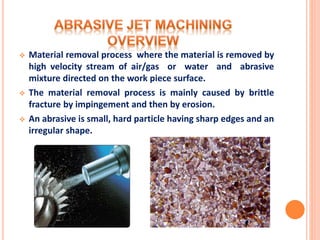
 An abrasive is small, hard particle having sharp edges and an
irregular shape.
 Air Compressor
 Abrasive delivery system
 Nozzle
 Mixing tube
 Motion system
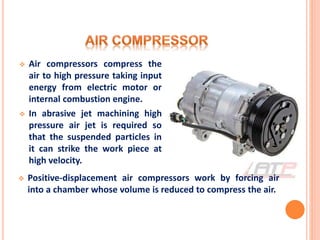
 Air compressors compress the
air to high pressure taking input
energy from electric motor or
internal combustion engine.
 In abrasive jet machining high
pressure air jet is required so
that the suspended particles in
it can strike the work piece at
high velocity.
 Positive-displacement air compressors work by forcing air
into a chamber whose volume is reduced to compress the air.
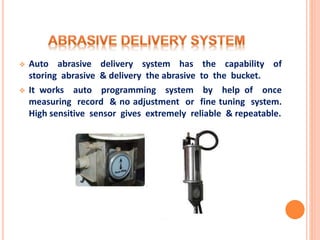
 Auto abrasive delivery system has the capability of
storing abrasive & delivery the abrasive to the bucket.
 It works auto programming system by help of once
measuring record & no adjustment or fine tuning system.
High sensitive sensor gives extremely reliable & repeatable.
 All abrasive jet systems use the same basic
two stage nozzle . First , water passes through
a small diameter jewel orifice to form a
narrow jet.
 The abrasive particles are accelerated by the
moving stream of water & they pass into a
long hollow cylindrical ceramic mixing tube.
 Generally two type of nozzle use , right angle
head & straight head.
 The mixing tube is where the
abrasive mixes with the high
pressure water.
 The mixing tube should be replaced
when tolerances drop below
acceptable levels.
 For maximum accuracy , replace the
mixing tube more frequently.
 In order to make precision parts , an abrasive jet system
must have a precision x-y table and motion control
system.
 Tables fall into three general categories.
 Floor-mounted gantry systems
 Integrated table/gantry systems
 Floor-mounted cantilever systems
 Automation of AJM is done by implementing Computer
Numerical Control (CNC) into the motion system.
 A numerical control system in which the data handling, control
sequences, and response to input is determined by an on-board
computer system at the machine tool.
 A CNC machine consists of the following 6 major elements:
 Input Device
 Machine Control Unit
 Machine Tool
 Driving system
 Feedback Devices
 Display Units
 Easier to program.
 Easy storage of existing programs.
 Easy to change programs.
 Avoids human errors.
 CNC machines are safe to operate.
 Complex geometry is produced as cheaply as simpler ones.
 Usually generates closer tolerances than manual machines.
 Costly Setup.
 Skilled operators.
 Computers and programming knowledge required.
 Maintenance is difficult.
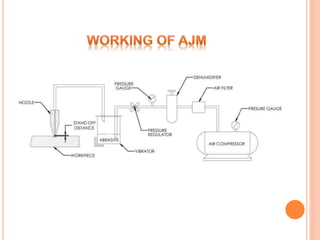
 Air from the atmosphere is compressed by the compressor
and is delivered to the mixing chamber vie the filter and
regulator.
 The mixing chamber contains the abrasive powders and is
made to vibrate by an electric motor and cam arrangement.
 Then the abrasive particles are passed into a connecting
hose leading to the nozzle.
 This abrasive and gas mixture emerges from the orifice of
nozzle at high velocity.
 The feed rate of abrasive air is controlled by the amplitude
of vibration of the mixing chamber.
 A pressure regulator installed in the system controls the gas
flow and pressure.
 The nozzle is mounted on a plate which is screwed to the
frame.
 The work piece is moved by moving the x-y table to control
the size and shape of the cut.
 Dust removal equipment is necessary to protect the
environment.
 It has the ability to cut intricate holes shape in materials of
having any hardness and brittleness.
 It can cut fragile and heat sensitive material without
damage as physical tool is absent.
 No alteration in microstructure of materials as no heat is
generated.
 Smooth finish can be obtained.
 Capital cost is low.
 Material removal rate is low and hence its application is
limited to small scale machining.
 Stray strings can occur and so its application is limited.
 Embedding of the abrasive particles in the work piece
surface may occur while machining softer material.
 The abrasive material may accumulate at nozzle and fail the
process if moisture is contained in the air.
 It cannot be used to drill blind holes.
 Machining of brittle materials and heat sensitive materials
like quartz glass, sapphire, mica and ceramics.
 Countering, drilling, cutting slot, thin sections, de-burring
for producing integrate shapes in hard and brittle materials.
 Cleaning and polishing of plastics like nylon.
 Micro machining is possible in brittle materials.

Abrasive Jet machine (AJM)

  • 2.
     Material removalprocess where the material is removed by high velocity stream of air/gas or water and abrasive mixture directed on the work piece surface.  The material removal process is mainly caused by brittle fracture by impingement and then by erosion.  An abrasive is small, hard particle having sharp edges and an irregular shape.
  • 3.
     Air Compressor Abrasive delivery system  Nozzle  Mixing tube  Motion system
  • 4.
     Air compressorscompress the air to high pressure taking input energy from electric motor or internal combustion engine.  In abrasive jet machining high pressure air jet is required so that the suspended particles in it can strike the work piece at high velocity.  Positive-displacement air compressors work by forcing air into a chamber whose volume is reduced to compress the air.
  • 5.
     Auto abrasivedelivery system has the capability of storing abrasive & delivery the abrasive to the bucket.  It works auto programming system by help of once measuring record & no adjustment or fine tuning system. High sensitive sensor gives extremely reliable & repeatable.
  • 6.
     All abrasivejet systems use the same basic two stage nozzle . First , water passes through a small diameter jewel orifice to form a narrow jet.  The abrasive particles are accelerated by the moving stream of water & they pass into a long hollow cylindrical ceramic mixing tube.  Generally two type of nozzle use , right angle head & straight head.
  • 7.
     The mixingtube is where the abrasive mixes with the high pressure water.  The mixing tube should be replaced when tolerances drop below acceptable levels.  For maximum accuracy , replace the mixing tube more frequently.
  • 8.
     In orderto make precision parts , an abrasive jet system must have a precision x-y table and motion control system.  Tables fall into three general categories.  Floor-mounted gantry systems  Integrated table/gantry systems  Floor-mounted cantilever systems  Automation of AJM is done by implementing Computer Numerical Control (CNC) into the motion system.
  • 9.
     A numericalcontrol system in which the data handling, control sequences, and response to input is determined by an on-board computer system at the machine tool.  A CNC machine consists of the following 6 major elements:  Input Device  Machine Control Unit  Machine Tool  Driving system  Feedback Devices  Display Units
  • 11.
     Easier toprogram.  Easy storage of existing programs.  Easy to change programs.  Avoids human errors.  CNC machines are safe to operate.  Complex geometry is produced as cheaply as simpler ones.  Usually generates closer tolerances than manual machines.
  • 12.
     Costly Setup. Skilled operators.  Computers and programming knowledge required.  Maintenance is difficult.
  • 14.
     Air fromthe atmosphere is compressed by the compressor and is delivered to the mixing chamber vie the filter and regulator.  The mixing chamber contains the abrasive powders and is made to vibrate by an electric motor and cam arrangement.  Then the abrasive particles are passed into a connecting hose leading to the nozzle.  This abrasive and gas mixture emerges from the orifice of nozzle at high velocity.  The feed rate of abrasive air is controlled by the amplitude of vibration of the mixing chamber.
  • 15.
     A pressureregulator installed in the system controls the gas flow and pressure.  The nozzle is mounted on a plate which is screwed to the frame.  The work piece is moved by moving the x-y table to control the size and shape of the cut.  Dust removal equipment is necessary to protect the environment.
  • 16.
     It hasthe ability to cut intricate holes shape in materials of having any hardness and brittleness.  It can cut fragile and heat sensitive material without damage as physical tool is absent.  No alteration in microstructure of materials as no heat is generated.  Smooth finish can be obtained.  Capital cost is low.
  • 17.
     Material removalrate is low and hence its application is limited to small scale machining.  Stray strings can occur and so its application is limited.  Embedding of the abrasive particles in the work piece surface may occur while machining softer material.  The abrasive material may accumulate at nozzle and fail the process if moisture is contained in the air.  It cannot be used to drill blind holes.
  • 18.
     Machining ofbrittle materials and heat sensitive materials like quartz glass, sapphire, mica and ceramics.  Countering, drilling, cutting slot, thin sections, de-burring for producing integrate shapes in hard and brittle materials.  Cleaning and polishing of plastics like nylon.  Micro machining is possible in brittle materials.