MODIGLIANI-MILLER
APPROACH
(to capital structure)
Dr. Mohamed Kutty
Kakkakunnan
Associate Professor
P G Dept. of Commerce
N A M College Kallikkandy
Kannur – Kerala -India
Modigliani-Miller Approach
 Against NI approach and Traditional approach
 According to this approach, leverage will not
affect value of the firm and cost of capital –
remain unaffected
 No optimal capital structure or optimal debt
equity mix
 Argued that – regardless of the impact of savings
due to interest, the cost of equity will raise to
offset any possible savings from the low cost
debt
Modigliani-Miller Approach contd….
 More resembles to the NOI approach and
supports the proposition of independent of the
cost of capital of the degree of leverage.
 Maintains that the weighted average cost of
capital (overall cost of capital – Ko) does not
change with a change in the debt equity ratio or
proportion of debt in the capital structure
 The greatest advantage of this approach is that,
it provides operational justification for their
argument as opposed to other theories
Propositions of MM theory
• Three basic propositions
1. The overall cost of capital (Ko) and the value of the firm
(V) are independent of its capital structure. The Ko and V
are constant for all degree of leverages. The total value is
obtained by capitalizing the expected stream of
operating earnings at a discount rate appropriate to its
risk class
2. The Ke is equal to the capitalization rate of a pure equity
stream plus a premium for financial risk equal to the
difference between pure equity capitalization rate (Ke)
and Kd times the ratio of debt t equity. In other words,
Ke increases in a manner to offset exactly the use of a
less expensive source of funds represented by debt
3. The cut off rate for investment purpose is completely
independent of the way which an investment is financed
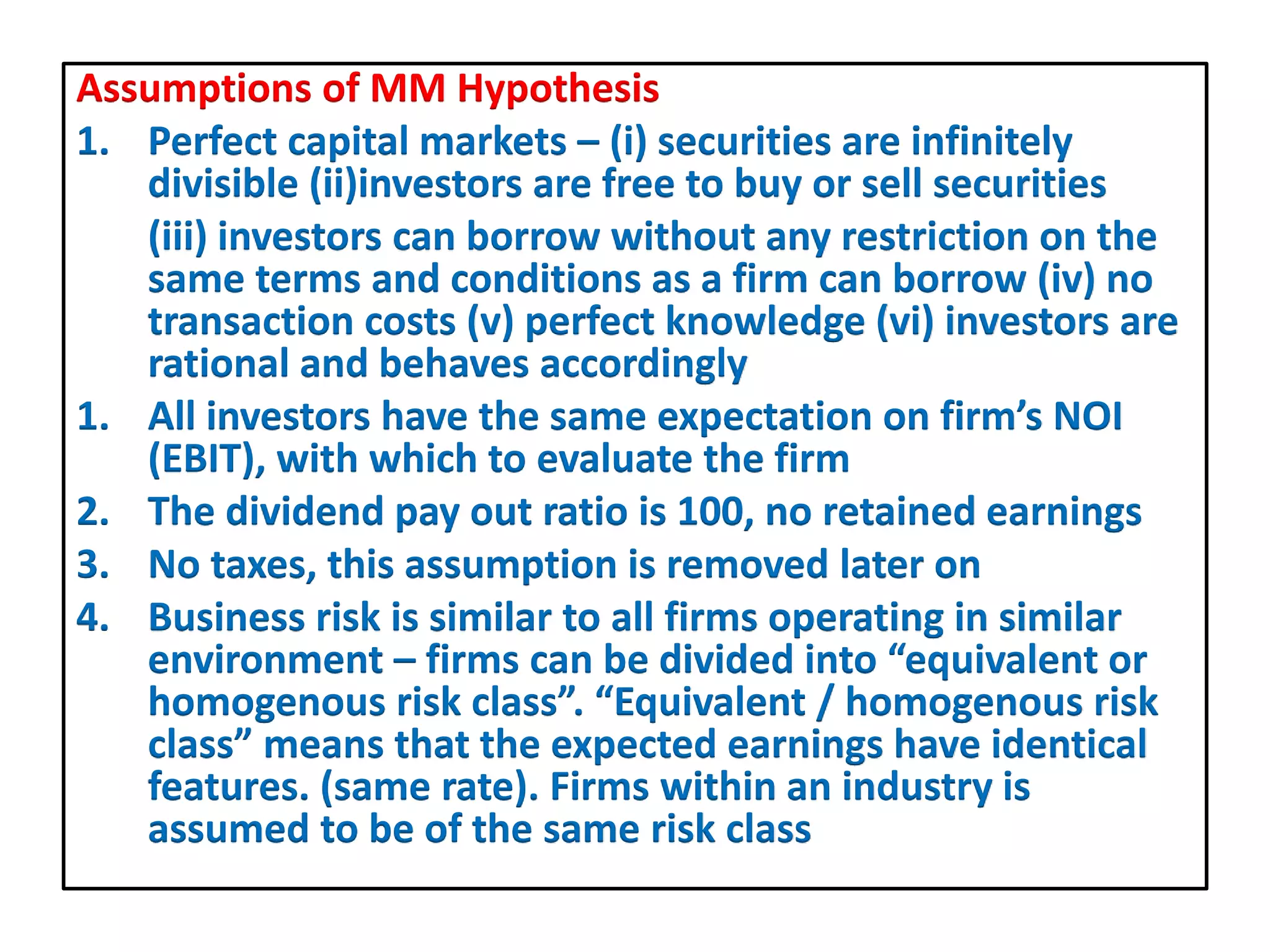
Assumptions of MM Hypothesis
1. Perfect capital markets – (i) securities are infinitely
divisible (ii)investors are free to buy or sell securities
(iii) investors can borrow without any restriction on the
same terms and conditions as a firm can borrow (iv) no
transaction costs (v) perfect knowledge (vi) investors are
rational and behaves accordingly
1. All investors have the same expectation on firm’s NOI
(EBIT), with which to evaluate the firm
2. The dividend pay out ratio is 100, no retained earnings
3. No taxes, this assumption is removed later on
4. Business risk is similar to all firms operating in similar
environment – firms can be divided into “equivalent or
homogenous risk class”. “Equivalent / homogenous risk
class” means that the expected earnings have identical
features. (same rate). Firms within an industry is
assumed to be of the same risk class
Arbitrage Process?
 The basic premise is that (proposition I) the total
value of a firm will be constant irrespective of
the degree of leverage (debt-equity ratio)
 Similarly, the overall cost of capital of the firm
and market price of shares remain constant
irrespective of the debt-equity mix
 The justification given by MM hypothesis is the
“ARBITRAGE PROCESS”
 “the act of buying an asset/ security in one
market (at lower prices) and selling it another
market (higher prices)
 This process results in eliminating the price
differentials and reaching the equilibrium stage
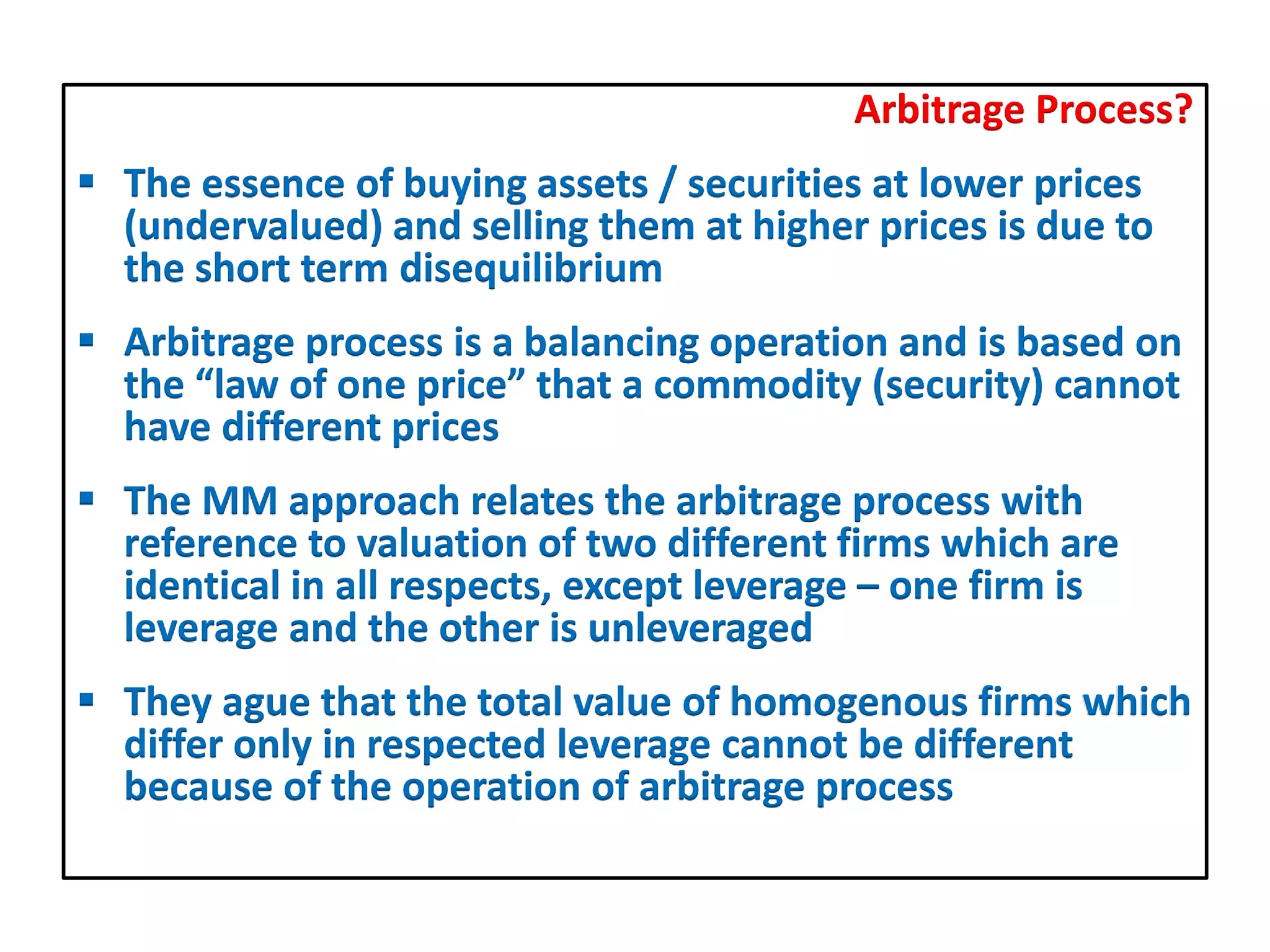
Arbitrage Process?
 The essence of buying assets / securities at lower prices
(undervalued) and selling them at higher prices is due to
the short term disequilibrium
 Arbitrage process is a balancing operation and is based on
the “law of one price” that a commodity (security) cannot
have different prices
 The MM approach relates the arbitrage process with
reference to valuation of two different firms which are
identical in all respects, except leverage – one firm is
leverage and the other is unleveraged
 They ague that the total value of homogenous firms which
differ only in respected leverage cannot be different
because of the operation of arbitrage process
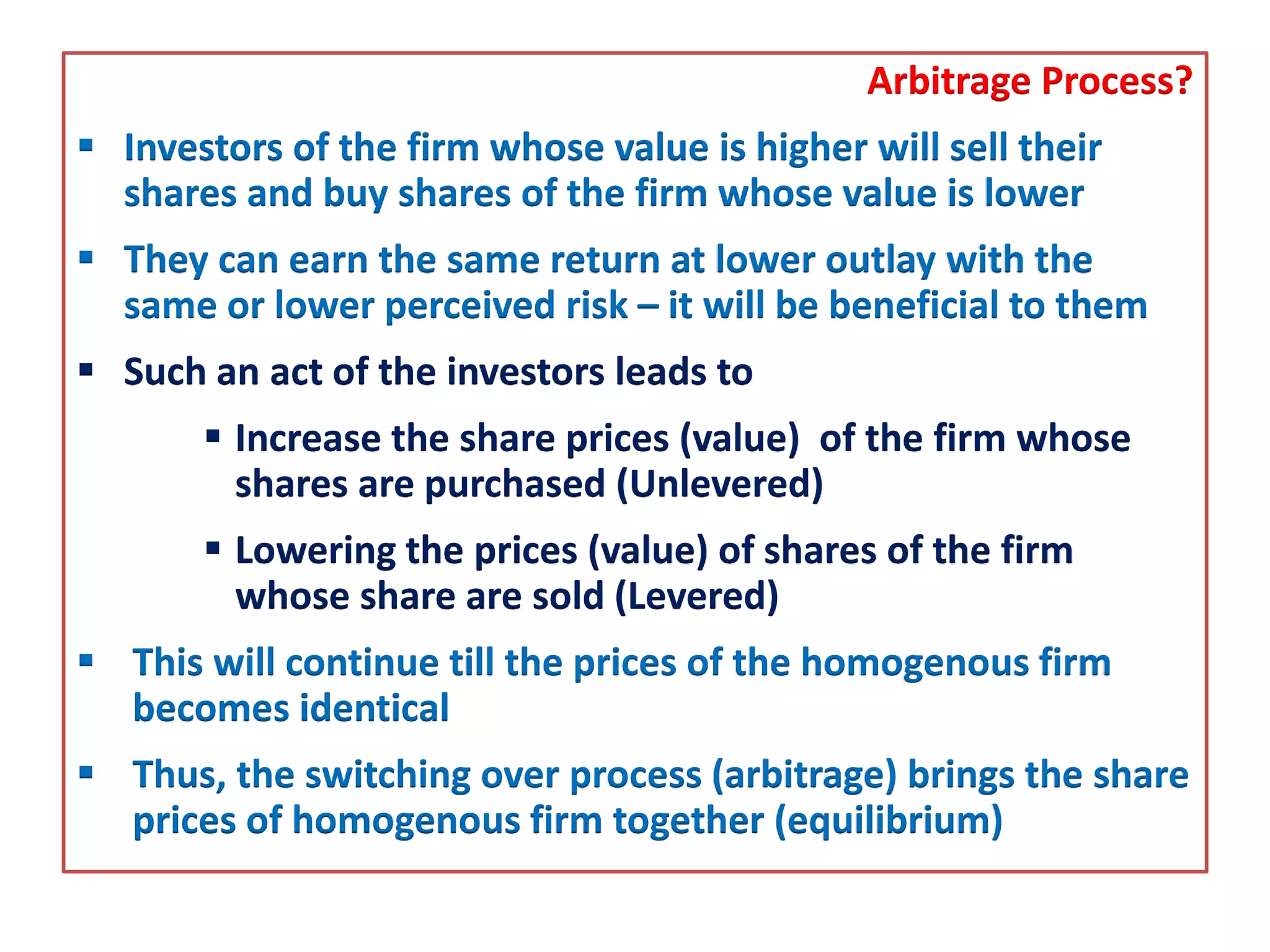
Arbitrage Process?
 Investors of the firm whose value is higher will sell their
shares and buy shares of the firm whose value is lower
 They can earn the same return at lower outlay with the
same or lower perceived risk – it will be beneficial to them
 Such an act of the investors leads to
 Increase the share prices (value) of the firm whose
shares are purchased (Unlevered)
 Lowering the prices (value) of shares of the firm
whose share are sold (Levered)
 This will continue till the prices of the homogenous firm
becomes identical
 Thus, the switching over process (arbitrage) brings the share
prices of homogenous firm together (equilibrium)
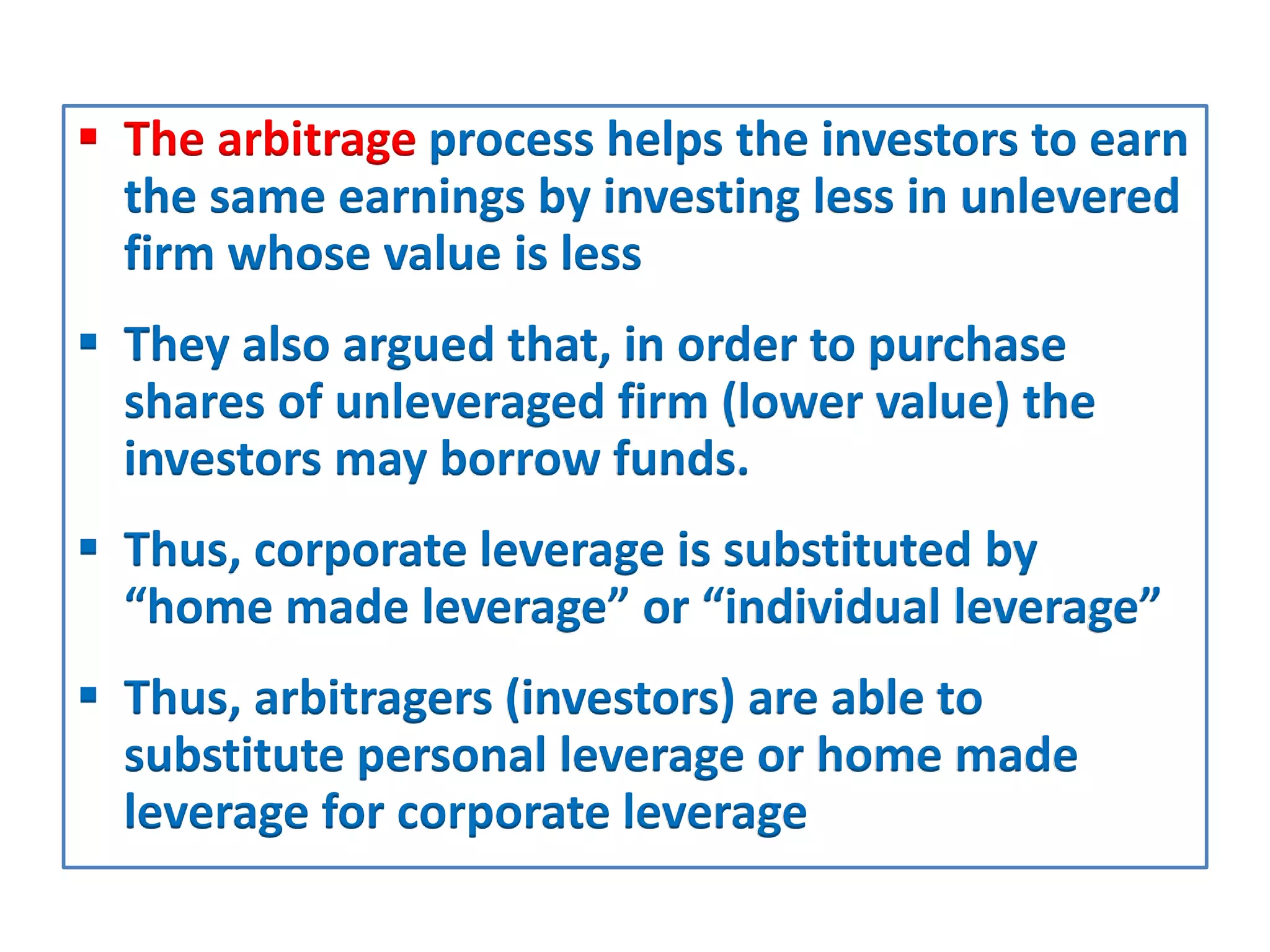
 The arbitrage process helps the investors to earn
the same earnings by investing less in unlevered
firm whose value is less
 They also argued that, in order to purchase
shares of unleveraged firm (lower value) the
investors may borrow funds.
 Thus, corporate leverage is substituted by
“home made leverage” or “individual leverage”
 Thus, arbitragers (investors) are able to
substitute personal leverage or home made
leverage for corporate leverage
The following symbols and expressions are used in
MM theory
Vu = market value of ungearded firm = 100% equity
= Market value of equity shares (given) (Ve)
Vg = market value of geared company = Veg + D
Veg = NOI/Ko
Vg= market value of equity in geared company =
NI/Ke
Ke= cost of equity =
Kd = cost of debt
Ko= Overall cost of capital
MM Theory and Corporate Taxation
Modigliani and Miller, latter on modified their theory by
incorporating corporate taxation in their theory
 Debt – tax advantage
 Thus, benefit of tax advantage will make the debt cheaper
and reduce the weighted average cost of capital
Ke
Ko (WACC
Kd (After Tax)
Overall cost of capital (Ko) of a geared firm
Ko = (Ke x E/V) + (1-t) (Kd x D/V)
Ke = Ku + (1-t) (Ku-Kd) x D/V
Where Ku = WACC of unlevered firm
Kd = Cost of Debt
Value of the firm
According to MM, due to the tax advantage the value of a levered
firm will be more than that of an unlevered firm
Thus, Vl = vu+TD
Where Vl = value of levered firm
Vu = value of unlevered firm
TD = Present value of tax shield
Where T = Tax rate; Kd = cost of debt, D = Debt

Modigiliani miller

  • 1.
    MODIGLIANI-MILLER APPROACH (to capital structure) Dr.Mohamed Kutty Kakkakunnan Associate Professor P G Dept. of Commerce N A M College Kallikkandy Kannur – Kerala -India
  • 2.
    Modigliani-Miller Approach  AgainstNI approach and Traditional approach  According to this approach, leverage will not affect value of the firm and cost of capital – remain unaffected  No optimal capital structure or optimal debt equity mix  Argued that – regardless of the impact of savings due to interest, the cost of equity will raise to offset any possible savings from the low cost debt
  • 3.
    Modigliani-Miller Approach contd…. More resembles to the NOI approach and supports the proposition of independent of the cost of capital of the degree of leverage.  Maintains that the weighted average cost of capital (overall cost of capital – Ko) does not change with a change in the debt equity ratio or proportion of debt in the capital structure  The greatest advantage of this approach is that, it provides operational justification for their argument as opposed to other theories
  • 4.
    Propositions of MMtheory • Three basic propositions 1. The overall cost of capital (Ko) and the value of the firm (V) are independent of its capital structure. The Ko and V are constant for all degree of leverages. The total value is obtained by capitalizing the expected stream of operating earnings at a discount rate appropriate to its risk class 2. The Ke is equal to the capitalization rate of a pure equity stream plus a premium for financial risk equal to the difference between pure equity capitalization rate (Ke) and Kd times the ratio of debt t equity. In other words, Ke increases in a manner to offset exactly the use of a less expensive source of funds represented by debt 3. The cut off rate for investment purpose is completely independent of the way which an investment is financed
  • 5.
    Assumptions of MMHypothesis 1. Perfect capital markets – (i) securities are infinitely divisible (ii)investors are free to buy or sell securities (iii) investors can borrow without any restriction on the same terms and conditions as a firm can borrow (iv) no transaction costs (v) perfect knowledge (vi) investors are rational and behaves accordingly 1. All investors have the same expectation on firm’s NOI (EBIT), with which to evaluate the firm 2. The dividend pay out ratio is 100, no retained earnings 3. No taxes, this assumption is removed later on 4. Business risk is similar to all firms operating in similar environment – firms can be divided into “equivalent or homogenous risk class”. “Equivalent / homogenous risk class” means that the expected earnings have identical features. (same rate). Firms within an industry is assumed to be of the same risk class
  • 6.
    Arbitrage Process?  Thebasic premise is that (proposition I) the total value of a firm will be constant irrespective of the degree of leverage (debt-equity ratio)  Similarly, the overall cost of capital of the firm and market price of shares remain constant irrespective of the debt-equity mix  The justification given by MM hypothesis is the “ARBITRAGE PROCESS”  “the act of buying an asset/ security in one market (at lower prices) and selling it another market (higher prices)  This process results in eliminating the price differentials and reaching the equilibrium stage
  • 7.
    Arbitrage Process?  Theessence of buying assets / securities at lower prices (undervalued) and selling them at higher prices is due to the short term disequilibrium  Arbitrage process is a balancing operation and is based on the “law of one price” that a commodity (security) cannot have different prices  The MM approach relates the arbitrage process with reference to valuation of two different firms which are identical in all respects, except leverage – one firm is leverage and the other is unleveraged  They ague that the total value of homogenous firms which differ only in respected leverage cannot be different because of the operation of arbitrage process
  • 8.
    Arbitrage Process?  Investorsof the firm whose value is higher will sell their shares and buy shares of the firm whose value is lower  They can earn the same return at lower outlay with the same or lower perceived risk – it will be beneficial to them  Such an act of the investors leads to  Increase the share prices (value) of the firm whose shares are purchased (Unlevered)  Lowering the prices (value) of shares of the firm whose share are sold (Levered)  This will continue till the prices of the homogenous firm becomes identical  Thus, the switching over process (arbitrage) brings the share prices of homogenous firm together (equilibrium)
  • 9.
     The arbitrageprocess helps the investors to earn the same earnings by investing less in unlevered firm whose value is less  They also argued that, in order to purchase shares of unleveraged firm (lower value) the investors may borrow funds.  Thus, corporate leverage is substituted by “home made leverage” or “individual leverage”  Thus, arbitragers (investors) are able to substitute personal leverage or home made leverage for corporate leverage
  • 10.
    The following symbolsand expressions are used in MM theory Vu = market value of ungearded firm = 100% equity = Market value of equity shares (given) (Ve) Vg = market value of geared company = Veg + D Veg = NOI/Ko Vg= market value of equity in geared company = NI/Ke Ke= cost of equity = Kd = cost of debt Ko= Overall cost of capital
  • 11.
    MM Theory andCorporate Taxation Modigliani and Miller, latter on modified their theory by incorporating corporate taxation in their theory  Debt – tax advantage  Thus, benefit of tax advantage will make the debt cheaper and reduce the weighted average cost of capital Ke Ko (WACC Kd (After Tax)
  • 12.
    Overall cost ofcapital (Ko) of a geared firm Ko = (Ke x E/V) + (1-t) (Kd x D/V) Ke = Ku + (1-t) (Ku-Kd) x D/V Where Ku = WACC of unlevered firm Kd = Cost of Debt Value of the firm According to MM, due to the tax advantage the value of a levered firm will be more than that of an unlevered firm Thus, Vl = vu+TD Where Vl = value of levered firm Vu = value of unlevered firm TD = Present value of tax shield Where T = Tax rate; Kd = cost of debt, D = Debt