SOLIDSTATE DEVICES
Presented By-
TOPIC : PHOTOVOLTAIC EFFECT
ELECTRONICS AND TELECOMMUNICATION
ENGINEERING
SECOND YEAR
1. Arpita Banerjee
2. Rohan Hore
3. Soumya Ghosh Chowdhury
3. Ranik Ahamed
INDEX
 DEFINATION OF PHOTOVOLTAIC EFFECT
 INVENTED BY
 DESCRIPTION
 HOW DO PHOTOVOLTAICS WORK?
 USES OF PHOTOVOLTAIC EFFECT
 HOW CAN WE GET ELECTRICITY FROM THE SUN?
 WHAT'S THE DIFFERENCE BETWEEN PV AND OTHER SOLAR ENERGY TECHNOLOGIES?
 WHY SHOULD WE PURCHASE A PV SYSTEM?
 ADVANTAGES
 DISADVANTAGES
 ENQUERIES ???
 THANK YOU
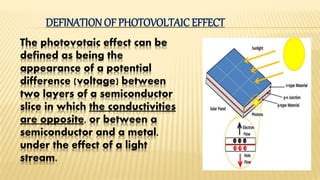
The photovotaic effect can be
defined as being the
appearance of a potential
difference (voltage) between
two layers of a semiconductor
slice in which the conductivities
are opposite, or between a
semiconductor and a metal,
under the effect of a light
stream.
DEFINATION OF PHOTOVOLTAIC EFFECT
INVENTED BY-
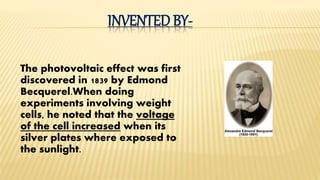
The photovoltaic effect was first
discovered in 1839 by Edmond
Becquerel.When doing
experiments involving weight
cells, he noted that the voltage
of the cell increased when its
silver plates where exposed to
the sunlight.
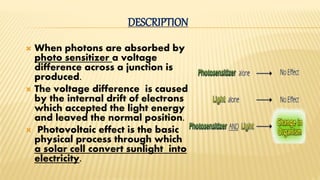
 When photons are absorbed by
photo sensitizer a voltage
difference across a junction is
produced.
 The voltage difference is caused
by the internal drift of electrons
which accepted the light energy
and leaved the normal position.
 Photovoltaic effect is the basic
physical process through which
a solar cell convert sunlight into
electricity.
DESCRIPTION
HOWDO PHOTOVOLTAICS WORK?
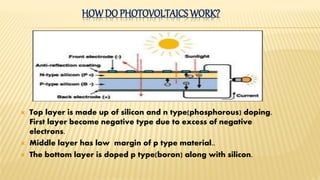
 Top layer is made up of silicon and n type(phosphorous) doping.
First layer become negative type due to excess of negative
electrons.
 Middle layer has low margin of p type material..
 The bottom layer is doped p type(boron) along with silicon.
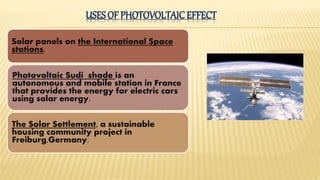
Solar panels on the International Space
stations.
Photovoltaic Sudi shade is an
autonomous and mobile station in France
that provides the energy for electric cars
using solar energy.
The Solar Settlement, a sustainable
housing community project in
Freiburg,Germany.
USES OF PHOTOVOLTAIC EFFECT
HOWCAN WE GET ELECTRICITYFROMTHE SUN?
When certain semiconducting materials, such as certain kinds of silicon, are exposed to sunlight, they
release small amounts of electricity. This process is known as the photoelectric effect. The photoelectric
effect refers to the emission, of electrons from the surface of a metal in response to light. It
is the basic physical process in which a solar electric or photovoltaic (PV) cell converts sunlight to
electricity.
Sunlight is made up of photons, or particles of solar energy. Photons contain various amounts of energy,
corresponding to the different wavelengths of the solar spectrum. When photons strike a PV cell, they
may be reflected or absorbed, or they may pass right through. Only the absorbed photons generate
electricity. When this happens, the energy of the photon is transferred to an electron in an atom of the
PV cell (which is actually a semiconductor).
WHAT'S THE DIFFERENCE BETWEEN PV ANDOTHER SOLAR ENERGY
TECHNOLOGIES?
 Photovoltaic (PV) systems, which convert sunlight directly to
electricity by means of PV cells made of semiconductor materials.
 Concentrating solar power (CSP) systems, which concentrate the
sun's energy using reflective devices such as troughs or mirror
panels to produce heat that is then used to generate electricity.
 Solar water heating systems, which contain a solar collector that
faces the sun and either heats water directly or heats a "working
fluid" that, in turn, is used to heat water.
 Transpired solar collectors, or "solar walls," which use solar energy
to preheat ventilation air for a building.
WHY SHOULDWE PURCHASE A PV SYSTEM?
 People decide to buy solar products to preserve the Earth's
finite fossil-fuel resources and to reduce air pollution. Others
would rather spend their money on an energy-producing
improvement to their property than send their money to a
utility. Some people like the security of reducing the amount
of electricity they buy from their utility.
 If it's designed correctly, a solar system might be able to
provide power during a utility power outage, thereby
adding power reliability to your home.
ADVANTAGES
I. ELECTRICITY PRODUCED BY SOLAR CELLS IS CLEAN AND
SILENT.
II. PV SYSTEMS ARE QUIET AND VISUALLY UNOBTRUSIVE.
III. SMALL- SCALE SOLAR PLANT S CAN TAKE ADVANTAGE OF
UNUSED SPACE ON ROOF TOPS OF EXISTING BUILDINGS.
IV. SOLAR ENERGY IS A LOCALLY AVAILABLE RENEWABLE
RESOURCE. IT DOESN`T NEED TO BE IMPORTED FROM OTHER
REGIONS OF THE COUNTRY OR ACROSS THE WORLD.
DISADVANTAGES
 Some toxic chemicals, like Cadmium(Cd) and Arsenic(As), are used
in the pv production process .
 Solar energy is somewhat more expensive to produce than
conventional sources of energy due in part to the cost of
manufacturing pv devices and in part to conversion efficiencies of
the equipment.
 Solar power is a variable energy source, with energy production
dependent on the sun.
ENQUERIES ???
 WHAT IS PHOTOVOLTAICS ?
 WHAT ARE THE COMPONENTS OF PV SYSTEM ?
 CAN WE USE PHOTOVOLTAICS TO POWER OUR HOME ?
THANK YOU

ppt on photo voltaic effect

  • 1.
    SOLIDSTATE DEVICES Presented By- TOPIC: PHOTOVOLTAIC EFFECT ELECTRONICS AND TELECOMMUNICATION ENGINEERING SECOND YEAR 1. Arpita Banerjee 2. Rohan Hore 3. Soumya Ghosh Chowdhury 3. Ranik Ahamed
  • 2.
    INDEX  DEFINATION OFPHOTOVOLTAIC EFFECT  INVENTED BY  DESCRIPTION  HOW DO PHOTOVOLTAICS WORK?  USES OF PHOTOVOLTAIC EFFECT  HOW CAN WE GET ELECTRICITY FROM THE SUN?  WHAT'S THE DIFFERENCE BETWEEN PV AND OTHER SOLAR ENERGY TECHNOLOGIES?  WHY SHOULD WE PURCHASE A PV SYSTEM?  ADVANTAGES  DISADVANTAGES  ENQUERIES ???  THANK YOU
  • 3.
    The photovotaic effectcan be defined as being the appearance of a potential difference (voltage) between two layers of a semiconductor slice in which the conductivities are opposite, or between a semiconductor and a metal, under the effect of a light stream. DEFINATION OF PHOTOVOLTAIC EFFECT
  • 4.
    INVENTED BY- The photovoltaiceffect was first discovered in 1839 by Edmond Becquerel.When doing experiments involving weight cells, he noted that the voltage of the cell increased when its silver plates where exposed to the sunlight.
  • 5.
     When photonsare absorbed by photo sensitizer a voltage difference across a junction is produced.  The voltage difference is caused by the internal drift of electrons which accepted the light energy and leaved the normal position.  Photovoltaic effect is the basic physical process through which a solar cell convert sunlight into electricity. DESCRIPTION
  • 6.
    HOWDO PHOTOVOLTAICS WORK? Top layer is made up of silicon and n type(phosphorous) doping. First layer become negative type due to excess of negative electrons.  Middle layer has low margin of p type material..  The bottom layer is doped p type(boron) along with silicon.
  • 7.
    Solar panels onthe International Space stations. Photovoltaic Sudi shade is an autonomous and mobile station in France that provides the energy for electric cars using solar energy. The Solar Settlement, a sustainable housing community project in Freiburg,Germany. USES OF PHOTOVOLTAIC EFFECT
  • 8.
    HOWCAN WE GETELECTRICITYFROMTHE SUN? When certain semiconducting materials, such as certain kinds of silicon, are exposed to sunlight, they release small amounts of electricity. This process is known as the photoelectric effect. The photoelectric effect refers to the emission, of electrons from the surface of a metal in response to light. It is the basic physical process in which a solar electric or photovoltaic (PV) cell converts sunlight to electricity. Sunlight is made up of photons, or particles of solar energy. Photons contain various amounts of energy, corresponding to the different wavelengths of the solar spectrum. When photons strike a PV cell, they may be reflected or absorbed, or they may pass right through. Only the absorbed photons generate electricity. When this happens, the energy of the photon is transferred to an electron in an atom of the PV cell (which is actually a semiconductor).
  • 9.
    WHAT'S THE DIFFERENCEBETWEEN PV ANDOTHER SOLAR ENERGY TECHNOLOGIES?  Photovoltaic (PV) systems, which convert sunlight directly to electricity by means of PV cells made of semiconductor materials.  Concentrating solar power (CSP) systems, which concentrate the sun's energy using reflective devices such as troughs or mirror panels to produce heat that is then used to generate electricity.  Solar water heating systems, which contain a solar collector that faces the sun and either heats water directly or heats a "working fluid" that, in turn, is used to heat water.  Transpired solar collectors, or "solar walls," which use solar energy to preheat ventilation air for a building.
  • 10.
    WHY SHOULDWE PURCHASEA PV SYSTEM?  People decide to buy solar products to preserve the Earth's finite fossil-fuel resources and to reduce air pollution. Others would rather spend their money on an energy-producing improvement to their property than send their money to a utility. Some people like the security of reducing the amount of electricity they buy from their utility.  If it's designed correctly, a solar system might be able to provide power during a utility power outage, thereby adding power reliability to your home.
  • 11.
    ADVANTAGES I. ELECTRICITY PRODUCEDBY SOLAR CELLS IS CLEAN AND SILENT. II. PV SYSTEMS ARE QUIET AND VISUALLY UNOBTRUSIVE. III. SMALL- SCALE SOLAR PLANT S CAN TAKE ADVANTAGE OF UNUSED SPACE ON ROOF TOPS OF EXISTING BUILDINGS. IV. SOLAR ENERGY IS A LOCALLY AVAILABLE RENEWABLE RESOURCE. IT DOESN`T NEED TO BE IMPORTED FROM OTHER REGIONS OF THE COUNTRY OR ACROSS THE WORLD.
  • 12.
    DISADVANTAGES  Some toxicchemicals, like Cadmium(Cd) and Arsenic(As), are used in the pv production process .  Solar energy is somewhat more expensive to produce than conventional sources of energy due in part to the cost of manufacturing pv devices and in part to conversion efficiencies of the equipment.  Solar power is a variable energy source, with energy production dependent on the sun.
  • 13.
    ENQUERIES ???  WHATIS PHOTOVOLTAICS ?  WHAT ARE THE COMPONENTS OF PV SYSTEM ?  CAN WE USE PHOTOVOLTAICS TO POWER OUR HOME ?
  • 14.