Hydrologic Engineering Center 1
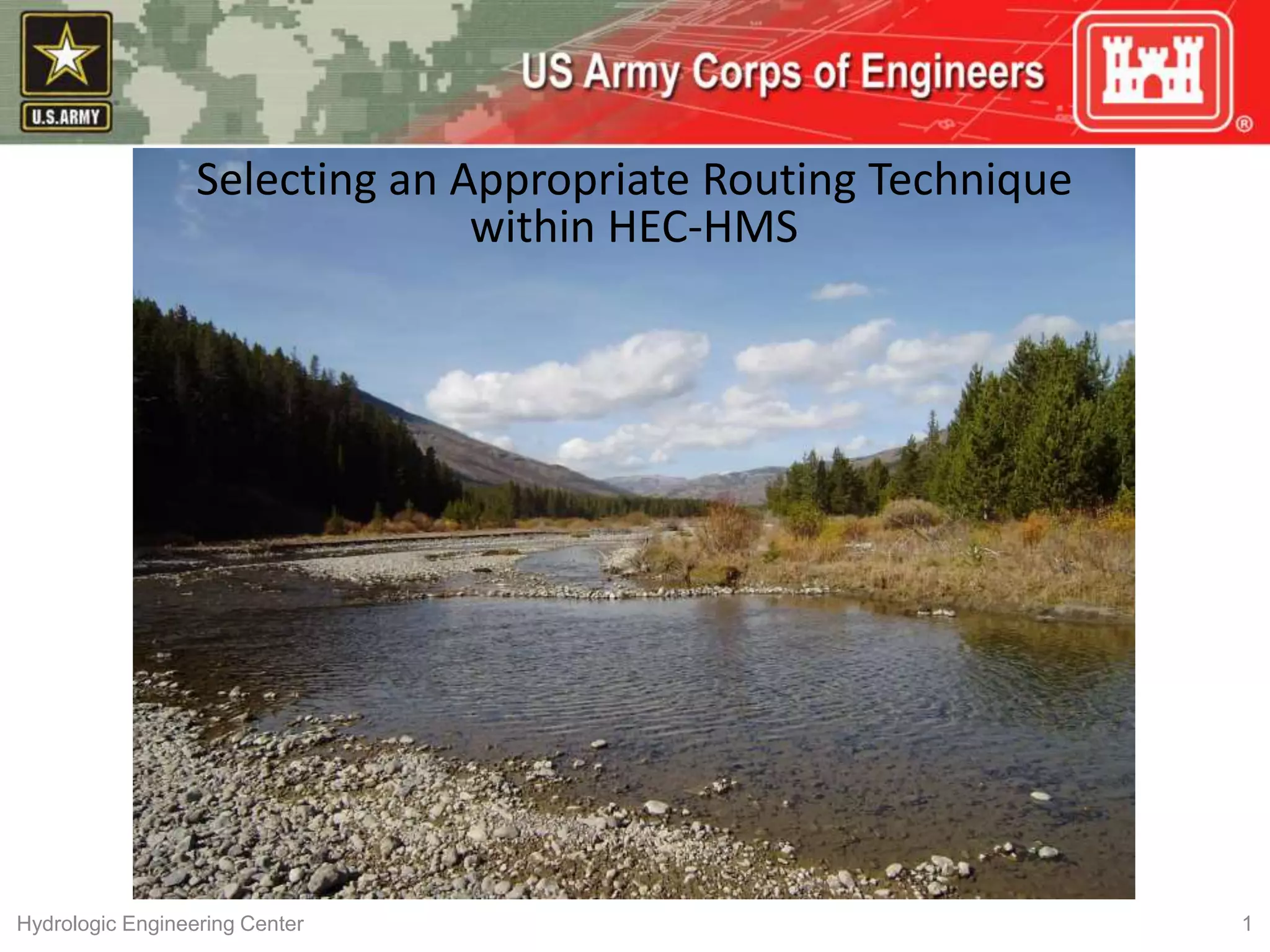
Selecting an Appropriate Routing Technique
within HEC-HMS
Objectives
• Assist modelers in the identification of an
appropriate hydrologic or hydraulic routing
method for a given problem
• Discuss important study objectives and
physical considerations
• Provide rules of thumb
Hydrologic Engineering Center 2
Keep In Mind…
• All routing models are simplifications of the
real world
• An appropriate method captures the
significant aspects of the system in question
• An appropriate method provides the
necessary information to meet study
objectives
Hydrologic Engineering Center 3
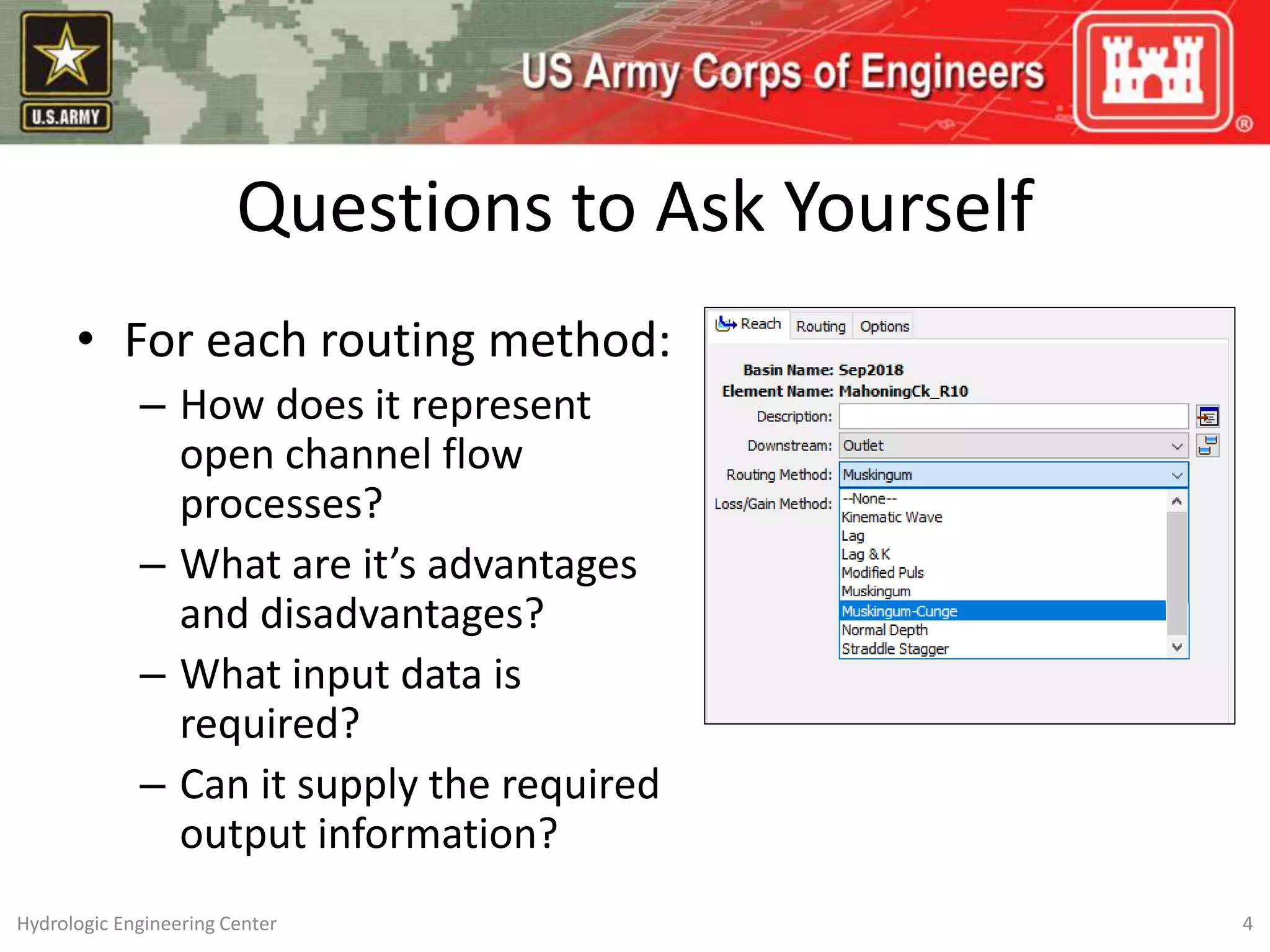
Questions to Ask Yourself
• For each routing method:
– How does it represent
open channel flow
processes?
– What are it’s advantages
and disadvantages?
– What input data is
required?
– Can it supply the required
output information?
4
Hydrologic Engineering Center
Additional Factors to Consider
• What type of study / what will be considered?
– Reservoir design
– Channel modifications
– System effects (changes to the watershed)
• Level of detail
– Feasibility, planning, or design
• Characteristics of the physical system in question
• Familiarity and experience of the modeler
• Time and Costs
5
Hydrologic Engineering Center
Backwater Effects
• Caused by tides, confluences, hydraulic structures,
bridges, culverts, channel constrictions, and other
obstructions
• Hydrologic methods generally do not simulate
backwater effects
– Modified Puls can
• Hydraulic methods generally do account for
backwater
– Kinematic Wave cannot
6
Hydrologic Engineering Center
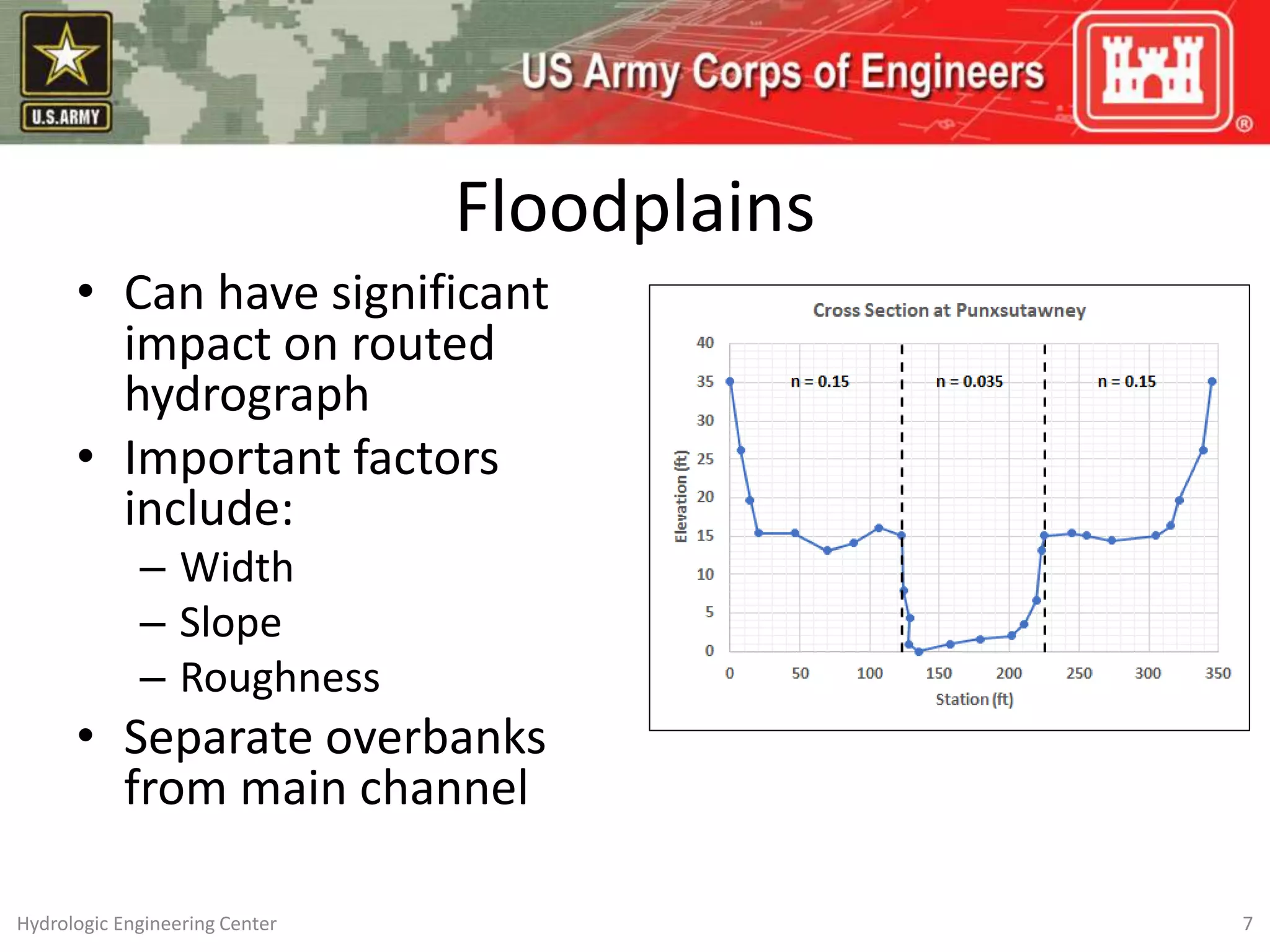
Floodplains
• Can have significant
impact on routed
hydrograph
• Important factors
include:
– Width
– Slope
– Roughness
• Separate overbanks
from main channel
7
Hydrologic Engineering Center
Floodplains
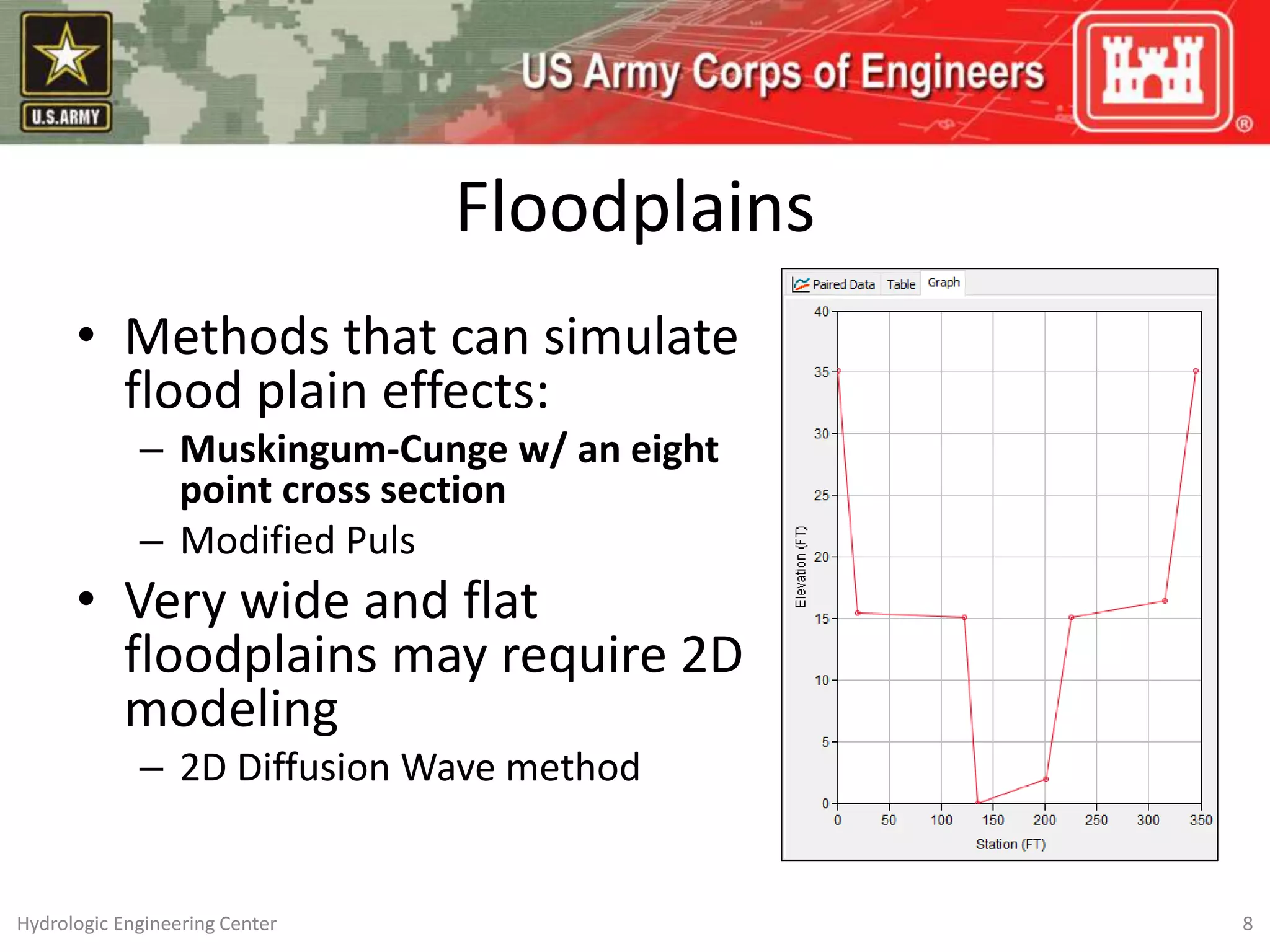
• Methods that can simulate
flood plain effects:
– Muskingum-Cunge w/ an eight
point cross section
– Modified Puls
• Very wide and flat
floodplains may require 2D
modeling
– 2D Diffusion Wave method
8
Hydrologic Engineering Center
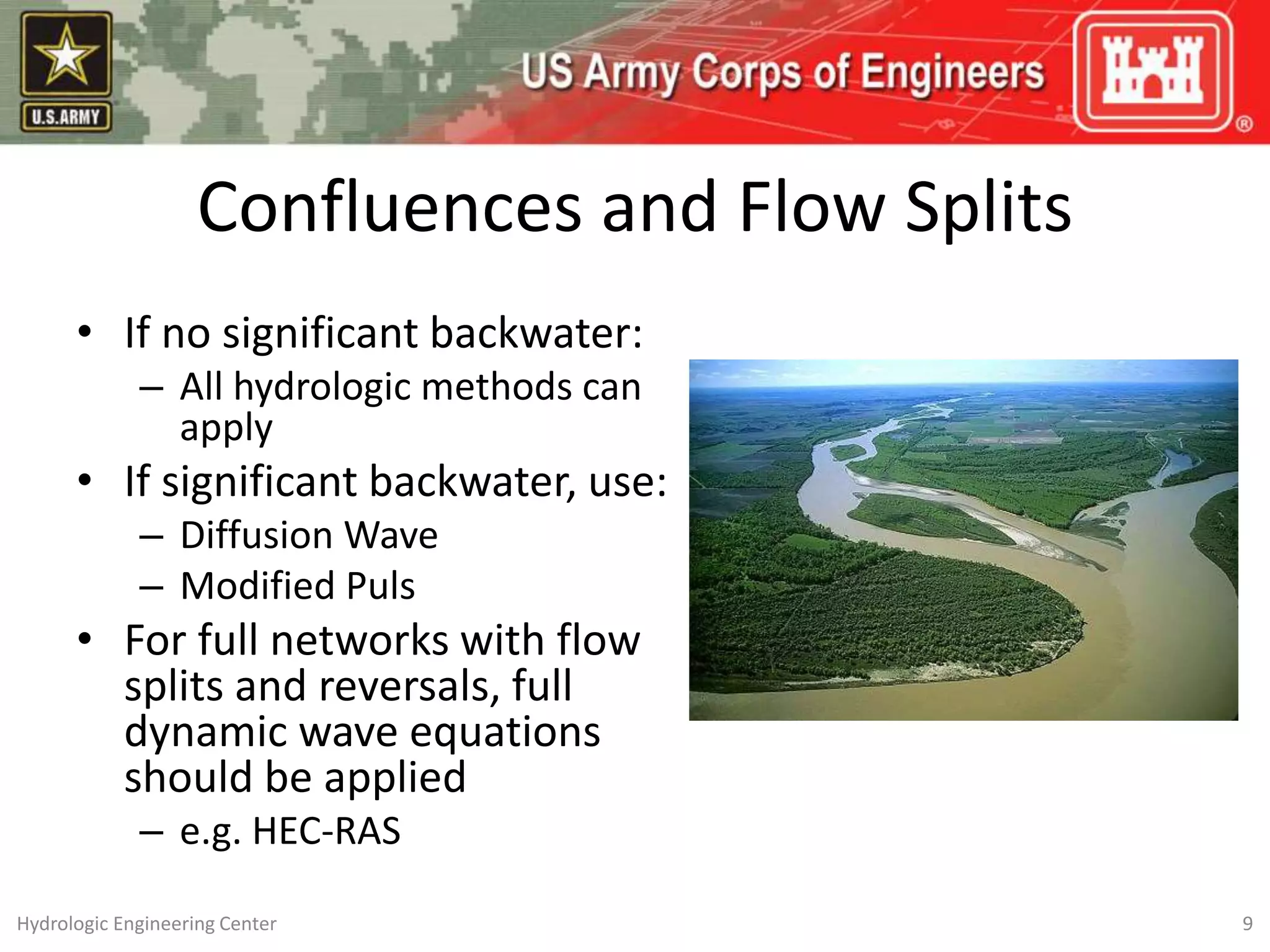
• If no significant backwater:
– All hydrologic methods can
apply
• If significant backwater, use:
– Diffusion Wave
– Modified Puls
• For full networks with flow
splits and reversals, full
dynamic wave equations
should be applied
– e.g. HEC-RAS
9
Hydrologic Engineering Center
Confluences and Flow Splits
Supercritical Flow
• Hydrologic methods do not know about flow
regime
• If supercritical for a long reach, or stage is
important, supercritical reach should be
isolated
• Intermittent supercritical can be ignored for
hydrologic routing purposes
10
Hydrologic Engineering Center
Observed Data
• If observed data is not
available:
– Physically based methods
should be used
• Easier to estimate input
data
• More reliable results
• When observed data is
available:
– Must calibrate and
validate
– Use statistical metrics
11
Hydrologic Engineering Center
Channel Slope
• As slope gets flatter,
hydrologic methods
begin to fail
– Simplifications
become more and
more important
– e.g. acceleration
terms w/in
Momentum equation
12
Hydrologic Engineering Center
Slope and Rate-of-Rise Rules of Thumb
• When bed slope > 10 ft/mi:
– Most hydrologic routing methods are okay to use
• When bed slope < 2 ft/mi:
– Most hydrologic routing methods will produce erroneous
results
• When bed slope is between 2 and 10 ft/mi:
– Depends upon the channel properties, chosen method,
and rate-of-rise of the hydrograph
13
Hydrologic Engineering Center
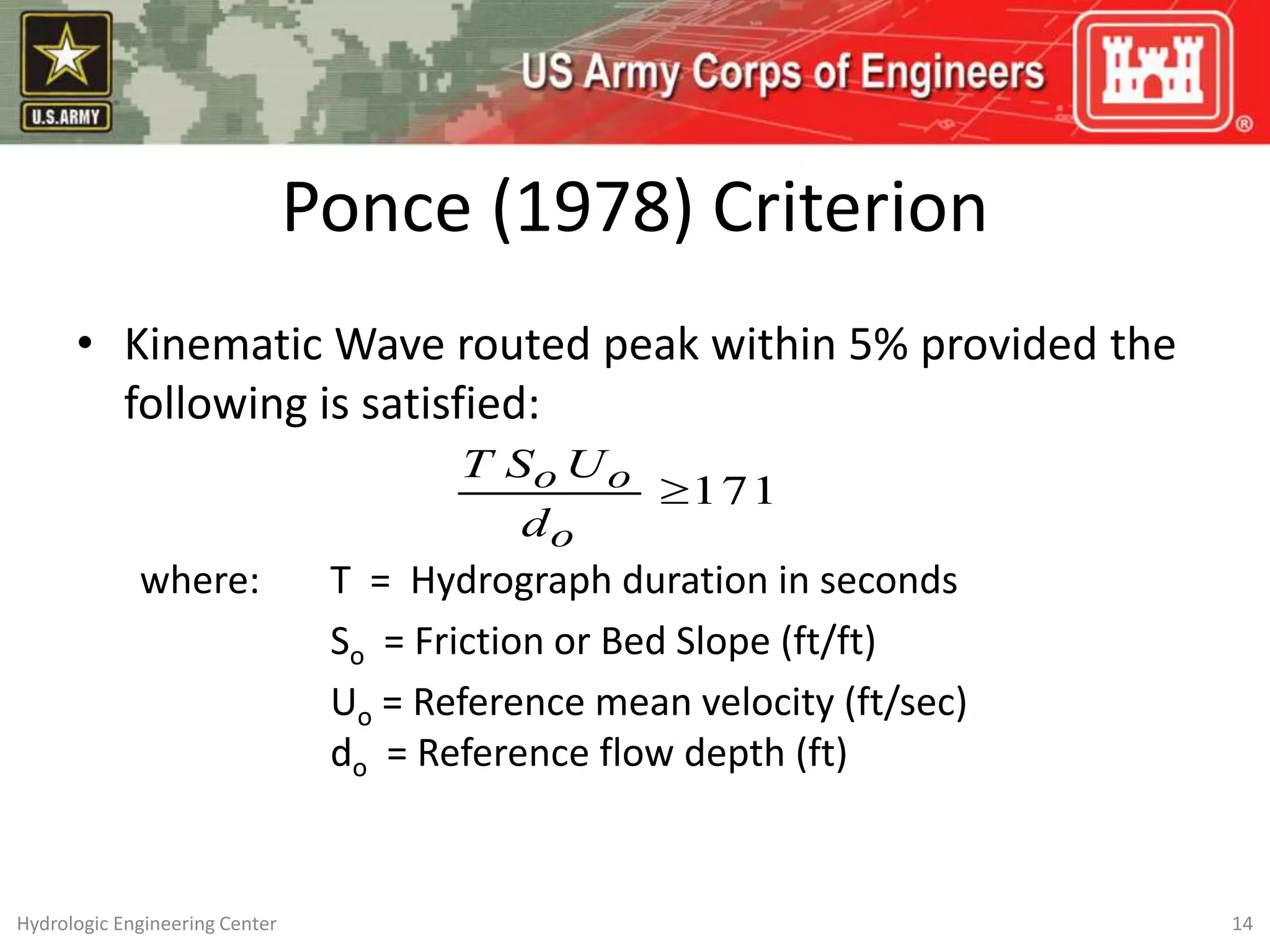
Ponce (1978) Criterion
• Kinematic Wave routed peak within 5% provided the
following is satisfied:
where: T = Hydrograph duration in seconds
So = Friction or Bed Slope (ft/ft)
Uo = Reference mean velocity (ft/sec)
do = Reference flow depth (ft)
171

o
o
o
d
U
S
T
14
Hydrologic Engineering Center
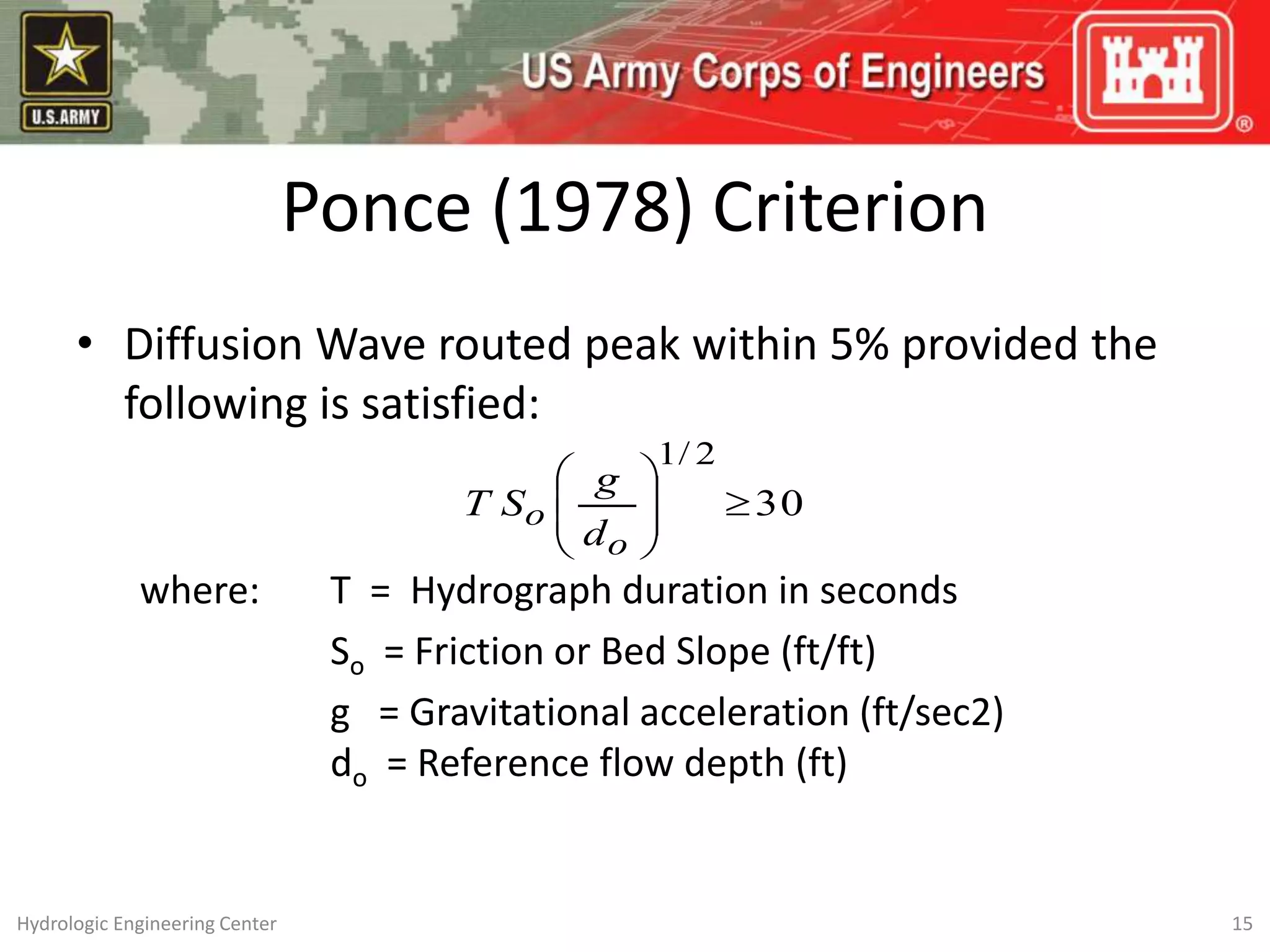
Ponce (1978) Criterion
• Diffusion Wave routed peak within 5% provided the
following is satisfied:
where: T = Hydrograph duration in seconds
So = Friction or Bed Slope (ft/ft)
g = Gravitational acceleration (ft/sec2)
do = Reference flow depth (ft)
30
2
/
1









o
o
d
g
S
T
15
Hydrologic Engineering Center
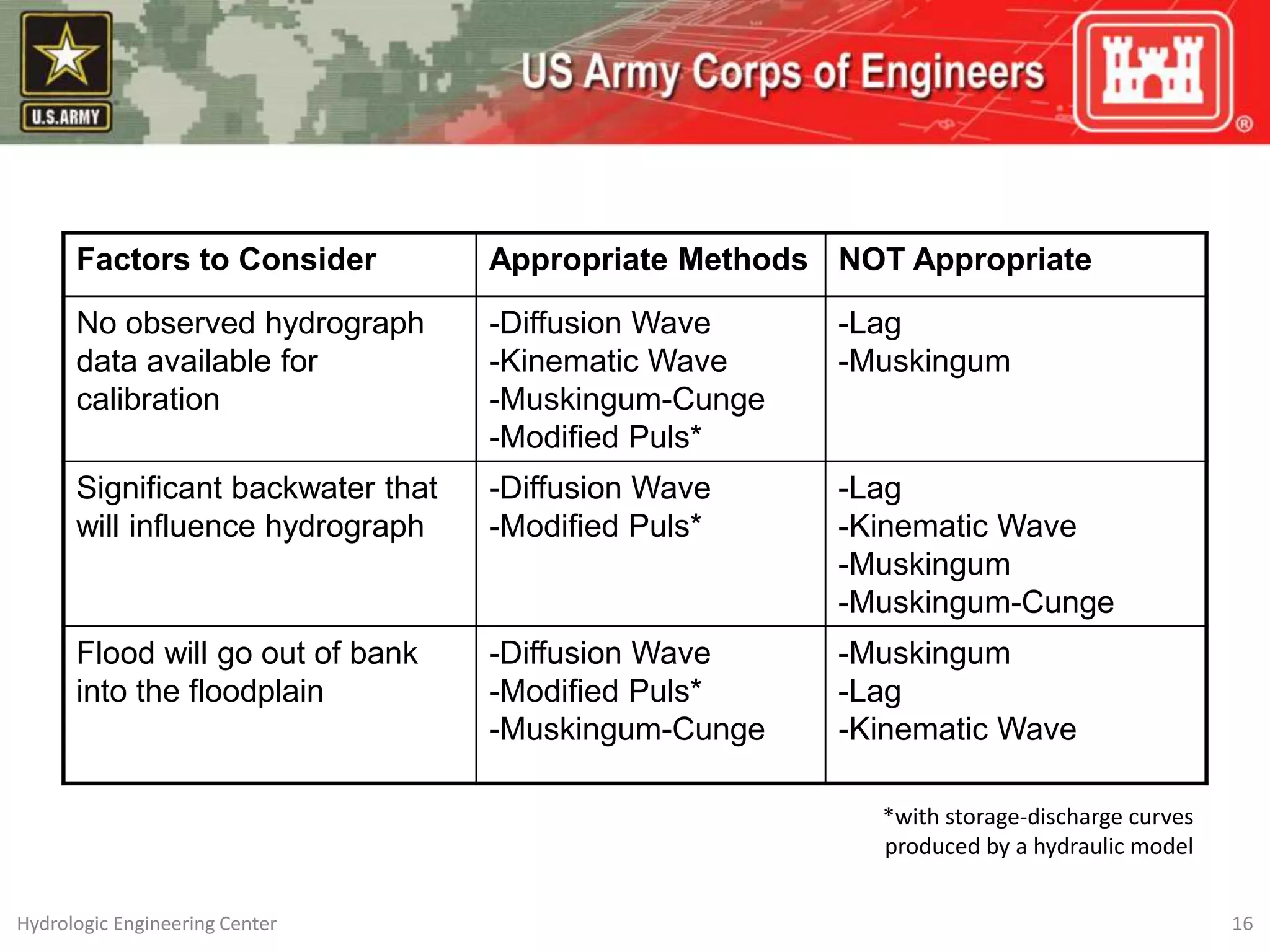
Factors to Consider Appropriate Methods NOT Appropriate
No observed hydrograph
data available for
calibration
-Diffusion Wave
-Kinematic Wave
-Muskingum-Cunge
-Modified Puls*
-Lag
-Muskingum
Significant backwater that
will influence hydrograph
-Diffusion Wave
-Modified Puls*
-Lag
-Kinematic Wave
-Muskingum
-Muskingum-Cunge
Flood will go out of bank
into the floodplain
-Diffusion Wave
-Modified Puls*
-Muskingum-Cunge
-Muskingum
-Lag
-Kinematic Wave
16
Hydrologic Engineering Center
*with storage-discharge curves
produced by a hydraulic model
Factors to Consider
Appropriate
Methods
NOT Appropriate
Slope > 10 ft/mi and: -Most, if not all,
methods
-None
2 < Slope < 10 ft/mi and: -Diffusion Wave
-Muskingum-Cunge
-Modified Puls*
-Muskingum
-Kinematic Wave
-Lag
Slope < 2 ft/mi and: -Diffusion Wave
-Muskingum-Cunge
-Modified Puls*
-Kinematic Wave
-Muskingum
-Lag
Slope < 2 ft/mi and: -Full Dynamic Wave -All other methods
171

o
o
o
d
u
S
T
171

o
o
o
d
u
S
T
30
2
/
1









o
o
d
g
S
T
30
2
/
1









o
o
d
g
S
T
17
Hydrologic Engineering Center
T = Hydrograph Duration [sec]
S0 = Friction Slope [ft/ft]
u0 = Average Velocity [ft/s]
d0 = Flow Depth [ft]
*with storage-discharge curves
produced by a hydraulic model
Conclusion
• The most appropriate method depends upon
many considerations
• Important physical considerations include
backwater effects, floodplains, and channel
slope
• Slope rule of thumb and Ponce criterion can be
used to narrow the list of appropriate methods
18
Hydrologic Engineering Center

L 10 e selecting the appropriate routing technique

  • 1.
    Hydrologic Engineering Center1 Selecting an Appropriate Routing Technique within HEC-HMS
  • 2.
    Objectives • Assist modelersin the identification of an appropriate hydrologic or hydraulic routing method for a given problem • Discuss important study objectives and physical considerations • Provide rules of thumb Hydrologic Engineering Center 2
  • 3.
    Keep In Mind… •All routing models are simplifications of the real world • An appropriate method captures the significant aspects of the system in question • An appropriate method provides the necessary information to meet study objectives Hydrologic Engineering Center 3
  • 4.
    Questions to AskYourself • For each routing method: – How does it represent open channel flow processes? – What are it’s advantages and disadvantages? – What input data is required? – Can it supply the required output information? 4 Hydrologic Engineering Center
  • 5.
    Additional Factors toConsider • What type of study / what will be considered? – Reservoir design – Channel modifications – System effects (changes to the watershed) • Level of detail – Feasibility, planning, or design • Characteristics of the physical system in question • Familiarity and experience of the modeler • Time and Costs 5 Hydrologic Engineering Center
  • 6.
    Backwater Effects • Causedby tides, confluences, hydraulic structures, bridges, culverts, channel constrictions, and other obstructions • Hydrologic methods generally do not simulate backwater effects – Modified Puls can • Hydraulic methods generally do account for backwater – Kinematic Wave cannot 6 Hydrologic Engineering Center
  • 7.
    Floodplains • Can havesignificant impact on routed hydrograph • Important factors include: – Width – Slope – Roughness • Separate overbanks from main channel 7 Hydrologic Engineering Center
  • 8.
    Floodplains • Methods thatcan simulate flood plain effects: – Muskingum-Cunge w/ an eight point cross section – Modified Puls • Very wide and flat floodplains may require 2D modeling – 2D Diffusion Wave method 8 Hydrologic Engineering Center
  • 9.
    • If nosignificant backwater: – All hydrologic methods can apply • If significant backwater, use: – Diffusion Wave – Modified Puls • For full networks with flow splits and reversals, full dynamic wave equations should be applied – e.g. HEC-RAS 9 Hydrologic Engineering Center Confluences and Flow Splits
  • 10.
    Supercritical Flow • Hydrologicmethods do not know about flow regime • If supercritical for a long reach, or stage is important, supercritical reach should be isolated • Intermittent supercritical can be ignored for hydrologic routing purposes 10 Hydrologic Engineering Center
  • 11.
    Observed Data • Ifobserved data is not available: – Physically based methods should be used • Easier to estimate input data • More reliable results • When observed data is available: – Must calibrate and validate – Use statistical metrics 11 Hydrologic Engineering Center
  • 12.
    Channel Slope • Asslope gets flatter, hydrologic methods begin to fail – Simplifications become more and more important – e.g. acceleration terms w/in Momentum equation 12 Hydrologic Engineering Center
  • 13.
    Slope and Rate-of-RiseRules of Thumb • When bed slope > 10 ft/mi: – Most hydrologic routing methods are okay to use • When bed slope < 2 ft/mi: – Most hydrologic routing methods will produce erroneous results • When bed slope is between 2 and 10 ft/mi: – Depends upon the channel properties, chosen method, and rate-of-rise of the hydrograph 13 Hydrologic Engineering Center
  • 14.
    Ponce (1978) Criterion •Kinematic Wave routed peak within 5% provided the following is satisfied: where: T = Hydrograph duration in seconds So = Friction or Bed Slope (ft/ft) Uo = Reference mean velocity (ft/sec) do = Reference flow depth (ft) 171  o o o d U S T 14 Hydrologic Engineering Center
  • 15.
    Ponce (1978) Criterion •Diffusion Wave routed peak within 5% provided the following is satisfied: where: T = Hydrograph duration in seconds So = Friction or Bed Slope (ft/ft) g = Gravitational acceleration (ft/sec2) do = Reference flow depth (ft) 30 2 / 1          o o d g S T 15 Hydrologic Engineering Center
  • 16.
    Factors to ConsiderAppropriate Methods NOT Appropriate No observed hydrograph data available for calibration -Diffusion Wave -Kinematic Wave -Muskingum-Cunge -Modified Puls* -Lag -Muskingum Significant backwater that will influence hydrograph -Diffusion Wave -Modified Puls* -Lag -Kinematic Wave -Muskingum -Muskingum-Cunge Flood will go out of bank into the floodplain -Diffusion Wave -Modified Puls* -Muskingum-Cunge -Muskingum -Lag -Kinematic Wave 16 Hydrologic Engineering Center *with storage-discharge curves produced by a hydraulic model
  • 17.
    Factors to Consider Appropriate Methods NOTAppropriate Slope > 10 ft/mi and: -Most, if not all, methods -None 2 < Slope < 10 ft/mi and: -Diffusion Wave -Muskingum-Cunge -Modified Puls* -Muskingum -Kinematic Wave -Lag Slope < 2 ft/mi and: -Diffusion Wave -Muskingum-Cunge -Modified Puls* -Kinematic Wave -Muskingum -Lag Slope < 2 ft/mi and: -Full Dynamic Wave -All other methods 171  o o o d u S T 171  o o o d u S T 30 2 / 1          o o d g S T 30 2 / 1          o o d g S T 17 Hydrologic Engineering Center T = Hydrograph Duration [sec] S0 = Friction Slope [ft/ft] u0 = Average Velocity [ft/s] d0 = Flow Depth [ft] *with storage-discharge curves produced by a hydraulic model
  • 18.
    Conclusion • The mostappropriate method depends upon many considerations • Important physical considerations include backwater effects, floodplains, and channel slope • Slope rule of thumb and Ponce criterion can be used to narrow the list of appropriate methods 18 Hydrologic Engineering Center