HYDRAULIC METHOD
OF FLOOD ROUTING
JEREMY SARVIDA
LUVILLEEN TALINGTING
FLOOD ROUTING
is the technique of determining the flood
hydrograph at a section of a river by utilizing
the data of flood flow at one or more
upstream sections. The hydrologic analysis
of problems such as flood forecasting, flood
protection, reservoir design, and spillway
design invariably include flood routing.
A variety of routing methods are available
and they can be broadly classified into two
categories as :
❖ HYDROLOGIC ROUTING
❖ HYDRAULIC ROUTING
HYDROLOGIC ROUTING
➢ Is a method used to predict the changes in a shape of a hydrograph
as water moves through a river channel or reservoir. In flood
forecasting, hydrologists may want to know how a short burst of
intense rain in an area upstream of a city will change as it reaches
the city.
➢ Uses the continuity equation to relate inflows, outflows, and storage
to solve for outflows.
➢ Simpler , more empirical, parameters estimated at application scale
from experienced and data.
HYDRAULIC ROUTING
➢ Is based on the solution of partial differential equations of unsteady
open channel flow. The equations used are the St. Venant equations
or the associated dynamic wave equations.
➢ The hydraulic models require the gathering of a lot of data related to
river and morphology and consume a lot of computer resources in
order to solve the equations numerically.
➢ Uses continuity and momentum to solve open channel flow
equations.
➢ More complex, while elegant mathematically, often requires
information on flow geometry that is difficult to obtain or not
available.
DIFFERENCES OF THE TWO CATEGORIES:
HYDRAULIC ROUTING
➢ USES BOTH DYNAMIC AND
CONTINUITY EQUATIONS (ST. VENANT
EQUATIONS)
➢ ALLOWS BACKWATER EFFECTS TO BE
MODELLED
➢ SOLUTION ADVANCED BY TIMESTEP
(Δt)
➢ FLOW IS CALCULATED AS A
FUNCTION OF SPACE AND TIME
THROUGHOUT THE SYSTEM
HYDROLOGIC ROUTING
➢ USES ONLY CONTINUITY EQUATION
➢ CANNOT MODEL BACKWATER
EFFECTS
➢ SOLUTION ADVANCED
DOWNSTREAM BY (Δx)
➢ FLOW IS CALCULATED AS A
FUNCTION OF TIME ALONE AT A
PARTICULAR LOCATION
HYDRAULIC ROUTING
❖ HYDRAULIC ROUTING METHOD COMBINES THE CONTINUITY EQUATION
WITH A MORE REALISTIC RELATIONSHIP DESCRIBING THE ACTUAL
PHYSICS OF THE MOVEMENT OF THE WATER
❖ THE EQUATION USED RESULTS FROM CONSERVATION OF MOMENTUM,
ASSUMING
- UNIFORM VELOCITY DISTRIBUTION
- HYDROSTATIC PRESSURE
- SMALL BOTTOM SLOPE
❖ IN HYDRAULIC ROUTING ANALYSIS, IT IS INTENDED THAT THE DYNAMICS
OF THE WATER OR FLOOD WAVE MOVEMENT BE MORE ACCURATELY
DESCRIBED
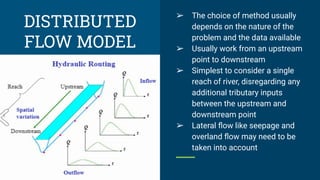
DISTRIBUTED
FLOW MODEL
➢ The choice of method usually
depends on the nature of the
problem and the data available
➢ Usually work from an upstream
point to downstream
➢ Simplest to consider a single
reach of river, disregarding any
additional tributary inputs
between the upstream and
downstream point
➢ Lateral flow like seepage and
overland flow may need to be
taken into account
UNSTEADY FLOOD FLOW
In an unsteady flow, velocities and depths change with time at any fixed spatial
position in an open channel. Open channel flow in natural channel almost always
is unsteady and by nature is non uniform because of the free surface.
Mathematically this means that the two dependent flow variables (velocity and
depth or discharge and depth) are functions of both distance along the channel
and time for one-dimensional applications.
Problem formulation requires two partial differential equations representing the
continuity and momentum principles in the two unknown dependent variables.
The full differential forms of the two governing equations are called the
Saint-Venant Equations.
❖ The St. Venant Equations were formulated in the the 19th century by two
mathematicians, de Saint Venant and Bousinnesque.
❖ The solution of the St. Venant Equations is known as dynamic routing,
which is generally the standard to which other methods are measured to
compared.
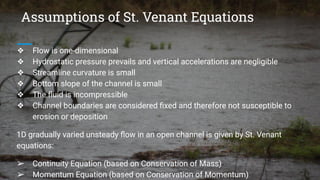
Assumptions of St. Venant Equations
❖ Flow is one-dimensional
❖ Hydrostatic pressure prevails and vertical accelerations are negligible
❖ Streamline curvature is small
❖ Bottom slope of the channel is small
❖ The fluid is incompressible
❖ Channel boundaries are considered fixed and therefore not susceptible to
erosion or deposition
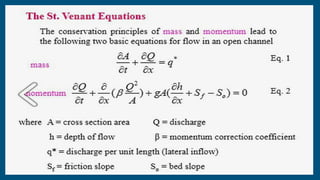
1D gradually varied unsteady flow in an open channel is given by St. Venant
equations:
➢ Continuity Equation (based on Conservation of Mass)
➢ Momentum Equation (based on Conservation of Momentum)
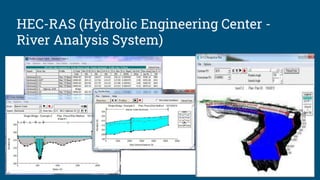
HEC-RAS (Hydrolic Engineering Center -
River Analysis System)
Hydraulic Routing Disadvantages:
There are some important disadvantages of hydraulic routing that need to be
kept in mind. Three key disadvantages are:
➢ Specialized computer software is needed to solve the equations
➢ There is a need for extensive data to describe the channel topography and
cross sections
➢ This is a numeric method, so there are situations where the underlying
equations may produce unrealistic or undefined answers
SOURCES:
● Handbook of Applied Hydrology, Second Edition
● https://issuu.com/floodmitigation744/docs/hydraulic_methods_of_flood_ro
uting
● https://www.youtube.com/watch?v=y2PNq7QTwhc&pbjreload=101
● http://stream1.cmatc.cn/pub/comet/HydrologyFlooding/streamflow/comet
/hydro/basic/Routing/print_version/08-hydraulic.htm
● http://water.usgs.gov/software/code/surface_water/feq/doc/feq.pdf
● https://nptel.ac.in/content/storage2/courses/105101010/downloads/Lectu
re33.pdf
THANK YOU
FOR
LISTENING!

MODULE 19 - HYDRAULIC METHOD OF FLOOD ROUTING.pdf

  • 1.
    HYDRAULIC METHOD OF FLOODROUTING JEREMY SARVIDA LUVILLEEN TALINGTING
  • 2.
    FLOOD ROUTING is thetechnique of determining the flood hydrograph at a section of a river by utilizing the data of flood flow at one or more upstream sections. The hydrologic analysis of problems such as flood forecasting, flood protection, reservoir design, and spillway design invariably include flood routing.
  • 3.
    A variety ofrouting methods are available and they can be broadly classified into two categories as : ❖ HYDROLOGIC ROUTING ❖ HYDRAULIC ROUTING
  • 4.
    HYDROLOGIC ROUTING ➢ Isa method used to predict the changes in a shape of a hydrograph as water moves through a river channel or reservoir. In flood forecasting, hydrologists may want to know how a short burst of intense rain in an area upstream of a city will change as it reaches the city. ➢ Uses the continuity equation to relate inflows, outflows, and storage to solve for outflows. ➢ Simpler , more empirical, parameters estimated at application scale from experienced and data.
  • 5.
    HYDRAULIC ROUTING ➢ Isbased on the solution of partial differential equations of unsteady open channel flow. The equations used are the St. Venant equations or the associated dynamic wave equations. ➢ The hydraulic models require the gathering of a lot of data related to river and morphology and consume a lot of computer resources in order to solve the equations numerically. ➢ Uses continuity and momentum to solve open channel flow equations. ➢ More complex, while elegant mathematically, often requires information on flow geometry that is difficult to obtain or not available.
  • 7.
    DIFFERENCES OF THETWO CATEGORIES: HYDRAULIC ROUTING ➢ USES BOTH DYNAMIC AND CONTINUITY EQUATIONS (ST. VENANT EQUATIONS) ➢ ALLOWS BACKWATER EFFECTS TO BE MODELLED ➢ SOLUTION ADVANCED BY TIMESTEP (Δt) ➢ FLOW IS CALCULATED AS A FUNCTION OF SPACE AND TIME THROUGHOUT THE SYSTEM HYDROLOGIC ROUTING ➢ USES ONLY CONTINUITY EQUATION ➢ CANNOT MODEL BACKWATER EFFECTS ➢ SOLUTION ADVANCED DOWNSTREAM BY (Δx) ➢ FLOW IS CALCULATED AS A FUNCTION OF TIME ALONE AT A PARTICULAR LOCATION
  • 8.
    HYDRAULIC ROUTING ❖ HYDRAULICROUTING METHOD COMBINES THE CONTINUITY EQUATION WITH A MORE REALISTIC RELATIONSHIP DESCRIBING THE ACTUAL PHYSICS OF THE MOVEMENT OF THE WATER ❖ THE EQUATION USED RESULTS FROM CONSERVATION OF MOMENTUM, ASSUMING - UNIFORM VELOCITY DISTRIBUTION - HYDROSTATIC PRESSURE - SMALL BOTTOM SLOPE ❖ IN HYDRAULIC ROUTING ANALYSIS, IT IS INTENDED THAT THE DYNAMICS OF THE WATER OR FLOOD WAVE MOVEMENT BE MORE ACCURATELY DESCRIBED
  • 9.
    DISTRIBUTED FLOW MODEL ➢ Thechoice of method usually depends on the nature of the problem and the data available ➢ Usually work from an upstream point to downstream ➢ Simplest to consider a single reach of river, disregarding any additional tributary inputs between the upstream and downstream point ➢ Lateral flow like seepage and overland flow may need to be taken into account
  • 10.
    UNSTEADY FLOOD FLOW Inan unsteady flow, velocities and depths change with time at any fixed spatial position in an open channel. Open channel flow in natural channel almost always is unsteady and by nature is non uniform because of the free surface.
  • 11.
    Mathematically this meansthat the two dependent flow variables (velocity and depth or discharge and depth) are functions of both distance along the channel and time for one-dimensional applications. Problem formulation requires two partial differential equations representing the continuity and momentum principles in the two unknown dependent variables. The full differential forms of the two governing equations are called the Saint-Venant Equations.
  • 12.
    ❖ The St.Venant Equations were formulated in the the 19th century by two mathematicians, de Saint Venant and Bousinnesque. ❖ The solution of the St. Venant Equations is known as dynamic routing, which is generally the standard to which other methods are measured to compared.
  • 13.
    Assumptions of St.Venant Equations ❖ Flow is one-dimensional ❖ Hydrostatic pressure prevails and vertical accelerations are negligible ❖ Streamline curvature is small ❖ Bottom slope of the channel is small ❖ The fluid is incompressible ❖ Channel boundaries are considered fixed and therefore not susceptible to erosion or deposition 1D gradually varied unsteady flow in an open channel is given by St. Venant equations: ➢ Continuity Equation (based on Conservation of Mass) ➢ Momentum Equation (based on Conservation of Momentum)
  • 15.
    HEC-RAS (Hydrolic EngineeringCenter - River Analysis System)
  • 16.
    Hydraulic Routing Disadvantages: Thereare some important disadvantages of hydraulic routing that need to be kept in mind. Three key disadvantages are: ➢ Specialized computer software is needed to solve the equations ➢ There is a need for extensive data to describe the channel topography and cross sections ➢ This is a numeric method, so there are situations where the underlying equations may produce unrealistic or undefined answers
  • 17.
    SOURCES: ● Handbook ofApplied Hydrology, Second Edition ● https://issuu.com/floodmitigation744/docs/hydraulic_methods_of_flood_ro uting ● https://www.youtube.com/watch?v=y2PNq7QTwhc&pbjreload=101 ● http://stream1.cmatc.cn/pub/comet/HydrologyFlooding/streamflow/comet /hydro/basic/Routing/print_version/08-hydraulic.htm ● http://water.usgs.gov/software/code/surface_water/feq/doc/feq.pdf ● https://nptel.ac.in/content/storage2/courses/105101010/downloads/Lectu re33.pdf
  • 18.