Dept. of Electronicsand Instrumentation Engineering
B.E.-VI semester
Pow er Electronics Lab
LIST OF EXPERIM ENTS
1. SWITCHING CHARACTERISTICS OF
a) Power M OSFET b) IGBT
2. M OSFET BASED SINGLEQUADRANT DC CHOPPER
3. SINGLEPHASE CYCLOCONVERTER W ITH RESISTIVELOAD
4. SINGLEPHASE SERIES INVERTER USING SCR
5. SINGLE PHASE FULLY CONTROLLED BRIDGE RECTIFIER W ITH R AND R-L LOAD
6. SINGLEPHASE AC VOLTAGE CONTROLLER WITH R AND R-L LOAD
7. VOLTAGE COM M UTATION CIRCUIT FOR SCR
8. SIM ULATION OF SINGLEQUADRANT DC CHOPPER AND SINGLEPHASE AC VOLTAGE
CONTROLLER USING ORCAD SOFTW ARE
Print to PDF without this message by purchasing novaPDF (http://www.novapdf.com/)
Ex.No.:
DATE:
SWITCHING CHARACTERISTICSOF a)POWER MOSFET
AND b) IGBT
a) METAL-OXIDE SEMICONDUCTOR FIELD EFFECT TRANSISTOR
(MOSFET)
AIM
To study the switching characteristics of a MOSFET and to determine the
timing parameters.
APPARATUS REQUIRED
1. MOSFET module
2. CRO
THEORY
Bipolar Junction Transistor (BJT) is a current controlled device. In this
device, the flow of collector current is controlled by base current and hence,
current gain is highly dependent on the junction temperature.
However, a power MOSFET is a voltage controlled device, which requires
only a small input current. The switching times of these devices are of the order of
nanoseconds. Power MOSFETs are finding increasing applications in low-power,
high frequency converters. MOSFETs do not have the problems of second
breakdown phenomena as do in BJTs. However, MOSFETs have the problem of
electrostatic discharge and requires special care in handling. In addition, it is
relatively difficult to protect them under short-circuited fault condition.
MOSFETs are generally classified into two types: Depletion MOSFETs
and Enhancement MOSFETs. The three terminals of MOSFET are named as
gate (G), drain (D) and source (S) as shown in Fig.1. In case of MOSFET, the
gate voltage controls the flow of current from drain to source. From the output
characteristics, drain current (ID) is a function of drain-to-source voltage VDS with
gate-to-source voltage at constant VGS as shown in Fig.2(a) for an n-channel
MOSFET. The output characteristics for p-channel device are the same except,
that the current and voltage polarities are reversed and hence the characteristics
for the p-channel device would appear in the third quadrant of the ID-VDS plane.
In power electronics applications, the MOSFET is used as a switch to
control the flow of power to the load. In these applications, the MOSFET
traverses the ID-VDS characteristics from cutoff region to ohmic region through
active region as the device turns ON, back again when it turns OFF. The cutoff,
ohmic and active regions of the characteristics are shown in Fig.2(a). The
MOSFET is in cutoff, when VGS < VGS (th), then the device will act as an open
circuit and also the drain-source breakdown voltage (BVDSS) must be larger than
the applied VDS to avoid breakdown due to avalanche effect.
1
Print to PDF without this message by purchasing novaPDF (http://www.novapdf.com/)
ID
D
G
P +
RD
VDD
S
VGS
Fig.1. Schematicdiagramofn-channel PowerMOSFET.
iD
ohmic
region
VGSP5
VGSP4
VGSP3
VGSP2
VGSP1
0
(VGS - VGS(th) =vDS)
Active region
VGS5
VGS4
VGS3
VGS2
VGS1
VGS5 > VGS4 > VGS3 -----
BVDSS
vDS
Cut-off region (VGS < VGS(th))
Fig.2(a). Drain characteristics ofn-channel E-MOSFET.
2
Print to PDF without this message by purchasing novaPDF (http://www.novapdf.com/)
When the device is driven by a large VGS, it is driven into the ohmic
region, where the voltage VDS (on) is small that is
VGS V S(th) v
DS
0
G
In the active region, the current ID is independent of the drain-source
voltage and depends only on gate-source voltage. The current is sometime said to
have saturated, and consequently this regions is sometimes called the saturation
region or pentode region.
iD KVGS V S(th) G
In this experiment, a gate pulse VGate is applied to the n-channel MOSFET,
the drain current ID is noted down for the given VGS (as shown in Fig.2 (b) and
2(c)). The parameters like tdn, tr, tdf, and tf are represented in Fig.3.
DEFINITIONS
From the graphical representation shown in Fig.3, the following
parameters are defined:
Turn on delay time (tdn )
It is the time in which, input capacitance of MOSFET charges to gate
threshold voltage VGS (th).
Rise time (tr)
It is the time in which, drain current ‘ID’ rises to steady state value when
the gate voltage rises from VGS (th) to VGSP.
Turn-on time (ton)
It is the summation of the delay time ‘tdn’ and rise time ‘tr’.
Turn off delay time (tdf)
ton tdn tr
It is the time in which, the drain current does not change while reducing the
input signal. During tdf, input capacitance discharges from V1 to VGSP.
Fall Time (tf)
It is the time in which, the drain current falls from ID to zero and input
capacitance falls from VGSP to VGS (th).
Turn off time (toff)
It is the summation of turn off delay time and fall time
t
off
.
3
tdf  tf
Print to PDF without this message by purchasing novaPDF (http://www.novapdf.com/)
2
Fig.2(c). Symbolic representationofn-channel E-MOSFET.
4
iD Actual
Linearized
0 VGS(th) vGS
Fig.2(b). Transfercharacteristics ofn-channel E-MOSFET.
iD
D
+
G
vDS
_
vGS
S
Print to PDF without this message by purchasing novaPDF (http://www.novapdf.com/)
Fig.3. Switching characteristicsofE-MOSFET.
S1
15V
ON/OFF
+ 15V -
DC
Frequency CRO CH2
kHz min
SQUARE WAVE
OUTPUT
INV
IL
max
D
LOAD
CRO
CH1
R1
G
DRIVER P
VGS
S
R2
GND
SQUARE WAVE
OSCILLATOR
Fig.4. SchematicdiagramofE-MOSFET.
5
Print to PDF without this message by purchasing novaPDF (http://www.novapdf.com/)
PRECAUTIONS
1) Keep the oscillator switch in maximum frequency position.
2) Before giving connections, check whether all the switches are in OFF
position.
PROCEDURE
1. Give connections as per the circuit diagram shown in Fig.4.
2. Switch ON the CRO and fix with x10 magnifying mode.
3. Turn ON the trainer power switch.
4. Turn ON the 15V DC selector switch.
5. To observe the device voltage (VDS), connect the channel 2 of CRO to
drain of MOSFET with respect to ground. The load voltage is the
inversion of the device voltage, so the channel-2 is in invert mode.
Since the load is R, the measure of the load voltage is proportional to
the load current IL and hence ID.
6. To observe the trigger pulse (VGS) applied to the gate through the
driver, connect the channel 1 of CRO at the input of the driver with
respect to ground.
7. Compare the above two signals. Determine the parameters tdn, tr, tdf,
and tf and tabulate the values in Table1.
Table 1. Switching parameters of n-channel E-MOSFET for gating signal frequency
1.8kHz.
Turn ON time (ms) Turn OFF time (ms)
tdn tr ton tdf tf toff
6
Print to PDF without this message by purchasing novaPDF (http://www.novapdf.com/)
b) INSULATED GATE BIPOLAR TRANSISTOR (IGBT)
AIM
To study the switching characteristics of IGBT and to determine the timing
parameters.
APPARATUS REQUIRED
1. IGBT module
2. CRO
THEORY
IGBT combines the advantages of BJT and MOSFET. It has high impedance
gate like MOSFET and low on-state conduction losses like BJT. Also there is no
second breakdown problem like BJT. It is a voltage controlled device, similar to
the power MOSFET and has lower switching and conduction losses. IGBT is
inherently faster than BJT. However, the switching speed of IGBT is inferior to
that of MOSFET. IGBTs are used in medium power applications such as DC and
AC motor drives, power supplies, solid- state relays and contactors. The I-V
characteristics, transfer charactyeristics and symbol of an n-channel IGBT are
shown in Figs.5(a), (b) and (c) respectively.
In the forward direction, they appear qualitatively similar to those of a logic-
level BJT except that the controlling parameter is an input voltage, the gate-
source voltage, rather than an input base current. The transfer characteristics ID-
VGS is shown in Fig.5(b) is identical to that of E-MOSFET. The curve is
reasonably linear over most of the drain current range and becomes nonlinear only
at low drain currents, where the gate-source voltage is approaching the threshold.
If VGS<VGS (th), then the IGBT is in OFF state. The maximum voltage that should
be applied to the gate-source (VGS) terminal is usually limited by the maximum
drain current (ID) that is permitted to flow in the IGBT. It is basically a BJT with a
MOSFET gate input and thus the modified BJT for the n-channel IGBT as shown
in Fig.5(a). The schematic diagram of an IGBT is shown in Fig.6.
In this experiment, a gate pulse VGate is applied to the IGBT, the collector
current IC is noted down for the given VGE. The parameters like tdn, tr, tdf, tf1 and tf2
are noted down as represented in Fig.7.
7
Print to PDF without this message by purchasing novaPDF (http://www.novapdf.com/)
Fig.5(b). The IGBT ID-VDS characteristics.
8
Print to PDF without this message by purchasing novaPDF (http://www.novapdf.com/)
Fig.5(a). Symbolic representationofIGBT and its analogy to
E-MOSFET.
iD
IncreasingVGS
VGS4
VGS3
VGS2
VGS1
VRM
vDS
0 BVDSS
DEFINITIONS
Form the graphical representation shown in Fig.7, the switching
parameters are defined as follows:
Delay time (tdn)
It is the time in which, the collector current rises from collector-emitter
leakage current (ICEO) to 10% of collector current.
9
Print to PDF without this message by purchasing novaPDF (http://www.novapdf.com/)
iD
0 VGS(th) vGS
Fig.5(c). Transfercharacteristics ofIGBT.
C
RMOD
B
PNP
D E
P
RBE
G
S
Fig. 6. Schematic diagramofIGBT.
Rise time (tr)
It is the time in which, the collector current rises from 10% of IC to
steady state collector current (IC).
Turn–on time (ton)
It is the summation of the delay time and rise time.
Delay time (tdf)
ton tdn tr
It is the time in which, the collector current falls from 100% to 90%.
Initial fall time (tf1)
It is the time in which the collector current falls from 90% to 20%.
Final fall time (tf2)
It is the time in which the collector current falls from 20% to10%.
Turn off time (toff)
It is the summation of delay time, initial fall time and final fall time.
PRECAUTIONS
t
off tdf  tf1 tf2
1) Keep the oscillator switch in maximum frequency position.
2) Before giving connections, check whether all the switches are in OFF
position.
PROCEDURE
1. Give connections as per the circuit diagram shown in Fig.8.
2. Switch ON the CRO and fix with x10 magnifying mode.
3. Turn ON the trainer power switch.
4. Turn ON the 15V DC selector switch.
5. To observe the device voltage (VCE), connect the channel 2 of CRO
to collector of IGBT with respect to ground. Since the load voltage is
the inversion of the device voltage, so the channel-2 is in invert
mode. Since the load is R, the measure of the load voltage is
proportional to the load current IL and hence iC.
6. To observe the trigger pulse (VGE = VGS) applied to the base, connect
the channel 1 of CRO at the input of the driver, with respect to
ground.
7. Compare the above two signals. Determine the parameters tdn, tr, tdf,
and tf and tabulate the values in Table 2.
10
Print to PDF without this message by purchasing novaPDF (http://www.novapdf.com/)
VGE
VGE(th) VGE(th)
tdf
tf1
t
tf2
vCE, iC
VCE VCE
IC
0.9 VCE
0.9 IC
0.1VCE
VCE = VCC
0.1IC
ICEO tdn
tr
VCES toff
0.2IC
0.1IC
t
ton
ICEO – Collector emitter leakage current
VCES – Conduction drop of IGBT
Fig.7. Switching characteristics ofIGBT
+ 15V -
S1
15V
ON/OFF
Frquency
kHZ
min SQUARE WAVE
OSCILLATOR
SQUARE WAVE
OUTPUT
CRO CH2
INV
RL
max
CRO
CH1
R1
G
DRIVER
C IL
IGBT
E
R2
GND
Fig.8. ConnectiondiagramofIGBT.
11
Print to PDF without this message by purchasing novaPDF (http://www.novapdf.com/)
RESULT
Switching characteristics of E-MOSFET and IGBT were studied and the
parameters were determined and tabulated.
Table 2. Switching parameters of IGBT for gating signal frequency 10kHz.
Turn ON time (ms) Turn OFF time (ms)
tdn tr ton tdf tf1 tf2 toff
12
Print to PDF without this message by purchasing novaPDF (http://www.novapdf.com/)
13
Print to PDF without this message by purchasing novaPDF (http://www.novapdf.com/)
Ex.No.:
DATE:
MOSFET BASED SINGLE QUADRANT DC
CHOPPER
AIM
1. To study the operation of a single quadrant step-down DC chopper.
2. To obtain the output voltage waveforms.
APPARATUS REQUIRED
1. VPET-208 module: DC Chopper Control Circuit.
2. DMM
3. CRO
THEORY
In a.c. circuits, the transformer converts electric power efficiently from one voltage level
to another voltage level. DC-to-DC converters do a similar job in DC circuits are called
choppers. The operation of transformer is based on an alternating magnitude field. But in
choppers, the voltage conversion is achieved using high frequency power semiconductor
switches, which operate either in fully ON or fully OFF state.
Choppers are widely used for DC motor control, electric vehicles, trolley cars, lamp
loads, heater loads and in DC voltage regulators. DC choppers provide smooth acceleration
control, high efficiency and fast dynamic response in electric vehicles. They are classified as:
1. Buck converter i.e. Vo < Vin (step down)
2. Boost converter i.e. Vo > Vin (step up)
3. Buck Boost converter (combination of both)
The circuit configuration of a chopper can be designed either to step down or step up the
input voltage level. In this experiment, the operation of step down chopper circuit is studied. The
two modes of operation of step down chopper are explained as follows:
TWO MODES OF OPERATION OF CHOPPER
Mode 1: 0 t TON
When the switch (S) is ON by applying a gating pulse VG as shown in Fig.1(a), the
device voltage Vd (drop across the switch) becomes zero and the load voltage Vo = Vin. Hence
Vo = Vin = Io*R
15
Print to PDF without this message by purchasing novaPDF (http://www.novapdf.com/)
o
Therefore the load current
V
I in
R
Mode 2: TON t T
16
Print to PDF without this message by purchasing novaPDF (http://www.novapdf.com/)
Fig.1(a). Mode 1:Circuit diagram ofstep-downDC chopper
Fig.1(b). Mode 2:Circuit diagram ofstep-down DC chopper

When the switch (S) is OFF (VG=0) as shown in Fig.1(b), the device voltage (Vd) becomes Vin
and the output voltage Vo = 0 and the load current Io = 0. Hence, the power dissipation in the
switch (Pd) is zero.
Combining Mode 1(M1) andMode 2 (M2)
Theoretical waveforms for input voltage (Vin), gating pulse (VG), output voltage (Vo)
and the device voltage (Vd) are shown in Fig.2. Referring the waveforms, it is clear that
1. The switch closes for TON seconds in M1 and for this period, the input voltage appears across
the load.
2. The switch opens for TOFF seconds in M2 and for this period, the load voltage becomes zero.
3. The sum of TON and TOFF is called chopping period, T and chopping frequency is equal to
1/ T.
STEP DOWN CHOPPER
A chopper which gives an output voltage less than or equal to the input voltage is called a
step down chopper. Neglecting, the voltage drop across the switch, the average output voltage
Vo,avg is given by
1 period  (1)
Vo,avg period 0
Vo(t) dt
Where Vo (t) Vin ; 0 t TON
And Vo(t) 0 ; TON t T
Period T TON TOFF
Therefore the equation (1) becomes
1 T
Vo,avg 
T o
Vo(t) dt
=
1 
TON V (t) dt + 
T
V (t) dt
T 0 o
TON o 








17
Print to PDF without this message by purchasing novaPDF (http://www.novapdf.com/)
18
Print to PDF without this message by purchasing novaPDF (http://www.novapdf.com/)
Fig.2. Waveforms of step-down DC chopper.
CRO
CH.1
CRO
GND
Fig.3(a). CircuitdiagramofDC chopper.
=
1 
TON V dt + 
T
0 dt
T 0 in
TON 


1
[V ] [t]
TON
T in 0
V
in

T
*TON
T
V V * ON
(2)
o,avg in T
where T = Chopping period and
TON
T
= Duty cycle ratio
From Eqn. 2, it is clear that the average output voltage Vo,avg depends on the TON and T.
It can be varied by varying either the chopping frequency (f) or by varying TON. Thus the power
flow in the circuit can be controlled.
The switch shown in Fig.3, can be any one of the following power semiconductor
devices: i) SCR, ii) power transistor (power-BJT), iii) power-MOSFET, iv) IGBT and v) GTO.
In this experiment, IGBT [Insulated Gate Bipolar Junction Transistor] is used as a switch.
PRECAUTIONS
1. Ensure the switch is in OFF position while doing circuit connection.
2. Ensure pulse release switch in OFF position whenever power is switched ON.
EXPERIMENTAL PROCEDURE
I) Fixed Frequency Variable Time Ratio Control (FFVTRC)
1. Connect the load and the device as shown is Fig.(3a).
2. Connect channel-1 of CRO and ground across the load (R), to measure the output
voltage. Connect Channel-2 of CRO to measure the input voltage (Vin) as shown in Fig.
(3a).
3. Fix the carrier frequency knob at one position and adjust TON and TOFF as given
in Table 1.
19
Print to PDF without this message by purchasing novaPDF (http://www.novapdf.com/)
4. Trace the output voltage on CRO for different TON settings and simultaneously note down
the average output voltage using DMM and verify with theoretical value as given below:
TV ON
V (3)
o,avg T in
5.
Fig.3(b). Connectiondiagramofstepdown DC chopper.
20
Print to PDF without this message by purchasing novaPDF (http://www.novapdf.com/)
Table 1. Fixed Frequency Variable Time Ratio Control (FFVTRC)
Table 2. Variable Frequency Variable Time Ratio Control (VFVTRC)
Chopping
frequency
fs
Chopping
period
T
Off
period
Toff
On
period
Ton
Theoretical
output
voltage
Vo (avg)
(V)
Practical
output
voltage
Vo (avg)
(V)
Input
voltage
Vin
(V)
Chopping
frequency
fs
Chopping
period
T
Off
period
Toff
On
period
Ton
Theoretical
output
voltage
Vo (avg)
(V)
Practical output
voltage
Vo (avg)
(V)
21
Print to PDF without this message by purchasing novaPDF (http://www.novapdf.com/)
II) Variable Frequency Variable Time Ratio Control (VFVTRC)
1. The connect ion and procedure are similar to the FFVTRC.
2. Vary both the carrier frequency knob and voltage knob simultaneously to keep TON fixed
and TOFF variable, as given in Table 2.
3. Trace the output voltage for different TOFF settings and simultaneously note down the
average output voltage using DMM and verify with theoretical value as given below:
Vo,avg 
T
TON V
T in (4)
ON OFF
Result
The operation of a single quadrant step-down DC-DC converter (chopper) with fixed load
was studied and output waveforms were obtained.
22
Print to PDF without this message by purchasing novaPDF (http://www.novapdf.com/)
Ex.No.:
DATE:
SINGLE PHASE CYCLOCONVERTERWITHRESITIVE LOAD
AIM
1. To study the principle of operation of single phase cycloconverter with
resistive load.
2. To obtain the output waveforms with frequency as an integral sub-multiple
of the input frequency.
APPARATUS REQUIRED
1) Control / firing module
2) Cycloconverter module
3) Rheostat 220, 1A
4) CRO
5) Inductance 125mH
6) Transformer (230 / 24-0-24 Volts )
THEORY
Cycloconverter is a device which converts power at one frequency to power at a
different frequency with one stage conversion. It is an AC to AC converter. The two
types of cycloconverter are:
i) Step-downcycloconverter.
ii) Step-up cycloconverter.
In step-down cycloconverter, the output frequency fo is lower than the input supply
frequency fs (fofs). In step-up cycloconverter, the output frequency fo is higher than the
input supply frequency fs (fo>fs). In this experiment, fofs is considered and operation of
the cycloconverter as shown in Fig.1 is explained for fo = fs/2 (two cycles of AC input
signal corresponds to one cycle of AC output). The modes of operation of cycloconverter
are shown in Fig.2.
In order to satisfy fo = fs/2, the output voltage should be positive for first cycle
and negative for second cycle of input signal as shown in Fig.3. The principle of
operation of single-phase cycloconverter can be explained with the help of Fig.1.
23
Print to PDF without this message by purchasing novaPDF (http://www.novapdf.com/)
SCR1
24
Print to PDF without this message by purchasing novaPDF (http://www.novapdf.com/)
A1 K1
P
K4 A4
SCR4
0%
CRO
1Ø
230 V
AC Supply
50%
X
RL
Y
100%
SCR3
A3 K3
N 230 / 24-0-24 V
Centre Tapped
Transformer K2 A2
SCR2
Fig.1. Circuitdiagram ofsingle phase cycloconverterwithR load.
During the first positive half cycle, point ‘a’ is positive with respect to point ‘b’
and point ‘c’ is positive with respect to point ‘d’ and hence, SCR1 and SCR2 are forward
biased. Since positive load voltage is required (load current flows from y +ve to x -
ve), SCR1 alone is triggered as shown in Fig.2(a) and SCR2 is not fired because it will
produce negative load voltage. For the first negative half cycle, point ‘a’ is negative with
respect to point ‘b’ and point ‘c’ is negative with respect to point ‘d’ and hence, SCR3 and
SCR4 are forward biased. Since positive load voltage is required (load current flows from
y+ve to x-ve), SCR3 alone is fired as shown in Fig.2(b) and SCR4 is not fired
because it will produce negative load voltage.
During the second positive half cycle, point ‘a’ is positive with respect to point
‘b’ and point ‘c’ is positive with respect to point ‘d’ and hence, SCR1 and SCR2 are
forward biased. In this cycle, only negative load voltage is required (load current flows
from x +ve to y-ve), SCR2 alone is triggered as shown in Fig.2 (c) and SCR1 is not
fired because it will produce positive load voltage. For the second negative half cycle,
point ‘a’ is negative with respect to point ‘b’ and point ‘c’ is negative with respect to
point ‘d’ and hence, SCR3 and SCR4 are forward biased. In this cycle, only negative
load voltage is required (load current flows from x+ve to y-ve), SCR4 alone is fired
as shown in Fig.2(d) and SCR3 is not fired because it will produce positive load voltage.
By changing the firing angle , the duration of conduction of each SCRs can be varied.
The gating sequence of SCRs for fo = fs/2 are tabulated in Table 1. The SCRs are turned
OFF by natural commutation at the end of each half cycle due to resistive load. The
waveforms of input voltage, output voltage and gating pulses are shown in Fig. 3.
PRECAUTIONS
1. The load rheostat must be kept at maximum resistance position.
2. Pulse release switch should be in OFF position while main supply is switched ON.
3. The maximum output frequency of cycloconverter should be limited to one- fourth
of the input frequency to maintain acceptable waveform with a low harmonic
content.
25
Print to PDF without this message by purchasing novaPDF (http://www.novapdf.com/)
SCR1
P A1 K1
a +
0%
1Ø
230 V
AC Sup ply
b -
- +
c + X RL
Y
d -
50%
100%
N
230 / 24-0-24 V
Centre Tapped
Transformer
K2 A2
SCR2
Fig.2(a). Mode diagramof1st
positive half cycle
P
a - K4
SCR4
A4
0%
1Ø b + - +
230 V
AC Supply
N
c -
d +
230 / 24-0-24 V
Centre Tapped
Transformer
X
RL
Y
A3 K3
SCR3
50%
100%
Fig.2(b). Mode diagramof 1st
negative half cycle
26
Print to PDF without this message by purchasing novaPDF (http://www.novapdf.com/)
P
a + A1
SCR1
K1
1Ø
230 V
b - + -
0%
50%
AC Supply c + X RL Y
100%
d -
N 230 / 24-0-24 V
Centre Tapped
Transformer
K2 A2
SCR2
Fig.2(c). Mode diagramof2nd
positive half cycle
P
a - K4
SCR4
A4
0%
1Ø
230 V
b + + -
50%
AC Supply c - X RL Y
100%
d +
N 230 / 24-0-24 V
Centre Tapped
Transformer
A3 K3
SCR3
Fig.2(d). Mode diagramof 2nd
negative halfcycle
27
Print to PDF without this message by purchasing novaPDF (http://www.novapdf.com/)
Fig.3. Waveforms ofsingle phase cycloconverterfo = fs/2
28
Print to PDF without this message by purchasing novaPDF (http://www.novapdf.com/)
Fig.4. Connectiondiagramofsingle phase cycloconverter.
Table 1. Gating sequences ofSCRs for fo = fs/2
Serial number
of half cycle
Nature of
half cycle
SCRs forward
biased
SCR triggered Nature of
load voltage
1 PHC 1,2 1 y = +ve;
x = -ve
2 NHC 3,4 3 y = +ve;
x = -ve
3 PHC 1,2 2 y = -ve;
x = +ve
4 NHC 3,4 4 y = -ve;
x = +ve
PHC Positive Half Cycle and NHC Negative Half Cycle
29
Print to PDF without this message by purchasing novaPDF (http://www.novapdf.com/)
Table 2. Experimental result, α = ……..
Switch position Input frequency
fs (Hz)
Output frequency
fo (Hz)
SA SB
0 0 50
1 0 50
1 1 50
0 1 50
Model calculations for firing angle α = 90˚
Fig.5. Modelcalculationsforfiring angle α = 90˚.
From Fig.5.
Number of time divisions for one cycle = 4
Therefore 4 divisions = 360˚
Hence, the time divisions required to set α at 90˚ = (4 / 360)*90 = 1 div.
30
Print to PDF without this message by purchasing novaPDF (http://www.novapdf.com/)
PROCEDURE
1. The connections are given as per the circuit diagram as shown in Fig. 4.
2. Connect the firing pulses from cycloconverter firing control module to
device module.
3. Switch ON the power supply (230V AC) to the primary of the transformer.
4. Switch ON firing and device module.
5. Connect the CRO across the load.
6. Turn ON the pulse release switch.
7. Observe the output voltage waveform on CRO for the following switch select
(SA, SB) positions.
a) SA=0 and SB= 0 output frequency = input frequency
b) SA=1 and SB= 0 output frequency = 1/2 input frequency
c) SA=1 and SB= 1 output frequency = 1/3 input frequency
d) SA=0 and SB=1 output frequency = 1/4 input frequency
8. Vary the firing angle α (0 to π) and observe the frequency of the output waveform
and tabulate the readings in Table 2.
RESULT
Thus the conversion of single phase AC voltage of particular frequency to
single phase of AC voltage of lower frequency was achieved with a cycloconverter and
the relevant waveforms were traced.
31
Print to PDF without this message by purchasing novaPDF (http://www.novapdf.com/)
32
Print to PDF without this message by purchasing novaPDF (http://www.novapdf.com/)
Ex.No.:
DATE:
SINGLE PHASE SERIES INVERTER USING SCRWITHRESISTIVE
LOAD
AIM
To study the operation of single phase series inverter circuit using SCR with resistive
load and obtain its output voltage waveform.
APPRATUS REQUIRED
1. SCR series inverter circuit module
2. Resistive load
3. CRO
4. Pulse patch chords
5. Connection patch chords
Features of PEC14M6
 Test points are provided to observe the signals at each stage.
 Heat sinks are provided with SCRs to dissipate the heat at a faster rate.
 Firing circuit and power circuit are isolated.
 The 24 volts DC has short circuit production.
 SCR is provided with Snubber circuit.
 Output frequency can be controlled from 300Hz to 650Hz.
THEORY
DC to AC converter is known as inverter. The function of an inverter is to change a fixed
DC input voltage in to a symmetrical AC output voltage of desired magnitude and frequency. For
sinusoidal AC input, the magnitude, frequency and phase can be controllable. According to the
type of AC output, these topologies can be classified into voltage source inverter (VSI) and
current source inverter (CSI). In case of VSI, the independently controlled AC output is a voltage
waveform and DC source maintains constant voltage. But in case of CSI, the independently
controlled AC output is a current waveform and DC source maintains constant current.
A single phase series inverter circuit using SCR with resistive load is shown in the Fig.1.
Initially capacitor C2 is assumed to be charged to voltage Vc with upper plate negative and lower
plate positive. As the capacitors C1 and C2 together are connected across the battery, the total
voltage across C1 and C2 should be equal to VDC. Therefore, C1 will be charged to ( VDC + Vc )
value with upper plate positive .
33
Print to PDF without this message by purchasing novaPDF (http://www.novapdf.com/)
Thyristor T1 is triggered at instant ‘0’. with this ,the two current flow through the
thyristor T1 and load R. Current i1 flows through the path VDC (+)--T1--L1--R-- C2(+)-- C2(-)VDC
,thus charging capacitor C2 ,which is already charged at this instant will provide the second
current i2 . This discharge current i2 has the path C1 (+) --- T1---L1---R-- C1 (-).
Since the driving voltage (VDC+Vc) , the capacitors C1, C2 and the initial conditions are
identical for both these paths, the two currents i1 and i2 will always be equal. Hence, 50% of the
load current is drawn from the input source and 50% from the discharge of the capacitor.
At the end of the positive half cycle, when the load current becomes zero, SCR T1 will be
turned off and the voltage across the capacitors reversed. In the steady state, capacitor C2 will be
charged to voltage (VDC + Vc) in the opposite direction and capacitor C1 to Vc. When SCR T2 is
triggered, identical load current is obtained from the d.c. input source and the rest 50% from the
load current is obtained from the input d.c. supply no more remains intermittent in nature and the
ripples are reduced to minimum.The peak forward off-state voltage for the SCRS is VDC and Vc
is the peak reverse voltage.
EXPERIMENTAL PROCEDURE
1. Give connections as per the connection diagram shown in Fig.2
2. Switch ON AC power supply
3. Switch ON control circuitry
4. Switch ON 24 volts DC supply.
5. Trace the input, output and capacitor voltage waveforms at desired frequency and observe
SCRturn ON and turn OFF times.
34
Print to PDF without this message by purchasing novaPDF (http://www.novapdf.com/)
CIRCUIT DIAGRAM
The series inverter circuit diagram using SCRs with resistive load is shown in Fig.1
Fig.2 Connection diagram of series inverter.
35
Print to PDF without this message by purchasing novaPDF (http://www.novapdf.com/)
Fig.1 Circuit diagram of series inverter.
MODAL OUTPUT WAVEFORMS
Typical waveforms of input voltage, SCR turn ON and turn OFF voltages, and output
load voltage are shown in Fig.3 to Fig.5 respectively.
Fig.5 Load Voltage
RESULT
Operation of single phase series inverter using SCR was studied and the output voltage
waveform was obtained.
36
Print to PDF without this message by purchasing novaPDF (http://www.novapdf.com/)
Fig.3 Input DC Voltage Fig.4 SCR Voltage
Ex.No.:
DATE:
SINGLE PHASE FULLY CONTROLLEDBRIDGE RECTIFIER
AIM
To study the characteristics of single phase fully controlled bridge rectifier.
APPARATUS REQUIRED
1) Single phase SCR bridge rectifier module
2) Voltmeter 0 – 30V MC
3) CRO
THEORY
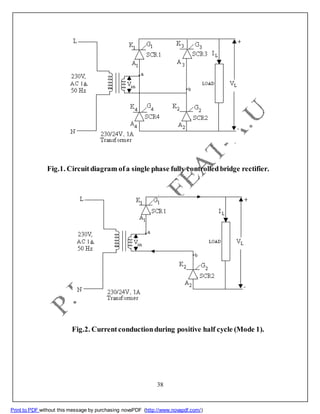
The circuit diagram of single phase fully controlled bridge rectifier consists of four
SCRs is shown in Fig.1. The two modes of operation of bridge rectifier are explained as
follows:
Mode 1: Operation with resistive load
In mode 1, bridge rectifier is operated with resistive load. During positive half
cycle of AC input voltage, point ‘a’ is positive with respect to point ‘b’. Hence, SCR1
and SCR2 are forward biased as shown in Fig.2. They are fired simultaneously at a firing
angle of α.The supply voltage appears across the load RL (VL = Vin). Now the load
current flows from supply through SCR1, load and SCR2. The current waveform is in
phase with the voltage waveform due to resistive load. At the end of positive half cycle
(ωt = π), the load current falls to zero and SCR1 and SCR2 turns OFF by natural
commutation. During negative half cycle of AC input voltage, point ‘b’ is positive with
respect to point ‘a’. Hence, SCR3 and SCR4 are forward biased as shown in Fig.3. They
are fired simultaneously at a firing angle of π+α . The load voltage is zero from π to π+α .
Hence, the supply voltage appears across the load RL (VL = Vin). The load current flows
from supply through SCR3, load and SCR4. The direction of current through the load is
same in both positive and negative half cycles of AC input voltage and hence, a positive
average output voltage Vo is obtained. The waveforms of load current, load voltage and
gating pulses are shown in Fig.4.
The connection diagram for mode 1 is shown in Fig.5 and the procedure is as
follows:
37
Print to PDF without this message by purchasing novaPDF (http://www.novapdf.com/)
Fig.2. Currentconductionduring positive half cycle (Mode 1).
38
Print to PDF without this message by purchasing novaPDF (http://www.novapdf.com/)
Fig.1. Circuitdiagram ofa single phase fully controlledbridge rectifier.
o
PROCEDURE FOR MODE1
(i) Give connections as per the circuit diagram shown in Fig.5 and Fig.6.
(ii) Provide the switch SW2 in “INT” mode.
(iii) Keep the firing knob in minimum position.
(iv) Switch ON the trainer power module.
(v) Switch ON the power circuit switch SW4.
(vi) Release the pulse through pulse release (PR) switch SW3.
(vii) Vary the control voltage (firing angle) from 0 to 180 degrees in steps of 30.
(viii) Note down the DC average output voltage for each step using DMM.
(ix) Trace the output voltage waveform from CRO.
(x) Calculate the firing angle from the waveform obtained.
Compare the theoretical and practical values of Vo obtained for various α and
tabulate in Table1.
Formula for obtaining average dc output voltage with resistive load
Average DC output voltage V =
2 *Vin *[1+cosα]
π
where
Vin = RMS value of AC input voltage = 24 volts.
 = Firing angle in degrees (0 
to 180
) = (180*t)/T
t = triggering time
T= total time for one half cycle.
Specimen calculation for output voltage
For = 45


Vo 
2*24[1+cos45o
]
3.14
= 18.45 V
39
Print to PDF without this message by purchasing novaPDF (http://www.novapdf.com/)
Fig.4. Waveforms offully controlledbridge rectifier for R load.
40
Print to PDF without this message by purchasing novaPDF (http://www.novapdf.com/)
Fig.3.Current conduction during negative half cycle. (Mode 2)
Fig.5. Connectiondiagramofa single phase fully controlled
bridge rectifierwith resistive load.
Table1. Parameters obtained with resistive load
Sl.
No.
Firing angle () Calculated
average output
voltage Vo (V)
Measured
average output
voltage Vo (V)Divisions Degrees
41
Print to PDF without this message by purchasing novaPDF (http://www.novapdf.com/)
42
Print to PDF without this message by purchasing novaPDF (http://www.novapdf.com/)
Fig.6.FrontpaneldiagramofbridgeconvertermoduleforR-load.
o
Mode 2: Operation with resistive and inductive loads
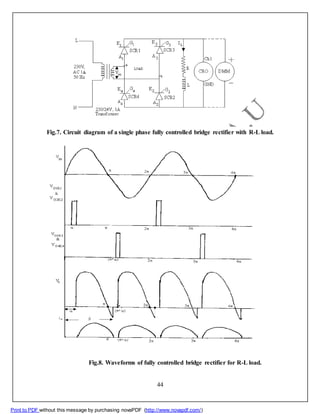
Bridge rectifier operated with resistive and inductive loads is shown in Fig.7.
Working principle is same as explained in mode1 except that during positive half cycle of
AC input voltage SCR1 and SCR2 will continue to conduct beyond ωt = π due to
inductive load even though the supply voltage reverse its polarity in the negative half
cycle. Due to this, the load current will reach zero only at π+β where β is known as
extinction angle. SCR1 and SCR2 turn OFF by current commutation. Similarly during
negative half cycle of AC input voltage, SCR3 and SCR4 will continue to conduct
beyond ωt = 2π due to inductive load even though the supply voltage reverse its polarity
in the positive half cycle. The load current will reach zero only at 2π+β. SCR3 and SCR4
turns OFF by current commutation as before. Hence, the cycles repeat. The waveforms of
load current, load voltage and gating pulses are shown in Fig.8. The front panel
connection diagram for mode 2 is shown in Fig.9 and the procedure is as follows:
PROCEDURE FOR MODE2
(i) Give the connections as per Figs.7 and 9.
(ii) Repeat the mode1 procedure from steps (ii) to (x).
(iii) Calculate the extinction angle (β) from the waveform obtained.
(iv) Comparison of the theoretical and practical values of Vo are tabulated in Table. 2.
Formula for obtaining average dc output voltage with resistive and inductive loads
Average DC output voltage V =
2*Vin *[cosα-cosβ]
π
where
Vin = RMS value of AC input voltage = 24 V.
 = Firing angle in degrees (0 
to 180
)
 = Extinction angle in degrees (0
to 180
)
43
Print to PDF without this message by purchasing novaPDF (http://www.novapdf.com/)
Fig.8. Waveforms of fully controlled bridge rectifier for R-L load.
44
Print to PDF without this message by purchasing novaPDF (http://www.novapdf.com/)
Fig.7. Circuit diagram of a single phase fully controlled bridge rectifier with R-L load.
45
Print to PDF without this message by purchasing novaPDF (http://www.novapdf.com/)
Fig.9.FrontpaneldiagramofbridgeconvertermoduleforR-Lload.
Table2. Parameters obtained with resistive and inductive loads.
Sl.
No.
Firing angle () Extinction angle ()
Calculated
DC average
output
voltage Vo
(V)
Measured
DC average
output
voltage Vo
(V)
Divisions Degrees Divisions Degrees
RESULT
The characteristics of single phase fully controlled bridge rectifier was studied and
the parameters were tabulated.
46
Print to PDF without this message by purchasing novaPDF (http://www.novapdf.com/)
Ex.No.:
DATE:
SINGLE PHASE AC VOLTAGE CONTROLLER WITH
R AND R-L LOAD
AIM
1. To study the principle of operation of single phase AC voltage controller.
2. To obtain the output voltage across R and R-L loads for various firing angles by
conducting suitable experiment.
APPARATUS REQUIRED
1. Single phase AC voltage controller module.
2. DMM or AC Voltmeter (0-30V) MI.
3. CRO.
SPECIFICATIONS
SCR
 SCR = TYN612.
 Maximum anode to cathode voltage (Vak) = 600V.
 Maximum anode current (Ia) = 12 A.
 Maximum gate to anode voltage (Vga) = 18V.
Snubber circuit
 Snubber resistance - 500 , 5 W.
 Snubber capacitance - 0.1F, 1200V.
Load components
 Load resistance (R) = 225, 5 W
 Load inductance (L) = 48.5mH.
THEORY
AC voltage controllers are thyristor based devices, which converts fixed
alternating voltage to variable alternating voltage without a change in the frequency.
Some of the main applications of AC voltage controllers are domestic and industrial
heating, transformer tap changing, lighting control and speed control of single phase and
three phase ac drives and starting of induction motors. Earlier, the devices used for these
applications were autotransformers, tap changing transformers, magnetic amplifiers,
saturable reactors, etc. But these devices are now replaced by thyristor based ac voltage
controllers because of their high efficiency, flexibility in control, compact size and less
maintenance. AC voltage controllers are also adaptable for closed loop control systems.
47
Print to PDF without this message by purchasing novaPDF (http://www.novapdf.com/)
Fig.2. Connection diagram of single phase AC voltage controller
module with R load.
48
Print to PDF without this message by purchasing novaPDF (http://www.novapdf.com/)
Fig.1. Circuit diagram of single phase AC voltage controller with
R load.
Since the ac voltage is phase controlled devices, thyristors and triacs are line
commutated and as such no complex commutation circuitry is required. The main
disadvantage of ac voltage controllers is the introduction of objectionable harmonics in
the supply current and load voltage waveforms, particularly at reduced output voltage
levels.
There are two types of control normally used for AC voltage controllers namely
1) On-off control
2) Phase-angle control
In on-off control, thyristor switches connect the load to the AC source for few
cycles of input voltage and disconnect it for another few cycles of input voltage. In phase
control, thyristor switches connect the load to the AC source for a portion of each half
cycle of input voltage. In this experiment, phase control method is used.
The AC voltage controllers can be classified into two types:
1) Single-phase controllers.
2) Three-phase controllers.
The objective of this experiment is to study the principle of single phase AC
voltage controller and to obtain the output voltage for R and R-L loads with various firing
angles. The single-phase AC voltage controller with R load in which, the thyristors are
connected in anti-parallel fashion is shown in Fig.1. If an anti-parallel combination of
thyristors is connected between AC supply and load, the power flow to the load can be
controlled by varying the firing angle of SCRs and hence, the RMS value of AC voltage
to the load is changed.
(i) Operation of single-phase AC voltage controller with R load
The operation of single phase AC voltage controller with R load is explained by
referring Fig.1. Thyristors T1 and T2 are forward biased during positive and negative half
cycles of the input sine signals, respectively. During positive half cycle, T1 is triggered at
a firing angle of value π and hence it starts conducting. The source voltage appears across
the load for the value of ωt from to π. At π, both load voltage Vo and load current io
falls to zero and after π, T1 is subjected to reverse bias, it is therefore commutated.
During negative half cycle, T2 is triggered at (π + ) and it starts conducting from (π + )
to 2 π. Soon after 2π, T2 is subjected to reverse bias, it is therefore commutated. This
cycle repeats. By changing the firing angle , the duration of conduction of each SCR
can be varied thereby varying the load voltage. Each conducting SCR turns-off by natural
commutation at the end of each half cycle due to resistive load.
Connection diagram of single phase AC voltage controller module with R load is
shown in Fig. 2. The theoretical waveforms of input voltage (vs), output voltage (Vo),
gate currents (ig1 and ig2) and device voltages (vT1 and vT2) of the single phase AC voltage
controller with ‘R’ load are shown in Fig.3.
49
Print to PDF without this message by purchasing novaPDF (http://www.novapdf.com/)
Fig.3. Waveforms of single phase AC voltage controller with R load.
50
Print to PDF without this message by purchasing novaPDF (http://www.novapdf.com/)

B.e. vi semester-power electronics lab

  • 1.
    Dept. of ElectronicsandInstrumentation Engineering B.E.-VI semester Pow er Electronics Lab LIST OF EXPERIM ENTS 1. SWITCHING CHARACTERISTICS OF a) Power M OSFET b) IGBT 2. M OSFET BASED SINGLEQUADRANT DC CHOPPER 3. SINGLEPHASE CYCLOCONVERTER W ITH RESISTIVELOAD 4. SINGLEPHASE SERIES INVERTER USING SCR 5. SINGLE PHASE FULLY CONTROLLED BRIDGE RECTIFIER W ITH R AND R-L LOAD 6. SINGLEPHASE AC VOLTAGE CONTROLLER WITH R AND R-L LOAD 7. VOLTAGE COM M UTATION CIRCUIT FOR SCR 8. SIM ULATION OF SINGLEQUADRANT DC CHOPPER AND SINGLEPHASE AC VOLTAGE CONTROLLER USING ORCAD SOFTW ARE Print to PDF without this message by purchasing novaPDF (http://www.novapdf.com/)
  • 2.
    Ex.No.: DATE: SWITCHING CHARACTERISTICSOF a)POWERMOSFET AND b) IGBT a) METAL-OXIDE SEMICONDUCTOR FIELD EFFECT TRANSISTOR (MOSFET) AIM To study the switching characteristics of a MOSFET and to determine the timing parameters. APPARATUS REQUIRED 1. MOSFET module 2. CRO THEORY Bipolar Junction Transistor (BJT) is a current controlled device. In this device, the flow of collector current is controlled by base current and hence, current gain is highly dependent on the junction temperature. However, a power MOSFET is a voltage controlled device, which requires only a small input current. The switching times of these devices are of the order of nanoseconds. Power MOSFETs are finding increasing applications in low-power, high frequency converters. MOSFETs do not have the problems of second breakdown phenomena as do in BJTs. However, MOSFETs have the problem of electrostatic discharge and requires special care in handling. In addition, it is relatively difficult to protect them under short-circuited fault condition. MOSFETs are generally classified into two types: Depletion MOSFETs and Enhancement MOSFETs. The three terminals of MOSFET are named as gate (G), drain (D) and source (S) as shown in Fig.1. In case of MOSFET, the gate voltage controls the flow of current from drain to source. From the output characteristics, drain current (ID) is a function of drain-to-source voltage VDS with gate-to-source voltage at constant VGS as shown in Fig.2(a) for an n-channel MOSFET. The output characteristics for p-channel device are the same except, that the current and voltage polarities are reversed and hence the characteristics for the p-channel device would appear in the third quadrant of the ID-VDS plane. In power electronics applications, the MOSFET is used as a switch to control the flow of power to the load. In these applications, the MOSFET traverses the ID-VDS characteristics from cutoff region to ohmic region through active region as the device turns ON, back again when it turns OFF. The cutoff, ohmic and active regions of the characteristics are shown in Fig.2(a). The MOSFET is in cutoff, when VGS < VGS (th), then the device will act as an open circuit and also the drain-source breakdown voltage (BVDSS) must be larger than the applied VDS to avoid breakdown due to avalanche effect. 1 Print to PDF without this message by purchasing novaPDF (http://www.novapdf.com/)
  • 3.
    ID D G P + RD VDD S VGS Fig.1. Schematicdiagramofn-channelPowerMOSFET. iD ohmic region VGSP5 VGSP4 VGSP3 VGSP2 VGSP1 0 (VGS - VGS(th) =vDS) Active region VGS5 VGS4 VGS3 VGS2 VGS1 VGS5 > VGS4 > VGS3 ----- BVDSS vDS Cut-off region (VGS < VGS(th)) Fig.2(a). Drain characteristics ofn-channel E-MOSFET. 2 Print to PDF without this message by purchasing novaPDF (http://www.novapdf.com/)
  • 4.
    When the deviceis driven by a large VGS, it is driven into the ohmic region, where the voltage VDS (on) is small that is VGS V S(th) v DS 0 G In the active region, the current ID is independent of the drain-source voltage and depends only on gate-source voltage. The current is sometime said to have saturated, and consequently this regions is sometimes called the saturation region or pentode region. iD KVGS V S(th) G In this experiment, a gate pulse VGate is applied to the n-channel MOSFET, the drain current ID is noted down for the given VGS (as shown in Fig.2 (b) and 2(c)). The parameters like tdn, tr, tdf, and tf are represented in Fig.3. DEFINITIONS From the graphical representation shown in Fig.3, the following parameters are defined: Turn on delay time (tdn ) It is the time in which, input capacitance of MOSFET charges to gate threshold voltage VGS (th). Rise time (tr) It is the time in which, drain current ‘ID’ rises to steady state value when the gate voltage rises from VGS (th) to VGSP. Turn-on time (ton) It is the summation of the delay time ‘tdn’ and rise time ‘tr’. Turn off delay time (tdf) ton tdn tr It is the time in which, the drain current does not change while reducing the input signal. During tdf, input capacitance discharges from V1 to VGSP. Fall Time (tf) It is the time in which, the drain current falls from ID to zero and input capacitance falls from VGSP to VGS (th). Turn off time (toff) It is the summation of turn off delay time and fall time t off . 3 tdf  tf Print to PDF without this message by purchasing novaPDF (http://www.novapdf.com/) 2
  • 5.
    Fig.2(c). Symbolic representationofn-channelE-MOSFET. 4 iD Actual Linearized 0 VGS(th) vGS Fig.2(b). Transfercharacteristics ofn-channel E-MOSFET. iD D + G vDS _ vGS S
  • 6.
    Print to PDFwithout this message by purchasing novaPDF (http://www.novapdf.com/)
  • 7.
    Fig.3. Switching characteristicsofE-MOSFET. S1 15V ON/OFF +15V - DC Frequency CRO CH2 kHz min SQUARE WAVE OUTPUT INV IL max D LOAD CRO CH1 R1 G DRIVER P VGS S R2 GND SQUARE WAVE OSCILLATOR Fig.4. SchematicdiagramofE-MOSFET. 5 Print to PDF without this message by purchasing novaPDF (http://www.novapdf.com/)
  • 8.
    PRECAUTIONS 1) Keep theoscillator switch in maximum frequency position. 2) Before giving connections, check whether all the switches are in OFF position. PROCEDURE 1. Give connections as per the circuit diagram shown in Fig.4. 2. Switch ON the CRO and fix with x10 magnifying mode. 3. Turn ON the trainer power switch. 4. Turn ON the 15V DC selector switch. 5. To observe the device voltage (VDS), connect the channel 2 of CRO to drain of MOSFET with respect to ground. The load voltage is the inversion of the device voltage, so the channel-2 is in invert mode. Since the load is R, the measure of the load voltage is proportional to the load current IL and hence ID. 6. To observe the trigger pulse (VGS) applied to the gate through the driver, connect the channel 1 of CRO at the input of the driver with respect to ground. 7. Compare the above two signals. Determine the parameters tdn, tr, tdf, and tf and tabulate the values in Table1. Table 1. Switching parameters of n-channel E-MOSFET for gating signal frequency 1.8kHz. Turn ON time (ms) Turn OFF time (ms) tdn tr ton tdf tf toff 6 Print to PDF without this message by purchasing novaPDF (http://www.novapdf.com/)
  • 9.
    b) INSULATED GATEBIPOLAR TRANSISTOR (IGBT) AIM To study the switching characteristics of IGBT and to determine the timing parameters. APPARATUS REQUIRED 1. IGBT module 2. CRO THEORY IGBT combines the advantages of BJT and MOSFET. It has high impedance gate like MOSFET and low on-state conduction losses like BJT. Also there is no second breakdown problem like BJT. It is a voltage controlled device, similar to the power MOSFET and has lower switching and conduction losses. IGBT is inherently faster than BJT. However, the switching speed of IGBT is inferior to that of MOSFET. IGBTs are used in medium power applications such as DC and AC motor drives, power supplies, solid- state relays and contactors. The I-V characteristics, transfer charactyeristics and symbol of an n-channel IGBT are shown in Figs.5(a), (b) and (c) respectively. In the forward direction, they appear qualitatively similar to those of a logic- level BJT except that the controlling parameter is an input voltage, the gate- source voltage, rather than an input base current. The transfer characteristics ID- VGS is shown in Fig.5(b) is identical to that of E-MOSFET. The curve is reasonably linear over most of the drain current range and becomes nonlinear only at low drain currents, where the gate-source voltage is approaching the threshold. If VGS<VGS (th), then the IGBT is in OFF state. The maximum voltage that should be applied to the gate-source (VGS) terminal is usually limited by the maximum drain current (ID) that is permitted to flow in the IGBT. It is basically a BJT with a MOSFET gate input and thus the modified BJT for the n-channel IGBT as shown in Fig.5(a). The schematic diagram of an IGBT is shown in Fig.6. In this experiment, a gate pulse VGate is applied to the IGBT, the collector current IC is noted down for the given VGE. The parameters like tdn, tr, tdf, tf1 and tf2 are noted down as represented in Fig.7. 7 Print to PDF without this message by purchasing novaPDF (http://www.novapdf.com/)
  • 10.
    Fig.5(b). The IGBTID-VDS characteristics. 8 Print to PDF without this message by purchasing novaPDF (http://www.novapdf.com/) Fig.5(a). Symbolic representationofIGBT and its analogy to E-MOSFET. iD IncreasingVGS VGS4 VGS3 VGS2 VGS1 VRM vDS 0 BVDSS
  • 11.
    DEFINITIONS Form the graphicalrepresentation shown in Fig.7, the switching parameters are defined as follows: Delay time (tdn) It is the time in which, the collector current rises from collector-emitter leakage current (ICEO) to 10% of collector current. 9 Print to PDF without this message by purchasing novaPDF (http://www.novapdf.com/) iD 0 VGS(th) vGS Fig.5(c). Transfercharacteristics ofIGBT. C RMOD B PNP D E P RBE G S Fig. 6. Schematic diagramofIGBT.
  • 12.
    Rise time (tr) Itis the time in which, the collector current rises from 10% of IC to steady state collector current (IC). Turn–on time (ton) It is the summation of the delay time and rise time. Delay time (tdf) ton tdn tr It is the time in which, the collector current falls from 100% to 90%. Initial fall time (tf1) It is the time in which the collector current falls from 90% to 20%. Final fall time (tf2) It is the time in which the collector current falls from 20% to10%. Turn off time (toff) It is the summation of delay time, initial fall time and final fall time. PRECAUTIONS t off tdf  tf1 tf2 1) Keep the oscillator switch in maximum frequency position. 2) Before giving connections, check whether all the switches are in OFF position. PROCEDURE 1. Give connections as per the circuit diagram shown in Fig.8. 2. Switch ON the CRO and fix with x10 magnifying mode. 3. Turn ON the trainer power switch. 4. Turn ON the 15V DC selector switch. 5. To observe the device voltage (VCE), connect the channel 2 of CRO to collector of IGBT with respect to ground. Since the load voltage is the inversion of the device voltage, so the channel-2 is in invert mode. Since the load is R, the measure of the load voltage is proportional to the load current IL and hence iC. 6. To observe the trigger pulse (VGE = VGS) applied to the base, connect the channel 1 of CRO at the input of the driver, with respect to ground. 7. Compare the above two signals. Determine the parameters tdn, tr, tdf, and tf and tabulate the values in Table 2. 10 Print to PDF without this message by purchasing novaPDF (http://www.novapdf.com/)
  • 13.
    VGE VGE(th) VGE(th) tdf tf1 t tf2 vCE, iC VCEVCE IC 0.9 VCE 0.9 IC 0.1VCE VCE = VCC 0.1IC ICEO tdn tr VCES toff 0.2IC 0.1IC t ton ICEO – Collector emitter leakage current VCES – Conduction drop of IGBT Fig.7. Switching characteristics ofIGBT + 15V - S1 15V ON/OFF Frquency kHZ min SQUARE WAVE OSCILLATOR SQUARE WAVE OUTPUT CRO CH2 INV RL max CRO CH1 R1 G DRIVER C IL IGBT E R2 GND Fig.8. ConnectiondiagramofIGBT. 11 Print to PDF without this message by purchasing novaPDF (http://www.novapdf.com/)
  • 14.
    RESULT Switching characteristics ofE-MOSFET and IGBT were studied and the parameters were determined and tabulated. Table 2. Switching parameters of IGBT for gating signal frequency 10kHz. Turn ON time (ms) Turn OFF time (ms) tdn tr ton tdf tf1 tf2 toff 12 Print to PDF without this message by purchasing novaPDF (http://www.novapdf.com/)
  • 15.
    13 Print to PDFwithout this message by purchasing novaPDF (http://www.novapdf.com/)
  • 16.
    Ex.No.: DATE: MOSFET BASED SINGLEQUADRANT DC CHOPPER AIM 1. To study the operation of a single quadrant step-down DC chopper. 2. To obtain the output voltage waveforms. APPARATUS REQUIRED 1. VPET-208 module: DC Chopper Control Circuit. 2. DMM 3. CRO THEORY In a.c. circuits, the transformer converts electric power efficiently from one voltage level to another voltage level. DC-to-DC converters do a similar job in DC circuits are called choppers. The operation of transformer is based on an alternating magnitude field. But in choppers, the voltage conversion is achieved using high frequency power semiconductor switches, which operate either in fully ON or fully OFF state. Choppers are widely used for DC motor control, electric vehicles, trolley cars, lamp loads, heater loads and in DC voltage regulators. DC choppers provide smooth acceleration control, high efficiency and fast dynamic response in electric vehicles. They are classified as: 1. Buck converter i.e. Vo < Vin (step down) 2. Boost converter i.e. Vo > Vin (step up) 3. Buck Boost converter (combination of both) The circuit configuration of a chopper can be designed either to step down or step up the input voltage level. In this experiment, the operation of step down chopper circuit is studied. The two modes of operation of step down chopper are explained as follows: TWO MODES OF OPERATION OF CHOPPER Mode 1: 0 t TON When the switch (S) is ON by applying a gating pulse VG as shown in Fig.1(a), the device voltage Vd (drop across the switch) becomes zero and the load voltage Vo = Vin. Hence Vo = Vin = Io*R 15 Print to PDF without this message by purchasing novaPDF (http://www.novapdf.com/)
  • 17.
    o Therefore the loadcurrent V I in R Mode 2: TON t T 16 Print to PDF without this message by purchasing novaPDF (http://www.novapdf.com/) Fig.1(a). Mode 1:Circuit diagram ofstep-downDC chopper Fig.1(b). Mode 2:Circuit diagram ofstep-down DC chopper
  • 18.
     When the switch(S) is OFF (VG=0) as shown in Fig.1(b), the device voltage (Vd) becomes Vin and the output voltage Vo = 0 and the load current Io = 0. Hence, the power dissipation in the switch (Pd) is zero. Combining Mode 1(M1) andMode 2 (M2) Theoretical waveforms for input voltage (Vin), gating pulse (VG), output voltage (Vo) and the device voltage (Vd) are shown in Fig.2. Referring the waveforms, it is clear that 1. The switch closes for TON seconds in M1 and for this period, the input voltage appears across the load. 2. The switch opens for TOFF seconds in M2 and for this period, the load voltage becomes zero. 3. The sum of TON and TOFF is called chopping period, T and chopping frequency is equal to 1/ T. STEP DOWN CHOPPER A chopper which gives an output voltage less than or equal to the input voltage is called a step down chopper. Neglecting, the voltage drop across the switch, the average output voltage Vo,avg is given by 1 period  (1) Vo,avg period 0 Vo(t) dt Where Vo (t) Vin ; 0 t TON And Vo(t) 0 ; TON t T Period T TON TOFF Therefore the equation (1) becomes 1 T Vo,avg  T o Vo(t) dt = 1  TON V (t) dt +  T V (t) dt T 0 o TON o          17 Print to PDF without this message by purchasing novaPDF (http://www.novapdf.com/)
  • 19.
    18 Print to PDFwithout this message by purchasing novaPDF (http://www.novapdf.com/) Fig.2. Waveforms of step-down DC chopper. CRO CH.1 CRO GND Fig.3(a). CircuitdiagramofDC chopper.
  • 20.
    = 1  TON Vdt +  T 0 dt T 0 in TON    1 [V ] [t] TON T in 0 V in  T *TON T V V * ON (2) o,avg in T where T = Chopping period and TON T = Duty cycle ratio From Eqn. 2, it is clear that the average output voltage Vo,avg depends on the TON and T. It can be varied by varying either the chopping frequency (f) or by varying TON. Thus the power flow in the circuit can be controlled. The switch shown in Fig.3, can be any one of the following power semiconductor devices: i) SCR, ii) power transistor (power-BJT), iii) power-MOSFET, iv) IGBT and v) GTO. In this experiment, IGBT [Insulated Gate Bipolar Junction Transistor] is used as a switch. PRECAUTIONS 1. Ensure the switch is in OFF position while doing circuit connection. 2. Ensure pulse release switch in OFF position whenever power is switched ON. EXPERIMENTAL PROCEDURE I) Fixed Frequency Variable Time Ratio Control (FFVTRC) 1. Connect the load and the device as shown is Fig.(3a). 2. Connect channel-1 of CRO and ground across the load (R), to measure the output voltage. Connect Channel-2 of CRO to measure the input voltage (Vin) as shown in Fig. (3a). 3. Fix the carrier frequency knob at one position and adjust TON and TOFF as given in Table 1. 19 Print to PDF without this message by purchasing novaPDF (http://www.novapdf.com/)
  • 21.
    4. Trace theoutput voltage on CRO for different TON settings and simultaneously note down the average output voltage using DMM and verify with theoretical value as given below: TV ON V (3) o,avg T in 5. Fig.3(b). Connectiondiagramofstepdown DC chopper. 20 Print to PDF without this message by purchasing novaPDF (http://www.novapdf.com/)
  • 22.
    Table 1. FixedFrequency Variable Time Ratio Control (FFVTRC) Table 2. Variable Frequency Variable Time Ratio Control (VFVTRC) Chopping frequency fs Chopping period T Off period Toff On period Ton Theoretical output voltage Vo (avg) (V) Practical output voltage Vo (avg) (V) Input voltage Vin (V) Chopping frequency fs Chopping period T Off period Toff On period Ton Theoretical output voltage Vo (avg) (V) Practical output voltage Vo (avg) (V) 21 Print to PDF without this message by purchasing novaPDF (http://www.novapdf.com/)
  • 23.
    II) Variable FrequencyVariable Time Ratio Control (VFVTRC) 1. The connect ion and procedure are similar to the FFVTRC. 2. Vary both the carrier frequency knob and voltage knob simultaneously to keep TON fixed and TOFF variable, as given in Table 2. 3. Trace the output voltage for different TOFF settings and simultaneously note down the average output voltage using DMM and verify with theoretical value as given below: Vo,avg  T TON V T in (4) ON OFF Result The operation of a single quadrant step-down DC-DC converter (chopper) with fixed load was studied and output waveforms were obtained. 22 Print to PDF without this message by purchasing novaPDF (http://www.novapdf.com/)
  • 24.
    Ex.No.: DATE: SINGLE PHASE CYCLOCONVERTERWITHRESITIVELOAD AIM 1. To study the principle of operation of single phase cycloconverter with resistive load. 2. To obtain the output waveforms with frequency as an integral sub-multiple of the input frequency. APPARATUS REQUIRED 1) Control / firing module 2) Cycloconverter module 3) Rheostat 220, 1A 4) CRO 5) Inductance 125mH 6) Transformer (230 / 24-0-24 Volts ) THEORY Cycloconverter is a device which converts power at one frequency to power at a different frequency with one stage conversion. It is an AC to AC converter. The two types of cycloconverter are: i) Step-downcycloconverter. ii) Step-up cycloconverter. In step-down cycloconverter, the output frequency fo is lower than the input supply frequency fs (fofs). In step-up cycloconverter, the output frequency fo is higher than the input supply frequency fs (fo>fs). In this experiment, fofs is considered and operation of the cycloconverter as shown in Fig.1 is explained for fo = fs/2 (two cycles of AC input signal corresponds to one cycle of AC output). The modes of operation of cycloconverter are shown in Fig.2. In order to satisfy fo = fs/2, the output voltage should be positive for first cycle and negative for second cycle of input signal as shown in Fig.3. The principle of operation of single-phase cycloconverter can be explained with the help of Fig.1. 23 Print to PDF without this message by purchasing novaPDF (http://www.novapdf.com/)
  • 25.
    SCR1 24 Print to PDFwithout this message by purchasing novaPDF (http://www.novapdf.com/) A1 K1 P K4 A4 SCR4 0% CRO 1Ø 230 V AC Supply 50% X RL Y 100% SCR3 A3 K3 N 230 / 24-0-24 V Centre Tapped Transformer K2 A2 SCR2 Fig.1. Circuitdiagram ofsingle phase cycloconverterwithR load.
  • 26.
    During the firstpositive half cycle, point ‘a’ is positive with respect to point ‘b’ and point ‘c’ is positive with respect to point ‘d’ and hence, SCR1 and SCR2 are forward biased. Since positive load voltage is required (load current flows from y +ve to x - ve), SCR1 alone is triggered as shown in Fig.2(a) and SCR2 is not fired because it will produce negative load voltage. For the first negative half cycle, point ‘a’ is negative with respect to point ‘b’ and point ‘c’ is negative with respect to point ‘d’ and hence, SCR3 and SCR4 are forward biased. Since positive load voltage is required (load current flows from y+ve to x-ve), SCR3 alone is fired as shown in Fig.2(b) and SCR4 is not fired because it will produce negative load voltage. During the second positive half cycle, point ‘a’ is positive with respect to point ‘b’ and point ‘c’ is positive with respect to point ‘d’ and hence, SCR1 and SCR2 are forward biased. In this cycle, only negative load voltage is required (load current flows from x +ve to y-ve), SCR2 alone is triggered as shown in Fig.2 (c) and SCR1 is not fired because it will produce positive load voltage. For the second negative half cycle, point ‘a’ is negative with respect to point ‘b’ and point ‘c’ is negative with respect to point ‘d’ and hence, SCR3 and SCR4 are forward biased. In this cycle, only negative load voltage is required (load current flows from x+ve to y-ve), SCR4 alone is fired as shown in Fig.2(d) and SCR3 is not fired because it will produce positive load voltage. By changing the firing angle , the duration of conduction of each SCRs can be varied. The gating sequence of SCRs for fo = fs/2 are tabulated in Table 1. The SCRs are turned OFF by natural commutation at the end of each half cycle due to resistive load. The waveforms of input voltage, output voltage and gating pulses are shown in Fig. 3. PRECAUTIONS 1. The load rheostat must be kept at maximum resistance position. 2. Pulse release switch should be in OFF position while main supply is switched ON. 3. The maximum output frequency of cycloconverter should be limited to one- fourth of the input frequency to maintain acceptable waveform with a low harmonic content. 25 Print to PDF without this message by purchasing novaPDF (http://www.novapdf.com/)
  • 27.
    SCR1 P A1 K1 a+ 0% 1Ø 230 V AC Sup ply b - - + c + X RL Y d - 50% 100% N 230 / 24-0-24 V Centre Tapped Transformer K2 A2 SCR2 Fig.2(a). Mode diagramof1st positive half cycle P a - K4 SCR4 A4 0% 1Ø b + - + 230 V AC Supply N c - d + 230 / 24-0-24 V Centre Tapped Transformer X RL Y A3 K3 SCR3 50% 100% Fig.2(b). Mode diagramof 1st negative half cycle 26 Print to PDF without this message by purchasing novaPDF (http://www.novapdf.com/)
  • 28.
    P a + A1 SCR1 K1 1Ø 230V b - + - 0% 50% AC Supply c + X RL Y 100% d - N 230 / 24-0-24 V Centre Tapped Transformer K2 A2 SCR2 Fig.2(c). Mode diagramof2nd positive half cycle P a - K4 SCR4 A4 0% 1Ø 230 V b + + - 50% AC Supply c - X RL Y 100% d + N 230 / 24-0-24 V Centre Tapped Transformer A3 K3 SCR3 Fig.2(d). Mode diagramof 2nd negative halfcycle 27 Print to PDF without this message by purchasing novaPDF (http://www.novapdf.com/)
  • 29.
    Fig.3. Waveforms ofsinglephase cycloconverterfo = fs/2 28 Print to PDF without this message by purchasing novaPDF (http://www.novapdf.com/)
  • 30.
    Fig.4. Connectiondiagramofsingle phasecycloconverter. Table 1. Gating sequences ofSCRs for fo = fs/2 Serial number of half cycle Nature of half cycle SCRs forward biased SCR triggered Nature of load voltage 1 PHC 1,2 1 y = +ve; x = -ve 2 NHC 3,4 3 y = +ve; x = -ve 3 PHC 1,2 2 y = -ve; x = +ve 4 NHC 3,4 4 y = -ve; x = +ve PHC Positive Half Cycle and NHC Negative Half Cycle 29 Print to PDF without this message by purchasing novaPDF (http://www.novapdf.com/)
  • 31.
    Table 2. Experimentalresult, α = …….. Switch position Input frequency fs (Hz) Output frequency fo (Hz) SA SB 0 0 50 1 0 50 1 1 50 0 1 50 Model calculations for firing angle α = 90˚ Fig.5. Modelcalculationsforfiring angle α = 90˚. From Fig.5. Number of time divisions for one cycle = 4 Therefore 4 divisions = 360˚ Hence, the time divisions required to set α at 90˚ = (4 / 360)*90 = 1 div. 30 Print to PDF without this message by purchasing novaPDF (http://www.novapdf.com/)
  • 32.
    PROCEDURE 1. The connectionsare given as per the circuit diagram as shown in Fig. 4. 2. Connect the firing pulses from cycloconverter firing control module to device module. 3. Switch ON the power supply (230V AC) to the primary of the transformer. 4. Switch ON firing and device module. 5. Connect the CRO across the load. 6. Turn ON the pulse release switch. 7. Observe the output voltage waveform on CRO for the following switch select (SA, SB) positions. a) SA=0 and SB= 0 output frequency = input frequency b) SA=1 and SB= 0 output frequency = 1/2 input frequency c) SA=1 and SB= 1 output frequency = 1/3 input frequency d) SA=0 and SB=1 output frequency = 1/4 input frequency 8. Vary the firing angle α (0 to π) and observe the frequency of the output waveform and tabulate the readings in Table 2. RESULT Thus the conversion of single phase AC voltage of particular frequency to single phase of AC voltage of lower frequency was achieved with a cycloconverter and the relevant waveforms were traced. 31 Print to PDF without this message by purchasing novaPDF (http://www.novapdf.com/)
  • 33.
    32 Print to PDFwithout this message by purchasing novaPDF (http://www.novapdf.com/)
  • 34.
    Ex.No.: DATE: SINGLE PHASE SERIESINVERTER USING SCRWITHRESISTIVE LOAD AIM To study the operation of single phase series inverter circuit using SCR with resistive load and obtain its output voltage waveform. APPRATUS REQUIRED 1. SCR series inverter circuit module 2. Resistive load 3. CRO 4. Pulse patch chords 5. Connection patch chords Features of PEC14M6  Test points are provided to observe the signals at each stage.  Heat sinks are provided with SCRs to dissipate the heat at a faster rate.  Firing circuit and power circuit are isolated.  The 24 volts DC has short circuit production.  SCR is provided with Snubber circuit.  Output frequency can be controlled from 300Hz to 650Hz. THEORY DC to AC converter is known as inverter. The function of an inverter is to change a fixed DC input voltage in to a symmetrical AC output voltage of desired magnitude and frequency. For sinusoidal AC input, the magnitude, frequency and phase can be controllable. According to the type of AC output, these topologies can be classified into voltage source inverter (VSI) and current source inverter (CSI). In case of VSI, the independently controlled AC output is a voltage waveform and DC source maintains constant voltage. But in case of CSI, the independently controlled AC output is a current waveform and DC source maintains constant current. A single phase series inverter circuit using SCR with resistive load is shown in the Fig.1. Initially capacitor C2 is assumed to be charged to voltage Vc with upper plate negative and lower plate positive. As the capacitors C1 and C2 together are connected across the battery, the total voltage across C1 and C2 should be equal to VDC. Therefore, C1 will be charged to ( VDC + Vc ) value with upper plate positive . 33 Print to PDF without this message by purchasing novaPDF (http://www.novapdf.com/)
  • 35.
    Thyristor T1 istriggered at instant ‘0’. with this ,the two current flow through the thyristor T1 and load R. Current i1 flows through the path VDC (+)--T1--L1--R-- C2(+)-- C2(-)VDC ,thus charging capacitor C2 ,which is already charged at this instant will provide the second current i2 . This discharge current i2 has the path C1 (+) --- T1---L1---R-- C1 (-). Since the driving voltage (VDC+Vc) , the capacitors C1, C2 and the initial conditions are identical for both these paths, the two currents i1 and i2 will always be equal. Hence, 50% of the load current is drawn from the input source and 50% from the discharge of the capacitor. At the end of the positive half cycle, when the load current becomes zero, SCR T1 will be turned off and the voltage across the capacitors reversed. In the steady state, capacitor C2 will be charged to voltage (VDC + Vc) in the opposite direction and capacitor C1 to Vc. When SCR T2 is triggered, identical load current is obtained from the d.c. input source and the rest 50% from the load current is obtained from the input d.c. supply no more remains intermittent in nature and the ripples are reduced to minimum.The peak forward off-state voltage for the SCRS is VDC and Vc is the peak reverse voltage. EXPERIMENTAL PROCEDURE 1. Give connections as per the connection diagram shown in Fig.2 2. Switch ON AC power supply 3. Switch ON control circuitry 4. Switch ON 24 volts DC supply. 5. Trace the input, output and capacitor voltage waveforms at desired frequency and observe SCRturn ON and turn OFF times. 34 Print to PDF without this message by purchasing novaPDF (http://www.novapdf.com/)
  • 36.
    CIRCUIT DIAGRAM The seriesinverter circuit diagram using SCRs with resistive load is shown in Fig.1 Fig.2 Connection diagram of series inverter. 35 Print to PDF without this message by purchasing novaPDF (http://www.novapdf.com/) Fig.1 Circuit diagram of series inverter.
  • 37.
    MODAL OUTPUT WAVEFORMS Typicalwaveforms of input voltage, SCR turn ON and turn OFF voltages, and output load voltage are shown in Fig.3 to Fig.5 respectively. Fig.5 Load Voltage RESULT Operation of single phase series inverter using SCR was studied and the output voltage waveform was obtained. 36 Print to PDF without this message by purchasing novaPDF (http://www.novapdf.com/) Fig.3 Input DC Voltage Fig.4 SCR Voltage
  • 38.
    Ex.No.: DATE: SINGLE PHASE FULLYCONTROLLEDBRIDGE RECTIFIER AIM To study the characteristics of single phase fully controlled bridge rectifier. APPARATUS REQUIRED 1) Single phase SCR bridge rectifier module 2) Voltmeter 0 – 30V MC 3) CRO THEORY The circuit diagram of single phase fully controlled bridge rectifier consists of four SCRs is shown in Fig.1. The two modes of operation of bridge rectifier are explained as follows: Mode 1: Operation with resistive load In mode 1, bridge rectifier is operated with resistive load. During positive half cycle of AC input voltage, point ‘a’ is positive with respect to point ‘b’. Hence, SCR1 and SCR2 are forward biased as shown in Fig.2. They are fired simultaneously at a firing angle of α.The supply voltage appears across the load RL (VL = Vin). Now the load current flows from supply through SCR1, load and SCR2. The current waveform is in phase with the voltage waveform due to resistive load. At the end of positive half cycle (ωt = π), the load current falls to zero and SCR1 and SCR2 turns OFF by natural commutation. During negative half cycle of AC input voltage, point ‘b’ is positive with respect to point ‘a’. Hence, SCR3 and SCR4 are forward biased as shown in Fig.3. They are fired simultaneously at a firing angle of π+α . The load voltage is zero from π to π+α . Hence, the supply voltage appears across the load RL (VL = Vin). The load current flows from supply through SCR3, load and SCR4. The direction of current through the load is same in both positive and negative half cycles of AC input voltage and hence, a positive average output voltage Vo is obtained. The waveforms of load current, load voltage and gating pulses are shown in Fig.4. The connection diagram for mode 1 is shown in Fig.5 and the procedure is as follows: 37 Print to PDF without this message by purchasing novaPDF (http://www.novapdf.com/)
  • 39.
    Fig.2. Currentconductionduring positivehalf cycle (Mode 1). 38 Print to PDF without this message by purchasing novaPDF (http://www.novapdf.com/) Fig.1. Circuitdiagram ofa single phase fully controlledbridge rectifier.
  • 40.
    o PROCEDURE FOR MODE1 (i)Give connections as per the circuit diagram shown in Fig.5 and Fig.6. (ii) Provide the switch SW2 in “INT” mode. (iii) Keep the firing knob in minimum position. (iv) Switch ON the trainer power module. (v) Switch ON the power circuit switch SW4. (vi) Release the pulse through pulse release (PR) switch SW3. (vii) Vary the control voltage (firing angle) from 0 to 180 degrees in steps of 30. (viii) Note down the DC average output voltage for each step using DMM. (ix) Trace the output voltage waveform from CRO. (x) Calculate the firing angle from the waveform obtained. Compare the theoretical and practical values of Vo obtained for various α and tabulate in Table1. Formula for obtaining average dc output voltage with resistive load Average DC output voltage V = 2 *Vin *[1+cosα] π where Vin = RMS value of AC input voltage = 24 volts.  = Firing angle in degrees (0  to 180 ) = (180*t)/T t = triggering time T= total time for one half cycle. Specimen calculation for output voltage For = 45   Vo  2*24[1+cos45o ] 3.14 = 18.45 V 39 Print to PDF without this message by purchasing novaPDF (http://www.novapdf.com/)
  • 41.
    Fig.4. Waveforms offullycontrolledbridge rectifier for R load. 40 Print to PDF without this message by purchasing novaPDF (http://www.novapdf.com/) Fig.3.Current conduction during negative half cycle. (Mode 2)
  • 42.
    Fig.5. Connectiondiagramofa singlephase fully controlled bridge rectifierwith resistive load. Table1. Parameters obtained with resistive load Sl. No. Firing angle () Calculated average output voltage Vo (V) Measured average output voltage Vo (V)Divisions Degrees 41 Print to PDF without this message by purchasing novaPDF (http://www.novapdf.com/)
  • 43.
    42 Print to PDFwithout this message by purchasing novaPDF (http://www.novapdf.com/) Fig.6.FrontpaneldiagramofbridgeconvertermoduleforR-load.
  • 44.
    o Mode 2: Operationwith resistive and inductive loads Bridge rectifier operated with resistive and inductive loads is shown in Fig.7. Working principle is same as explained in mode1 except that during positive half cycle of AC input voltage SCR1 and SCR2 will continue to conduct beyond ωt = π due to inductive load even though the supply voltage reverse its polarity in the negative half cycle. Due to this, the load current will reach zero only at π+β where β is known as extinction angle. SCR1 and SCR2 turn OFF by current commutation. Similarly during negative half cycle of AC input voltage, SCR3 and SCR4 will continue to conduct beyond ωt = 2π due to inductive load even though the supply voltage reverse its polarity in the positive half cycle. The load current will reach zero only at 2π+β. SCR3 and SCR4 turns OFF by current commutation as before. Hence, the cycles repeat. The waveforms of load current, load voltage and gating pulses are shown in Fig.8. The front panel connection diagram for mode 2 is shown in Fig.9 and the procedure is as follows: PROCEDURE FOR MODE2 (i) Give the connections as per Figs.7 and 9. (ii) Repeat the mode1 procedure from steps (ii) to (x). (iii) Calculate the extinction angle (β) from the waveform obtained. (iv) Comparison of the theoretical and practical values of Vo are tabulated in Table. 2. Formula for obtaining average dc output voltage with resistive and inductive loads Average DC output voltage V = 2*Vin *[cosα-cosβ] π where Vin = RMS value of AC input voltage = 24 V.  = Firing angle in degrees (0  to 180 )  = Extinction angle in degrees (0 to 180 ) 43 Print to PDF without this message by purchasing novaPDF (http://www.novapdf.com/)
  • 45.
    Fig.8. Waveforms offully controlled bridge rectifier for R-L load. 44 Print to PDF without this message by purchasing novaPDF (http://www.novapdf.com/) Fig.7. Circuit diagram of a single phase fully controlled bridge rectifier with R-L load.
  • 46.
    45 Print to PDFwithout this message by purchasing novaPDF (http://www.novapdf.com/) Fig.9.FrontpaneldiagramofbridgeconvertermoduleforR-Lload.
  • 47.
    Table2. Parameters obtainedwith resistive and inductive loads. Sl. No. Firing angle () Extinction angle () Calculated DC average output voltage Vo (V) Measured DC average output voltage Vo (V) Divisions Degrees Divisions Degrees RESULT The characteristics of single phase fully controlled bridge rectifier was studied and the parameters were tabulated. 46 Print to PDF without this message by purchasing novaPDF (http://www.novapdf.com/)
  • 48.
    Ex.No.: DATE: SINGLE PHASE ACVOLTAGE CONTROLLER WITH R AND R-L LOAD AIM 1. To study the principle of operation of single phase AC voltage controller. 2. To obtain the output voltage across R and R-L loads for various firing angles by conducting suitable experiment. APPARATUS REQUIRED 1. Single phase AC voltage controller module. 2. DMM or AC Voltmeter (0-30V) MI. 3. CRO. SPECIFICATIONS SCR  SCR = TYN612.  Maximum anode to cathode voltage (Vak) = 600V.  Maximum anode current (Ia) = 12 A.  Maximum gate to anode voltage (Vga) = 18V. Snubber circuit  Snubber resistance - 500 , 5 W.  Snubber capacitance - 0.1F, 1200V. Load components  Load resistance (R) = 225, 5 W  Load inductance (L) = 48.5mH. THEORY AC voltage controllers are thyristor based devices, which converts fixed alternating voltage to variable alternating voltage without a change in the frequency. Some of the main applications of AC voltage controllers are domestic and industrial heating, transformer tap changing, lighting control and speed control of single phase and three phase ac drives and starting of induction motors. Earlier, the devices used for these applications were autotransformers, tap changing transformers, magnetic amplifiers, saturable reactors, etc. But these devices are now replaced by thyristor based ac voltage controllers because of their high efficiency, flexibility in control, compact size and less maintenance. AC voltage controllers are also adaptable for closed loop control systems. 47 Print to PDF without this message by purchasing novaPDF (http://www.novapdf.com/)
  • 49.
    Fig.2. Connection diagramof single phase AC voltage controller module with R load. 48 Print to PDF without this message by purchasing novaPDF (http://www.novapdf.com/) Fig.1. Circuit diagram of single phase AC voltage controller with R load.
  • 50.
    Since the acvoltage is phase controlled devices, thyristors and triacs are line commutated and as such no complex commutation circuitry is required. The main disadvantage of ac voltage controllers is the introduction of objectionable harmonics in the supply current and load voltage waveforms, particularly at reduced output voltage levels. There are two types of control normally used for AC voltage controllers namely 1) On-off control 2) Phase-angle control In on-off control, thyristor switches connect the load to the AC source for few cycles of input voltage and disconnect it for another few cycles of input voltage. In phase control, thyristor switches connect the load to the AC source for a portion of each half cycle of input voltage. In this experiment, phase control method is used. The AC voltage controllers can be classified into two types: 1) Single-phase controllers. 2) Three-phase controllers. The objective of this experiment is to study the principle of single phase AC voltage controller and to obtain the output voltage for R and R-L loads with various firing angles. The single-phase AC voltage controller with R load in which, the thyristors are connected in anti-parallel fashion is shown in Fig.1. If an anti-parallel combination of thyristors is connected between AC supply and load, the power flow to the load can be controlled by varying the firing angle of SCRs and hence, the RMS value of AC voltage to the load is changed. (i) Operation of single-phase AC voltage controller with R load The operation of single phase AC voltage controller with R load is explained by referring Fig.1. Thyristors T1 and T2 are forward biased during positive and negative half cycles of the input sine signals, respectively. During positive half cycle, T1 is triggered at a firing angle of value π and hence it starts conducting. The source voltage appears across the load for the value of ωt from to π. At π, both load voltage Vo and load current io falls to zero and after π, T1 is subjected to reverse bias, it is therefore commutated. During negative half cycle, T2 is triggered at (π + ) and it starts conducting from (π + ) to 2 π. Soon after 2π, T2 is subjected to reverse bias, it is therefore commutated. This cycle repeats. By changing the firing angle , the duration of conduction of each SCR can be varied thereby varying the load voltage. Each conducting SCR turns-off by natural commutation at the end of each half cycle due to resistive load. Connection diagram of single phase AC voltage controller module with R load is shown in Fig. 2. The theoretical waveforms of input voltage (vs), output voltage (Vo), gate currents (ig1 and ig2) and device voltages (vT1 and vT2) of the single phase AC voltage controller with ‘R’ load are shown in Fig.3. 49 Print to PDF without this message by purchasing novaPDF (http://www.novapdf.com/)
  • 51.
    Fig.3. Waveforms ofsingle phase AC voltage controller with R load. 50 Print to PDF without this message by purchasing novaPDF (http://www.novapdf.com/)