PRESENT TENSES
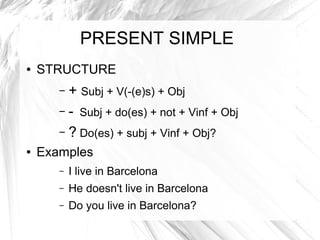
PRESENT SIMPLE
●   STRUCTURE
       – + Subj + V(-(e)s) + Obj
       – - Subj + do(es) + not + Vinf + Obj
       – ? Do(es) + subj + Vinf + Obj?
●   Examples
       –   I live in Barcelona
       –   He doesn't live in Barcelona
       –   Do you live in Barcelona?
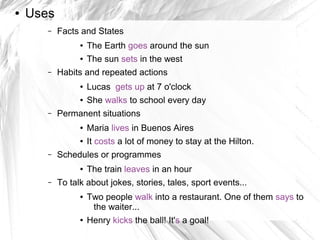
●   Uses
       –   Facts and States
                 ●   The Earth goes around the sun
                 ●   The sun sets in the west
       –   Habits and repeated actions
                 ●   Lucas gets up at 7 o'clock
                 ●   She walks to school every day
       –   Permanent situations
                 ●   Maria lives in Buenos Aires
                 ●   It costs a lot of money to stay at the Hilton.
       –   Schedules or programmes
                 ●   The train leaves in an hour
       –   To talk about jokes, stories, tales, sport events...
                 ●   Two people walk into a restaurant. One of them says to
                      the waiter...
                 ●   Henry kicks the ball! It's a goal!
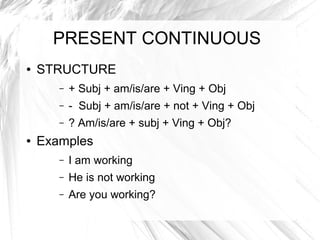
PRESENT CONTINUOUS
●   STRUCTURE
       –   + Subj + am/is/are + Ving + Obj
       –   - Subj + am/is/are + not + Ving + Obj
       –   ? Am/is/are + subj + Ving + Obj?
●   Examples
       –   I am working
       –   He is not working
       –   Are you working?
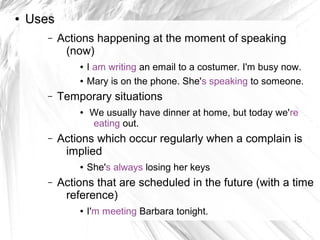
●   Uses
       –   Actions happening at the moment of speaking
            (now)
               ●   I am writing an email to a costumer. I'm busy now.
               ●   Mary is on the phone. She's speaking to someone.
       –   Temporary situations
               ●   We usually have dinner at home, but today we're
                   eating out.
       –   Actions which occur regularly when a complain is
            implied
               ●   She's always losing her keys
       –   Actions that are scheduled in the future (with a time
            reference)
               ●   I'm meeting Barbara tonight.
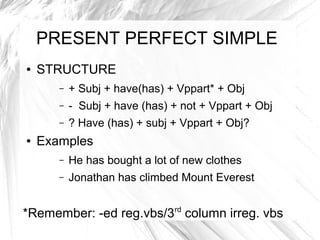
PRESENT PERFECT SIMPLE
●   STRUCTURE
       –   + Subj + have(has) + Vppart* + Obj
       –   - Subj + have (has) + not + Vppart + Obj
       –   ? Have (has) + subj + Vppart + Obj?
●   Examples
       –   He has bought a lot of new clothes
       –   Jonathan has climbed Mount Everest


*Remember: -ed reg.vbs/3rd column irreg. vbs
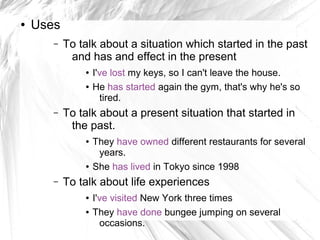
●   Uses
       –   To talk about a situation which started in the past
            and has and effect in the present
               ●   I've lost my keys, so I can't leave the house.
               ●   He has started again the gym, that's why he's so
                     tired.
       –   To talk about a present situation that started in
            the past.
               ●   They have owned different restaurants for several
                    years.
               ●   She has lived in Tokyo since 1998
       –   To talk about life experiences
               ●   I've visited New York three times
               ●   They have done bungee jumping on several
                     occasions.
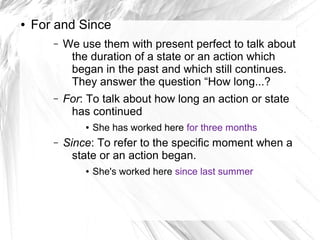
●   For and Since
       –   We use them with present perfect to talk about
            the duration of a state or an action which
            began in the past and which still continues.
            They answer the question “How long...?
       –   For: To talk about how long an action or state
            has continued
               ●   She has worked here for three months
       –   Since: To refer to the specific moment when a
             state or an action began.
               ●   She's worked here since last summer
●   Already and Yet
       –   Yet at the end of the sentence. Already between the
             auxiliary verb have and the past participle of the main
             verb.
                ●She hasn't left yet
               ● She's already left


       –   We use Yet in questions to ask whether an action has
            been completed
                ●Have you bought those new trainers yet?
       –   We use yet in negative sentences to talk about an action
            that we have not completed at the present time, but
            that we intend to complete in the future
                I haven't saved enough money yet.
                ●


       –   We use already to emphasize that an action has
            happened
                ●   They've already made a million dolars.

Present tenses

  • 1.
  • 2.
    PRESENT SIMPLE ● STRUCTURE – + Subj + V(-(e)s) + Obj – - Subj + do(es) + not + Vinf + Obj – ? Do(es) + subj + Vinf + Obj? ● Examples – I live in Barcelona – He doesn't live in Barcelona – Do you live in Barcelona?
  • 3.
    Uses – Facts and States ● The Earth goes around the sun ● The sun sets in the west – Habits and repeated actions ● Lucas gets up at 7 o'clock ● She walks to school every day – Permanent situations ● Maria lives in Buenos Aires ● It costs a lot of money to stay at the Hilton. – Schedules or programmes ● The train leaves in an hour – To talk about jokes, stories, tales, sport events... ● Two people walk into a restaurant. One of them says to the waiter... ● Henry kicks the ball! It's a goal!
  • 4.
    PRESENT CONTINUOUS ● STRUCTURE – + Subj + am/is/are + Ving + Obj – - Subj + am/is/are + not + Ving + Obj – ? Am/is/are + subj + Ving + Obj? ● Examples – I am working – He is not working – Are you working?
  • 5.
    Uses – Actions happening at the moment of speaking (now) ● I am writing an email to a costumer. I'm busy now. ● Mary is on the phone. She's speaking to someone. – Temporary situations ● We usually have dinner at home, but today we're eating out. – Actions which occur regularly when a complain is implied ● She's always losing her keys – Actions that are scheduled in the future (with a time reference) ● I'm meeting Barbara tonight.
  • 6.
    PRESENT PERFECT SIMPLE ● STRUCTURE – + Subj + have(has) + Vppart* + Obj – - Subj + have (has) + not + Vppart + Obj – ? Have (has) + subj + Vppart + Obj? ● Examples – He has bought a lot of new clothes – Jonathan has climbed Mount Everest *Remember: -ed reg.vbs/3rd column irreg. vbs
  • 7.
    Uses – To talk about a situation which started in the past and has and effect in the present ● I've lost my keys, so I can't leave the house. ● He has started again the gym, that's why he's so tired. – To talk about a present situation that started in the past. ● They have owned different restaurants for several years. ● She has lived in Tokyo since 1998 – To talk about life experiences ● I've visited New York three times ● They have done bungee jumping on several occasions.
  • 8.
    For and Since – We use them with present perfect to talk about the duration of a state or an action which began in the past and which still continues. They answer the question “How long...? – For: To talk about how long an action or state has continued ● She has worked here for three months – Since: To refer to the specific moment when a state or an action began. ● She's worked here since last summer
  • 9.
    Already and Yet – Yet at the end of the sentence. Already between the auxiliary verb have and the past participle of the main verb. ●She hasn't left yet ● She's already left – We use Yet in questions to ask whether an action has been completed ●Have you bought those new trainers yet? – We use yet in negative sentences to talk about an action that we have not completed at the present time, but that we intend to complete in the future I haven't saved enough money yet. ● – We use already to emphasize that an action has happened ● They've already made a million dolars.