Changing Verbs From Present to Past and Future Second Grade Grammar
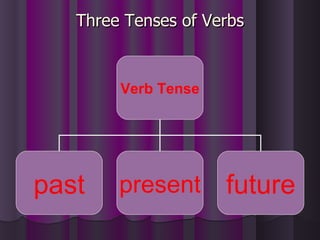
Three Tenses of Verbs Verb Tense past present future
Past Tense Verbs Most past tense verbs end in “ed”, but there are several rules to use while changing the present to past tense. Past tense verbs tell action that has already happened. Some words change spelling to show past tense. Examples: Beg = begged  grow = grew Feed = fed  like = liked Run = ran  play = played
Present Tense Verbs Actions that happen now or today Some present tense verbs have “ing”,  “s”, or “es” on the end of them. Clue words: now, today Examples: Stays  plays  hikes  drives Flies  juggles  fusses  dresses Floats  jogs  runs  carries
Future tense verbs Many verbs have the helping verb “will” in front of them to show they will be happening. Clue words to look for are:  tomorrow, some day, next time, or next week. Examples: Will play  will lead  will be happy Will have  will eat  will like
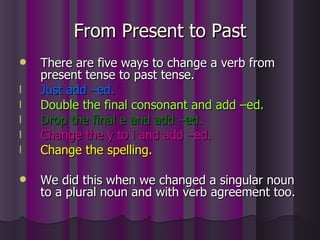
From Present to Past There are five ways to change a verb from present tense to past tense. Just add –ed. Double the final consonant and add –ed. Drop the final e and add –ed. Change the y to i and add –ed. Change the spelling. We did this when we changed a singular noun to a plural noun and with verb agreement too.
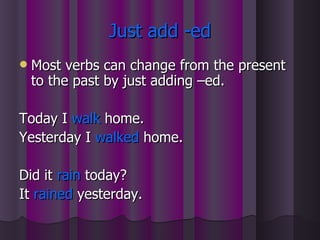
Just add -ed Most verbs can change from the present to the past by just adding –ed. Today I  walk  home. Yesterday I  walked  home. Did it  rain  today? It  rained  yesterday.
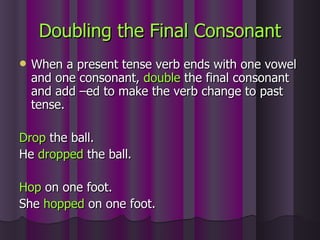
Doubling the Final Consonant When a present tense verb ends with one vowel and one consonant,  double  the final consonant and add –ed to make the verb change to past tense. Drop  the ball. He  dropped  the ball. Hop  on one foot. She  hopped  on one foot.
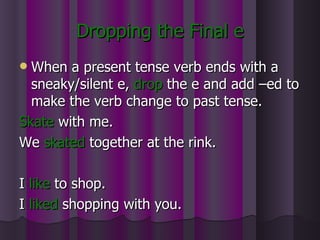
Dropping the Final e When a present tense verb ends with a sneaky/silent e,  drop   the e and add –ed to make the verb change to past tense. Skate  with me. We  skated  together at the rink. I  like  to shop. I  liked  shopping with you.
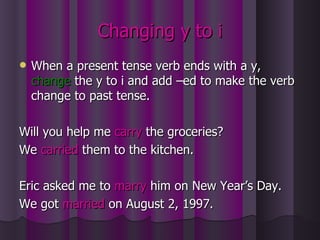
Changing y to i When a present tense verb ends with a y,  change   the y to i and add –ed to make the verb change to past tense. Will you help me  carry  the groceries? We  carried  them to the kitchen. Eric asked me to  marry  him on New Year’s Day. We got  married  on August 2, 1997.
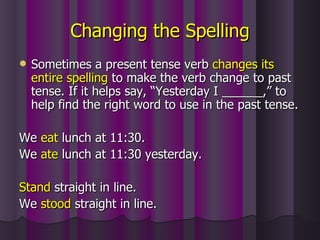
Changing the Spelling Sometimes a present tense verb  changes its   entire spelling  to make the verb change to past tense. If it helps say, “Yesterday I ______,” to help find the right word to use in the past tense. We  eat  lunch at 11:30. We  ate  lunch at 11:30 yesterday. Stand  straight in line. We  stood  straight in line.
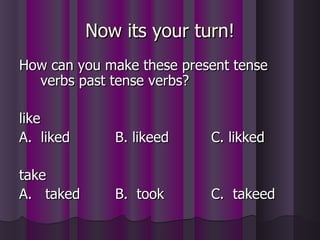
Now its your turn! How can you make these present tense verbs past tense verbs? like A.  liked  B. likeed   C. likked take A.  taked B.  took C.  takeed
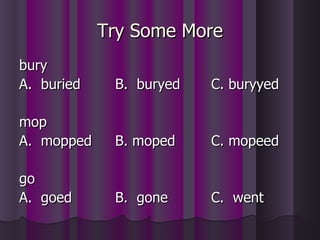
Try Some More bury A.  buried B.  buryed C. buryyed mop A.  mopped  B. moped C. mopeed go A.  goed B.  gone C.  went
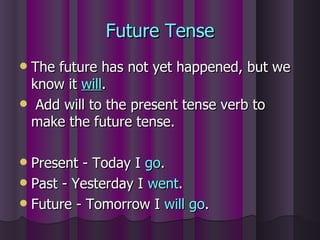
Future Tense The future has not yet happened, but we know it  will .  Add will to the present tense verb to make the future tense. Present - Today I  go . Past - Yesterday I  went . Future - Tomorrow I  will go .
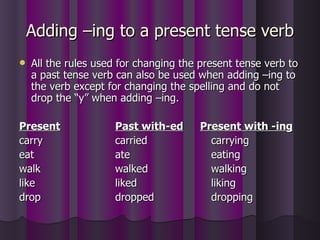
Adding –ing to a present tense verb All the rules used for changing the present tense verb to a past tense verb can also be used when adding –ing to the verb except for changing the spelling and do not drop the “y” when adding –ing. Present Past with-ed   Present with -ing carry carried carrying eat ate eating walk walked walking like liked liking drop dropped dropping

Changing verbs from_present_to_past

  • 1.
    Changing Verbs FromPresent to Past and Future Second Grade Grammar
  • 2.
    Three Tenses ofVerbs Verb Tense past present future
  • 3.
    Past Tense VerbsMost past tense verbs end in “ed”, but there are several rules to use while changing the present to past tense. Past tense verbs tell action that has already happened. Some words change spelling to show past tense. Examples: Beg = begged grow = grew Feed = fed like = liked Run = ran play = played
  • 4.
    Present Tense VerbsActions that happen now or today Some present tense verbs have “ing”, “s”, or “es” on the end of them. Clue words: now, today Examples: Stays plays hikes drives Flies juggles fusses dresses Floats jogs runs carries
  • 5.
    Future tense verbsMany verbs have the helping verb “will” in front of them to show they will be happening. Clue words to look for are: tomorrow, some day, next time, or next week. Examples: Will play will lead will be happy Will have will eat will like
  • 6.
    From Present toPast There are five ways to change a verb from present tense to past tense. Just add –ed. Double the final consonant and add –ed. Drop the final e and add –ed. Change the y to i and add –ed. Change the spelling. We did this when we changed a singular noun to a plural noun and with verb agreement too.
  • 7.
    Just add -edMost verbs can change from the present to the past by just adding –ed. Today I walk home. Yesterday I walked home. Did it rain today? It rained yesterday.
  • 8.
    Doubling the FinalConsonant When a present tense verb ends with one vowel and one consonant, double the final consonant and add –ed to make the verb change to past tense. Drop the ball. He dropped the ball. Hop on one foot. She hopped on one foot.
  • 9.
    Dropping the Finale When a present tense verb ends with a sneaky/silent e, drop the e and add –ed to make the verb change to past tense. Skate with me. We skated together at the rink. I like to shop. I liked shopping with you.
  • 10.
    Changing y toi When a present tense verb ends with a y, change the y to i and add –ed to make the verb change to past tense. Will you help me carry the groceries? We carried them to the kitchen. Eric asked me to marry him on New Year’s Day. We got married on August 2, 1997.
  • 11.
    Changing the SpellingSometimes a present tense verb changes its entire spelling to make the verb change to past tense. If it helps say, “Yesterday I ______,” to help find the right word to use in the past tense. We eat lunch at 11:30. We ate lunch at 11:30 yesterday. Stand straight in line. We stood straight in line.
  • 12.
    Now its yourturn! How can you make these present tense verbs past tense verbs? like A. liked B. likeed C. likked take A. taked B. took C. takeed
  • 13.
    Try Some Morebury A. buried B. buryed C. buryyed mop A. mopped B. moped C. mopeed go A. goed B. gone C. went
  • 14.
    Future Tense Thefuture has not yet happened, but we know it will . Add will to the present tense verb to make the future tense. Present - Today I go . Past - Yesterday I went . Future - Tomorrow I will go .
  • 15.
    Adding –ing toa present tense verb All the rules used for changing the present tense verb to a past tense verb can also be used when adding –ing to the verb except for changing the spelling and do not drop the “y” when adding –ing. Present Past with-ed Present with -ing carry carried carrying eat ate eating walk walked walking like liked liking drop dropped dropping