Parts of Speech
Word Classes
Lexical Categories
The traditional term for a
GRAMMATICAL CLASS of WORDS.
Thennarasu Sakkan
There are many linguistics predictions in different part
of the world.
But in the west, it started with Aristotle in the 4th
century there are part-of-speech categories, lexical
categories, word classes.
But Thrax Alexandria proposed the 8 parts of
speech.
English words have been traditionally classified into
eight parts of speech such noun, pronoun, adjective,
verb, adverb, preposition, conjunction and
interjection.
Open classes are the words which constantly acquire
new members. Noun, Verb, Adjective and Adverb.
Closed classes are the words which acquire new
members infrequently if at all. Pronouns, preposition,
conjunction and interjection etc.
LINGUISTS tend to prefer such terms as WORD-
CLASS FORM-CLASS, where the grouping is based
on FORMAL criteria of a more UNIVERSALLY
applicable kind.
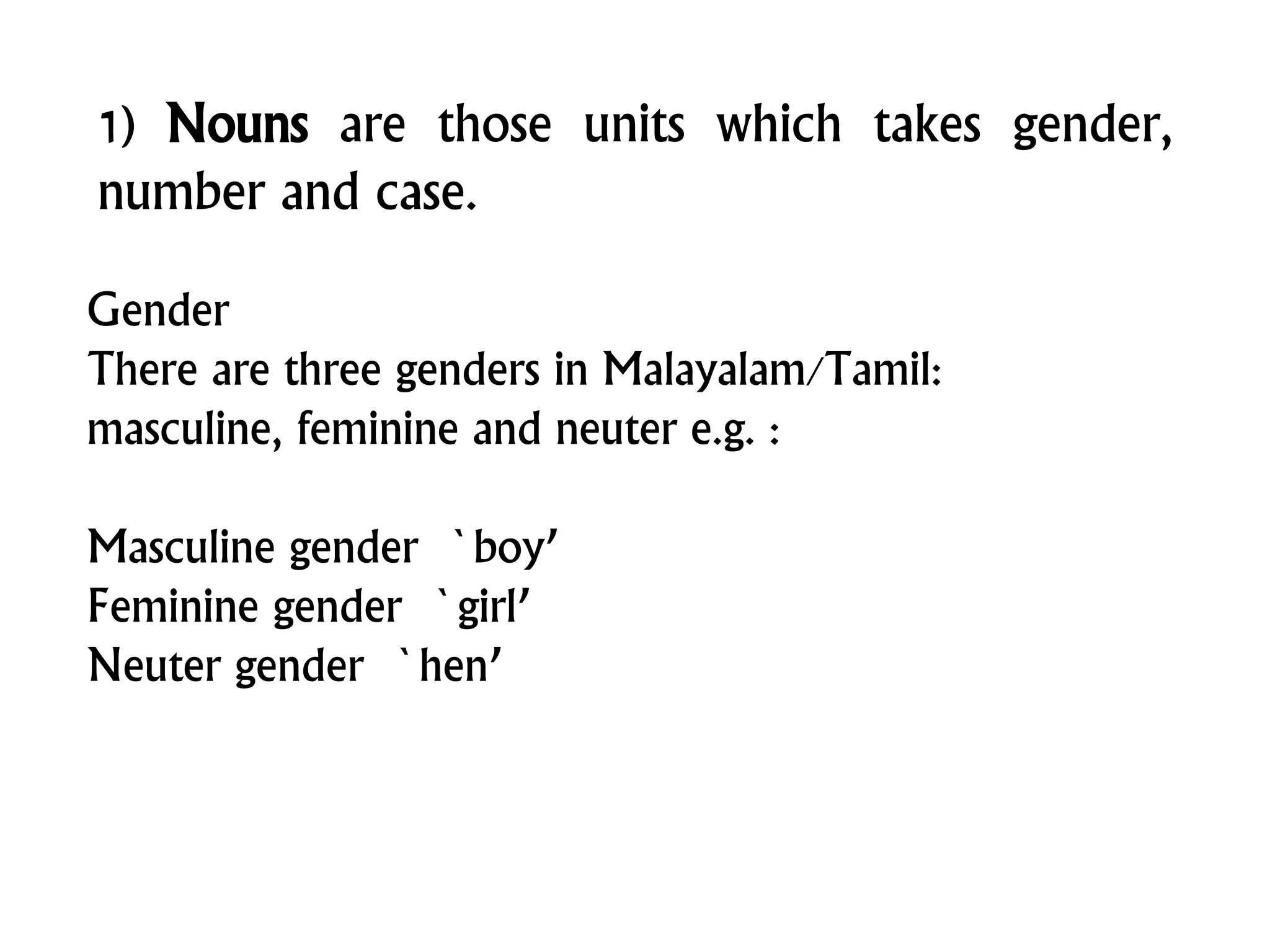
1) Nouns are those units which takes gender,
number and case.
Gender
There are three genders in Malayalam/Tamil:
masculine, feminine and neuter e.g. :
Masculine gender `boy’
Feminine gender `girl’
Neuter gender `hen’
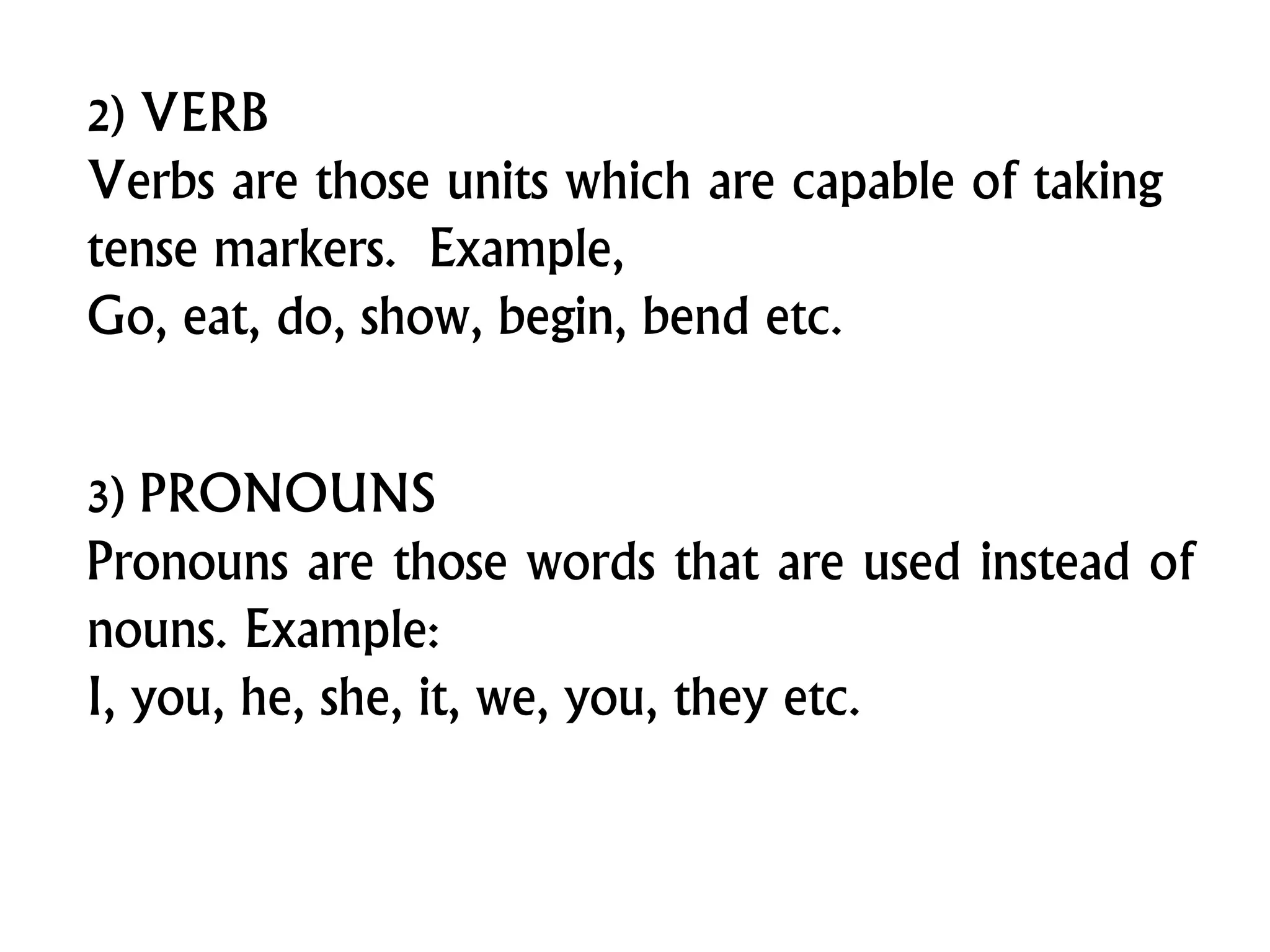
2) VERB
Verbs are those units which are capable of taking
tense markers. Example,
Go, eat, do, show, begin, bend etc.
3) PRONOUNS
Pronouns are those words that are used instead of
nouns. Example:
I, you, he, she, it, we, you, they etc.
4) ADJECTIVE
Cold, hot, good, big, small, sad, old etc.
5) ADVERB
Badly, quietly, slowly, closely, fast etc.
6) DEMONSTRATIVE
This, that , those, these etc.
7) PARTICIPLE
Participles are verb forms that functions as
adjectives. E.g. Running is good for health.
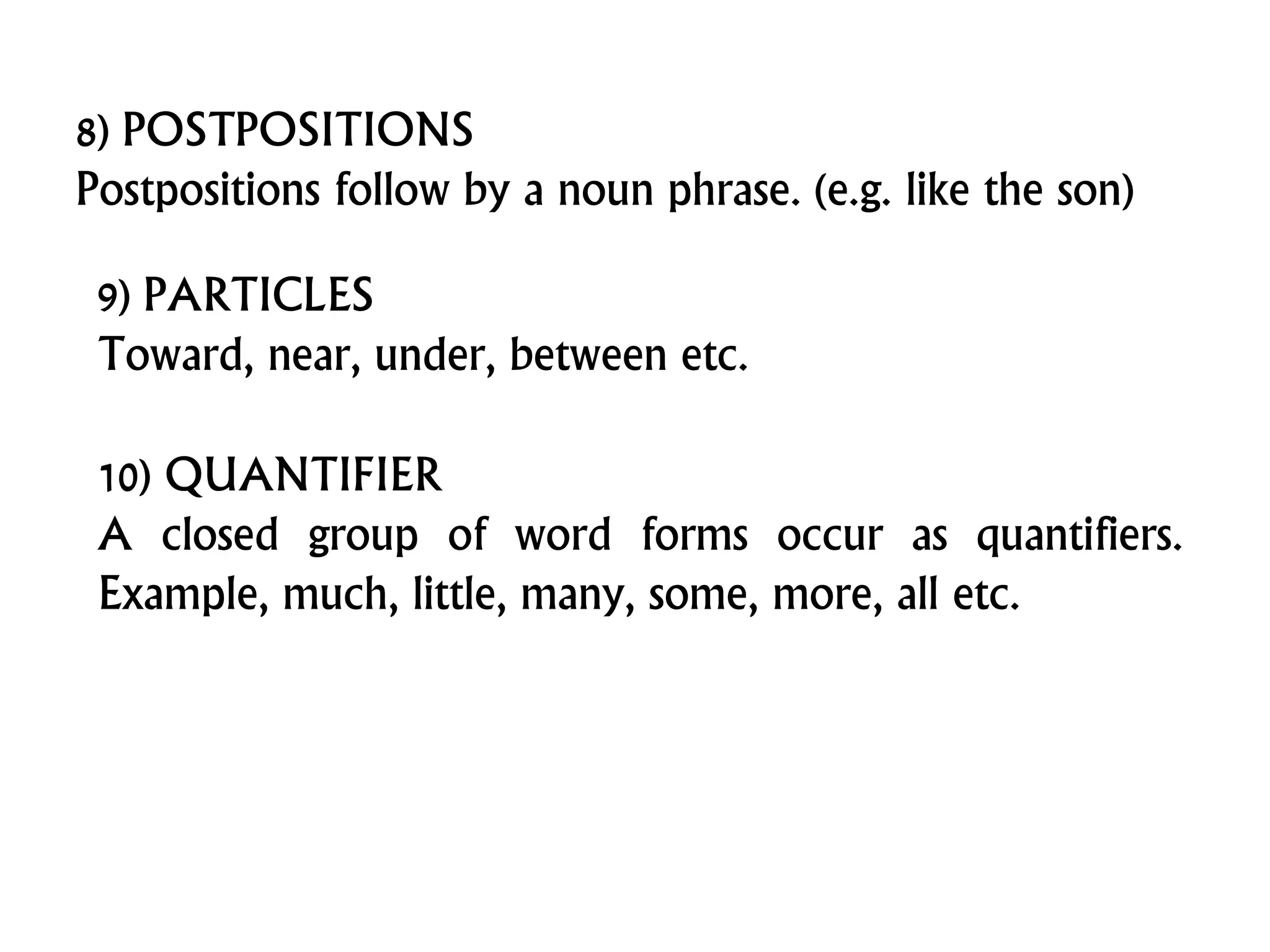
8) POSTPOSITIONS
Postpositions follow by a noun phrase. (e.g. like the son)
9) PARTICLES
Toward, near, under, between etc.
10) QUANTIFIER
A closed group of word forms occur as quantifiers.
Example, much, little, many, some, more, all etc.
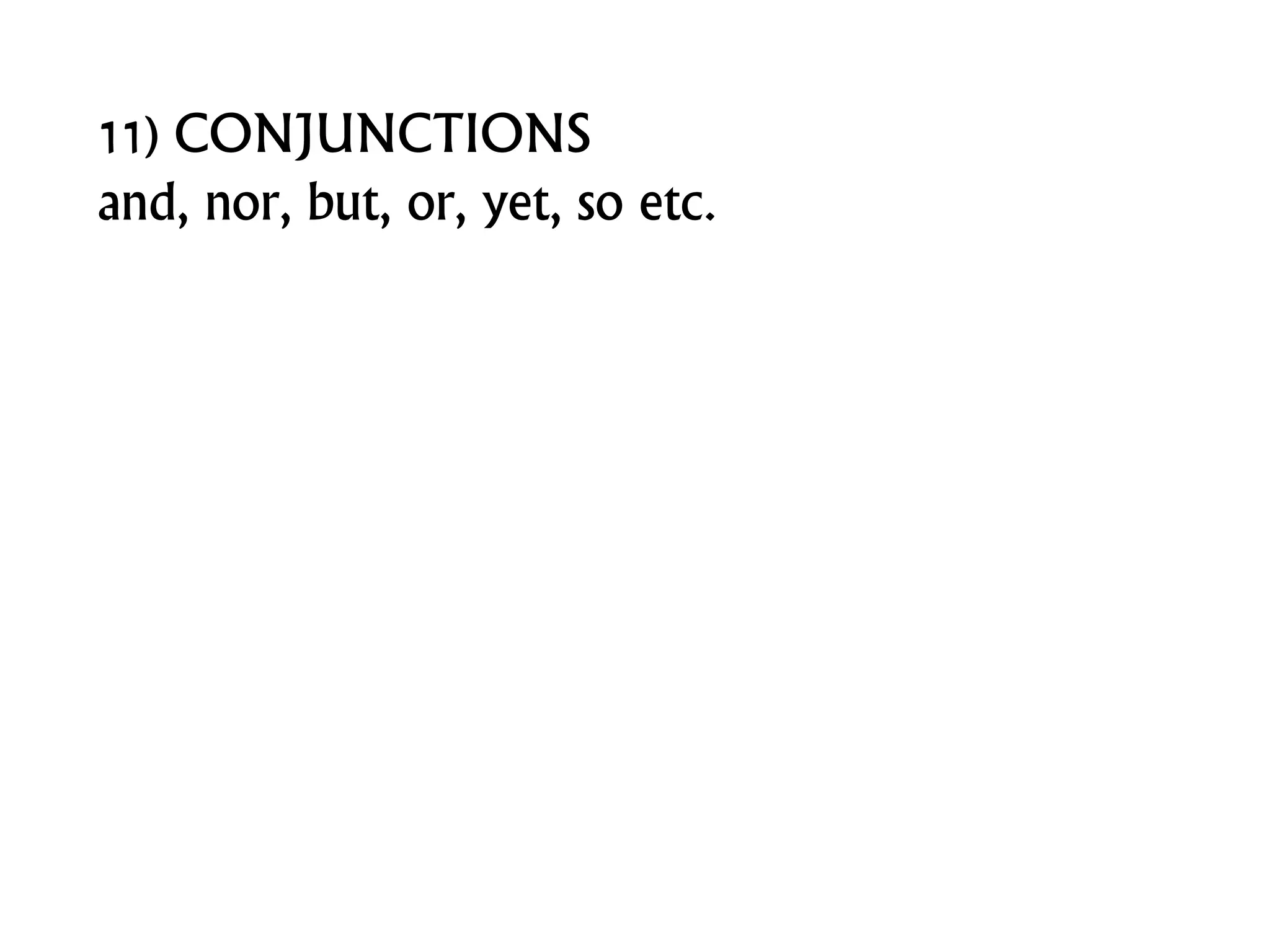
11) CONJUNCTIONS
and, nor, but, or, yet, so etc.
1) Characterize the word classes (noun, verb etc.)
in your (target) language and give 3 examples of
each with translation.
Once there was a boy whose name was Suresh.
He was very clever. One day he went to the market to buy some apples.
When he came back home, he was very hungry and he looked for something to eat.
But he didn't find anything so he decided to eat the apples. But those apples were full
of mud.
As he was washing the apples with water, suddenly his mother appeared and asked
“why are you wasting the water”?
By hearing his mother's voice he splashed the water on himself.
When the mother saw that she became even more angry.
But the boy looked at her with a smile and said, “now let me have a bite”.
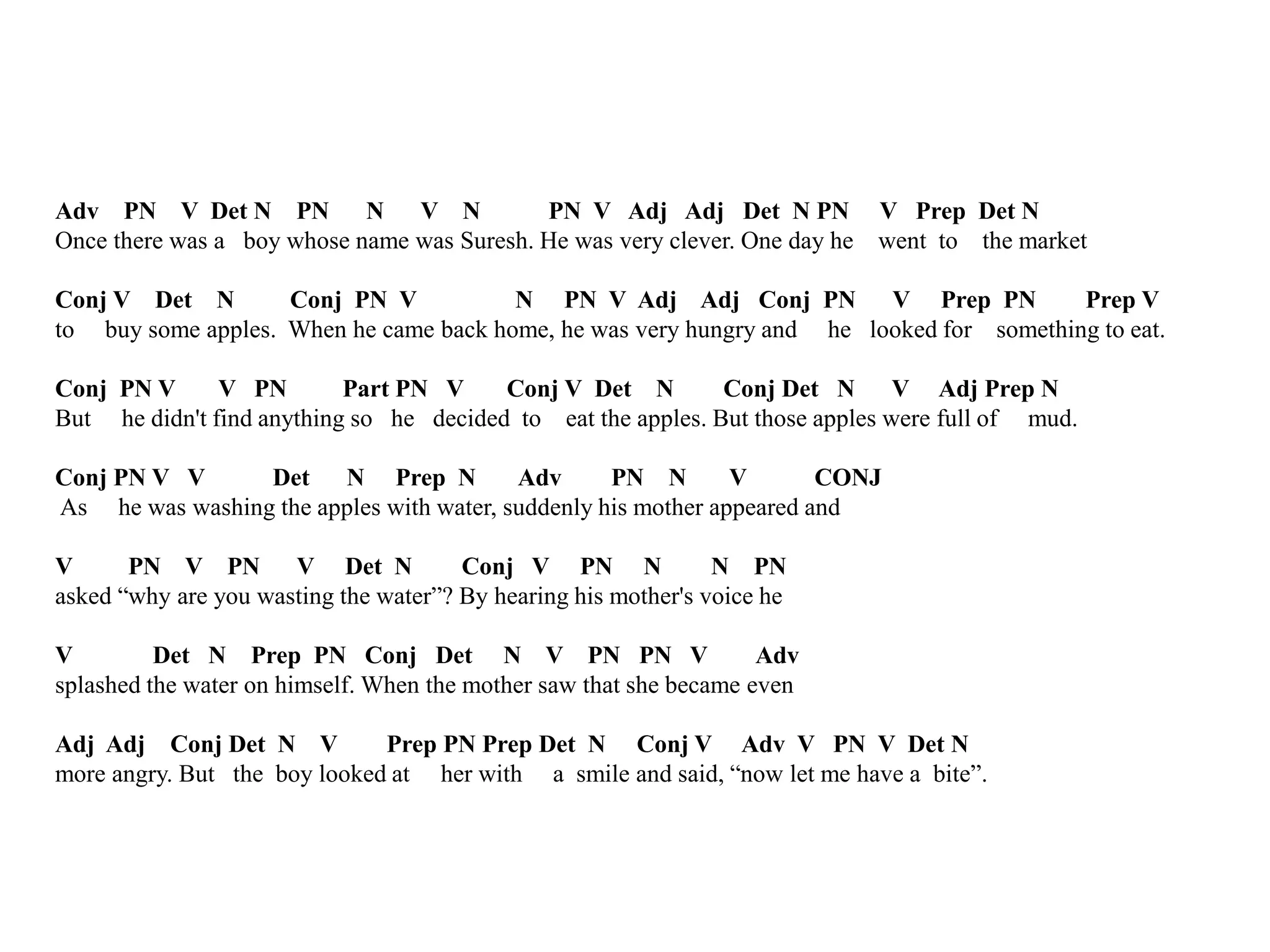
Adv PN V Det N PN N V N PN V Adj Adj Det N PN V Prep Det N
Once there was a boy whose name was Suresh. He was very clever. One day he went to the market
Conj V Det N Conj PN V N PN V Adj Adj Conj PN V Prep PN Prep V
to buy some apples. When he came back home, he was very hungry and he looked for something to eat.
Conj PN V V PN Part PN V Conj V Det N Conj Det N V Adj Prep N
But he didn't find anything so he decided to eat the apples. But those apples were full of mud.
Conj PN V V Det N Prep N Adv PN N V CONJ
As he was washing the apples with water, suddenly his mother appeared and
V PN V PN V Det N Conj V PN N N PN
asked “why are you wasting the water”? By hearing his mother's voice he
V Det N Prep PN Conj Det N V PN PN V Adv
splashed the water on himself. When the mother saw that she became even
Adj Adj Conj Det N V Prep PN Prep Det N Conj V Adv V PN V Det N
more angry. But the boy looked at her with a smile and said, “now let me have a bite”.
Any Questions

10 word classes

  • 1.
    Parts of Speech WordClasses Lexical Categories The traditional term for a GRAMMATICAL CLASS of WORDS. Thennarasu Sakkan
  • 2.
    There are manylinguistics predictions in different part of the world. But in the west, it started with Aristotle in the 4th century there are part-of-speech categories, lexical categories, word classes. But Thrax Alexandria proposed the 8 parts of speech. English words have been traditionally classified into eight parts of speech such noun, pronoun, adjective, verb, adverb, preposition, conjunction and interjection.
  • 3.
    Open classes arethe words which constantly acquire new members. Noun, Verb, Adjective and Adverb. Closed classes are the words which acquire new members infrequently if at all. Pronouns, preposition, conjunction and interjection etc. LINGUISTS tend to prefer such terms as WORD- CLASS FORM-CLASS, where the grouping is based on FORMAL criteria of a more UNIVERSALLY applicable kind.
  • 4.
    1) Nouns arethose units which takes gender, number and case. Gender There are three genders in Malayalam/Tamil: masculine, feminine and neuter e.g. : Masculine gender `boy’ Feminine gender `girl’ Neuter gender `hen’
  • 5.
    2) VERB Verbs arethose units which are capable of taking tense markers. Example, Go, eat, do, show, begin, bend etc. 3) PRONOUNS Pronouns are those words that are used instead of nouns. Example: I, you, he, she, it, we, you, they etc.
  • 6.
    4) ADJECTIVE Cold, hot,good, big, small, sad, old etc. 5) ADVERB Badly, quietly, slowly, closely, fast etc. 6) DEMONSTRATIVE This, that , those, these etc. 7) PARTICIPLE Participles are verb forms that functions as adjectives. E.g. Running is good for health.
  • 7.
    8) POSTPOSITIONS Postpositions followby a noun phrase. (e.g. like the son) 9) PARTICLES Toward, near, under, between etc. 10) QUANTIFIER A closed group of word forms occur as quantifiers. Example, much, little, many, some, more, all etc.
  • 8.
    11) CONJUNCTIONS and, nor,but, or, yet, so etc.
  • 9.
    1) Characterize theword classes (noun, verb etc.) in your (target) language and give 3 examples of each with translation.
  • 10.
    Once there wasa boy whose name was Suresh. He was very clever. One day he went to the market to buy some apples. When he came back home, he was very hungry and he looked for something to eat. But he didn't find anything so he decided to eat the apples. But those apples were full of mud. As he was washing the apples with water, suddenly his mother appeared and asked “why are you wasting the water”? By hearing his mother's voice he splashed the water on himself. When the mother saw that she became even more angry. But the boy looked at her with a smile and said, “now let me have a bite”.
  • 11.
    Adv PN VDet N PN N V N PN V Adj Adj Det N PN V Prep Det N Once there was a boy whose name was Suresh. He was very clever. One day he went to the market Conj V Det N Conj PN V N PN V Adj Adj Conj PN V Prep PN Prep V to buy some apples. When he came back home, he was very hungry and he looked for something to eat. Conj PN V V PN Part PN V Conj V Det N Conj Det N V Adj Prep N But he didn't find anything so he decided to eat the apples. But those apples were full of mud. Conj PN V V Det N Prep N Adv PN N V CONJ As he was washing the apples with water, suddenly his mother appeared and V PN V PN V Det N Conj V PN N N PN asked “why are you wasting the water”? By hearing his mother's voice he V Det N Prep PN Conj Det N V PN PN V Adv splashed the water on himself. When the mother saw that she became even Adj Adj Conj Det N V Prep PN Prep Det N Conj V Adv V PN V Det N more angry. But the boy looked at her with a smile and said, “now let me have a bite”.
  • 12.