Present Perfect Continuous
Tense
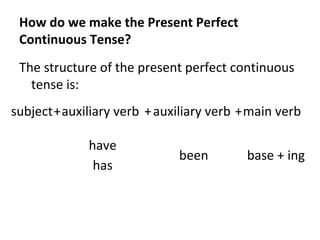
How do we make the Present Perfect
Continuous Tense?
The structure of the present perfect continuous
tense is:
subject+auxiliary verb + auxiliary verb +main verb
have
has

been

base + ing
examples of the present perfect continuous tense:
auxiliary
subject
verb

auxiliary
main verb
verb

+ I

have

been

waiting

for one hour.

+ You

have

been

talking

too much.

- It

has

not

been

raining.

- We

have

not

been

playing

football.

? Have

you

been

seeing

her?

doing

their
homework?

? Have

they

been
Contractions
When we use the present perfect continuous tense in
speaking, we often contract the subject and the
first auxiliary. We also sometimes do this in
informal writing.
I have been

I've been

You have been

You've been

He has been
She has been
It has been
John has been

He's been
She's been
It's been
John's been

We have been

We've been

They have been

They've been
Here are some examples:
• I've been reading.
• The car's been giving trouble.
• We've been playing tennis for two hours.
How do we use the Present Perfect Continuous
Tense?
This tense is called the present perfect
continuous tense. There is usually a
connection with the present or now. There
are basically two uses for the present perfect
continuous tense:
1. An action that has just stopped or recently
stopped
2. An action continuing up to now
1. An action that has just stopped or
recently stopped
• We use the present perfect continuous tense
to talk about an action that started in the past
and stopped recently.
• There is usually a result now.
I'm tired because I've been running.
past

present

--------------

!!!

Recent action.

future

Result now.

•I'm tired [now] because I've been running.
•Why is the grass wet [now]? Has it been raining?
•You don't understand [now] because you haven't
been listening.
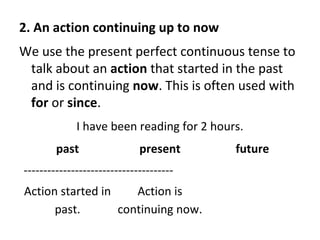
2. An action continuing up to now
We use the present perfect continuous tense to
talk about an action that started in the past
and is continuing now. This is often used with
for or since.
I have been reading for 2 hours.
past

present

-------------------------------------Action started in
Action is
past.
continuing now.

future
Example
• I have been reading for 2 hours. [I am still
reading now.]
• We've been studying since 9 o'clock. [We're
still studying now.]
• How long have you been learning English?
[You are still learning now.]
• We have not been smoking. [And we are not
smoking now.]
For and Since with Present Perfect
Continuous Tense
We often use for and since with the present
perfect tense.
• We use for to talk about a period of time - 5
minutes, 2 weeks, 6 years.
• We use since to talk about a point in past time
- 9 o'clock, 1st January, Monday.
Here are some examples:
•
•
•
•
•
•

I have been studying for 3 hours.
I have been watching TV since 7pm.
Tara hasn't been feeling well for 2 weeks.
Tara hasn't been visiting us since March.
He has been playing football for a long time.
He has been living in Bangkok since he left
school.
For can be used with all tenses. Since is usually
used with perfect tenses only.

Present perfect continuous tense

  • 1.
  • 2.
    How do wemake the Present Perfect Continuous Tense? The structure of the present perfect continuous tense is: subject+auxiliary verb + auxiliary verb +main verb have has been base + ing
  • 3.
    examples of thepresent perfect continuous tense: auxiliary subject verb auxiliary main verb verb + I have been waiting for one hour. + You have been talking too much. - It has not been raining. - We have not been playing football. ? Have you been seeing her? doing their homework? ? Have they been
  • 4.
    Contractions When we usethe present perfect continuous tense in speaking, we often contract the subject and the first auxiliary. We also sometimes do this in informal writing. I have been I've been You have been You've been He has been She has been It has been John has been He's been She's been It's been John's been We have been We've been They have been They've been
  • 5.
    Here are someexamples: • I've been reading. • The car's been giving trouble. • We've been playing tennis for two hours.
  • 6.
    How do weuse the Present Perfect Continuous Tense? This tense is called the present perfect continuous tense. There is usually a connection with the present or now. There are basically two uses for the present perfect continuous tense: 1. An action that has just stopped or recently stopped 2. An action continuing up to now
  • 7.
    1. An actionthat has just stopped or recently stopped • We use the present perfect continuous tense to talk about an action that started in the past and stopped recently. • There is usually a result now.
  • 8.
    I'm tired becauseI've been running. past present -------------- !!! Recent action. future Result now. •I'm tired [now] because I've been running. •Why is the grass wet [now]? Has it been raining? •You don't understand [now] because you haven't been listening.
  • 9.
    2. An actioncontinuing up to now We use the present perfect continuous tense to talk about an action that started in the past and is continuing now. This is often used with for or since. I have been reading for 2 hours. past present -------------------------------------Action started in Action is past. continuing now. future
  • 10.
    Example • I havebeen reading for 2 hours. [I am still reading now.] • We've been studying since 9 o'clock. [We're still studying now.] • How long have you been learning English? [You are still learning now.] • We have not been smoking. [And we are not smoking now.]
  • 11.
    For and Sincewith Present Perfect Continuous Tense We often use for and since with the present perfect tense. • We use for to talk about a period of time - 5 minutes, 2 weeks, 6 years. • We use since to talk about a point in past time - 9 o'clock, 1st January, Monday.
  • 12.
    Here are someexamples: • • • • • • I have been studying for 3 hours. I have been watching TV since 7pm. Tara hasn't been feeling well for 2 weeks. Tara hasn't been visiting us since March. He has been playing football for a long time. He has been living in Bangkok since he left school. For can be used with all tenses. Since is usually used with perfect tenses only.