We can use the PRESENT PERFECT
  CONTINUOUS tense to talk about the
duration of events. How long something has
              been happening


                          Anastasya Nindya E.
                                  X5
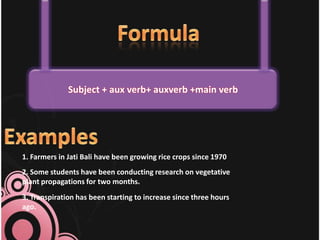
Subject + aux verb+ auxverb +main verb


1. Farmers in Jati Bali have been growing rice crops since 1970
2. Some students have been conducting research on vegetative
plant propagations for two months.
3. Transpiration has been starting to increase since three hours
ago.
subject   auxiliary         auxiliary   main verb
              verb              verb

+   I         have              been        waiting     for one hour.


+   You       have              been        talking     too much.

-   It        has         not   been        raining.

-   We        have        not   been        playing     football.

?   Have      you               been        seeing      her?

?   Have      they              been        doing       their
                                                        homework?
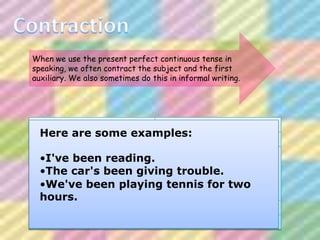
When we use the present perfect continuous tense in
speaking, we often contract the subject and the first
auxiliary. We also sometimes do this in informal writing.


I have been                       I've been
  Here are some examples:
You have been      You've been

He has been                He's been
    •I've been reading. She's been
She has been
It has been car's been giving trouble.
    •The                   It's been
    •We've been playing tennis for
John has been              John's been               two
  hours.
The car has been           The car's been

We have been                      We've been

They have been                    They've been
We use the present perfect continuous tense to talk
about an action that started in tusually he past and
     stopped recently. There is a result now.
We use the present perfect continuous tense to talk
 about an action that started in the past and is
        continuing now. This is often used
                with for or since.


                      Examples:

                      1. I have been reading for 2 hours. [I am still reading now.]
                      2. We've been studying since 9 o'clock. [We're still
                      studying now.]
                      3. How long have you been learning English? [You are still
                      learning now.]
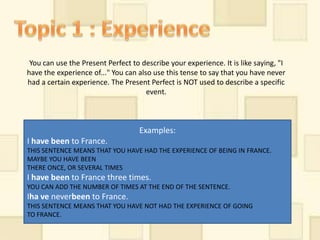
You can use the Present Perfect to describe your experience. It is like saying, "I
have the experience of..." You can also use this tense to say that you have never
had a certain experience. The Present Perfect is NOT used to describe a specific
                                      event.


                                    Examples:
I have been to France.
THIS SENTENCE MEANS THAT YOU HAVE HAD THE EXPERIENCE OF BEING IN FRANCE.
MAYBE YOU HAVE BEEN
THERE ONCE, OR SEVERAL TIMES
I have been to France three times.
YOU CAN ADD THE NUMBER OF TIMES AT THE END OF THE SENTENCE.
Iha ve neverbeen to France.
THIS SENTENCE MEANS THAT YOU HAVE NOT HAD THE EXPERIENCE OF GOING
TO FRANCE.
We often use the Present Perfect to talk about change that has happened
                            over a period of time


Examples:

1. You have grown since the last time I saw you.
2. The government has become more interested in arts education.
3. Japanese has become one of the most popular courses at the
university since the Asian studies program was established.
4. My English has really improved since I moved to Australia.
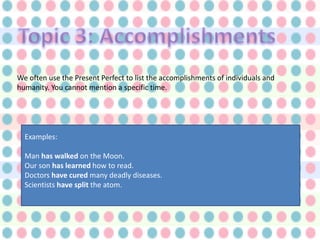
We often use the Present Perfect to list the accomplishments of individuals and
humanity. You cannot mention a specific time.


  Examples:

  Man has walked on the Moon.
  Our son has learned how to read.
  Doctors have cured many deadly diseases.
  Scientists have split the atom.
We often use the Present Perfect to say that an action which we expected
 has not happened. Using the Present Perfect suggests that we are still
                    waiting for the action to happen


Examples:

James has not finished his homework yet.
Susan hasn't mastered Japanese, but she can communicate.
Bill has still not arrived.
The rain hasn't stopped.
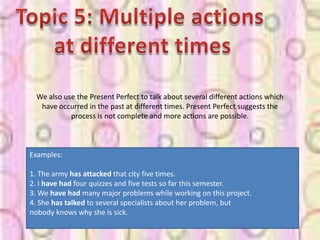
We also use the Present Perfect to talk about several different actions which
  have occurred in the past at different times. Present Perfect suggests the
           process is not complete and more actions are possible.


Examples:

1. The army has attacked that city five times.
2. I have had four quizzes and five tests so far this semester.
3. We have had many major problems while working on this project.
4. She has talked to several specialists about her problem, but
nobody knows why she is sick.
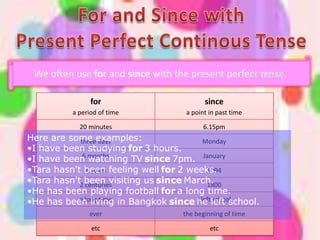
We often use for and since with the present perfect tense.

                for                       since
          a period of time          a point in past time

            20 minutes                    6.15pm
Here are some examples:
            three days                    Monday
•I have been studying for 3 hours.
•I have been months
             6
                watching TV since 7pm. January
•Tara hasn't been feeling well for 2 weeks.
               4 years                     1994
•Tara hasn't2 been visiting us since March.
              centuries                    1800
•He has been playing football for a long time.
•He has been living in Bangkok since he left school.
            a long time                I left school

               ever                the beginning of time

                etc                         etc
You can also use the Present Perfect Continuous WITHOUT a duration such
        as "for two weeks." Without the duration, the tense has a more general
          meaning of "lately." We often use the words "lately" or "recently" to
                                emphasize this meaning.


Examples:

Recently, I have been feeling really tired.
She has been watching too much television lately.
Have you been exercising lately?
Mary has been feeling a little depressed.
Lisa has not been practicing her English.
What have you been doing?
It is important to remember that Non-continuous verbs cannot be
      used in any continuous tenses. Also, certain non-continuous meanings
      for mixed verbs cannot be used in continuous tenses. Instead of using
        Present Perfect Continuous with these verbs, you must use Present
                                     perfect


Examples:

•Sam has been having his car for two years. Not Correct
•Sam has had his car for two years. Correct
The examples below show the placement for
                        grammar adverbs such as: always, only, never, ever,
                                         still, just, etc.


Examples:

1. You have only been waiting here for one hour.
2. Have you only been waiting here for one hour?
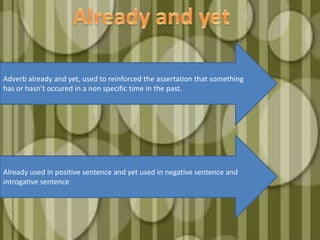
Adverb already and yet, used to reinforced the assertation that something
has or hasn’t occured in a non specific time in the past.


Already used in positive sentence and yet used in negative sentence and
introgative sentence
Already typically placed between the auxiliary verb and verb3. in addition, already
may be placed after the sentence without changing the meaning of the sentence.


              Subject + (has/have) + already + been +
                            (verb1+ing)


           Subject + (has/have) + been + (verb1+ing) +
                            already
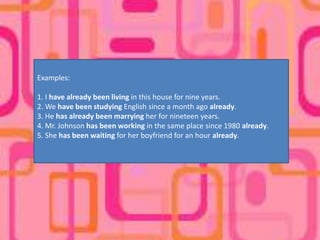
Examples:

1. I have already been living in this house for nine years.
2. We have been studying English since a month ago already.
3. He has already been marrying her for nineteen years.
4. Mr. Johnson has been working in the same place since 1980 already.
5. She has been waiting for her boyfriend for an hour already.
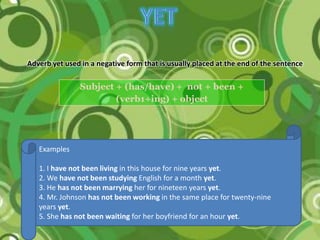
Adverb yet used in a negative form that is usually placed at the end of the sentence

                Subject + (has/have) + not + been +
                        (verb1+ing) + object


   Examples

   1. I have not been living in this house for nine years yet.
   2. We have not been studying English for a month yet.
   3. He has not been marrying her for nineteen years yet.
   4. Mr. Johnson has not been working in the same place for twenty-nine
   years yet.
   5. She has not been waiting for her boyfriend for an hour yet.

present perfect continuous tense

  • 1.
    We can usethe PRESENT PERFECT CONTINUOUS tense to talk about the duration of events. How long something has been happening Anastasya Nindya E. X5
  • 2.
    Subject + auxverb+ auxverb +main verb 1. Farmers in Jati Bali have been growing rice crops since 1970 2. Some students have been conducting research on vegetative plant propagations for two months. 3. Transpiration has been starting to increase since three hours ago.
  • 3.
    subject auxiliary auxiliary main verb verb verb + I have been waiting for one hour. + You have been talking too much. - It has not been raining. - We have not been playing football. ? Have you been seeing her? ? Have they been doing their homework?
  • 4.
    When we usethe present perfect continuous tense in speaking, we often contract the subject and the first auxiliary. We also sometimes do this in informal writing. I have been I've been Here are some examples: You have been You've been He has been He's been •I've been reading. She's been She has been It has been car's been giving trouble. •The It's been •We've been playing tennis for John has been John's been two hours. The car has been The car's been We have been We've been They have been They've been
  • 5.
    We use thepresent perfect continuous tense to talk about an action that started in tusually he past and stopped recently. There is a result now.
  • 6.
    We use thepresent perfect continuous tense to talk about an action that started in the past and is continuing now. This is often used with for or since. Examples: 1. I have been reading for 2 hours. [I am still reading now.] 2. We've been studying since 9 o'clock. [We're still studying now.] 3. How long have you been learning English? [You are still learning now.]
  • 8.
    You can usethe Present Perfect to describe your experience. It is like saying, "I have the experience of..." You can also use this tense to say that you have never had a certain experience. The Present Perfect is NOT used to describe a specific event. Examples: I have been to France. THIS SENTENCE MEANS THAT YOU HAVE HAD THE EXPERIENCE OF BEING IN FRANCE. MAYBE YOU HAVE BEEN THERE ONCE, OR SEVERAL TIMES I have been to France three times. YOU CAN ADD THE NUMBER OF TIMES AT THE END OF THE SENTENCE. Iha ve neverbeen to France. THIS SENTENCE MEANS THAT YOU HAVE NOT HAD THE EXPERIENCE OF GOING TO FRANCE.
  • 9.
    We often usethe Present Perfect to talk about change that has happened over a period of time Examples: 1. You have grown since the last time I saw you. 2. The government has become more interested in arts education. 3. Japanese has become one of the most popular courses at the university since the Asian studies program was established. 4. My English has really improved since I moved to Australia.
  • 10.
    We often usethe Present Perfect to list the accomplishments of individuals and humanity. You cannot mention a specific time. Examples: Man has walked on the Moon. Our son has learned how to read. Doctors have cured many deadly diseases. Scientists have split the atom.
  • 11.
    We often usethe Present Perfect to say that an action which we expected has not happened. Using the Present Perfect suggests that we are still waiting for the action to happen Examples: James has not finished his homework yet. Susan hasn't mastered Japanese, but she can communicate. Bill has still not arrived. The rain hasn't stopped.
  • 12.
    We also usethe Present Perfect to talk about several different actions which have occurred in the past at different times. Present Perfect suggests the process is not complete and more actions are possible. Examples: 1. The army has attacked that city five times. 2. I have had four quizzes and five tests so far this semester. 3. We have had many major problems while working on this project. 4. She has talked to several specialists about her problem, but nobody knows why she is sick.
  • 13.
    We often usefor and since with the present perfect tense. for since a period of time a point in past time 20 minutes 6.15pm Here are some examples: three days Monday •I have been studying for 3 hours. •I have been months 6 watching TV since 7pm. January •Tara hasn't been feeling well for 2 weeks. 4 years 1994 •Tara hasn't2 been visiting us since March. centuries 1800 •He has been playing football for a long time. •He has been living in Bangkok since he left school. a long time I left school ever the beginning of time etc etc
  • 14.
    You can alsouse the Present Perfect Continuous WITHOUT a duration such as "for two weeks." Without the duration, the tense has a more general meaning of "lately." We often use the words "lately" or "recently" to emphasize this meaning. Examples: Recently, I have been feeling really tired. She has been watching too much television lately. Have you been exercising lately? Mary has been feeling a little depressed. Lisa has not been practicing her English. What have you been doing?
  • 15.
    It is importantto remember that Non-continuous verbs cannot be used in any continuous tenses. Also, certain non-continuous meanings for mixed verbs cannot be used in continuous tenses. Instead of using Present Perfect Continuous with these verbs, you must use Present perfect Examples: •Sam has been having his car for two years. Not Correct •Sam has had his car for two years. Correct
  • 16.
    The examples belowshow the placement for grammar adverbs such as: always, only, never, ever, still, just, etc. Examples: 1. You have only been waiting here for one hour. 2. Have you only been waiting here for one hour?
  • 17.
    Adverb already andyet, used to reinforced the assertation that something has or hasn’t occured in a non specific time in the past. Already used in positive sentence and yet used in negative sentence and introgative sentence
  • 18.
    Already typically placedbetween the auxiliary verb and verb3. in addition, already may be placed after the sentence without changing the meaning of the sentence. Subject + (has/have) + already + been + (verb1+ing) Subject + (has/have) + been + (verb1+ing) + already
  • 19.
    Examples: 1. I havealready been living in this house for nine years. 2. We have been studying English since a month ago already. 3. He has already been marrying her for nineteen years. 4. Mr. Johnson has been working in the same place since 1980 already. 5. She has been waiting for her boyfriend for an hour already.
  • 20.
    Adverb yet usedin a negative form that is usually placed at the end of the sentence Subject + (has/have) + not + been + (verb1+ing) + object Examples 1. I have not been living in this house for nine years yet. 2. We have not been studying English for a month yet. 3. He has not been marrying her for nineteen years yet. 4. Mr. Johnson has not been working in the same place for twenty-nine years yet. 5. She has not been waiting for her boyfriend for an hour yet.