Present Perfect Tense
• The present perfect tense is a rather
important tense in English, but it gives
speakers of some languages a difficult time.
• That is because it uses concepts or ideas that
do not exist in those languages.
• In fact, the structure of the present perfect
tense is very simple.
• The problems come with the use of the tense.
In this lesson we look at the structure and use of
the present perfect
• Structure: how to make the present perfect
tense
• Use: when and why to use the present perfect
tense
• For and Since with the present perfect tense.
What's the difference?
• Present Perfect Quiz
NOTE
• The present perfect tense is really a very
interesting tense, and a very useful one.
• Try not to translate the present perfect tense
into your language.
• Just try to accept the concepts of this tense
and learn to "think" present perfect! You will
soon learn to like the present perfect tense!
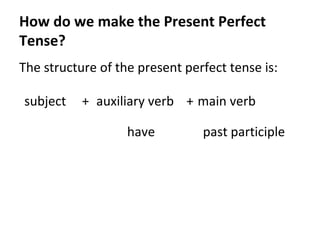
How do we make the Present Perfect
Tense?
The structure of the present perfect tense is:
subject

+ auxiliary verb + main verb
have

past participle
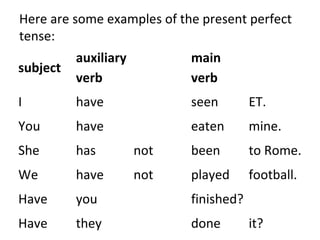
Here are some examples of the present perfect
tense:
subject

auxiliary
verb

main
verb

I

have

seen

ET.

You

have

eaten

mine.

She

has

not

been

to Rome.

We

have

not

played

football.

Have

you

finished?

Have

they

done

it?
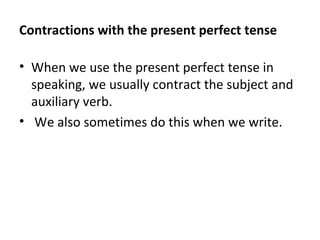
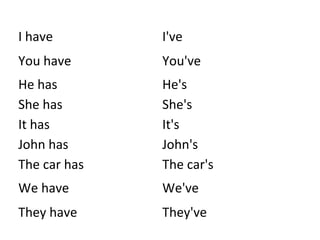
Contractions with the present perfect tense
• When we use the present perfect tense in
speaking, we usually contract the subject and
auxiliary verb.
• We also sometimes do this when we write.
I have

I've

You have

You've

He has
She has
It has
John has
The car has

He's
She's
It's
John's
The car's

We have

We've

They have

They've
Here are some examples:
• I've finished my work.
• John's seen ET.
• They've gone home.
He's or he's??? Be careful! The 's contraction is
used for the auxiliary verbs have and be. For
example, "It's eaten" can mean:
• It has eaten. [present perfect tense, active
voice]
• It is eaten. [present tense, passive voice]
It is usually clear from the context.
How do we use the Present Perfect
Tense?

This tense is called the present perfect tense.
There is always a connection with the past
and with the present. There are basically
three uses for the present perfect tense:
• experience
• change
• continuing situation
1. Present perfect tense for experience
• We often use the present perfect tense to talk
about experience from the past.
• We are not interested in when you did
something. We only want to know if you did
it:
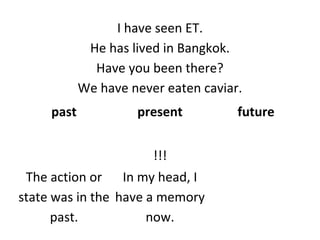
I have seen ET.
He has lived in Bangkok.
Have you been there?
We have never eaten caviar.
past

present
!!!

The action or In my head, I
state was in the have a memory
past.
now.

future
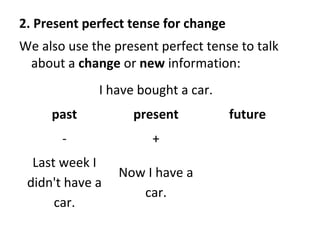
2. Present perfect tense for change
We also use the present perfect tense to talk
about a change or new information:
I have bought a car.
past

present

-

+

Last week I
didn't have a
car.

Now I have a
car.

future
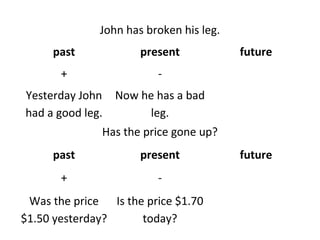
John has broken his leg.
past

present

+

-

Yesterday John
had a good leg.

future

Now he has a bad
leg.

Has the price gone up?
past

present

+

-

Was the price Is the price $1.70
$1.50 yesterday?
today?

future
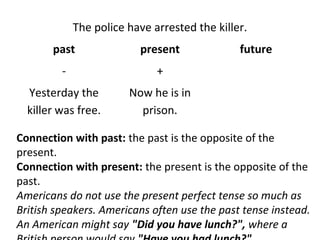
The police have arrested the killer.
past

present

-

+

Yesterday the
killer was free.

future

Now he is in
prison.

Connection with past: the past is the opposite of the
present.
Connection with present: the present is the opposite of the
past.
Americans do not use the present perfect tense so much as
British speakers. Americans often use the past tense instead.
An American might say "Did you have lunch?", where a
3. Present perfect tense for continuing situation
• We often use the present perfect tense to talk
about a continuing situation.
• This is a state that started in the past and
continues in the present (and will probably
continue into the future).
• This is a state (not an action). We usually use
for or since with this structure.
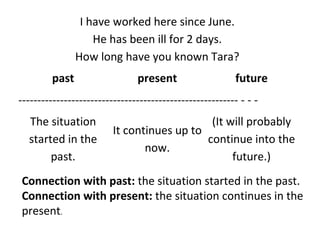
I have worked here since June.
He has been ill for 2 days.
How long have you known Tara?
past

present

future

---------------------------------------------------------- - - The situation
started in the
past.

(It will probably
It continues up to
continue into the
now.
future.)

Connection with past: the situation started in the past.
Connection with present: the situation continues in the
present.
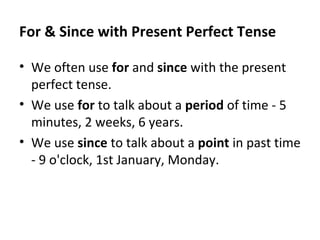
For & Since with Present Perfect Tense
• We often use for and since with the present
perfect tense.
• We use for to talk about a period of time - 5
minutes, 2 weeks, 6 years.
• We use since to talk about a point in past time
- 9 o'clock, 1st January, Monday.
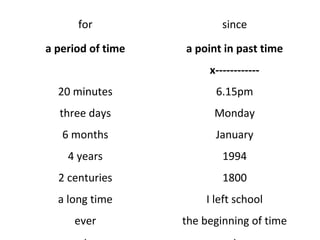
for

since

a period of time

a point in past time
x------------

20 minutes

6.15pm

three days

Monday

6 months

January

4 years

1994

2 centuries

1800

a long time

I left school

ever

the beginning of time
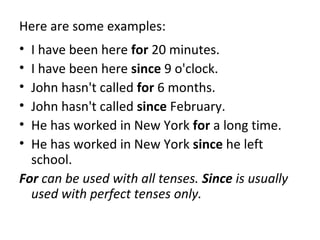
Here are some examples:
•
•
•
•
•
•

I have been here for 20 minutes.
I have been here since 9 o'clock.
John hasn't called for 6 months.
John hasn't called since February.
He has worked in New York for a long time.
He has worked in New York since he left
school.
For can be used with all tenses. Since is usually
used with perfect tenses only.

Present perfect tense

  • 1.
  • 2.
    • The presentperfect tense is a rather important tense in English, but it gives speakers of some languages a difficult time. • That is because it uses concepts or ideas that do not exist in those languages. • In fact, the structure of the present perfect tense is very simple. • The problems come with the use of the tense.
  • 3.
    In this lessonwe look at the structure and use of the present perfect • Structure: how to make the present perfect tense • Use: when and why to use the present perfect tense • For and Since with the present perfect tense. What's the difference? • Present Perfect Quiz
  • 4.
    NOTE • The presentperfect tense is really a very interesting tense, and a very useful one. • Try not to translate the present perfect tense into your language. • Just try to accept the concepts of this tense and learn to "think" present perfect! You will soon learn to like the present perfect tense!
  • 5.
    How do wemake the Present Perfect Tense? The structure of the present perfect tense is: subject + auxiliary verb + main verb have past participle
  • 6.
    Here are someexamples of the present perfect tense: subject auxiliary verb main verb I have seen ET. You have eaten mine. She has not been to Rome. We have not played football. Have you finished? Have they done it?
  • 7.
    Contractions with thepresent perfect tense • When we use the present perfect tense in speaking, we usually contract the subject and auxiliary verb. • We also sometimes do this when we write.
  • 8.
    I have I've You have You've Hehas She has It has John has The car has He's She's It's John's The car's We have We've They have They've
  • 9.
    Here are someexamples: • I've finished my work. • John's seen ET. • They've gone home. He's or he's??? Be careful! The 's contraction is used for the auxiliary verbs have and be. For example, "It's eaten" can mean: • It has eaten. [present perfect tense, active voice] • It is eaten. [present tense, passive voice] It is usually clear from the context.
  • 10.
    How do weuse the Present Perfect Tense? This tense is called the present perfect tense. There is always a connection with the past and with the present. There are basically three uses for the present perfect tense: • experience • change • continuing situation
  • 11.
    1. Present perfecttense for experience • We often use the present perfect tense to talk about experience from the past. • We are not interested in when you did something. We only want to know if you did it:
  • 12.
    I have seenET. He has lived in Bangkok. Have you been there? We have never eaten caviar. past present !!! The action or In my head, I state was in the have a memory past. now. future
  • 13.
    2. Present perfecttense for change We also use the present perfect tense to talk about a change or new information: I have bought a car. past present - + Last week I didn't have a car. Now I have a car. future
  • 14.
    John has brokenhis leg. past present + - Yesterday John had a good leg. future Now he has a bad leg. Has the price gone up? past present + - Was the price Is the price $1.70 $1.50 yesterday? today? future
  • 15.
    The police havearrested the killer. past present - + Yesterday the killer was free. future Now he is in prison. Connection with past: the past is the opposite of the present. Connection with present: the present is the opposite of the past. Americans do not use the present perfect tense so much as British speakers. Americans often use the past tense instead. An American might say "Did you have lunch?", where a
  • 16.
    3. Present perfecttense for continuing situation • We often use the present perfect tense to talk about a continuing situation. • This is a state that started in the past and continues in the present (and will probably continue into the future). • This is a state (not an action). We usually use for or since with this structure.
  • 17.
    I have workedhere since June. He has been ill for 2 days. How long have you known Tara? past present future ---------------------------------------------------------- - - The situation started in the past. (It will probably It continues up to continue into the now. future.) Connection with past: the situation started in the past. Connection with present: the situation continues in the present.
  • 18.
    For & Sincewith Present Perfect Tense • We often use for and since with the present perfect tense. • We use for to talk about a period of time - 5 minutes, 2 weeks, 6 years. • We use since to talk about a point in past time - 9 o'clock, 1st January, Monday.
  • 19.
    for since a period oftime a point in past time x------------ 20 minutes 6.15pm three days Monday 6 months January 4 years 1994 2 centuries 1800 a long time I left school ever the beginning of time
  • 20.
    Here are someexamples: • • • • • • I have been here for 20 minutes. I have been here since 9 o'clock. John hasn't called for 6 months. John hasn't called since February. He has worked in New York for a long time. He has worked in New York since he left school. For can be used with all tenses. Since is usually used with perfect tenses only.