



PHRASAL
VERBS
Introduction
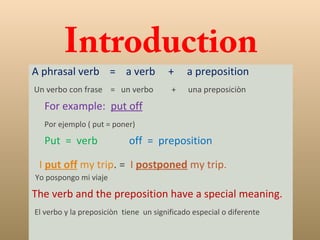
A phrasal verb = a verb + a preposition
Un verbo con frase = un verbo + una preposiciòn
For example: put off
Por ejemplo ( put = poner)
Put = verb off = preposition
I put off my trip. = I postponed my trip.
Yo pospongo mi viaje
The verb and the preposition have a special meaning.
El verbo y la preposiciòn tiene un significado especial o diferente
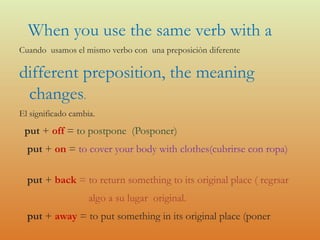
When you use the same verb with a
Cuando usamos el mismo verbo con una preposiciòn diferente
different preposition, the meaning
changes.
El significado cambia.
put + off = to postpone (Posponer)
put + on = to cover your body with clothes(cubrirse con ropa)
put + back = to return something to its original place ( regrsar
algo a su lugar original.
put + away = to put something in its original place (poner
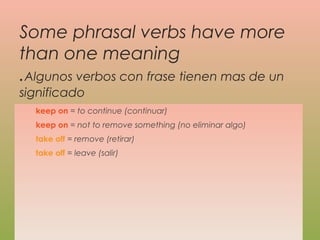
Some phrasal verbs have more
than one meaning
.Algunos verbos con frase tienen mas de un
significado
keep on = to continue (continuar)
keep on = not to remove something (no eliminar algo)
take off = remove (retirar)
take off = leave (salir)
•They are very common,
especially in informal
English.
• Estos phrasal verbs es muy comùn usarlos
especialmente en el Inglès informal.
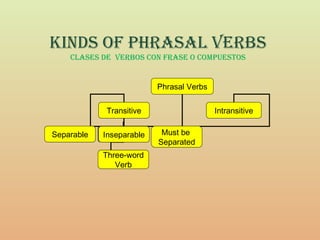
Kinds of Phrasal Verbs
clases de Verbos con frase o comPuestos
Phrasal Verbs
Transitive Intransitive
InseparableSeparable Must be
Separated
Three-word
Verb
Intransitive Phrasal
Verbs
These verbs do not have objects.
Tony’s car broke down.
Jane grew up in a small town.
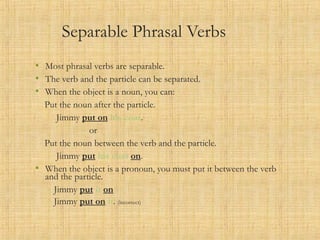
Separable Phrasal Verbs
• Most phrasal verbs are separable.
• The verb and the particle can be separated.
• When the object is a noun, you can:
Put the noun after the particle.
Jimmy put on his coat.
or
Put the noun between the verb and the particle.
Jimmy put his coat on.
• When the object is a pronoun, you must put it between the verb
and the particle.
Jimmy put it on
Jimmy put on it. (incorrect)
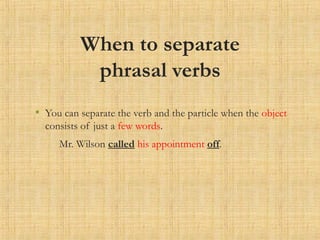
When to separate
phrasal verbs
• You can separate the verb and the particle when the object
consists of just a few words.
Mr. Wilson called his appointment off.
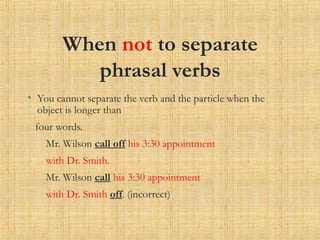
When not to separate
phrasal verbs
• You cannot separate the verb and the particle when the
object is longer than
four words.
Mr. Wilson call off his 3:30 appointment
with Dr. Smith.
Mr. Wilson call his 3:30 appointment
with Dr. Smith off. (incorrect)
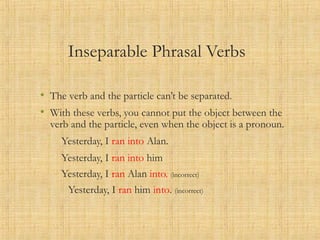
Inseparable Phrasal Verbs
• The verb and the particle can’t be separated.
• With these verbs, you cannot put the object between the
verb and the particle, even when the object is a pronoun.
Yesterday, I ran into Alan.
Yesterday, I ran into him
Yesterday, I ran Alan into. (incorrect)
Yesterday, I ran him into. (incorrect)
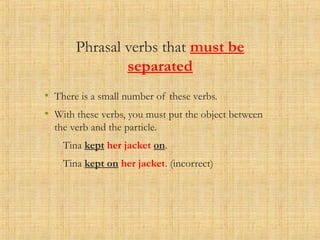
Phrasal verbs that must be
separated
• There is a small number of these verbs.
• With these verbs, you must put the object between
the verb and the particle.
Tina kept her jacket on.
Tina kept on her jacket. (incorrect)
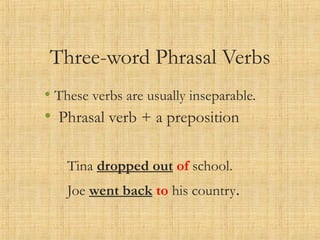
Three-word Phrasal Verbs
• These verbs are usually inseparable.
• Phrasal verb + a preposition
Tina dropped out of school.
Joe went back to his country.
REVIEW
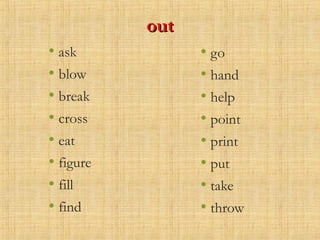
Two Word Phrasal Verbs
outout
• ask
• blow
• break
• cross
• eat
• figure
• fill
• find
• go
• hand
• help
• point
• print
• put
• take
• throw
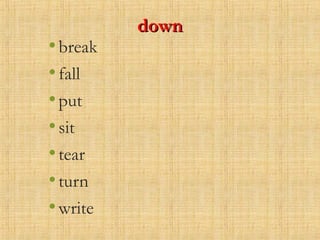
downdown
•break
•fall
•put
•sit
•tear
•turn
•write
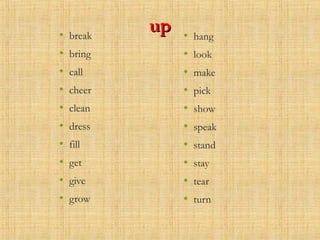
upup• break
• bring
• call
• cheer
• clean
• dress
• fill
• get
• give
• grow
• hang
• look
• make
• pick
• show
• speak
• stand
• stay
• tear
• turn
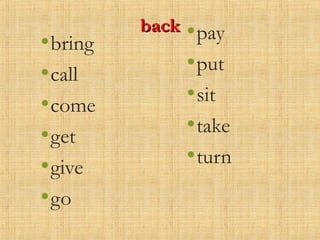
backback
•bring
•call
•come
•get
•give
•go
•pay
•put
•sit
•take
•turn
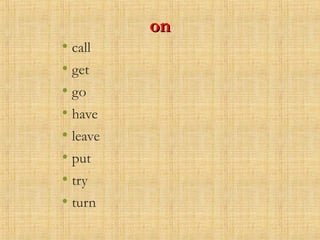
onon
• call
• get
• go
• have
• leave
• put
• try
• turn
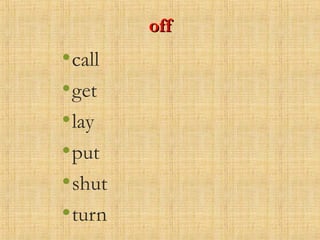
offoff
•call
•get
•lay
•put
•shut
•turn
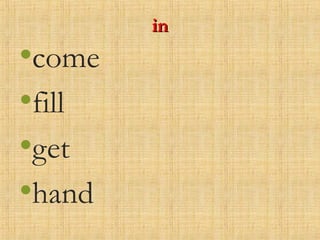
inin
•come
•fill
•get
•hand
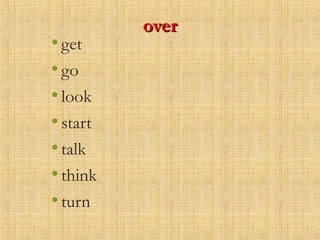
overover
•get
•go
•look
•start
•talk
•think
•turn
Review
Three Word Phrasal Verbs
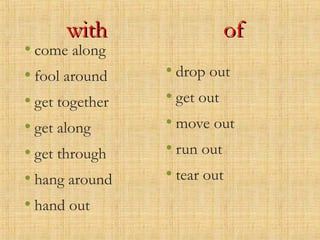
withwith
• come along
• fool around
• get together
• get along
• get through
• hang around
• hand out
ofof
• drop out
• get out
• move out
• run out
• tear out
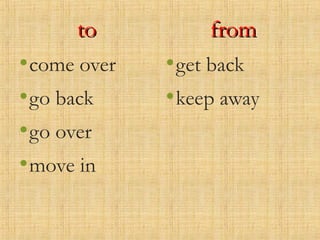
toto
•come over
•go back
•go over
•move in
fromfrom
•get back
•keep away
How can I learn the phrasal verbs?
By heartBy heart !!
Phrasal verbs

Phrasal verbs

  • 1.
  • 2.
    Introduction A phrasal verb= a verb + a preposition Un verbo con frase = un verbo + una preposiciòn For example: put off Por ejemplo ( put = poner) Put = verb off = preposition I put off my trip. = I postponed my trip. Yo pospongo mi viaje The verb and the preposition have a special meaning. El verbo y la preposiciòn tiene un significado especial o diferente
  • 3.
    When you usethe same verb with a Cuando usamos el mismo verbo con una preposiciòn diferente different preposition, the meaning changes. El significado cambia. put + off = to postpone (Posponer) put + on = to cover your body with clothes(cubrirse con ropa) put + back = to return something to its original place ( regrsar algo a su lugar original. put + away = to put something in its original place (poner
  • 4.
    Some phrasal verbshave more than one meaning .Algunos verbos con frase tienen mas de un significado keep on = to continue (continuar) keep on = not to remove something (no eliminar algo) take off = remove (retirar) take off = leave (salir)
  • 5.
    •They are verycommon, especially in informal English. • Estos phrasal verbs es muy comùn usarlos especialmente en el Inglès informal.
  • 6.
    Kinds of PhrasalVerbs clases de Verbos con frase o comPuestos Phrasal Verbs Transitive Intransitive InseparableSeparable Must be Separated Three-word Verb
  • 7.
    Intransitive Phrasal Verbs These verbsdo not have objects. Tony’s car broke down. Jane grew up in a small town.
  • 8.
    Separable Phrasal Verbs •Most phrasal verbs are separable. • The verb and the particle can be separated. • When the object is a noun, you can: Put the noun after the particle. Jimmy put on his coat. or Put the noun between the verb and the particle. Jimmy put his coat on. • When the object is a pronoun, you must put it between the verb and the particle. Jimmy put it on Jimmy put on it. (incorrect)
  • 9.
    When to separate phrasalverbs • You can separate the verb and the particle when the object consists of just a few words. Mr. Wilson called his appointment off.
  • 10.
    When not toseparate phrasal verbs • You cannot separate the verb and the particle when the object is longer than four words. Mr. Wilson call off his 3:30 appointment with Dr. Smith. Mr. Wilson call his 3:30 appointment with Dr. Smith off. (incorrect)
  • 11.
    Inseparable Phrasal Verbs •The verb and the particle can’t be separated. • With these verbs, you cannot put the object between the verb and the particle, even when the object is a pronoun. Yesterday, I ran into Alan. Yesterday, I ran into him Yesterday, I ran Alan into. (incorrect) Yesterday, I ran him into. (incorrect)
  • 12.
    Phrasal verbs thatmust be separated • There is a small number of these verbs. • With these verbs, you must put the object between the verb and the particle. Tina kept her jacket on. Tina kept on her jacket. (incorrect)
  • 13.
    Three-word Phrasal Verbs •These verbs are usually inseparable. • Phrasal verb + a preposition Tina dropped out of school. Joe went back to his country.
  • 14.
  • 15.
    outout • ask • blow •break • cross • eat • figure • fill • find • go • hand • help • point • print • put • take • throw
  • 16.
  • 17.
    upup• break • bring •call • cheer • clean • dress • fill • get • give • grow • hang • look • make • pick • show • speak • stand • stay • tear • turn
  • 18.
  • 19.
    onon • call • get •go • have • leave • put • try • turn
  • 20.
  • 21.
  • 22.
  • 23.
  • 24.
    withwith • come along •fool around • get together • get along • get through • hang around • hand out ofof • drop out • get out • move out • run out • tear out
  • 25.
    toto •come over •go back •goover •move in fromfrom •get back •keep away
  • 26.
    How can Ilearn the phrasal verbs? By heartBy heart !!