By Sofea, Doreen and Jeremy
PRESENT PERFECT TENSE
&
PRESENT PERFECT
CONTINUOUS TENSE
PRESENT PERFECT
TENSE
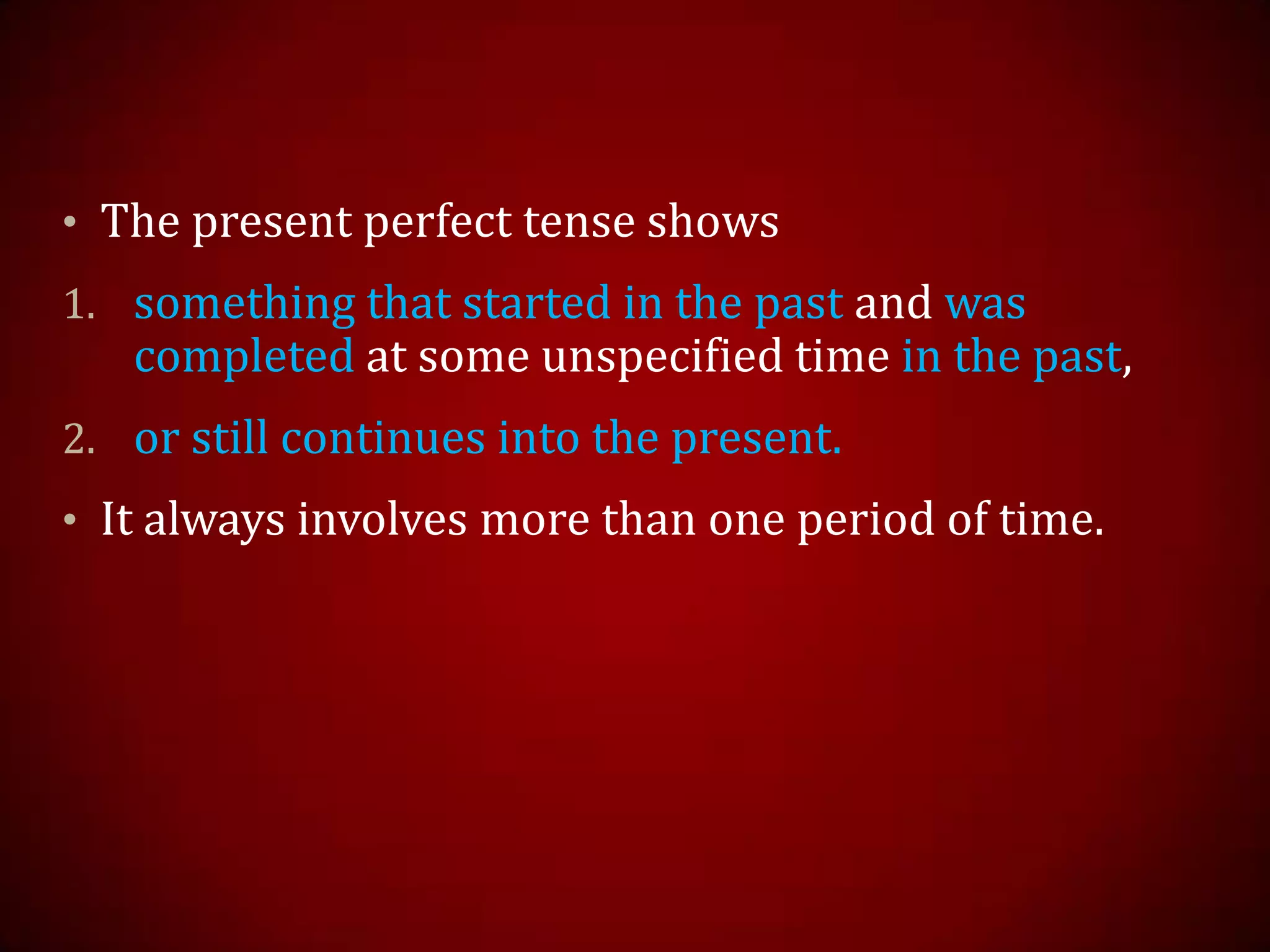
• The present perfect tense shows
1. something that started in the past and was
completed at some unspecified time in the past,
2. or still continues into the present.
• It always involves more than one period of time.
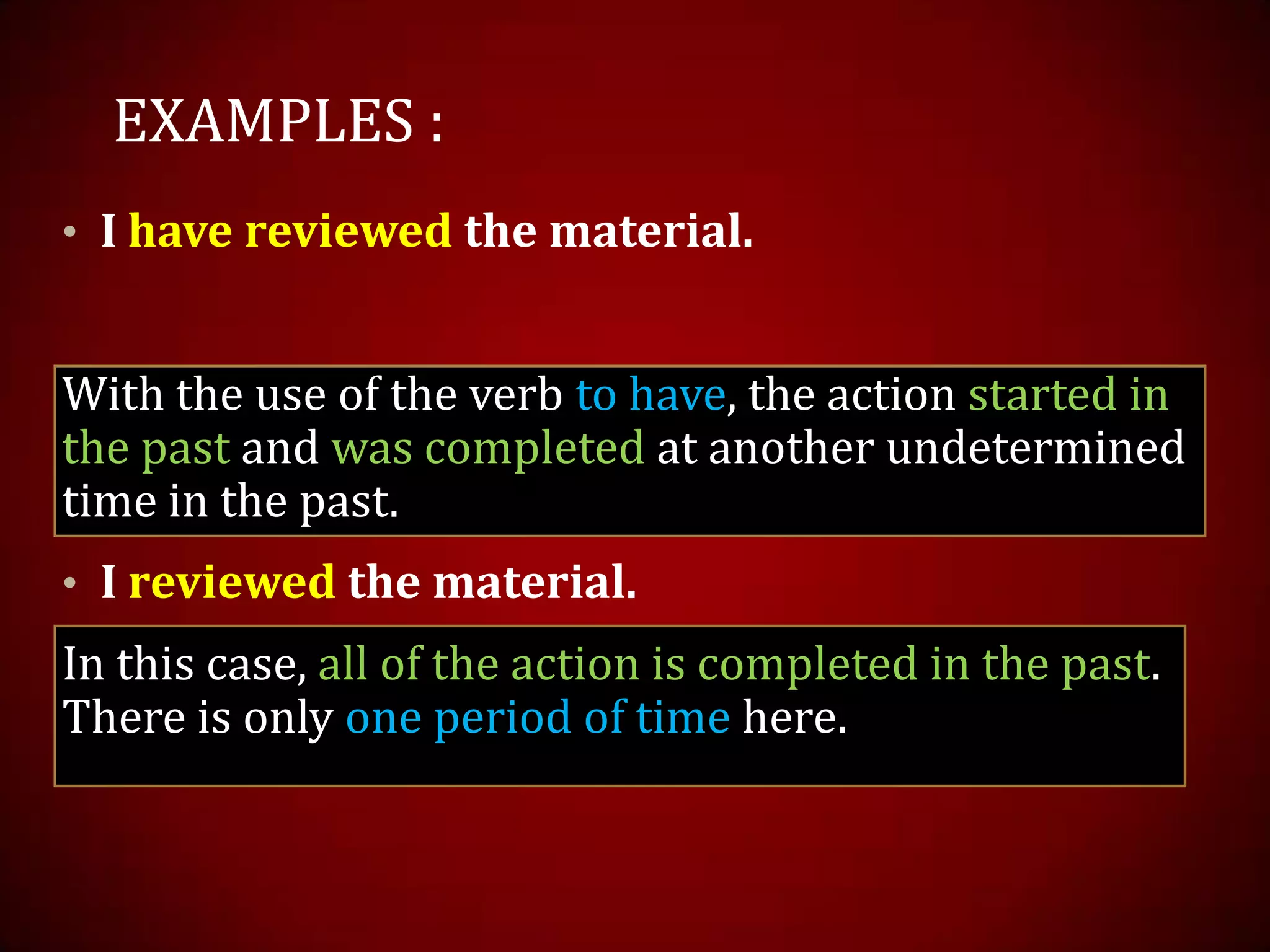
EXAMPLES :
• I have reviewed the material.
With the use of the verb to have, the action started in
the past and was completed at another undetermined
time in the past.
• I reviewed the material.
In this case, all of the action is completed in the past.
There is only one period of time here.
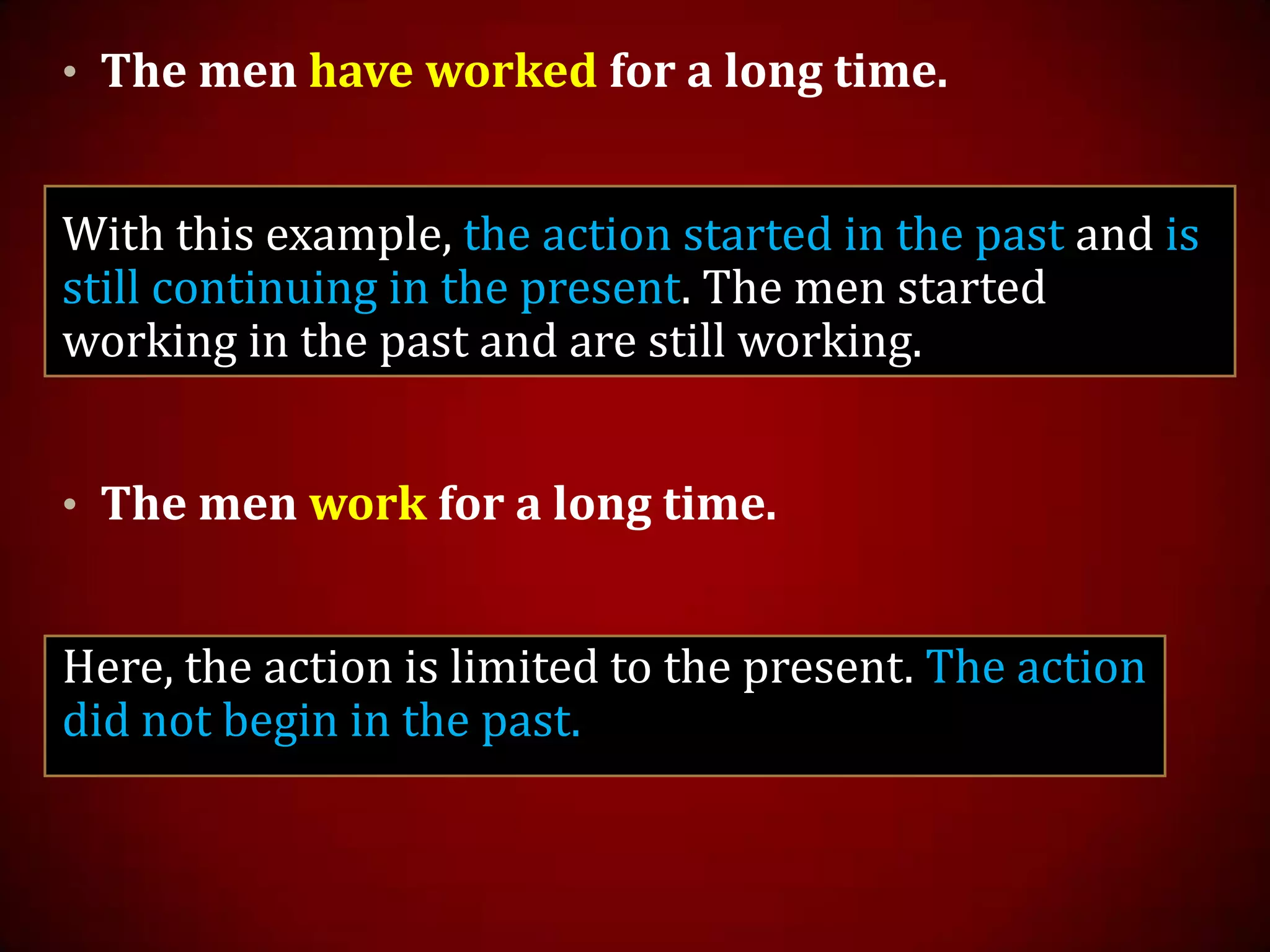
• The men have worked for a long time.
With this example, the action started in the past and is
still continuing in the present. The men started
working in the past and are still working.
• The men work for a long time.
Here, the action is limited to the present. The action
did not begin in the past.
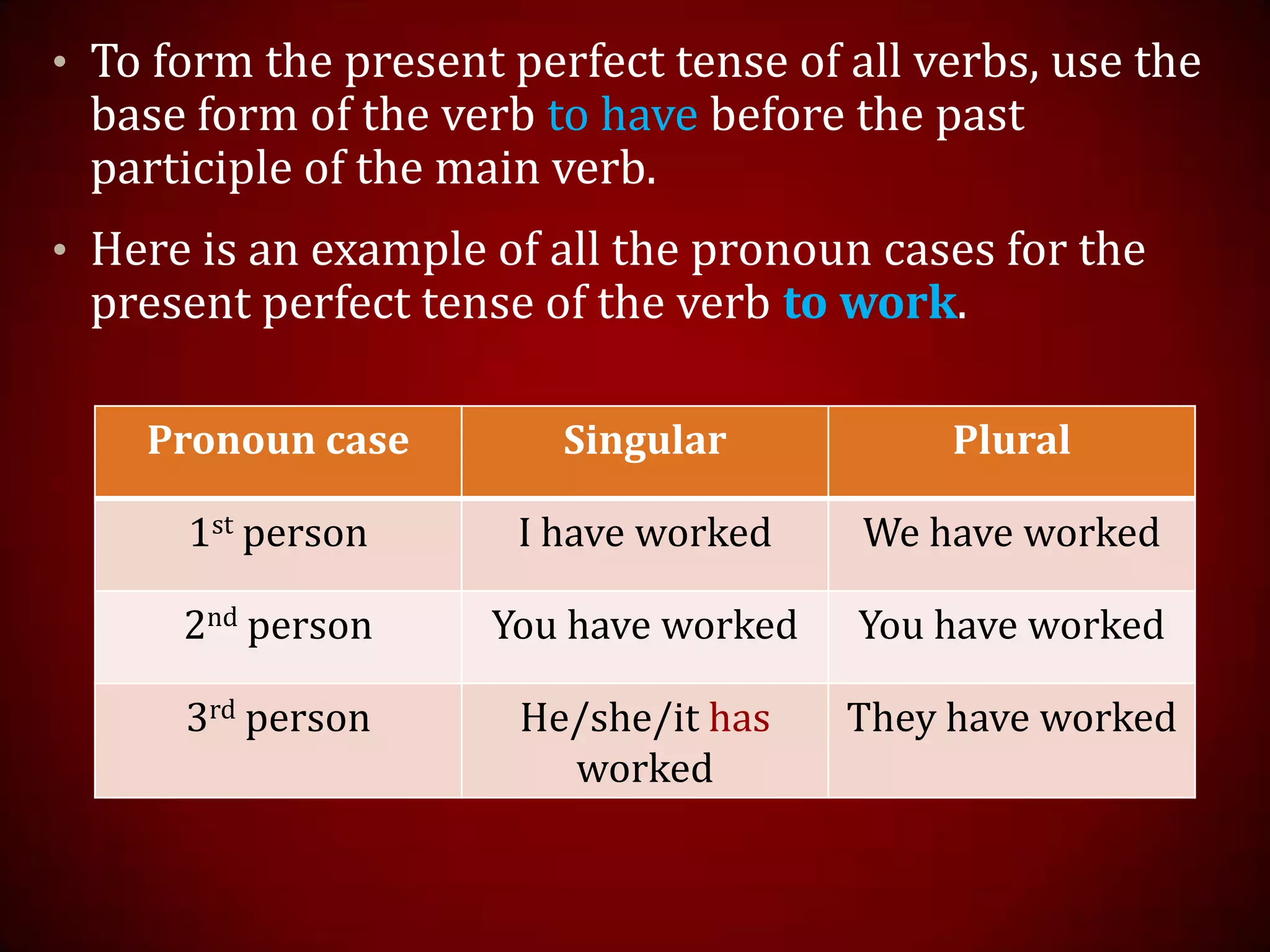
• To form the present perfect tense of all verbs, use the
base form of the verb to have before the past
participle of the main verb.
• Here is an example of all the pronoun cases for the
present perfect tense of the verb to work.
Pronoun case Singular Plural
1st person I have worked We have worked
2nd person You have worked You have worked
3rd person He/she/it has
worked
They have worked
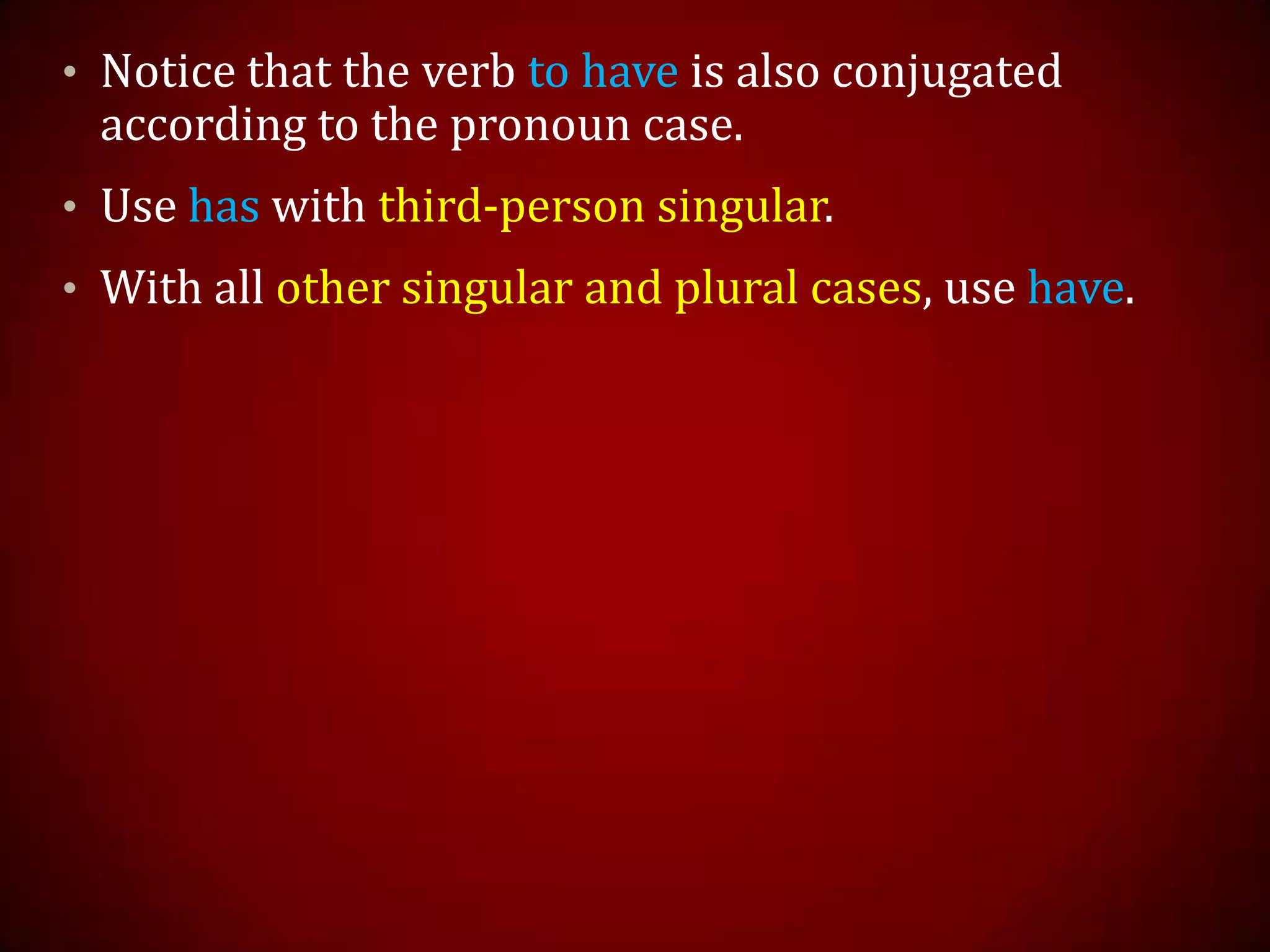
• Notice that the verb to have is also conjugated
according to the pronoun case.
• Use has with third-person singular.
• With all other singular and plural cases, use have.
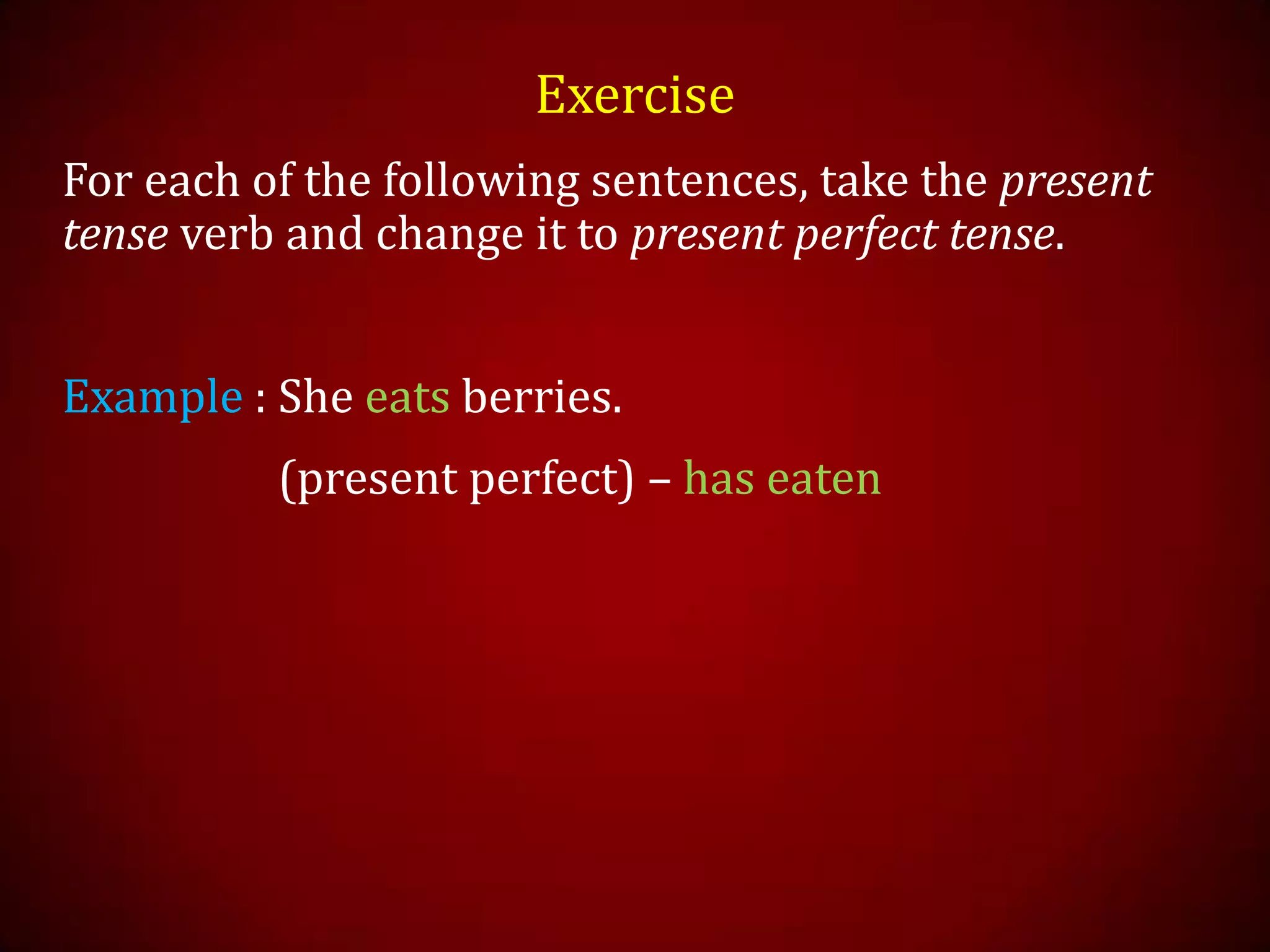
Exercise
For each of the following sentences, take the present
tense verb and change it to present perfect tense.
Example : She eats berries.
(present perfect) – has eaten
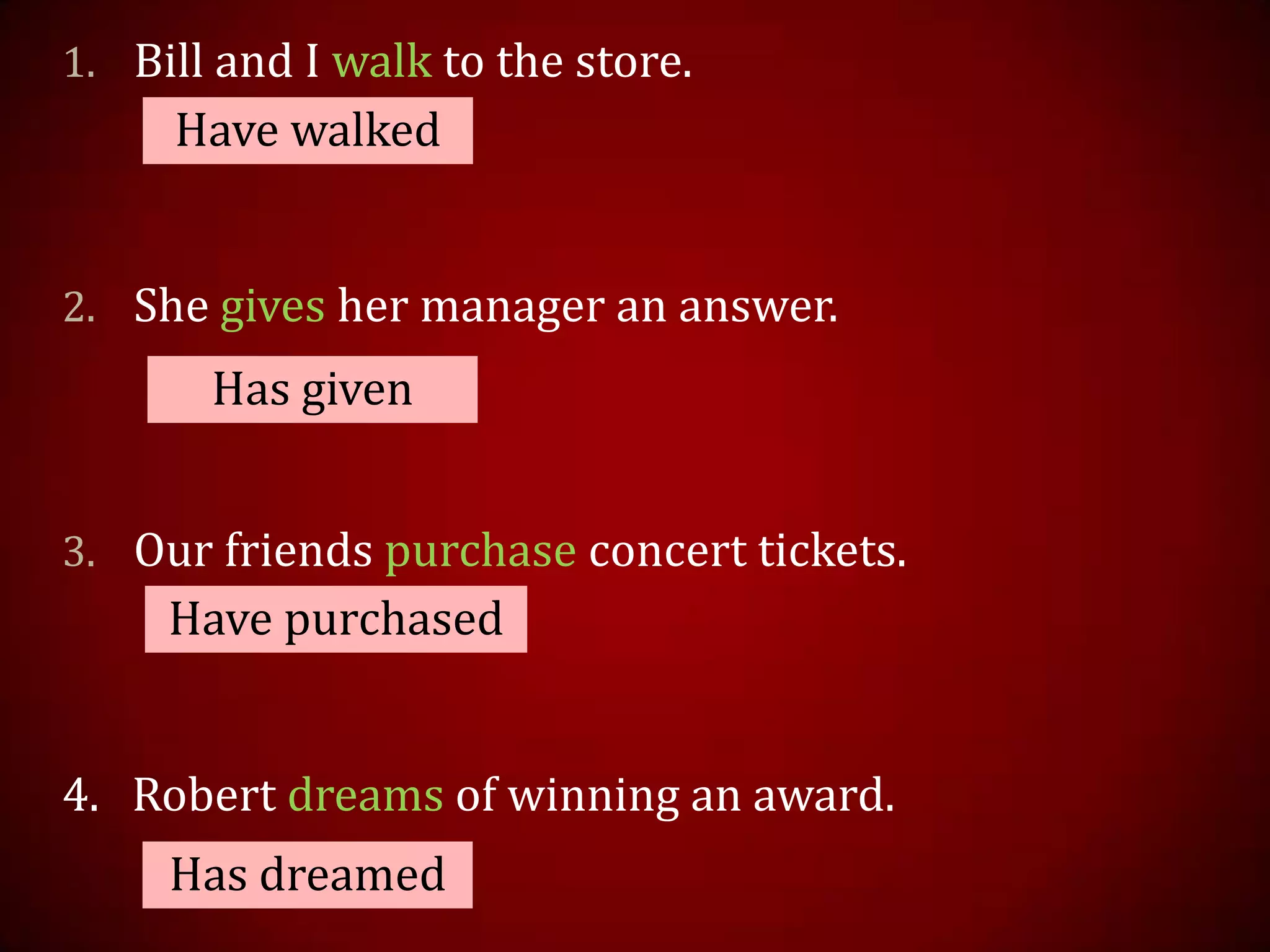
1. Bill and I walk to the store.
2. She gives her manager an answer.
3. Our friends purchase concert tickets.
4. Robert dreams of winning an award.
Have walked
Has given
Have purchased
Has dreamed
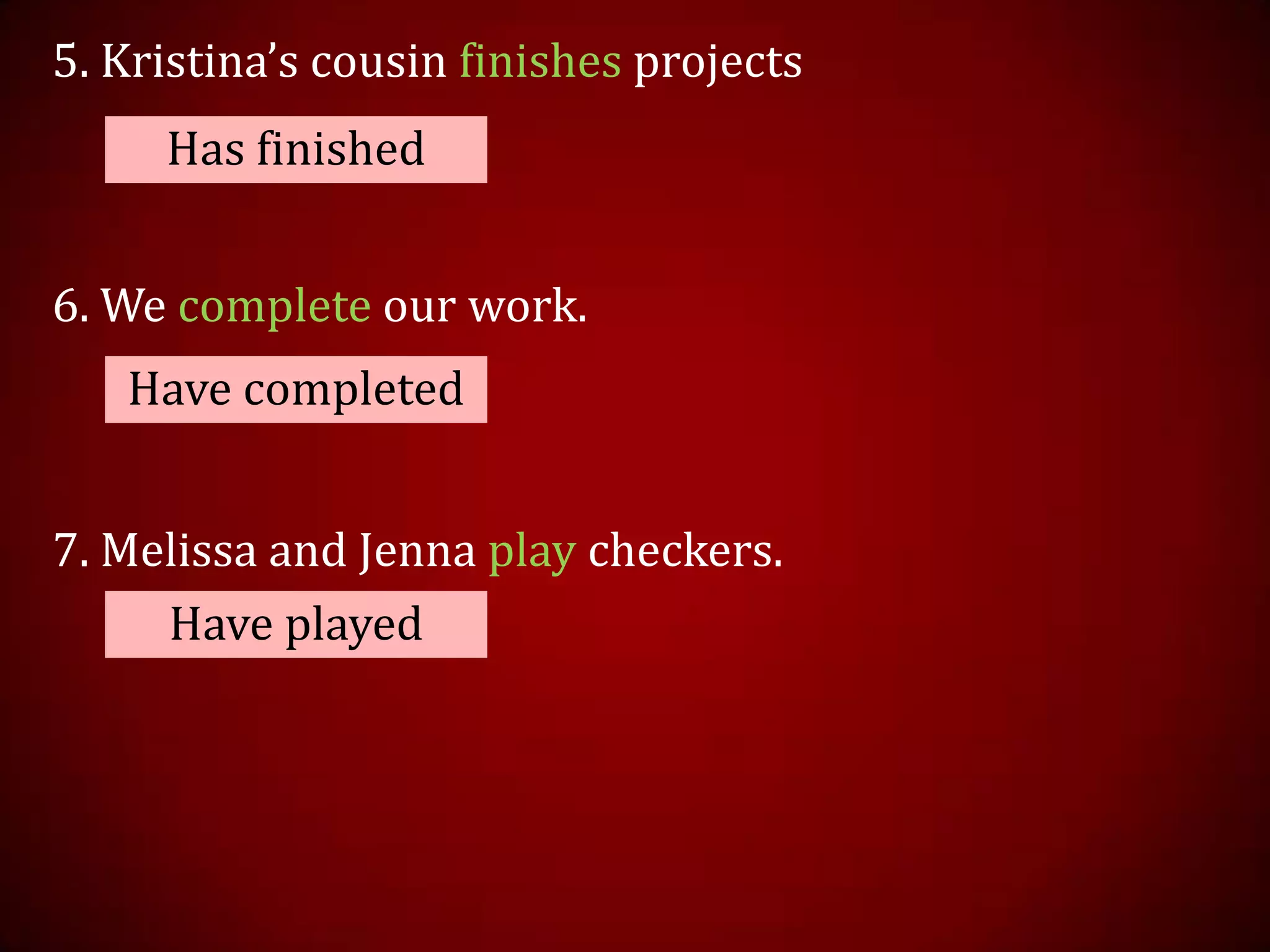
5. Kristina’s cousin finishes projects
6. We complete our work.
7. Melissa and Jenna play checkers.
Has finished
Have completed
Have played
PRESENT PERFECT
CONTINUOUS TENSE
• We use the Present Perfect Continuous to show that
something started in the past and has continued up
until now
• "For five minutes," "for two weeks," and "since
Tuesday" are all durations which can be used with
the Present Perfect Continuous.
• Requires the auxiliary verb to have and to be, along
with the present participle of the main verb.
• Form :
[Has/ have + been + present participle]
Examples :
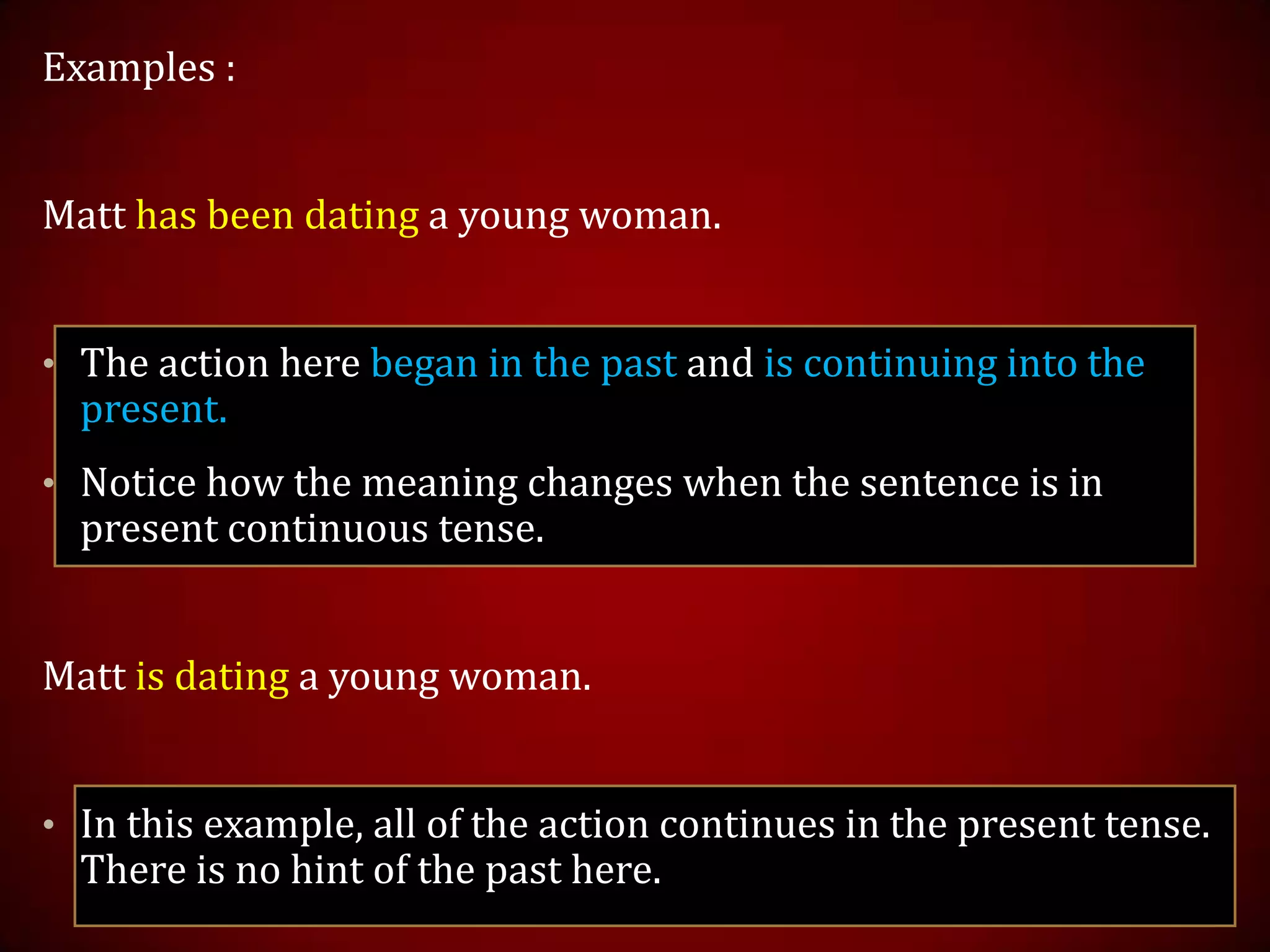
Matt has been dating a young woman.
• The action here began in the past and is continuing into the
present.
• Notice how the meaning changes when the sentence is in
present continuous tense.
Matt is dating a young woman.
• In this example, all of the action continues in the present tense.
There is no hint of the past here.
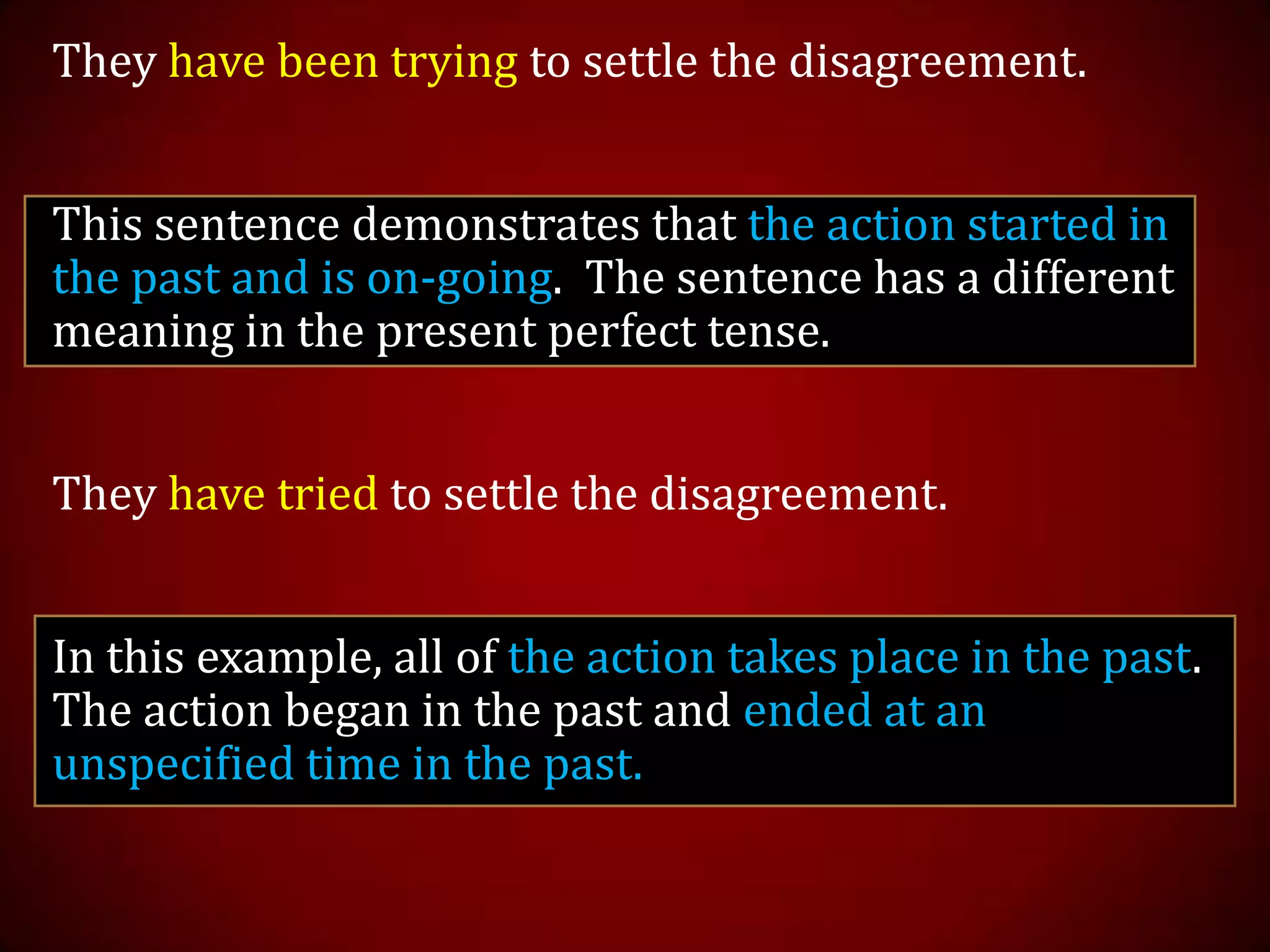
They have been trying to settle the disagreement.
This sentence demonstrates that the action started in
the past and is on-going. The sentence has a different
meaning in the present perfect tense.
They have tried to settle the disagreement.
In this example, all of the action takes place in the past.
The action began in the past and ended at an
unspecified time in the past.
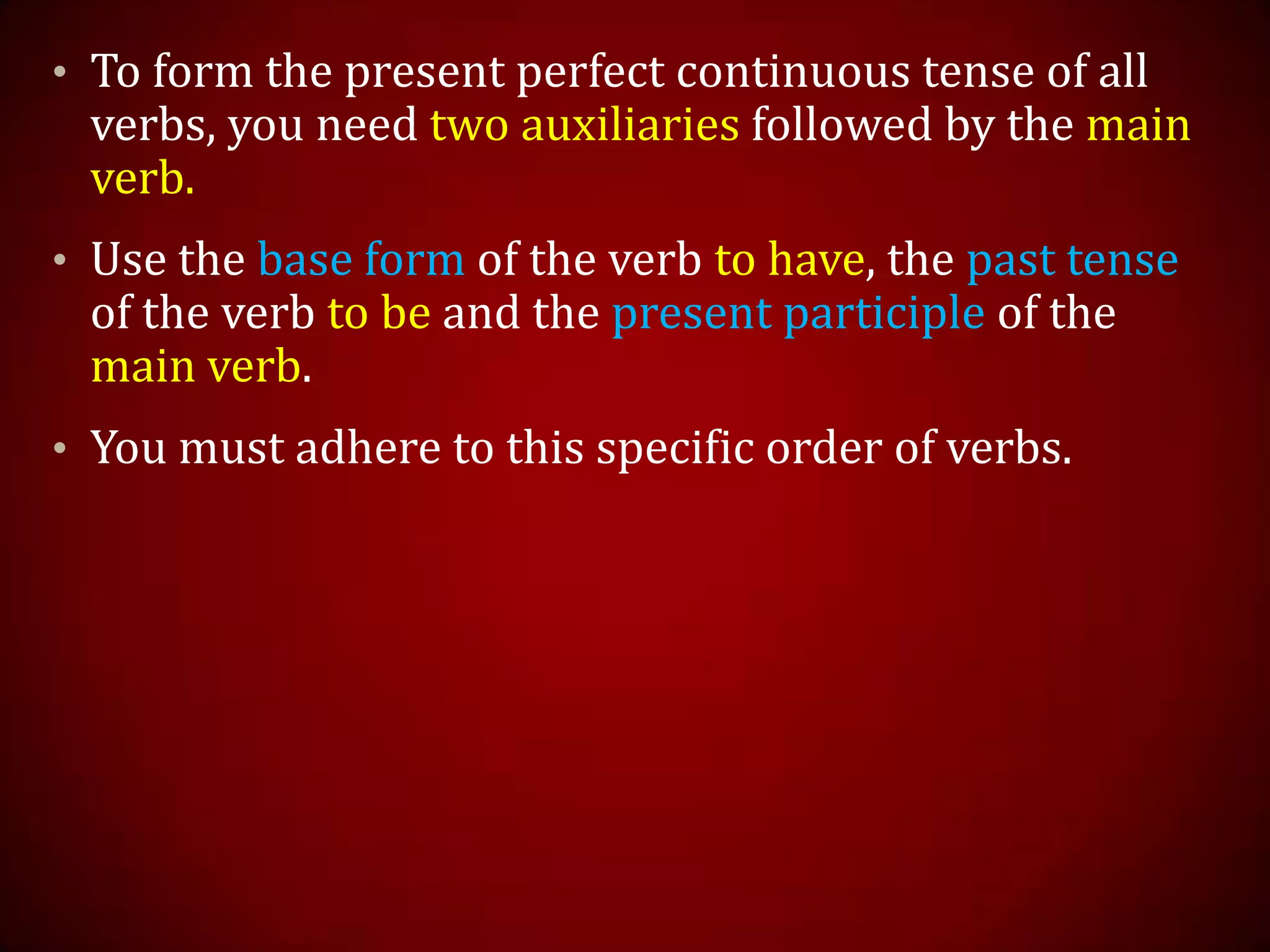
• To form the present perfect continuous tense of all
verbs, you need two auxiliaries followed by the main
verb.
• Use the base form of the verb to have, the past tense
of the verb to be and the present participle of the
main verb.
• You must adhere to this specific order of verbs.
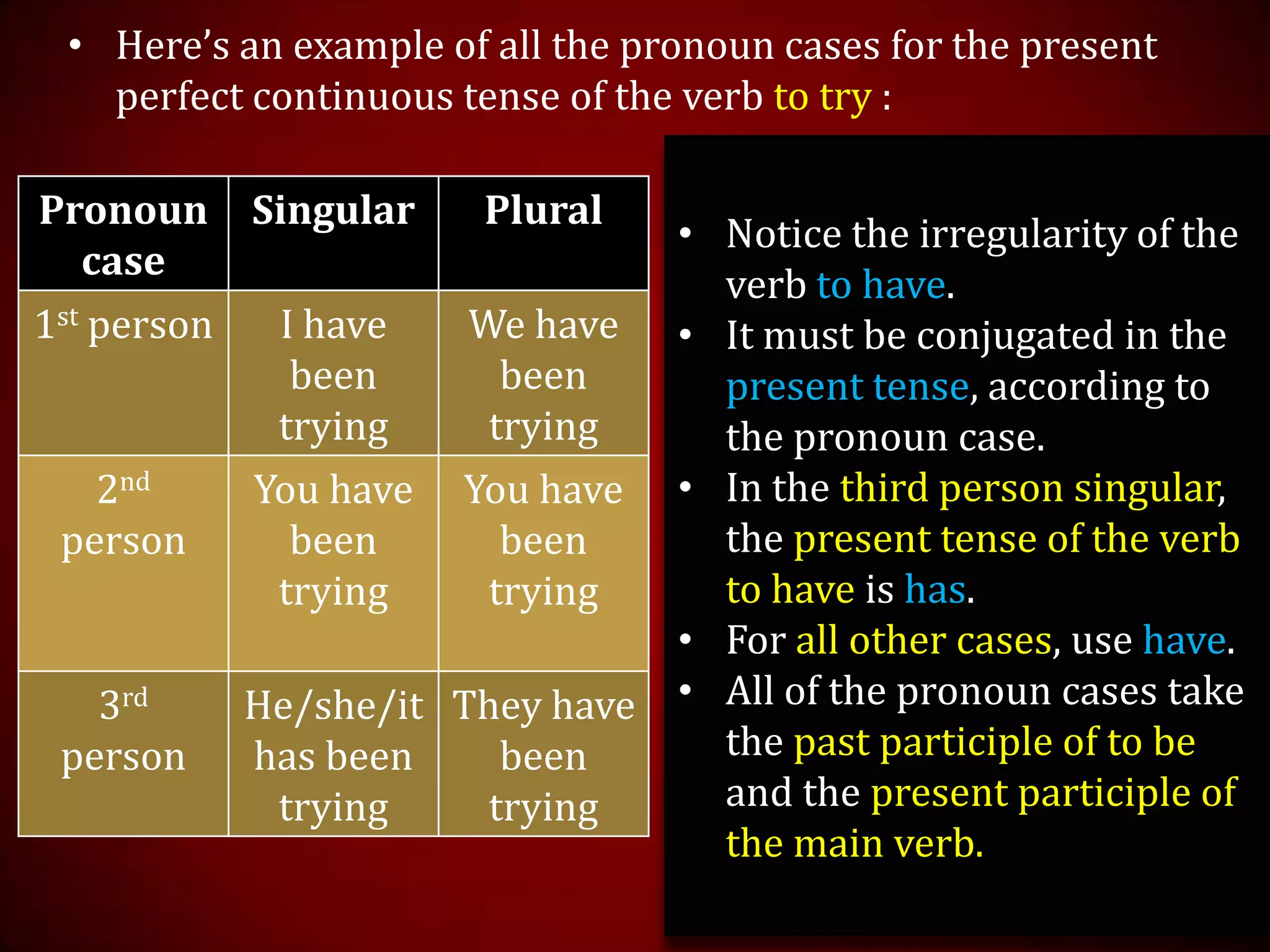
Pronoun
case
Singular Plural
1st person I have
been
trying
We have
been
trying
2nd
person
You have
been
trying
You have
been
trying
3rd
person
He/she/it
has been
trying
They have
been
trying
• Here’s an example of all the pronoun cases for the present
perfect continuous tense of the verb to try :
• Notice the irregularity of the
verb to have.
• It must be conjugated in the
present tense, according to
the pronoun case.
• In the third person singular,
the present tense of the verb
to have is has.
• For all other cases, use have.
• All of the pronoun cases take
the past participle of to be
and the present participle of
the main verb.
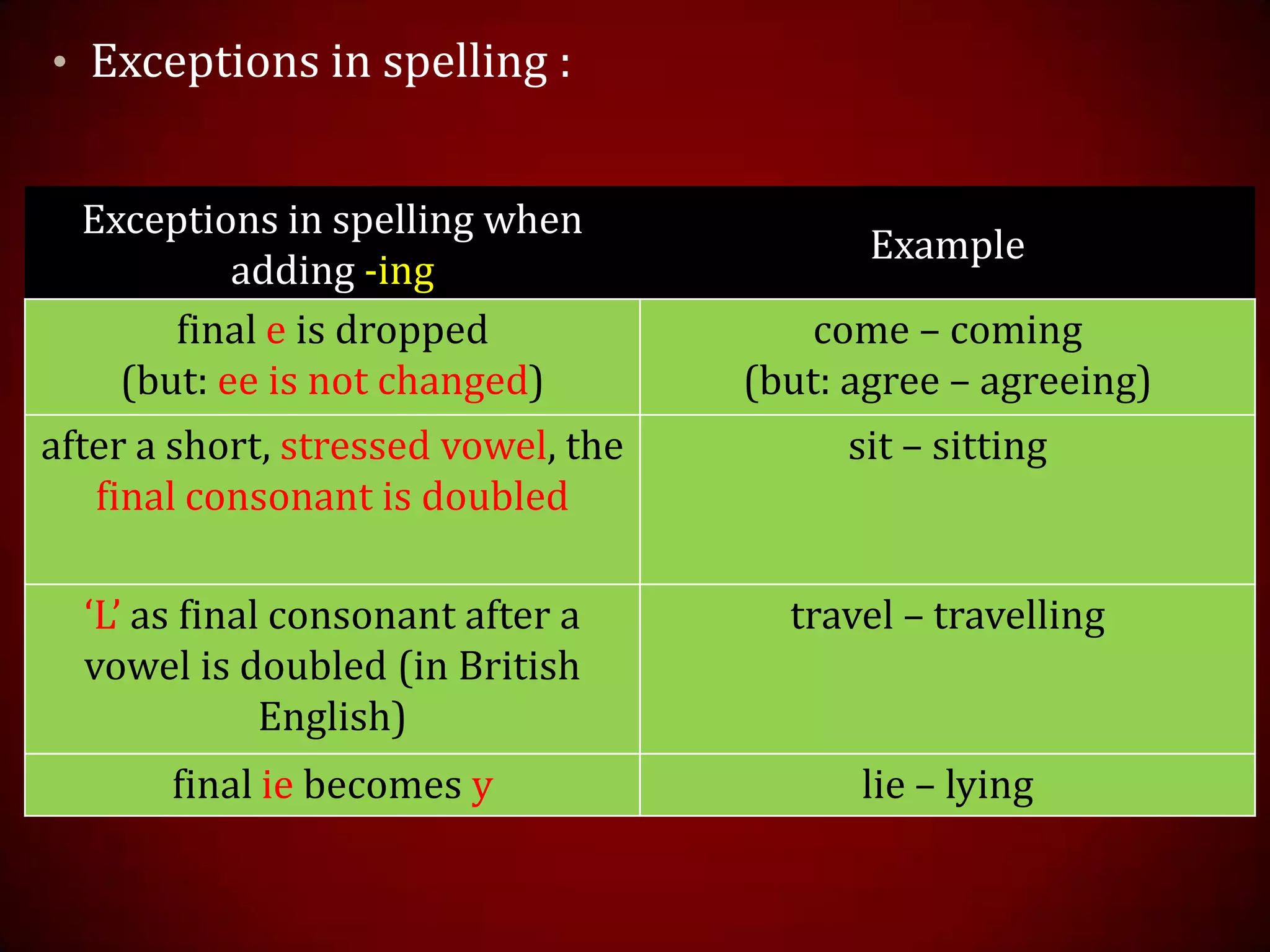
• Exceptions in spelling :
Exceptions in spelling when
adding -ing
Example
final e is dropped
(but: ee is not changed)
come – coming
(but: agree – agreeing)
after a short, stressed vowel, the
final consonant is doubled
sit – sitting
‘L’ as final consonant after a
vowel is doubled (in British
English)
travel – travelling
final ie becomes y lie – lying
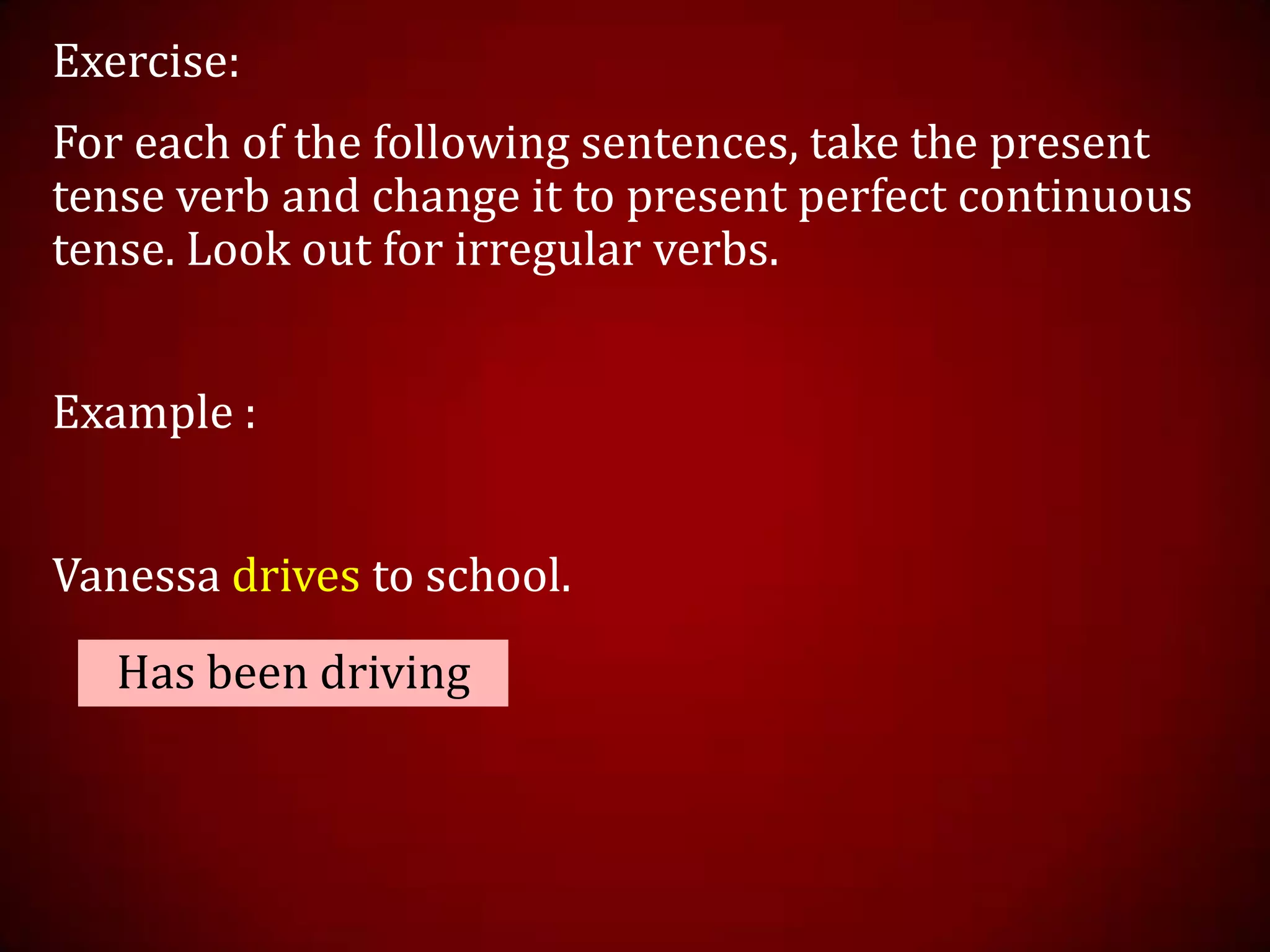
Exercise:
For each of the following sentences, take the present
tense verb and change it to present perfect continuous
tense. Look out for irregular verbs.
Example :
Vanessa drives to school.
Has been driving
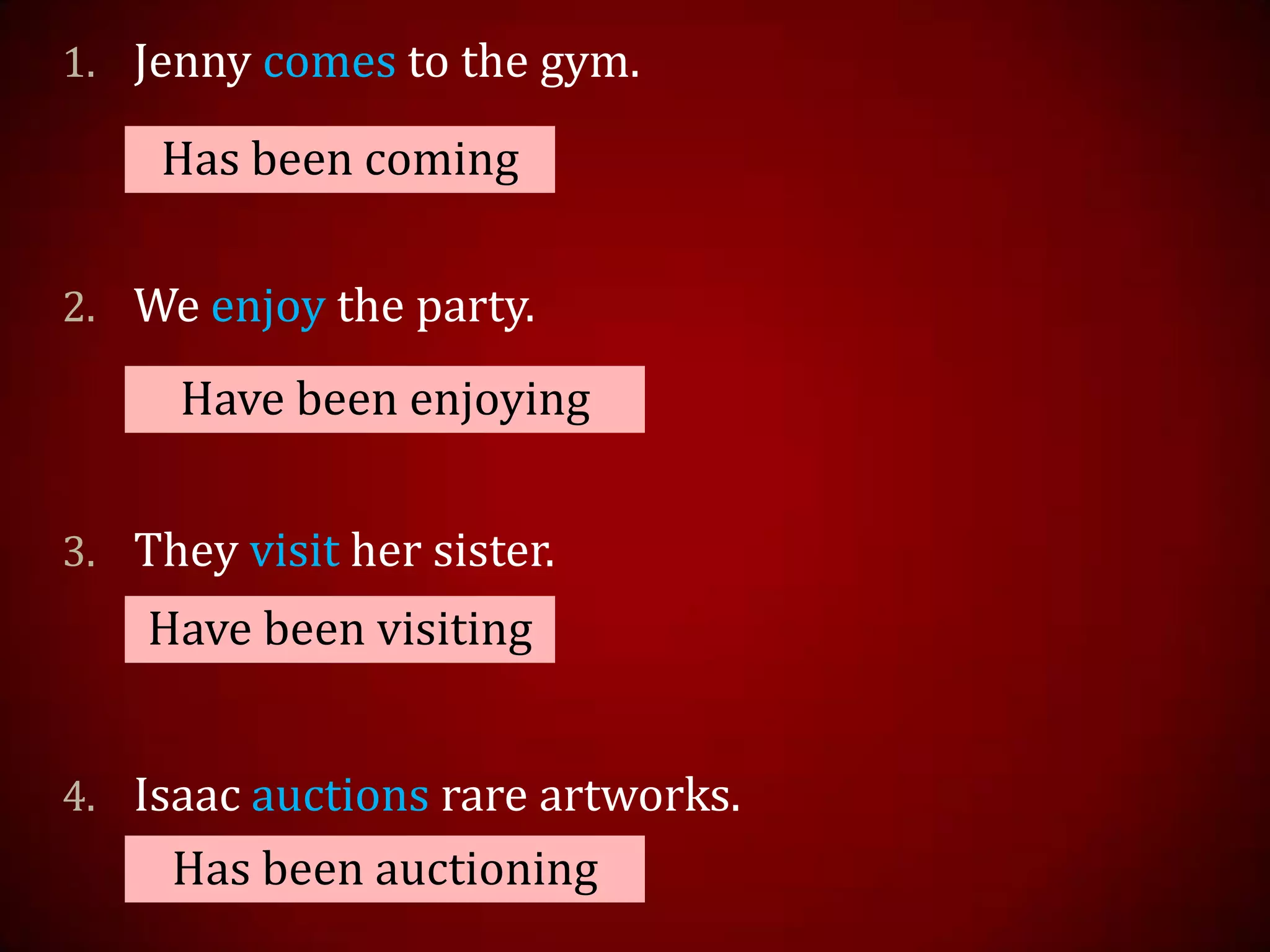
1. Jenny comes to the gym.
2. We enjoy the party.
3. They visit her sister.
4. Isaac auctions rare artworks.
Has been coming
Have been enjoying
Have been visiting
Has been auctioning
END OF SLIDE.
THANK YOU FOR YOUR
ATTENTION! 
References :
Lindner, M. (2011). English Language & Composition : Up your
score on school & college essays. Selangor D.E. : Advantage Quest
Sdn. Bhd
English Grammar Online. (2010). Present Perfect Progressive.
Retrieved from http://www.ego4u.com/en/cram-
up/grammar/present-perfect-progressive

Present perfect & present perfect continuous

  • 1.
    By Sofea, Doreenand Jeremy PRESENT PERFECT TENSE & PRESENT PERFECT CONTINUOUS TENSE
  • 2.
  • 3.
    • The presentperfect tense shows 1. something that started in the past and was completed at some unspecified time in the past, 2. or still continues into the present. • It always involves more than one period of time.
  • 4.
    EXAMPLES : • Ihave reviewed the material. With the use of the verb to have, the action started in the past and was completed at another undetermined time in the past. • I reviewed the material. In this case, all of the action is completed in the past. There is only one period of time here.
  • 5.
    • The menhave worked for a long time. With this example, the action started in the past and is still continuing in the present. The men started working in the past and are still working. • The men work for a long time. Here, the action is limited to the present. The action did not begin in the past.
  • 6.
    • To formthe present perfect tense of all verbs, use the base form of the verb to have before the past participle of the main verb. • Here is an example of all the pronoun cases for the present perfect tense of the verb to work. Pronoun case Singular Plural 1st person I have worked We have worked 2nd person You have worked You have worked 3rd person He/she/it has worked They have worked
  • 7.
    • Notice thatthe verb to have is also conjugated according to the pronoun case. • Use has with third-person singular. • With all other singular and plural cases, use have.
  • 8.
    Exercise For each ofthe following sentences, take the present tense verb and change it to present perfect tense. Example : She eats berries. (present perfect) – has eaten
  • 9.
    1. Bill andI walk to the store. 2. She gives her manager an answer. 3. Our friends purchase concert tickets. 4. Robert dreams of winning an award. Have walked Has given Have purchased Has dreamed
  • 10.
    5. Kristina’s cousinfinishes projects 6. We complete our work. 7. Melissa and Jenna play checkers. Has finished Have completed Have played
  • 11.
  • 12.
    • We usethe Present Perfect Continuous to show that something started in the past and has continued up until now • "For five minutes," "for two weeks," and "since Tuesday" are all durations which can be used with the Present Perfect Continuous. • Requires the auxiliary verb to have and to be, along with the present participle of the main verb. • Form : [Has/ have + been + present participle]
  • 13.
    Examples : Matt hasbeen dating a young woman. • The action here began in the past and is continuing into the present. • Notice how the meaning changes when the sentence is in present continuous tense. Matt is dating a young woman. • In this example, all of the action continues in the present tense. There is no hint of the past here.
  • 14.
    They have beentrying to settle the disagreement. This sentence demonstrates that the action started in the past and is on-going. The sentence has a different meaning in the present perfect tense. They have tried to settle the disagreement. In this example, all of the action takes place in the past. The action began in the past and ended at an unspecified time in the past.
  • 15.
    • To formthe present perfect continuous tense of all verbs, you need two auxiliaries followed by the main verb. • Use the base form of the verb to have, the past tense of the verb to be and the present participle of the main verb. • You must adhere to this specific order of verbs.
  • 16.
    Pronoun case Singular Plural 1st personI have been trying We have been trying 2nd person You have been trying You have been trying 3rd person He/she/it has been trying They have been trying • Here’s an example of all the pronoun cases for the present perfect continuous tense of the verb to try : • Notice the irregularity of the verb to have. • It must be conjugated in the present tense, according to the pronoun case. • In the third person singular, the present tense of the verb to have is has. • For all other cases, use have. • All of the pronoun cases take the past participle of to be and the present participle of the main verb.
  • 17.
    • Exceptions inspelling : Exceptions in spelling when adding -ing Example final e is dropped (but: ee is not changed) come – coming (but: agree – agreeing) after a short, stressed vowel, the final consonant is doubled sit – sitting ‘L’ as final consonant after a vowel is doubled (in British English) travel – travelling final ie becomes y lie – lying
  • 18.
    Exercise: For each ofthe following sentences, take the present tense verb and change it to present perfect continuous tense. Look out for irregular verbs. Example : Vanessa drives to school. Has been driving
  • 19.
    1. Jenny comesto the gym. 2. We enjoy the party. 3. They visit her sister. 4. Isaac auctions rare artworks. Has been coming Have been enjoying Have been visiting Has been auctioning
  • 20.
    END OF SLIDE. THANKYOU FOR YOUR ATTENTION!  References : Lindner, M. (2011). English Language & Composition : Up your score on school & college essays. Selangor D.E. : Advantage Quest Sdn. Bhd English Grammar Online. (2010). Present Perfect Progressive. Retrieved from http://www.ego4u.com/en/cram- up/grammar/present-perfect-progressive