
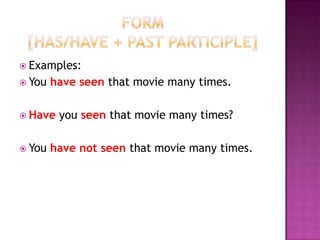
 Examples:
 You   have seen that movie many times.

 Have   you seen that movie many times?

 You   have not seen that movie many times.
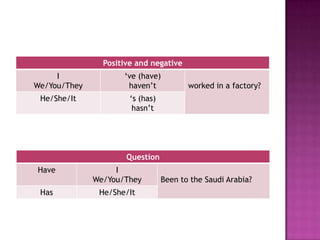
Positive and negative
     I               ‘ve (have)
We/You/They           haven’t            worked in a factory?
 He/She/It             ‘s (has)
                        hasn’t


                      Question
Have               I
              We/You/They         Been to the Saudi Arabia?
 Has           He/She/It
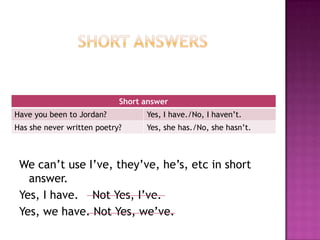
Short answer
Have you been to Jordan?          Yes, I have./No, I haven’t.
Has she never written poetry?     Yes, she has./No, she hasn’t.


 We can’t use I’ve, they’ve, he’s, etc in short
   answer.
 Yes, I have. Not Yes, I’ve.
 Yes, we have. Not Yes, we’ve.
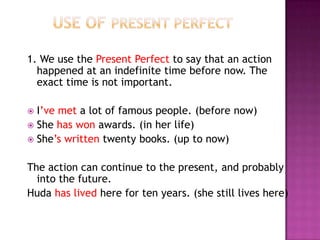
1. We use the Present Perfect to say that an action
  happened at an indefinite time before now. The
  exact time is not important.

 I’ve met a lot of famous people. (before now)
 She has won awards. (in her life)
 She’s written twenty books. (up to now)


The action can continue to the present, and probably
  into the future.
Huda has lived here for ten years. (she still lives here)
2. We use Present perfect to express an
  experience as part of someone’s life.

 I’vetravelled a lot in Asia.
 They’ve lived all over the world.


 Ever   and never are common with this use.

 Haveyou ever been in a car crash?
 My mother has never flown in a plane.
3. We use Present Perfect to express an action or
  state which began in the past and continues to
  the present.
 I’ve known Alice for six years.
 How long have you worked as a teacher?


 For (a period of time) and since (a point in time)
  are common in this use.
 We’ve lived here for tow years. (a period of
  time)
 I’ve had a beard since I left the army. (a point in
  time)
4. We use Present Perfect to express a past
  action with results in the present. It’s
  often a recent past action.
 I’ve lost my wallet. (I haven’t got it now)
 The taxi’s arrived. (It’s outside the door
  now)
 Has the postman been? (Are there any
  letters for me?)
   The adverbs just, already, and yet are common
    with this use.

 She’s  just had some good news.
 I’ve already had breakfast.
 Has the postman been yet?
 It’s 11:00 and she hasn’t got up yet.
Should you have any further
questions/clarifications, please don’t
  hesitate to contact me directly.
     Khaleelbader@gmail.com


       Thank You
          

Present Perfect Presentation - Group 601

  • 2.
     Examples:  You have seen that movie many times.  Have you seen that movie many times?  You have not seen that movie many times.
  • 3.
    Positive and negative I ‘ve (have) We/You/They haven’t worked in a factory? He/She/It ‘s (has) hasn’t Question Have I We/You/They Been to the Saudi Arabia? Has He/She/It
  • 4.
    Short answer Have youbeen to Jordan? Yes, I have./No, I haven’t. Has she never written poetry? Yes, she has./No, she hasn’t. We can’t use I’ve, they’ve, he’s, etc in short answer. Yes, I have. Not Yes, I’ve. Yes, we have. Not Yes, we’ve.
  • 5.
    1. We usethe Present Perfect to say that an action happened at an indefinite time before now. The exact time is not important.  I’ve met a lot of famous people. (before now)  She has won awards. (in her life)  She’s written twenty books. (up to now) The action can continue to the present, and probably into the future. Huda has lived here for ten years. (she still lives here)
  • 6.
    2. We usePresent perfect to express an experience as part of someone’s life.  I’vetravelled a lot in Asia.  They’ve lived all over the world.  Ever and never are common with this use.  Haveyou ever been in a car crash?  My mother has never flown in a plane.
  • 7.
    3. We usePresent Perfect to express an action or state which began in the past and continues to the present.  I’ve known Alice for six years.  How long have you worked as a teacher?  For (a period of time) and since (a point in time) are common in this use.  We’ve lived here for tow years. (a period of time)  I’ve had a beard since I left the army. (a point in time)
  • 8.
    4. We usePresent Perfect to express a past action with results in the present. It’s often a recent past action.  I’ve lost my wallet. (I haven’t got it now)  The taxi’s arrived. (It’s outside the door now)  Has the postman been? (Are there any letters for me?)
  • 9.
    The adverbs just, already, and yet are common with this use.  She’s just had some good news.  I’ve already had breakfast.  Has the postman been yet?  It’s 11:00 and she hasn’t got up yet.
  • 10.
    Should you haveany further questions/clarifications, please don’t hesitate to contact me directly. Khaleelbader@gmail.com Thank You 