


The Present
Continuous Tense
   Use and form
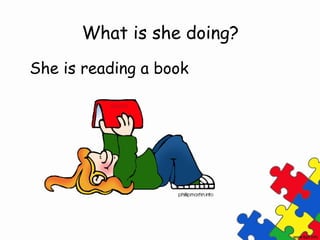
What is she doing?
She is reading a book
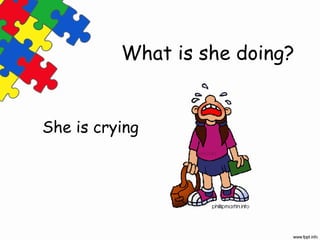
What is she doing?


She is crying
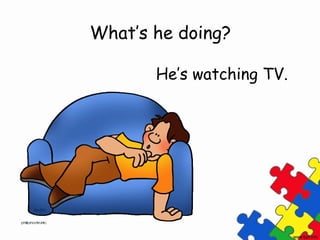
What’s he doing?

       He’s watching TV.
Where’s he going?


He’s going to ITESCA
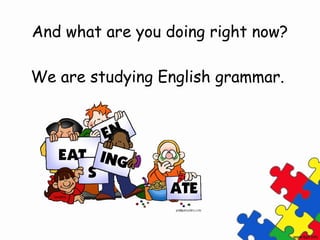
And what are you doing right now?

We are studying English grammar.
Use 1

The previous examples show that we use
 this tense to denote an action happening
 at the time of speaking (adverbs: now,
 right now, at the moment).
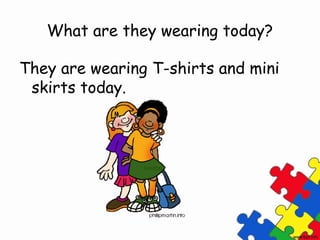
What are they wearing today?

They are wearing T-shirts and mini
 skirts today.
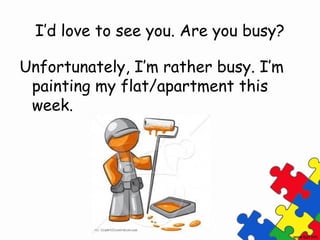
I’d love to see you. Are you busy?

Unfortunately, I’m rather busy. I’m
 painting my flat/apartment this
 week.
Are you having fun this summer?

Not really. I’m working as a waiter. I
need some money for college.
Use 2

These examples show that the Present
 Continuous Tense is also used to denote
 a temporary action happening today or
 these days.
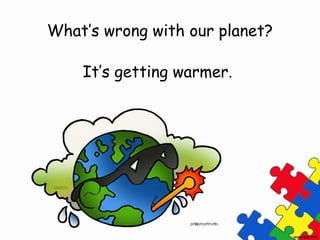
What’s wrong with our planet?

    It’s getting warmer.
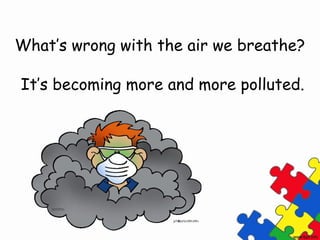
What’s wrong with the air we breathe?

It’s becoming more and more polluted.
Use 3

It is also used to express the ongoing
  changes, especially with verbs such as
  become, get, grow, change, and with
  expressions like more and more.
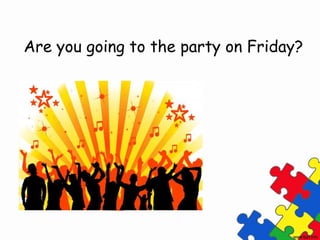
Are you going to the party on Friday?
We’re leaving tomorrow.
Use 4

We use it for future arrangements
 with a time reference.
Form
• Affirmative
I am sleeping.
He/she/it is sleeping.
You/we/they are sleeping.
• Negative
I am not (I’m not) singing.
He/she/it is not (isn’t) singing.
You/we/they are not (aren’t) singing.
Form - continued
• Interrogative
Am I dreaming?
Is he/she/it dreaming?
Are you/we/they dreaming?
• Short answers
Yes, I am/he is/we are…
No, I’m not/he isn’t/we aren’t…
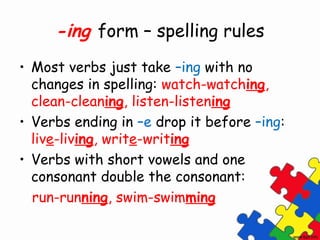
-ing form – spelling rules
• Most verbs just take –ing with no
  changes in spelling: watch-watching,
  clean-cleaning, listen-listening
• Verbs ending in –e drop it before –ing:
  live-living, write-writing
• Verbs with short vowels and one
  consonant double the consonant:
  run-running, swim-swimming
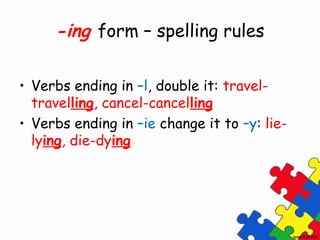
-ing form – spelling rules

• Verbs ending in –l, double it: travel-
  travelling, cancel-cancelling
• Verbs ending in –ie change it to –y: lie-
  lying, die-dying

Present continuous presentation

  • 1.
  • 2.
    What is shedoing? She is reading a book
  • 3.
    What is shedoing? She is crying
  • 4.
    What’s he doing? He’s watching TV.
  • 5.
  • 6.
    And what areyou doing right now? We are studying English grammar.
  • 7.
    Use 1 The previousexamples show that we use this tense to denote an action happening at the time of speaking (adverbs: now, right now, at the moment).
  • 8.
    What are theywearing today? They are wearing T-shirts and mini skirts today.
  • 9.
    I’d love tosee you. Are you busy? Unfortunately, I’m rather busy. I’m painting my flat/apartment this week.
  • 10.
    Are you havingfun this summer? Not really. I’m working as a waiter. I need some money for college.
  • 11.
    Use 2 These examplesshow that the Present Continuous Tense is also used to denote a temporary action happening today or these days.
  • 12.
    What’s wrong withour planet? It’s getting warmer.
  • 13.
    What’s wrong withthe air we breathe? It’s becoming more and more polluted.
  • 14.
    Use 3 It isalso used to express the ongoing changes, especially with verbs such as become, get, grow, change, and with expressions like more and more.
  • 15.
    Are you goingto the party on Friday?
  • 16.
  • 17.
    Use 4 We useit for future arrangements with a time reference.
  • 18.
    Form • Affirmative I amsleeping. He/she/it is sleeping. You/we/they are sleeping. • Negative I am not (I’m not) singing. He/she/it is not (isn’t) singing. You/we/they are not (aren’t) singing.
  • 19.
    Form - continued •Interrogative Am I dreaming? Is he/she/it dreaming? Are you/we/they dreaming? • Short answers Yes, I am/he is/we are… No, I’m not/he isn’t/we aren’t…
  • 20.
    -ing form –spelling rules • Most verbs just take –ing with no changes in spelling: watch-watching, clean-cleaning, listen-listening • Verbs ending in –e drop it before –ing: live-living, write-writing • Verbs with short vowels and one consonant double the consonant: run-running, swim-swimming
  • 21.
    -ing form –spelling rules • Verbs ending in –l, double it: travel- travelling, cancel-cancelling • Verbs ending in –ie change it to –y: lie- lying, die-dying