DEPARTMENT OF ENGLISH LANGUAGE AND TRANSLATION.
DONE BY : GHADEER ALZAWAHREH.
SUPERVISED BY :DR. KHALEEL AL BATAINEH.
SEMANTICS
• Semantics is the study of the meaning of meaningful units.
• Semantics is concerned with cognitive meaning.
• Cognitive meaning is the contribution that the word (lexeme)
systematically makes to the cognitive meaning of sentences.
• The cognative meaning of lexeme is sometimes called sense.
SENSE RELATIONS BETWEEN WORDS
• The relationships between lexemes established on the basis of
their senses are called sense relations.
• Or lexical relations.
LEXICAL RELATIONS
• Synonymy
• Homonomy
• Polysemy
• Antonymy
• Hyponymy
SYNONYMY
Two or more lexemes have the same meaning.
examples :
big = larg.
broad = wide.
AMBIGUITY
1. Homonymy : two or more phonologically and orthographically
identical lexemes have completely different, unrelated meaning.
• Examples :
bank ( side of the river) _ bank ( financial institution).
bat (bird) _ bat (used in sports).
2. Polysemy : the meaning of one lexeme is metaphorically
extended on the basis of some similarity.
• Examples :
leg (of a man) VS. leg (of a table).
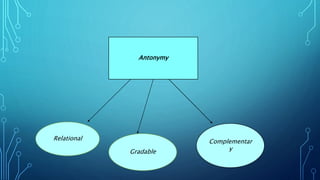
Antonymy
Complementar
y
Gradable
Relational
• Complementary : the negation of the meaning of one lexeme
gives us the meaning of the other.
• Examples:
dead VS. Alive (not dead means alive, not alive means
dead).
single VS. married.
• Gradable opposites : gradable lexemes, relative to some norm.
• Examples :
• Small VS. Larg
• Hot VS. Cold
• Old VS. New
• Relational opposites : lexemes referring to symmetrically
opposites aspect of the same situation
• Examples:
• Employer vs. Employee.
• Husband vs . Wife.
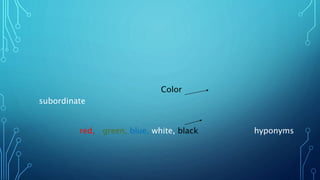
HYPONYMY
• The relation between a cognitively superordinate.
• More general lexeme and the more specific lexemes that are
cognitively subordinate to.
Color
subordinate
red, green, blue, white, black hyponyms
Semantics

Semantics

  • 1.
    DEPARTMENT OF ENGLISHLANGUAGE AND TRANSLATION. DONE BY : GHADEER ALZAWAHREH. SUPERVISED BY :DR. KHALEEL AL BATAINEH.
  • 2.
  • 3.
    • Semantics isthe study of the meaning of meaningful units. • Semantics is concerned with cognitive meaning.
  • 4.
    • Cognitive meaningis the contribution that the word (lexeme) systematically makes to the cognitive meaning of sentences. • The cognative meaning of lexeme is sometimes called sense.
  • 5.
    SENSE RELATIONS BETWEENWORDS • The relationships between lexemes established on the basis of their senses are called sense relations. • Or lexical relations.
  • 6.
    LEXICAL RELATIONS • Synonymy •Homonomy • Polysemy • Antonymy • Hyponymy
  • 7.
    SYNONYMY Two or morelexemes have the same meaning. examples : big = larg. broad = wide.
  • 8.
    AMBIGUITY 1. Homonymy :two or more phonologically and orthographically identical lexemes have completely different, unrelated meaning. • Examples : bank ( side of the river) _ bank ( financial institution). bat (bird) _ bat (used in sports).
  • 9.
    2. Polysemy :the meaning of one lexeme is metaphorically extended on the basis of some similarity. • Examples : leg (of a man) VS. leg (of a table).
  • 10.
  • 11.
    • Complementary :the negation of the meaning of one lexeme gives us the meaning of the other. • Examples: dead VS. Alive (not dead means alive, not alive means dead). single VS. married.
  • 12.
    • Gradable opposites: gradable lexemes, relative to some norm. • Examples : • Small VS. Larg • Hot VS. Cold • Old VS. New
  • 13.
    • Relational opposites: lexemes referring to symmetrically opposites aspect of the same situation • Examples: • Employer vs. Employee. • Husband vs . Wife.
  • 14.
    HYPONYMY • The relationbetween a cognitively superordinate. • More general lexeme and the more specific lexemes that are cognitively subordinate to.
  • 15.