Present Perfect
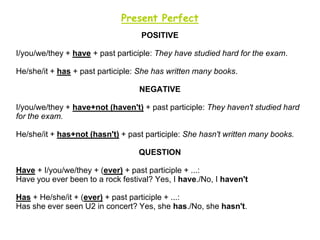
                                   POSITIVE

I/you/we/they + have + past participle: They have studied hard for the exam.

He/she/it + has + past participle: She has written many books.

                                  NEGATIVE

I/you/we/they + have+not (haven't) + past participle: They haven't studied hard
for the exam.

He/she/it + has+not (hasn't) + past participle: She hasn't written many books.

                                  QUESTION

Have + I/you/we/they + (ever) + past participle + ...:
Have you ever been to a rock festival? Yes, I have./No, I haven't

Has + He/she/it + (ever) + past participle + ...:
Has she ever seen U2 in concert? Yes, she has./No, she hasn't.
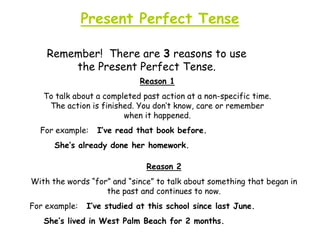
Present Perfect Tense

    Remember! There are 3 reasons to use
        the Present Perfect Tense.
                            Reason 1
   To talk about a completed past action at a non-specific time.
    The action is finished. You don‟t know, care or remember
                        when it happened.
  For example:   I’ve read that book before.
      She’s already done her homework.

                              Reason 2
With the words “for” and “since” to talk about something that began in
                   the past and continues to now.
For example:   I’ve studied at this school since last June.
   She’s lived in West Palm Beach for 2 months.
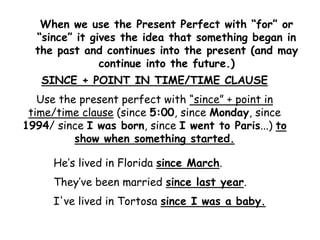
When we use the Present Perfect with “for” or
  “since” it gives the idea that something began in
  the past and continues into the present (and may
               continue into the future.)
   SINCE + POINT IN TIME/TIME CLAUSE
   Use the present perfect with “since” + point in
 time/time clause (since 5:00, since Monday, since
1994/ since I was born, since I went to Paris...) to
          show when something started.

      He‟s lived in Florida since March.
      They‟ve been married since last year.
      I've lived in Tortosa since I was a baby.
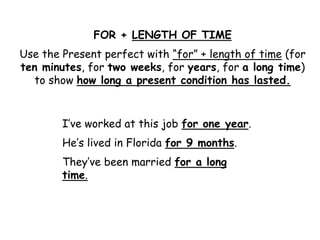
FOR + LENGTH OF TIME
Use the Present perfect with “for” + length of time (for
ten minutes, for two weeks, for years, for a long time)
  to show how long a present condition has lasted.


        I‟ve worked at this job for one year.
        He‟s lived in Florida for 9 months.
        They‟ve been married for a long
        time.
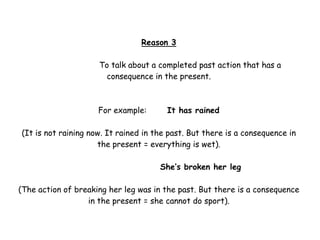
Reason 3

                     To talk about a completed past action that has a
                      consequence in the present.


                     For example:       It has rained

(It is not raining now. It rained in the past. But there is a consequence in
                     the present = everything is wet).

                                      She’s broken her leg

(The action of breaking her leg was in the past. But there is a consequence
                  in the present = she cannot do sport).
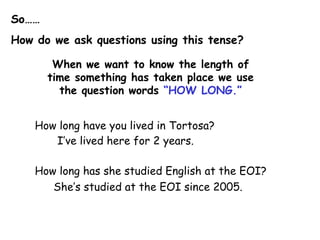
So……
How do we ask questions using this tense?

        When we want to know the length of
       time something has taken place we use
         the question words “HOW LONG.”


    How long have you lived in Tortosa?
       I‟ve lived here for 2 years.

    How long has she studied English at the EOI?
       She‟s studied at the EOI since 2005.
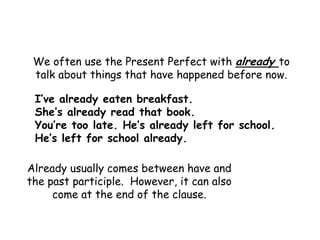
We often use the Present Perfect with already to
 talk about things that have happened before now.

 I’ve already eaten breakfast.
 She’s already read that book.
 You’re too late. He’s already left for school.
 He’s left for school already.

Already usually comes between have and
the past participle. However, it can also
     come at the end of the clause.
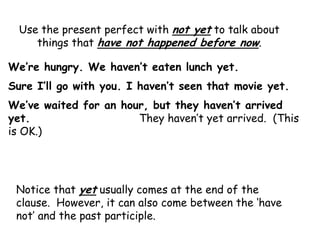
Use the present perfect with not yet to talk about
     things that have not happened before now.

We’re hungry. We haven’t eaten lunch yet.
Sure I’ll go with you. I haven’t seen that movie yet.
We’ve waited for an hour, but they haven’t arrived
yet.                   They haven‟t yet arrived. (This
is OK.)


 Notice that yet usually comes at the end of the
 clause. However, it can also come between the „have
 not‟ and the past participle.
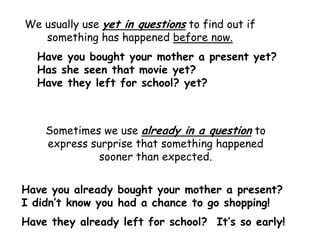
We usually use yet in questions to find out if
   something has happened before now.
  Have you bought your mother a present yet?
  Has she seen that movie yet?
  Have they left for school? yet?


    Sometimes we use already in a question to
    express surprise that something happened
              sooner than expected.


Have you already bought your mother a present?
I didn’t know you had a chance to go shopping!
Have they already left for school? It’s so early!
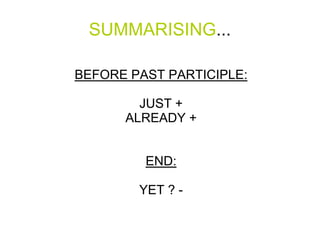
SUMMARISING...

BEFORE PAST PARTICIPLE:

        JUST +
      ALREADY +


         END:

        YET ? -

Presentperfect

  • 1.
    Present Perfect POSITIVE I/you/we/they + have + past participle: They have studied hard for the exam. He/she/it + has + past participle: She has written many books. NEGATIVE I/you/we/they + have+not (haven't) + past participle: They haven't studied hard for the exam. He/she/it + has+not (hasn't) + past participle: She hasn't written many books. QUESTION Have + I/you/we/they + (ever) + past participle + ...: Have you ever been to a rock festival? Yes, I have./No, I haven't Has + He/she/it + (ever) + past participle + ...: Has she ever seen U2 in concert? Yes, she has./No, she hasn't.
  • 2.
    Present Perfect Tense Remember! There are 3 reasons to use the Present Perfect Tense. Reason 1 To talk about a completed past action at a non-specific time. The action is finished. You don‟t know, care or remember when it happened. For example: I’ve read that book before. She’s already done her homework. Reason 2 With the words “for” and “since” to talk about something that began in the past and continues to now. For example: I’ve studied at this school since last June. She’s lived in West Palm Beach for 2 months.
  • 3.
    When we usethe Present Perfect with “for” or “since” it gives the idea that something began in the past and continues into the present (and may continue into the future.) SINCE + POINT IN TIME/TIME CLAUSE Use the present perfect with “since” + point in time/time clause (since 5:00, since Monday, since 1994/ since I was born, since I went to Paris...) to show when something started. He‟s lived in Florida since March. They‟ve been married since last year. I've lived in Tortosa since I was a baby.
  • 4.
    FOR + LENGTHOF TIME Use the Present perfect with “for” + length of time (for ten minutes, for two weeks, for years, for a long time) to show how long a present condition has lasted. I‟ve worked at this job for one year. He‟s lived in Florida for 9 months. They‟ve been married for a long time.
  • 5.
    Reason 3 To talk about a completed past action that has a consequence in the present. For example: It has rained (It is not raining now. It rained in the past. But there is a consequence in the present = everything is wet). She’s broken her leg (The action of breaking her leg was in the past. But there is a consequence in the present = she cannot do sport).
  • 6.
    So…… How do weask questions using this tense? When we want to know the length of time something has taken place we use the question words “HOW LONG.” How long have you lived in Tortosa? I‟ve lived here for 2 years. How long has she studied English at the EOI? She‟s studied at the EOI since 2005.
  • 7.
    We often usethe Present Perfect with already to talk about things that have happened before now. I’ve already eaten breakfast. She’s already read that book. You’re too late. He’s already left for school. He’s left for school already. Already usually comes between have and the past participle. However, it can also come at the end of the clause.
  • 8.
    Use the presentperfect with not yet to talk about things that have not happened before now. We’re hungry. We haven’t eaten lunch yet. Sure I’ll go with you. I haven’t seen that movie yet. We’ve waited for an hour, but they haven’t arrived yet. They haven‟t yet arrived. (This is OK.) Notice that yet usually comes at the end of the clause. However, it can also come between the „have not‟ and the past participle.
  • 9.
    We usually useyet in questions to find out if something has happened before now. Have you bought your mother a present yet? Has she seen that movie yet? Have they left for school? yet? Sometimes we use already in a question to express surprise that something happened sooner than expected. Have you already bought your mother a present? I didn’t know you had a chance to go shopping! Have they already left for school? It’s so early!
  • 10.
    SUMMARISING... BEFORE PAST PARTICIPLE: JUST + ALREADY + END: YET ? -