PRESENT PERFECTTELLING EXPERIENCES
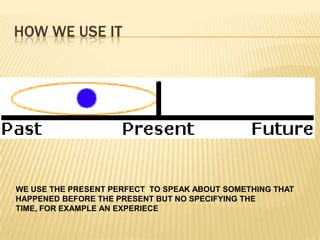
HOW WE USE ITWE USE THE PRESENT PERFECT  TO SPEAK ABOUT SOMETHING THAT HAPPENED BEFORE THE PRESENT BUT NO SPECIFYING THE TIME, FOR EXAMPLE AN EXPERIECE
EXAMPLESI have seen that movie twenty times. I think I have met him once before. There have been many earthquakes in California. People have traveled to the Moon. People have not traveled to Mars.
THE LAST EXAMPLES DID NOT SPECIFY THE TIME.I have seen that movie twenty times. This means thatyousawthemovie, butyou are notsaying WHEN yousawthemovie.  Youonlysaidthenumber of times yousawit.Wealso use PresentPerfectwhensomethingstarted in past and isstill happening in thepresent
MORE EXAMPLESShe has sangsinceshewas 17 yearsold.He has dancedhisentirelife.I havelived in Pereira since I was a baby
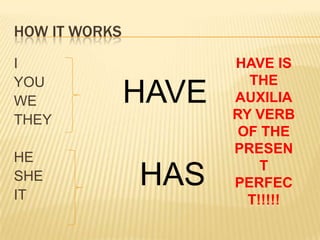
HOW IT WORKSIYOU WETHEYHE SHE ITHAVE IS THE AUXILIARY VERB OF THE PRESENT PERFECT!!!!!HAVEHAS
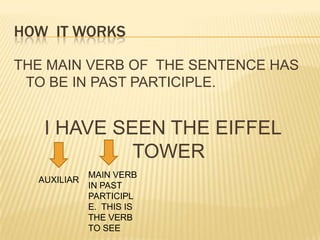
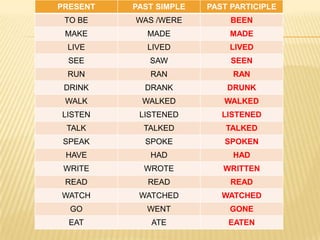
HOW  IT WORKSTHE MAIN VERB OF  THE SENTENCE HAS TO BE IN PAST PARTICIPLE.I HAVE SEEN THE EIFFEL TOWERMAIN VERB IN PAST PARTICIPLE.  THIS IS THE VERB TO SEEAUXILIAR
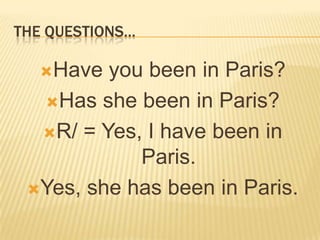
The questions…Have you been in Paris?Has she been in Paris?R/ = Yes, I have been in Paris.Yes, she has been in Paris.
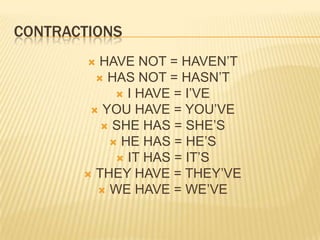
ContractionsHAVE NOT = HAVEN’THAS NOT = HASN’TI HAVE = I’VEYOU HAVE = YOU’VESHE HAS = SHE’SHE HAS = HE’SIT HAS = IT’STHEY HAVE = THEY’VEWE HAVE = WE’VE
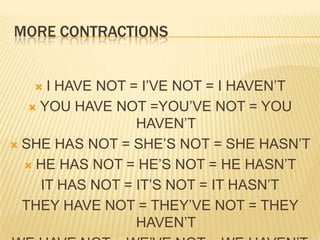
More contractionsI HAVE NOT = I’VE NOT = I HAVEN’TYOU HAVE NOT =YOU’VE NOT = YOU HAVEN’TSHE HAS NOT = SHE’S NOT = SHE HASN’THE HAS NOT = HE’S NOT = HE HASN’TIT HAS NOT = IT’S NOT = IT HASN’TTHEY HAVE NOT = THEY’VE NOT = THEY HAVEN’TWE HAVE NOT = WE’VE NOT = WE HAVEN’T
LET’S REVIEW ALL THE USES!!!!WITH EXAMPLES
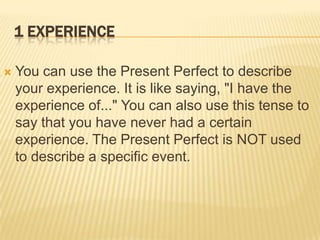
1 ExperienceYou can use the Present Perfect to describe your experience. It is like saying, "I have the experience of..." You can also use this tense to say that you have never had a certain experience. The Present Perfect is NOT used to describe a specific event.
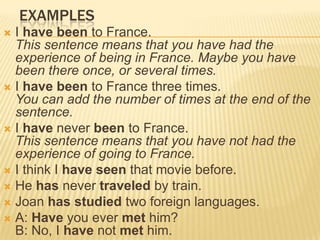
examplesI have been to France.This sentence means that you have had the experience of being in France. Maybe you have been there once, or several times.I have been to France three times.You can add the number of times at the end of the sentence.I have never been to France.This sentence means that you have not had the experience of going to France.I think I have seen that movie before.He has never traveled by train.Joan has studied two foreign languages.A: Have you ever met him?B: No, I have not met him.
2 ChangeOver TimeWe often use the Present Perfect to talk about change that has happened over a period of time.
EXAMPLESYou have grown since the last time I saw you.The government has become more interested in arts education.Japanese has become one of the most popular courses at the university since the Asian studies program was established.My English has really improved since I moved to Australia.
3 AccomplishmentsWe often use the Present Perfect to list the accomplishments of individuals and humanity. You cannot mention a specific time.
EXAMPLESMan has walked on the Moon.Our son has learned how to read.Doctors have cured many deadly diseases.Scientists have split the atom.
4 An Uncompleted Action You Are ExpectingWe often use the Present Perfect to say that an action which we expected has not happened. Using the Present Perfect suggests that we are still waiting for the action to happen.
EXAMPLESJames has not finished his homework yet.Susan hasn't mastered Japanese, but she can communicate.Bill has still not arrived.The rain hasn't stopped.
5 Multiple Actions at Different TimesWe also use the Present Perfect to talk about several different actions which have occurred in the past at different times. Present Perfect suggests the process is not complete and more actions are possible.
EXAMPLESThe army has attacked that city five times.I have had four quizzes and five tests so far this semester.We have had many major problems while working on this project.She has talked to several specialists about her problem, but nobody knows why she is sick.
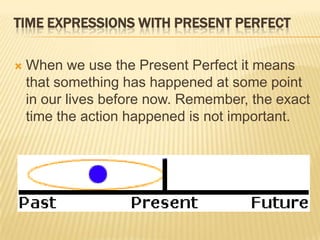
Time Expressions with Present PerfectWhen we use the Present Perfect it means that something has happened at some point in our lives before now. Remember, the exact time the action happened is not important.
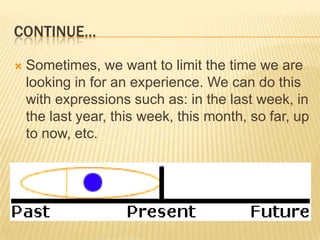
CONTINUE…Sometimes, we want to limit the time we are looking in for an experience. We can do this with expressions such as: in the last week, in the last year, this week, this month, so far, up to now, etc.
EXAMPLESHave you been to Mexico in the last year?I have seen that movie six times in the last month.They have had three tests in the last week.She graduated from university less than three years ago. She has worked for three different companies so far.My car has broken down three times this week.
NOTICE!!!!!!!!!!!!!!!!!"Last year" and "in the last year" are very different in meaning. "Last year" means the year before now, and it is considered a specific time which requires Simple Past. "In the last year" means from 365 days ago until now. It is not considered a specific time, so it requires Present Perfect.
EXAMPLESExamples:I went to Mexico last year.I went to Mexico in the calendar year before this one.I have been to Mexico in the last year.I have been to Mexico at least once at some point between 365 days ago and now.
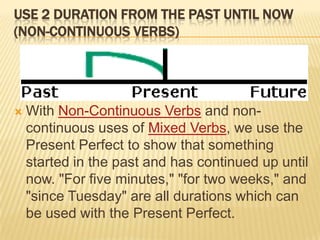
USE 2 Duration From the Past Until Now (Non-Continuous Verbs)With Non-Continuous Verbs and non-continuous uses of Mixed Verbs, we use the Present Perfect to show that something started in the past and has continued up until now. "For five minutes," "for two weeks," and "since Tuesday" are all durations which can be used with the Present Perfect.
EXAMPLESI have had a cold for two weeks.She has been in England for six months.Mary has loved chocolate since she was a little girl.
ADVERB PLACEMENTThe examples below show the placement for grammar adverbs such as: always, only, never, ever, still, just, etc.Examples:You have only seen that movie one time.Have you only seen that movie one time?
Already is used in affirmative sentences. Yet & anymore are used in negative sentences. Still is used in affirmative or negative sentences. Using ALREADY, YET, STILL, ANYMORE
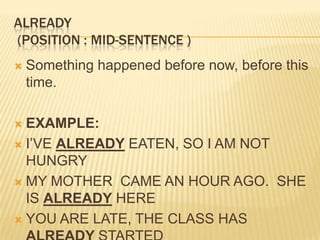
ALREADY (Position : mid-sentence )Something happened before now, before this time. EXAMPLE:I’VE ALREADY EATEN, SO I AM NOT HUNGRYMY MOTHER  CAME AN HOUR AGO.  SHE IS ALREADY HEREYOU ARE LATE, THE CLASS HAS ALREADY STARTED
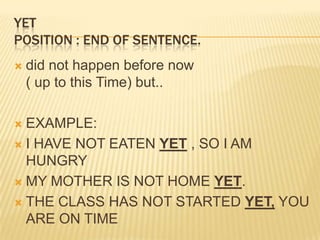
YETPosition : end of sentence. did not happen before now ( up to this Time) but..EXAMPLE:I HAVE NOT EATEN YET , SO I AM HUNGRYMY MOTHER IS NOT HOME YET.THE CLASS HAS NOT STARTED YET, YOU ARE ON TIME
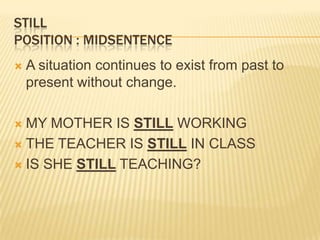
STILLPosition : midsentenceA situation continues to exist from past to present without change. MY MOTHER IS STILL WORKINGTHE TEACHER IS STILL IN CLASSIS SHE STILL TEACHING?
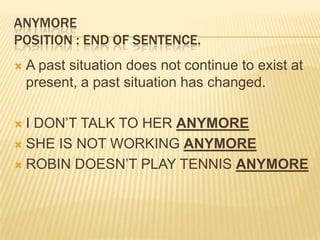
ANYMOREPosition : end of sentence.A past situation does not continue to exist at present, a past situation has changed. I DON’T TALK TO HER ANYMORESHE IS NOT WORKING ANYMOREROBIN DOESN’T PLAY TENNIS ANYMORE

Present perfect

  • 1.
  • 2.
    HOW WE USEITWE USE THE PRESENT PERFECT TO SPEAK ABOUT SOMETHING THAT HAPPENED BEFORE THE PRESENT BUT NO SPECIFYING THE TIME, FOR EXAMPLE AN EXPERIECE
  • 3.
    EXAMPLESI have seenthat movie twenty times. I think I have met him once before. There have been many earthquakes in California. People have traveled to the Moon. People have not traveled to Mars.
  • 4.
    THE LAST EXAMPLESDID NOT SPECIFY THE TIME.I have seen that movie twenty times. This means thatyousawthemovie, butyou are notsaying WHEN yousawthemovie. Youonlysaidthenumber of times yousawit.Wealso use PresentPerfectwhensomethingstarted in past and isstill happening in thepresent
  • 5.
    MORE EXAMPLESShe hassangsinceshewas 17 yearsold.He has dancedhisentirelife.I havelived in Pereira since I was a baby
  • 6.
    HOW IT WORKSIYOUWETHEYHE SHE ITHAVE IS THE AUXILIARY VERB OF THE PRESENT PERFECT!!!!!HAVEHAS
  • 7.
    HOW ITWORKSTHE MAIN VERB OF THE SENTENCE HAS TO BE IN PAST PARTICIPLE.I HAVE SEEN THE EIFFEL TOWERMAIN VERB IN PAST PARTICIPLE. THIS IS THE VERB TO SEEAUXILIAR
  • 9.
    The questions…Have youbeen in Paris?Has she been in Paris?R/ = Yes, I have been in Paris.Yes, she has been in Paris.
  • 10.
    ContractionsHAVE NOT =HAVEN’THAS NOT = HASN’TI HAVE = I’VEYOU HAVE = YOU’VESHE HAS = SHE’SHE HAS = HE’SIT HAS = IT’STHEY HAVE = THEY’VEWE HAVE = WE’VE
  • 11.
    More contractionsI HAVENOT = I’VE NOT = I HAVEN’TYOU HAVE NOT =YOU’VE NOT = YOU HAVEN’TSHE HAS NOT = SHE’S NOT = SHE HASN’THE HAS NOT = HE’S NOT = HE HASN’TIT HAS NOT = IT’S NOT = IT HASN’TTHEY HAVE NOT = THEY’VE NOT = THEY HAVEN’TWE HAVE NOT = WE’VE NOT = WE HAVEN’T
  • 12.
    LET’S REVIEW ALLTHE USES!!!!WITH EXAMPLES
  • 13.
    1 ExperienceYou canuse the Present Perfect to describe your experience. It is like saying, "I have the experience of..." You can also use this tense to say that you have never had a certain experience. The Present Perfect is NOT used to describe a specific event.
  • 14.
    examplesI have beento France.This sentence means that you have had the experience of being in France. Maybe you have been there once, or several times.I have been to France three times.You can add the number of times at the end of the sentence.I have never been to France.This sentence means that you have not had the experience of going to France.I think I have seen that movie before.He has never traveled by train.Joan has studied two foreign languages.A: Have you ever met him?B: No, I have not met him.
  • 16.
    2 ChangeOver TimeWeoften use the Present Perfect to talk about change that has happened over a period of time.
  • 17.
    EXAMPLESYou have grownsince the last time I saw you.The government has become more interested in arts education.Japanese has become one of the most popular courses at the university since the Asian studies program was established.My English has really improved since I moved to Australia.
  • 18.
    3 AccomplishmentsWe oftenuse the Present Perfect to list the accomplishments of individuals and humanity. You cannot mention a specific time.
  • 19.
    EXAMPLESMan has walkedon the Moon.Our son has learned how to read.Doctors have cured many deadly diseases.Scientists have split the atom.
  • 20.
    4 An UncompletedAction You Are ExpectingWe often use the Present Perfect to say that an action which we expected has not happened. Using the Present Perfect suggests that we are still waiting for the action to happen.
  • 21.
    EXAMPLESJames has notfinished his homework yet.Susan hasn't mastered Japanese, but she can communicate.Bill has still not arrived.The rain hasn't stopped.
  • 22.
    5 Multiple Actionsat Different TimesWe also use the Present Perfect to talk about several different actions which have occurred in the past at different times. Present Perfect suggests the process is not complete and more actions are possible.
  • 23.
    EXAMPLESThe army hasattacked that city five times.I have had four quizzes and five tests so far this semester.We have had many major problems while working on this project.She has talked to several specialists about her problem, but nobody knows why she is sick.
  • 24.
    Time Expressions withPresent PerfectWhen we use the Present Perfect it means that something has happened at some point in our lives before now. Remember, the exact time the action happened is not important.
  • 25.
    CONTINUE…Sometimes, we wantto limit the time we are looking in for an experience. We can do this with expressions such as: in the last week, in the last year, this week, this month, so far, up to now, etc.
  • 26.
    EXAMPLESHave you beento Mexico in the last year?I have seen that movie six times in the last month.They have had three tests in the last week.She graduated from university less than three years ago. She has worked for three different companies so far.My car has broken down three times this week.
  • 27.
    NOTICE!!!!!!!!!!!!!!!!!"Last year" and"in the last year" are very different in meaning. "Last year" means the year before now, and it is considered a specific time which requires Simple Past. "In the last year" means from 365 days ago until now. It is not considered a specific time, so it requires Present Perfect.
  • 28.
    EXAMPLESExamples:I went toMexico last year.I went to Mexico in the calendar year before this one.I have been to Mexico in the last year.I have been to Mexico at least once at some point between 365 days ago and now.
  • 29.
    USE 2 DurationFrom the Past Until Now (Non-Continuous Verbs)With Non-Continuous Verbs and non-continuous uses of Mixed Verbs, we use the Present Perfect to show that something started in the past and has continued up until now. "For five minutes," "for two weeks," and "since Tuesday" are all durations which can be used with the Present Perfect.
  • 30.
    EXAMPLESI have hada cold for two weeks.She has been in England for six months.Mary has loved chocolate since she was a little girl.
  • 31.
    ADVERB PLACEMENTThe examplesbelow show the placement for grammar adverbs such as: always, only, never, ever, still, just, etc.Examples:You have only seen that movie one time.Have you only seen that movie one time?
  • 32.
    Already is usedin affirmative sentences. Yet & anymore are used in negative sentences. Still is used in affirmative or negative sentences. Using ALREADY, YET, STILL, ANYMORE
  • 33.
    ALREADY (Position :mid-sentence )Something happened before now, before this time. EXAMPLE:I’VE ALREADY EATEN, SO I AM NOT HUNGRYMY MOTHER CAME AN HOUR AGO. SHE IS ALREADY HEREYOU ARE LATE, THE CLASS HAS ALREADY STARTED
  • 34.
    YETPosition : endof sentence. did not happen before now ( up to this Time) but..EXAMPLE:I HAVE NOT EATEN YET , SO I AM HUNGRYMY MOTHER IS NOT HOME YET.THE CLASS HAS NOT STARTED YET, YOU ARE ON TIME
  • 35.
    STILLPosition : midsentenceAsituation continues to exist from past to present without change. MY MOTHER IS STILL WORKINGTHE TEACHER IS STILL IN CLASSIS SHE STILL TEACHING?
  • 36.
    ANYMOREPosition : endof sentence.A past situation does not continue to exist at present, a past situation has changed. I DON’T TALK TO HER ANYMORESHE IS NOT WORKING ANYMOREROBIN DOESN’T PLAY TENNIS ANYMORE