Presented to : Dr. Khaleel Al Bataineh
By : Hasan Alomari
Department of English Language and Translation
RESPONDING TO ORAL ERRORS
-
Error correction should be positive .
Why ?! To Encourage the students to
concentrate on what they have to got
right .
Praise : Teachers should praise students for
correct and partly correct answers .
Why ? To Make them feel they are making
progress .
RESPONDING TO ORAL ERRORS
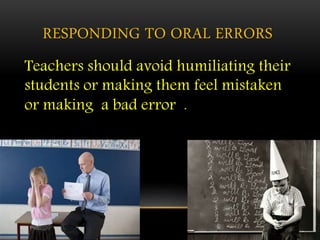
Teachers should avoid humiliating their
students or making them feel mistaken
or making a bad error .
RESPONDING TO ORAL ERRORS
Teachers should be aware of :
Effect on each individual learner of correcting the errors . By :
flexible and use different strategies according to the kind of error.
The ability and personality of the students .
The kind of activity .
The general atmosphere in the class .
RESPONDING TO ORAL ERRORS
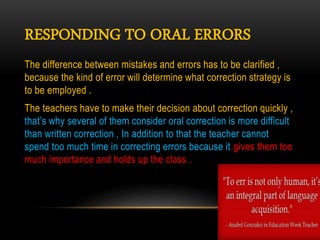
The difference between mistakes and errors has to be clarified ,
because the kind of error will determine what correction strategy is
to be employed .
The teachers have to make their decision about correction quickly ,
that’s why several of them consider oral correction is more difficult
than written correction , In addition to that the teacher cannot
spend too much time in correcting errors because it gives them too
much importance and holds up the class .
RESPONDING TO ORAL ERRORS
Teachers have to consider several factors :
What to correct . ( the nature of error or mistake ).
When to correct . ( students purposes in speaking ,
concentrating on fluency or accuracy ).
How much to correct . ( selection of errors to be
corrected , individual or common problems ).
RESPONDING TO ORAL ERRORS
The ease with which the error or mistake can be
corrected , avoidance of overcorrection .
How to correct . ( indication of the error , person providing
correction , personality of the student ).
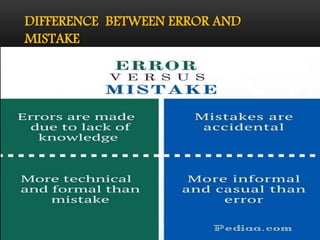
a mistake is usually inadvertent and can quickly be noticed
and corrected. For example, one could miss a letter or a digit
when writing. On the other hand, an error is something done
wrong due to lack of knowledge.
DIFFERENCE BETWEEN ERROR AND
MISTAKE
ACCURACY & FLUENCY
The issue of when and what to correct is related to
what the focus is at the time accuracy and
fluency it depends on :
the kind of activity we are doing .
The aim of the activity .
* We want students to produce accurate language or to
express themselves freely and develop fluency .
ACCURACY
Accuracy is important for learners in the accurate
reproduction stage .
Two basic stages :
The teacher indicates that something is wrong .
ask for correction .
INDICATION OF INCORRECTNESS
Several techniques were suggested by Harmer :
Repeating .( repeat what she / he said ).
Echoing . ( questioning intonation )
Denial . ( Simply the answer is not right ) .
Questioning . ( is that correct ?? ) .
Expression . ( facial expression or gesture ).
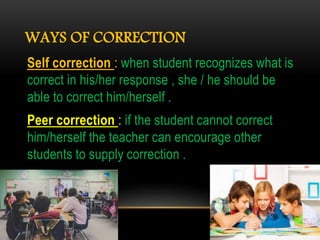
WAYS OF CORRECTION
Self correction : when student recognizes what is
correct in his/her response , she / he should be
able to correct him/herself .
Peer correction : if the student cannot correct
him/herself the teacher can encourage other
students to supply correction .
WAYS OF CORRECTION
Advantages of peer correction method according to edge
(1990) :
Its encourages cooperation , students get used to the idea
that they can learn from each other .
Both learners who made the error and correct are involved
in listening to and thinking about the languages .
The teacher gets a lot of important information about the
learner's ability .
If the students learn to practice peer correction without
hurting each other's feelings , they will do the same in pair-
working activities .
WAYS OF CORRECTION
Teacher correction : if no one can correct the
teacher must realise that the point has not yet
been laernt probably .
In this case the teacher can re-explain the
problematic item of language , especially if the
teacher sees that the majority of the class has the
same problem . ( there might be more repetition
and practice necessary ).
FLUENCY
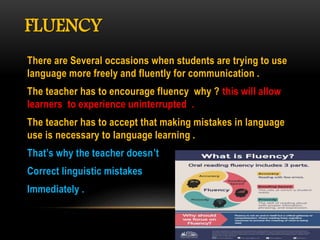
There are Several occasions when students are trying to use
language more freely and fluently for communication .
The teacher has to encourage fluency why ? this will allow
learners to experience uninterrupted .
The teacher has to accept that making mistakes in language
use is necessary to language learning .
That’s why the teacher doesn’t
Correct linguistic mistakes
Immediately .
FLUENCY
Gentle correction : means that the teacher doesn’t want
to seriously intervene and spoil the atmosphere of pair-work or
free conversation, so the teacher just indicates the student that
a mistake has been made, gives the correct form but does not
spend too much time on it and doesn’t make the student
repeat it .
Although in communicative activities students are allowed to
use any language they like, it doesn't mean that the teacher
cannot use any form of correction when fluency work is taking
place .
FLUENCY
guidance and correction cannot be given during the
activity, only afterwards .
While the students are involved in communication
activities in pairs or in small groups :
teacher can monitor their performance by walking
round making notes of the mistakes and errors,
and after the activity give individual students notes with
the errors they have made indicating the way of correction
or discuss the errors with the class.
FLUENCY
If there are common mistakes, they can be
written on the blackboard and corrected by the
students , It might be necessary to have more
practice in the given structure.
CORRECTION OF WRITTEN ERRORS
Some times teacher concentrate on accuracy .
Written work is to be marked according to the purpose : if
the aim is communication, the written work should not be
marked according to e.g. spelling
The great number of corrections will discourage the
students.
It is better to reduce the amount of underlining
and write corrections in the margin this way the
page will look less heavily corrected.
CORRECTION OF WRITTEN ERRORS
The same stages are to be followed in the
correction of written work as in oral correction.
The teacher indicates where the student has
made important errors .
The teacher can use a system of abbreviations or
symbols to indicate the line or the place in a line
where the mistake occurs.
the nature of the mistakes: Sp for spelling, Gr for grammar,
WO for word order, T for tense etc .
CORRECTION OF WRITTEN ERRORS
The use of correction codes by the teacher
instead of giving full correction is a widespread
practice, the rationale behind it is that it
encourages students to think about their writing
and correct themselves.
The teacher also can ask students to exchange their
pieces of written work and discuss them in groups so
that they can correct each other’s errors.
CORRECTION OF WRITTEN ERRORS
some learners may prefer their errors to be
corrected in full, saying that they are unable to
correct some of the mistakes they made
themselves.
Teachers can vary their approach according to
the wishes of individual learners.
QUESTIONS ?
This Photo by Unknown Author is licensed under CC BY-SA
Source: Sárosdy, Bencze, Poór and Vadnay. 2006. Applied Linguistics I for BA Students in English

Respond Oral Errors

  • 1.
    Presented to :Dr. Khaleel Al Bataineh By : Hasan Alomari Department of English Language and Translation RESPONDING TO ORAL ERRORS
  • 2.
    - Error correction shouldbe positive . Why ?! To Encourage the students to concentrate on what they have to got right . Praise : Teachers should praise students for correct and partly correct answers . Why ? To Make them feel they are making progress . RESPONDING TO ORAL ERRORS
  • 3.
    RESPONDING TO ORALERRORS Teachers should avoid humiliating their students or making them feel mistaken or making a bad error .
  • 4.
    RESPONDING TO ORALERRORS Teachers should be aware of : Effect on each individual learner of correcting the errors . By : flexible and use different strategies according to the kind of error. The ability and personality of the students . The kind of activity . The general atmosphere in the class .
  • 5.
    RESPONDING TO ORALERRORS The difference between mistakes and errors has to be clarified , because the kind of error will determine what correction strategy is to be employed . The teachers have to make their decision about correction quickly , that’s why several of them consider oral correction is more difficult than written correction , In addition to that the teacher cannot spend too much time in correcting errors because it gives them too much importance and holds up the class .
  • 6.
    RESPONDING TO ORALERRORS Teachers have to consider several factors : What to correct . ( the nature of error or mistake ). When to correct . ( students purposes in speaking , concentrating on fluency or accuracy ). How much to correct . ( selection of errors to be corrected , individual or common problems ).
  • 7.
    RESPONDING TO ORALERRORS The ease with which the error or mistake can be corrected , avoidance of overcorrection . How to correct . ( indication of the error , person providing correction , personality of the student ). a mistake is usually inadvertent and can quickly be noticed and corrected. For example, one could miss a letter or a digit when writing. On the other hand, an error is something done wrong due to lack of knowledge.
  • 8.
  • 9.
    ACCURACY & FLUENCY Theissue of when and what to correct is related to what the focus is at the time accuracy and fluency it depends on : the kind of activity we are doing . The aim of the activity . * We want students to produce accurate language or to express themselves freely and develop fluency .
  • 10.
    ACCURACY Accuracy is importantfor learners in the accurate reproduction stage . Two basic stages : The teacher indicates that something is wrong . ask for correction .
  • 11.
    INDICATION OF INCORRECTNESS Severaltechniques were suggested by Harmer : Repeating .( repeat what she / he said ). Echoing . ( questioning intonation ) Denial . ( Simply the answer is not right ) . Questioning . ( is that correct ?? ) . Expression . ( facial expression or gesture ).
  • 12.
    WAYS OF CORRECTION Selfcorrection : when student recognizes what is correct in his/her response , she / he should be able to correct him/herself . Peer correction : if the student cannot correct him/herself the teacher can encourage other students to supply correction .
  • 13.
    WAYS OF CORRECTION Advantagesof peer correction method according to edge (1990) : Its encourages cooperation , students get used to the idea that they can learn from each other . Both learners who made the error and correct are involved in listening to and thinking about the languages . The teacher gets a lot of important information about the learner's ability . If the students learn to practice peer correction without hurting each other's feelings , they will do the same in pair- working activities .
  • 14.
    WAYS OF CORRECTION Teachercorrection : if no one can correct the teacher must realise that the point has not yet been laernt probably . In this case the teacher can re-explain the problematic item of language , especially if the teacher sees that the majority of the class has the same problem . ( there might be more repetition and practice necessary ).
  • 15.
    FLUENCY There are Severaloccasions when students are trying to use language more freely and fluently for communication . The teacher has to encourage fluency why ? this will allow learners to experience uninterrupted . The teacher has to accept that making mistakes in language use is necessary to language learning . That’s why the teacher doesn’t Correct linguistic mistakes Immediately .
  • 16.
    FLUENCY Gentle correction :means that the teacher doesn’t want to seriously intervene and spoil the atmosphere of pair-work or free conversation, so the teacher just indicates the student that a mistake has been made, gives the correct form but does not spend too much time on it and doesn’t make the student repeat it . Although in communicative activities students are allowed to use any language they like, it doesn't mean that the teacher cannot use any form of correction when fluency work is taking place .
  • 17.
    FLUENCY guidance and correctioncannot be given during the activity, only afterwards . While the students are involved in communication activities in pairs or in small groups : teacher can monitor their performance by walking round making notes of the mistakes and errors, and after the activity give individual students notes with the errors they have made indicating the way of correction or discuss the errors with the class.
  • 18.
    FLUENCY If there arecommon mistakes, they can be written on the blackboard and corrected by the students , It might be necessary to have more practice in the given structure.
  • 19.
    CORRECTION OF WRITTENERRORS Some times teacher concentrate on accuracy . Written work is to be marked according to the purpose : if the aim is communication, the written work should not be marked according to e.g. spelling The great number of corrections will discourage the students. It is better to reduce the amount of underlining and write corrections in the margin this way the page will look less heavily corrected.
  • 20.
    CORRECTION OF WRITTENERRORS The same stages are to be followed in the correction of written work as in oral correction. The teacher indicates where the student has made important errors . The teacher can use a system of abbreviations or symbols to indicate the line or the place in a line where the mistake occurs. the nature of the mistakes: Sp for spelling, Gr for grammar, WO for word order, T for tense etc .
  • 21.
    CORRECTION OF WRITTENERRORS The use of correction codes by the teacher instead of giving full correction is a widespread practice, the rationale behind it is that it encourages students to think about their writing and correct themselves. The teacher also can ask students to exchange their pieces of written work and discuss them in groups so that they can correct each other’s errors.
  • 22.
    CORRECTION OF WRITTENERRORS some learners may prefer their errors to be corrected in full, saying that they are unable to correct some of the mistakes they made themselves. Teachers can vary their approach according to the wishes of individual learners.
  • 23.
  • 24.
    This Photo byUnknown Author is licensed under CC BY-SA Source: Sárosdy, Bencze, Poór and Vadnay. 2006. Applied Linguistics I for BA Students in English