
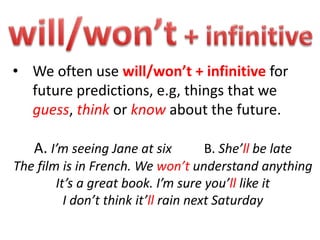
• We often use will/won’t + infinitive for
future predictions, e.g, things that we
guess, think or know about the future.
A. I’m seeing Jane at six B. She’ll be late
The film is in French. We won’t understand anything
It’s a great book. I’m sure you’ll like it
I don’t think it’ll rain next Saturday
➕ ➖
I /YOU/HE/SHE
IT/WE/THEY
‘LL BE LATE
I /YOU/HE/SHE
IT/WE/THEY
WON’T BE LATE
? ✅ ❎
WILL
I
YOU
HE
SHE
IT
WE
THEY
BE
LATE?
YES,
I
YOU
HE
SHE
IT
WE
THEY
WILL NO,
I
YOU
HE
SHE
IT
WE
THEY
WON’T
will = ‘ll; will not = won’t
• We often use:
I think/I don’t think + will
Don’t use won’t: I think + won’t
I think I’ll fail the exam. I don’t think I’ll pass
I think I won’t pass the exam

The future will/won't

  • 6.
    • We oftenuse will/won’t + infinitive for future predictions, e.g, things that we guess, think or know about the future. A. I’m seeing Jane at six B. She’ll be late The film is in French. We won’t understand anything It’s a great book. I’m sure you’ll like it I don’t think it’ll rain next Saturday
  • 7.
    ➕ ➖ I /YOU/HE/SHE IT/WE/THEY ‘LLBE LATE I /YOU/HE/SHE IT/WE/THEY WON’T BE LATE ? ✅ ❎ WILL I YOU HE SHE IT WE THEY BE LATE? YES, I YOU HE SHE IT WE THEY WILL NO, I YOU HE SHE IT WE THEY WON’T will = ‘ll; will not = won’t
  • 8.
    • We oftenuse: I think/I don’t think + will Don’t use won’t: I think + won’t I think I’ll fail the exam. I don’t think I’ll pass I think I won’t pass the exam