














Prepare Students for the
GED® Test Extended Response
Meagen Farrell
The Literacy Cooperative
March 20, 2015
Meagen Farrell
Teacher Trainer
Instructional Designer
@farrellink
Facebook.com/farrell.ink
Farrellink.com
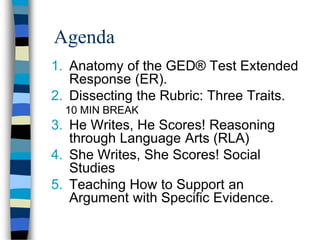
Agenda
1. Anatomy of the GED® Test Extended
Response (ER).
2. Dissecting the Rubric: Three Traits.
10 MIN BREAK
3. He Writes, He Scores! Reasoning
through Language Arts (RLA)
4. She Writes, She Scores! Social
Studies
5. Teaching How to Support an
Argument with Specific Evidence.
Rules for the Road
• Stay with the group! Don’t get
distracted by your mobile
device or side conversations.
• Questions? Yes, please! Just
raise your hand.
Anatomy of the
GED® Test
Extended Response (ER)
Photo Source: Flickr User Hey Paul Studios
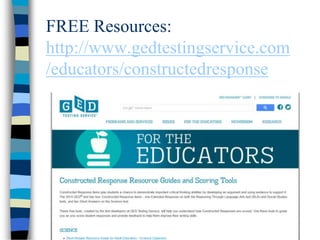
FREE Resources:
http://www.gedtestingservice.com
/educators/constructedresponse
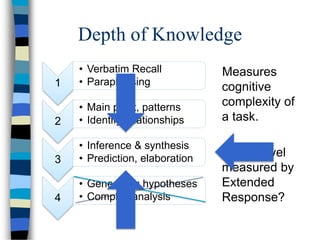
Depth of Knowledge
Measures
cognitive
complexity of
a task.
Which level
measured by
Extended
Response?
1
• Verbatim Recall
• Paraphrasing
2
• Main point, patterns
• Identify relationships
3
• Inference & synthesis
• Prediction, elaboration
4
• Generating hypotheses
• Complex analysis
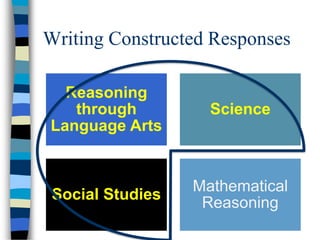
Writing Constructed Responses
Reasoning
through
Language Arts
Science
Social Studies
Mathematical
Reasoning
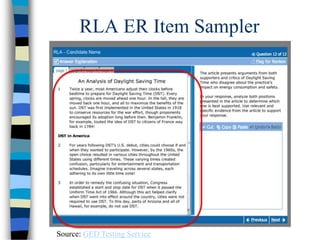
RLA ER Item Sampler
Source: GED Testing Service
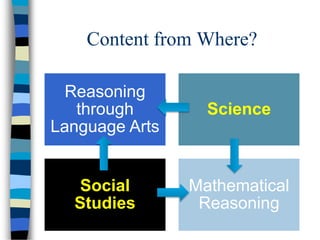
Content from Where?
Reasoning
through
Language Arts
Science
Social
Studies
Mathematical
Reasoning
Content from Where?
Reasoning
through
Language Arts
Science
Social Studies
Mathematical
Reasoning
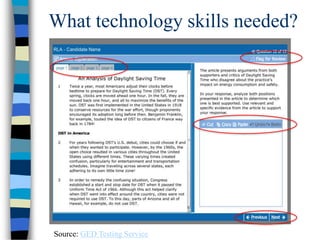
What technology skills needed?
Source: GED Testing Service
TECHNOLOGY SKILLS
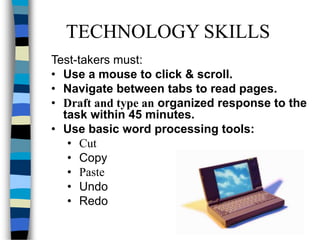
Test-takers must:
• Use a mouse to click & scroll.
• Navigate between tabs to read pages.
• Draft and type an organized response to the
task within 45 minutes.
• Use basic word processing tools:
• Cut
• Copy
• Paste
• Undo
• Redo
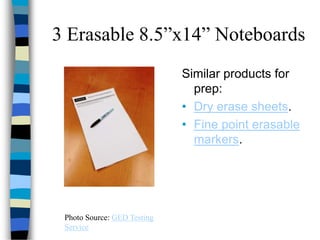
3 Erasable 8.5”x14” Noteboards
Photo Source: GED Testing
Service
Similar products for
prep:
• Dry erase sheets.
• Fine point erasable
markers.
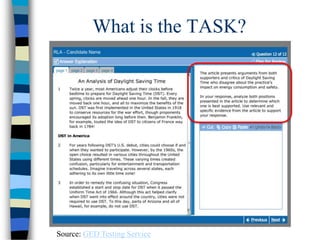
What is the TASK?
Source: GED Testing Service
What are test takers asked to DO?
“The article presents arguments from both
supporters and critics of Daylight Saving
Time who disagree about the practice’s
impact on energy consumption and safety.
“In your response, analyze both positions
presented in the article to determine which
one is best supported. Use relevant and
specific evidence from the article to support
your response.
“Type your response in the box below. You
should expect to spend up to 45 minutes in
planning, drafting, and editing your
response.”
Read the ER PROMPT
ER Prompts: 550-650 words.
• How long did it take YOU to read?
• How long do you think it would take
your STUDENTS?
If you finish early, SILENTLY consider
how you would respond to this task.
Take 5-7 minutes to
discuss the ER prompt:
• What reading skills do test takers
need to “analyze both positions”?
• What writing skills do test takers
need to “use relevant and specific
evidence” in their responses?
• What instructional activities can
you lead to build these skills?
Questions?
Dissecting the Rubric:
Three Traits
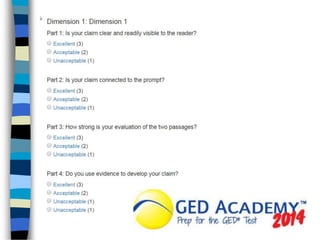
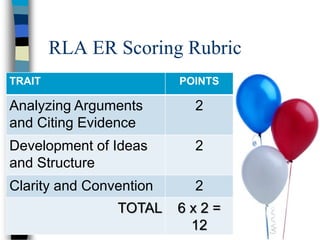
RLA ER Scoring Rubric
TRAIT POINTS
Analyzing Arguments
and Citing Evidence
2
Development of Ideas
and Structure
2
Clarity and Convention 2
TOTAL 6 x 2 =
12
SS ER Scoring Rubric
TRAIT POINTS
Analyzing Arguments
and Citing Evidence
2
Development of Ideas
and Structure
1
Clarity and Convention 1
TOTAL 4 x 2 = 8
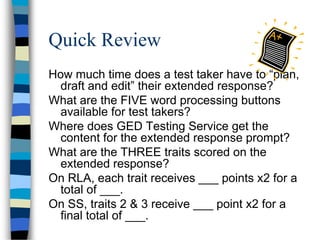
Quick Review
How much time does a test taker have to “plan,
draft and edit” their extended response?
What are the FIVE word processing buttons
available for test takers?
Where does GED Testing Service get the
content for the extended response prompt?
What are the THREE traits scored on the
extended response?
On RLA, each trait receives ___ points x2 for a
total of ___.
On SS, traits 2 & 3 receive ___ point x2 for a
final total of ___.
Twelve Volunteers Needed
for Part Two!
15 MINUTE BREAK
WELCOME BACK TO
Preparing for the ER! Part Deux!
Scoring and Teaching GED®
Reasoning through Language Arts
Test Extended Responses
Reasoning through Language Arts
“He Writes,
HE SCORES!”
RLA ER Scoring Rubric
TRAIT POINTS
Analyzing Arguments
and Citing Evidence
2
Development of Ideas
and Structure
2
Clarity and Convention 2
TOTAL 6 x 2 =
12
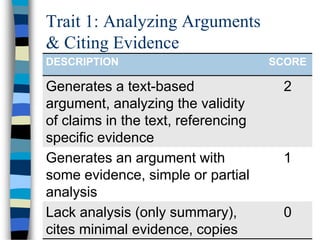
Trait 1: Analyzing Arguments
& Citing Evidence
DESCRIPTION SCORE
Generates a text-based
argument, analyzing the validity
of claims in the text, referencing
specific evidence
2
Generates an argument with
some evidence, simple or partial
analysis
1
Lack analysis (only summary),
cites minimal evidence, copies
0
It’s Time to Play…
INTRODUCING
our JUDGES!
Let’s Welcome Our Contestants!
Test-Taker Anchor Response 2
What do the
JUDGES say?
Test-Taker Anchor Response 2
Score &
Annotations from
the GED® Testing
Service Subject
Matter Expert!
Test-Taker Anchor Response 4
What do the
JUDGES say?
Test-Taker Anchor Response 4
Score &
Annotations from
the GED® Testing
Service Subject
Matter Expert!
Test-Taker Anchor Response 7
What do the
JUDGES say?
Test-Taker Anchor Response 7
Score &
Annotations from
the GED® Testing
Service Subject
Matter Expert!
THANK YOU VOLUNTEERS!
Now it’s YOUR turn!
Trait 2: Development of Ideas and
Organizational Structure
DESCRIPTION SCORE
Well developed ideas, clear
connections with transitions,
formal style, precise words
2
Some ideas elaborated, vague
terms and structure, disjointed
details
1
Little elaboration on main idea,
informal style
0
Find a Partner
• Re-read Anchor Response 7.
• Take a few minutes silently to
score the passage ONLY on
TRAIT 2: Development of Ideas
and Organizational Structure.
• Once both partners have
finished scoring, compare your
scores and cite specific
evidence to support your choice.
What Score Did You Give?
WHY?
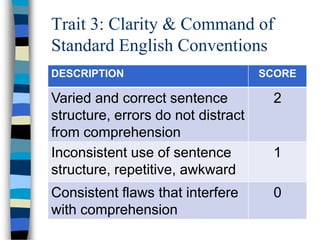
Trait 3: Clarity & Command of
Standard English Conventions
DESCRIPTION SCORE
Varied and correct sentence
structure, errors do not distract
from comprehension
2
Inconsistent use of sentence
structure, repetitive, awkward
1
Consistent flaws that interfere
with comprehension
0
Find a Partner
• Re-read Anchor Response 4.
• Take a few minutes silently to
score the passage ONLY on TRAIT
3: Clarity and Command of
Standard English Conventions.
• Once both partners have finished
scoring, compare your scores and
cite specific evidence to support
your choice.
What Score Did You Give?
WHY?
Social Studies
“She Writes,
SHE SCORES!”
Read the SS PROMPT
If you finish early, SILENTLY consider
how you would respond to this task.
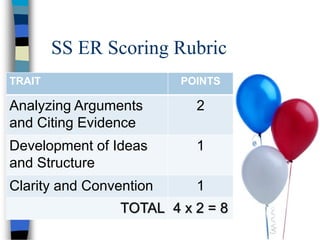
SS ER Scoring Rubric
TRAIT POINTS
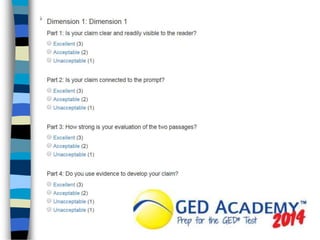
Analyzing Arguments
and Citing Evidence
2
Development of Ideas
and Structure
1
Clarity and Convention 1
TOTAL 4 x 2 = 8
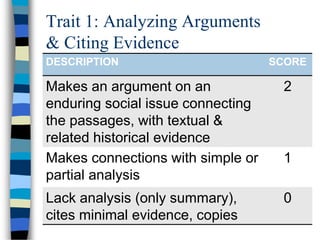
Trait 1: Analyzing Arguments
& Citing Evidence
DESCRIPTION SCORE
Makes an argument on an
enduring social issue connecting
the passages, with textual &
related historical evidence
2
Makes connections with simple or
partial analysis
1
Lack analysis (only summary),
cites minimal evidence, copies
0
It’s Time to Play…
INTRODUCING
our JUDGES!
Let’s Welcome Our Contestants!
Test-Taker Anchor Response 1
What do the
JUDGES say?
Test-Taker Anchor Response 1
Score &
Annotations from
the GED® Testing
Service Subject
Matter Expert!
Test-Taker Anchor Response 6
What do the
JUDGES say?
Test-Taker Anchor Response 6
Score &
Annotations from
the GED® Testing
Service Subject
Matter Expert!
Test-Taker Anchor Response 9
What do the
JUDGES say?
Test-Taker Anchor Response 9
Score &
Annotations from
the GED® Testing
Service Subject
Matter Expert!
THANK YOU VOLUNTEERS!
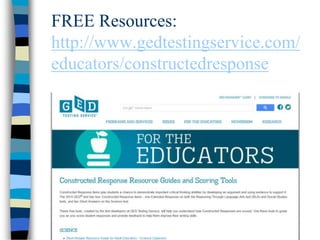
FREE Resources:
http://www.gedtestingservice.com/
educators/constructedresponse
Teaching How to Support an
Argument with Evidence
Remember Your Ideas?
• What reading skills do test takers
need to “analyze both positions”?
• What writing skills do test takers
need to “use relevant and specific
evidence” in their responses?
• What instructional activities can
you lead to build these skills?
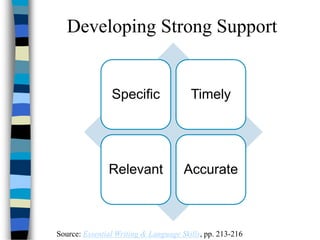
Developing Strong Support
Specific Timely
Relevant Accurate
Source: Essential Writing & Language Skills, pp. 213-216
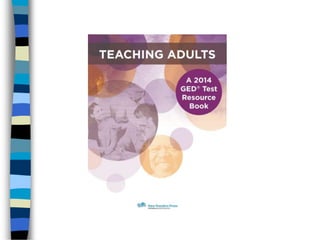
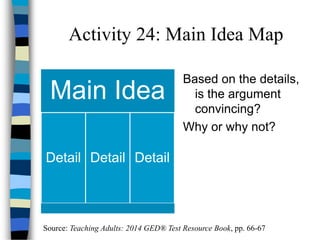
Source: Teaching Adults: 2014 GED® Test Resource Book, pp. 66-67
Activity 24: Main Idea Map
Main Idea
Detail Detail Detail
Based on the details,
is the argument
convincing?
Why or why not?
Final Questions?
Thank You!
PassGED.com/educators
Essential Writing & Language Skills
Teaching Adults: 2014 GED® Test from
NewReadersPress.com
GED® is a registered trademark of the American Council on Education and
may not be used without permission. The GED® and GED Testing Service®
brands are administered by GED Testing Service LLC under license.

Prepare Your Students for the GED Test Extended Response

  • 1.
    Prepare Students forthe GED® Test Extended Response Meagen Farrell The Literacy Cooperative March 20, 2015
  • 2.
    Meagen Farrell Teacher Trainer InstructionalDesigner @farrellink Facebook.com/farrell.ink Farrellink.com
  • 5.
    Agenda 1. Anatomy ofthe GED® Test Extended Response (ER). 2. Dissecting the Rubric: Three Traits. 10 MIN BREAK 3. He Writes, He Scores! Reasoning through Language Arts (RLA) 4. She Writes, She Scores! Social Studies 5. Teaching How to Support an Argument with Specific Evidence.
  • 6.
    Rules for theRoad • Stay with the group! Don’t get distracted by your mobile device or side conversations. • Questions? Yes, please! Just raise your hand.
  • 7.
    Anatomy of the GED®Test Extended Response (ER) Photo Source: Flickr User Hey Paul Studios
  • 8.
  • 9.
    Depth of Knowledge Measures cognitive complexityof a task. Which level measured by Extended Response? 1 • Verbatim Recall • Paraphrasing 2 • Main point, patterns • Identify relationships 3 • Inference & synthesis • Prediction, elaboration 4 • Generating hypotheses • Complex analysis
  • 10.
    Writing Constructed Responses Reasoning through LanguageArts Science Social Studies Mathematical Reasoning
  • 11.
    RLA ER ItemSampler Source: GED Testing Service
  • 12.
    Content from Where? Reasoning through LanguageArts Science Social Studies Mathematical Reasoning
  • 13.
    Content from Where? Reasoning through LanguageArts Science Social Studies Mathematical Reasoning
  • 14.
    What technology skillsneeded? Source: GED Testing Service
  • 15.
    TECHNOLOGY SKILLS Test-takers must: •Use a mouse to click & scroll. • Navigate between tabs to read pages. • Draft and type an organized response to the task within 45 minutes. • Use basic word processing tools: • Cut • Copy • Paste • Undo • Redo
  • 16.
    3 Erasable 8.5”x14”Noteboards Photo Source: GED Testing Service Similar products for prep: • Dry erase sheets. • Fine point erasable markers.
  • 17.
    What is theTASK? Source: GED Testing Service
  • 18.
    What are testtakers asked to DO? “The article presents arguments from both supporters and critics of Daylight Saving Time who disagree about the practice’s impact on energy consumption and safety. “In your response, analyze both positions presented in the article to determine which one is best supported. Use relevant and specific evidence from the article to support your response. “Type your response in the box below. You should expect to spend up to 45 minutes in planning, drafting, and editing your response.”
  • 19.
    Read the ERPROMPT ER Prompts: 550-650 words. • How long did it take YOU to read? • How long do you think it would take your STUDENTS? If you finish early, SILENTLY consider how you would respond to this task.
  • 20.
    Take 5-7 minutesto discuss the ER prompt: • What reading skills do test takers need to “analyze both positions”? • What writing skills do test takers need to “use relevant and specific evidence” in their responses? • What instructional activities can you lead to build these skills?
  • 21.
  • 22.
  • 23.
    RLA ER ScoringRubric TRAIT POINTS Analyzing Arguments and Citing Evidence 2 Development of Ideas and Structure 2 Clarity and Convention 2 TOTAL 6 x 2 = 12
  • 24.
    SS ER ScoringRubric TRAIT POINTS Analyzing Arguments and Citing Evidence 2 Development of Ideas and Structure 1 Clarity and Convention 1 TOTAL 4 x 2 = 8
  • 25.
    Quick Review How muchtime does a test taker have to “plan, draft and edit” their extended response? What are the FIVE word processing buttons available for test takers? Where does GED Testing Service get the content for the extended response prompt? What are the THREE traits scored on the extended response? On RLA, each trait receives ___ points x2 for a total of ___. On SS, traits 2 & 3 receive ___ point x2 for a final total of ___.
  • 26.
  • 27.
  • 28.
    WELCOME BACK TO Preparingfor the ER! Part Deux! Scoring and Teaching GED® Reasoning through Language Arts Test Extended Responses
  • 29.
    Reasoning through LanguageArts “He Writes, HE SCORES!”
  • 30.
    RLA ER ScoringRubric TRAIT POINTS Analyzing Arguments and Citing Evidence 2 Development of Ideas and Structure 2 Clarity and Convention 2 TOTAL 6 x 2 = 12
  • 31.
    Trait 1: AnalyzingArguments & Citing Evidence DESCRIPTION SCORE Generates a text-based argument, analyzing the validity of claims in the text, referencing specific evidence 2 Generates an argument with some evidence, simple or partial analysis 1 Lack analysis (only summary), cites minimal evidence, copies 0
  • 32.
    It’s Time toPlay… INTRODUCING our JUDGES!
  • 33.
    Let’s Welcome OurContestants!
  • 34.
    Test-Taker Anchor Response2 What do the JUDGES say?
  • 35.
    Test-Taker Anchor Response2 Score & Annotations from the GED® Testing Service Subject Matter Expert!
  • 36.
    Test-Taker Anchor Response4 What do the JUDGES say?
  • 37.
    Test-Taker Anchor Response4 Score & Annotations from the GED® Testing Service Subject Matter Expert!
  • 38.
    Test-Taker Anchor Response7 What do the JUDGES say?
  • 39.
    Test-Taker Anchor Response7 Score & Annotations from the GED® Testing Service Subject Matter Expert!
  • 40.
  • 41.
  • 42.
    Trait 2: Developmentof Ideas and Organizational Structure DESCRIPTION SCORE Well developed ideas, clear connections with transitions, formal style, precise words 2 Some ideas elaborated, vague terms and structure, disjointed details 1 Little elaboration on main idea, informal style 0
  • 43.
    Find a Partner •Re-read Anchor Response 7. • Take a few minutes silently to score the passage ONLY on TRAIT 2: Development of Ideas and Organizational Structure. • Once both partners have finished scoring, compare your scores and cite specific evidence to support your choice.
  • 44.
    What Score DidYou Give? WHY?
  • 45.
    Trait 3: Clarity& Command of Standard English Conventions DESCRIPTION SCORE Varied and correct sentence structure, errors do not distract from comprehension 2 Inconsistent use of sentence structure, repetitive, awkward 1 Consistent flaws that interfere with comprehension 0
  • 46.
    Find a Partner •Re-read Anchor Response 4. • Take a few minutes silently to score the passage ONLY on TRAIT 3: Clarity and Command of Standard English Conventions. • Once both partners have finished scoring, compare your scores and cite specific evidence to support your choice.
  • 47.
    What Score DidYou Give? WHY?
  • 48.
  • 49.
    Read the SSPROMPT If you finish early, SILENTLY consider how you would respond to this task.
  • 50.
    SS ER ScoringRubric TRAIT POINTS Analyzing Arguments and Citing Evidence 2 Development of Ideas and Structure 1 Clarity and Convention 1 TOTAL 4 x 2 = 8
  • 51.
    Trait 1: AnalyzingArguments & Citing Evidence DESCRIPTION SCORE Makes an argument on an enduring social issue connecting the passages, with textual & related historical evidence 2 Makes connections with simple or partial analysis 1 Lack analysis (only summary), cites minimal evidence, copies 0
  • 52.
    It’s Time toPlay… INTRODUCING our JUDGES!
  • 53.
    Let’s Welcome OurContestants!
  • 54.
    Test-Taker Anchor Response1 What do the JUDGES say?
  • 55.
    Test-Taker Anchor Response1 Score & Annotations from the GED® Testing Service Subject Matter Expert!
  • 56.
    Test-Taker Anchor Response6 What do the JUDGES say?
  • 57.
    Test-Taker Anchor Response6 Score & Annotations from the GED® Testing Service Subject Matter Expert!
  • 58.
    Test-Taker Anchor Response9 What do the JUDGES say?
  • 59.
    Test-Taker Anchor Response9 Score & Annotations from the GED® Testing Service Subject Matter Expert!
  • 60.
  • 61.
  • 63.
    Teaching How toSupport an Argument with Evidence
  • 64.
    Remember Your Ideas? •What reading skills do test takers need to “analyze both positions”? • What writing skills do test takers need to “use relevant and specific evidence” in their responses? • What instructional activities can you lead to build these skills?
  • 65.
    Developing Strong Support SpecificTimely Relevant Accurate Source: Essential Writing & Language Skills, pp. 213-216
  • 66.
    Source: Teaching Adults:2014 GED® Test Resource Book, pp. 66-67 Activity 24: Main Idea Map Main Idea Detail Detail Detail Based on the details, is the argument convincing? Why or why not?
  • 67.
  • 68.
    Thank You! PassGED.com/educators Essential Writing& Language Skills Teaching Adults: 2014 GED® Test from NewReadersPress.com GED® is a registered trademark of the American Council on Education and may not be used without permission. The GED® and GED Testing Service® brands are administered by GED Testing Service LLC under license.

Editor's Notes

  • #3 Why did New Readers Press ask me to write this book? They want an instructional perspective.
  • #11 Why not math? “Great strides have been made in automated scoring over the last decade, [but]…is not fully developed enough to result in reliable scoring in the area of mathematics.” (p. 53)
  • #12 “Logistically, the ER item in RLS is in its own separately-timed section of the test at the end of the first half of the RLS module (prior to a 10-minute break).” (p. 53)