Prepared by Keisha Parris
Quotation marks always come after a
comma or other punctuation mark.
Quotation marks surround the direct
(spoken) speech only. The words which tell
the reader who is speaking are called the
reporting words.
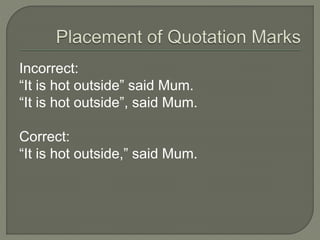
Incorrect:
“It is hot outside” said Mum.
“It is hot outside”, said Mum.
Correct:
“It is hot outside,” said Mum.
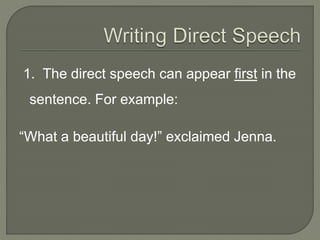
1. The direct speech can appear first in the
sentence. For example:
“What a beautiful day!” exclaimed Jenna.
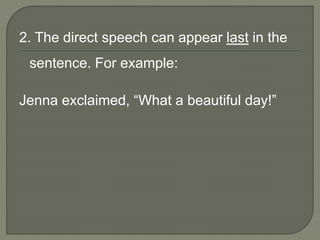
2. The direct speech can appear last in the
sentence. For example:
Jenna exclaimed, “What a beautiful day!”
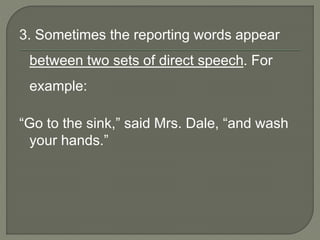
3. Sometimes the reporting words appear
between two sets of direct speech. For
example:
“Go to the sink,” said Mrs. Dale, “and wash
your hands.”
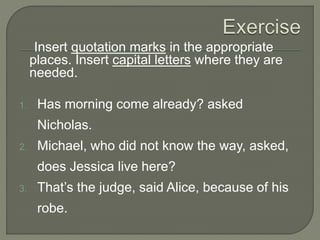
Insert quotation marks in the appropriate
places. Insert capital letters where they are
needed.
1. Has morning come already? asked
Nicholas.
2. Michael, who did not know the way, asked,
does Jessica live here?
3. That’s the judge, said Alice, because of his
robe.
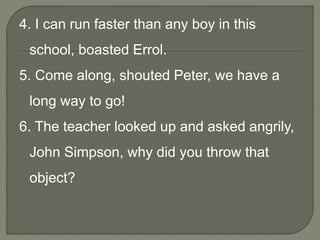
4. I can run faster than any boy in this
school, boasted Errol.
5. Come along, shouted Peter, we have a
long way to go!
6. The teacher looked up and asked angrily,
John Simpson, why did you throw that
object?
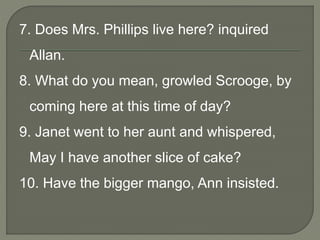
7. Does Mrs. Phillips live here? inquired
Allan.
8. What do you mean, growled Scrooge, by
coming here at this time of day?
9. Janet went to her aunt and whispered,
May I have another slice of cake?
10. Have the bigger mango, Ann insisted.

Quotation Marks

  • 1.
  • 2.
    Quotation marks alwayscome after a comma or other punctuation mark. Quotation marks surround the direct (spoken) speech only. The words which tell the reader who is speaking are called the reporting words.
  • 3.
    Incorrect: “It is hotoutside” said Mum. “It is hot outside”, said Mum. Correct: “It is hot outside,” said Mum.
  • 4.
    1. The directspeech can appear first in the sentence. For example: “What a beautiful day!” exclaimed Jenna.
  • 5.
    2. The directspeech can appear last in the sentence. For example: Jenna exclaimed, “What a beautiful day!”
  • 6.
    3. Sometimes thereporting words appear between two sets of direct speech. For example: “Go to the sink,” said Mrs. Dale, “and wash your hands.”
  • 7.
    Insert quotation marksin the appropriate places. Insert capital letters where they are needed. 1. Has morning come already? asked Nicholas. 2. Michael, who did not know the way, asked, does Jessica live here? 3. That’s the judge, said Alice, because of his robe.
  • 8.
    4. I canrun faster than any boy in this school, boasted Errol. 5. Come along, shouted Peter, we have a long way to go! 6. The teacher looked up and asked angrily, John Simpson, why did you throw that object?
  • 9.
    7. Does Mrs.Phillips live here? inquired Allan. 8. What do you mean, growled Scrooge, by coming here at this time of day? 9. Janet went to her aunt and whispered, May I have another slice of cake? 10. Have the bigger mango, Ann insisted.