Essay & Paragraph
    Structure
PARAGRAPH STRUCTURE
A paragraph is a group of sentences
 that work together to make a point.


• A good paragraph contains (a):
  – Topic Sentence
  – Support Sentences
  – Concluding Sentence
Topic Sentence
• States the main point
• First sentence of your paragraph


   Topic + Controlling Idea=
        Topic Sentence
Support Sentences
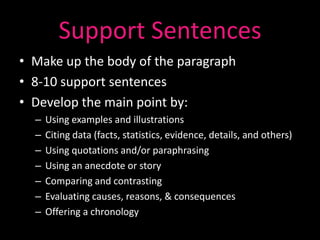
• Make up the body of the paragraph
• 8-10 support sentences
• Develop the main point by:
  –   Using examples and illustrations
  –   Citing data (facts, statistics, evidence, details, and others)
  –   Using quotations and/or paraphrasing
  –   Using an anecdote or story
  –   Comparing and contrasting
  –   Evaluating causes, reasons, & consequences
  –   Offering a chronology
Concluding Sentence
• Summarizes/Restates the main idea
• Uses different language
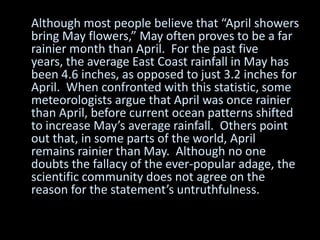
Although most people believe that “April showers
bring May flowers,” May often proves to be a far
rainier month than April. For the past five
years, the average East Coast rainfall in May has
been 4.6 inches, as opposed to just 3.2 inches for
April. When confronted with this statistic, some
meteorologists argue that April was once rainier
than April, before current ocean patterns shifted
to increase May’s average rainfall. Others point
out that, in some parts of the world, April
remains rainier than May. Although no one
doubts the fallacy of the ever-popular adage, the
scientific community does not agree on the
reason for the statement’s untruthfulness.
ELEMENTS OF A PARAGRAPH
Unity
• Unity refers to the idea that all of the ideas in a
  written piece are relevant and appropriate to the
  focus. Some considerations include:
   – each claim (assertion, topic sentence) supports
     the thesis (or topic sentence)
   – each piece of evidence is important and relevant
     to the focus of the paragraph or the piece of
     writing as a whole
Coherence
• Coherence refers to the organization and logic
  of a piece of writing; some considerations
  include:
  – precision and clarity in a thesis and supportive
    arguments
  – the arguments ordered in the most effective way
    for the writer's intent
  – the sentences and paragraphs "flow smoothly" for
    the reader; there should not be any abrupt leaps
    or gaps in the presentation of the ideas or story
Transitions
• Use transition words to connect sentences:
  – However
  – Furthermore
  – As a result
  – In fact
  – Yet
  – Finally
  – Meanwhile
ESSAY STRUCTURE
Essay Format
I. Introduction (ending in thesis
     statement) – three to five sentences
II. Body paragraph 1 (format already
     given) – 12 to 15 sentences
III. Body paragraph 2 (format already
     given) – 12 to 15 sentences
IV.Conclusion – three to five sentences
Function of an Introduction
•   captures your audience's attention.
•   gives background on your topic.
•   develops interest in your topic.
•   guides your reader to your thesis.
How do I write an Introduction?
• Write the introduction after you write the
  body of your essay.
• Write the introduction before you write the
  body of your essay.
• Rough out the introduction first and then
  focus and revise it once you have written your
  essay.
Writing an Introduction
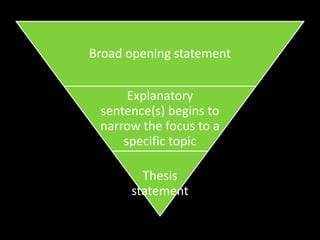
• Envision your introduction as an upside
  down triangle. It begins broad and gets
  specific.
• Make a general statement about your topic.
• Write a sentence which explains the topic
  and begins to narrow your focus.
• End with a thesis statement that provides a
  clear idea of your topic and gives your
  attitude or opinion on the topic.
Broad opening statement


      Explanatory
 sentence(s) begins to
 narrow the focus to a
     specific topic

        Thesis
      statement
Broad Opening Statement
• An opening statement is often called a “hook,”
  and it should grab your reader’s attention. You
  can…
  – Make a general statement.
  – begin with a surprising fact.
  – ask a question.
  – use a quotation.
  – tell a story.
  – provide a definition.
Writing a Thesis Statement
• Placed at the end of your introduction
• Includes your specific topic + your
  opinion on the topic
• It may also include the reasons you will
  give to support your argument or
  develop your point.
Sample Introduction
• The common saying “A dog is man’s best friend”
  may have some truth to it, but dogs aren’t the
  only animal people enjoy owning (general
  statement about pets). In fact, nearly as many
  people own cats as own dogs (narrowed slightly
  to cat ownership). Dog lovers might argue that
  canines make better pets, but they are mistaken
  (further narrowed). Fabulous felines make better
  companions than mangy mutts because they are
  both smarter and easier to care for (thesis with
  topic, opinion, and reasons).
Body Paragraphs
Topic sentence which indicates first point - Cats are smarter than dogs.
     A. Supporting idea 1
          1. Detail
          2. Detail
     B. Supporting idea 2
          1. Detail
          2. Detail
     C. Supporting idea 3
          1. Detail
          2. Detail
     D. Concluding sentence
III. Repeat of first body paragraph using second point – Cats are easier
     to care for than dogs.
Conclusion
• Emphasizes the purpose and importance of your
  essay
• Explains the significance or consequences of your
  findings
• Indicates the wider applications of the method
  developed in your essay
• Establishes your essay as the basis for further
  investigation
• Shows other directions of inquiry into the subject
Organizing a Conclusion
• Transition from last body paragraph
• Sentences explaining how paper has fit together and
  leads to a stronger, more emphatic and more detailed
  version of your thesis
• Discussion of implications for further research
   • Other areas that can use the same method
   • How your finds change the readers’ understanding of the
     topic
   • Discussion of areas in need of more detailed investigation
• Final words
• Why the essay was important or interesting
• Any other areas in which your essay has significance:
  ethics, practical applications, politics
Sample Conclusion
• As one can clearly see, cats are far superior
  to dogs as house pets. They’re smart
  enough and independent enough to take
  care of themselves, and they won’t make a
  mess of your home because caring for a cat
  is simple (restatement of thesis and main
  ideas). If everyone could only understand
  just how great cats are, there wouldn’t be a
  single household without at least one feline
  for a pet (idea that speaks to a larger issue).

Paragraph and essay structure

  • 1.
  • 2.
  • 3.
    A paragraph isa group of sentences that work together to make a point. • A good paragraph contains (a): – Topic Sentence – Support Sentences – Concluding Sentence
  • 4.
    Topic Sentence • Statesthe main point • First sentence of your paragraph Topic + Controlling Idea= Topic Sentence
  • 5.
    Support Sentences • Makeup the body of the paragraph • 8-10 support sentences • Develop the main point by: – Using examples and illustrations – Citing data (facts, statistics, evidence, details, and others) – Using quotations and/or paraphrasing – Using an anecdote or story – Comparing and contrasting – Evaluating causes, reasons, & consequences – Offering a chronology
  • 6.
    Concluding Sentence • Summarizes/Restatesthe main idea • Uses different language
  • 7.
    Although most peoplebelieve that “April showers bring May flowers,” May often proves to be a far rainier month than April. For the past five years, the average East Coast rainfall in May has been 4.6 inches, as opposed to just 3.2 inches for April. When confronted with this statistic, some meteorologists argue that April was once rainier than April, before current ocean patterns shifted to increase May’s average rainfall. Others point out that, in some parts of the world, April remains rainier than May. Although no one doubts the fallacy of the ever-popular adage, the scientific community does not agree on the reason for the statement’s untruthfulness.
  • 8.
    ELEMENTS OF APARAGRAPH
  • 9.
    Unity • Unity refersto the idea that all of the ideas in a written piece are relevant and appropriate to the focus. Some considerations include: – each claim (assertion, topic sentence) supports the thesis (or topic sentence) – each piece of evidence is important and relevant to the focus of the paragraph or the piece of writing as a whole
  • 10.
    Coherence • Coherence refersto the organization and logic of a piece of writing; some considerations include: – precision and clarity in a thesis and supportive arguments – the arguments ordered in the most effective way for the writer's intent – the sentences and paragraphs "flow smoothly" for the reader; there should not be any abrupt leaps or gaps in the presentation of the ideas or story
  • 11.
    Transitions • Use transitionwords to connect sentences: – However – Furthermore – As a result – In fact – Yet – Finally – Meanwhile
  • 12.
  • 13.
    Essay Format I. Introduction(ending in thesis statement) – three to five sentences II. Body paragraph 1 (format already given) – 12 to 15 sentences III. Body paragraph 2 (format already given) – 12 to 15 sentences IV.Conclusion – three to five sentences
  • 14.
    Function of anIntroduction • captures your audience's attention. • gives background on your topic. • develops interest in your topic. • guides your reader to your thesis.
  • 15.
    How do Iwrite an Introduction? • Write the introduction after you write the body of your essay. • Write the introduction before you write the body of your essay. • Rough out the introduction first and then focus and revise it once you have written your essay.
  • 16.
    Writing an Introduction •Envision your introduction as an upside down triangle. It begins broad and gets specific. • Make a general statement about your topic. • Write a sentence which explains the topic and begins to narrow your focus. • End with a thesis statement that provides a clear idea of your topic and gives your attitude or opinion on the topic.
  • 17.
    Broad opening statement Explanatory sentence(s) begins to narrow the focus to a specific topic Thesis statement
  • 18.
    Broad Opening Statement •An opening statement is often called a “hook,” and it should grab your reader’s attention. You can… – Make a general statement. – begin with a surprising fact. – ask a question. – use a quotation. – tell a story. – provide a definition.
  • 19.
    Writing a ThesisStatement • Placed at the end of your introduction • Includes your specific topic + your opinion on the topic • It may also include the reasons you will give to support your argument or develop your point.
  • 20.
    Sample Introduction • Thecommon saying “A dog is man’s best friend” may have some truth to it, but dogs aren’t the only animal people enjoy owning (general statement about pets). In fact, nearly as many people own cats as own dogs (narrowed slightly to cat ownership). Dog lovers might argue that canines make better pets, but they are mistaken (further narrowed). Fabulous felines make better companions than mangy mutts because they are both smarter and easier to care for (thesis with topic, opinion, and reasons).
  • 21.
    Body Paragraphs Topic sentencewhich indicates first point - Cats are smarter than dogs. A. Supporting idea 1 1. Detail 2. Detail B. Supporting idea 2 1. Detail 2. Detail C. Supporting idea 3 1. Detail 2. Detail D. Concluding sentence III. Repeat of first body paragraph using second point – Cats are easier to care for than dogs.
  • 22.
    Conclusion • Emphasizes thepurpose and importance of your essay • Explains the significance or consequences of your findings • Indicates the wider applications of the method developed in your essay • Establishes your essay as the basis for further investigation • Shows other directions of inquiry into the subject
  • 23.
    Organizing a Conclusion •Transition from last body paragraph • Sentences explaining how paper has fit together and leads to a stronger, more emphatic and more detailed version of your thesis • Discussion of implications for further research • Other areas that can use the same method • How your finds change the readers’ understanding of the topic • Discussion of areas in need of more detailed investigation • Final words • Why the essay was important or interesting • Any other areas in which your essay has significance: ethics, practical applications, politics
  • 24.
    Sample Conclusion • Asone can clearly see, cats are far superior to dogs as house pets. They’re smart enough and independent enough to take care of themselves, and they won’t make a mess of your home because caring for a cat is simple (restatement of thesis and main ideas). If everyone could only understand just how great cats are, there wouldn’t be a single household without at least one feline for a pet (idea that speaks to a larger issue).