PRESENTED BY
Dr. Revanuru Subramanyam
Professor (Associate), Department of Civil Engineering
Papua New Guinea University of Technology
2023 1
PREPARATION
OF
ENVIRONMENTAL AND SOCIAL MANAGEMENT PLAN
(ESMP)
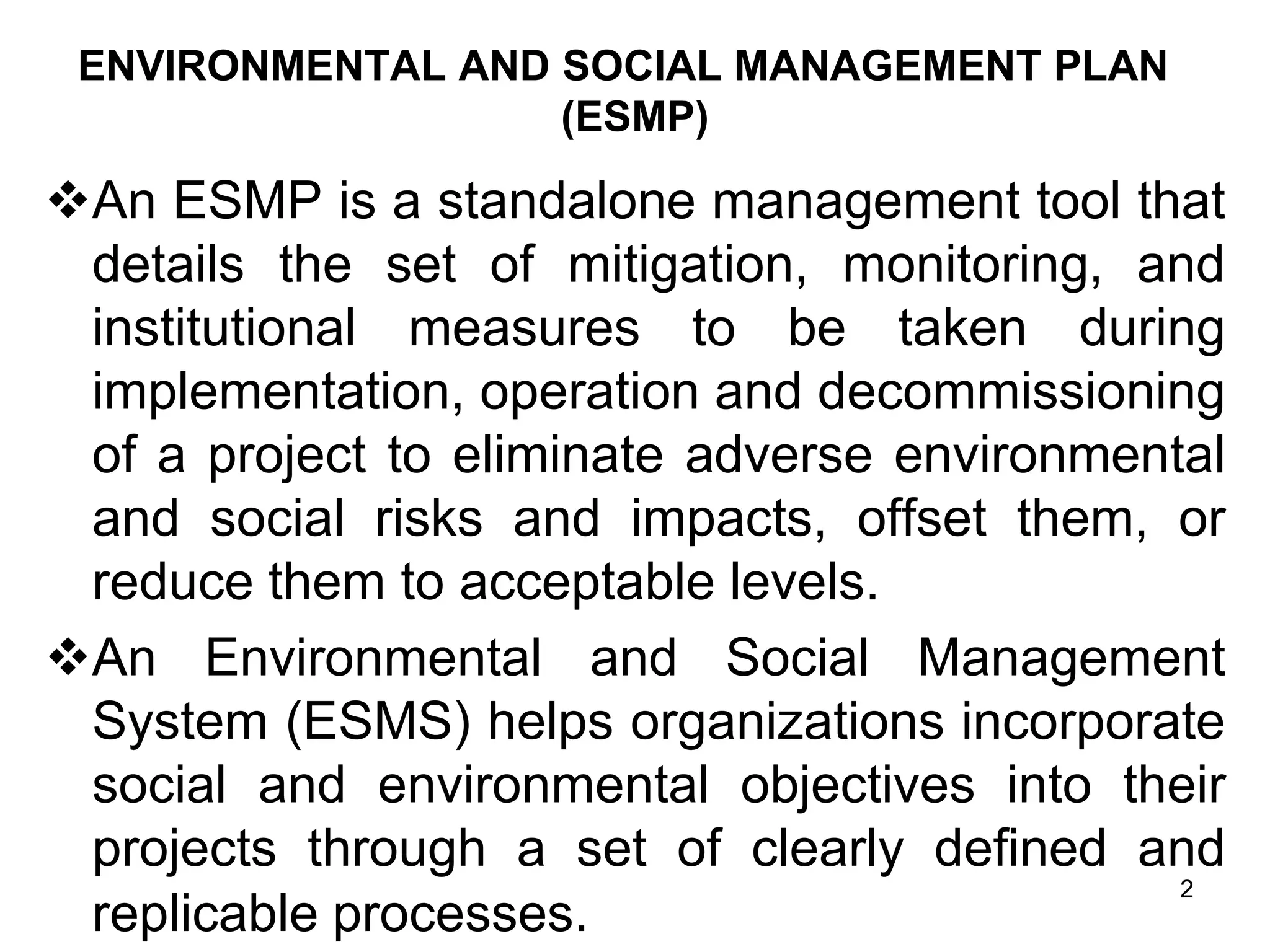
❖An ESMP is a standalone management tool that
details the set of mitigation, monitoring, and
institutional measures to be taken during
implementation, operation and decommissioning
of a project to eliminate adverse environmental
and social risks and impacts, offset them, or
reduce them to acceptable levels.
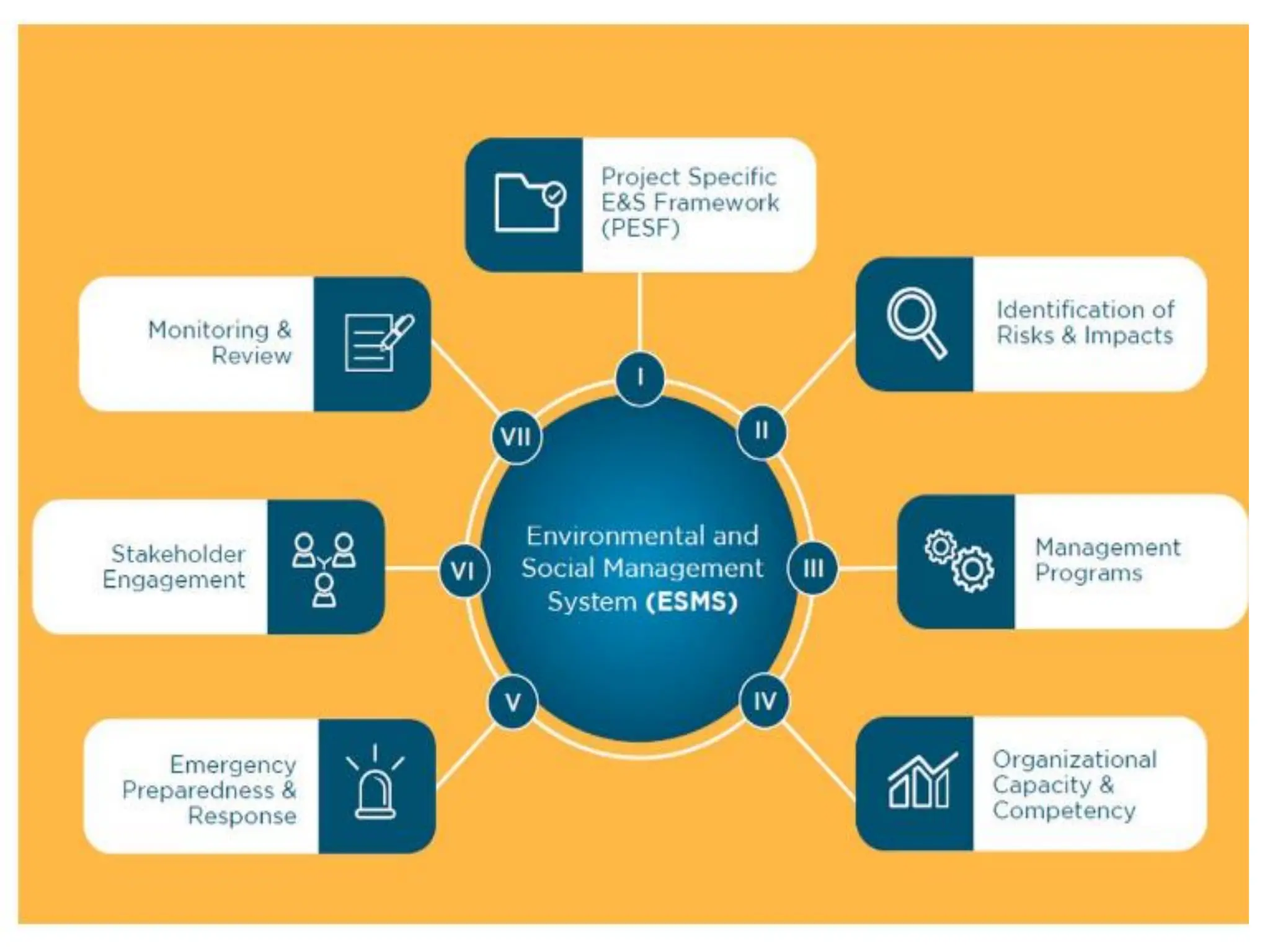
❖An Environmental and Social Management
System (ESMS) helps organizations incorporate
social and environmental objectives into their
projects through a set of clearly defined and
replicable processes.
2
3
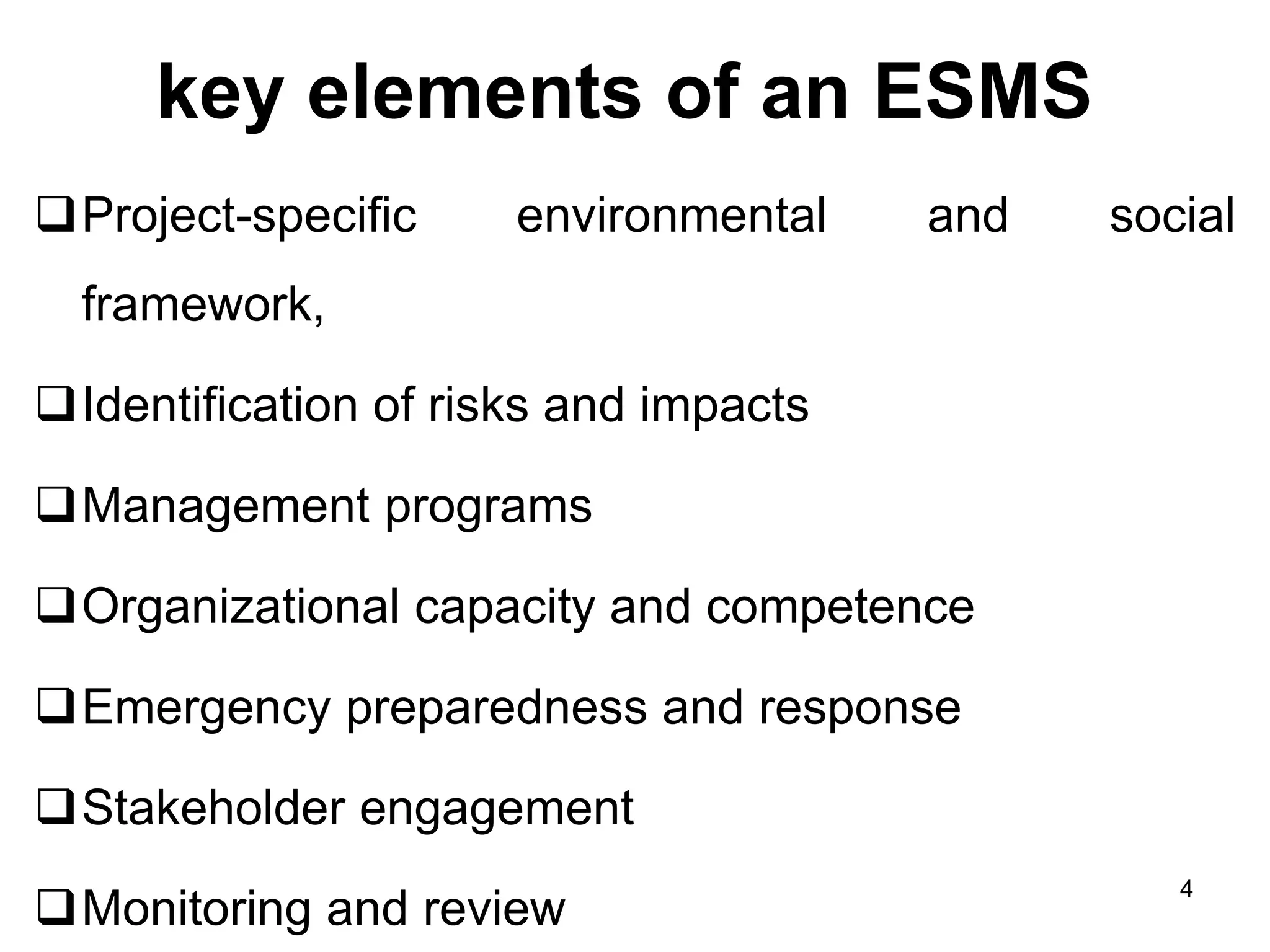
key elements of an ESMS
❑Project-specific environmental and social
framework,
❑Identification of risks and impacts
❑Management programs
❑Organizational capacity and competence
❑Emergency preparedness and response
❑Stakeholder engagement
❑Monitoring and review
4
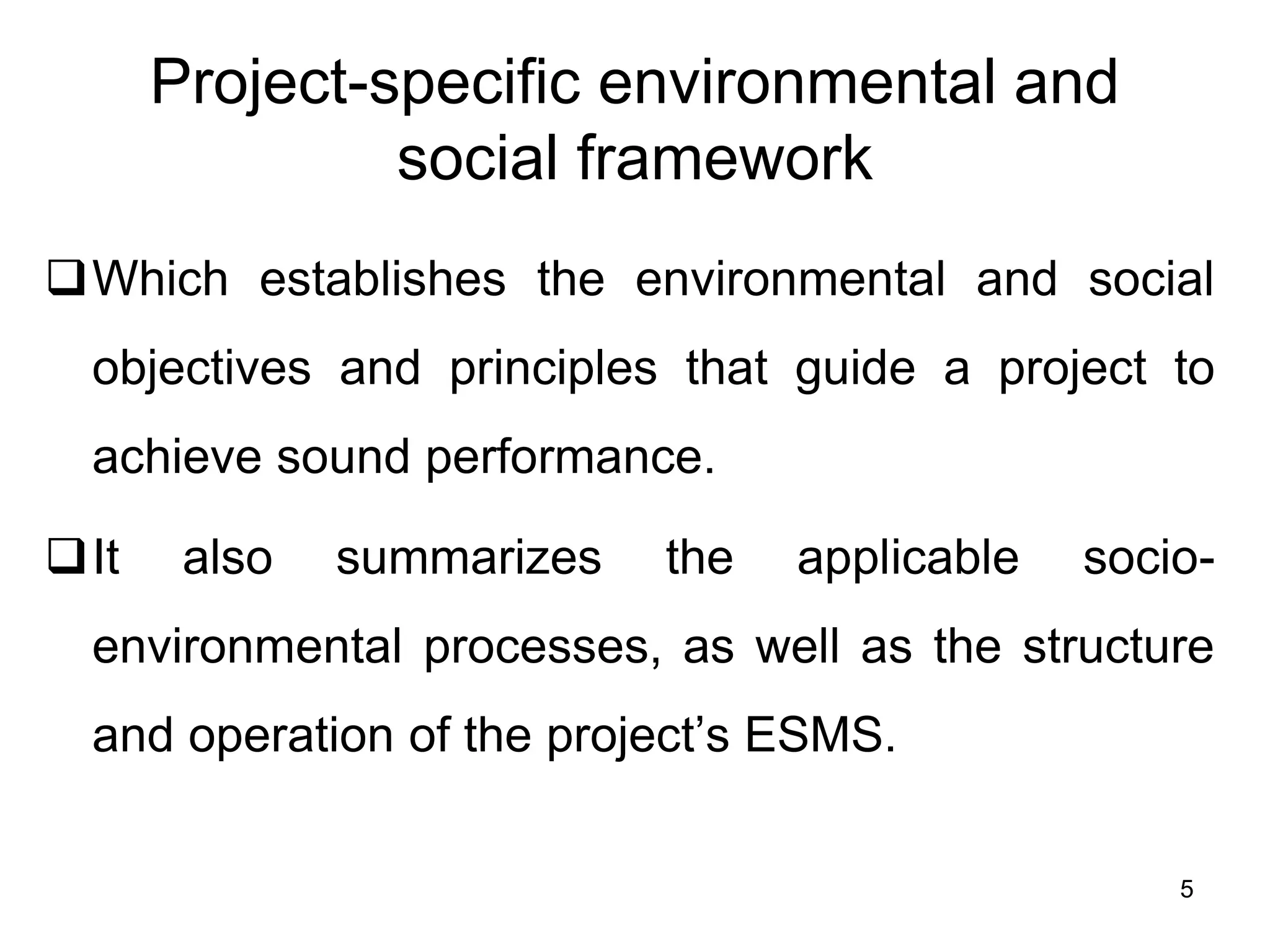
Project-specific environmental and
social framework
❑Which establishes the environmental and social
objectives and principles that guide a project to
achieve sound performance.
❑It also summarizes the applicable socio-
environmental processes, as well as the structure
and operation of the project’s ESMS.
5
Project-specific environmental and
social framework
❖This document defines the “roadmap” and, as such, is
complementary to and interrelated with the other
components of the ESMS.
❖The framework will indicate who, within the borrower’s
organization, will be responsible for its execution.
❖The borrower will communicate the framework at all
relevant levels of the project.
6
Identification of risks and impacts
❖Identification of risks and impacts according
to the type, size and location of the project.
❖All relevant environmental and social risks
and impacts of the project, which may be
direct, indirect or cumulative, will be
considered in the process.
❖The scope of this process will be determined
by the application of the mitigation hierarchy,
in accordance with good international
practices in the corresponding sector.
7
Identification of risks and impacts
❖On the other hand, the dynamic nature of
developing a project must be recognized
and integrated into the process of identifying
environmental and social risks and impacts,
which requires adequate evaluation tools to
identify risks and impacts, such as analysis
of alternatives, background studies,
environmental and social assessments,
audits, surveys, specialized studies and
consultations with technical specialists.
8
Management programs
▪ Management programs that include
mitigation measures to address the
environmental and social risks and impacts
that have been identified in the project.
▪ Programs may consist of a documented
combination of operating procedures,
practices, plans, and existing legal
agreements between the borrower and third
parties, which address mitigation measures
related to specific impacts.
9
Management programs
▪ Environmental and social action plans will be
established in these programs to define the
desired results and actions, which will be
proportional to the project’s risks and impacts
and will take into consideration the results of
the stakeholder engagement process.
10
Organizational capacity and competence
❑Organizational capacity and competence
through a structure that defines the functions,
responsibilities and powers for the application
of the ESMS.
❑This element includes human and financial
resources, managerial and administrative
commitment, and borrower personnel
responsible for project implementation.
11
Emergency preparedness and response
• Emergency preparedness and response to
adequately address accidental and emergency
situations related to the project that may harm
people or the environment.
• It is important to ensure a participatory process
with local government agencies in their
preparations to respond effectively to
emergency situations. 12
Stakeholder engagement
❑Stakeholder engagement through an
analysis of the people affected by the
project, as well as those parties that are not
directly affected but that have an interest in
the project, such as national and local
authorities, neighbouring projects or non-
governmental organizations.
❑This element helps define the consultation
processes, grievance mechanisms and
information disclosure strategies, among
others. 13
Stakeholder engagement
❑Stakeholder engagement is a continuous
and iterative process whereby the borrower
or project facilitates two-way interaction with
said stakeholders.
14
Monitoring and review
❑Monitoring and review according to the
project’s environmental and social risks
and impacts and its compliance
requirements.
❑This element is the main way in which the
borrower can control and evaluate the
progress in the project’s implementation
and management programs, including the
adaptation of the ESMS to real conditions
during the execution stage. 15
16

PREPARATION OF ENVIRONMENTAL AND SOCIAL MANAGEMENT PLAN

  • 1.
    PRESENTED BY Dr. RevanuruSubramanyam Professor (Associate), Department of Civil Engineering Papua New Guinea University of Technology 2023 1 PREPARATION OF ENVIRONMENTAL AND SOCIAL MANAGEMENT PLAN
  • 2.
    ENVIRONMENTAL AND SOCIALMANAGEMENT PLAN (ESMP) ❖An ESMP is a standalone management tool that details the set of mitigation, monitoring, and institutional measures to be taken during implementation, operation and decommissioning of a project to eliminate adverse environmental and social risks and impacts, offset them, or reduce them to acceptable levels. ❖An Environmental and Social Management System (ESMS) helps organizations incorporate social and environmental objectives into their projects through a set of clearly defined and replicable processes. 2
  • 3.
  • 4.
    key elements ofan ESMS ❑Project-specific environmental and social framework, ❑Identification of risks and impacts ❑Management programs ❑Organizational capacity and competence ❑Emergency preparedness and response ❑Stakeholder engagement ❑Monitoring and review 4
  • 5.
    Project-specific environmental and socialframework ❑Which establishes the environmental and social objectives and principles that guide a project to achieve sound performance. ❑It also summarizes the applicable socio- environmental processes, as well as the structure and operation of the project’s ESMS. 5
  • 6.
    Project-specific environmental and socialframework ❖This document defines the “roadmap” and, as such, is complementary to and interrelated with the other components of the ESMS. ❖The framework will indicate who, within the borrower’s organization, will be responsible for its execution. ❖The borrower will communicate the framework at all relevant levels of the project. 6
  • 7.
    Identification of risksand impacts ❖Identification of risks and impacts according to the type, size and location of the project. ❖All relevant environmental and social risks and impacts of the project, which may be direct, indirect or cumulative, will be considered in the process. ❖The scope of this process will be determined by the application of the mitigation hierarchy, in accordance with good international practices in the corresponding sector. 7
  • 8.
    Identification of risksand impacts ❖On the other hand, the dynamic nature of developing a project must be recognized and integrated into the process of identifying environmental and social risks and impacts, which requires adequate evaluation tools to identify risks and impacts, such as analysis of alternatives, background studies, environmental and social assessments, audits, surveys, specialized studies and consultations with technical specialists. 8
  • 9.
    Management programs ▪ Managementprograms that include mitigation measures to address the environmental and social risks and impacts that have been identified in the project. ▪ Programs may consist of a documented combination of operating procedures, practices, plans, and existing legal agreements between the borrower and third parties, which address mitigation measures related to specific impacts. 9
  • 10.
    Management programs ▪ Environmentaland social action plans will be established in these programs to define the desired results and actions, which will be proportional to the project’s risks and impacts and will take into consideration the results of the stakeholder engagement process. 10
  • 11.
    Organizational capacity andcompetence ❑Organizational capacity and competence through a structure that defines the functions, responsibilities and powers for the application of the ESMS. ❑This element includes human and financial resources, managerial and administrative commitment, and borrower personnel responsible for project implementation. 11
  • 12.
    Emergency preparedness andresponse • Emergency preparedness and response to adequately address accidental and emergency situations related to the project that may harm people or the environment. • It is important to ensure a participatory process with local government agencies in their preparations to respond effectively to emergency situations. 12
  • 13.
    Stakeholder engagement ❑Stakeholder engagementthrough an analysis of the people affected by the project, as well as those parties that are not directly affected but that have an interest in the project, such as national and local authorities, neighbouring projects or non- governmental organizations. ❑This element helps define the consultation processes, grievance mechanisms and information disclosure strategies, among others. 13
  • 14.
    Stakeholder engagement ❑Stakeholder engagementis a continuous and iterative process whereby the borrower or project facilitates two-way interaction with said stakeholders. 14
  • 15.
    Monitoring and review ❑Monitoringand review according to the project’s environmental and social risks and impacts and its compliance requirements. ❑This element is the main way in which the borrower can control and evaluate the progress in the project’s implementation and management programs, including the adaptation of the ESMS to real conditions during the execution stage. 15
  • 16.