NATIONAL AGRICULTURAL VALUE
CHAIN DEVELOPMENT PROJECT
TRAINING :AUGUST 2024
PRESENTER: MUNIKA SHAMALA
ENVIRONMENTAL SAFEGUARDS AND
RISK MANAGEMENT
Presentation Outline
• Objectives of WB safeguards policy
• What is safeguards?
• Why safeguards?
• Environmental and Social Management Frameworks (ESMF)
• ESS Evaluation tools
• Screening process
• WB policies triggered by the project
• OSH
 Do no harm: protect people and Environment from adverse
impacts
 Do good: enhance social equity and promote environmental
sustainability
 Reduce and manage risk for the Client and for the WB
 Respond to a world-wide constituency
3
Objectives of World Bank Safeguard Policies
What is safeguards ???
 These are mechanisms for integrating Environmental and
social issues into decision making
 They provide a set of specialized tools to support development
processes and
 Mechanisms that support participatory approaches and
transparency
Why safeguards ???
 To avoid negative impacts where possible; otherwise
minimize, mitigate, compensate (in that order)
 To identify and support sustainable approaches /
environmental and social benefits
 To inform the public and enable people to participate in
decisions which affect them
 To integrate environmental and social issues into project
identification, design and implementation
 To strengthen borrower / implementer/beneficiary capacity
Environmental and Social Management
Frameworks (ESMF)
 The ESMF outlines the process for undertaking an Environmental and Social
assessment to guide the implementing and executing agencies at the National,
County, and community levels; to identify, assess, and avoid or mitigate the
potential negative impacts of the proposed subprojects and micro projects.
 Further ESMF defines uniform screening mechanisms and monitoring procedures
for identifying and managing localized, potentially adverse Environmental and
social impacts
ESMF EVALUATION TOOLS
1. An Environmental and Social Screening Checklist to help
identify potential adverse Environmental and social impacts;
2. An Environmental project report and Social Project Report
that will outline simple Environmental mitigation measures for
micro-projects that do not require a full Environmental and
Social Impact Assessment report;
3. A summary of World Bank Environmental and Social
Standards to ensure that they are taken into account during the
subproject and micro-project planning stage
Implementation of Environmental and
Social Management framework ( ESMF)
 a. Community level Investments
● Initial screening will be carried out using a screening checklist
● An ESMP will be developed by ESS team who will backstop the community to
monitor ESMPs and write quarterly reports to NPCU
 All the completed screening instruments will be reviewed by a relevant
multidisciplinary professional team of CTDs (ESS) that will make
comprehensive recommendations for the next action.
 CPCU to facilitate the ESS team to visit the sites whenever required before
funding the group
 An ESMP will be developed for these Micro- investments which will be monitored
from time to time during the implementation.
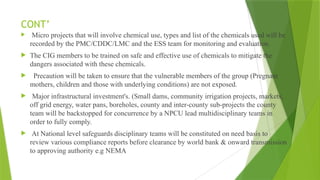
CONT’
 Micro projects that will involve chemical use, types and list of the chemicals used will be
recorded by the PMC/CDDC/LMC and the ESS team for monitoring and evaluation.
 The CIG members to be trained on safe and effective use of chemicals to mitigate the
dangers associated with these chemicals.
 Precaution will be taken to ensure that the vulnerable members of the group (Pregnant
mothers, children and those with underlying conditions) are not exposed.
 Major infrastructural investment's. (Small dams, community irrigation projects, markets,
off grid energy, water pans, boreholes, county and inter-county sub-projects the county
team will be backstopped for concurrence by a NPCU lead multidisciplinary teams in
order to fully comply.
 At National level safeguards disciplinary teams will be constituted on need basis to
review various compliance reports before clearance by world bank & onward transmission
to approving authority e.g NEMA
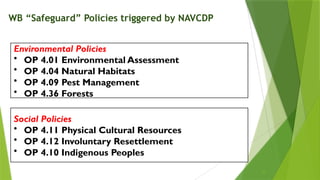
Environmental Policies
• OP 4.01 Environmental Assessment
• OP 4.04 Natural Habitats
• OP 4.09 Pest Management
• OP 4.36 Forests
Social Policies
• OP 4.11 Physical Cultural Resources
• OP 4.12 Involuntary Resettlement
• OP 4.10 Indigenous Peoples
WB “Safeguard” Policies triggered by NAVCDP
10
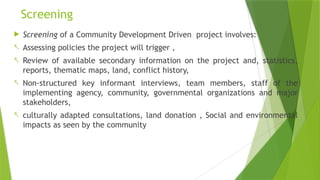
Screening
 Screening of a Community Development Driven project involves:
- Assessing policies the project will trigger ,
- Review of available secondary information on the project and, statistics,
reports, thematic maps, land, conflict history,
- Non-structured key informant interviews, team members, staff of the
implementing agency, community, governmental organizations and major
stakeholders,
- culturally adapted consultations, land donation , Social and environmental
impacts as seen by the community
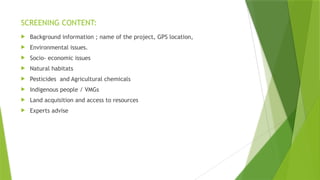
SCREENING CONTENT:
 Background information ; name of the project, GPS location,
 Environmental issues.
 Socio- economic issues
 Natural habitats
 Pesticides and Agricultural chemicals
 Indigenous people / VMGs
 Land acquisition and access to resources
 Experts advise
ENSURING COMPLIANCE IN PROJECT
IMPLEMENTATION
 PUBLIC CONSULTATION
 GENDER ISSUES ( EQUITY & EQUALITY)
 RELEVANT COMPLIANCE TOOLS DEVELOPED
 ANALYSIS OF ALTERNATIVES WITH THE BENEFICIARIES
 GRIEVANCE REDRESS MECHANISMS
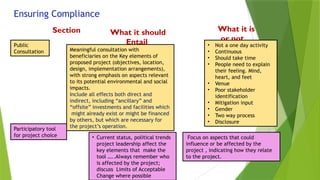
Ensuring Compliance
Section What it should
Entail
What it is
or not…
Meaningful consultation with
beneficiaries on the Key elements of
proposed project (objectives, location,
design, implementation arrangements),
with strong emphasis on aspects relevant
to its potential environmental and social
impacts.
Include all effects both direct and
indirect, including “ancillary” and
“offsite” investments and facilities which
might already exist or might be financed
by others, but which are necessary for
the project’s operation.
• Not a one day activity
• Continuous
• Should take time
• People need to explain
their feeling. Mind,
heart, and feet
• Venue
• Poor stakeholder
identification
• Mitigation input
• Gender
• Two way process
• Disclosure
Public
Consultation
Participatory tool
for project choice Focus on aspects that could
influence or be affected by the
project , indicating how they relate
to the project.
• Current status, political trends
project leadership affect the
key elements that make the
tool …..Always remember who
is affected by the project;
discuss Limits of Acceptable
Change where possible
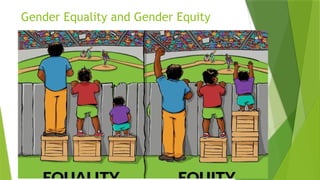
Gender Equality and Gender Equity
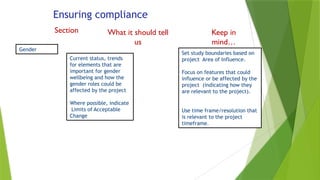
Ensuring compliance
Section What it should tell
us
Keep in
mind…
Gender
Set study boundaries based on
project Area of Influence.
Focus on features that could
influence or be affected by the
project (indicating how they
are relevant to the project).
Use time frame/resolution that
is relevant to the project
timeframe.
Current status, trends
for elements that are
important for gender
wellbeing and how the
gender roles could be
affected by the project
Where possible, indicate
Limits of Acceptable
Change
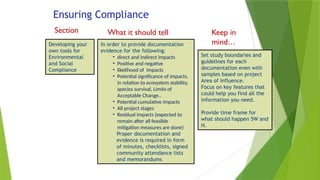
Ensuring Compliance
Section What it should tell
us
Keep in
mind…
Developing your
own tools for
Environmental
and Social
Compliance
Set study boundaries and
guidelines for each
documentation even with
samples based on project
Area of Influence.
Focus on key features that
could help you find all the
information you need.
Provide time frame for
what should happen 5W and
H.
In order to provide documentation
evidence for the following:
• direct and indirect impacts
• Positive and negative
• likelihood of impacts
• Potential significance of impacts,
in relation to ecosystem stability,
species survival, Limits of
Acceptable Change..
• Potential cumulative impacts
• All project stages
• Residual impacts (expected to
remain after all feasible
mitigation measures are done)
Proper documentation and
evidence is required in form
of minutes, checklists, signed
community attendance lists
and memorandums
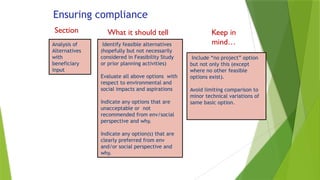
Ensuring compliance
Section What it should tell
us
Keep in
mind…
Analysis of
Alternatives
with
beneficiary
input
Include “no project” option
but not only this (except
where no other feasible
options exist).
Avoid limiting comparison to
minor technical variations of
same basic option.
Identify feasible alternatives
(hopefully but not necessarily
considered in Feasibility Study
or prior planning activities)
Evaluate all above options with
respect to environmental and
social impacts and aspirations
Indicate any options that are
unacceptable or not
recommended from env/social
perspective and why.
Indicate any option(s) that are
clearly preferred from env
and/or social perspective and
why.
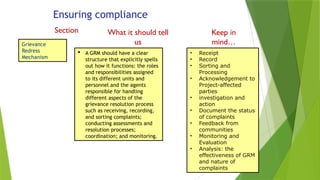
Ensuring compliance
Section What it should tell
us
Keep in
mind…
Grievance
Redress
Mechanism
• Receipt
• Record
• Sorting and
Processing
• Acknowledgement to
Project-affected
parties
• investigation and
action
• Document the status
of complaints
• Feedback from
communities
• Monitoring and
Evaluation
• Analysis: the
effectiveness of GRM
and nature of
complaints
 A GRM should have a clear
structure that explicitly spells
out how it functions: the roles
and responsibilities assigned
to its different units and
personnel and the agents
responsible for handling
different aspects of the
grievance resolution process
such as receiving, recording,
and sorting complaints;
conducting assessments and
resolution processes;
coordination; and monitoring.
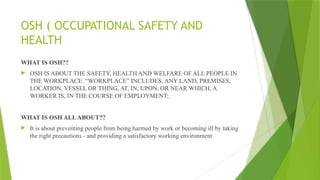
OSH ( OCCUPATIONAL SAFETY AND
HEALTH
WHAT IS OSH??
 OSH IS ABOUT THE SAFETY, HEALTH AND WELFARE OF ALL PEOPLE IN
THE WORKPLACE. “WORKPLACE” INCLUDES, ANY LAND, PREMISES,
LOCATION, VESSEL OR THING, AT, IN, UPON, OR NEAR WHICH, A
WORKER IS, IN THE COURSE OF EMPLOYMENT;
WHAT IS OSH ALLABOUT??
 It is about preventing people from being harmed by work or becoming ill by taking
the right precautions - and providing a satisfactory working environment
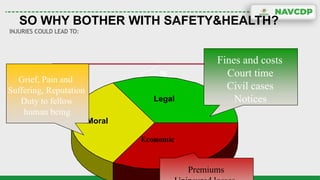
SO WHY BOTHER WITH SAFETY&HEALTH?
INJURIES COULD LEAD TO:
Legal
Moral
Economic
Fines and costs
Court time
Civil cases
Notices
Grief, Pain and
Suffering, Reputation
Duty to fellow
human being
Premiums
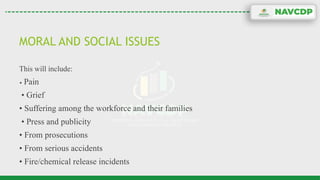
MORAL AND SOCIAL ISSUES
This will include:
• Pain
• Grief
• Suffering among the workforce and their families
• Press and publicity
• From prosecutions
• From serious accidents
• Fire/chemical release incidents
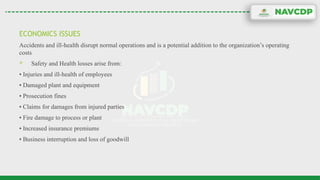
ECONOMICS ISSUES
Accidents and ill-health disrupt normal operations and is a potential addition to the organization’s operating
costs
 Safety and Health losses arise from:
• Injuries and ill-health of employees
• Damaged plant and equipment
• Prosecution fines
• Claims for damages from injured parties
• Fire damage to process or plant
• Increased insurance premiums
• Business interruption and loss of goodwill
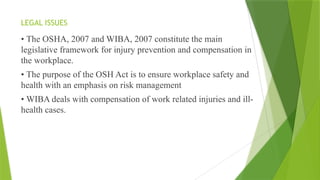
LEGAL ISSUES
• The OSHA, 2007 and WIBA, 2007 constitute the main
legislative framework for injury prevention and compensation in
the workplace.
• The purpose of the OSH Act is to ensure workplace safety and
health with an emphasis on risk management
• WIBA deals with compensation of work related injuries and ill-
health cases.
DUTIES OF EMPLOYERS
 The maintenance of any workplace under the occupier's control, in a
condition that is safe and without risks to health and the provision and
maintenance of means of access to and egress from it that are safe and
without such risks to health;
 The provision and maintenance of a working environment for every
person employed that is, safe, without risks to health, and adequate as
regards facilities and arrangements for the employees welfare at work;
 Inform all persons employed of——
(i) any risks from new technologies; and (ii) imminent danger; and
ensuring that every person employed participates in the application and
review of safety and health measures
DUTIES OF EMPLOYEES
 Every employee shall, while at the workplace—
• Ensure his own safety and health and that of other persons who may be affected by his acts or
omissions at the workplace;
• Co-operate with his employer or any other person in the discharge of any duty or requirement
imposed on the employer or that other person by this Act or any regulation made hereunder;
• At all times wear or use any protective equipment or clothing provided by the employer for the
purpose of preventing risks to his safety and health
• Comply with the safety and health procedures, requirements and instructions given by a person
having authority over him for his own or any other person’s safety;
• Report to the supervisor, any situation which he has reason to believe would present a hazard and
which he cannot correct;
• Report to his supervisor any accident or injury that arises in the course of or in connection with his
work; and with regard to any duty or requirement imposed on his employer or any other person by or
under any other relevant statutory provision, co-operate with the employer or other person to enable
that duty or requirement to be performed or complied with.
HEALTH CONSIDERATIONS:
GENERAL PROVISIONS
 Cleanliness. Have a clean working place
 Overcrowding. Working place to be spacious
 Ventilation. Well ventilated working space
 Lighting. Have enough lighting
 Drainage of floors. Avoid slippery floors, wet floors
 Sanitary conveniences. Preferably have for each gender well
labeled, clean, lockable
 ETC, ETC
WORKPLACE SAFETY –
GENERAL PROVISIONS
 Vessels containing dangerous liquids to be well labeled and stored
 Storage: Separate explosives from non-explosives
 Ladders:
 Safe means of access and safe place of employment.
 Fire prevention.
 Precautions in places where dangerous fumes are likely to be there
 Precautions with respect to explosive or inflammable dust or gas.
 Safety provisions in case of fire.
 Evacuation procedures
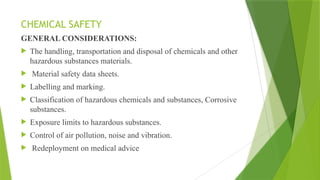
CHEMICAL SAFETY
GENERAL CONSIDERATIONS:
 The handling, transportation and disposal of chemicals and other
hazardous substances materials.
 Material safety data sheets.
 Labelling and marking.
 Classification of hazardous chemicals and substances, Corrosive
substances.
 Exposure limits to hazardous substances.
 Control of air pollution, noise and vibration.
 Redeployment on medical advice
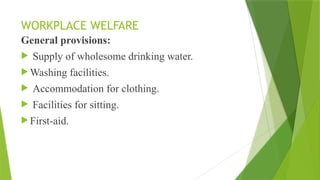
WORKPLACE WELFARE
General provisions:
 Supply of wholesome drinking water.
 Washing facilities.
 Accommodation for clothing.
 Facilities for sitting.
 First-aid.
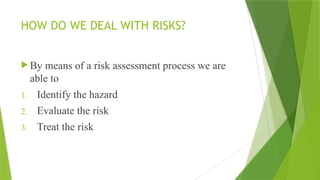
HOW DO WE DEAL WITH RISKS?
 By means of a risk assessment process we are
able to
1. Identify the hazard
2. Evaluate the risk
3. Treat the risk
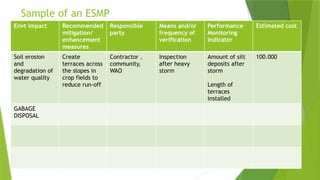
Sample of an ESMP
Envt impact Recommended
mitigation/
enhancement
measures
Responsible
party
Means and/or
frequency of
verification
Performance
Monitoring
Indicator
Estimated cost
Soil erosion
and
degradation of
water quality
Create
terraces across
the slopes in
crop fields to
reduce run-off
Contractor ,
community,
WAO
Inspection
after heavy
storm
Amount of silt
deposits after
storm
Length of
terraces
installed
100.000
GABAGE
DISPOSAL
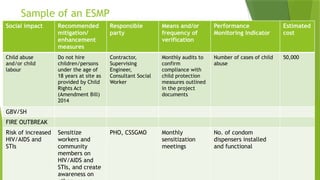
Sample of an ESMP
Social impact Recommended
mitigation/
enhancement
measures
Responsible
party
Means and/or
frequency of
verification
Performance
Monitoring Indicator
Estimated
cost
Child abuse
and/or child
labour
Do not hire
children/persons
under the age of
18 years at site as
provided by Child
Rights Act
(Amendment Bill)
2014
Contractor,
Supervising
Engineer,
Consultant Social
Worker
Monthly audits to
confirm
compliance with
child protection
measures outlined
in the project
documents
Number of cases of child
abuse
50,000
GBV/SH
FIRE OUTBREAK
Risk of increased
HIV/AIDS and
STIs
Sensitize
workers and
community
members on
HIV/AIDS and
STIs, and create
awareness on
PHO, CSSGMO Monthly
sensitization
meetings
No. of condom
dispensers installed
and functional
THANK YOU
FOR YOUR
PARTICIPATION

ENVIRONMENTAL SAFEGUARDS (ESS) PRESENTATION_072331-1.pptx

  • 1.
    NATIONAL AGRICULTURAL VALUE CHAINDEVELOPMENT PROJECT TRAINING :AUGUST 2024 PRESENTER: MUNIKA SHAMALA ENVIRONMENTAL SAFEGUARDS AND RISK MANAGEMENT
  • 2.
    Presentation Outline • Objectivesof WB safeguards policy • What is safeguards? • Why safeguards? • Environmental and Social Management Frameworks (ESMF) • ESS Evaluation tools • Screening process • WB policies triggered by the project • OSH
  • 3.
     Do noharm: protect people and Environment from adverse impacts  Do good: enhance social equity and promote environmental sustainability  Reduce and manage risk for the Client and for the WB  Respond to a world-wide constituency 3 Objectives of World Bank Safeguard Policies
  • 4.
    What is safeguards???  These are mechanisms for integrating Environmental and social issues into decision making  They provide a set of specialized tools to support development processes and  Mechanisms that support participatory approaches and transparency
  • 5.
    Why safeguards ??? To avoid negative impacts where possible; otherwise minimize, mitigate, compensate (in that order)  To identify and support sustainable approaches / environmental and social benefits  To inform the public and enable people to participate in decisions which affect them  To integrate environmental and social issues into project identification, design and implementation  To strengthen borrower / implementer/beneficiary capacity
  • 6.
    Environmental and SocialManagement Frameworks (ESMF)  The ESMF outlines the process for undertaking an Environmental and Social assessment to guide the implementing and executing agencies at the National, County, and community levels; to identify, assess, and avoid or mitigate the potential negative impacts of the proposed subprojects and micro projects.  Further ESMF defines uniform screening mechanisms and monitoring procedures for identifying and managing localized, potentially adverse Environmental and social impacts
  • 7.
    ESMF EVALUATION TOOLS 1.An Environmental and Social Screening Checklist to help identify potential adverse Environmental and social impacts; 2. An Environmental project report and Social Project Report that will outline simple Environmental mitigation measures for micro-projects that do not require a full Environmental and Social Impact Assessment report; 3. A summary of World Bank Environmental and Social Standards to ensure that they are taken into account during the subproject and micro-project planning stage
  • 8.
    Implementation of Environmentaland Social Management framework ( ESMF)  a. Community level Investments ● Initial screening will be carried out using a screening checklist ● An ESMP will be developed by ESS team who will backstop the community to monitor ESMPs and write quarterly reports to NPCU  All the completed screening instruments will be reviewed by a relevant multidisciplinary professional team of CTDs (ESS) that will make comprehensive recommendations for the next action.  CPCU to facilitate the ESS team to visit the sites whenever required before funding the group  An ESMP will be developed for these Micro- investments which will be monitored from time to time during the implementation.
  • 9.
    CONT’  Micro projectsthat will involve chemical use, types and list of the chemicals used will be recorded by the PMC/CDDC/LMC and the ESS team for monitoring and evaluation.  The CIG members to be trained on safe and effective use of chemicals to mitigate the dangers associated with these chemicals.  Precaution will be taken to ensure that the vulnerable members of the group (Pregnant mothers, children and those with underlying conditions) are not exposed.  Major infrastructural investment's. (Small dams, community irrigation projects, markets, off grid energy, water pans, boreholes, county and inter-county sub-projects the county team will be backstopped for concurrence by a NPCU lead multidisciplinary teams in order to fully comply.  At National level safeguards disciplinary teams will be constituted on need basis to review various compliance reports before clearance by world bank & onward transmission to approving authority e.g NEMA
  • 10.
    Environmental Policies • OP4.01 Environmental Assessment • OP 4.04 Natural Habitats • OP 4.09 Pest Management • OP 4.36 Forests Social Policies • OP 4.11 Physical Cultural Resources • OP 4.12 Involuntary Resettlement • OP 4.10 Indigenous Peoples WB “Safeguard” Policies triggered by NAVCDP 10
  • 11.
    Screening  Screening ofa Community Development Driven project involves: - Assessing policies the project will trigger , - Review of available secondary information on the project and, statistics, reports, thematic maps, land, conflict history, - Non-structured key informant interviews, team members, staff of the implementing agency, community, governmental organizations and major stakeholders, - culturally adapted consultations, land donation , Social and environmental impacts as seen by the community
  • 12.
    SCREENING CONTENT:  Backgroundinformation ; name of the project, GPS location,  Environmental issues.  Socio- economic issues  Natural habitats  Pesticides and Agricultural chemicals  Indigenous people / VMGs  Land acquisition and access to resources  Experts advise
  • 13.
    ENSURING COMPLIANCE INPROJECT IMPLEMENTATION  PUBLIC CONSULTATION  GENDER ISSUES ( EQUITY & EQUALITY)  RELEVANT COMPLIANCE TOOLS DEVELOPED  ANALYSIS OF ALTERNATIVES WITH THE BENEFICIARIES  GRIEVANCE REDRESS MECHANISMS
  • 14.
    Ensuring Compliance Section Whatit should Entail What it is or not… Meaningful consultation with beneficiaries on the Key elements of proposed project (objectives, location, design, implementation arrangements), with strong emphasis on aspects relevant to its potential environmental and social impacts. Include all effects both direct and indirect, including “ancillary” and “offsite” investments and facilities which might already exist or might be financed by others, but which are necessary for the project’s operation. • Not a one day activity • Continuous • Should take time • People need to explain their feeling. Mind, heart, and feet • Venue • Poor stakeholder identification • Mitigation input • Gender • Two way process • Disclosure Public Consultation Participatory tool for project choice Focus on aspects that could influence or be affected by the project , indicating how they relate to the project. • Current status, political trends project leadership affect the key elements that make the tool …..Always remember who is affected by the project; discuss Limits of Acceptable Change where possible
  • 15.
    Gender Equality andGender Equity
  • 16.
    Ensuring compliance Section Whatit should tell us Keep in mind… Gender Set study boundaries based on project Area of Influence. Focus on features that could influence or be affected by the project (indicating how they are relevant to the project). Use time frame/resolution that is relevant to the project timeframe. Current status, trends for elements that are important for gender wellbeing and how the gender roles could be affected by the project Where possible, indicate Limits of Acceptable Change
  • 17.
    Ensuring Compliance Section Whatit should tell us Keep in mind… Developing your own tools for Environmental and Social Compliance Set study boundaries and guidelines for each documentation even with samples based on project Area of Influence. Focus on key features that could help you find all the information you need. Provide time frame for what should happen 5W and H. In order to provide documentation evidence for the following: • direct and indirect impacts • Positive and negative • likelihood of impacts • Potential significance of impacts, in relation to ecosystem stability, species survival, Limits of Acceptable Change.. • Potential cumulative impacts • All project stages • Residual impacts (expected to remain after all feasible mitigation measures are done) Proper documentation and evidence is required in form of minutes, checklists, signed community attendance lists and memorandums
  • 18.
    Ensuring compliance Section Whatit should tell us Keep in mind… Analysis of Alternatives with beneficiary input Include “no project” option but not only this (except where no other feasible options exist). Avoid limiting comparison to minor technical variations of same basic option. Identify feasible alternatives (hopefully but not necessarily considered in Feasibility Study or prior planning activities) Evaluate all above options with respect to environmental and social impacts and aspirations Indicate any options that are unacceptable or not recommended from env/social perspective and why. Indicate any option(s) that are clearly preferred from env and/or social perspective and why.
  • 19.
    Ensuring compliance Section Whatit should tell us Keep in mind… Grievance Redress Mechanism • Receipt • Record • Sorting and Processing • Acknowledgement to Project-affected parties • investigation and action • Document the status of complaints • Feedback from communities • Monitoring and Evaluation • Analysis: the effectiveness of GRM and nature of complaints  A GRM should have a clear structure that explicitly spells out how it functions: the roles and responsibilities assigned to its different units and personnel and the agents responsible for handling different aspects of the grievance resolution process such as receiving, recording, and sorting complaints; conducting assessments and resolution processes; coordination; and monitoring.
  • 20.
    OSH ( OCCUPATIONALSAFETY AND HEALTH WHAT IS OSH??  OSH IS ABOUT THE SAFETY, HEALTH AND WELFARE OF ALL PEOPLE IN THE WORKPLACE. “WORKPLACE” INCLUDES, ANY LAND, PREMISES, LOCATION, VESSEL OR THING, AT, IN, UPON, OR NEAR WHICH, A WORKER IS, IN THE COURSE OF EMPLOYMENT; WHAT IS OSH ALLABOUT??  It is about preventing people from being harmed by work or becoming ill by taking the right precautions - and providing a satisfactory working environment
  • 21.
    SO WHY BOTHERWITH SAFETY&HEALTH? INJURIES COULD LEAD TO: Legal Moral Economic Fines and costs Court time Civil cases Notices Grief, Pain and Suffering, Reputation Duty to fellow human being Premiums
  • 22.
    MORAL AND SOCIALISSUES This will include: • Pain • Grief • Suffering among the workforce and their families • Press and publicity • From prosecutions • From serious accidents • Fire/chemical release incidents
  • 23.
    ECONOMICS ISSUES Accidents andill-health disrupt normal operations and is a potential addition to the organization’s operating costs  Safety and Health losses arise from: • Injuries and ill-health of employees • Damaged plant and equipment • Prosecution fines • Claims for damages from injured parties • Fire damage to process or plant • Increased insurance premiums • Business interruption and loss of goodwill
  • 24.
    LEGAL ISSUES • TheOSHA, 2007 and WIBA, 2007 constitute the main legislative framework for injury prevention and compensation in the workplace. • The purpose of the OSH Act is to ensure workplace safety and health with an emphasis on risk management • WIBA deals with compensation of work related injuries and ill- health cases.
  • 25.
    DUTIES OF EMPLOYERS The maintenance of any workplace under the occupier's control, in a condition that is safe and without risks to health and the provision and maintenance of means of access to and egress from it that are safe and without such risks to health;  The provision and maintenance of a working environment for every person employed that is, safe, without risks to health, and adequate as regards facilities and arrangements for the employees welfare at work;  Inform all persons employed of—— (i) any risks from new technologies; and (ii) imminent danger; and ensuring that every person employed participates in the application and review of safety and health measures
  • 26.
    DUTIES OF EMPLOYEES Every employee shall, while at the workplace— • Ensure his own safety and health and that of other persons who may be affected by his acts or omissions at the workplace; • Co-operate with his employer or any other person in the discharge of any duty or requirement imposed on the employer or that other person by this Act or any regulation made hereunder; • At all times wear or use any protective equipment or clothing provided by the employer for the purpose of preventing risks to his safety and health • Comply with the safety and health procedures, requirements and instructions given by a person having authority over him for his own or any other person’s safety; • Report to the supervisor, any situation which he has reason to believe would present a hazard and which he cannot correct; • Report to his supervisor any accident or injury that arises in the course of or in connection with his work; and with regard to any duty or requirement imposed on his employer or any other person by or under any other relevant statutory provision, co-operate with the employer or other person to enable that duty or requirement to be performed or complied with.
  • 27.
    HEALTH CONSIDERATIONS: GENERAL PROVISIONS Cleanliness. Have a clean working place  Overcrowding. Working place to be spacious  Ventilation. Well ventilated working space  Lighting. Have enough lighting  Drainage of floors. Avoid slippery floors, wet floors  Sanitary conveniences. Preferably have for each gender well labeled, clean, lockable  ETC, ETC
  • 28.
    WORKPLACE SAFETY – GENERALPROVISIONS  Vessels containing dangerous liquids to be well labeled and stored  Storage: Separate explosives from non-explosives  Ladders:  Safe means of access and safe place of employment.  Fire prevention.  Precautions in places where dangerous fumes are likely to be there  Precautions with respect to explosive or inflammable dust or gas.  Safety provisions in case of fire.  Evacuation procedures
  • 29.
    CHEMICAL SAFETY GENERAL CONSIDERATIONS: The handling, transportation and disposal of chemicals and other hazardous substances materials.  Material safety data sheets.  Labelling and marking.  Classification of hazardous chemicals and substances, Corrosive substances.  Exposure limits to hazardous substances.  Control of air pollution, noise and vibration.  Redeployment on medical advice
  • 30.
    WORKPLACE WELFARE General provisions: Supply of wholesome drinking water.  Washing facilities.  Accommodation for clothing.  Facilities for sitting.  First-aid.
  • 31.
    HOW DO WEDEAL WITH RISKS?  By means of a risk assessment process we are able to 1. Identify the hazard 2. Evaluate the risk 3. Treat the risk
  • 32.
    Sample of anESMP Envt impact Recommended mitigation/ enhancement measures Responsible party Means and/or frequency of verification Performance Monitoring Indicator Estimated cost Soil erosion and degradation of water quality Create terraces across the slopes in crop fields to reduce run-off Contractor , community, WAO Inspection after heavy storm Amount of silt deposits after storm Length of terraces installed 100.000 GABAGE DISPOSAL
  • 33.
    Sample of anESMP Social impact Recommended mitigation/ enhancement measures Responsible party Means and/or frequency of verification Performance Monitoring Indicator Estimated cost Child abuse and/or child labour Do not hire children/persons under the age of 18 years at site as provided by Child Rights Act (Amendment Bill) 2014 Contractor, Supervising Engineer, Consultant Social Worker Monthly audits to confirm compliance with child protection measures outlined in the project documents Number of cases of child abuse 50,000 GBV/SH FIRE OUTBREAK Risk of increased HIV/AIDS and STIs Sensitize workers and community members on HIV/AIDS and STIs, and create awareness on PHO, CSSGMO Monthly sensitization meetings No. of condom dispensers installed and functional
  • 34.

Editor's Notes

  • #10 The ‘safeguard policies’ are instruments applied by the Bank in its operations to protect the interest of the beneficiaries, clients, shareholders and the Bank. They are linked to one another, and taken collectively, they provide a comprehensive framework for avoiding negative impact on the environment and the livelihood of people.