91
Objectives
Grammar:
The present perfect tense with for or since and
contrasted with the past simple
Reading
Reading news reports
Listening
Listening to a conversation about the news
Speaking
Talking about and responding to the news
Writing
Writing a news report
LESSON 1 SB page 40
Outcomes
•	To talk about the news
•	To read news reports and answer questions
•	To carry out an internet search about a recent
news story
Before using the book:
•	Write the title of the unit In the news on the board
and ask the students to tell you what they think
they will study in the unit. Confirm any correct
answers.
•	Brainstorm the kind of information that is reported
in the news (e.g. local, national and international
events, the weather, sports).
•	Hold a short class discussion about why the news
is important.
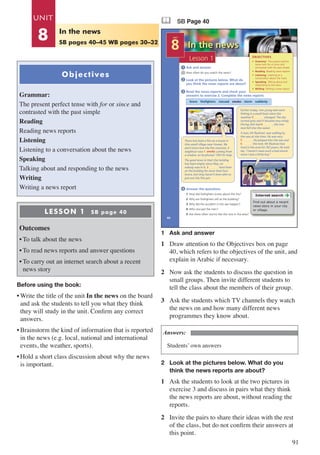
& SB Page 40
In the news
40
Lesson 1
UNIT
8
OBJECTIVES
• Grammar The present perfect
tense with for or since and
contrasted with the past simple
• Reading Reading news reports
• Listening Listening to a
conversation about the news
• Speaking Talking about and
responding to the news
• Writing Writing a news report
Ask and answer
How often do you watch the news?
Look at the pictures below. What do
you think the news reports are about?
1
2
3
4
brave firefighters rescued smoke storm suddenly
Internet search
Find out about a recent
news story in your city
or village.
Answer the questions
1 How did firefighters know about the fire?
2 Why are firefighters still at the building?
3 Why did the accident in the sea happen?
4 Who rescued the men?
5 Are there often storms like this one in the area?
Read the news reports and check your
answers to exercise 2. Complete the news reports
There has been a fire at a house in
this small village near Aswan. We
don’t know how the fire started. A
neighbour saw 1 …..…….. coming from
a window, so he phoned 180 for help.
The good news is that the building
has been empty since May, so
nobody was in it. 2 …..…….. have been
at the building for more than four
hours, but they haven’t been able to
put out the fire yet.
Earlier today, two young men were
fishing in a small boat when the
weather 3 …..…….. changed. The sky
turned grey and it became very windy.
During this bad 4 …..…….., the two
men fell into the water.
A man, Mr Badrawi, was walking by
the sea at the time. He was very
5 …..……... He jumped into the sea and
6 …..…….. the men. Mr Badrawi has
lived in the area for 30 years. He told
me, “I haven’t seen such a bad storm
since I was a little boy.”
smoke
1	 Ask and answer
1	 Draw attention to the Objectives box on page
40, which refers to the objectives of the unit, and
explain in Arabic if necessary.
2	 Now ask the students to discuss the question in
small groups. Then invite different students to
tell the class about the members of their group.
3	 Ask the students which TV channels they watch
the news on and how many different news
programmes they know about.
Answers:
Students’ own answers
2	 Look at the pictures below. What do you 		
	 think the news reports are about?
1	 Ask the students to look at the two pictures in
exercise 3 and discuss in pairs what they think
the news reports are about, without reading the
reports.
2	 Invite the pairs to share their ideas with the rest
of the class, but do not confirm their answers at
this point.
In the news
SB pages 40–45 WB pages 30–32
UNIT
8
92
3	 Read the news reports and check your 		
	 answers to exercise 2. Complete the news 	
	 reports
1	 Ask the students to read the news reports quickly
to check their answers to exercise 2. Tell them
not to worry about the gaps in the text at this
point.
2	 Ask different students to say what each news
report is about, and check answers to exercise 2.
3	 Check the meaning and pronunciation of the
words in the box.
4	 Then ask the students to complete the texts with
the words. Check the answers as a whole class.
Exercise 2 answers:
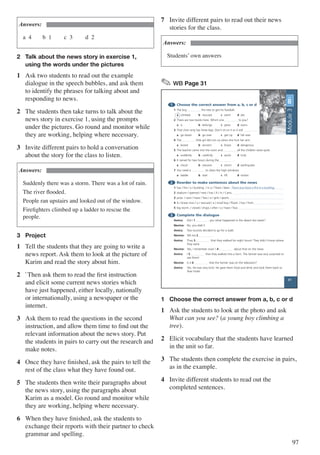
First picture: a house fire
Second picture: a storm
Exercise 3 answers:
2 Firefighters		 3 suddenly
4 storm			 5 brave
6 rescued
4	 Answer the questions
1	 Ask the students to read the questions and read
the news reports again more carefully to find the
answers to the questions.
2	 Then invite different students to give their
answers
3	 Finally, go through any unknown vocabulary in
the text.
Answers:
1	 A neighbour phoned 180 for help.
2	 Because they haven’t been able to put out the 	
	 fire yet.
3	 There was a bad storm./It became very windy.
4	 A brave man, Mr Badrawi, rescued the men.
5	 No, there aren’t. There hasn’t been such a bad 	
	 storm since Mr Badrawi was a little boy.
: Internet search
1	 Ask the students what’s happening in the news at
the moment. Then ask them what’s happening in
their own city or village.
2	 Ask the students to look at the question in the
Internet search and tell them that they are going
to find out more about local news by carrying
out an internet search. Ask what they might
type into a search engine in order to get the
information they need.
3	 The students then work in pairs to carry out their
research. If the pairs live in different places, ask
them to find out about one story from each place.
4	 Finally, ask the pairs to report back their findings
to the rest of the class.
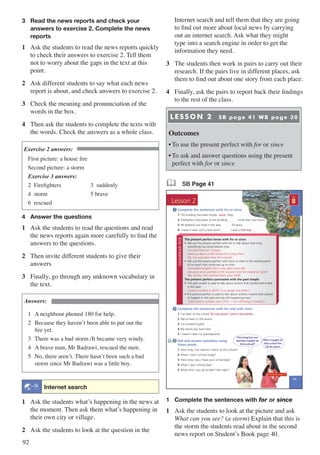
LESSON 2 SB page 41 WB page 30
Outcomes
•	To use the present perfect with for or since
•	To ask and answer questions using the present
perfect with for or since
& SB Page 41
Complete the sentences with for or since
1 The building has been empty …..…….. May.
2 Firefighters have been at the building …..…….. more than four hours.
3 Mr Badrawi has lived in the area …..…….. 30 years.
4 I haven’t seen such a bad storm …..…….. I was a little boy.
1
The present perfect tense with for or since
• We use the present perfect with for to talk about how long
something has lasted before now:
I’ve lived here for 13 years.
Have you been at this school for a long time?
No, I’ve only been here for a month.
• We use the present perfect with since to refer to the starting point
of an event that continues up to now:
I’ve studied English since I was eight years old.
Has your uncle worked at the hospital since he moved to Cairo?
Yes, he has. He’s worked there since 2008.
The present perfect contrasted with the past simple
• The past simple is used to talk about actions that started and ended
in the past:
I lived in London in 2010. ( I no longer live there.)
• The present perfect is used to talk about actions / events that started
to happen in the past and are still happening now:
I have lived in London since 2010. ( I am still living in London.)
GRAMMARBOX
3 Ask and answer questions using
these words
1 How long / our teacher / teach at this school?
2 When / start / school today?
3 How long / you / have your school bag?
4 When / get / school bag?
5 What time / you go to bed / last night?
How long has our
teacher taught at
this school?
She’s taught at
this school for
three years.
since
Complete the sentences with for and with since
1 I’ve been at this school …..…...................................................…..
2 We’ve been in this lesson …..……..
3 I’ve studied English …..……..
4 My family has lived here …..……..
5 I haven’t seen my grandparents …..……..
2
for two years / since I was eleven.
Lesson 2
41
8
UNIT
Workbook page 30
1	 Complete the sentences with for or since
1	 Ask the students to look at the picture and ask
What can you see? (a storm) Explain that this is
the storm the students read about in the second
news report on Student’s Book page 40.
93
2	 Elicit the form of the present perfect (have/has
+ past participle). Ask when it is used (to talk
about a time before now).
3	 Explain that the students are going to find out
about time references used with the present
perfect. Write for on the board as a heading,
and write some time references underneath, for
example, three years, a week, an hour and a
half, two months. Do the same with since, for
example, yesterday, 2012, August, last year.
Elicit the difference between the time references
(for is used to talk about how long, and since is
used to refer to the starting point).
4	 Ask the students to complete the sentences in
pairs and then check the answers as a whole
class.
5	 Ask the students to read the first point in the
Grammar box and elicit further time references
to add to the board under the for heading.
Repeat the process with the second point and the
since heading on the board.
6	 Ask the students to read the third point in the
Grammar box. Ask which of the sentences in
exercise 1 is similar (4).
7	 Ask the students to read the first sentence in
exercise 1 again and work in pairs to think
of a second sentence to add about a complete
time in the past, for example, The building has
been empty since May. Before that it was an
apartment block. Do the same for sentences 2–4.
Answers:
2 for		 3 for		 4 since
2	 Complete the sentences with for and with 	
	 since
1	 Ask the students to read the example answer and
explain that they have to complete the rest of the
sentences with information that is true for them.
2	 Ask them to complete the sentences individually.
Remind them to refer to the Grammar box if
necessary, and explain that they should finish
each sentence with two alternatives, as in the
example.
3	 Then ask the students to compare their answers
with a partner and to correct any errors in their
answers.
4	 Invite different students to read out the
completed sentences with both alternatives
for the rest of the class to check that for and
since have been used correctly with the time
references.
Suggested answers:
2	 for twenty minutes / since 10 o'clock.
3	 for many years / since I was six.
4	 since 2012 / for four years.
5	 since last weekend / for three days.
3	 Ask and answer questions using these words
1	Write How long … ? on the board and invite
the students to complete the question using the
present perfect, for example, How long have
you played the oud? How long have you lived in
Cairo?
2	 Then write When … ? and What time …?
on the board. Elicit which tense is used after
these question words (the past simple) and
some examples (e.g. When did you start
learning English? What time did you get up this
morning?).
3	 Ask two students to read out the question and
answer shown in the speech bubbles. The
students then work in small groups to ask and
answer questions using the prompts and the
present perfect or past simple. Go round and
monitor while they are working, helping where
necessary.
4	 Invite different pairs of students to ask and
answer the questions for the class to listen.
Answers:
2	 When did you start school today?
3	 How long have you had your school bag?
4	 When did you get your school bag?
5	 What time did you go to bed last night?
94
. WB Page 30
In the
news
1 Read and match
1 e to save a person from something dangerous a put out
2 happening from the beginning to the end b during
3 no person c firefighter
4 someone who stops fires d nobody
5 this goes into the air when something burns e rescue
6 to stop a fire burning f smoke
2 Match to make sentences
1 d There has not been a storm here since a he bought a mobile
phone last year.
2 My uncle has been a firefighter since b for 20 minutes longer
than yesterday.
3 Ahmed has had that computer c he left school in 1994.
4 Sara has waited for a bus d 2012.
5 Khaled has not used a camera since e for five years.
3 Complete the sentences
1 Ali started work at ten o’clock. It is now twelve o’clock. He has worked for
two hours.
2 Mona started running twenty minutes ago. It is now twelve o’clock. She has run
since
3 Hana was born in her house. She is now twelve. She has lived in her house for
4 The football team started playing when the stadium opened ten years ago. The
football team have played in the stadium since
5 I saw my cousins in Aswan in December. It is now March. I have not seen them
for
Module3
UNIT
8
30
1	 Read and match
1	 Elicit the vocabulary mentioned in the news
reports in Lesson 1. Ask the students to read the
words on the right and say what they mean.
2	 Then ask the students to read the example before
matching the words with the definitions.
3	 Check the answers as a whole class.
Answers:
2 b	 3 d	 4 c	 5 f	 6 a
2	 Match to make sentences
1	 Elicit the use of for and since (for is used to
say how long, and since says when something
started).
2	 Then ask the students to work in pairs to match
the rest of the sentence halves.
3	 Invite different students to read out the full
sentences.
Answers:
2 c	 3 e	 4 b	 5 a
3	 Complete the sentences
1	 Ask the students to read the example and
then work in pairs to complete the rest of the
sentences.
2	 Invite different students to read out the
completed sentences.
Answers:
2	 twenty to twelve/eleven forty
3	 twelve years
4	 it opened/2006 [or an appropriate year]
5	 three months
L E S S O N 3 S B p a g e 4 2
Outcomes
•	To listen to two friends discussing the news and
sequence events
•	To talk about and respond to news
95
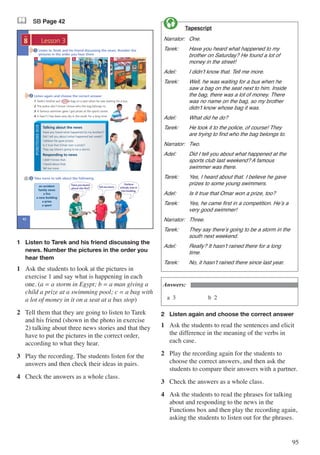
& SB Page 42
42
8
UNIT
Lesson 3
FUNCTIONSBOX
Have you heard what happened (to my brother)?
Did I tell you about (what happened last week)?
I believe (he gave prizes).
Is it true that (Omar won a prize)?
They say (there’s going to be a storm).
I didn’t know that.
I heard about that.
Tell me more.
Talking about the news
Responding to news
Listen to Tarek and his friend discussing the news. Number the
pictures in the order you hear them
Take turns to talk about the following
1
2
3
Have you heard
about the fire?
I believe
nobody was in
the building.
Tell me more.an accident
family news
a fire
a new building
a prize
a sport
a b c 1
Listen again and choose the correct answer
1 Tarek’s brother put / saw a bag on a seat when he was waiting for a bus.
2 The police don’t know / know who the bag belongs to.
3 A famous swimmer gave / got prizes at the sports centre.
4 It hasn’t / has been very dry in the south for a long time.
1	 Listen to Tarek and his friend discussing the 	
	 news. Number the pictures in the order you 	
	 hear them
1	 Ask the students to look at the pictures in
exercise 1 and say what is happening in each
one. (a = a storm in Egypt; b = a man giving a
child a prize at a swimming pool; c = a bag with
a lot of money in it on a seat at a bus stop)
2	 Tell them that they are going to listen to Tarek
and his friend (shown in the photo in exercise
2) talking about three news stories and that they
have to put the pictures in the correct order,
according to what they hear.
3	 Play the recording. The students listen for the
answers and then check their ideas in pairs.
4	 Check the answers as a whole class.
 Tapescript
Narrator:	One.
Tarek:	 Have you heard what happened to my 	
	 brother on Saturday? He found a lot of 	
	 money in the street!
Adel:	 I didn’t know that. Tell me more.
Tarek:	 Well, he was waiting for a bus when he 	
	 saw a bag on the seat next to him. Inside 	
	 the bag, there was a lot of money. There 	
	 was no name on the bag, so my brother 	
	 didn’t know whose bag it was.
Adel:	 What did he do?
Tarek:	 He took it to the police, of course! They 	
	 are trying to find who the bag belongs to.
Narrator:	Two.
Adel:	 Did I tell you about what happened at the 	
	 sports club last weekend? A famous 	
	 swimmer was there.
Tarek:	 Yes, I heard about that. I believe he gave 	
	 prizes to some young swimmers.
Adel:	 Is it true that Omar won a prize, too?
Tarek:	 Yes, he came first in a competition. He’s a 	
	 very good swimmer!
Narrator:	Three.
Tarek:	 They say there’s going to be a storm in the 	
	 south next weekend.
Adel:	 Really? It hasn’t rained there for a long 	
	time.
Tarek:	 No, it hasn’t rained there since last year.
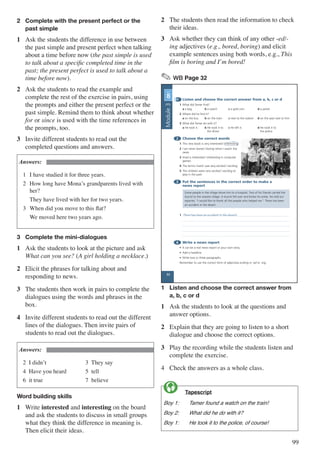
Answers:
a 3		 b 2
2	 Listen again and choose the correct answer
1	 Ask the students to read the sentences and elicit
the difference in the meaning of the verbs in
each case.
2	 Play the recording again for the students to
choose the correct answers, and then ask the
students to compare their answers with a partner.
3	 Check the answers as a whole class.
4	 Ask the students to read the phrases for talking
about and responding to the news in the
Functions box and then play the recording again,
asking the students to listen out for the phrases.
96
Answers:
2	 don’t know
3	gave
4	 has been
3	 Take turns to talk about the following
1	 Ask two students to read out the question and
sentences shown in the speech bubbles. Tell
them that they are going to talk about and
respond to the news stories in the box.
2	 Then ask them to read the ideas in the box and
ask them to work in pairs to make notes about
two details for each news story.
3	 The pairs then join another pair to ask and
answer questions, as in the example, using the
phrases from the Functions box. Go round and
monitor while they are working, helping where
necessary.
4	 Ask different groups of students to ask and
answer about the different news stories for the
class to listen and identify the phrases they use
from the Functions box.
Answers:
Students’ own answers
LESSON 4 SB page 43 WB page 31
Outcomes
•	To sequence events
•	To talk about a news story
•	To write two paragraphs to make a news report
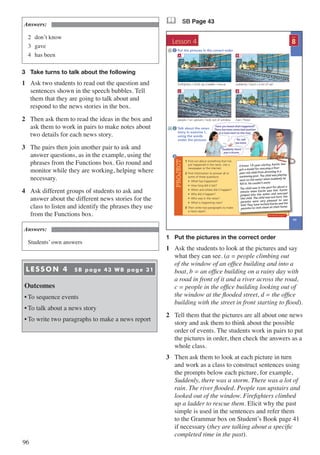
& SB Page 43
PROJECT
3
Put the pictures in the correct order
Talk about the news
story in exercise 1,
using the words
under the pictures
1
2
1 Find out about something that has
just happened in the news. Use a
newspaper or the internet.
2 Find information to answer all or
some of these questions:
• What has happened?
• How long did it last?
• When and where did it happen?
• Why did it happen?
• Who was in the news?
• What is happening now?
3 Then write two paragraphs to make
a news report.
A brave 13-year-old boy, Karim, has
got a medal for rescuing a four-
year-old child from drowning in a
swimming pool. The child was playing
next to the water when suddenly he
fell in. He couldn’t swim.
The child was in the pool for about a
minute when Karim saw him. Karim
jumped into the water and rescued
the child. The child was not hurt. His
parents were very pleased to see
him! They have invited Karim and his
parents to visit them at their home.
Have you heard what happened?
There has been some bad weather
in a town next to the river.
No, tell
me more.
suddenly / storm / a lot of rainfirefighters / climb up a ladder / rescue
river / floodpeople / run upstairs / look out of window
a
c
b
d
1
43
8
UNIT
Lesson 4
Workbook page 31
Suddenly there
was a storm.
1	 Put the pictures in the correct order
1	 Ask the students to look at the pictures and say
what they can see. (a = people climbing out
of the window of an office building and into a
boat, b = an office building on a rainy day with
a road in front of it and a river across the road,
c = people in the office building looking out of
the window at the flooded street, d = the office
building with the street in front starting to flood).
2	 Tell them that the pictures are all about one news
story and ask them to think about the possible
order of events. The students work in pairs to put
the pictures in order, then check the answers as a
whole class.
3	 Then ask them to look at each picture in turn
and work as a class to construct sentences using
the prompts below each picture, for example,
Suddenly, there was a storm. There was a lot of
rain. The river flooded. People ran upstairs and
looked out of the window. Firefighters climbed
up a ladder to rescue them. Elicit why the past
simple is used in the sentences and refer them
to the Grammar box on Student’s Book page 41
if necessary (they are talking about a specific
completed time in the past).
97
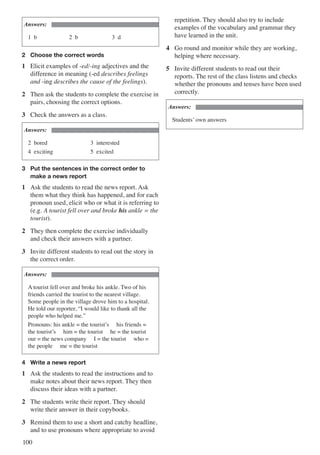
Answers:
a 4	 b 1	 c 3	 d 2
2	 Talk about the news story in exercise 1, 		
	 using the words under the pictures
1	 Ask two students to read out the example
dialogue in the speech bubbles, and ask them
to identify the phrases for talking about and
responding to news.
2	 The students then take turns to talk about the
news story in exercise 1, using the prompts
under the pictures. Go round and monitor while
they are working, helping where necessary.
3	 Invite different pairs to hold a conversation
about the story for the class to listen.
Answers:
Suddenly there was a storm. There was a lot of rain.
The river flooded.
People ran upstairs and looked out of the window.
Firefighters climbed up a ladder to rescue the
people.
3	 Project
1	 Tell the students that they are going to write a
news report. Ask them to look at the picture of
Karim and read the story about him.
2	 `Then ask them to read the first instruction
and elicit some current news stories which
have just happened, either locally, nationally
or internationally, using a newspaper or the
internet.
3	 Ask them to read the questions in the second
instruction, and allow them time to find out the
relevant information about the news story. Put
the students in pairs to carry out the research and
make notes.
4	 Once they have finished, ask the pairs to tell the
rest of the class what they have found out.
5	 The students then write their paragraphs about
the news story, using the paragraphs about
Karim as a model. Go round and monitor while
they are working, helping where necessary.
6	 When they have finished, ask the students to
exchange their reports with their partner to check
grammar and spelling.
7	 Invite different pairs to read out their news
stories for the class.
Answers:
Students’ own answers
. WB Page 31
1 Choose the correct answer from a, b, c or d
1 The boy the tree to get his football.
a climbed b rescued c went d ate
2 There are two books here. Which one to you?
a is b belongs c gives d owns
3 That chair only has three legs. Don’t sit on it or it will .
a go down b go over c get up d fall over
4 The little girl did not cry when she hurt her arm.
a bored b ancient c brave d dangerous
5 The teacher came into the room and all the children were quiet.
a suddenly b carefully c quick d truly
6 It rained for two hours during the .
a cloud b volcano c storm d earthquake
7 You need a to clean the high windows.
a ladder b stair c lift d rocket
2 Reorder to make sentences about the news
1 has / fire / a / building. / in a / There / been There has been a fire in a building.
2 stadium / opened / new / has / A / in / Cairo.
3 prize. / won / have / Two / a / girls / sports
4 A / brave man / a / rescued / a / small boy / flood. / has / from
5 big storm. / closed / shops / after / a / have / Two
3 Complete the dialogue
Amira: Did I 1 you what happened in the desert last week?
Nevine: No, you didn’t.
Amira: Two tourists decided to go for a walk.
Nevine: Tell me 2 .
Amira: They 3 that they walked for eight hours! They didn’t know where
they were.
Nevine: Yes, I remember now! I 4 about that on the news.
Amira: I 5 that they walked into a farm. The farmer was very surprised to
see them!
Nevine: Is it 6 that the farmer was on the television?
Amira: Yes. He was very kind. He gave them food and drink and took them back to
their hotel.
UNIT
8
31
Module3
1	 Choose the correct answer from a, b, c or d
1	 Ask the students to look at the photo and ask
What can you see? (a young boy climbing a
tree).
2	 Elicit vocabulary that the students have learned
in the unit so far.
3	 The students then complete the exercise in pairs,
as in the example.
4	 Invite different students to read out the
completed sentences.
98
Answers:
2 b		 3 d		 4 c
5 a		 6 c		 7 a
2	 Reorder to make sentences about the news
1	 Ask the students to read the example sentence
and elicit which tense is used (the present
perfect) and why (because this happened before
now, but we don’t know when).
2	 Then ask them to work in pairs to reorder the
rest of the sentences.
3	 Invite different students to read out their
reordered sentences.
Answers:
2	 A new stadium has opened in Cairo.
3	 Two girls have won a sports prize.
4	 A brave man has rescued a small boy from 	
	 a flood.
5	 Two shops have closed after a big storm.
3	 Complete the dialogue
1	 Ask the students to read the dialogue and think
about which words might go in the spaces.
2	 The students then work in pairs to complete the
exercise.
3	 Check the answers by inviting pairs of students
to read out the different lines of the dialogue.
Then ask two students to read out the whole
dialogue.
Answers:
1 tell		 2 more		 3 say
4 heard		 5 believe	 6 true
REVIEW S B p a g e 4 4 W B p a g e 3 2
Outcomes
•	To review and practise the vocabulary and
structures of the unit
•	To practise using pronouns to avoid repetition
Before using the book:
•	Write In the news on the board and ask the
students what they have learned in this unit.
Brainstorm a list of topics, vocabulary and
grammar points.
•	Tell the students that they are now going to
complete the review section for this unit, to see
what they can remember.
& SB Page 44
Noha: 1 …..….............…. about what happened to me yesterday?
I found some jewellery in the street!
Dina: 2 …..……. know that! What did you do with it?
Noha: I gave it to the police. 3 …..……. that it belongs to Mrs Nevine.
Fawzi: 4 …..……. what happened at school yesterday?
Mazen: No, 5 …..……. me more.
Fawzi: Yasser had an accident. He was playing football when he fell over.
Hussein: Is 6 …..……. there was an earthquake in India yesterday?
Basel: Yes, there was. But I 7 …..……. that nobody was hurt.
Complete with the present perfect or the past simple tense
1 How long / you study English? …..……..........................................................
I / study / it / three years …..…….
2 How long / Mona’s grandparents live with her? …..……. They / lived with her / two years …..….
3 When / you / move to this flat? …..……. We / move / here / two years ago …..…….
Complete the mini-dialogues
Now you can …
• use the present perfect tense with for or since
• contrast the present perfect tense with the past simple
• talk about and respond to news
Complete the sentences with for or since
1 Ali has had his phone …..……. the beginning of this year.
2 Have you lived in this village …..……. a long time?
3 I haven’t seen Hassan …..……. last Tuesday.
4 Sara has wanted to be a doctor …..……. she was seven years old.
1
2
3
believe Did I tell you Have you heard I didn’t it true tell They say
since
How long have you studied English?
Did I tell you
44
8
UNIT
Review
Many adjectives are made from verbs that end in -ed or -ing.
Adjectives that end in -ed usually describe feelings.
I am interested in history. He is excited about the football match.
Adjectives that end in -ing describe what or who causes that
feeling.
History is a very interesting subject. This football match is exciting.
You are amazing, Salma!
Word building skills
Workbook page 32
1	 Complete the sentences with for or since
1	Write for and since on the board as headings
and invite different students to come to the board
and write appropriate time references under each
one. Ask the rest of the class to say whether the
references are in the correct columns.
2	 The students then complete the exercise in pairs.
Check the answers as a whole class.
Answers:
2 for		 3 since		 4 since
99
2	 Complete with the present perfect or the 		
	 past simple
1	 Ask the students the difference in use between
the past simple and present perfect when talking
about a time before now (the past simple is used
to talk about a specific completed time in the
past; the present perfect is used to talk about a
time before now).
2	 Ask the students to read the example and
complete the rest of the exercise in pairs, using
the prompts and either the present perfect or the
past simple. Remind them to think about whether
for or since is used with the time references in
the prompts, too.
3	 Invite different students to read out the
completed questions and answers.
Answers:
1	 I have studied it for three years.
2	 How long have Mona’s grandparents lived with 	
	her?
	 They have lived with her for two years.
3	 When did you move to this flat?
	 We moved here two years ago.
3	 Complete the mini-dialogues
1	 Ask the students to look at the picture and ask
What can you see? (A girl holding a necklace.)
2	 Elicit the phrases for talking about and
responding to news.
3	 The students then work in pairs to complete the
dialogues using the words and phrases in the
box.
4	 Invite different students to read out the different
lines of the dialogues. Then invite pairs of
students to read out the dialogues.
Answers:
2 I didn’t		 3 They say
4 Have you heard	 5 tell
6 it true		 7 believe
Word building skills
1	Write interested and interesting on the board
and ask the students to discuss in small groups
what they think the difference in meaning is.
Then elicit their ideas.
2	 The students then read the information to check
their ideas.
3	 Ask whether they can think of any other -ed/-
ing adjectives (e.g., bored, boring) and elicit
example sentences using both words, e.g., This
film is boring and I’m bored!
. WB Page 32
1 Listen and choose the correct answer from a, b, c or d
1 What did Tamer find?
a a bag b a watch c a gold coin d a jacket
2 Where did he find it?
a on the bus b on the train c next to the station d on the seat next to him
3 What did Tamer do with it?
a He took it. b He took it to c He left it. d He took it to
the driver. the police.
2 Choose the correct words
1 This new book is very interested / interesting.
2 I am never bored / boring when I watch the
news.
3 Imad is interested / interesting in computer
games.
4 The tennis match was very excited / exciting.
5 The children were very excited / exciting to
play in the park.
3 Put the sentences in the correct order to make a
news report
1 There has been an accident in the desert.
4 Write a news report
• It can be a real news report or your own story.
• Add a headline.
• Write two or three paragraphs.
Remember to use the correct form of adjectives ending in -ed or -ing.
UNIT
8
UNIT
8
Some people in the village drove him to a hospital. Two of his friends carried the
tourist to the nearest village. A tourist fell over and broke his ankle. He told our
reporter, “I would like to thank all the people who helped me.” There has been
an accident in the desert.
32
Module3
1	 Listen and choose the correct answer from 	
	 a, b, c or d
1	 Ask the students to look at the questions and
answer options.
2	 Explain that they are going to listen to a short
dialogue and choose the correct options.
3	 Play the recording while the students listen and
complete the exercise.
4	 Check the answers as a whole class.
 Tapescript
Boy 1: 	 Tamer found a watch on the train!
Boy 2: 	 What did he do with it?
Boy 1: 	 He took it to the police, of course!
100
Answers:
1 b		 2 b		 3 d
2	 Choose the correct words
1	 Elicit examples of -ed/-ing adjectives and the
difference in meaning (-ed describes feelings
and -ing describes the cause of the feelings).
2	 Then ask the students to complete the exercise in
pairs, choosing the correct options.
3	 Check the answers as a class.
Answers:
2 bored			 3 interested
4 exciting		 5 excited
3	 Put the sentences in the correct order to 		
	 make a news report
1	 Ask the students to read the news report. Ask
them what they think has happened, and for each
pronoun used, elicit who or what it is referring to
(e.g. A tourist fell over and broke his ankle = the
tourist).
2	 They then complete the exercise individually
and check their answers with a partner.
3	 Invite different students to read out the story in
the correct order.
Answers:
A tourist fell over and broke his ankle. Two of his
friends carried the tourist to the nearest village.
Some people in the village drove him to a hospital.
He told our reporter, “I would like to thank all the
people who helped me.”
Pronouns: his ankle = the tourist’s his friends =
the tourist’s him = the tourist he = the tourist
our = the news company I = the tourist who =
the people me = the tourist
4	 Write a news report
1	 Ask the students to read the instructions and to
make notes about their news report. They then
discuss their ideas with a partner.
2	 The students write their report. They should
write their answer in their copybooks.
3	 Remind them to use a short and catchy headline,
and to use pronouns where appropriate to avoid
repetition. They should also try to include
examples of the vocabulary and grammar they
have learned in the unit.
4	 Go round and monitor while they are working,
helping where necessary.
5	 Invite different students to read out their
reports. The rest of the class listens and checks
whether the pronouns and tenses have been used
correctly.
Answers:
Students’ own answers
101
A s s e s s m e n t
Speaking task
Outcome: to ask and answer questions using the
present perfect tense with for and since
Use SB page 41, exercise 3
Write the following prompts on the board:
study English, live in your house, play your
favourite sport, be friends with your best friend,
have your favourite clothes.
Students make questions for their partner to answer,
using How long and the present perfect. Students
answer using for and since. Assess them on accurate
use of the present perfect with for and since.
Reading task
Outcome: to understand news stories
Use SB page 40, exercise 3 texts
Write the following statements on the board:
1 There has been a fire in Cairo.
2 Four people lived in the building.
3 The fire is still burning.
4 Two men were swimming when there was a 		
storm.
5 Mr Badrawi saved the men.
Students read the texts again and decide whether the
statements are true or false.
Writing Task
Outcome: to write a short news report
Students think of a story which is in the news at the
moment. They then write a short news story (using
three or four sentences) explaining what happened.
They can invent their story if they prefer.
Listening task
Outcome: understanding talk and responses about
the news
Use the tapescript for SB page 42, exercises 1 and 2
Write the tapescript on the board, leaving blanks
for the following phrases: (dialogue 1) Have you
heard, didn’t know; (dialogue 2) Did I tell, Is it true;
dialogue 3: Really.
Play the recording for students to complete the
missing phrases.

Prep 2 tg-unit-8

  • 1.
    91 Objectives Grammar: The present perfecttense with for or since and contrasted with the past simple Reading Reading news reports Listening Listening to a conversation about the news Speaking Talking about and responding to the news Writing Writing a news report LESSON 1 SB page 40 Outcomes • To talk about the news • To read news reports and answer questions • To carry out an internet search about a recent news story Before using the book: • Write the title of the unit In the news on the board and ask the students to tell you what they think they will study in the unit. Confirm any correct answers. • Brainstorm the kind of information that is reported in the news (e.g. local, national and international events, the weather, sports). • Hold a short class discussion about why the news is important. & SB Page 40 In the news 40 Lesson 1 UNIT 8 OBJECTIVES • Grammar The present perfect tense with for or since and contrasted with the past simple • Reading Reading news reports • Listening Listening to a conversation about the news • Speaking Talking about and responding to the news • Writing Writing a news report Ask and answer How often do you watch the news? Look at the pictures below. What do you think the news reports are about? 1 2 3 4 brave firefighters rescued smoke storm suddenly Internet search Find out about a recent news story in your city or village. Answer the questions 1 How did firefighters know about the fire? 2 Why are firefighters still at the building? 3 Why did the accident in the sea happen? 4 Who rescued the men? 5 Are there often storms like this one in the area? Read the news reports and check your answers to exercise 2. Complete the news reports There has been a fire at a house in this small village near Aswan. We don’t know how the fire started. A neighbour saw 1 …..…….. coming from a window, so he phoned 180 for help. The good news is that the building has been empty since May, so nobody was in it. 2 …..…….. have been at the building for more than four hours, but they haven’t been able to put out the fire yet. Earlier today, two young men were fishing in a small boat when the weather 3 …..…….. changed. The sky turned grey and it became very windy. During this bad 4 …..…….., the two men fell into the water. A man, Mr Badrawi, was walking by the sea at the time. He was very 5 …..……... He jumped into the sea and 6 …..…….. the men. Mr Badrawi has lived in the area for 30 years. He told me, “I haven’t seen such a bad storm since I was a little boy.” smoke 1 Ask and answer 1 Draw attention to the Objectives box on page 40, which refers to the objectives of the unit, and explain in Arabic if necessary. 2 Now ask the students to discuss the question in small groups. Then invite different students to tell the class about the members of their group. 3 Ask the students which TV channels they watch the news on and how many different news programmes they know about. Answers: Students’ own answers 2 Look at the pictures below. What do you think the news reports are about? 1 Ask the students to look at the two pictures in exercise 3 and discuss in pairs what they think the news reports are about, without reading the reports. 2 Invite the pairs to share their ideas with the rest of the class, but do not confirm their answers at this point. In the news SB pages 40–45 WB pages 30–32 UNIT 8
  • 2.
    92 3 Read thenews reports and check your answers to exercise 2. Complete the news reports 1 Ask the students to read the news reports quickly to check their answers to exercise 2. Tell them not to worry about the gaps in the text at this point. 2 Ask different students to say what each news report is about, and check answers to exercise 2. 3 Check the meaning and pronunciation of the words in the box. 4 Then ask the students to complete the texts with the words. Check the answers as a whole class. Exercise 2 answers: First picture: a house fire Second picture: a storm Exercise 3 answers: 2 Firefighters 3 suddenly 4 storm 5 brave 6 rescued 4 Answer the questions 1 Ask the students to read the questions and read the news reports again more carefully to find the answers to the questions. 2 Then invite different students to give their answers 3 Finally, go through any unknown vocabulary in the text. Answers: 1 A neighbour phoned 180 for help. 2 Because they haven’t been able to put out the fire yet. 3 There was a bad storm./It became very windy. 4 A brave man, Mr Badrawi, rescued the men. 5 No, there aren’t. There hasn’t been such a bad storm since Mr Badrawi was a little boy. : Internet search 1 Ask the students what’s happening in the news at the moment. Then ask them what’s happening in their own city or village. 2 Ask the students to look at the question in the Internet search and tell them that they are going to find out more about local news by carrying out an internet search. Ask what they might type into a search engine in order to get the information they need. 3 The students then work in pairs to carry out their research. If the pairs live in different places, ask them to find out about one story from each place. 4 Finally, ask the pairs to report back their findings to the rest of the class. LESSON 2 SB page 41 WB page 30 Outcomes • To use the present perfect with for or since • To ask and answer questions using the present perfect with for or since & SB Page 41 Complete the sentences with for or since 1 The building has been empty …..…….. May. 2 Firefighters have been at the building …..…….. more than four hours. 3 Mr Badrawi has lived in the area …..…….. 30 years. 4 I haven’t seen such a bad storm …..…….. I was a little boy. 1 The present perfect tense with for or since • We use the present perfect with for to talk about how long something has lasted before now: I’ve lived here for 13 years. Have you been at this school for a long time? No, I’ve only been here for a month. • We use the present perfect with since to refer to the starting point of an event that continues up to now: I’ve studied English since I was eight years old. Has your uncle worked at the hospital since he moved to Cairo? Yes, he has. He’s worked there since 2008. The present perfect contrasted with the past simple • The past simple is used to talk about actions that started and ended in the past: I lived in London in 2010. ( I no longer live there.) • The present perfect is used to talk about actions / events that started to happen in the past and are still happening now: I have lived in London since 2010. ( I am still living in London.) GRAMMARBOX 3 Ask and answer questions using these words 1 How long / our teacher / teach at this school? 2 When / start / school today? 3 How long / you / have your school bag? 4 When / get / school bag? 5 What time / you go to bed / last night? How long has our teacher taught at this school? She’s taught at this school for three years. since Complete the sentences with for and with since 1 I’ve been at this school …..…...................................................….. 2 We’ve been in this lesson …..…….. 3 I’ve studied English …..…….. 4 My family has lived here …..…….. 5 I haven’t seen my grandparents …..…….. 2 for two years / since I was eleven. Lesson 2 41 8 UNIT Workbook page 30 1 Complete the sentences with for or since 1 Ask the students to look at the picture and ask What can you see? (a storm) Explain that this is the storm the students read about in the second news report on Student’s Book page 40.
  • 3.
    93 2 Elicit theform of the present perfect (have/has + past participle). Ask when it is used (to talk about a time before now). 3 Explain that the students are going to find out about time references used with the present perfect. Write for on the board as a heading, and write some time references underneath, for example, three years, a week, an hour and a half, two months. Do the same with since, for example, yesterday, 2012, August, last year. Elicit the difference between the time references (for is used to talk about how long, and since is used to refer to the starting point). 4 Ask the students to complete the sentences in pairs and then check the answers as a whole class. 5 Ask the students to read the first point in the Grammar box and elicit further time references to add to the board under the for heading. Repeat the process with the second point and the since heading on the board. 6 Ask the students to read the third point in the Grammar box. Ask which of the sentences in exercise 1 is similar (4). 7 Ask the students to read the first sentence in exercise 1 again and work in pairs to think of a second sentence to add about a complete time in the past, for example, The building has been empty since May. Before that it was an apartment block. Do the same for sentences 2–4. Answers: 2 for 3 for 4 since 2 Complete the sentences with for and with since 1 Ask the students to read the example answer and explain that they have to complete the rest of the sentences with information that is true for them. 2 Ask them to complete the sentences individually. Remind them to refer to the Grammar box if necessary, and explain that they should finish each sentence with two alternatives, as in the example. 3 Then ask the students to compare their answers with a partner and to correct any errors in their answers. 4 Invite different students to read out the completed sentences with both alternatives for the rest of the class to check that for and since have been used correctly with the time references. Suggested answers: 2 for twenty minutes / since 10 o'clock. 3 for many years / since I was six. 4 since 2012 / for four years. 5 since last weekend / for three days. 3 Ask and answer questions using these words 1 Write How long … ? on the board and invite the students to complete the question using the present perfect, for example, How long have you played the oud? How long have you lived in Cairo? 2 Then write When … ? and What time …? on the board. Elicit which tense is used after these question words (the past simple) and some examples (e.g. When did you start learning English? What time did you get up this morning?). 3 Ask two students to read out the question and answer shown in the speech bubbles. The students then work in small groups to ask and answer questions using the prompts and the present perfect or past simple. Go round and monitor while they are working, helping where necessary. 4 Invite different pairs of students to ask and answer the questions for the class to listen. Answers: 2 When did you start school today? 3 How long have you had your school bag? 4 When did you get your school bag? 5 What time did you go to bed last night?
  • 4.
    94 . WB Page30 In the news 1 Read and match 1 e to save a person from something dangerous a put out 2 happening from the beginning to the end b during 3 no person c firefighter 4 someone who stops fires d nobody 5 this goes into the air when something burns e rescue 6 to stop a fire burning f smoke 2 Match to make sentences 1 d There has not been a storm here since a he bought a mobile phone last year. 2 My uncle has been a firefighter since b for 20 minutes longer than yesterday. 3 Ahmed has had that computer c he left school in 1994. 4 Sara has waited for a bus d 2012. 5 Khaled has not used a camera since e for five years. 3 Complete the sentences 1 Ali started work at ten o’clock. It is now twelve o’clock. He has worked for two hours. 2 Mona started running twenty minutes ago. It is now twelve o’clock. She has run since 3 Hana was born in her house. She is now twelve. She has lived in her house for 4 The football team started playing when the stadium opened ten years ago. The football team have played in the stadium since 5 I saw my cousins in Aswan in December. It is now March. I have not seen them for Module3 UNIT 8 30 1 Read and match 1 Elicit the vocabulary mentioned in the news reports in Lesson 1. Ask the students to read the words on the right and say what they mean. 2 Then ask the students to read the example before matching the words with the definitions. 3 Check the answers as a whole class. Answers: 2 b 3 d 4 c 5 f 6 a 2 Match to make sentences 1 Elicit the use of for and since (for is used to say how long, and since says when something started). 2 Then ask the students to work in pairs to match the rest of the sentence halves. 3 Invite different students to read out the full sentences. Answers: 2 c 3 e 4 b 5 a 3 Complete the sentences 1 Ask the students to read the example and then work in pairs to complete the rest of the sentences. 2 Invite different students to read out the completed sentences. Answers: 2 twenty to twelve/eleven forty 3 twelve years 4 it opened/2006 [or an appropriate year] 5 three months L E S S O N 3 S B p a g e 4 2 Outcomes • To listen to two friends discussing the news and sequence events • To talk about and respond to news
  • 5.
    95 & SB Page42 42 8 UNIT Lesson 3 FUNCTIONSBOX Have you heard what happened (to my brother)? Did I tell you about (what happened last week)? I believe (he gave prizes). Is it true that (Omar won a prize)? They say (there’s going to be a storm). I didn’t know that. I heard about that. Tell me more. Talking about the news Responding to news Listen to Tarek and his friend discussing the news. Number the pictures in the order you hear them Take turns to talk about the following 1 2 3 Have you heard about the fire? I believe nobody was in the building. Tell me more.an accident family news a fire a new building a prize a sport a b c 1 Listen again and choose the correct answer 1 Tarek’s brother put / saw a bag on a seat when he was waiting for a bus. 2 The police don’t know / know who the bag belongs to. 3 A famous swimmer gave / got prizes at the sports centre. 4 It hasn’t / has been very dry in the south for a long time. 1 Listen to Tarek and his friend discussing the news. Number the pictures in the order you hear them 1 Ask the students to look at the pictures in exercise 1 and say what is happening in each one. (a = a storm in Egypt; b = a man giving a child a prize at a swimming pool; c = a bag with a lot of money in it on a seat at a bus stop) 2 Tell them that they are going to listen to Tarek and his friend (shown in the photo in exercise 2) talking about three news stories and that they have to put the pictures in the correct order, according to what they hear. 3 Play the recording. The students listen for the answers and then check their ideas in pairs. 4 Check the answers as a whole class.  Tapescript Narrator: One. Tarek: Have you heard what happened to my brother on Saturday? He found a lot of money in the street! Adel: I didn’t know that. Tell me more. Tarek: Well, he was waiting for a bus when he saw a bag on the seat next to him. Inside the bag, there was a lot of money. There was no name on the bag, so my brother didn’t know whose bag it was. Adel: What did he do? Tarek: He took it to the police, of course! They are trying to find who the bag belongs to. Narrator: Two. Adel: Did I tell you about what happened at the sports club last weekend? A famous swimmer was there. Tarek: Yes, I heard about that. I believe he gave prizes to some young swimmers. Adel: Is it true that Omar won a prize, too? Tarek: Yes, he came first in a competition. He’s a very good swimmer! Narrator: Three. Tarek: They say there’s going to be a storm in the south next weekend. Adel: Really? It hasn’t rained there for a long time. Tarek: No, it hasn’t rained there since last year. Answers: a 3 b 2 2 Listen again and choose the correct answer 1 Ask the students to read the sentences and elicit the difference in the meaning of the verbs in each case. 2 Play the recording again for the students to choose the correct answers, and then ask the students to compare their answers with a partner. 3 Check the answers as a whole class. 4 Ask the students to read the phrases for talking about and responding to the news in the Functions box and then play the recording again, asking the students to listen out for the phrases.
  • 6.
    96 Answers: 2 don’t know 3 gave 4 has been 3 Take turns to talk about the following 1 Ask two students to read out the question and sentences shown in the speech bubbles. Tell them that they are going to talk about and respond to the news stories in the box. 2 Then ask them to read the ideas in the box and ask them to work in pairs to make notes about two details for each news story. 3 The pairs then join another pair to ask and answer questions, as in the example, using the phrases from the Functions box. Go round and monitor while they are working, helping where necessary. 4 Ask different groups of students to ask and answer about the different news stories for the class to listen and identify the phrases they use from the Functions box. Answers: Students’ own answers LESSON 4 SB page 43 WB page 31 Outcomes • To sequence events • To talk about a news story • To write two paragraphs to make a news report & SB Page 43 PROJECT 3 Put the pictures in the correct order Talk about the news story in exercise 1, using the words under the pictures 1 2 1 Find out about something that has just happened in the news. Use a newspaper or the internet. 2 Find information to answer all or some of these questions: • What has happened? • How long did it last? • When and where did it happen? • Why did it happen? • Who was in the news? • What is happening now? 3 Then write two paragraphs to make a news report. A brave 13-year-old boy, Karim, has got a medal for rescuing a four- year-old child from drowning in a swimming pool. The child was playing next to the water when suddenly he fell in. He couldn’t swim. The child was in the pool for about a minute when Karim saw him. Karim jumped into the water and rescued the child. The child was not hurt. His parents were very pleased to see him! They have invited Karim and his parents to visit them at their home. Have you heard what happened? There has been some bad weather in a town next to the river. No, tell me more. suddenly / storm / a lot of rainfirefighters / climb up a ladder / rescue river / floodpeople / run upstairs / look out of window a c b d 1 43 8 UNIT Lesson 4 Workbook page 31 Suddenly there was a storm. 1 Put the pictures in the correct order 1 Ask the students to look at the pictures and say what they can see. (a = people climbing out of the window of an office building and into a boat, b = an office building on a rainy day with a road in front of it and a river across the road, c = people in the office building looking out of the window at the flooded street, d = the office building with the street in front starting to flood). 2 Tell them that the pictures are all about one news story and ask them to think about the possible order of events. The students work in pairs to put the pictures in order, then check the answers as a whole class. 3 Then ask them to look at each picture in turn and work as a class to construct sentences using the prompts below each picture, for example, Suddenly, there was a storm. There was a lot of rain. The river flooded. People ran upstairs and looked out of the window. Firefighters climbed up a ladder to rescue them. Elicit why the past simple is used in the sentences and refer them to the Grammar box on Student’s Book page 41 if necessary (they are talking about a specific completed time in the past).
  • 7.
    97 Answers: a 4 b1 c 3 d 2 2 Talk about the news story in exercise 1, using the words under the pictures 1 Ask two students to read out the example dialogue in the speech bubbles, and ask them to identify the phrases for talking about and responding to news. 2 The students then take turns to talk about the news story in exercise 1, using the prompts under the pictures. Go round and monitor while they are working, helping where necessary. 3 Invite different pairs to hold a conversation about the story for the class to listen. Answers: Suddenly there was a storm. There was a lot of rain. The river flooded. People ran upstairs and looked out of the window. Firefighters climbed up a ladder to rescue the people. 3 Project 1 Tell the students that they are going to write a news report. Ask them to look at the picture of Karim and read the story about him. 2 `Then ask them to read the first instruction and elicit some current news stories which have just happened, either locally, nationally or internationally, using a newspaper or the internet. 3 Ask them to read the questions in the second instruction, and allow them time to find out the relevant information about the news story. Put the students in pairs to carry out the research and make notes. 4 Once they have finished, ask the pairs to tell the rest of the class what they have found out. 5 The students then write their paragraphs about the news story, using the paragraphs about Karim as a model. Go round and monitor while they are working, helping where necessary. 6 When they have finished, ask the students to exchange their reports with their partner to check grammar and spelling. 7 Invite different pairs to read out their news stories for the class. Answers: Students’ own answers . WB Page 31 1 Choose the correct answer from a, b, c or d 1 The boy the tree to get his football. a climbed b rescued c went d ate 2 There are two books here. Which one to you? a is b belongs c gives d owns 3 That chair only has three legs. Don’t sit on it or it will . a go down b go over c get up d fall over 4 The little girl did not cry when she hurt her arm. a bored b ancient c brave d dangerous 5 The teacher came into the room and all the children were quiet. a suddenly b carefully c quick d truly 6 It rained for two hours during the . a cloud b volcano c storm d earthquake 7 You need a to clean the high windows. a ladder b stair c lift d rocket 2 Reorder to make sentences about the news 1 has / fire / a / building. / in a / There / been There has been a fire in a building. 2 stadium / opened / new / has / A / in / Cairo. 3 prize. / won / have / Two / a / girls / sports 4 A / brave man / a / rescued / a / small boy / flood. / has / from 5 big storm. / closed / shops / after / a / have / Two 3 Complete the dialogue Amira: Did I 1 you what happened in the desert last week? Nevine: No, you didn’t. Amira: Two tourists decided to go for a walk. Nevine: Tell me 2 . Amira: They 3 that they walked for eight hours! They didn’t know where they were. Nevine: Yes, I remember now! I 4 about that on the news. Amira: I 5 that they walked into a farm. The farmer was very surprised to see them! Nevine: Is it 6 that the farmer was on the television? Amira: Yes. He was very kind. He gave them food and drink and took them back to their hotel. UNIT 8 31 Module3 1 Choose the correct answer from a, b, c or d 1 Ask the students to look at the photo and ask What can you see? (a young boy climbing a tree). 2 Elicit vocabulary that the students have learned in the unit so far. 3 The students then complete the exercise in pairs, as in the example. 4 Invite different students to read out the completed sentences.
  • 8.
    98 Answers: 2 b 3d 4 c 5 a 6 c 7 a 2 Reorder to make sentences about the news 1 Ask the students to read the example sentence and elicit which tense is used (the present perfect) and why (because this happened before now, but we don’t know when). 2 Then ask them to work in pairs to reorder the rest of the sentences. 3 Invite different students to read out their reordered sentences. Answers: 2 A new stadium has opened in Cairo. 3 Two girls have won a sports prize. 4 A brave man has rescued a small boy from a flood. 5 Two shops have closed after a big storm. 3 Complete the dialogue 1 Ask the students to read the dialogue and think about which words might go in the spaces. 2 The students then work in pairs to complete the exercise. 3 Check the answers by inviting pairs of students to read out the different lines of the dialogue. Then ask two students to read out the whole dialogue. Answers: 1 tell 2 more 3 say 4 heard 5 believe 6 true REVIEW S B p a g e 4 4 W B p a g e 3 2 Outcomes • To review and practise the vocabulary and structures of the unit • To practise using pronouns to avoid repetition Before using the book: • Write In the news on the board and ask the students what they have learned in this unit. Brainstorm a list of topics, vocabulary and grammar points. • Tell the students that they are now going to complete the review section for this unit, to see what they can remember. & SB Page 44 Noha: 1 …..….............…. about what happened to me yesterday? I found some jewellery in the street! Dina: 2 …..……. know that! What did you do with it? Noha: I gave it to the police. 3 …..……. that it belongs to Mrs Nevine. Fawzi: 4 …..……. what happened at school yesterday? Mazen: No, 5 …..……. me more. Fawzi: Yasser had an accident. He was playing football when he fell over. Hussein: Is 6 …..……. there was an earthquake in India yesterday? Basel: Yes, there was. But I 7 …..……. that nobody was hurt. Complete with the present perfect or the past simple tense 1 How long / you study English? …..…….......................................................... I / study / it / three years …..……. 2 How long / Mona’s grandparents live with her? …..……. They / lived with her / two years …..…. 3 When / you / move to this flat? …..……. We / move / here / two years ago …..……. Complete the mini-dialogues Now you can … • use the present perfect tense with for or since • contrast the present perfect tense with the past simple • talk about and respond to news Complete the sentences with for or since 1 Ali has had his phone …..……. the beginning of this year. 2 Have you lived in this village …..……. a long time? 3 I haven’t seen Hassan …..……. last Tuesday. 4 Sara has wanted to be a doctor …..……. she was seven years old. 1 2 3 believe Did I tell you Have you heard I didn’t it true tell They say since How long have you studied English? Did I tell you 44 8 UNIT Review Many adjectives are made from verbs that end in -ed or -ing. Adjectives that end in -ed usually describe feelings. I am interested in history. He is excited about the football match. Adjectives that end in -ing describe what or who causes that feeling. History is a very interesting subject. This football match is exciting. You are amazing, Salma! Word building skills Workbook page 32 1 Complete the sentences with for or since 1 Write for and since on the board as headings and invite different students to come to the board and write appropriate time references under each one. Ask the rest of the class to say whether the references are in the correct columns. 2 The students then complete the exercise in pairs. Check the answers as a whole class. Answers: 2 for 3 since 4 since
  • 9.
    99 2 Complete withthe present perfect or the past simple 1 Ask the students the difference in use between the past simple and present perfect when talking about a time before now (the past simple is used to talk about a specific completed time in the past; the present perfect is used to talk about a time before now). 2 Ask the students to read the example and complete the rest of the exercise in pairs, using the prompts and either the present perfect or the past simple. Remind them to think about whether for or since is used with the time references in the prompts, too. 3 Invite different students to read out the completed questions and answers. Answers: 1 I have studied it for three years. 2 How long have Mona’s grandparents lived with her? They have lived with her for two years. 3 When did you move to this flat? We moved here two years ago. 3 Complete the mini-dialogues 1 Ask the students to look at the picture and ask What can you see? (A girl holding a necklace.) 2 Elicit the phrases for talking about and responding to news. 3 The students then work in pairs to complete the dialogues using the words and phrases in the box. 4 Invite different students to read out the different lines of the dialogues. Then invite pairs of students to read out the dialogues. Answers: 2 I didn’t 3 They say 4 Have you heard 5 tell 6 it true 7 believe Word building skills 1 Write interested and interesting on the board and ask the students to discuss in small groups what they think the difference in meaning is. Then elicit their ideas. 2 The students then read the information to check their ideas. 3 Ask whether they can think of any other -ed/- ing adjectives (e.g., bored, boring) and elicit example sentences using both words, e.g., This film is boring and I’m bored! . WB Page 32 1 Listen and choose the correct answer from a, b, c or d 1 What did Tamer find? a a bag b a watch c a gold coin d a jacket 2 Where did he find it? a on the bus b on the train c next to the station d on the seat next to him 3 What did Tamer do with it? a He took it. b He took it to c He left it. d He took it to the driver. the police. 2 Choose the correct words 1 This new book is very interested / interesting. 2 I am never bored / boring when I watch the news. 3 Imad is interested / interesting in computer games. 4 The tennis match was very excited / exciting. 5 The children were very excited / exciting to play in the park. 3 Put the sentences in the correct order to make a news report 1 There has been an accident in the desert. 4 Write a news report • It can be a real news report or your own story. • Add a headline. • Write two or three paragraphs. Remember to use the correct form of adjectives ending in -ed or -ing. UNIT 8 UNIT 8 Some people in the village drove him to a hospital. Two of his friends carried the tourist to the nearest village. A tourist fell over and broke his ankle. He told our reporter, “I would like to thank all the people who helped me.” There has been an accident in the desert. 32 Module3 1 Listen and choose the correct answer from a, b, c or d 1 Ask the students to look at the questions and answer options. 2 Explain that they are going to listen to a short dialogue and choose the correct options. 3 Play the recording while the students listen and complete the exercise. 4 Check the answers as a whole class.  Tapescript Boy 1: Tamer found a watch on the train! Boy 2: What did he do with it? Boy 1: He took it to the police, of course!
  • 10.
    100 Answers: 1 b 2b 3 d 2 Choose the correct words 1 Elicit examples of -ed/-ing adjectives and the difference in meaning (-ed describes feelings and -ing describes the cause of the feelings). 2 Then ask the students to complete the exercise in pairs, choosing the correct options. 3 Check the answers as a class. Answers: 2 bored 3 interested 4 exciting 5 excited 3 Put the sentences in the correct order to make a news report 1 Ask the students to read the news report. Ask them what they think has happened, and for each pronoun used, elicit who or what it is referring to (e.g. A tourist fell over and broke his ankle = the tourist). 2 They then complete the exercise individually and check their answers with a partner. 3 Invite different students to read out the story in the correct order. Answers: A tourist fell over and broke his ankle. Two of his friends carried the tourist to the nearest village. Some people in the village drove him to a hospital. He told our reporter, “I would like to thank all the people who helped me.” Pronouns: his ankle = the tourist’s his friends = the tourist’s him = the tourist he = the tourist our = the news company I = the tourist who = the people me = the tourist 4 Write a news report 1 Ask the students to read the instructions and to make notes about their news report. They then discuss their ideas with a partner. 2 The students write their report. They should write their answer in their copybooks. 3 Remind them to use a short and catchy headline, and to use pronouns where appropriate to avoid repetition. They should also try to include examples of the vocabulary and grammar they have learned in the unit. 4 Go round and monitor while they are working, helping where necessary. 5 Invite different students to read out their reports. The rest of the class listens and checks whether the pronouns and tenses have been used correctly. Answers: Students’ own answers
  • 11.
    101 A s se s s m e n t Speaking task Outcome: to ask and answer questions using the present perfect tense with for and since Use SB page 41, exercise 3 Write the following prompts on the board: study English, live in your house, play your favourite sport, be friends with your best friend, have your favourite clothes. Students make questions for their partner to answer, using How long and the present perfect. Students answer using for and since. Assess them on accurate use of the present perfect with for and since. Reading task Outcome: to understand news stories Use SB page 40, exercise 3 texts Write the following statements on the board: 1 There has been a fire in Cairo. 2 Four people lived in the building. 3 The fire is still burning. 4 Two men were swimming when there was a storm. 5 Mr Badrawi saved the men. Students read the texts again and decide whether the statements are true or false. Writing Task Outcome: to write a short news report Students think of a story which is in the news at the moment. They then write a short news story (using three or four sentences) explaining what happened. They can invent their story if they prefer. Listening task Outcome: understanding talk and responses about the news Use the tapescript for SB page 42, exercises 1 and 2 Write the tapescript on the board, leaving blanks for the following phrases: (dialogue 1) Have you heard, didn’t know; (dialogue 2) Did I tell, Is it true; dialogue 3: Really. Play the recording for students to complete the missing phrases.