School Of Agriculture In North-East
EANOR
ENGINEER Oscar García
English
Practice No. 5
Alejandro José Almaraz Acevedo
5to Perito Agrónomo
Grupo No. 1
Present Simple Whit Future Meaning
 a. A future tense is not used in a time clause or conditional clause. The
meaning of the clause is future, but the simple present tense is used, e.g.
 Occasionally, the present perfect is used in a time clause, as in the last
sentence. The last two sentences have the same meaning. The present
perfect stresses the completion of the act in the time clause before the other
act occurs in the future.
 b. Sometimes the simple present is used in sentences that contain future time
words. The simple present is used primarily with verbs such as open / close,
begin / end, arrive / leave and expresses an established fact, e.g.
 c. Statements about the calendar are also the straightforward illustrations of
the use of the simple present referring to future time, e.g.
EXAMPLES
 a. Linda will leave soon. Before she leaves, she is going to finish her work.
 I will wait until she comes.
 I will go to bed after I finish my work.
 I will go to bed after I have finished my work.
 b. The restaurant opens at ten tomorrow morning.
 The plane arrives at 8:00 next Sunday.
 c. Tomorrow is Wednesday.
 Next New Year's Eve falls on Friday.
FUTURE “BE ABOUT TO” + INFINITIVE
 a. You're quite right, Young. This is a future form. When we say that things
are to happen, we are talking about official arrangements and formal
instructions that are imposed on us by other people. This structure is quite
common in news reports and official notices of various kinds:
 b. It is also frequently used by parents or other responsible adults to give
instruction to children.
EXAMPLES
 a. Laboratory equipment is not to be left unattended in the science labs.
 This medicine is to be taken three times daily after meals.
 All visitors entering the hospital are to wear masks as protection against
infection.
 Manchester City are to return to their famous sky-blue shirts next season
after agreeing a sponsorship deal with Reebok.
VERBS + INFINITEVE
 The infinitive form of a verb is the verb in its basic form. It is the version of
the verb which will appear in the dictionary.
The infinitive form of a verb is usually preceded by to (e.g., to run, to dance,
to think). The infinitive form is not always preceded by to.
EXAMPLES
•I must run every day. (After certain verbs, the to is dropped (more on this below).)
•I need to run every day. (The infinitive form with the word to is called the full infinitive
or to-infinitive.)
•I run every day. (This is not in the infinitive form. This is a finite verb, i.e., a verb
functioning as the main verb.)
Present perfect simple + “just/for/since”
 Just
 Examples
Is used to actions or events that occurred recently and as such can be translated as "
finish " or "just " . As with "already " , "just" goes before the verb or between the
auxiliary and the verb in the sentence.
•I just ate, but I'm already hungry again. (Acabo de comer pero ya tengo hambre de nuevo.)
•Play
Where's Jacob? He's just left. (¿Donde está Jacob? Acaba de irse.)
•Play
Beth has just moved to New York. (Beth acaba de trasladarse a Nueva York.)
 For/Since
 Using the present perfect, we can define a period of time before now by
considering its duration, with for + a period of time, or by considering its
starting point, with since + a point in time. FOR and SINCE can also both be
used with the past perfect. SINCE can only be used with perfect tenses. FOR
can also be used with the simple past.
EXAMPLES
 For + a period of time
 for six years, for a week, for a month, for hours, for two hours
I have worked here for five years.
 Since + a point in time
 since this morning, since last week, since yesterday
since I was a child, since Wednesday, since 2 o'clock
Present perfect with FOR
 She has lived here for twenty years.
We have taught at this school for a long time.
Alice has been married forthree months.
 Present perfect with SINCE
 She has lived here since 1980.
We have taught at this school since 1965.
Alice has been married since March 2nd.
REPORTED SPEECH
 If we report what another person has said, we usually do not use the
speaker’s exact words (direct speech), but reported (indirect) speech.
Therefore, you need to learn how to transform direct speech into reported
speech. The structure is a little different depending on whether you want to
transform a statement, question or request.
 When transforming statements, check whether you have to change:
 pronouns
 present tense verbs (3rd person singular)
 place and time expressions
 tenses (backshift)
EJEMPLOS
 I speak English.
 He says that he speaks English.
 He said that he spoke English.
 He said that he travelled a lot in his job.
 She said they’d always been very kind to
Past TENCE OF THERE IS/THERE ARE
 I know the French translation of there is/are is 'Il y a' but I'm unsure of how to
say this in the past tense. I conjugated it as 'Il y a eu' but I'm sure that's
wrong. What I want to say is 'There were fourteen girls and one boy, therefore
there was a lot of drama.' I am talking about a specific trip, so I am assuming I
use the passé composé, correct?
Il y a eu quatorze filles et un garçon, donc il y a eu beaucoup du drame.
EXAMPLES
 There was a lightning storm last night.
 There were many things to do and see at the amusement park.
 There was also a lot of food there.
 There were a lot of students on this website last night.
 Were there a lot of students on this website last week?
 There wasn't any furniture in the apartment.
 It was almost empty.
PAST CONTINUOUS
 a. Use the Past Continuous to indicate that a longer action in the past was
interrupted. The interruption is usually a shorter action in the Simple Past.
Remember this can be a real interruption or just an interruption in time.
 b. In USE 1, described above, the Past Continuous is interrupted by a shorter
action in the Simple Past. However, you can also use a specific time as an
interruption.
EXAMPLES
 a.
 b.
•I was watching TV when she called.
•When the phone rang, she was writing a letter.
•While we were having the picnic, it started to rain.
•What were you doing when the earthquake started?
•Last night at 6 PM, I was eating dinner.
•At midnight, we were still driving through the desert.
•Yesterday at this time, I was sitting at my desk at work
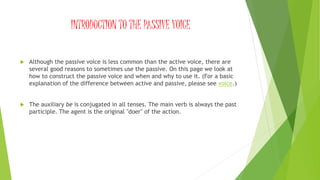
INTRODUCTION TO THE PASSIVE VOICE
 Although the passive voice is less common than the active voice, there are
several good reasons to sometimes use the passive. On this page we look at
how to construct the passive voice and when and why to use it. (For a basic
explanation of the difference between active and passive, please see voice.)
 The auxiliary be is conjugated in all tenses. The main verb is always the past
participle. The agent is the original "doer" of the action.
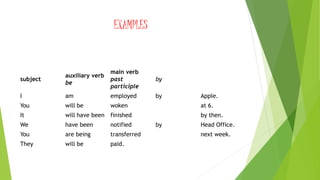
EXAMPLES
subject
auxiliary verb
be
main verb
past
participle
by
I am employed by Apple.
You will be woken at 6.
It will have been finished by then.
We have been notified by Head Office.
You are being transferred next week.
They will be paid.
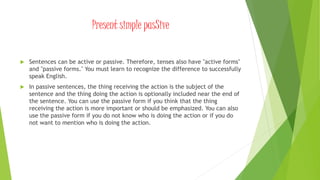
Present simple pasSive
 Sentences can be active or passive. Therefore, tenses also have "active forms"
and "passive forms." You must learn to recognize the difference to successfully
speak English.
 In passive sentences, the thing receiving the action is the subject of the
sentence and the thing doing the action is optionally included near the end of
the sentence. You can use the passive form if you think that the thing
receiving the action is more important or should be emphasized. You can also
use the passive form if you do not know who is doing the action or if you do
not want to mention who is doing the action.
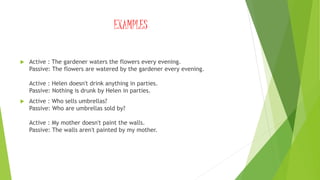
EXAMPLES
 Active : The gardener waters the flowers every evening.
Passive: The flowers are watered by the gardener every evening.
Active : Helen doesn't drink anything in parties.
Passive: Nothing is drunk by Helen in parties.
 Active : Who sells umbrellas?
Passive: Who are umbrellas sold by?
Active : My mother doesn't paint the walls.
Passive: The walls aren't painted by my mother.
LITERATURE
 http://www.englishteachermelanie.com/grammar-using-the-present-simple-
to-talk-about-the-future/
 http://www.bbc.co.uk/worldservice/learningenglish/grammar/learnit/learnit
v103.shtml
 http://www.englishexperts.com.br/forum/exercicio-present-perfect-just-
already-since-for-or-yet-t8702.html
 http://www.ego4u.com/en/cram-up/grammar/reported-speech
 http://www.learnamericanenglishonline.com/Blue%20Level/B16_Part_2_Ther
e_was.html
 http://www.curso-ingles.com/gramatica-inglesa/pasado_continuo.php
 http://www.engvid.com/english-grammar-passive-introduction/
 http://www.blueblocnotes.com/grammar/passive-voice/present-simple

Alejandro almaraz practica no. 5

  • 1.
    School Of AgricultureIn North-East EANOR ENGINEER Oscar García English Practice No. 5 Alejandro José Almaraz Acevedo 5to Perito Agrónomo Grupo No. 1
  • 2.
    Present Simple WhitFuture Meaning  a. A future tense is not used in a time clause or conditional clause. The meaning of the clause is future, but the simple present tense is used, e.g.  Occasionally, the present perfect is used in a time clause, as in the last sentence. The last two sentences have the same meaning. The present perfect stresses the completion of the act in the time clause before the other act occurs in the future.  b. Sometimes the simple present is used in sentences that contain future time words. The simple present is used primarily with verbs such as open / close, begin / end, arrive / leave and expresses an established fact, e.g.  c. Statements about the calendar are also the straightforward illustrations of the use of the simple present referring to future time, e.g.
  • 3.
    EXAMPLES  a. Lindawill leave soon. Before she leaves, she is going to finish her work.  I will wait until she comes.  I will go to bed after I finish my work.  I will go to bed after I have finished my work.  b. The restaurant opens at ten tomorrow morning.  The plane arrives at 8:00 next Sunday.  c. Tomorrow is Wednesday.  Next New Year's Eve falls on Friday.
  • 4.
    FUTURE “BE ABOUTTO” + INFINITIVE  a. You're quite right, Young. This is a future form. When we say that things are to happen, we are talking about official arrangements and formal instructions that are imposed on us by other people. This structure is quite common in news reports and official notices of various kinds:  b. It is also frequently used by parents or other responsible adults to give instruction to children.
  • 5.
    EXAMPLES  a. Laboratoryequipment is not to be left unattended in the science labs.  This medicine is to be taken three times daily after meals.  All visitors entering the hospital are to wear masks as protection against infection.  Manchester City are to return to their famous sky-blue shirts next season after agreeing a sponsorship deal with Reebok.
  • 6.
    VERBS + INFINITEVE The infinitive form of a verb is the verb in its basic form. It is the version of the verb which will appear in the dictionary. The infinitive form of a verb is usually preceded by to (e.g., to run, to dance, to think). The infinitive form is not always preceded by to.
  • 7.
    EXAMPLES •I must runevery day. (After certain verbs, the to is dropped (more on this below).) •I need to run every day. (The infinitive form with the word to is called the full infinitive or to-infinitive.) •I run every day. (This is not in the infinitive form. This is a finite verb, i.e., a verb functioning as the main verb.)
  • 8.
    Present perfect simple+ “just/for/since”  Just  Examples Is used to actions or events that occurred recently and as such can be translated as " finish " or "just " . As with "already " , "just" goes before the verb or between the auxiliary and the verb in the sentence. •I just ate, but I'm already hungry again. (Acabo de comer pero ya tengo hambre de nuevo.) •Play Where's Jacob? He's just left. (¿Donde está Jacob? Acaba de irse.) •Play Beth has just moved to New York. (Beth acaba de trasladarse a Nueva York.)
  • 9.
     For/Since  Usingthe present perfect, we can define a period of time before now by considering its duration, with for + a period of time, or by considering its starting point, with since + a point in time. FOR and SINCE can also both be used with the past perfect. SINCE can only be used with perfect tenses. FOR can also be used with the simple past.
  • 10.
    EXAMPLES  For +a period of time  for six years, for a week, for a month, for hours, for two hours I have worked here for five years.  Since + a point in time  since this morning, since last week, since yesterday since I was a child, since Wednesday, since 2 o'clock Present perfect with FOR  She has lived here for twenty years. We have taught at this school for a long time. Alice has been married forthree months.  Present perfect with SINCE  She has lived here since 1980. We have taught at this school since 1965. Alice has been married since March 2nd.
  • 11.
    REPORTED SPEECH  Ifwe report what another person has said, we usually do not use the speaker’s exact words (direct speech), but reported (indirect) speech. Therefore, you need to learn how to transform direct speech into reported speech. The structure is a little different depending on whether you want to transform a statement, question or request.  When transforming statements, check whether you have to change:  pronouns  present tense verbs (3rd person singular)  place and time expressions  tenses (backshift)
  • 12.
    EJEMPLOS  I speakEnglish.  He says that he speaks English.  He said that he spoke English.  He said that he travelled a lot in his job.  She said they’d always been very kind to
  • 13.
    Past TENCE OFTHERE IS/THERE ARE  I know the French translation of there is/are is 'Il y a' but I'm unsure of how to say this in the past tense. I conjugated it as 'Il y a eu' but I'm sure that's wrong. What I want to say is 'There were fourteen girls and one boy, therefore there was a lot of drama.' I am talking about a specific trip, so I am assuming I use the passé composé, correct? Il y a eu quatorze filles et un garçon, donc il y a eu beaucoup du drame.
  • 14.
    EXAMPLES  There wasa lightning storm last night.  There were many things to do and see at the amusement park.  There was also a lot of food there.  There were a lot of students on this website last night.  Were there a lot of students on this website last week?  There wasn't any furniture in the apartment.  It was almost empty.
  • 15.
    PAST CONTINUOUS  a.Use the Past Continuous to indicate that a longer action in the past was interrupted. The interruption is usually a shorter action in the Simple Past. Remember this can be a real interruption or just an interruption in time.  b. In USE 1, described above, the Past Continuous is interrupted by a shorter action in the Simple Past. However, you can also use a specific time as an interruption.
  • 16.
    EXAMPLES  a.  b. •Iwas watching TV when she called. •When the phone rang, she was writing a letter. •While we were having the picnic, it started to rain. •What were you doing when the earthquake started? •Last night at 6 PM, I was eating dinner. •At midnight, we were still driving through the desert. •Yesterday at this time, I was sitting at my desk at work
  • 17.
    INTRODUCTION TO THEPASSIVE VOICE  Although the passive voice is less common than the active voice, there are several good reasons to sometimes use the passive. On this page we look at how to construct the passive voice and when and why to use it. (For a basic explanation of the difference between active and passive, please see voice.)  The auxiliary be is conjugated in all tenses. The main verb is always the past participle. The agent is the original "doer" of the action.
  • 18.
    EXAMPLES subject auxiliary verb be main verb past participle by Iam employed by Apple. You will be woken at 6. It will have been finished by then. We have been notified by Head Office. You are being transferred next week. They will be paid.
  • 19.
    Present simple pasSive Sentences can be active or passive. Therefore, tenses also have "active forms" and "passive forms." You must learn to recognize the difference to successfully speak English.  In passive sentences, the thing receiving the action is the subject of the sentence and the thing doing the action is optionally included near the end of the sentence. You can use the passive form if you think that the thing receiving the action is more important or should be emphasized. You can also use the passive form if you do not know who is doing the action or if you do not want to mention who is doing the action.
  • 20.
    EXAMPLES  Active :The gardener waters the flowers every evening. Passive: The flowers are watered by the gardener every evening. Active : Helen doesn't drink anything in parties. Passive: Nothing is drunk by Helen in parties.  Active : Who sells umbrellas? Passive: Who are umbrellas sold by? Active : My mother doesn't paint the walls. Passive: The walls aren't painted by my mother.
  • 21.
    LITERATURE  http://www.englishteachermelanie.com/grammar-using-the-present-simple- to-talk-about-the-future/  http://www.bbc.co.uk/worldservice/learningenglish/grammar/learnit/learnit v103.shtml http://www.englishexperts.com.br/forum/exercicio-present-perfect-just- already-since-for-or-yet-t8702.html  http://www.ego4u.com/en/cram-up/grammar/reported-speech  http://www.learnamericanenglishonline.com/Blue%20Level/B16_Part_2_Ther e_was.html  http://www.curso-ingles.com/gramatica-inglesa/pasado_continuo.php  http://www.engvid.com/english-grammar-passive-introduction/  http://www.blueblocnotes.com/grammar/passive-voice/present-simple