

English Language – Beginners
Lesson 1
Version 1.0
Dernière Mise à Jour : 28/12/2011
Lesson objectives
• Review some fundamentals about english
– Singular and plurals
– Verb tenses
– Using At, on and in
– Pronouns
SINGULAR AND PLURALS
English lesson 1
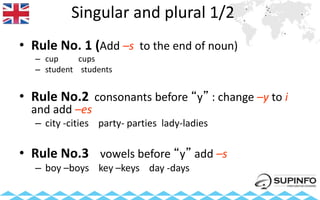
Singular and plural 1/2
• Rule No. 1 (Add –s to the end of noun)
– cup cups
– student students
• Rule No.2 consonants before “y” : change –y to i
and add –es
– city -cities party- parties lady-ladies
• Rule No.3 vowels before “y” add –s
– boy –boys key –keys day -days
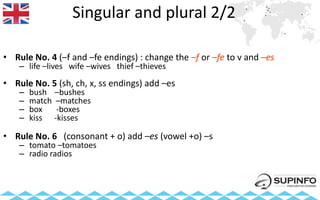
Singular and plural 2/2
• Rule No. 4 (–f and –fe endings) : change the –f or –fe to v and –es
– life –lives wife –wives thief –thieves
• Rule No. 5 (sh, ch, x, ss endings) add –es
– bush –bushes
– match –matches
– box -boxes
– kiss -kisses
• Rule No. 6 (consonant + o) add –es (vowel +o) –s
– tomato –tomatoes
– radio radios
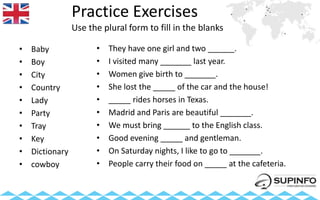
Practice Exercises
Use the plural form to fill in the blanks
• Baby
• Boy
• City
• Country
• Lady
• Party
• Tray
• Key
• Dictionary
• cowboy
• They have one girl and two ______.
• I visited many _______ last year.
• Women give birth to _______.
• She lost the _____ of the car and the house!
• _____ rides horses in Texas.
• Madrid and Paris are beautiful _______.
• We must bring ______ to the English class.
• Good evening _____ and gentleman.
• On Saturday nights, I like to go to _______.
• People carry their food on _____ at the cafeteria.
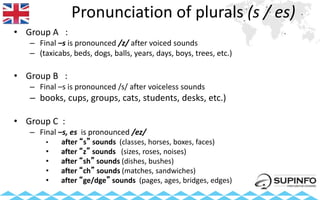
Pronunciation of plurals (s / es)
• Group A :
– Final –s is pronounced /z/ after voiced sounds
– (taxicabs, beds, dogs, balls, years, days, boys, trees, etc.)
• Group B :
– Final –s is pronounced /s/ after voiceless sounds
– books, cups, groups, cats, students, desks, etc.)
• Group C :
– Final –s, es is pronounced /ez/
• after “s” sounds (classes, horses, boxes, faces)
• after “z” sounds (sizes, roses, noises)
• after “sh” sounds (dishes, bushes)
• after “ch” sounds (matches, sandwiches)
• after “ge/dge” sounds (pages, ages, bridges, edges)
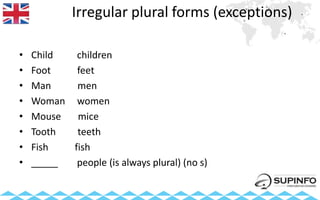
Irregular plural forms (exceptions)
• Child children
• Foot feet
• Man men
• Woman women
• Mouse mice
• Tooth teeth
• Fish fish
• _____ people (is always plural) (no s)
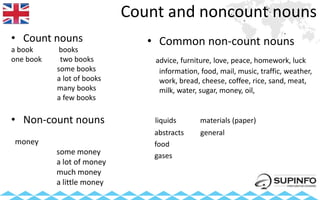
Count and noncount nouns
• Count nouns
a book books
one book two books
some books
a lot of books
many books
a few books
• Non-count nouns
money
some money
a lot of money
much money
a little money
• Common non-count nouns
advice, furniture, love, peace, homework, luck
information, food, mail, music, traffic, weather,
work, bread, cheese, coffee, rice, sand, meat,
milk, water, sugar, money, oil,
liquids materials (paper)
abstracts general
food
gases
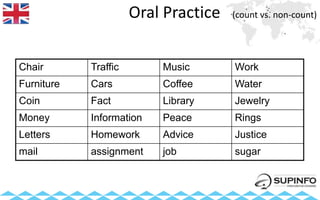
Oral Practice (count vs. non-count)
Chair Traffic Music Work
Furniture Cars Coffee Water
Coin Fact Library Jewelry
Money Information Peace Rings
Letters Homework Advice Justice
mail assignment job sugar
VERB TENSES
English lesson 1
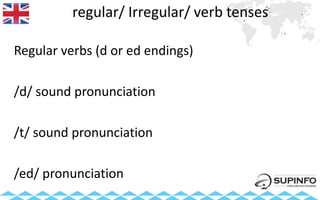
regular/ Irregular/ verb tenses
Regular verbs (d or ed endings)
/d/ sound pronunciation
/t/ sound pronunciation
/ed/ pronunciation
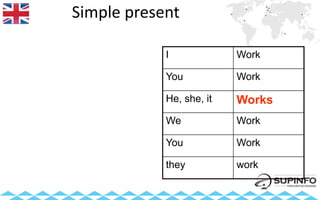
Simple present
I Work
You Work
He, she, it Works
We Work
You Work
they work
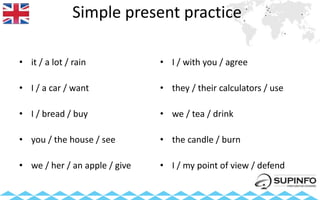
Simple present practice
• it / a lot / rain
• I / a car / want
• I / bread / buy
• you / the house / see
• we / her / an apple / give
• I / with you / agree
• they / their calculators / use
• we / tea / drink
• the candle / burn
• I / my point of view / defend
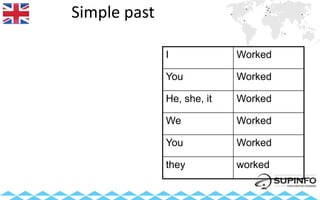
Simple past
I Worked
You Worked
He, she, it Worked
We Worked
You Worked
they worked
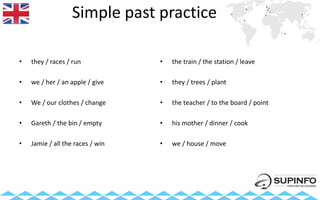
Simple past practice
• they / races / run
• we / her / an apple / give
• We / our clothes / change
• Gareth / the bin / empty
• Jamie / all the races / win
• the train / the station / leave
• they / trees / plant
• the teacher / to the board / point
• his mother / dinner / cook
• we / house / move
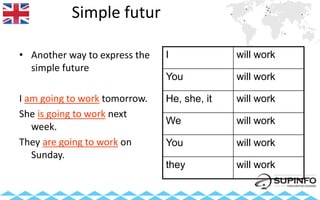
Simple futur
• Another way to express the
simple future
I am going to work tomorrow.
She is going to work next
week.
They are going to work on
Sunday.
I will work
You will work
He, she, it will work
We will work
You will work
they will work
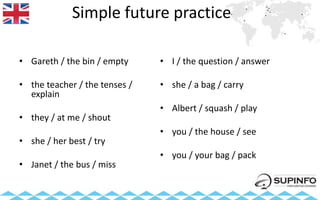
Simple future practice
• Gareth / the bin / empty
• the teacher / the tenses /
explain
• they / at me / shout
• she / her best / try
• Janet / the bus / miss
• I / the question / answer
• she / a bag / carry
• Albert / squash / play
• you / the house / see
• you / your bag / pack
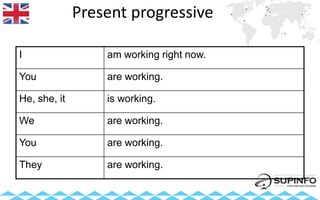
Present progressive
I am working right now.
You are working.
He, she, it is working.
We are working.
You are working.
They are working.
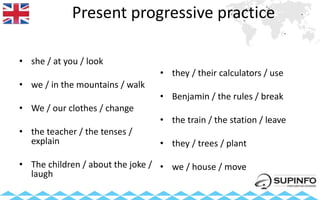
Present progressive practice
• she / at you / look
• we / in the mountains / walk
• We / our clothes / change
• the teacher / the tenses /
explain
• The children / about the joke /
laugh
• they / their calculators / use
• Benjamin / the rules / break
• the train / the station / leave
• they / trees / plant
• we / house / move
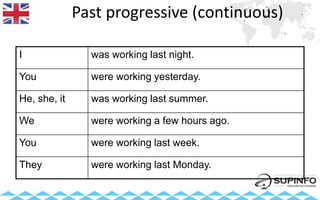
Past progressive (continuous)
I was working last night.
You were working yesterday.
He, she, it was working last summer.
We were working a few hours ago.
You were working last week.
They were working last Monday.
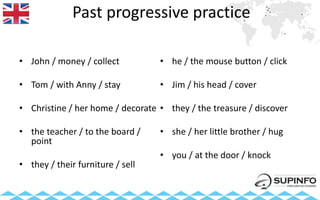
Past progressive practice
• John / money / collect
• Tom / with Anny / stay
• Christine / her home / decorate
• the teacher / to the board /
point
• they / their furniture / sell
• he / the mouse button / click
• Jim / his head / cover
• they / the treasure / discover
• she / her little brother / hug
• you / at the door / knock
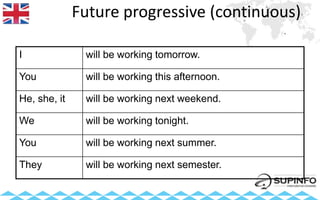
Future progressive (continuous)
I will be working tomorrow.
You will be working this afternoon.
He, she, it will be working next weekend.
We will be working tonight.
You will be working next summer.
They will be working next semester.
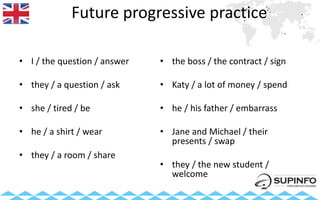
Future progressive practice
• I / the question / answer
• they / a question / ask
• she / tired / be
• he / a shirt / wear
• they / a room / share
• the boss / the contract / sign
• Katy / a lot of money / spend
• he / his father / embarrass
• Jane and Michael / their
presents / swap
• they / the new student /
welcome
AT, ON AND IN
English lesson 1
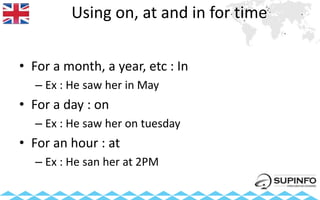
Using on, at and in for time
• For a month, a year, etc : In
– Ex : He saw her in May
• For a day : on
– Ex : He saw her on tuesday
• For an hour : at
– Ex : He san her at 2PM
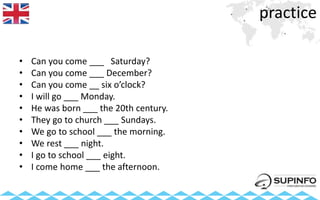
practice
• Can you come ___ Saturday?
• Can you come ___ December?
• Can you come __ six o’clock?
• I will go ___ Monday.
• He was born ___ the 20th century.
• They go to church ___ Sundays.
• We go to school ___ the morning.
• We rest ___ night.
• I go to school ___ eight.
• I come home ___ the afternoon.
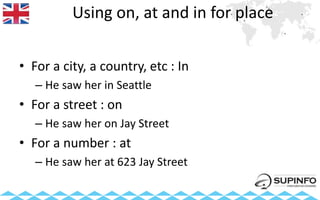
Using on, at and in for place
• For a city, a country, etc : In
– He saw her in Seattle
• For a street : on
– He saw her on Jay Street
• For a number : at
– He saw her at 623 Jay Street
Practice
• He lives ___ my street.
• He lives ___ 2054 Main Street.
• Can you meet me ___ the corner?
• The apartment is ___ the fifth floor.
• The security man was ___ the gate.
• The game started after the players were ___ the field.
• The desk is ___ the front.
• When will you be ___ California?
• They visited friends ___ Rome.
More practice
• They go home ___ the afternoon.
• She saw him ___ school.
• Everyone is happy ___ Friday.
• The book was ___ the sidewalk.
• The date changes ___ midnight.
• What do teachers do ___ summer?
• It is nice ___ home.
• They eat lunch ___ noon every day.
• It’s cold ___ winter.
• School ends ___ 3:15.
PRONOUNS
Ensligh Lesson 1
PRONOUNS: Personal pronouns
• Pronouns can be used as subjects.
• They can also be used as direct objects.
Subject form
• I - You He/she/it We – You - They
• Examples:
– I am eating an apple
– They are watching television
Subject form practice
• Replace the nouns with a pronoun (subject form)
– (Jenny and Max) __________ will be late for school.
– I bought a new car. ____________ is French.
– My name is Tom. _______ am your English teacher.
– (James and I) _____ have already seen this movie.
– (James) ________ didn’t like it.
– I have a cat. _______ is brown.
Object form
• Me - You - Him, Her, It Us - You - Them
• Examples:
– He told me that he expected to be late.
– Are you going with him to the party?
– I will ask them if they like Italian food before
booking the restaurant.
Object form practice
• Complete for following sentences :
– I am going shopping. Would you like to come with
__________.
– My girlfriend likes music. I just bought this CD for
____________.
– I love this watch! Would you buy it for ______________?
– It’s my parents’ anniversary. I bought ____________ a
present.
– Caroline and I are also leaving tomorrow morning. Do you
want __________ to give you a ride to the airport?
PRACTICE EXERCISES
English lesson 1
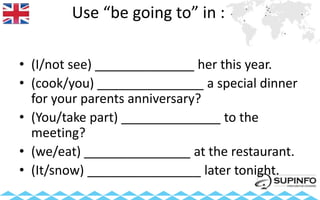
Use “be going to” in :
• (I/not see) ______________ her this year.
• (cook/you) _______________ a special dinner
for your parents anniversary?
• (You/take part) ______________ to the
meeting?
• (we/eat) _______________ at the restaurant.
• (It/snow) ________________ later tonight.
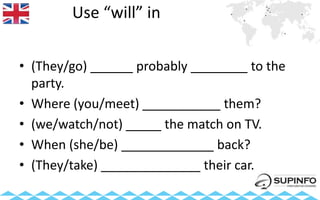
Use “will” in
• (They/go) ______ probably ________ to the
party.
• Where (you/meet) ___________ them?
• (we/watch/not) _____ the match on TV.
• When (she/be) _____________ back?
• (They/take) ______________ their car.
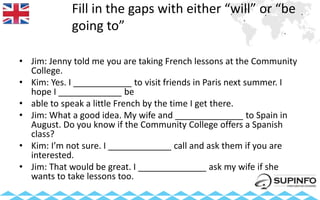
Fill in the gaps with either “will” or “be
going to”
• Jim: Jenny told me you are taking French lessons at the Community
College.
• Kim: Yes. I ____________ to visit friends in Paris next summer. I
hope I _____________ be
• able to speak a little French by the time I get there.
• Jim: What a good idea. My wife and ______________ to Spain in
August. Do you know if the Community College offers a Spanish
class?
• Kim: I’m not sure. I _____________ call and ask them if you are
interested.
• Jim: That would be great. I ______________ ask my wife if she
wants to take lessons too.
Anglais - 01   beginners - lesson 1

Anglais - 01 beginners - lesson 1

  • 1.
    English Language –Beginners Lesson 1 Version 1.0 Dernière Mise à Jour : 28/12/2011
  • 2.
    Lesson objectives • Reviewsome fundamentals about english – Singular and plurals – Verb tenses – Using At, on and in – Pronouns
  • 3.
  • 4.
    Singular and plural1/2 • Rule No. 1 (Add –s to the end of noun) – cup cups – student students • Rule No.2 consonants before “y” : change –y to i and add –es – city -cities party- parties lady-ladies • Rule No.3 vowels before “y” add –s – boy –boys key –keys day -days
  • 5.
    Singular and plural2/2 • Rule No. 4 (–f and –fe endings) : change the –f or –fe to v and –es – life –lives wife –wives thief –thieves • Rule No. 5 (sh, ch, x, ss endings) add –es – bush –bushes – match –matches – box -boxes – kiss -kisses • Rule No. 6 (consonant + o) add –es (vowel +o) –s – tomato –tomatoes – radio radios
  • 6.
    Practice Exercises Use theplural form to fill in the blanks • Baby • Boy • City • Country • Lady • Party • Tray • Key • Dictionary • cowboy • They have one girl and two ______. • I visited many _______ last year. • Women give birth to _______. • She lost the _____ of the car and the house! • _____ rides horses in Texas. • Madrid and Paris are beautiful _______. • We must bring ______ to the English class. • Good evening _____ and gentleman. • On Saturday nights, I like to go to _______. • People carry their food on _____ at the cafeteria.
  • 7.
    Pronunciation of plurals(s / es) • Group A : – Final –s is pronounced /z/ after voiced sounds – (taxicabs, beds, dogs, balls, years, days, boys, trees, etc.) • Group B : – Final –s is pronounced /s/ after voiceless sounds – books, cups, groups, cats, students, desks, etc.) • Group C : – Final –s, es is pronounced /ez/ • after “s” sounds (classes, horses, boxes, faces) • after “z” sounds (sizes, roses, noises) • after “sh” sounds (dishes, bushes) • after “ch” sounds (matches, sandwiches) • after “ge/dge” sounds (pages, ages, bridges, edges)
  • 8.
    Irregular plural forms(exceptions) • Child children • Foot feet • Man men • Woman women • Mouse mice • Tooth teeth • Fish fish • _____ people (is always plural) (no s)
  • 9.
    Count and noncountnouns • Count nouns a book books one book two books some books a lot of books many books a few books • Non-count nouns money some money a lot of money much money a little money • Common non-count nouns advice, furniture, love, peace, homework, luck information, food, mail, music, traffic, weather, work, bread, cheese, coffee, rice, sand, meat, milk, water, sugar, money, oil, liquids materials (paper) abstracts general food gases
  • 10.
    Oral Practice (countvs. non-count) Chair Traffic Music Work Furniture Cars Coffee Water Coin Fact Library Jewelry Money Information Peace Rings Letters Homework Advice Justice mail assignment job sugar
  • 11.
  • 12.
    regular/ Irregular/ verbtenses Regular verbs (d or ed endings) /d/ sound pronunciation /t/ sound pronunciation /ed/ pronunciation
  • 13.
    Simple present I Work YouWork He, she, it Works We Work You Work they work
  • 14.
    Simple present practice •it / a lot / rain • I / a car / want • I / bread / buy • you / the house / see • we / her / an apple / give • I / with you / agree • they / their calculators / use • we / tea / drink • the candle / burn • I / my point of view / defend
  • 15.
    Simple past I Worked YouWorked He, she, it Worked We Worked You Worked they worked
  • 16.
    Simple past practice •they / races / run • we / her / an apple / give • We / our clothes / change • Gareth / the bin / empty • Jamie / all the races / win • the train / the station / leave • they / trees / plant • the teacher / to the board / point • his mother / dinner / cook • we / house / move
  • 17.
    Simple futur • Anotherway to express the simple future I am going to work tomorrow. She is going to work next week. They are going to work on Sunday. I will work You will work He, she, it will work We will work You will work they will work
  • 18.
    Simple future practice •Gareth / the bin / empty • the teacher / the tenses / explain • they / at me / shout • she / her best / try • Janet / the bus / miss • I / the question / answer • she / a bag / carry • Albert / squash / play • you / the house / see • you / your bag / pack
  • 19.
    Present progressive I amworking right now. You are working. He, she, it is working. We are working. You are working. They are working.
  • 20.
    Present progressive practice •she / at you / look • we / in the mountains / walk • We / our clothes / change • the teacher / the tenses / explain • The children / about the joke / laugh • they / their calculators / use • Benjamin / the rules / break • the train / the station / leave • they / trees / plant • we / house / move
  • 21.
    Past progressive (continuous) Iwas working last night. You were working yesterday. He, she, it was working last summer. We were working a few hours ago. You were working last week. They were working last Monday.
  • 22.
    Past progressive practice •John / money / collect • Tom / with Anny / stay • Christine / her home / decorate • the teacher / to the board / point • they / their furniture / sell • he / the mouse button / click • Jim / his head / cover • they / the treasure / discover • she / her little brother / hug • you / at the door / knock
  • 23.
    Future progressive (continuous) Iwill be working tomorrow. You will be working this afternoon. He, she, it will be working next weekend. We will be working tonight. You will be working next summer. They will be working next semester.
  • 24.
    Future progressive practice •I / the question / answer • they / a question / ask • she / tired / be • he / a shirt / wear • they / a room / share • the boss / the contract / sign • Katy / a lot of money / spend • he / his father / embarrass • Jane and Michael / their presents / swap • they / the new student / welcome
  • 25.
    AT, ON ANDIN English lesson 1
  • 26.
    Using on, atand in for time • For a month, a year, etc : In – Ex : He saw her in May • For a day : on – Ex : He saw her on tuesday • For an hour : at – Ex : He san her at 2PM
  • 27.
    practice • Can youcome ___ Saturday? • Can you come ___ December? • Can you come __ six o’clock? • I will go ___ Monday. • He was born ___ the 20th century. • They go to church ___ Sundays. • We go to school ___ the morning. • We rest ___ night. • I go to school ___ eight. • I come home ___ the afternoon.
  • 28.
    Using on, atand in for place • For a city, a country, etc : In – He saw her in Seattle • For a street : on – He saw her on Jay Street • For a number : at – He saw her at 623 Jay Street
  • 29.
    Practice • He lives___ my street. • He lives ___ 2054 Main Street. • Can you meet me ___ the corner? • The apartment is ___ the fifth floor. • The security man was ___ the gate. • The game started after the players were ___ the field. • The desk is ___ the front. • When will you be ___ California? • They visited friends ___ Rome.
  • 30.
    More practice • Theygo home ___ the afternoon. • She saw him ___ school. • Everyone is happy ___ Friday. • The book was ___ the sidewalk. • The date changes ___ midnight. • What do teachers do ___ summer? • It is nice ___ home. • They eat lunch ___ noon every day. • It’s cold ___ winter. • School ends ___ 3:15.
  • 31.
  • 32.
    PRONOUNS: Personal pronouns •Pronouns can be used as subjects. • They can also be used as direct objects.
  • 33.
    Subject form • I- You He/she/it We – You - They • Examples: – I am eating an apple – They are watching television
  • 34.
    Subject form practice •Replace the nouns with a pronoun (subject form) – (Jenny and Max) __________ will be late for school. – I bought a new car. ____________ is French. – My name is Tom. _______ am your English teacher. – (James and I) _____ have already seen this movie. – (James) ________ didn’t like it. – I have a cat. _______ is brown.
  • 35.
    Object form • Me- You - Him, Her, It Us - You - Them • Examples: – He told me that he expected to be late. – Are you going with him to the party? – I will ask them if they like Italian food before booking the restaurant.
  • 36.
    Object form practice •Complete for following sentences : – I am going shopping. Would you like to come with __________. – My girlfriend likes music. I just bought this CD for ____________. – I love this watch! Would you buy it for ______________? – It’s my parents’ anniversary. I bought ____________ a present. – Caroline and I are also leaving tomorrow morning. Do you want __________ to give you a ride to the airport?
  • 37.
  • 38.
    Use “be goingto” in : • (I/not see) ______________ her this year. • (cook/you) _______________ a special dinner for your parents anniversary? • (You/take part) ______________ to the meeting? • (we/eat) _______________ at the restaurant. • (It/snow) ________________ later tonight.
  • 39.
    Use “will” in •(They/go) ______ probably ________ to the party. • Where (you/meet) ___________ them? • (we/watch/not) _____ the match on TV. • When (she/be) _____________ back? • (They/take) ______________ their car.
  • 40.
    Fill in thegaps with either “will” or “be going to” • Jim: Jenny told me you are taking French lessons at the Community College. • Kim: Yes. I ____________ to visit friends in Paris next summer. I hope I _____________ be • able to speak a little French by the time I get there. • Jim: What a good idea. My wife and ______________ to Spain in August. Do you know if the Community College offers a Spanish class? • Kim: I’m not sure. I _____________ call and ask them if you are interested. • Jim: That would be great. I ______________ ask my wife if she wants to take lessons too.

Editor's Notes

  • #2 Sources : English Grammar – The Matrix by Aníbal Muñoz At, On, In by D. Fisher