154
Objectives
Grammar
Indefinite article, definite article and no article
Reading
Reading about hobbies
Listening
Listening to a student talking about a hobby
Speaking
Describing a process
Writing
Writing instructions using linking words
LESSON 1 SB page 12
Outcomes
•	To ask and answer about hobbies
•	To read a web page about hobbies and answer
questions
Before using the book:
•	 Write Hobbies and crafts on the board and ask
students to elicit the meaning of crafts.
•	 Divide the class into an even number of small
groups. Ask half of the groups to write a list of
crafts, and the other half to write a list of hobbies.
•	 Students make their lists. Stop them after a few
minutes and ask each group to read out their list.
Write their ideas on the board under the headings
hobbies or crafts.
•	 Ask students to tell their partner about one hobby
or craft they enjoy doing, and one hobby or craft
which they don’t like. Invite different students to
tell the class about their partner.
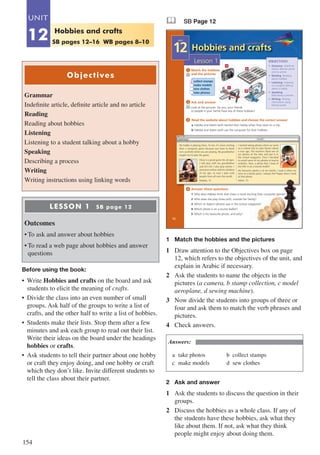
& SB Page 12
12
Read the website about hobbies and choose the correct answer
a Habiba and Adam both started their hobby when they were on a trip.
b Habiba and Adam both use the computer for their hobbies.
Match the hobbies
and the pictures
1
3
Lesson 1
Hobbies and crafts
2 Ask and answer
Look at the pictures. Do you, your friends
or people in your family have any of these hobbies?
UNIT
12
collect stamps
make models
sew clothes
take photos
My hobby is playing chess. To me, it’s more exciting
than a computer game because you have to think
very carefully while you are playing. My grandfather
taught me to play the game.
I started taking photos when we went
on a school trip to Lake Nasser about
a year ago. The teachers liked one of
my photos of the lake and put it in
the school magazine. Then I decided
to email some of my photos to tourist
websites. Now, a photo that I took of
the Nile is on a tourist leaflet!
OBJECTIVES
• Grammar Indefinite
article, definite article
and no article
• Reading Reading
about hobbies
• Listening Listening
to a student talking
about a hobby
• Speaking
Describing a process
• Writing Writing
instructions using
linking words
a
b
c
d
Chess is a great game for all ages.
I still play with my grandfather
and he’s 65! I also play online. I
joined an online club for children
of my age, so now I play with
people from all over the world.
Habiba, 14
My favourite photo is of my family. I took it when we
were at a family party. I always feel happy when I look
at that photo.
Adam, 15
Answer these questions
1 Why does Habiba think that chess is more exciting than computer games?
2 Who does she play chess with, outside her family?
3 Which of Adam’s photos was in the school magazine?
4 Which photo is on a tourist leaflet?
5 Which is his favourite photo, and why?
4
b
1	 Match the hobbies and the pictures
1	 Draw attention to the Objectives box on page
12, which refers to the objectives of the unit, and
explain in Arabic if necessary.
2	 Ask the students to name the objects in the
pictures (a camera, b stamp collection, c model
aeroplane, d sewing machine).
3	 Now divide the students into groups of three or
four and ask them to match the verb phrases and
pictures.
4	 Check answers.
Answers:
a	take photos				b	collect stamps
c	 make models			 d	 sew clothes
2	 Ask and answer
1	 Ask the students to discuss the question in their
groups.
2	 Discuss the hobbies as a whole class. If any of
the students have these hobbies, ask what they
like about them. If not, ask what they think
people might enjoy about doing them.
UNIT
12 Hobbies and crafts
SB pages 12–16 WB pages 8–10
155
Answers:
Students’ own answers
3	 Read the website about hobbies and choose 	
	 the correct answer
1	 Ask the students to look at the pictures and say
what they think the people’s hobbies are.
2	 Then ask them to scan the text quickly to check
their ideas (Habiba likes playing chess and
Adam likes taking photos).
3	 The students then read the texts more carefully
and choose the correct answer.
4	 Check the answer as a class.
Answers:
b
4	 Answer these questions
1	 Ask the students to read the questions and find
the answers in the text.
2	 Ask them to compare their answers with a
partner.
3	 Invite different students to answer the questions
and then read out the part of the text where they
found the answer.
4	 Ask the students whether there are any other
words in the text they don’t know and encourage
them to try to work out the meaning from the
context.
5	 Ask whether any of the students play chess or
enjoy other board or strategy games. Ask what
they like/don’t like about playing chess/board
games.
Answers:
1	 Because you have to think very carefully while 		
	 you are playing.
2	 She plays with people from all over the world, 		
	online.
3	 A photo of Lake Nasser
4	 A photo of the Nile
5	 It is a photo of his family because he always 			
	 feels happy when he looks at it.
L E S S O N 2 S B p a g e 1 3 W B p a g e 8
Outcomes
•	To use indefinite, definite or no article
•	To ask and answer about hobbies
& SB Page 13
I’ve got 1 …..……. sewing machine that I use to make
2 …..……. clothes. The first thing I made was 3 …..…….
jacket. 4 …..……. jacket is made of 5 …..……. cotton.
Lesson 2
Choose the correct article. Sometimes no article is needed.
1 My hobby is playing the / - chess.
2 My grandfather taught me to play a / the game.
3 I started taking the / - photos when we
went on a / the school trip.
4 It was to the / - Lake Nasser.
5 A photo that I took of the / - Nile is on a tourist leaflet!
Indefinite article, definite article and no article
• We use the indefinite article a / an with countable nouns when we talk
about something for the first time:
I’ve got a new camera. Have you ever had an operation?
• We don’t use indefinite articles before uncountable nouns or plural nouns:
Fish is my favourite food. I’m wearing black shoes.
• We use the definite article the when we have already talked about
something, or if we know which thing we are talking about:
The fish which we had for dinner last night was delicious.
I’m wearing the black shoes I bought yesterday.
• We also use the when there is only one (in the world or in a place):
the earth, the Nile, the school magazine
• We do not usually use the with the names of countries, lakes or mountains:
Egypt, Lake Nasser, Mount Sinai
Complete the texts with a / an, the or no article (-)
Ask and answer about
hobbies. Listen carefully.
Is your partner using
articles correctly?
12
UNIT
1
2
a
3
GRAMMARBOX
Workbook page 8
a
13
I enjoy making 6 …..……. model planes and boats. The
first model I finished was 7 …..……. boat that can float on
water. I took it with me when we went to 8 …..……. river
one day for 9 …..……. picnic. It was 10 …..……. windy day, so
11 …..……. boat sailed very quickly across 12 …..……. river!
b
Yes, I do. I have an
interesting computer
game about maths.
Do you like playing
computer games?
1	 Choose the correct article. Sometimes no 		
	 article is needed.
1	 Ask the students to look at the example. Ask
what they think the rule might be (We don’t use
an article with games or hobbies if they are
uncountable nouns.).
2	 Tell them to copy the rest of the sentences into
their copybooks and choose the option they think
is correct.
3	 Check answers. Then ask the students to work in
small groups to discuss what they think the rule
is for each sentence.
4	 Invite the students to share their ideas, and then
refer them to the Grammar box to check.
5	 Finally, ask them to find an example of each rule
in sentences 1–5 (rule 1 = a school trip; rule 2
= chess, photos; rule 3 = the game (referring to
156
chess); rule 4 = the Nile; rule 5 = Lake Nasser).
6	 Ask the students to work in their groups to think
of two more examples for each rule. Invite them
to share their ideas, and ask the rest of the class
to say whether they agree or not.
Answers:
2	the			3	-, a			4	-			5	the
2	 Complete the texts with a/an, the or no 		
	 article (-)
1	 Ask the students what the people in the pictures
are doing (sewing and playing with a model
boat).
2	 Ask the students to look at the example and
elicit why the indefinite article is used (because
sewing machine is a countable noun which we
are hearing about for the first time).
3	 Ask the students to work in pairs to complete
the text. Ask them to think carefully about which
rule to apply. Remind them to use the Grammar
box to help them decide.
4	 Check the answers as a class. Ask students to
explain which rule is applied in each case.
Answers:
2	-			3	a			4	The			 5	-			6	-	
7	a			8	a			9	a				10	a			11 the
12 the
3	 Ask and answer about hobbies. Listen 	
	 carefully. Is your partner using articles 		
	correctly?
1	 Ask the students to read the example question
and answer in the speech bubbles.
2	 Ask them to think of three hobbies or crafts to
ask their partner about.
3	 Students work in pairs to ask and answer their
questions. Ask them to listen and check whether
their partner is using articles correctly. Go round
and monitor, helping where necessary.
4	 Invite different pairs of students to ask and
answer questions for the rest of the class to listen
and check their use of articles.
Answers:
Students’ own answers
✎ WB Page 8
Hobbies and crafts
1 Read and match to make hobbies
1 d collect a clothes
2 play b photos
3 take c chess
4 sew d stamps
2 Listen and answer the questions
1 What is the girl’s hobby?
2 What did her mother buy her a year ago?
3 What was the first thing the girl made?
3 Read and correct the mistakes in these sentences
1 Do you like playing the computer games?
Do you like playing computer games?
2 My uncle has a house that is near Nile.
3 Mona’s favourite place is Egyptian Museum.
4 Cairo is a biggest city in Egypt.
5 Scientists have found a new animal that lives in the Brazil.
4 Choose the correct words
Module4
UNIT
12
Chess is 1 an / the / - ancient game. 2 A / The / - first
game of chess was probably played in 3 an / the /- India
in around 500 CE. 4 A / The / - hundred years later, it was
popular with 5 a / the / - King of Iran.
6 A / The / - game was soon played in North Africa. In
around 1000 CE, 7 a / the / - travellers took chess around
8 a / the / - world. By 1400 CE, people began to write the
rules for 9 a / the / - famous game which we know today.
8
1	 Read and match to make hobbies
1	 Elicit the hobbies that the students have learned
about in the lesson.
2	 The students then complete the exercise
individually and then check their answers in
pairs.
3	 Check the answers as a whole class.
Answers:
2	c			 3	b			 4	a
2 	 Listen and answer the following questions
1	 Ask the students to read the questions before you
play the tape.
2	 Play the tape twice and ask students to answer
the questions.
3	 Let them compare their answers with a partner
before you check the answers with the whole
class.
157
	 Tapescript
Girl:	 My hobby is sewing clothes. My mother 	
	 bought me a sewing machine last year. 	
	 The first thing I made was a hat for my 	
	brother.

Answers:
a	 sewing clothes			 b	 a sewing machine			
c	 a hat for her brother
3	 Read and correct the mistakes in these 		
	sentences
1	 With books closed, write sentence 1 on the board
and ask the students to say what is wrong with
it. Then ask them to open their books, read the
example answer in exercise 3 and check whether
they were correct.
2	 The students complete the exercise in pairs.
Then invite different students to read out the
corrected sentences.
Answers:
2	 My uncle has a house that is near the Nile.
3	 Mona’s favourite place is the Egyptian Museum.
4	 Cairo is the biggest city in Egypt.
5	 Scientists have found a new animal that lives in 		
	Brazil.
4	 Choose the correct words
1	 Ask the students what they know about the game
of chess. Tell them that they are going to find out
more about it.
2	 Refer students to the text. Ask why an is
circled in the first sentence (because ‘game’is
a countable noun and this is the first time it is
mentioned in the text. We use an before ancient
because ancient starts with a vowel sound.).
Then ask them to work in pairs to complete the
exercise.
3	 Check the answers as a whole class.
Answers:
2	The			3	-			4	A				5	the					
6	The			7	-			8	the			9	the
LESSON 3 SB page 14
Outcomes
•	To talk about collecting things
•	To listen to Tarek talking about his hobby
•	To describe a process
•	To carry out an internet search about the use of
stamps
& SB Page 14
14
12
UNIT
Lesson 3
Ask and answer
1 What kind of things do people sometimes
collect?
2 Do you collect anything?
3 Where can you keep things that you collect?
Listen again and answer the questions
1 How long has Tarek been collecting stamps?
2 How did he get a lot of stamps at that time?
3 How can you find stamps? Name two ways.
4 How can you get a stamp off an envelope?
5 How can you group the stamps in an album?
Name three ways.
1
3
Work in pairs
1 Think of a hobby, a game or a sport.
2 How do you do, make or play it?
Describe the process to your partner.
Listen to Tarek talking about his
hobby and choose the correct answer
1 Tarek collects ................... .
a letters b stamps c pictures of famous people
2 He keeps what he collects in ................... .
a an envelope b a bag c an album
2
4
FUNCTIONSBOX
The first thing that you have to do is (get
some stamps).
First, (cut the corner of the envelope off).
After that, (put the corner of the
envelope in some cold water).
Then (wait for it to dry).
The next step is (deciding where to put
the stamps).
Finally, I’m going to (put it in my stamp
album).
Describing a process
The first thing that
you have to do is learn to serve.
After that, you have to put the
ball in the right side of the court.
Internet search
When did people start
using stamps?
1	 Ask and answer
1	 Ask the students to look at the picture and
ask what they think it shows (a collection of
stamps and a magnifying glass). Ask Why is the
magnifying glass needed? (to look closely at the
detail of the stamps).
2	 Put the students into small groups to discuss the
questions. Go round and monitor, helping where
necessary.
3	 Invite different groups to talk about what they
discussed. Then ask why they think people enjoy
collecting things.
158
Suggested answers:
1	 coins, stamps, toys, magazines, books
2	 Students’ own answers
3	 in an album, in a cupboard, in your room, etc.
2	 Listen to Tarek talking about his hobby and 	
	 choose the correct answer
1	 Ask the students what they think Tarek’s hobby
might be. Do not confirm their answers at this
point. Tell them that they are going to listen and
find out.
2	 Ask the students to read the questions and
prepare to listen.
3	 Play the recording and then check the answers as
a whole class.
	 Tapescript
Tarek:	 I’ve been collecting stamps for eight years. 	
	 Eight years ago, my uncle was travelling 	
	 around the world for his job. He wrote us 	
	 lots of letters, and I loved looking at the 	
	 stamps. At that time, I didn’t know how many 	
	 different countries there were in the world!
		 It’s an easy hobby to start. The first thing 	
	 that you have to do is get some stamps! I 	
	 usually find them on letters people write 	
	 to me, my friends and family, but there are 	
	 also some shops that sell stamps.
		 If you see an interesting stamp on an 	
	 envelope, first cut the corner of the envelope 	
	 off very carefully.
		 After that, put the corner of the envelope 	
	 with the stamp on it in some cold water. 	
	 After ten minutes, take the stamp off the 	
	 paper carefully, then wait for it to dry.
		 Some people group their stamps by subject, 	
	 for example stamps with animals on them 	
	 or famous people, etc. Some people group 	
	 them by colour. But I prefer grouping them 	
	 by country.
		 The next step is deciding where to put the 	
	 stamps. Look at this interesting stamp. 	
	 It’s one hundred years old and it’s from 	
	 England! Finally, I’m going to put it in my 	
	 stamp album.

Answers:
1	b			 2	c
3	 Listen again and answer the questions
1	 Ask the students to read the questions and ask
them what they remember from Tarek’s talk.
2	 Then play the recording for them to listen and
answer the questions.
3	 Check the answers as a whole class and play the
recording again if necessary.
4	 Ask students whether they think Tarek’s hobby
sounds interesting and whether they’d like to
try it. If there are any students in the group who
collect stamps, ask them to compare what they
do with what Tarek does.
Answers:
1	 He has been collecting stamps for eight years.
2	 His uncle wrote lots of letters to the family.
3	 You can find them on letters or from shops that 		
	 sell stamps.
4	 You cut the corner of the envelope off carefully 		
	 and put it in cold water. After ten minutes, you 		
	 can take the stamp off.
5	 You can group them by subject, by colour or by 		
	country.
4	 Work in pairs
1	 Ask the students to look at the picture and say
what they think the students are playing. Then
ask them to call out some hobbies, games or
sports and write two or three examples on the
board.
2	 Ask confident students to explain what the
hobby entails, or how to play the game or do the
sport.
3	 Then ask them to read the Functions box and
example in the speech bubble.
4	 The students then choose a hobby, game or
sport that they know well and describe it to their
partner, using the phrases in the Functions box.
Go round and monitor, helping where necessary.
5	 Invite different students to describe a process for
the rest of the class to guess which hobby, game
or sport they are talking about.
Answers:
Students’ own answers
159
: Internet search
1	 Ask the students to read the Internet search box.
Ask them to discuss the question in pairs. Then
invite them to share their ideas.
2	 Tell them that they are going to do an internet
search to find out the answer to the question.
3	 Ask students to report back their findings to
the rest of the class. Ask what else they found
out about stamps while they were doing their
research.
L E S S O N 4 S B p a g e 1 5 W B p a g e 9
Outcomes
•	To read a text about Egyptian weaving and
answer questions
•	To use critical thinking skills to discuss
traditional crafts
& SB Page 15
The Wissa Wassef
Art Centre
• A man called Ramses Wissa Wassef started the centre in the
1950s, with his wife Sophie. Ramses wanted people to learn the
traditional Egyptian craft of weaving so that they could produce
beautiful tapestries.
• The first students were twelve boys and girls.The colours for the
wool came from natural dyes.They made these from trees.
• There is a museum at the centre where you can see many of the
first tapestries that the centre produced. Some of the tapestries are
also in museums in other countries.
• Although these first weavers are now grandparents, some of them are still weaving at the
centre, with a new group of children.
Egyptian weaving is very famous all over the world.The Wissa Wassef Art
Centre is in the village of Harraniyya, near Cairo. It teaches children to
design and weave carpets and tapestries.
15
12
UNIT
Lesson 4
Answer these questions
1 Why did Ramses Wissa Wassef
start the centre?
2 Who were the first students?
3 How did they produce different
colours for the wool?
4 What can you see at the
museum?
5 What are the older weavers still
doing at the centre?
2
CRITICAL
THINKING
1 Do you think machines can make
crafts better than human hands?
2 Do you think we need traditional
crafts if machines can make them?
Why? / Why not?
3 Why is it important for some
people to learn traditional
crafts?
3
Workbook page 9
Which of the words in red in the text mean
the following?
1 pictures or designs that are made by weaving ….......…........
2 things that change the colour of a material …..…….
3 people who make carpets or tapestries from wool …..…….
4 an activity in which you make something by hand …..…….
1
tapestries
1	 Which of the words in red in the text mean 	
	 the following?
1	 Ask the students to look at the title of the text
and the pictures. Ask if they know anything
about the Wissa Wassef Art Centre. Ask what
they think the pictures show. Tell them that they
are going to read and find out.
2	 Ask them to read the introductory paragraph.
Ask Do you have Egyptian carpets in your
home? What are they like?
3	 Then ask them to read the rest of the text. Ask
Would you like to visit the centre? Would you like
to make a carpet?
4	 Ask the students to look at exercise 1 and read
the first definition. Point out the words in red in
the text and explain that they have to match the
rest of the definitions with the words. Remind
them to read the context carefully to help them
decide.
5	 Check answers.
Answers:
2	dyes			3	weavers			4	craft
2	 Answer these questions
1	 Ask the students to read the questions and
discuss them in pairs before reading the text
again.
2	 They then read the text carefully to check their
answers. Remind them not to worry about any
words they don’t know at this point.
3	 Check answers as a class.
4	 Ask what colours can be made from natural dyes
(most colours).
Answers:
1	 He wanted people to learn the traditional 				
	 Egyptian craft of weaving so they could produce 	
	 beautiful tapestries.
2	 They were twelve boys and girls.
3	 They used natural dyes from trees.
4	 You can see many of the first tapestries that 			
	 were made at the centre.
5	 They are still weaving with a new group of 			
	children.
160
3	 Critical thinking
1	 Ask the students to read the questions in the
Critical thinking box. Divide them into small
groups to discuss them.
2	 Go round and monitor, helping where necessary.
3	 Invite the groups to share their ideas and have a
short class discussion about the importance of
traditional crafts. Ask the students whether they
do any traditional crafts or what they would like
to try. Ask which other places they know about
where they could try traditional crafts.
Answers:
1	 Students’ own answers
2	 Suggested: It is important to continue traditional 	
	 crafts because they are part of our culture.
3	 Students’ own answers
✎ WB Page 9
1 Choose the correct answer from a, b, c or d
1 In many houses, people put on the floors.
a albums b carpets c weaving d stamps
2 Do you like games like chess, or new games like computer games?
a noisy b important c traditional d favourite
3 I need to buy some so I can send these letters to my cousins.
a leaflets b albums c labels d stamps
4 The made the shirt a beautiful red colour.
a paint b dye c pen d pencil
5 People like to visit the art and craft in the village of Harraniyya.
a leaflet b weaver c material d centre
2 Answer the questions
1 What hobbies do you like doing?
2 Do you prefer playing sports or watching sports? Why?
3 Complete the dialogue
Mohamed: How do we fly this kite, Nur?
Nur: 1 The first thing you have to
do is find a place without too
many trees.
Mohamed: OK. Here’s a good place. What
next?
Nur: 2 that, put
the kite down.
Mohamed: I see.
Nur: 3 , wait for
the wind. The 4 step is to pull the kite into the wind.
Mohamed: Look! The kite is 5 !
4 Read and correct the underlined words
1 I’ve never had the operation before.
2 Sameh colored his jeans with a natural blue craft.
3 Stamps are pictures or designs that are made by weaving.
4 My mum is a great reader. She makes the best hand-made carpets!
UNIT
12
9
Module4
1	 Choose the correct answer from a, b, c or d
1	 Ask the students to call out any of the new words
they have learned in the lesson.
2	 Then ask them to look at the example and
complete the rest of the exercise in the same
way, choosing the correct answer.
3	 Check the answers as a whole class.
Answers:
2	c			 3	d			 4	b			 5	d
2	 Answer the questions
1	 Ask the students to read the questions and invite
them to answer orally.
2	 The students then write their answers before
comparing them with a partner.
3	 Invite different students to read out their
answers.
Answers:
Students’ own answers
3	 Complete the dialogue
1	 Elicit phrases for sequencing events, used to
describe a process (e.g., first, then etc.).
2	 Ask the students to look at the picture and elicit
the process of flying a kite.
3	 The students then complete the sentences using
the phrases in the box.
4	 Check answers as a class.
Answers:
2	After			3	Then			4	next			5	flying
4	 Read and correct the underlined words
1	 Read the first sentence with the students and ask
them why the is uncorrect here. (Operation is
countable and singular, and we are talking about
it for the first time, so we need the indefinite
article an.)
2	 Ask students to work alone to correct the other
sentences.
3	 Have them compare their answers with a partner
before checking the answers as a class.
Answers:
2	dye			3	tapestries			4	weaver
161
REVIEW S B p a g e 1 6 W B p a g e 1 0
Outcomes
•	To review and practise the vocabulary and
structures of the unit
•	To practise using articles
•	To practise using sequencing words
•	To practise using linking words although,
because and so
Before using the book:
•	 Write Hobbies and crafts on the board and
ask the students what they have learned in this
unit. Brainstorm a list of topics, vocabulary and
grammar points.
•	 Tell the students that they are now going to
complete the review section for this unit, to see
what they can remember.
& SB Page 16
Writing skills
Use the linking word although to give a contrasting idea or view:
I like making my own clothes although sewing takes a long time.
Use because to give a reason:
I’m not going to school today because it’s Friday.
Use so to talk about a consequence or result:
It is very hot today, so I’m going to stay at home.
Now you can …
• use words to talk about hobbies
• use indefinite articles, definite articles or no article
• describe a process
Choose the correct words
Complete the text with these words
album
craft
model
sew
After
Finally
first
next
Then
Complete the sentences with these words1
2
3
Workbook page 10
16
12
UNIT
Review
1 Can you …..……. your own clothes?
2 Their cousin’s favourite hobby is making …..……. planes.
3 My grandparents keep their family pictures in a photo …..……. .
4 Tapestry is a traditional Egyptian …..……. .
My friends and I have started a book club. The 1 …..……. thing you have
to do is choose a time and a place to meet. The 2 …..……. step is deciding
on a book to read. 3 …..……. that, read the book at home. 4 …..…….,
when you’ve all read the book, meet to discuss it. 5 …..……., choose the
next book to read!
I started collecting 1 a / the / - coins when I was about ten years old.
2 A / The / - first coin I kept was 3 an / the / - old coin from 1900. I found
it when we were having 4 a / the / - picnic by 5 an / the / - Nile. It has
6 an / the / - interesting picture on it of 7 an / the / - animal. Now I keep my
coins in 8 an / the / - album. I also go to a coin collecting club at school.
A boy in the club has 9 an / the / - coins from 10 an / the / - China!
first
sew
1	 Complete the sentences with these words
1	 Elicit the words connected with hobbies and
crafts that the students have studied in the unit.
Then ask the students to provide definitions for
the words in the box.
2	 Students then complete each sentences with a
word from the box.
3	 Invite different students to read out the
completed sentences.
Answers:
2	model			3	album			4	craft
2	 Choose the correct words
1	 Elicit the rules for using the definite, indefinite
or no article. Ask the students to provide some
example phrases or sentences.
2	 Then ask them to look at the example and ask a
confident student to explain why no article is the
correct answer (because ‘coins’is a plural noun
and it’s not talking about particular coins).
3	 The students complete the exercise individually
and check their answers in pairs. Then check the
answers as a whole class.
Answers:
2	The			3	an			4	a			5	the			6	an
7	an				8	an			9	-			10	-
3	 Complete the text with these words
1	 Elicit the sequencing words which can be used
to describe a process.
2	 The students then complete the text using the
words in the box.
3	 Check the answers as a whole class.
Answers:
2	next		 3	After		 4	Then		 5	Finally
Writing skills
1	 Write the three example sentences on the board,
leaving a space for the linking words. Ask the
students to suggest words which might fit in the
spaces.
2	 Then ask them to read the Writing skills box and
check their ideas.
3	 Then ask them to offer further examples of
sentences using although, because and so.
162
✎ WB Page 10
1 Listen and answer the following questions
1 What did Ramses Wassef start?
2 When did he start it?
3 Why did he want to teach people how to weave?
2 Complete the sentences with although, because or so
1 We went to the beach on Saturday although it was cold and cloudy.
2 Dina went to bed very early last night she was very tired.
3 Miss Heba was ill today, Miss Nadia took our English lesson.
4 Ola loves playing tennis she is not very good at it.
5 Grandfather is ill, I’ll call the doctor.
6 There are not many cars in the streets today it is a holiday.
3 Complete these instructions on how to collect fossils
4 Write instructions on how to do a new hobby
• Think of a hobby you do or would like to do.
• Tell a friend how to do this hobby.
Remember to use a / an, the or no article correctly.
UNIT
12
I like to collect fossils. It is an interesting hobby, although it is not always easy to find
them! 1 The first thing you have to do is find the right place. I know a place in the
desert where there are many fossils. When I see a fossil, first I look carefully to see if it
was a plant or a small animal. 2 .
Then, I take it home. 3 I
group fossils of animals and plants and keep them in different boxes.
4 .
• After that, I put the fossil in a small bag.
• Finally, I find out the name of the animal or plant and write it in my notebook.
• The first thing you have to do is find the right place.
• The next step is deciding where to put the fossil.
10
Module4
1	 Listen and answer the following questions
1	 Ask students to read the questions before you
play the recording.
2	 Play the recording once and ask them to write
the answers.
3	 Play the recording again and ask them to check
their answers. Then check the answers with the
class.
	 Tapescript
Ramses Wassef started the Wissa Wassef Art Centre
in the 1950s. He wanted people to learn how to
weave so that they could make beautiful tapestries.

Answers:
1	 the Wissa Wassef Art Centre
2	 in the 1950s
3	 so they could make beautiful tapestries
2	 Complete the sentences with although,		
	 because or so
1	 Elicit the uses of although, because and so.
2	 Then ask them to read the example and ask them
to complete the rest of the sentences using one of
the linking words.
3	 Check the answers as a whole class.
Answers:
2	because			3	so			4	although			5	so
6	because
3	 Complete these instructions on how to 		
	 collect fossils
1	 Ask the students to look at the picture and ask
What is it? ( fossils).
2	 Tell the students that they are going to read a text
about collecting fossils. Ask them to read the
first two sentences and complete the rest of the
text with the missing sentences.
3	 Check answers as a whole class.
Answers:
2	 After that, I put the fossil in a special bag.
3	 The next step is deciding where to put the fossil.
4	 Finally, I find out the name of the animal or plant 	
	 and write it in my notebook.
4	 Write instructions on how to do a new hobby
1	 Tell the students that they are going to write a
paragraph like the one in exercise 3.
2	 Ask them to read the points and plan what they
are going to write.
3	 They should write their answer in their
copybooks. Go round and monitor while the
students work, making suggestions where
necessary. When they have finished, ask them to
exchange their paragraphs with a partner to read
and check the spelling and grammar.
4	 Finally, invite different students to read out their
paragraphs for the class.
Answers:
Students’ own answers
163
A s s e s s m e n t
Speaking task
Outcome: to describe a process
Use SB page 14, exercise 4
On the board, write some ideas of simple processes
for the students to describe (for example, making tea
to drink, doing homework, getting up in the morning,
having breakfast and so on).
Students choose one of the processes and describe
it. Assess them on their use of phrases for describing
the process.
Reading task
Outcome: to understand a text about hobbies
Use SB page 12, exercise 3 texts
Write the following statements on the board:
1 Habiba prefers playing computer games to 		
	chess.
2 Habiba’s grandfather plays chess online with 		
	her.
3 Habiba plays chess with people in different 		
	 countries. 4 Adam went to visit Lake Nassar 		
	 with his family. 5 Tourists can see Adam’s photo	
	 of the Nile.
Students read the texts again and decide whether the
statements are true or false.
Writing Task
Outcome: to use the definite, indefinite or no article
Use SB page 12, exercise 1
Students choose one of the hobbies from exercise
1and write three sentences about it, using one
example each of the definite, indefinite and zero
article.
Listening task
Outcome: to use the definite, indefinite or no article
Use the tapescript for SB page 14, exercises 2 and 3
Using the tapescript, read out five sentences from
Tarek’s talk which contain examples of the definite,
indefinite or no article. Replace the article in each
case with a ‘bleep’ sound, for the students to choose
the correct article.

Prep 2 tg-unit-12

  • 1.
    154 Objectives Grammar Indefinite article, definitearticle and no article Reading Reading about hobbies Listening Listening to a student talking about a hobby Speaking Describing a process Writing Writing instructions using linking words LESSON 1 SB page 12 Outcomes • To ask and answer about hobbies • To read a web page about hobbies and answer questions Before using the book: • Write Hobbies and crafts on the board and ask students to elicit the meaning of crafts. • Divide the class into an even number of small groups. Ask half of the groups to write a list of crafts, and the other half to write a list of hobbies. • Students make their lists. Stop them after a few minutes and ask each group to read out their list. Write their ideas on the board under the headings hobbies or crafts. • Ask students to tell their partner about one hobby or craft they enjoy doing, and one hobby or craft which they don’t like. Invite different students to tell the class about their partner. & SB Page 12 12 Read the website about hobbies and choose the correct answer a Habiba and Adam both started their hobby when they were on a trip. b Habiba and Adam both use the computer for their hobbies. Match the hobbies and the pictures 1 3 Lesson 1 Hobbies and crafts 2 Ask and answer Look at the pictures. Do you, your friends or people in your family have any of these hobbies? UNIT 12 collect stamps make models sew clothes take photos My hobby is playing chess. To me, it’s more exciting than a computer game because you have to think very carefully while you are playing. My grandfather taught me to play the game. I started taking photos when we went on a school trip to Lake Nasser about a year ago. The teachers liked one of my photos of the lake and put it in the school magazine. Then I decided to email some of my photos to tourist websites. Now, a photo that I took of the Nile is on a tourist leaflet! OBJECTIVES • Grammar Indefinite article, definite article and no article • Reading Reading about hobbies • Listening Listening to a student talking about a hobby • Speaking Describing a process • Writing Writing instructions using linking words a b c d Chess is a great game for all ages. I still play with my grandfather and he’s 65! I also play online. I joined an online club for children of my age, so now I play with people from all over the world. Habiba, 14 My favourite photo is of my family. I took it when we were at a family party. I always feel happy when I look at that photo. Adam, 15 Answer these questions 1 Why does Habiba think that chess is more exciting than computer games? 2 Who does she play chess with, outside her family? 3 Which of Adam’s photos was in the school magazine? 4 Which photo is on a tourist leaflet? 5 Which is his favourite photo, and why? 4 b 1 Match the hobbies and the pictures 1 Draw attention to the Objectives box on page 12, which refers to the objectives of the unit, and explain in Arabic if necessary. 2 Ask the students to name the objects in the pictures (a camera, b stamp collection, c model aeroplane, d sewing machine). 3 Now divide the students into groups of three or four and ask them to match the verb phrases and pictures. 4 Check answers. Answers: a take photos b collect stamps c make models d sew clothes 2 Ask and answer 1 Ask the students to discuss the question in their groups. 2 Discuss the hobbies as a whole class. If any of the students have these hobbies, ask what they like about them. If not, ask what they think people might enjoy about doing them. UNIT 12 Hobbies and crafts SB pages 12–16 WB pages 8–10
  • 2.
    155 Answers: Students’ own answers 3 Read the website about hobbies and choose the correct answer 1 Ask the students to look at the pictures and say what they think the people’s hobbies are. 2 Then ask them to scan the text quickly to check their ideas (Habiba likes playing chess and Adam likes taking photos). 3 The students then read the texts more carefully and choose the correct answer. 4 Check the answer as a class. Answers: b 4 Answer these questions 1 Ask the students to read the questions and find the answers in the text. 2 Ask them to compare their answers with a partner. 3 Invite different students to answer the questions and then read out the part of the text where they found the answer. 4 Ask the students whether there are any other words in the text they don’t know and encourage them to try to work out the meaning from the context. 5 Ask whether any of the students play chess or enjoy other board or strategy games. Ask what they like/don’t like about playing chess/board games. Answers: 1 Because you have to think very carefully while you are playing. 2 She plays with people from all over the world, online. 3 A photo of Lake Nasser 4 A photo of the Nile 5 It is a photo of his family because he always feels happy when he looks at it. L E S S O N 2 S B p a g e 1 3 W B p a g e 8 Outcomes • To use indefinite, definite or no article • To ask and answer about hobbies & SB Page 13 I’ve got 1 …..……. sewing machine that I use to make 2 …..……. clothes. The first thing I made was 3 …..……. jacket. 4 …..……. jacket is made of 5 …..……. cotton. Lesson 2 Choose the correct article. Sometimes no article is needed. 1 My hobby is playing the / - chess. 2 My grandfather taught me to play a / the game. 3 I started taking the / - photos when we went on a / the school trip. 4 It was to the / - Lake Nasser. 5 A photo that I took of the / - Nile is on a tourist leaflet! Indefinite article, definite article and no article • We use the indefinite article a / an with countable nouns when we talk about something for the first time: I’ve got a new camera. Have you ever had an operation? • We don’t use indefinite articles before uncountable nouns or plural nouns: Fish is my favourite food. I’m wearing black shoes. • We use the definite article the when we have already talked about something, or if we know which thing we are talking about: The fish which we had for dinner last night was delicious. I’m wearing the black shoes I bought yesterday. • We also use the when there is only one (in the world or in a place): the earth, the Nile, the school magazine • We do not usually use the with the names of countries, lakes or mountains: Egypt, Lake Nasser, Mount Sinai Complete the texts with a / an, the or no article (-) Ask and answer about hobbies. Listen carefully. Is your partner using articles correctly? 12 UNIT 1 2 a 3 GRAMMARBOX Workbook page 8 a 13 I enjoy making 6 …..……. model planes and boats. The first model I finished was 7 …..……. boat that can float on water. I took it with me when we went to 8 …..……. river one day for 9 …..……. picnic. It was 10 …..……. windy day, so 11 …..……. boat sailed very quickly across 12 …..……. river! b Yes, I do. I have an interesting computer game about maths. Do you like playing computer games? 1 Choose the correct article. Sometimes no article is needed. 1 Ask the students to look at the example. Ask what they think the rule might be (We don’t use an article with games or hobbies if they are uncountable nouns.). 2 Tell them to copy the rest of the sentences into their copybooks and choose the option they think is correct. 3 Check answers. Then ask the students to work in small groups to discuss what they think the rule is for each sentence. 4 Invite the students to share their ideas, and then refer them to the Grammar box to check. 5 Finally, ask them to find an example of each rule in sentences 1–5 (rule 1 = a school trip; rule 2 = chess, photos; rule 3 = the game (referring to
  • 3.
    156 chess); rule 4= the Nile; rule 5 = Lake Nasser). 6 Ask the students to work in their groups to think of two more examples for each rule. Invite them to share their ideas, and ask the rest of the class to say whether they agree or not. Answers: 2 the 3 -, a 4 - 5 the 2 Complete the texts with a/an, the or no article (-) 1 Ask the students what the people in the pictures are doing (sewing and playing with a model boat). 2 Ask the students to look at the example and elicit why the indefinite article is used (because sewing machine is a countable noun which we are hearing about for the first time). 3 Ask the students to work in pairs to complete the text. Ask them to think carefully about which rule to apply. Remind them to use the Grammar box to help them decide. 4 Check the answers as a class. Ask students to explain which rule is applied in each case. Answers: 2 - 3 a 4 The 5 - 6 - 7 a 8 a 9 a 10 a 11 the 12 the 3 Ask and answer about hobbies. Listen carefully. Is your partner using articles correctly? 1 Ask the students to read the example question and answer in the speech bubbles. 2 Ask them to think of three hobbies or crafts to ask their partner about. 3 Students work in pairs to ask and answer their questions. Ask them to listen and check whether their partner is using articles correctly. Go round and monitor, helping where necessary. 4 Invite different pairs of students to ask and answer questions for the rest of the class to listen and check their use of articles. Answers: Students’ own answers ✎ WB Page 8 Hobbies and crafts 1 Read and match to make hobbies 1 d collect a clothes 2 play b photos 3 take c chess 4 sew d stamps 2 Listen and answer the questions 1 What is the girl’s hobby? 2 What did her mother buy her a year ago? 3 What was the first thing the girl made? 3 Read and correct the mistakes in these sentences 1 Do you like playing the computer games? Do you like playing computer games? 2 My uncle has a house that is near Nile. 3 Mona’s favourite place is Egyptian Museum. 4 Cairo is a biggest city in Egypt. 5 Scientists have found a new animal that lives in the Brazil. 4 Choose the correct words Module4 UNIT 12 Chess is 1 an / the / - ancient game. 2 A / The / - first game of chess was probably played in 3 an / the /- India in around 500 CE. 4 A / The / - hundred years later, it was popular with 5 a / the / - King of Iran. 6 A / The / - game was soon played in North Africa. In around 1000 CE, 7 a / the / - travellers took chess around 8 a / the / - world. By 1400 CE, people began to write the rules for 9 a / the / - famous game which we know today. 8 1 Read and match to make hobbies 1 Elicit the hobbies that the students have learned about in the lesson. 2 The students then complete the exercise individually and then check their answers in pairs. 3 Check the answers as a whole class. Answers: 2 c 3 b 4 a 2 Listen and answer the following questions 1 Ask the students to read the questions before you play the tape. 2 Play the tape twice and ask students to answer the questions. 3 Let them compare their answers with a partner before you check the answers with the whole class.
  • 4.
    157 Tapescript Girl: Myhobby is sewing clothes. My mother bought me a sewing machine last year. The first thing I made was a hat for my brother.  Answers: a sewing clothes b a sewing machine c a hat for her brother 3 Read and correct the mistakes in these sentences 1 With books closed, write sentence 1 on the board and ask the students to say what is wrong with it. Then ask them to open their books, read the example answer in exercise 3 and check whether they were correct. 2 The students complete the exercise in pairs. Then invite different students to read out the corrected sentences. Answers: 2 My uncle has a house that is near the Nile. 3 Mona’s favourite place is the Egyptian Museum. 4 Cairo is the biggest city in Egypt. 5 Scientists have found a new animal that lives in Brazil. 4 Choose the correct words 1 Ask the students what they know about the game of chess. Tell them that they are going to find out more about it. 2 Refer students to the text. Ask why an is circled in the first sentence (because ‘game’is a countable noun and this is the first time it is mentioned in the text. We use an before ancient because ancient starts with a vowel sound.). Then ask them to work in pairs to complete the exercise. 3 Check the answers as a whole class. Answers: 2 The 3 - 4 A 5 the 6 The 7 - 8 the 9 the LESSON 3 SB page 14 Outcomes • To talk about collecting things • To listen to Tarek talking about his hobby • To describe a process • To carry out an internet search about the use of stamps & SB Page 14 14 12 UNIT Lesson 3 Ask and answer 1 What kind of things do people sometimes collect? 2 Do you collect anything? 3 Where can you keep things that you collect? Listen again and answer the questions 1 How long has Tarek been collecting stamps? 2 How did he get a lot of stamps at that time? 3 How can you find stamps? Name two ways. 4 How can you get a stamp off an envelope? 5 How can you group the stamps in an album? Name three ways. 1 3 Work in pairs 1 Think of a hobby, a game or a sport. 2 How do you do, make or play it? Describe the process to your partner. Listen to Tarek talking about his hobby and choose the correct answer 1 Tarek collects ................... . a letters b stamps c pictures of famous people 2 He keeps what he collects in ................... . a an envelope b a bag c an album 2 4 FUNCTIONSBOX The first thing that you have to do is (get some stamps). First, (cut the corner of the envelope off). After that, (put the corner of the envelope in some cold water). Then (wait for it to dry). The next step is (deciding where to put the stamps). Finally, I’m going to (put it in my stamp album). Describing a process The first thing that you have to do is learn to serve. After that, you have to put the ball in the right side of the court. Internet search When did people start using stamps? 1 Ask and answer 1 Ask the students to look at the picture and ask what they think it shows (a collection of stamps and a magnifying glass). Ask Why is the magnifying glass needed? (to look closely at the detail of the stamps). 2 Put the students into small groups to discuss the questions. Go round and monitor, helping where necessary. 3 Invite different groups to talk about what they discussed. Then ask why they think people enjoy collecting things.
  • 5.
    158 Suggested answers: 1 coins,stamps, toys, magazines, books 2 Students’ own answers 3 in an album, in a cupboard, in your room, etc. 2 Listen to Tarek talking about his hobby and choose the correct answer 1 Ask the students what they think Tarek’s hobby might be. Do not confirm their answers at this point. Tell them that they are going to listen and find out. 2 Ask the students to read the questions and prepare to listen. 3 Play the recording and then check the answers as a whole class. Tapescript Tarek: I’ve been collecting stamps for eight years. Eight years ago, my uncle was travelling around the world for his job. He wrote us lots of letters, and I loved looking at the stamps. At that time, I didn’t know how many different countries there were in the world! It’s an easy hobby to start. The first thing that you have to do is get some stamps! I usually find them on letters people write to me, my friends and family, but there are also some shops that sell stamps. If you see an interesting stamp on an envelope, first cut the corner of the envelope off very carefully. After that, put the corner of the envelope with the stamp on it in some cold water. After ten minutes, take the stamp off the paper carefully, then wait for it to dry. Some people group their stamps by subject, for example stamps with animals on them or famous people, etc. Some people group them by colour. But I prefer grouping them by country. The next step is deciding where to put the stamps. Look at this interesting stamp. It’s one hundred years old and it’s from England! Finally, I’m going to put it in my stamp album.  Answers: 1 b 2 c 3 Listen again and answer the questions 1 Ask the students to read the questions and ask them what they remember from Tarek’s talk. 2 Then play the recording for them to listen and answer the questions. 3 Check the answers as a whole class and play the recording again if necessary. 4 Ask students whether they think Tarek’s hobby sounds interesting and whether they’d like to try it. If there are any students in the group who collect stamps, ask them to compare what they do with what Tarek does. Answers: 1 He has been collecting stamps for eight years. 2 His uncle wrote lots of letters to the family. 3 You can find them on letters or from shops that sell stamps. 4 You cut the corner of the envelope off carefully and put it in cold water. After ten minutes, you can take the stamp off. 5 You can group them by subject, by colour or by country. 4 Work in pairs 1 Ask the students to look at the picture and say what they think the students are playing. Then ask them to call out some hobbies, games or sports and write two or three examples on the board. 2 Ask confident students to explain what the hobby entails, or how to play the game or do the sport. 3 Then ask them to read the Functions box and example in the speech bubble. 4 The students then choose a hobby, game or sport that they know well and describe it to their partner, using the phrases in the Functions box. Go round and monitor, helping where necessary. 5 Invite different students to describe a process for the rest of the class to guess which hobby, game or sport they are talking about. Answers: Students’ own answers
  • 6.
    159 : Internet search 1 Ask the students to read the Internet search box. Ask them to discuss the question in pairs. Then invite them to share their ideas. 2 Tell them that they are going to do an internet search to find out the answer to the question. 3 Ask students to report back their findings to the rest of the class. Ask what else they found out about stamps while they were doing their research. L E S S O N 4 S B p a g e 1 5 W B p a g e 9 Outcomes • To read a text about Egyptian weaving and answer questions • To use critical thinking skills to discuss traditional crafts & SB Page 15 The Wissa Wassef Art Centre • A man called Ramses Wissa Wassef started the centre in the 1950s, with his wife Sophie. Ramses wanted people to learn the traditional Egyptian craft of weaving so that they could produce beautiful tapestries. • The first students were twelve boys and girls.The colours for the wool came from natural dyes.They made these from trees. • There is a museum at the centre where you can see many of the first tapestries that the centre produced. Some of the tapestries are also in museums in other countries. • Although these first weavers are now grandparents, some of them are still weaving at the centre, with a new group of children. Egyptian weaving is very famous all over the world.The Wissa Wassef Art Centre is in the village of Harraniyya, near Cairo. It teaches children to design and weave carpets and tapestries. 15 12 UNIT Lesson 4 Answer these questions 1 Why did Ramses Wissa Wassef start the centre? 2 Who were the first students? 3 How did they produce different colours for the wool? 4 What can you see at the museum? 5 What are the older weavers still doing at the centre? 2 CRITICAL THINKING 1 Do you think machines can make crafts better than human hands? 2 Do you think we need traditional crafts if machines can make them? Why? / Why not? 3 Why is it important for some people to learn traditional crafts? 3 Workbook page 9 Which of the words in red in the text mean the following? 1 pictures or designs that are made by weaving ….......…........ 2 things that change the colour of a material …..……. 3 people who make carpets or tapestries from wool …..……. 4 an activity in which you make something by hand …..……. 1 tapestries 1 Which of the words in red in the text mean the following? 1 Ask the students to look at the title of the text and the pictures. Ask if they know anything about the Wissa Wassef Art Centre. Ask what they think the pictures show. Tell them that they are going to read and find out. 2 Ask them to read the introductory paragraph. Ask Do you have Egyptian carpets in your home? What are they like? 3 Then ask them to read the rest of the text. Ask Would you like to visit the centre? Would you like to make a carpet? 4 Ask the students to look at exercise 1 and read the first definition. Point out the words in red in the text and explain that they have to match the rest of the definitions with the words. Remind them to read the context carefully to help them decide. 5 Check answers. Answers: 2 dyes 3 weavers 4 craft 2 Answer these questions 1 Ask the students to read the questions and discuss them in pairs before reading the text again. 2 They then read the text carefully to check their answers. Remind them not to worry about any words they don’t know at this point. 3 Check answers as a class. 4 Ask what colours can be made from natural dyes (most colours). Answers: 1 He wanted people to learn the traditional Egyptian craft of weaving so they could produce beautiful tapestries. 2 They were twelve boys and girls. 3 They used natural dyes from trees. 4 You can see many of the first tapestries that were made at the centre. 5 They are still weaving with a new group of children.
  • 7.
    160 3 Critical thinking 1 Ask the students to read the questions in the Critical thinking box. Divide them into small groups to discuss them. 2 Go round and monitor, helping where necessary. 3 Invite the groups to share their ideas and have a short class discussion about the importance of traditional crafts. Ask the students whether they do any traditional crafts or what they would like to try. Ask which other places they know about where they could try traditional crafts. Answers: 1 Students’ own answers 2 Suggested: It is important to continue traditional crafts because they are part of our culture. 3 Students’ own answers ✎ WB Page 9 1 Choose the correct answer from a, b, c or d 1 In many houses, people put on the floors. a albums b carpets c weaving d stamps 2 Do you like games like chess, or new games like computer games? a noisy b important c traditional d favourite 3 I need to buy some so I can send these letters to my cousins. a leaflets b albums c labels d stamps 4 The made the shirt a beautiful red colour. a paint b dye c pen d pencil 5 People like to visit the art and craft in the village of Harraniyya. a leaflet b weaver c material d centre 2 Answer the questions 1 What hobbies do you like doing? 2 Do you prefer playing sports or watching sports? Why? 3 Complete the dialogue Mohamed: How do we fly this kite, Nur? Nur: 1 The first thing you have to do is find a place without too many trees. Mohamed: OK. Here’s a good place. What next? Nur: 2 that, put the kite down. Mohamed: I see. Nur: 3 , wait for the wind. The 4 step is to pull the kite into the wind. Mohamed: Look! The kite is 5 ! 4 Read and correct the underlined words 1 I’ve never had the operation before. 2 Sameh colored his jeans with a natural blue craft. 3 Stamps are pictures or designs that are made by weaving. 4 My mum is a great reader. She makes the best hand-made carpets! UNIT 12 9 Module4 1 Choose the correct answer from a, b, c or d 1 Ask the students to call out any of the new words they have learned in the lesson. 2 Then ask them to look at the example and complete the rest of the exercise in the same way, choosing the correct answer. 3 Check the answers as a whole class. Answers: 2 c 3 d 4 b 5 d 2 Answer the questions 1 Ask the students to read the questions and invite them to answer orally. 2 The students then write their answers before comparing them with a partner. 3 Invite different students to read out their answers. Answers: Students’ own answers 3 Complete the dialogue 1 Elicit phrases for sequencing events, used to describe a process (e.g., first, then etc.). 2 Ask the students to look at the picture and elicit the process of flying a kite. 3 The students then complete the sentences using the phrases in the box. 4 Check answers as a class. Answers: 2 After 3 Then 4 next 5 flying 4 Read and correct the underlined words 1 Read the first sentence with the students and ask them why the is uncorrect here. (Operation is countable and singular, and we are talking about it for the first time, so we need the indefinite article an.) 2 Ask students to work alone to correct the other sentences. 3 Have them compare their answers with a partner before checking the answers as a class. Answers: 2 dye 3 tapestries 4 weaver
  • 8.
    161 REVIEW S Bp a g e 1 6 W B p a g e 1 0 Outcomes • To review and practise the vocabulary and structures of the unit • To practise using articles • To practise using sequencing words • To practise using linking words although, because and so Before using the book: • Write Hobbies and crafts on the board and ask the students what they have learned in this unit. Brainstorm a list of topics, vocabulary and grammar points. • Tell the students that they are now going to complete the review section for this unit, to see what they can remember. & SB Page 16 Writing skills Use the linking word although to give a contrasting idea or view: I like making my own clothes although sewing takes a long time. Use because to give a reason: I’m not going to school today because it’s Friday. Use so to talk about a consequence or result: It is very hot today, so I’m going to stay at home. Now you can … • use words to talk about hobbies • use indefinite articles, definite articles or no article • describe a process Choose the correct words Complete the text with these words album craft model sew After Finally first next Then Complete the sentences with these words1 2 3 Workbook page 10 16 12 UNIT Review 1 Can you …..……. your own clothes? 2 Their cousin’s favourite hobby is making …..……. planes. 3 My grandparents keep their family pictures in a photo …..……. . 4 Tapestry is a traditional Egyptian …..……. . My friends and I have started a book club. The 1 …..……. thing you have to do is choose a time and a place to meet. The 2 …..……. step is deciding on a book to read. 3 …..……. that, read the book at home. 4 …..……., when you’ve all read the book, meet to discuss it. 5 …..……., choose the next book to read! I started collecting 1 a / the / - coins when I was about ten years old. 2 A / The / - first coin I kept was 3 an / the / - old coin from 1900. I found it when we were having 4 a / the / - picnic by 5 an / the / - Nile. It has 6 an / the / - interesting picture on it of 7 an / the / - animal. Now I keep my coins in 8 an / the / - album. I also go to a coin collecting club at school. A boy in the club has 9 an / the / - coins from 10 an / the / - China! first sew 1 Complete the sentences with these words 1 Elicit the words connected with hobbies and crafts that the students have studied in the unit. Then ask the students to provide definitions for the words in the box. 2 Students then complete each sentences with a word from the box. 3 Invite different students to read out the completed sentences. Answers: 2 model 3 album 4 craft 2 Choose the correct words 1 Elicit the rules for using the definite, indefinite or no article. Ask the students to provide some example phrases or sentences. 2 Then ask them to look at the example and ask a confident student to explain why no article is the correct answer (because ‘coins’is a plural noun and it’s not talking about particular coins). 3 The students complete the exercise individually and check their answers in pairs. Then check the answers as a whole class. Answers: 2 The 3 an 4 a 5 the 6 an 7 an 8 an 9 - 10 - 3 Complete the text with these words 1 Elicit the sequencing words which can be used to describe a process. 2 The students then complete the text using the words in the box. 3 Check the answers as a whole class. Answers: 2 next 3 After 4 Then 5 Finally Writing skills 1 Write the three example sentences on the board, leaving a space for the linking words. Ask the students to suggest words which might fit in the spaces. 2 Then ask them to read the Writing skills box and check their ideas. 3 Then ask them to offer further examples of sentences using although, because and so.
  • 9.
    162 ✎ WB Page10 1 Listen and answer the following questions 1 What did Ramses Wassef start? 2 When did he start it? 3 Why did he want to teach people how to weave? 2 Complete the sentences with although, because or so 1 We went to the beach on Saturday although it was cold and cloudy. 2 Dina went to bed very early last night she was very tired. 3 Miss Heba was ill today, Miss Nadia took our English lesson. 4 Ola loves playing tennis she is not very good at it. 5 Grandfather is ill, I’ll call the doctor. 6 There are not many cars in the streets today it is a holiday. 3 Complete these instructions on how to collect fossils 4 Write instructions on how to do a new hobby • Think of a hobby you do or would like to do. • Tell a friend how to do this hobby. Remember to use a / an, the or no article correctly. UNIT 12 I like to collect fossils. It is an interesting hobby, although it is not always easy to find them! 1 The first thing you have to do is find the right place. I know a place in the desert where there are many fossils. When I see a fossil, first I look carefully to see if it was a plant or a small animal. 2 . Then, I take it home. 3 I group fossils of animals and plants and keep them in different boxes. 4 . • After that, I put the fossil in a small bag. • Finally, I find out the name of the animal or plant and write it in my notebook. • The first thing you have to do is find the right place. • The next step is deciding where to put the fossil. 10 Module4 1 Listen and answer the following questions 1 Ask students to read the questions before you play the recording. 2 Play the recording once and ask them to write the answers. 3 Play the recording again and ask them to check their answers. Then check the answers with the class. Tapescript Ramses Wassef started the Wissa Wassef Art Centre in the 1950s. He wanted people to learn how to weave so that they could make beautiful tapestries.  Answers: 1 the Wissa Wassef Art Centre 2 in the 1950s 3 so they could make beautiful tapestries 2 Complete the sentences with although, because or so 1 Elicit the uses of although, because and so. 2 Then ask them to read the example and ask them to complete the rest of the sentences using one of the linking words. 3 Check the answers as a whole class. Answers: 2 because 3 so 4 although 5 so 6 because 3 Complete these instructions on how to collect fossils 1 Ask the students to look at the picture and ask What is it? ( fossils). 2 Tell the students that they are going to read a text about collecting fossils. Ask them to read the first two sentences and complete the rest of the text with the missing sentences. 3 Check answers as a whole class. Answers: 2 After that, I put the fossil in a special bag. 3 The next step is deciding where to put the fossil. 4 Finally, I find out the name of the animal or plant and write it in my notebook. 4 Write instructions on how to do a new hobby 1 Tell the students that they are going to write a paragraph like the one in exercise 3. 2 Ask them to read the points and plan what they are going to write. 3 They should write their answer in their copybooks. Go round and monitor while the students work, making suggestions where necessary. When they have finished, ask them to exchange their paragraphs with a partner to read and check the spelling and grammar. 4 Finally, invite different students to read out their paragraphs for the class. Answers: Students’ own answers
  • 10.
    163 A s se s s m e n t Speaking task Outcome: to describe a process Use SB page 14, exercise 4 On the board, write some ideas of simple processes for the students to describe (for example, making tea to drink, doing homework, getting up in the morning, having breakfast and so on). Students choose one of the processes and describe it. Assess them on their use of phrases for describing the process. Reading task Outcome: to understand a text about hobbies Use SB page 12, exercise 3 texts Write the following statements on the board: 1 Habiba prefers playing computer games to chess. 2 Habiba’s grandfather plays chess online with her. 3 Habiba plays chess with people in different countries. 4 Adam went to visit Lake Nassar with his family. 5 Tourists can see Adam’s photo of the Nile. Students read the texts again and decide whether the statements are true or false. Writing Task Outcome: to use the definite, indefinite or no article Use SB page 12, exercise 1 Students choose one of the hobbies from exercise 1and write three sentences about it, using one example each of the definite, indefinite and zero article. Listening task Outcome: to use the definite, indefinite or no article Use the tapescript for SB page 14, exercises 2 and 3 Using the tapescript, read out five sentences from Tarek’s talk which contain examples of the definite, indefinite or no article. Replace the article in each case with a ‘bleep’ sound, for the students to choose the correct article.