ESCUELA : NOMBRES: COMUNICATIVE GRAMMAR III  PERÍODO: Mgs. Paúl González T. ABRIL – AGOSTO 2011 Inglés
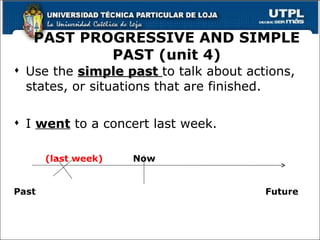
Use the  simple past  to talk about actions, states, or situations that are finished. I  went  to a concert last week. (last week)    Now Past Future PAST PROGRESSIVE AND SIMPLE PAST (unit 4)
Use the  past progressive  to describe an action that was  in progress  at a specific time in the past. My friends  were playing soccer  at 8:00. 8:00     Now Past Future were playing
The action began before the specific time and may or may not continue after the specific time. I  wasn’t watching TV  that night.
Use the  past progressive  to focus on the  duration  of an action, not its completion. Paul  was eating  a hot dog last night. (We don’t know if he finished it or not.) Use the  simple past  to focus on the  completion  of an action. Paul  ate  a hot dog last night. (He finished it.)
Use the  past progressive  with the  simple past  to talk about an action that was  interrupted  by another action. Use the simple past for the interrupting action. He  was looking  for  his bag when the  telephone  rang . In this case, you can use  when  to introduce the  simple past  action.
Use  while  to introduce the  past progressive  action. While  he  was looking  for  his bag, the telephone rang. phone rang     Now Past Future was looking for
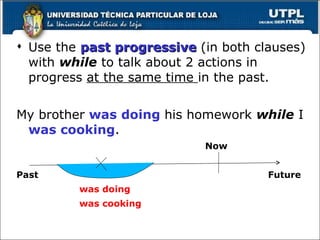
Use the  past progressive  (in both clauses) with  while  to talk about 2 actions in progress  at the same time  in the past. My brother  was   doing  his homework  while  I  was cooking .     Now Past Future was doing was cooking
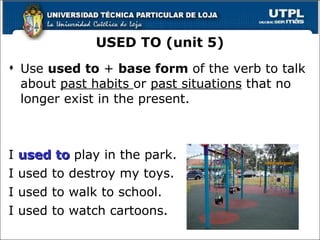
Use  used to  +  base form  of the verb to talk about  past habits  or  past situations  that no longer exist in the present. I  used to  play in the park. I used to destroy my toys. I used to walk to school. I used to watch cartoons. USED TO (unit 5)
NEGATIVE:  didn’t  +  use to She  didn’t   use to  read fairy tales. In negative statements,  never + used to  is more common than  didn’t use to . She  never   used to  read fairy tales.
QUESTIONS :  did + use to Did  you  use to  read comics?
Do not confuse  used to + base form   with  be used to + base form +  -ing   or  get used to + base form +  -ing . She  used to  read comics when she was younger.  (She doesn’t read comics now) She is used to reading books.  (She is accustomed to reading books) She’ll get used to reading books online.  (She’ll get accustomed to reading books online.)
Remember that there are several ways to talk about the  future . You can use  be going to ,  will , the present progressive or the simple present. You can make predictions or guesses about the future. I think I  will  watch a movie tomorrow. FUTURE TIME CLAUSES (unit 7)
You can talk about future intentions or plans. I’ m   going to  watch a movie tomorrow.   Now Past     Future    movie
A sentence about the future can also have 2 clauses. The verb in the  main clause  is often in the  future  ( will  or  be going to ). He  will look  for a job  when  he graduates. He  will look  for a job     main clause when  he graduates     time clause
The verb in the  time clause  is often in the  simple present  and can come at the beginning or at the end of the sentence. When he  graduates , he  will look  for a job. When he  graduates     time clause He  will look  for a job     main clause
Use a  comma  after the time clause when it comes at the beginning. Do not use a comma when it comes at the end. main clause time clause He’s going to work  after he graduates. After he graduates ,  he’s going to work.
REFLEXIVE AND RECIPROCAL PRONOUNS (unit 9) Use a  reflexive pronoun  when the subject and object of a sentence refers to the same people or things. They  felt proud of  themselves . (They were proud of their own actions)
Use a reflexive pronoun to  emphasize a noun . In this case, the reflexive pronoun usually follows the noun directly. Karen was upset when she lost her job. The  job itself  wasn’t important to her, but she needed the money. The  process itself  is an on-going process.
By + a reflexive pronoun  means alone or without any help. I finished the job  by myself .  (No one helped me) John lives  by himself .  (He lives alone) Be + a reflexive pronoun  means act in the usual way. Just  be  yourself  on a first date.
Use a  reciprocal pronoun  when the subject and object of a sentence refer to the same people, and these people have a two-way relationship. Use  each other  for  two  people. He and Mary love  each other . Use  one another  for  more than two people . When people respect  one another , there are fewer conflicts.
QUESTIONS?
MODALS AND SIMILAR EXPRESSIONS Modals  (CAN, COULD, MAY, SHOULD, OUGH TO, WOULD, WILL) can be used to express ability, permission, requests, advice, and suggestions. Other expressions can also be used; for example: BE ABLE TO, DO YOU MIND IF, HAD BETTER, HOW ABOUT, WHY DON’T We will focus on 3 uses:  permission ,  requests  and  suggestions .
PERMISSION:  CAN, COULD, MAY, DO YOU MIND IF… (unit 12) Use the modals  can ,  could  and  may  to  ask permission . Could  I  borrow  your book? When you use  could  for permission, it is not the past. May  I  go  to the bathroom,  please ? May  is more formal than  can  and  could .
Use  can  or  may  in  answers . Don’t use  could . A:  Could  I please use your cell phone? B:   Yes , of course you  can .  ( NOT  Yes, you could.) B:   Sure.  (in conversation: sure, certainly, go ahead) B:   I’m sorry, but I need it.  (refuse permission)
Use  Do you mind if  to ask permission when your action may  annoy or inconvenience  someone.  A:  Do you mind if  I take this pencil? B:   Not at all . OR  No, I don’t .  (It’s OK …) B:   Yes, I do .  (It’s not OK …)
REQUESTS: CAN, COULD, WILL, WOULD, WOULD YOU MIND (unit 13) Will  you  bring  dessert? Can you bring dessert? Use  would  and  could  to  soften requests  and make them more polite. Could  you  call  me later? Would  you  please   close  the door?
We also use  Would you mind  +  gerund  ( verb+ -ing ) to make  polite requests . A:  Would you mind waiting  a minute? B:  Not al all .  (OK. I’ll do it.)
SUGGESTIONS: LET’S, COULD, WHY DON’T, WHY NOT, HOW ABOUT (unit 15) Let’s  always includes the speaker. It means “here’s a suggestion for you and me” Let’s go  to Salinas. We need to rest. (I suggest that we go to Salinas) Let’s not stay  at a hostel. (I suggest that we don’t stay at a hostel)
DIFFERENT FORMS:  Why  don’t  we  take  the bus?  (question-bfv) Why  not take  the bus?  (quest.-bfv) How about taking  the bus?  (quest.- gerund) How about the bus ?  (quest.- noun) Let’s take  the bus.  (statement- bfv) Maybe  we  could  take the bus.  (stmnt-bfv)
To  agree with a suggestion , we usually answer with an  informal expression . A:  Let’s take a walk. B:  Good idea . I’d like that . ( OK . ) ( Sure ) To  disagree , we often give an explanation and make another suggestion. A:  Why don’t we go to the park? B:  We go there a lot. How about the river ?
PRESENT PERFECT: SINCE and FOR (unit 16) You can use the  present perfect  to talk about things that happened at an  indefinite time  in the past. They ’ve   traveled  to Manta.  (You don’t know exactly when)
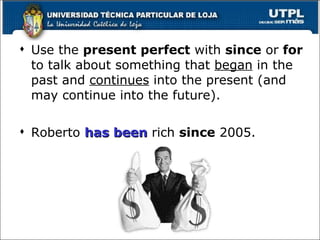
Use the  present perfect  with  since  or  for  to talk about something that  began  in the past and  continues  into the present (and may continue into the future). Roberto  has been  rich  since  2005.
Use  since + point in time  to show  when  something started.  I  have played  chess  since I was a child . Use  for + length of time  to show  how long  something has lasted. Joe  has sold  computers  for a long time .
We often use  the  present perfect  to talk about  how much someone has done ,  how many things someone has done , or  how many times someone has done something . I ’ve   learned   a lot  about it. He ’s   written   three  articles. She ’s   read  that article  twice . PRESENT PERFECT PROGRESSIVE AND PRESENT PERFECT (unit 19)
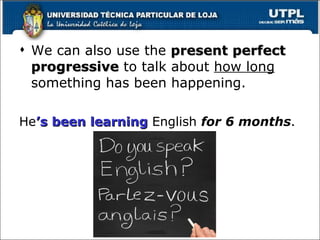
We can also use the  present perfect progressive  to talk about  how long  something has been happening. He ’s   been learning  English  for 6 months .
The  present perfect progressive  often shows that something is  unfinished . It started in the past and is still continuing. The emphasis is on the  continuation  of the action. I ’ve   been reading  a book about insects.  (I’m still reading it.)
The  present perfect  often shows that something is  finished . The emphasis is on the result of the action. I ’ve   read  a book about insects .
We often use the  present perfect progressive  to show that something is  temporary . They ’ve   been living  here  since  1995, but they’re moving next month. We can use the  present perfect  to show that something is  permanent . They ’ve   lived  here  since  they were children. They’ve always lived there.
Sometimes you can use  either the present perfect progressive or the present perfect . This is especially true with verbs such as  live ,  study ,  teach , and   work   with  for  or  since . He ’s   been working  at UTPL  for  6 years. He ’s worked  at UTPL  for  6 years.
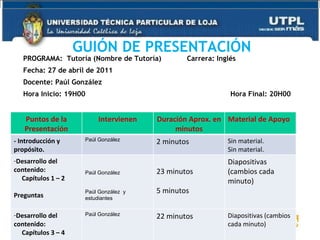
PROGRAMA:  Tutoría (Nombre de Tutoría)  Carrera: Inglés Fecha: 27 de abril de 2011 Docente: Paúl González Hora Inicio: 19H00  Hora Final: 20H00 GUIÓN DE PRESENTACIÓN  Puntos de la Presentación Intervienen Duración Aprox. en minutos Material de Apoyo - Introducción y propósito. Paúl González 2 minutos Sin material. Sin material. Desarrollo del contenido: Capítulos 1 – 2 Preguntas Paúl González Paúl González  y estudiantes 23 minutos 5 minutos Diapositivas (cambios cada minuto) Desarrollo del contenido: Capítulos 3 – 4 Preguntas Paúl González Paúl González  y estudiantes 22 minutos 5 minutos Diapositivas (cambios cada minuto) - Despedida (Contactos, Sugerencias) Paúl González 3 minutos Correo, teléfono, ext, horario de tutoría.

COMMUNICATIVE GRAMMAR III (I Bimestre Abril Agosto 2011)

  • 1.
    ESCUELA : NOMBRES:COMUNICATIVE GRAMMAR III PERÍODO: Mgs. Paúl González T. ABRIL – AGOSTO 2011 Inglés
  • 2.
    Use the simple past to talk about actions, states, or situations that are finished. I went to a concert last week. (last week) Now Past Future PAST PROGRESSIVE AND SIMPLE PAST (unit 4)
  • 3.
    Use the past progressive to describe an action that was in progress at a specific time in the past. My friends were playing soccer at 8:00. 8:00 Now Past Future were playing
  • 4.
    The action beganbefore the specific time and may or may not continue after the specific time. I wasn’t watching TV that night.
  • 5.
    Use the past progressive to focus on the duration of an action, not its completion. Paul was eating a hot dog last night. (We don’t know if he finished it or not.) Use the simple past to focus on the completion of an action. Paul ate a hot dog last night. (He finished it.)
  • 6.
    Use the past progressive with the simple past to talk about an action that was interrupted by another action. Use the simple past for the interrupting action. He was looking for his bag when the telephone rang . In this case, you can use when to introduce the simple past action.
  • 7.
    Use while to introduce the past progressive action. While he was looking for his bag, the telephone rang. phone rang Now Past Future was looking for
  • 8.
    Use the past progressive (in both clauses) with while to talk about 2 actions in progress at the same time in the past. My brother was doing his homework while I was cooking . Now Past Future was doing was cooking
  • 9.
    Use usedto + base form of the verb to talk about past habits or past situations that no longer exist in the present. I used to play in the park. I used to destroy my toys. I used to walk to school. I used to watch cartoons. USED TO (unit 5)
  • 10.
    NEGATIVE: didn’t + use to She didn’t use to read fairy tales. In negative statements, never + used to is more common than didn’t use to . She never used to read fairy tales.
  • 11.
    QUESTIONS : did + use to Did you use to read comics?
  • 12.
    Do not confuse used to + base form with be used to + base form + -ing or get used to + base form + -ing . She used to read comics when she was younger. (She doesn’t read comics now) She is used to reading books. (She is accustomed to reading books) She’ll get used to reading books online. (She’ll get accustomed to reading books online.)
  • 13.
    Remember that thereare several ways to talk about the future . You can use be going to , will , the present progressive or the simple present. You can make predictions or guesses about the future. I think I will watch a movie tomorrow. FUTURE TIME CLAUSES (unit 7)
  • 14.
    You can talkabout future intentions or plans. I’ m going to watch a movie tomorrow. Now Past Future movie
  • 15.
    A sentence aboutthe future can also have 2 clauses. The verb in the main clause is often in the future ( will or be going to ). He will look for a job when he graduates. He will look for a job  main clause when he graduates  time clause
  • 16.
    The verb inthe time clause is often in the simple present and can come at the beginning or at the end of the sentence. When he graduates , he will look for a job. When he graduates  time clause He will look for a job  main clause
  • 17.
    Use a comma after the time clause when it comes at the beginning. Do not use a comma when it comes at the end. main clause time clause He’s going to work after he graduates. After he graduates , he’s going to work.
  • 18.
    REFLEXIVE AND RECIPROCALPRONOUNS (unit 9) Use a reflexive pronoun when the subject and object of a sentence refers to the same people or things. They felt proud of themselves . (They were proud of their own actions)
  • 19.
    Use a reflexivepronoun to emphasize a noun . In this case, the reflexive pronoun usually follows the noun directly. Karen was upset when she lost her job. The job itself wasn’t important to her, but she needed the money. The process itself is an on-going process.
  • 20.
    By + areflexive pronoun means alone or without any help. I finished the job by myself . (No one helped me) John lives by himself . (He lives alone) Be + a reflexive pronoun means act in the usual way. Just be yourself on a first date.
  • 21.
    Use a reciprocal pronoun when the subject and object of a sentence refer to the same people, and these people have a two-way relationship. Use each other for two people. He and Mary love each other . Use one another for more than two people . When people respect one another , there are fewer conflicts.
  • 22.
  • 23.
    MODALS AND SIMILAREXPRESSIONS Modals (CAN, COULD, MAY, SHOULD, OUGH TO, WOULD, WILL) can be used to express ability, permission, requests, advice, and suggestions. Other expressions can also be used; for example: BE ABLE TO, DO YOU MIND IF, HAD BETTER, HOW ABOUT, WHY DON’T We will focus on 3 uses: permission , requests and suggestions .
  • 24.
    PERMISSION: CAN,COULD, MAY, DO YOU MIND IF… (unit 12) Use the modals can , could and may to ask permission . Could I borrow your book? When you use could for permission, it is not the past. May I go to the bathroom, please ? May is more formal than can and could .
  • 25.
    Use can or may in answers . Don’t use could . A: Could I please use your cell phone? B: Yes , of course you can . ( NOT Yes, you could.) B: Sure. (in conversation: sure, certainly, go ahead) B: I’m sorry, but I need it. (refuse permission)
  • 26.
    Use Doyou mind if to ask permission when your action may annoy or inconvenience someone. A: Do you mind if I take this pencil? B: Not at all . OR No, I don’t . (It’s OK …) B: Yes, I do . (It’s not OK …)
  • 27.
    REQUESTS: CAN, COULD,WILL, WOULD, WOULD YOU MIND (unit 13) Will you bring dessert? Can you bring dessert? Use would and could to soften requests and make them more polite. Could you call me later? Would you please close the door?
  • 28.
    We also use Would you mind + gerund ( verb+ -ing ) to make polite requests . A: Would you mind waiting a minute? B: Not al all . (OK. I’ll do it.)
  • 29.
    SUGGESTIONS: LET’S, COULD,WHY DON’T, WHY NOT, HOW ABOUT (unit 15) Let’s always includes the speaker. It means “here’s a suggestion for you and me” Let’s go to Salinas. We need to rest. (I suggest that we go to Salinas) Let’s not stay at a hostel. (I suggest that we don’t stay at a hostel)
  • 30.
    DIFFERENT FORMS: Why don’t we take the bus? (question-bfv) Why not take the bus? (quest.-bfv) How about taking the bus? (quest.- gerund) How about the bus ? (quest.- noun) Let’s take the bus. (statement- bfv) Maybe we could take the bus. (stmnt-bfv)
  • 31.
    To agreewith a suggestion , we usually answer with an informal expression . A: Let’s take a walk. B: Good idea . I’d like that . ( OK . ) ( Sure ) To disagree , we often give an explanation and make another suggestion. A: Why don’t we go to the park? B: We go there a lot. How about the river ?
  • 32.
    PRESENT PERFECT: SINCEand FOR (unit 16) You can use the present perfect to talk about things that happened at an indefinite time in the past. They ’ve traveled to Manta. (You don’t know exactly when)
  • 33.
    Use the present perfect with since or for to talk about something that began in the past and continues into the present (and may continue into the future). Roberto has been rich since 2005.
  • 34.
    Use since+ point in time to show when something started. I have played chess since I was a child . Use for + length of time to show how long something has lasted. Joe has sold computers for a long time .
  • 35.
    We often use the present perfect to talk about how much someone has done , how many things someone has done , or how many times someone has done something . I ’ve learned a lot about it. He ’s written three articles. She ’s read that article twice . PRESENT PERFECT PROGRESSIVE AND PRESENT PERFECT (unit 19)
  • 36.
    We can alsouse the present perfect progressive to talk about how long something has been happening. He ’s been learning English for 6 months .
  • 37.
    The presentperfect progressive often shows that something is unfinished . It started in the past and is still continuing. The emphasis is on the continuation of the action. I ’ve been reading a book about insects. (I’m still reading it.)
  • 38.
    The presentperfect often shows that something is finished . The emphasis is on the result of the action. I ’ve read a book about insects .
  • 39.
    We often usethe present perfect progressive to show that something is temporary . They ’ve been living here since 1995, but they’re moving next month. We can use the present perfect to show that something is permanent . They ’ve lived here since they were children. They’ve always lived there.
  • 40.
    Sometimes you canuse either the present perfect progressive or the present perfect . This is especially true with verbs such as live , study , teach , and work with for or since . He ’s been working at UTPL for 6 years. He ’s worked at UTPL for 6 years.
  • 42.
    PROGRAMA: Tutoría(Nombre de Tutoría) Carrera: Inglés Fecha: 27 de abril de 2011 Docente: Paúl González Hora Inicio: 19H00 Hora Final: 20H00 GUIÓN DE PRESENTACIÓN Puntos de la Presentación Intervienen Duración Aprox. en minutos Material de Apoyo - Introducción y propósito. Paúl González 2 minutos Sin material. Sin material. Desarrollo del contenido: Capítulos 1 – 2 Preguntas Paúl González Paúl González y estudiantes 23 minutos 5 minutos Diapositivas (cambios cada minuto) Desarrollo del contenido: Capítulos 3 – 4 Preguntas Paúl González Paúl González y estudiantes 22 minutos 5 minutos Diapositivas (cambios cada minuto) - Despedida (Contactos, Sugerencias) Paúl González 3 minutos Correo, teléfono, ext, horario de tutoría.

Editor's Notes

  • #2 utpl
  • #8 Time clause (the part of the sentence with when or while) can come at the beginning or the end of the sentence. Use comma after the time clause when it comes at the beginning. Do not use comma when it comes at the end. utpl
  • #10 USED TO always refers to the past. There is no present form. utpl
  • #16 utpl
  • #22 Many people use each other and one another in the same way. utpl
  • #25 We often say please when we ask permission.
  • #26 When people refuse permission , they usually apologize and give an explanation.
  • #27 It’s OK (giving permission) or It’s not OK (refusing permission) for you to take this pencil.
  • #28 Or Would you close the door, please ? utpl