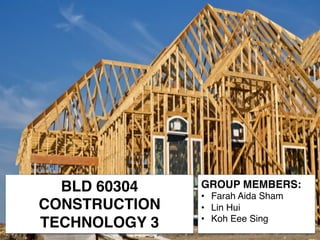
BLD 60304
CONSTRUCTION
TECHNOLOGY 3
GROUP MEMBERS:
•  Farah Aida Sham
•  Lin Hui
•  Koh Eee Sing	
  
INTRODUCTION
INTRODUCTION OF TIMBER FRAME
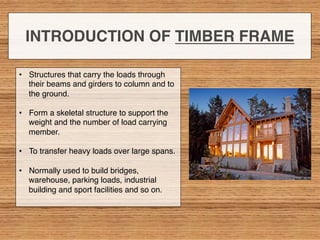
•  Structures that carry the loads through
their beams and girders to column and to
the ground.
•  Form a skeletal structure to support the
weight and the number of load carrying
member.
•  To transfer heavy loads over large spans.
•  Normally used to build bridges,
warehouse, parking loads, industrial
building and sport facilities and so on.
PREFABRICATED TIMBER FRAMING SYSTEM
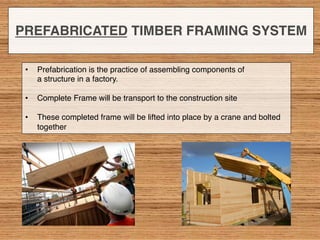
•  Prefabrication is the practice of assembling components of
a structure in a factory.
•  Complete Frame will be transport to the construction site
•  These completed frame will be lifted into place by a crane and bolted
together


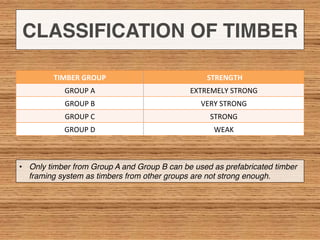
CLASSIFICATION OF TIMBER
TIMBER	
  GROUP	
   	
  STRENGTH	
  
GROUP	
  A	
   EXTREMELY	
  STRONG	
  
GROUP	
  B	
   VERY	
  STRONG	
  
GROUP	
  C	
   STRONG	
  
GROUP	
  D	
   WEAK	
  
•  Only timber from Group A and Group B can be used as prefabricated timber
framing system as timbers from other groups are not strong enough.
EXAMPLES OF TIMBER FROM GROUP A & B
Bakau	
   Cengal	
   Kekatong	
  
Keranji	
   Resak	
  
STRUCTURAL ELEMENTS
MANUFACTURING
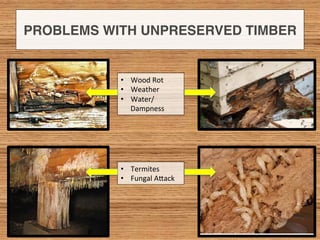
PROBLEMS WITH UNPRESERVED TIMBER
•  Wood	
  Rot	
  
•  Weather	
  
•  Water/	
  
Dampness	
  
•  Termites	
  
•  Fungal	
  AIack	
  
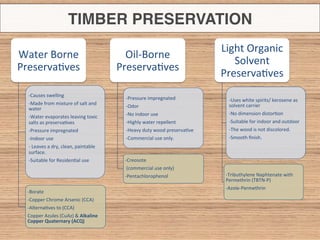
TIMBER PRESERVATION
Water	
  Borne	
  
PreservaLves	


-­‐Causes	
  swelling	
  
-­‐Made	
  from	
  mixture	
  of	
  salt	
  and	
  
water	
  
-­‐Water	
  evaporates	
  leaving	
  toxic	
  
salts	
  as	
  preservaLves	
  
-­‐Pressure	
  impregnated	
  
-­‐Indoor	
  use	
  
-­‐	
  Leaves	
  a	
  dry,	
  clean,	
  paintable	
  
surface.	
  
-­‐Suitable	
  for	
  ResidenLal	
  use	


-­‐Borate	
  
-­‐Copper	
  Chrome	
  Arsenic	
  (CCA)	
  	
  
-­‐AlternaLves	
  to	
  (CCA)	
  
Copper	
  Azules	
  (CuAz)	
  &	
  Alkaline	
  
Copper	
  Quaternary	
  (ACQ)	


Oil-­‐Borne	
  
PreservaLves	


-­‐Pressure	
  impregnated	
  
-­‐Odor	
  
-­‐No	
  indoor	
  use	
  
-­‐Highly	
  water	
  repellent	
  
-­‐Heavy	
  duty	
  wood	
  preservaLve	
  
-­‐Commercial	
  use	
  only.	


-­‐Creosote	
  
	
  (commercial	
  use	
  only)	
  
-­‐Pentachlorophenol	


Light	
  Organic	
  
Solvent	
  
PreservaLves	
  
-­‐Uses	
  white	
  spirits/	
  kerosene	
  as	
  
solvent	
  carrier	
  
-­‐No	
  dimension	
  distorLon	
  
-­‐Suitable	
  for	
  indoor	
  and	
  outdoor	
  
-­‐The	
  wood	
  is	
  not	
  discolored.	
  
-­‐Smooth	
  finish.	


-­‐Tributhylene	
  Naphtenate	
  with	
  
Permethrin	
  (TBTN-­‐P)	
  
-­‐Azole-­‐Permethrin	


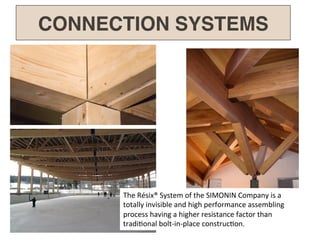
CONNECTION SYSTEMS
The	
  Résix®	
  System	
  of	
  the	
  SIMONIN	
  Company	
  is	
  a	
  
totally	
  invisible	
  and	
  high	
  performance	
  assembling	
  
process	
  having	
  a	
  higher	
  resistance	
  factor	
  than	
  
tradiLonal	
  bolt-­‐in-­‐place	
  construcLon.	
  	
  
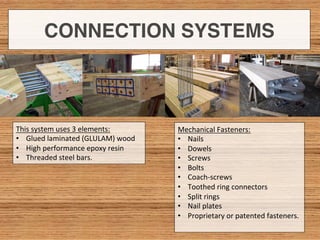
CONNECTION SYSTEMS
This	
  system	
  uses	
  3	
  elements:	
  	
  
•  Glued	
  laminated	
  (GLULAM)	
  wood	
  
•  High	
  performance	
  epoxy	
  resin	
  
•  Threaded	
  steel	
  bars.	
  	
  
Mechanical	
  Fasteners:	
  
•  Nails	
  
•  Dowels	
  
•  Screws	
  
•  Bolts	
  
•  Coach-­‐screws	
  
•  Toothed	
  ring	
  connectors	
  
•  Split	
  rings	
  
•  Nail	
  plates	
  
•  Proprietary	
  or	
  patented	
  fasteners.	


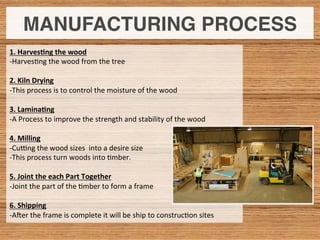
MANUFACTURING PROCESS
1.	
  HarvesDng	
  the	
  wood	
  	
  
-­‐HarvesLng	
  the	
  wood	
  from	
  the	
  tree	


2.	
  Kiln	
  Drying	
  
-­‐This	
  process	
  is	
  to	
  control	
  the	
  moisture	
  of	
  the	
  wood	


3.	
  LaminaDng	
  
-­‐A	
  Process	
  to	
  improve	
  the	
  strength	
  and	
  stability	
  of	
  the	
  wood	
  	
  
4.	
  Milling	
  	
  
-­‐Cu`ng	
  the	
  wood	
  sizes	
  	
  into	
  a	
  desire	
  size	
  	
  
-­‐This	
  process	
  turn	
  woods	
  into	
  Lmber.	


5.	
  Joint	
  the	
  each	
  Part	
  Together	
  	
  
-­‐Joint	
  the	
  part	
  of	
  the	
  Lmber	
  to	
  form	
  a	
  frame	


6.	
  Shipping	
  	
  
-­‐Aber	
  the	
  frame	
  is	
  complete	
  it	
  will	
  be	
  ship	
  to	
  construcLon	
  sites	
  
CASE STUDIES
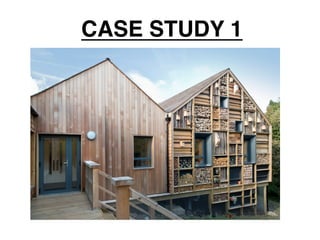
CASE STUDY 1
Completed: August 2015
Location: Stockport,
Manchester
Country: England
Sector: Education / School
Architect: Sarah
Wigglesworth Architects
Engineer: Rhodes and
Partners
Main con: MPS
Construction
Area: 226 sqm
Cost: £0.59M
Mellor Primary School ‘Forest School’
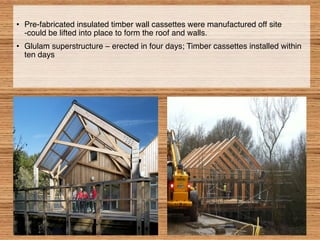
•  Pre-fabricated insulated timber wall cassettes were manufactured off site 

-could be lifted into place to form the roof and walls.
•  Glulam superstructure – erected in four days; Timber cassettes installed within
ten days
Types of Prefabricated Timber
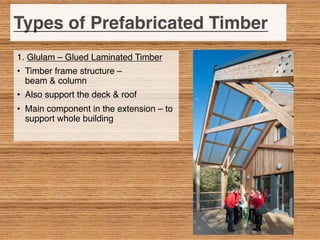
1. Glulam – Glued Laminated Timber
•  Timber frame structure – 

beam & column
•  Also support the deck & roof
•  Main component in the extension – to
support whole building
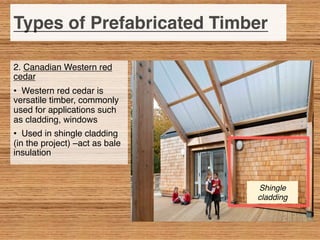
2. Canadian Western red
cedar
•  Western red cedar is
versatile timber, commonly
used for applications such
as cladding, windows
•  Used in shingle cladding
(in the project) –act as bale
insulation
Shingle
cladding
Types of Prefabricated Timber
CONSTRUCTION PROCESS
1. Glulam frame erected on foundation 2. Erected the floor platform
3. Erected the flooring 4. Erect the vertical walls
7. Final – Timber cladding
5. Erect the roof elements 6. Place the roof tiles
CASE STUDY 2
GlaxoSmithKline’s Carbon Neutral Laboratory
Completed: September
2016
Location: University of
Nottingham’s Jubilee
Campus
Country: England
Type: Education
Architect: Fairhursts
Design Group
Main contractor: Morgan
Sindall
Area: 4,500 sqm
Costing: £15.8m
GSK Carbon Neutral Laboratory
•  A two-storey, engineered
timber structure - 22m tall
•  Known as UK’s first
carbon neutral laboratory
– ‘’Green Building Lab’’
•  Achieved a LEED
Platinum certification &
BREEAM Excellent
•  built from natural
materials – timber &
energy used from
renewable sources, such
as solar power and
sustainable biofuel
•  to serve as a hub to
catalyse new
collaborations in
pharmaceutical industry
1. Glulam (Glued Laminated
Timber)
•  structural engineered wood -
bonded together with
durable, moisture-resistant
structural adhesives.
•  Used in Timber frame
structure (beam & column)
•  Largest glulam beams
spanned 8m, 1.8 tonnes
Types of Prefabricated Timber
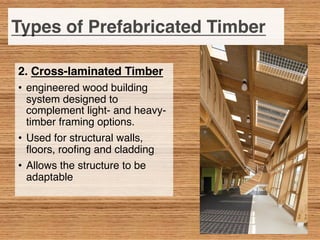
2. Cross-laminated Timber
•  engineered wood building
system designed to
complement light- and heavy-
timber framing options.
•  Used for structural walls,
floors, roofing and cladding
•  Allows the structure to be
adaptable
Types of Prefabricated Timber
CONSTRUCTION PROCESS
1.  Materials delivered to the site
2.  Erect the ground floor platform over the
foundation
3.  Build beam and column
4.  Next, build the floor platform
5.  Then, erect the vertical walls and roofs
6.  Repeat the steps again.
GlaxoSmithKline Carbon Neutral Laboratory
Construction Process (Time-Lapse)
•  Burn down in September 2014, when nearly two-thirds (70%)
complete
•  Cause by a fire started by an electrical fault at ground floor
•  The entire site were burned to the ground
•  No blame was attached to the building process and construction
firm - Morgan Sindall
This photo was taken hours before the fire
ravaged the building.
CHALLENGES:
SOLUTIONS
•  Decided to rebuilt it using exactly the same design
•  Rebuilt in 2015
•  Fire protection system added after the incident happened
ADVANTAGES AND
DISADVANTAGES
ADVANTAGES AND DISADVANTAGES OF
PREFABRICATED TIMBER FRAMING SYSTEM
ADVANTAGES	
   DISADVANTAGES	
  
Simple	
  and	
  easy	
  to	
  be	
  construct	
  	
   Poor	
  Sound	
  InsulaLon	
  
Not	
  weather	
  dependent	
  ,can	
  build	
  at	
  any	
  
Lme	
  without	
  any	
  weather	
  delay	
  
TransportaLon	
  to	
  site	
  could	
  be	
  a	
  problem	
  
Quality	
  Assurance	
   Shorter	
  fire	
  raLng	
  
Reduce	
  Material	
  Wastages	
   Biological	
  AIack	
  
CONCLUSION
Timber is specified as a robust and sustainable
material, offering clear benefits in terms of
ecological sustainability, structural performance,
durability, and long-term maintenance. Therefore, it
is widely used as main structural components in
England/UK. We hope that our country can also
widely promote the use of timber in building
construction.
PREFABRICATED TIMBER FRAMING SYSTEM

  • 1.
    BLD 60304 CONSTRUCTION TECHNOLOGY 3 GROUPMEMBERS: •  Farah Aida Sham •  Lin Hui •  Koh Eee Sing  
  • 2.
  • 3.
    INTRODUCTION OF TIMBERFRAME •  Structures that carry the loads through their beams and girders to column and to the ground. •  Form a skeletal structure to support the weight and the number of load carrying member. •  To transfer heavy loads over large spans. •  Normally used to build bridges, warehouse, parking loads, industrial building and sport facilities and so on.
  • 4.
    PREFABRICATED TIMBER FRAMINGSYSTEM •  Prefabrication is the practice of assembling components of a structure in a factory. •  Complete Frame will be transport to the construction site •  These completed frame will be lifted into place by a crane and bolted together      
  • 5.
    CLASSIFICATION OF TIMBER TIMBER  GROUP    STRENGTH   GROUP  A   EXTREMELY  STRONG   GROUP  B   VERY  STRONG   GROUP  C   STRONG   GROUP  D   WEAK   •  Only timber from Group A and Group B can be used as prefabricated timber framing system as timbers from other groups are not strong enough.
  • 6.
    EXAMPLES OF TIMBERFROM GROUP A & B Bakau   Cengal   Kekatong   Keranji   Resak  
  • 7.
  • 8.
    PROBLEMS WITH UNPRESERVEDTIMBER •  Wood  Rot   •  Weather   •  Water/   Dampness   •  Termites   •  Fungal  AIack  
  • 9.
    TIMBER PRESERVATION Water  Borne   PreservaLves     -­‐Causes  swelling   -­‐Made  from  mixture  of  salt  and   water   -­‐Water  evaporates  leaving  toxic   salts  as  preservaLves   -­‐Pressure  impregnated   -­‐Indoor  use   -­‐  Leaves  a  dry,  clean,  paintable   surface.   -­‐Suitable  for  ResidenLal  use         -­‐Borate   -­‐Copper  Chrome  Arsenic  (CCA)     -­‐AlternaLves  to  (CCA)   Copper  Azules  (CuAz)  &  Alkaline   Copper  Quaternary  (ACQ)     Oil-­‐Borne   PreservaLves     -­‐Pressure  impregnated   -­‐Odor   -­‐No  indoor  use   -­‐Highly  water  repellent   -­‐Heavy  duty  wood  preservaLve   -­‐Commercial  use  only.       -­‐Creosote    (commercial  use  only)   -­‐Pentachlorophenol     Light  Organic   Solvent   PreservaLves   -­‐Uses  white  spirits/  kerosene  as   solvent  carrier   -­‐No  dimension  distorLon   -­‐Suitable  for  indoor  and  outdoor   -­‐The  wood  is  not  discolored.   -­‐Smooth  finish.         -­‐Tributhylene  Naphtenate  with   Permethrin  (TBTN-­‐P)   -­‐Azole-­‐Permethrin        
  • 10.
    CONNECTION SYSTEMS The  Résix®  System  of  the  SIMONIN  Company  is  a   totally  invisible  and  high  performance  assembling   process  having  a  higher  resistance  factor  than   tradiLonal  bolt-­‐in-­‐place  construcLon.    
  • 11.
    CONNECTION SYSTEMS This  system  uses  3  elements:     •  Glued  laminated  (GLULAM)  wood   •  High  performance  epoxy  resin   •  Threaded  steel  bars.     Mechanical  Fasteners:   •  Nails   •  Dowels   •  Screws   •  Bolts   •  Coach-­‐screws   •  Toothed  ring  connectors   •  Split  rings   •  Nail  plates   •  Proprietary  or  patented  fasteners.      
  • 12.
    MANUFACTURING PROCESS 1.  HarvesDng  the  wood     -­‐HarvesLng  the  wood  from  the  tree       2.  Kiln  Drying   -­‐This  process  is  to  control  the  moisture  of  the  wood       3.  LaminaDng   -­‐A  Process  to  improve  the  strength  and  stability  of  the  wood     4.  Milling     -­‐Cu`ng  the  wood  sizes    into  a  desire  size     -­‐This  process  turn  woods  into  Lmber.     5.  Joint  the  each  Part  Together     -­‐Joint  the  part  of  the  Lmber  to  form  a  frame       6.  Shipping     -­‐Aber  the  frame  is  complete  it  will  be  ship  to  construcLon  sites  
  • 13.
  • 14.
  • 15.
    Completed: August 2015 Location:Stockport, Manchester Country: England Sector: Education / School Architect: Sarah Wigglesworth Architects Engineer: Rhodes and Partners Main con: MPS Construction Area: 226 sqm Cost: £0.59M Mellor Primary School ‘Forest School’
  • 16.
    •  Pre-fabricated insulatedtimber wall cassettes were manufactured off site 
 -could be lifted into place to form the roof and walls. •  Glulam superstructure – erected in four days; Timber cassettes installed within ten days
  • 17.
    Types of PrefabricatedTimber 1. Glulam – Glued Laminated Timber •  Timber frame structure – 
 beam & column •  Also support the deck & roof •  Main component in the extension – to support whole building
  • 18.
    2. Canadian Westernred cedar •  Western red cedar is versatile timber, commonly used for applications such as cladding, windows •  Used in shingle cladding (in the project) –act as bale insulation Shingle cladding Types of Prefabricated Timber
  • 19.
    CONSTRUCTION PROCESS 1. Glulamframe erected on foundation 2. Erected the floor platform 3. Erected the flooring 4. Erect the vertical walls
  • 20.
    7. Final –Timber cladding 5. Erect the roof elements 6. Place the roof tiles
  • 21.
  • 22.
    GlaxoSmithKline’s Carbon NeutralLaboratory Completed: September 2016 Location: University of Nottingham’s Jubilee Campus Country: England Type: Education Architect: Fairhursts Design Group Main contractor: Morgan Sindall Area: 4,500 sqm Costing: £15.8m
  • 23.
    GSK Carbon NeutralLaboratory •  A two-storey, engineered timber structure - 22m tall •  Known as UK’s first carbon neutral laboratory – ‘’Green Building Lab’’ •  Achieved a LEED Platinum certification & BREEAM Excellent •  built from natural materials – timber & energy used from renewable sources, such as solar power and sustainable biofuel •  to serve as a hub to catalyse new collaborations in pharmaceutical industry
  • 24.
    1. Glulam (GluedLaminated Timber) •  structural engineered wood - bonded together with durable, moisture-resistant structural adhesives. •  Used in Timber frame structure (beam & column) •  Largest glulam beams spanned 8m, 1.8 tonnes Types of Prefabricated Timber
  • 25.
    2. Cross-laminated Timber • engineered wood building system designed to complement light- and heavy- timber framing options. •  Used for structural walls, floors, roofing and cladding •  Allows the structure to be adaptable Types of Prefabricated Timber
  • 26.
    CONSTRUCTION PROCESS 1.  Materialsdelivered to the site 2.  Erect the ground floor platform over the foundation 3.  Build beam and column 4.  Next, build the floor platform 5.  Then, erect the vertical walls and roofs 6.  Repeat the steps again.
  • 27.
    GlaxoSmithKline Carbon NeutralLaboratory Construction Process (Time-Lapse)
  • 28.
    •  Burn downin September 2014, when nearly two-thirds (70%) complete •  Cause by a fire started by an electrical fault at ground floor •  The entire site were burned to the ground •  No blame was attached to the building process and construction firm - Morgan Sindall This photo was taken hours before the fire ravaged the building. CHALLENGES:
  • 29.
    SOLUTIONS •  Decided torebuilt it using exactly the same design •  Rebuilt in 2015 •  Fire protection system added after the incident happened
  • 30.
  • 31.
    ADVANTAGES AND DISADVANTAGESOF PREFABRICATED TIMBER FRAMING SYSTEM ADVANTAGES   DISADVANTAGES   Simple  and  easy  to  be  construct     Poor  Sound  InsulaLon   Not  weather  dependent  ,can  build  at  any   Lme  without  any  weather  delay   TransportaLon  to  site  could  be  a  problem   Quality  Assurance   Shorter  fire  raLng   Reduce  Material  Wastages   Biological  AIack  
  • 32.
  • 33.
    Timber is specifiedas a robust and sustainable material, offering clear benefits in terms of ecological sustainability, structural performance, durability, and long-term maintenance. Therefore, it is widely used as main structural components in England/UK. We hope that our country can also widely promote the use of timber in building construction.