Bachelor of Science (Honours) in Architecture  
 
BUILDING TECHNOLOGY I (BLD 61403) 
  
Project 1  
Industrialised Building System  
 
Group Members : 
Alexandra Go 
How Seng Guan 
Jacky Ting Sim Ming 
Lee Suk Fang 
Lee Wan Xuan 
Tan Chin Yin 
0325342 
1007P73021 
0325286 
0323293 
0325273 
0320080 
 
Tutor : Mr. Rizal 
1
Table of Contents Page 
 
1.Introduction    
1.1 Aims and objectives 1 
1.2 Introduction of IBS 1 
1.3 Types of IBS 3-4  
1.4 Concept and Framework  
1.4.1 Advantages of using IBS 5 
1.4.2 Defects of Precast Concrete Building 5 
1.4.3 Standard Design Workflow  6 
1.4.4 Structural Construction Process 6 
1.5 Case Study 
1.5.1 The Bayron, Devonshire Road, Singapore 7-8 
1.5.2 Seri Jati Apartment, Setia Alam 9  
 
2.Technical Drawings 
2.1 Architectural Plans 10-11 
2.2 Structural Plan 12 
2.3 Elevations 13-14 
2.4 Section 15 
2.5 Axonometric 16 
2.6 Sectional Perspective  17 
2.7 Construction Details 18 
 
3.Study of Proposed IBS categories and detail of components 
3.1 Precast Concrete Frame 19 
3.2 Precast Concrete Column 20 
3.3 Precast Concrete Beam 21 
3.4 Precast Concrete Floor Slab 22 
3.5 Precast Concrete Wall 22 
3.6 Precast Concrete Staircase 23 
3.7 Prefabricated Steel Framing Roof Truss 23 
 
4. Construction sequence 24-26 
5. Schedule of IBS Components 
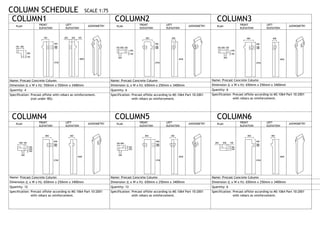
5.1 Column Schedule 27-28 
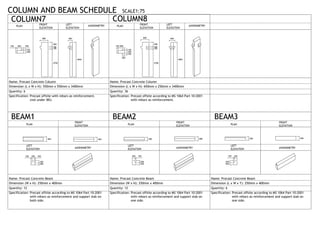
5.2 Column and Beam Schedule 29 
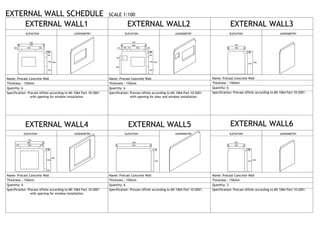
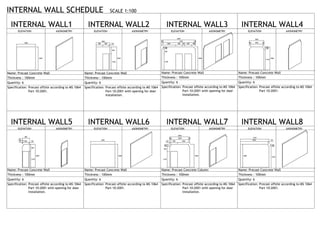
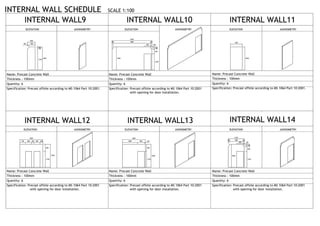
5.3 Wall Schedule 30-33  
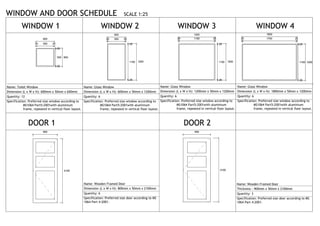
5.4 Door and Window Schedule 34 
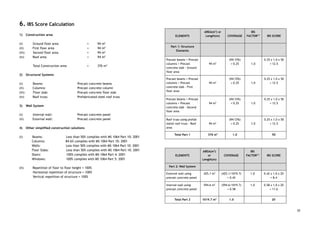
6. IBS Score Calculation 35-36 
7. Conclusion 36 
8. Reference List 37 


2
1.Introduction 
 
1.1 Aims and Objectives 
 
This project is to provide a in depth and well-documented analysis about the topic of                             
different types and methods of Industrialised Building System (IBS).For this report, we need                         
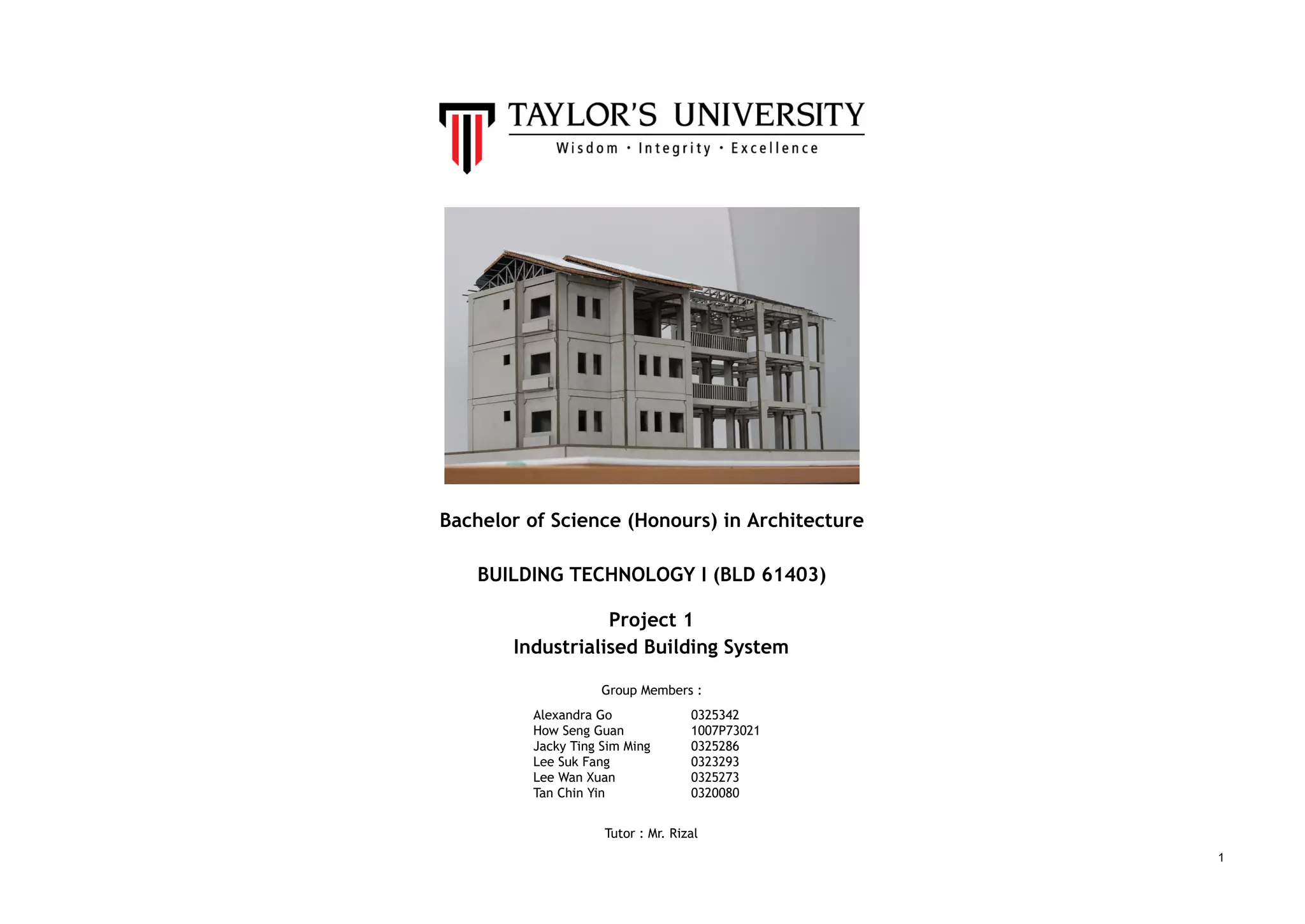
to proposed a 3-storey apartment block which using mainly IBS components. Done so over the                             
course of six to seven weeks,our learning outcome as the following: 
 
(i) To study and identify the research data about types of IBS and construction methods. 
 
(ii) Able to explain and apply the relevant knowledge through a set of architectural and                             
structural documentation. 
 
(iii) Able to relate the basic structural elements and structural principles in                       
construction.Further analyse and document construction methods and materials. 
 
(iv) To be able to produce a well-documented report that surmises our findings and analysis                             
of our case study - which can then serve as an example of our accumulated knowledge of the                                   
relationship between construction and building. 
 
By analysing the types of IBS applied in the apartment building, we are then able to develop                                 
a better understanding on the characteristics of each structural components and how it                         
affects the IBS score. It is also important to know how different types of components and                               
their construction method influence the construction efficiency and the overall aesthetic                     
appearance. 


1.2 Introduction of IBS 
 
What is IBS? 
 
Industrialised building system (IBS) also known as Pre-fabricated Construction and Off-site                     
Construction, is a method of construction where the structural of building components are                         
fabricated under a controlled environment. They are produced off-site later transported and                       
assembled into construction site. 
 
They are divided into two systems which are open system and close system: 
Open system refers to the IBS components are fabricated by different manufacturers                       
while; 
Close system is the IBS components are fabricated from one manufacturer. 
 
There are several building components using IBS, which are columns, beams, floor slabs,                         
walls, portal frame, steel roof truss and 3-D components such as balconies, staircases,                         
toilets, etc. 
 
The content of IBS (IBS Score) is determined based on the Construction Industry Standard 18                             
(CIS 18: 2010); either manually, web application or fully automated CAD-based IBS Score                         
calculator. 
 
In Malaysia, the implementation of IBS concept by using pre-cast concrete building were                         
introduced in Malaysia 1966 when the government launched two pilot projects for pre-cast                         
housing which involves the construction of Tuanku Abdul Rahman Flats in Kuala Lumpur and                           
the Rifle Range Road Flats in Penang.  
 
Since 1980’s there are intensive marketing strategies launched by the Malaysian Government                       
to introduce modular coordination, its acceptance has received poor responses for the                       
building industry. As a result even partial introduction of IBS such as lintels and staircase has                               
not been possible  
 
In the 90s, demand for the new township has seen to increase in the use of precast concrete                                   
system in high rise residential buildings. In the booming period of Malaysian construction                         
1994 to 1997, hybrid IBS application used in many national iconic landmarks such as Kuala                             
Lumpur Convention Center, Bukit Jalil Sport Complex constructed using steel beam and roof                         
trusses and precast concrete. Other than that, Lightweight Railway Train (LRT) and KL                         
Sentral was constructed by using steel roof structure and precast hollow core.  
 
 
3
1.3 Types of IBS 
 
The Malaysian construction industry is undergoing a transitional change from an                     
industry employing to one which is more systematic and mechanised. Based on                       
Construction Industry Development Berhad ( CIDB ), IBS is structurally classified into                       
six main groups, which are: 
 
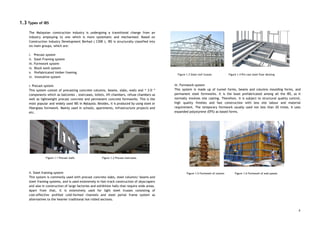
i. Precast system 
ii. Steel Framing system 
iii. Formwork system 
iv. Block work system 
v. Prefabricated timber framing 
vi. Innovative system 
 
i. Precast system 
This system consist of precasting concrete columns, beams, slabs, walls and “ 3-D ”                           
components which as balconies , staircases, toilets, lift chambers, refuse chambers as                       
well as lightweight precast concrete and permanent concrete formworks. This is the                       
most popular and widely used IBS in Malaysia. Besides, it is produced by using steel or                               
fiberglass formwork. Mainly used in schools, apartments, infrastructure projects and                   
etc. 
 
Figure 1.1 Precast walls Figure 1.2 Precast staircases 


ii. Steel framing system 
This system is commonly used with precast concrete slabs, steel columns/ beams and                         
steel framing systems, and is used extensively in fast-track construction of skyscrapers                       
and also in construction of large factories and exhibition halls that require wide areas.                           
Apart from that, it is extensively used for light steel trusses consisting of                         
cost-effective profiled cold-formed channels and steel portal frame system as                   
alternatives to the heavier traditional hot-rolled sections.  


Figure 1.3 Steel roof trusses Figure 1.4 Pre-cast steel floor decking 
 
iii. Formwork system 
This system is made up of tunnel forms, beams and columns moulding forms, and                           
permanent steel formworks. It is the least prefabricated among all the IBS, as it                           
normally involves site casting. Therefore, it is subject to structural quality control,                       
high quality finishes and fast construction with less site labour and material                       
requirement. The temporary formwork usually used not less than 20 times. It uses                         
expanded polystyrene (EPS) as based forms. 


Figure 1.5 Formwork of column Figure 1.6 Formwork of wall panels 


4
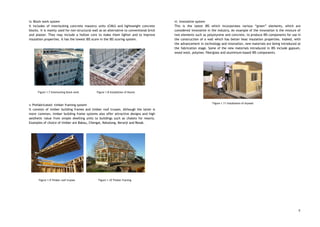
iv. Block work system 
It includes of interlocking concrete masonry units (CMU) and lightweight concrete                     
blocks. It is mainly used for non-structural wall as an alternative to conventional brick                           
and plaster. They may include a hollow core to make them lighter and to improve                             
insulation properties. It has the lowest IBS score in the IBS scoring system. 


Figure 1.7 Interlocking block work Figure 1.8 Installation of blocks 
 
 
v. Prefabricated- timber framing system 
It consists of timber building frames and timber roof trusses. Although the latter is                           
more common, timber building frame systems also offer attractive designs and high                       
aesthetic value from simple dwelling units to buildings such as chalets for resorts.                         
Examples of choice of timber are Bakau, Chengal, Kekatong, Keranji and Resak. 


Figure 1.9 Timber roof trusses Figure 1.10 Timber framing  


vi. Innovative system 
This is the latest IBS which incorporates various “green” elements, which are                       
considered innovative in the industry. An example of the innovation is the mixture of                           
two elements such as polystyrene and concrete, to produce IBS components for use in                           
the construction of a wall which has better heat insulation properties. Indeed, with                         
the advancement in technology and innovation, new materials are being introduced at                       
the fabrication stage. Some of the new materials introduced in IBS include gypsum,                         
wood wool, polymer, fiberglass and aluminium-based IBS components. 


Figure 1.11 Installation of drywall   


5
1.4 Concept and Framework 
 
1.4.1 What is the advantages of using IBS: 
● Results in high-quality products and minimum waste, due to a factory work                       
environment that is easier to control. 
● Results in elimination of conventional timber props and an obvious decrease of                       
supporting materials, through the use of complete assembly elements or prop system                       
for the onsite casting process. 
● Results in a stronger and safer work platform, produced through a complete assembly                         
element. 
● Results in faster completion, due to the introduction of prefabricated components to                       
replace onsite fabrication. 
● Results in a safer, cleaner and more organized site, due to the reduction of                           
construction waste, site workers and prefabricated construction materials; and 
● Results in a cheaper total construction cost, resulting from the above factors. 


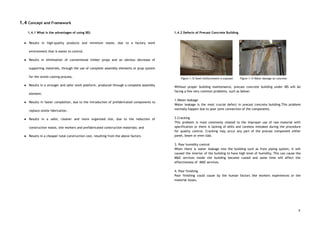
1.4.2 Defects of Precast Concrete Building 
 
 
Figure 1.12 Steel reinforcement is exposed Figure 1.13 Water damage on concrete 
 
Without proper building maintenance, precast concrete building under IBS will be                     
facing a few very common problems, such as below: 
 
1.Water leakage  
Water leakage is the most crucial defect in precast concrete building.This problem                       
normally happen due to poor joint connection of the components. 
 
2.Cracking  
This problem is most commonly related to the improper use of raw material with                           
specification or there is lacking of skills and careless mistakes during the procedure                         
for quality control. Cracking may occur any part of the precast component either                         
panel, beam or even slab.  
 
3. Poor humidity control  
When there is water leakage into the building such as from piping system, it will                             
caused the interior of the building to have high level of humidity. This can cause the                               
M&E services inside the building became rusted and same time will affect the                         
effectiveness of M&E services. 
 
4. Poor finishing 
Poor finishing could cause by the human factors like workers experiences or the                         
material issues.  


6
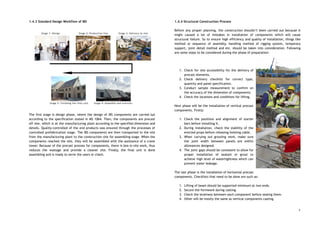
1.4.3 Standard Design Workflow of IBS 


The first stage is design phase, where the design of IBS components are carried out                             
according to the specification stated in MS 1064. Then, the components are precast                         
off site, which is at the manufacturing plant according to the specified dimension and                           
details. Quality-controlled of the end products was ensured through the processes of                       
controlled prefabrication stage. The IBS components are then transported to the site                       
from the manufacturing plant to the construction site for assembling stage. When the                         
components reached the site, they will be assembled with the assistance of a crane                           
tower. Because of the precast process for components, there is less in-site work, thus                           
reduces the wastage and provide a cleaner site. Finally, the final unit is done                           
assembling and is ready to serve the users or client. 


1.4.4 Structural Construction Process 
 
Before any proper planning, the construction shouldn’t been carried out because it                       
might caused a lot of mistakes in installation of components which will cause                         
structural failure. So to ensure high efficiency and quality of installation, things like                         
method or sequence of assembly, handling method of rigging system, temporary                     
support, joint detail method and etc. should be taken into consideration. Following                       
are some steps to be considered during the phase of preparation: 


1. Check for site accessibility for the delivery of               
precast elements. 
2. Check delivery checklist for correct type,           
quantity and panel specification. 
3. Conduct sample measurement to confirm on           
the accuracy of the dimension of components. 
4. Check the locations and conditions for lifting. 
 
Next phase will be the installation of vertical precast                 
components. Firstly: 
 
1. Check the positions and alignment of starter             
bars before installing it. 
2. During installation, check the stability of the             
erected props before releasing hoisting cable. 
3. When carrying out grouting work, make sure             
the joint width between panels are within             
allowances designed. 
4. The joint gaps should be consistent to allow for                 
proper installation of sealant or grout to             
achieve high level of watertightness which can             
prevent water leakage. 
 
The last phase is the installation of horizontal precast                 
components. Checklists that need to be done are such as: 
 
1. Lifting of beam should be supported minimum at two ends. 
2. Secure the formwork during casting. 
3. Check the levelness between each component before sealing them. 
4. Other will be mostly the same as vertical components casting. 
7
1.5 Case Studies 
 
1.5.1 The Bayron, Devonshire Road, Singapore 
 
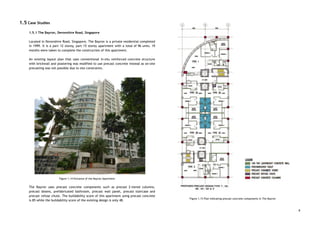
Located in Devonshire Road, Singapore, The Bayron is a private residential completed                       
in 1999. It is a part 12 storey, part 15 storey apartment with a total of 96 units. 19                                     
months were taken to complete the construction of this apartment.  
 
An existing layout plan that uses conventional in-situ reinforced concrete structure                     
with brickwall and plastering was modified to use precast concrete instead as on-site                         
precasting was not possible due to site constraints.  


Figure 1.14 Entrance of the Bayron Apartment 
 
The Bayron uses precast concrete components such as precast 2-tiered columns,                     
precast beams, prefabricated bathroom, precast wall panel, precast staircase and                   
precast refuse chute. The buildability score of this apartment using precast concrete                       
is 85 while the buildability score of the existing design is only 48. 


FIgure 1.15 Plan indicating precast concrete components in The Bayron 
 
8


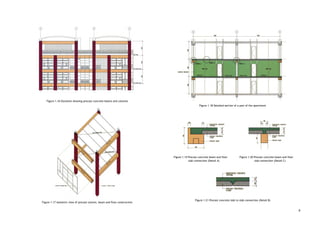
Figure 1.16 Elevation showing precast concrete beams and columns 


Figure 1.17 Isometric view of precast column, beam and floor construction 


Figure 1.18 Detailed section of a part of the apartment 


Figure 1.19 Precast concrete beam and floor Figure 1.20 Precast concrete beam and floor  
slab connection (Detail A) slab connection (Detail C) 


Figure 1.21 Precast concrete slab to slab connection (Detail B)   
9
1.5.2 Seri Jati Apartment, Setia Alam 
 
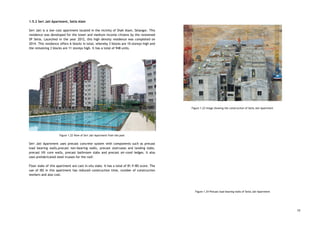
Seri Jati is a low cost apartment located in the vicinity of Shah Alam, Selangor. This                               
residence was developed for the lower and medium income citizens by the renowned                         
SP Setia. Launched in the year 2012, this high density residence was completed on                           
2014. This residence offers 6 blocks in total, whereby 3 blocks are 10 storeys high and                               
the remaining 3 blocks are 11 storeys high. It has a total of 948 units. 


Figure 1.22 View of Seri Jati Apartment from the pool 
 
Seri Jati Apartment uses precast concrete system with components such as precast                       
load bearing walls,precast non-bearing walls, precast staircases and landing slabs,                   
precast lift core walls, precast bathroom slabs and precast air-cond ledges. It also                         
uses prefabricated steel trusses for the roof.  
 
Floor slabs of this apartment are cast in-situ slabs. It has a total of 81.9 IBS score. The                                   
use of IBS in this apartment has reduced construction time, number of construction                         
workers and also cost. 


Figure 1.23 Image showing the construction of Setia Jati Apartment 


Figure 1.24 Precast load bearing walls of Setia Jati Apartment 


10
2.TechnicalDrawing
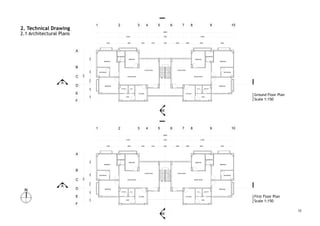
2.1ArchitecturalPlans
12
GroundFloorPlan
Scale1:150
FirstFloorPlan
Scale1:150
12
13
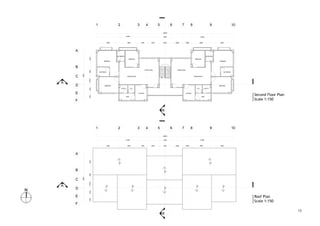
SecondFloorPlan
Scale1:150
RoofPlan
Scale1:150
14
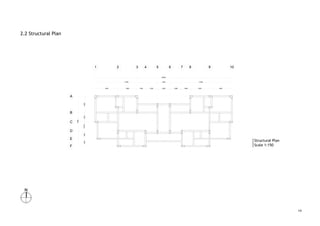
2.2StructuralPlan
StructuralPlan
Scale1:150
15
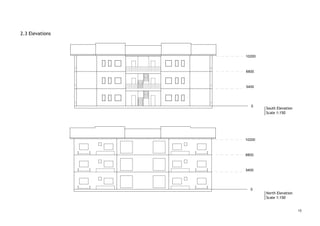
SouthElevation
Scale1:150
NorthElevation
Scale1:150
2.3Elevations
16
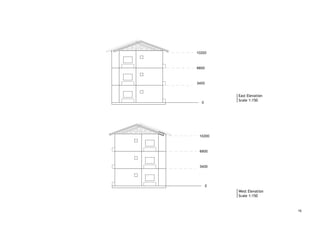
EastElevation
Scale1:150
WestElevation
Scale1:150
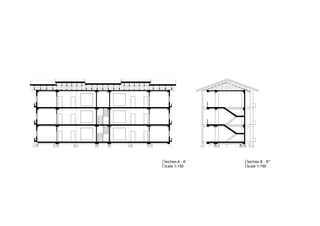
SectionA-A’
Scale1:150
SectionB-B’’
Scale1:150
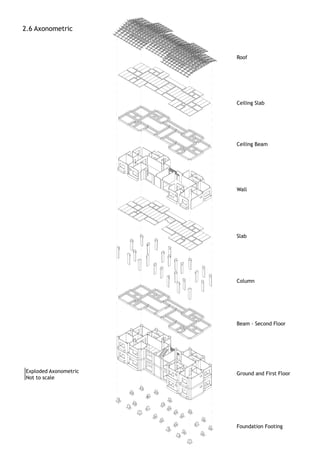
2.6Axonometric
Roof
CeilingSlab
Wall
Slab
Column
Beam-SecondFloor
GroundandFirstFloor
FoundationFooting
CeilingBeam
ExplodedAxonometric
Nottoscale
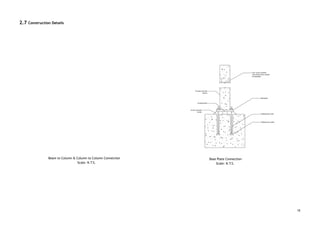
2.7 Construction Details 


Beam to Column & Column to Column Connection  
Scale: N.T.S.  


Base Plate Connection 
Scale: N.T.S. 


18


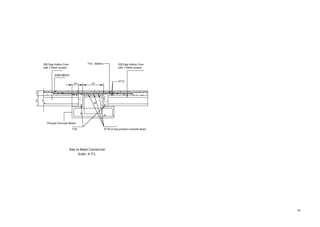
Slab to Beam Connection 
Scale: N.T.S.   
19
3. Study of Proposed IBS categories and detail of components 
3.1 Precast Concrete Frame 


Figure 3.1 Precast concrete frames are installed during construction 


Figure 3.2 Precast concrete frame during construction 
 
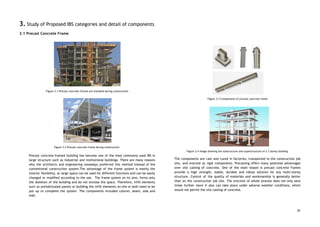
Precast concrete-framed building has become one of the most commonly used IBS in                         
large structure such as industrial and institutional buildings. There are many reasons                       
why the architects and engineering nowadays preferred this method instead of the                       
conventional construction system.The advantage of the frame system is mainly the                     
interior flexibility, as large space can be used for different functions and can be easily                             
changed or modified according to the use. The frame system on its own, forms only                             
the skeleton of the building and do not enclose the space. Therefore, infill elements                           
such as prefabricated panels or building the infill elements on site or both need to be                               
put up to complete the system. The components included column, beam, slab and                         
wall.  


Figure 3.3 Components of precast concrete frame 


Figure 3.4 Image showing the substructure and superstructure of a 3 storey building 
 
The components are cast and cured in factories, transported to the construction job                         
site, and erected as rigid components. Precasting offers many potential advantages                     
over site casting of concrete. One of the main reason is precast concrete frames                           
provide a high strength, stable, durable and robust solution for any multi-storey                       
structure. Control of the quality of materials and workmanship is generally better                       
than on the construction job site. The erection of whole process does not only save                             
times further more it also can take place under adverse weather conditions, which                         
would not permit the site casting of concrete. 
 
   
20
3.2 Precast Concrete Column 


Figure 3.5 Image above shows the corbel on the column supporting floor slabs. 
 
Precast concrete column is one of the load bearing element in the structural                         
component of a building. To minimize the number of precast elements the columns                         
have up to 3 stories height. The columns provide with single or multiple corbels to                             
support floor or roof beams. 


Figure 3.6 Connection of the column to the foundation 
 
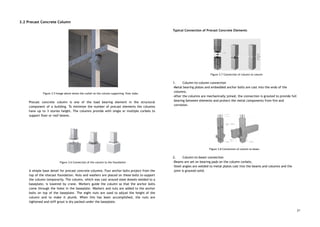
A simple base detail for precast concrete columns. Four anchor bolts project from the                           
top of the sitecast foundation. Nuts and washers are placed on these bolts to support                             
the column temporarily. The column, which was cast around steel dowels welded to a                           
baseplate, is lowered by crane. Workers guide the column so that the anchor bolts                           
come through the holes in the baseplate. Washers and nuts are added to the anchor                             
bolts on top of the baseplate. The eight nuts are used to adjust the height of the                                 
column and to make it plumb. When this has been accomplished, the nuts are                           
tightened and stiff grout is dry packed under the baseplate. 
 
 
Typical Connection of Precast Concrete Elements 


Figure 3.7 Connection of column to column 
 
1. Column-to-column connection   
-Metal bearing plates and embedded anchor bolts are cast into the ends of the  
columns. 
-After the columns are mechanically joined, the connection is grouted to provide full  
bearing between elements and protect the metal components from fire and  
corrosion. 


Figure 3.8 Connection of column to beam 
 
2. Column-to-beam connection 
-Beams are set on bearing pads on the column corbels. 
-Steel angles are welded to metal plates cast into the beams and columns and the  
joint is grouted solid. 


21
3.3 Precast Concrete Beam 


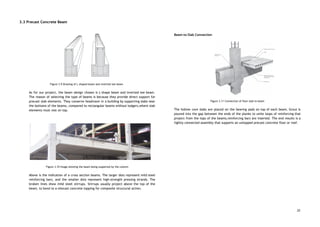
Figure 3.9 Drawing of L shaped beam and inverted tee beam 
 
As for our project, the beam design chosen is L-shape beam and inverted tee beam.                             
The reason of selecting the type of beams is because they provide direct support for                             
precast slab elements. They conserve headroom in a building by supporting slabs near                         
the bottoms of the beams, compared to rectangular beams without ledgers,where slab                       
elements must rest on top. 


Figure 3.10 Image showing the beam being supported by the column 
 
Above is the indication of a cross section beams. The larger dots represent mild steel                             
reinforcing bars, and the smaller dots represent high-strength pressing strands. The                     
broken lines show mild steel stirrups. Stirrups usually project above the top of the                           
beam, to bond to a sitecast concrete topping for composite structural action. 


Beam-to-Slab Connection 


Figure 3.11 Connection of floor slab to beam 
 
The hollow core slabs are placed on the bearing pads on top of each beam. Grout is                                 
poured into the gap between the ends of the planks to unite loops of reinforcing that                               
project from the tops of the beams,reinforcing bars are inserted. The end results is a                             
tightly connected assembly that supports an untopped precast concrete floor or roof. 


22
3.4 Precast Concrete Floor Slab 
 
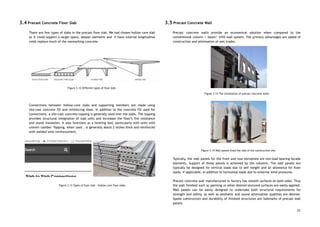
There are few types of slabs in the precast floor slab. We had chosen hollow core slab                                 
as it could support a larger spans, deeper elements and it have internal longitudinal                           
voids replace much of the nonworking concrete.  
 
 
Figure 3.12 Different types of floor slab 


Connections between hollow-core slabs and supporting members are made using                   
site-cast concrete fill and reinforcing steel. In addition to the concrete fill used for                           
connections, a site-cast concrete topping is generally used over the slabs. The topping                         
provides structural integration of slab units and increases the floor’s fire resistance                       
and sound insulation. It also functions as a leveling bed, particularly with units with                           
uneven camber. Topping, when used , is generally about 2 inches thick and reinforced                           
with welded wire reinforcement. 
 
 
Figure 3.13 Types of floor slab - Hollow core floor slabs  


3.5 Precast Concrete Wall 
 
Precast concrete walls provide an economical solution when compared to the                     
conventional column / beam/ infill wall system. The primary advantages are speed of                         
construction and elimination of wet trades. 


Figure 3.14 The installation of precast concrete walls 


Figure 3.15 Wall panels lined the side of the construction site 
 
Typically, the wall panels for the front and rear elevations are non-load bearing facade                           
elements. Support of these panels is achieved by the columns. The wall panels are                           
typically be designed for vertical loads due to self weight and an allowance for floor                             
loads, if applicable, in addition to horizontal loads due to external wind pressures.  
 
Precast concrete wall manufactured in factory has smooth surfaces on both sides. Thus                         
the wall finished such as painting or other desired textured surfaces are easily applied.                           
Wall panels can be easily designed to undertake both structural requirements for                       
strength and safety, as well as aesthetic and sound attenuation qualities are desired.                         
Speed construction and durability of finished structures are hallmarks of precast wall                       
panels. 
23
 
3.6 Pre-cast Concrete Staircases 


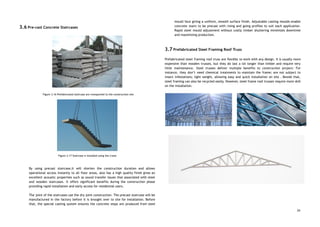
Figure 3.16 Prefabricated staircase are transported to the construction site 


Figure 3.17 Staircase is installed using the crane 
 
 
By using precast staircase,it will shorten the construction duration and allows                     
operational access instantly to all floor areas, also has a high quality finish gives an                             
excellent acoustic properties such as sound transfer issues that associated with steel                       
and wooden staircases. It offers significant benefits during the construction phase                     
providing rapid installation and early access for residential users. 
 
The joint of the staircases use the dry joint construction. The precast staircase will be                             
manufactured in the factory before it is brought over to site for installation. Before                           
that, the special casting system ensures the concrete steps are produced from steel                         
mould face giving a uniform, smooth surface finish. Adjustable casting moulds enable                       
concrete stairs to be precast with rising and going profiles to suit each application.                           
Rapid steel mould adjustment without costly timber shuttering minimizes downtime                   
and maximizing production. 
 
 
3.7 Prefabricated Steel Framing Roof Truss 
 
Prefabricated steel framing roof truss are flexible to work with any design. It is usually more                               
expensive than wooden trusses, but they do last a lot longer than timber and require very                               
little maintenance. Steel trusses deliver multiple benefits to construction project: For                     
instance, they don’t need chemical treatments to maintain the frame; are not subject to                           
insect infestations; light weight, allowing easy and quick installation on site . Beside that,                           
steel framing can also be recycled easily. However, steel frame roof trusses require more skill                             
on the installation. 


24
4. Model Construction Sequence 


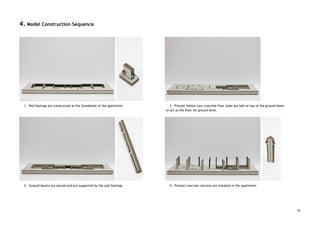
1. Pad footings are constructed as the foundation of the apartment. 


2. Ground beams are placed and are supported by the pad footings. 


3. Precast hollow core concrete floor slabs are laid on top of the ground beam 
to act as the floor for ground level. 


4. Precast concrete columns are installed in the apartment. 


25


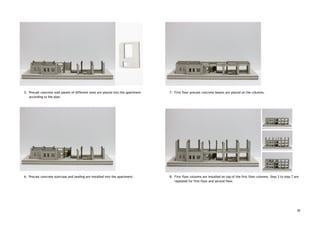
5. Precast concrete wall panels of different sizes are placed into the apartment 
according to the plan. 


6. Precast concrete staircase and landing are installed into the apartment.  


7. First floor precast concrete beams are placed on the columns. 


8. First floor columns are installed on top of the first floor columns. Step 3 to step 7 are 
repeated for first floor and second floor. 


26


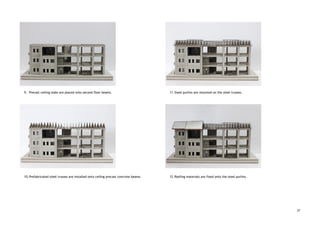
9. Precast ceiling slabs are placed onto second floor beams.  


10.Prefabricated steel trusses are installed onto ceiling precast concrete beams. 


11.Steel purlins are mounted on the steel trusses. 


12.Roofing materials are fixed onto the steel purlins.   
27
6. IBS Score Calculation 
 
1) Construction area 
  
(i) Ground floor area    = 94 m2 
(ii) First floor area  = 94 m2 
(iii) Second floor area    = 94 m2 
(iv) Roof area  = 94 m2 
  
Total Construction area  = 376 m2 
  
2) Structural Systems 
  
(i) Beams:  Precast concrete beams 
(ii) Columns:  Precast concrete column 
(iii) Floor slab:  Precast concrete floor slab 
(iv) Roof truss:    Prefabricated steel roof truss 
  
3) Wall System 
  
(i) Internal wall:  Precast concrete panel 
(ii) External wall:  Precast concrete panel 
  
4) Other simplified construction solutions 
  
(i) Beams: Less than 50% complies with MS 1064 Part 10: 2001 
Columns: 84.6% complies with MS 1064 Part 10: 2001 
Walls: Less than 50% complies with MS 1064 Part 10: 2001 
Floor Slabs: Less than 50% complies with MS 1064 Part 10: 2001 
Doors: 100% complies with MS 1064 Part 4: 2001 
Windows: 100% complies with MS 1064 Part 5: 2001 
  
(ii) Repetition of floor to floor height = 100% 
Horizontal repetition of structure = 100% 
Vertical repetition of structure = 100% 


ELEMENTS 
AREA(m2
) or 
Length(m) 
  
COVERAGE 
IBS 
FACTOR(1) 
  
IBS SCORE 
Part 1: Structure 
Elements 
           
Precast beams + Precast 
columns + Precast 
concrete slab - Ground 
floor area 
  
94 m2 
(94/376) 
= 0.25 
  
1.0 
0.25 x 1.0 x 50 
= 12.5 
Precast beams + Precast 
columns + Precast 
concrete slab - First 
floor area 
  
94 m2 
(94/376) 
= 0.25 
  
  
1.0 
0.25 x 1.0 x 50 
= 12.5 
Precast beams + Precast 
columns + Precast 
concrete slab - Second 
floor area 
  
94 m2 
(94/376) 
= 0.25 
  
  
1.0 
0.25 x 1.0 x 50 
= 12.5 
Roof truss using prefab 
metal roof truss - Roof 
area 
  
94 m2 
(94/376) 
= 0.25 
  
1.0 
0.25 x 1.0 x 50 
= 12.5 
Total Part 1  376 m2 
1.0     50 


ELEMENTS 
AREA(m2
) 
or 
Length(m) 
  
COVERAGE 
IBS 
FACTOR(1) 
  
IBS SCORE 
Part 2: Wall System             
External wall using 
precast concrete panel 
425.1 m2 
(425.1/1019.7) 
= 0.42 
1.0  0.42 x 1.0 x 20 
= 8.4 
Internal wall using 
precast concrete panel 
594.6 m2 
(594.6/1019.7) 
= 0.58 
1.0  0.58 x 1.0 x 20 
= 11.6 
Total Part 2  1019.7 m2 
1.0     20 
32
 
  
ELEMENTS 
AREA(m2
) or 
Length(m) 
  
COVERAGE 
IBS 
FACTOR(1) 
  
IBS SCORE 
Part 3: Other simplified 
construction solutions 
           
Column sizes follow 
MS1064 Part 10: 2001 
   84.6%     4 
Door sizes follow MS1064 
Part 4: 2001 
   100%     4 
Window sizes follow 
MS1064 Part 4: 2001 
   100%     4 
Repetition of floor to 
floor height 
   100%     2 
Horizontal repetition of 
structural floor layout (> 
2 storeys) 
   100%     2 
Vertical repetition of 
structural floor layout (> 
2 storeys) 
   100%     2 
Total Part 3           18 
 
 
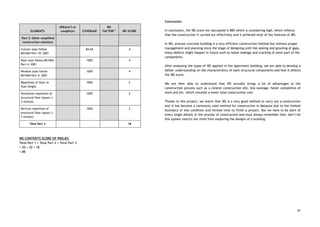
IBS CONTENTS SCORE OF PROJEC 
Total Part 1 + Total Part 2 + Total Part 3 
= 50 + 20 + 18 
= 88 


Conclusion: 
 
In conclusion, the IBS score we calculated is 88% which is considering high, which reflects 
that the construction if carried out effectively and it achieved most of the features of IBS. 
 
In IBS, precast concrete building is a very efficient construction method but without proper 
management and planning since the stage of designing until the sealing and grouting of gaps, 
many defects might happen in future such as water leakage and cracking of some part of the 
components. 
 
After analysing the types of IBS applied in the apartment building, we are able to develop a                                 
better understanding on the characteristics of each structural components and how it affects                         
the IBS score.  
 
We are then able to understand that IBS actually brings a lot of advantages to the                               
construction process such as a cleaner construction site, less wastage, faster completion of                         
work and etc. which resulted a lower total construction cost.  
 
Thanks to this project, we learnt that IBS is a very good method to carry out a construction                                   
and it has become a commonly used method for construction in Malaysia due to the limited                               
boundary of site condition and limited time to finish a project. But we have to be alert of                                   
every single details in the process of construction and must always remember that, don’t let                             
this system restrict our mind from exploring the designs of a building. 


33
Reference list:
1. Industrialised building system (IBS). (2017, September 27). Retrieved October 08, 2017, from
https://en.wikipedia.org/wiki/Industrialised_building_system_(IBS)
2. 마 이환 Follow. (2014, July 04). Group Assignment:IBS System. Retrieved October 08, 2017,
from https://www.slideshare.net/x3HwaN/group-assignmentibs-system
3. Concrete masonry unit. (2017, September 30). Retrieved October 08, 2017, from
https://en.wikipedia.org/wiki/Concrete_masonry_unit
4. Ibs Complete. (n.d.). Retrieved October 08, 2017, from
https://www.scribd.com/doc/21794505/Ibs-Complete
5. Concrete Frame Construction | Concrete Frame Structures. (n.d.). Retrieved October 08, 2017,
from http://www.understandconstruction.com/concrete-frame-structures.html
6. History Of Ibs In Malaysia Construction Essay. (n.d.). Retrieved October 08, 2017, from
https://essays.pw/essay/history-of-ibs-in-malaysia-construction-essay-68039
7. Bhd, I. M. (1970, January 01). IBS Modular. Retrieved October 08, 2017, from
http://ibsmodular.blogspot.my/
8. Abhishek Gupta, Working Follow. (2015, April 03). PreCast Construction. Retrieved October 08,
2017, from https://www.slideshare.net/shekhu001/precast-construction
9. Precast Concrete Frame Buildings Design Guide. (n.d.). Retrieved October 08, 2017, from
https://www.scribd.com/doc/51059215/Precast-Concrete-Frame-Buildings-Design-Guide
10. Experimental study of a new beam-to-column connection for precast concrete frames under
reversal cyclic loading. (n.d.). Retrieved October 08, 2017, from
http://journals.sagepub.com/doi/abs/10.1177/1369433216630122
11. Precast Wall Connections, Precast Walls, Precast Frames. (n.d.). Retrieved October 08, 2017,
from
http://www.oreillyconcrete.com/products/precast-walls/precast-wall-connection-details/#prettyPh
oto[postimages]/5/
12. (n.d.). Retrieved October 08, 2017, from http://www.swiftseal.com/construction%20joints.html
13. Industrialised building systems in Malaysia. (2006). Malaysia: CIDB.
34

Industrialised Building Solution

  • 1.
                      Bachelor of Science(Honours) in Architecture     BUILDING TECHNOLOGY I (BLD 61403)     Project 1   Industrialised Building System     Group Members :  Alexandra Go  How Seng Guan  Jacky Ting Sim Ming  Lee Suk Fang  Lee Wan Xuan  Tan Chin Yin  0325342  1007P73021  0325286  0323293  0325273  0320080    Tutor : Mr. Rizal  1
  • 2.
    Table of ContentsPage    1.Introduction     1.1 Aims and objectives 1  1.2 Introduction of IBS 1  1.3 Types of IBS 3-4   1.4 Concept and Framework   1.4.1 Advantages of using IBS 5  1.4.2 Defects of Precast Concrete Building 5  1.4.3 Standard Design Workflow  6  1.4.4 Structural Construction Process 6  1.5 Case Study  1.5.1 The Bayron, Devonshire Road, Singapore 7-8  1.5.2 Seri Jati Apartment, Setia Alam 9     2.Technical Drawings  2.1 Architectural Plans 10-11  2.2 Structural Plan 12  2.3 Elevations 13-14  2.4 Section 15  2.5 Axonometric 16  2.6 Sectional Perspective  17  2.7 Construction Details 18    3.Study of Proposed IBS categories and detail of components  3.1 Precast Concrete Frame 19  3.2 Precast Concrete Column 20  3.3 Precast Concrete Beam 21  3.4 Precast Concrete Floor Slab 22  3.5 Precast Concrete Wall 22  3.6 Precast Concrete Staircase 23  3.7 Prefabricated Steel Framing Roof Truss 23    4. Construction sequence 24-26  5. Schedule of IBS Components  5.1 Column Schedule 27-28  5.2 Column and Beam Schedule 29  5.3 Wall Schedule 30-33   5.4 Door and Window Schedule 34  6. IBS Score Calculation 35-36  7. Conclusion 36  8. Reference List 37                      2
  • 3.
    1.Introduction    1.1 Aims andObjectives    This project is to provide a in depth and well-documented analysis about the topic of                              different types and methods of Industrialised Building System (IBS).For this report, we need                          to proposed a 3-storey apartment block which using mainly IBS components. Done so over the                              course of six to seven weeks,our learning outcome as the following:    (i) To study and identify the research data about types of IBS and construction methods.    (ii) Able to explain and apply the relevant knowledge through a set of architectural and                              structural documentation.    (iii) Able to relate the basic structural elements and structural principles in                        construction.Further analyse and document construction methods and materials.    (iv) To be able to produce a well-documented report that surmises our findings and analysis                              of our case study - which can then serve as an example of our accumulated knowledge of the                                    relationship between construction and building.    By analysing the types of IBS applied in the apartment building, we are then able to develop                                  a better understanding on the characteristics of each structural components and how it                          affects the IBS score. It is also important to know how different types of components and                                their construction method influence the construction efficiency and the overall aesthetic                      appearance.                              1.2 Introduction of IBS    What is IBS?    Industrialised building system (IBS) also known as Pre-fabricated Construction and Off-site                      Construction, is a method of construction where the structural of building components are                          fabricated under a controlled environment. They are produced off-site later transported and                        assembled into construction site.    They are divided into two systems which are open system and close system:  Open system refers to the IBS components are fabricated by different manufacturers                        while;  Close system is the IBS components are fabricated from one manufacturer.    There are several building components using IBS, which are columns, beams, floor slabs,                          walls, portal frame, steel roof truss and 3-D components such as balconies, staircases,                          toilets, etc.    The content of IBS (IBS Score) is determined based on the Construction Industry Standard 18                              (CIS 18: 2010); either manually, web application or fully automated CAD-based IBS Score                          calculator.    In Malaysia, the implementation of IBS concept by using pre-cast concrete building were                          introduced in Malaysia 1966 when the government launched two pilot projects for pre-cast                          housing which involves the construction of Tuanku Abdul Rahman Flats in Kuala Lumpur and                            the Rifle Range Road Flats in Penang.     Since 1980’s there are intensive marketing strategies launched by the Malaysian Government                        to introduce modular coordination, its acceptance has received poor responses for the                        building industry. As a result even partial introduction of IBS such as lintels and staircase has                                not been possible     In the 90s, demand for the new township has seen to increase in the use of precast concrete                                    system in high rise residential buildings. In the booming period of Malaysian construction                          1994 to 1997, hybrid IBS application used in many national iconic landmarks such as Kuala                              Lumpur Convention Center, Bukit Jalil Sport Complex constructed using steel beam and roof                          trusses and precast concrete. Other than that, Lightweight Railway Train (LRT) and KL                          Sentral was constructed by using steel roof structure and precast hollow core.       3
  • 4.
    1.3 Types ofIBS    The Malaysian construction industry is undergoing a transitional change from an                      industry employing to one which is more systematic and mechanised. Based on                        Construction Industry Development Berhad ( CIDB ), IBS is structurally classified into                        six main groups, which are:    i. Precast system  ii. Steel Framing system  iii. Formwork system  iv. Block work system  v. Prefabricated timber framing  vi. Innovative system    i. Precast system  This system consist of precasting concrete columns, beams, slabs, walls and “ 3-D ”                            components which as balconies , staircases, toilets, lift chambers, refuse chambers as                        well as lightweight precast concrete and permanent concrete formworks. This is the                        most popular and widely used IBS in Malaysia. Besides, it is produced by using steel or                                fiberglass formwork. Mainly used in schools, apartments, infrastructure projects and                    etc.    Figure 1.1 Precast walls Figure 1.2 Precast staircases        ii. Steel framing system  This system is commonly used with precast concrete slabs, steel columns/ beams and                          steel framing systems, and is used extensively in fast-track construction of skyscrapers                        and also in construction of large factories and exhibition halls that require wide areas.                            Apart from that, it is extensively used for light steel trusses consisting of                          cost-effective profiled cold-formed channels and steel portal frame system as                    alternatives to the heavier traditional hot-rolled sections.                             Figure 1.3 Steel roof trusses Figure 1.4 Pre-cast steel floor decking    iii. Formwork system  This system is made up of tunnel forms, beams and columns moulding forms, and                            permanent steel formworks. It is the least prefabricated among all the IBS, as it                            normally involves site casting. Therefore, it is subject to structural quality control,                        high quality finishes and fast construction with less site labour and material                        requirement. The temporary formwork usually used not less than 20 times. It uses                          expanded polystyrene (EPS) as based forms.                            Figure 1.5 Formwork of column Figure 1.6 Formwork of wall panels                4
  • 5.
    iv. Block worksystem  It includes of interlocking concrete masonry units (CMU) and lightweight concrete                      blocks. It is mainly used for non-structural wall as an alternative to conventional brick                            and plaster. They may include a hollow core to make them lighter and to improve                              insulation properties. It has the lowest IBS score in the IBS scoring system.                        Figure 1.7 Interlocking block work Figure 1.8 Installation of blocks      v. Prefabricated- timber framing system  It consists of timber building frames and timber roof trusses. Although the latter is                            more common, timber building frame systems also offer attractive designs and high                        aesthetic value from simple dwelling units to buildings such as chalets for resorts.                          Examples of choice of timber are Bakau, Chengal, Kekatong, Keranji and Resak.                            Figure 1.9 Timber roof trusses Figure 1.10 Timber framing             vi. Innovative system  This is the latest IBS which incorporates various “green” elements, which are                        considered innovative in the industry. An example of the innovation is the mixture of                            two elements such as polystyrene and concrete, to produce IBS components for use in                            the construction of a wall which has better heat insulation properties. Indeed, with                          the advancement in technology and innovation, new materials are being introduced at                        the fabrication stage. Some of the new materials introduced in IBS include gypsum,                          wood wool, polymer, fiberglass and aluminium-based IBS components.                Figure 1.11 Installation of drywall            5
  • 6.
    1.4 Concept andFramework    1.4.1 What is the advantages of using IBS:  ● Results in high-quality products and minimum waste, due to a factory work                        environment that is easier to control.  ● Results in elimination of conventional timber props and an obvious decrease of                        supporting materials, through the use of complete assembly elements or prop system                        for the onsite casting process.  ● Results in a stronger and safer work platform, produced through a complete assembly                          element.  ● Results in faster completion, due to the introduction of prefabricated components to                        replace onsite fabrication.  ● Results in a safer, cleaner and more organized site, due to the reduction of                            construction waste, site workers and prefabricated construction materials; and  ● Results in a cheaper total construction cost, resulting from the above factors.                                  1.4.2 Defects of Precast Concrete Building      Figure 1.12 Steel reinforcement is exposed Figure 1.13 Water damage on concrete    Without proper building maintenance, precast concrete building under IBS will be                      facing a few very common problems, such as below:    1.Water leakage   Water leakage is the most crucial defect in precast concrete building.This problem                        normally happen due to poor joint connection of the components.    2.Cracking   This problem is most commonly related to the improper use of raw material with                            specification or there is lacking of skills and careless mistakes during the procedure                          for quality control. Cracking may occur any part of the precast component either                          panel, beam or even slab.     3. Poor humidity control   When there is water leakage into the building such as from piping system, it will                              caused the interior of the building to have high level of humidity. This can cause the                                M&E services inside the building became rusted and same time will affect the                          effectiveness of M&E services.    4. Poor finishing  Poor finishing could cause by the human factors like workers experiences or the                          material issues.             6
  • 7.
    1.4.3 Standard DesignWorkflow of IBS                                          The first stage is design phase, where the design of IBS components are carried out                              according to the specification stated in MS 1064. Then, the components are precast                          off site, which is at the manufacturing plant according to the specified dimension and                            details. Quality-controlled of the end products was ensured through the processes of                        controlled prefabrication stage. The IBS components are then transported to the site                        from the manufacturing plant to the construction site for assembling stage. When the                          components reached the site, they will be assembled with the assistance of a crane                            tower. Because of the precast process for components, there is less in-site work, thus                            reduces the wastage and provide a cleaner site. Finally, the final unit is done                            assembling and is ready to serve the users or client.                        1.4.4 Structural Construction Process    Before any proper planning, the construction shouldn’t been carried out because it                        might caused a lot of mistakes in installation of components which will cause                          structural failure. So to ensure high efficiency and quality of installation, things like                          method or sequence of assembly, handling method of rigging system, temporary                      support, joint detail method and etc. should be taken into consideration. Following                        are some steps to be considered during the phase of preparation:        1. Check for site accessibility for the delivery of                precast elements.  2. Check delivery checklist for correct type,            quantity and panel specification.  3. Conduct sample measurement to confirm on            the accuracy of the dimension of components.  4. Check the locations and conditions for lifting.    Next phase will be the installation of vertical precast                  components. Firstly:    1. Check the positions and alignment of starter              bars before installing it.  2. During installation, check the stability of the              erected props before releasing hoisting cable.  3. When carrying out grouting work, make sure              the joint width between panels are within              allowances designed.  4. The joint gaps should be consistent to allow for                  proper installation of sealant or grout to              achieve high level of watertightness which can              prevent water leakage.    The last phase is the installation of horizontal precast                  components. Checklists that need to be done are such as:    1. Lifting of beam should be supported minimum at two ends.  2. Secure the formwork during casting.  3. Check the levelness between each component before sealing them.  4. Other will be mostly the same as vertical components casting.  7
  • 8.
    1.5 Case Studies    1.5.1The Bayron, Devonshire Road, Singapore    Located in Devonshire Road, Singapore, The Bayron is a private residential completed                        in 1999. It is a part 12 storey, part 15 storey apartment with a total of 96 units. 19                                      months were taken to complete the construction of this apartment.     An existing layout plan that uses conventional in-situ reinforced concrete structure                      with brickwall and plastering was modified to use precast concrete instead as on-site                          precasting was not possible due to site constraints.                                                   Figure 1.14 Entrance of the Bayron Apartment    The Bayron uses precast concrete components such as precast 2-tiered columns,                      precast beams, prefabricated bathroom, precast wall panel, precast staircase and                    precast refuse chute. The buildability score of this apartment using precast concrete                        is 85 while the buildability score of the existing design is only 48.                                                                                  FIgure 1.15 Plan indicating precast concrete components in The Bayron    8
  • 9.
                                        Figure 1.16 Elevationshowing precast concrete beams and columns                                              Figure 1.17 Isometric view of precast column, beam and floor construction                                        Figure 1.18 Detailed section of a part of the apartment                        Figure 1.19 Precast concrete beam and floor Figure 1.20 Precast concrete beam and floor   slab connection (Detail A) slab connection (Detail C)                  Figure 1.21 Precast concrete slab to slab connection (Detail B)    9
  • 10.
    1.5.2 Seri JatiApartment, Setia Alam    Seri Jati is a low cost apartment located in the vicinity of Shah Alam, Selangor. This                                residence was developed for the lower and medium income citizens by the renowned                          SP Setia. Launched in the year 2012, this high density residence was completed on                            2014. This residence offers 6 blocks in total, whereby 3 blocks are 10 storeys high and                                the remaining 3 blocks are 11 storeys high. It has a total of 948 units.        Figure 1.22 View of Seri Jati Apartment from the pool    Seri Jati Apartment uses precast concrete system with components such as precast                        load bearing walls,precast non-bearing walls, precast staircases and landing slabs,                    precast lift core walls, precast bathroom slabs and precast air-cond ledges. It also                          uses prefabricated steel trusses for the roof.     Floor slabs of this apartment are cast in-situ slabs. It has a total of 81.9 IBS score. The                                    use of IBS in this apartment has reduced construction time, number of construction                          workers and also cost.                                                Figure 1.23 Image showing the construction of Setia Jati Apartment                                      Figure 1.24 Precast load bearing walls of Setia Jati Apartment        10
  • 11.
  • 12.
  • 13.
  • 14.
  • 15.
  • 16.
  • 17.
  • 18.
    2.7 Construction Details               Beam to Column & Column to Column Connection   Scale: N.T.S.                                                                                  Base Plate Connection  Scale: N.T.S.              18
  • 19.
            Slab to BeamConnection  Scale: N.T.S.    19
  • 20.
    3. Study ofProposed IBS categories and detail of components  3.1 Precast Concrete Frame                          Figure 3.1 Precast concrete frames are installed during construction                          Figure 3.2 Precast concrete frame during construction    Precast concrete-framed building has become one of the most commonly used IBS in                          large structure such as industrial and institutional buildings. There are many reasons                        why the architects and engineering nowadays preferred this method instead of the                        conventional construction system.The advantage of the frame system is mainly the                      interior flexibility, as large space can be used for different functions and can be easily                              changed or modified according to the use. The frame system on its own, forms only                              the skeleton of the building and do not enclose the space. Therefore, infill elements                            such as prefabricated panels or building the infill elements on site or both need to be                                put up to complete the system. The components included column, beam, slab and                          wall.                                         Figure 3.3 Components of precast concrete frame                        Figure 3.4 Image showing the substructure and superstructure of a 3 storey building    The components are cast and cured in factories, transported to the construction job                          site, and erected as rigid components. Precasting offers many potential advantages                      over site casting of concrete. One of the main reason is precast concrete frames                            provide a high strength, stable, durable and robust solution for any multi-storey                        structure. Control of the quality of materials and workmanship is generally better                        than on the construction job site. The erection of whole process does not only save                              times further more it also can take place under adverse weather conditions, which                          would not permit the site casting of concrete.        20
  • 21.
    3.2 Precast ConcreteColumn                                  Figure 3.5 Image above shows the corbel on the column supporting floor slabs.    Precast concrete column is one of the load bearing element in the structural                          component of a building. To minimize the number of precast elements the columns                          have up to 3 stories height. The columns provide with single or multiple corbels to                              support floor or roof beams.                      Figure 3.6 Connection of the column to the foundation    A simple base detail for precast concrete columns. Four anchor bolts project from the                            top of the sitecast foundation. Nuts and washers are placed on these bolts to support                              the column temporarily. The column, which was cast around steel dowels welded to a                            baseplate, is lowered by crane. Workers guide the column so that the anchor bolts                            come through the holes in the baseplate. Washers and nuts are added to the anchor                              bolts on top of the baseplate. The eight nuts are used to adjust the height of the                                  column and to make it plumb. When this has been accomplished, the nuts are                            tightened and stiff grout is dry packed under the baseplate.      Typical Connection of Precast Concrete Elements                    Figure 3.7 Connection of column to column    1. Column-to-column connection    -Metal bearing plates and embedded anchor bolts are cast into the ends of the   columns.  -After the columns are mechanically joined, the connection is grouted to provide full   bearing between elements and protect the metal components from fire and   corrosion.                    Figure 3.8 Connection of column to beam    2. Column-to-beam connection  -Beams are set on bearing pads on the column corbels.  -Steel angles are welded to metal plates cast into the beams and columns and the   joint is grouted solid.              21
  • 22.
    3.3 Precast ConcreteBeam                            Figure 3.9 Drawing of L shaped beam and inverted tee beam    As for our project, the beam design chosen is L-shape beam and inverted tee beam.                              The reason of selecting the type of beams is because they provide direct support for                              precast slab elements. They conserve headroom in a building by supporting slabs near                          the bottoms of the beams, compared to rectangular beams without ledgers,where slab                        elements must rest on top.                          Figure 3.10 Image showing the beam being supported by the column    Above is the indication of a cross section beams. The larger dots represent mild steel                              reinforcing bars, and the smaller dots represent high-strength pressing strands. The                      broken lines show mild steel stirrups. Stirrups usually project above the top of the                            beam, to bond to a sitecast concrete topping for composite structural action.              Beam-to-Slab Connection                              Figure 3.11 Connection of floor slab to beam    The hollow core slabs are placed on the bearing pads on top of each beam. Grout is                                  poured into the gap between the ends of the planks to unite loops of reinforcing that                                project from the tops of the beams,reinforcing bars are inserted. The end results is a                              tightly connected assembly that supports an untopped precast concrete floor or roof.          22
  • 23.
    3.4 Precast ConcreteFloor Slab    There are few types of slabs in the precast floor slab. We had chosen hollow core slab                                  as it could support a larger spans, deeper elements and it have internal longitudinal                            voids replace much of the nonworking concrete.       Figure 3.12 Different types of floor slab        Connections between hollow-core slabs and supporting members are made using                    site-cast concrete fill and reinforcing steel. In addition to the concrete fill used for                            connections, a site-cast concrete topping is generally used over the slabs. The topping                          provides structural integration of slab units and increases the floor’s fire resistance                        and sound insulation. It also functions as a leveling bed, particularly with units with                            uneven camber. Topping, when used , is generally about 2 inches thick and reinforced                            with welded wire reinforcement.      Figure 3.13 Types of floor slab - Hollow core floor slabs           3.5 Precast Concrete Wall    Precast concrete walls provide an economical solution when compared to the                      conventional column / beam/ infill wall system. The primary advantages are speed of                          construction and elimination of wet trades.                        Figure 3.14 The installation of precast concrete walls                          Figure 3.15 Wall panels lined the side of the construction site    Typically, the wall panels for the front and rear elevations are non-load bearing facade                            elements. Support of these panels is achieved by the columns. The wall panels are                            typically be designed for vertical loads due to self weight and an allowance for floor                              loads, if applicable, in addition to horizontal loads due to external wind pressures.     Precast concrete wall manufactured in factory has smooth surfaces on both sides. Thus                          the wall finished such as painting or other desired textured surfaces are easily applied.                            Wall panels can be easily designed to undertake both structural requirements for                        strength and safety, as well as aesthetic and sound attenuation qualities are desired.                          Speed construction and durability of finished structures are hallmarks of precast wall                        panels.  23
  • 24.
      3.6 Pre-cast ConcreteStaircases                              Figure 3.16 Prefabricated staircase are transported to the construction site                            Figure 3.17 Staircase is installed using the crane      By using precast staircase,it will shorten the construction duration and allows                      operational access instantly to all floor areas, also has a high quality finish gives an                              excellent acoustic properties such as sound transfer issues that associated with steel                        and wooden staircases. It offers significant benefits during the construction phase                      providing rapid installation and early access for residential users.    The joint of the staircases use the dry joint construction. The precast staircase will be                              manufactured in the factory before it is brought over to site for installation. Before                            that, the special casting system ensures the concrete steps are produced from steel                          mould face giving a uniform, smooth surface finish. Adjustable casting moulds enable                        concrete stairs to be precast with rising and going profiles to suit each application.                            Rapid steel mould adjustment without costly timber shuttering minimizes downtime                    and maximizing production.      3.7 Prefabricated Steel Framing Roof Truss    Prefabricated steel framing roof truss are flexible to work with any design. It is usually more                                expensive than wooden trusses, but they do last a lot longer than timber and require very                                little maintenance. Steel trusses deliver multiple benefits to construction project: For                      instance, they don’t need chemical treatments to maintain the frame; are not subject to                            insect infestations; light weight, allowing easy and quick installation on site . Beside that,                            steel framing can also be recycled easily. However, steel frame roof trusses require more skill                              on the installation.                          24
  • 25.
    4. Model ConstructionSequence                                                      1. Pad footings are constructed as the foundation of the apartment.                                    2. Ground beams are placed and are supported by the pad footings.                            3. Precast hollow core concrete floor slabs are laid on top of the ground beam  to act as the floor for ground level.                                  4. Precast concrete columns are installed in the apartment.          25
  • 26.
                                    5. Precast concretewall panels of different sizes are placed into the apartment  according to the plan.                                    6. Precast concrete staircase and landing are installed into the apartment.                                               7. First floor precast concrete beams are placed on the columns.                                      8. First floor columns are installed on top of the first floor columns. Step 3 to step 7 are  repeated for first floor and second floor.            26
  • 27.
                                    9. Precast ceilingslabs are placed onto second floor beams.                                       10.Prefabricated steel trusses are installed onto ceiling precast concrete beams.                                              11.Steel purlins are mounted on the steel trusses.                                      12.Roofing materials are fixed onto the steel purlins.    27
  • 34.
    6. IBS ScoreCalculation    1) Construction area     (i) Ground floor area    = 94 m2  (ii) First floor area  = 94 m2  (iii) Second floor area    = 94 m2  (iv) Roof area  = 94 m2     Total Construction area  = 376 m2     2) Structural Systems     (i) Beams:  Precast concrete beams  (ii) Columns:  Precast concrete column  (iii) Floor slab:  Precast concrete floor slab  (iv) Roof truss:    Prefabricated steel roof truss     3) Wall System     (i) Internal wall:  Precast concrete panel  (ii) External wall:  Precast concrete panel     4) Other simplified construction solutions     (i) Beams: Less than 50% complies with MS 1064 Part 10: 2001  Columns: 84.6% complies with MS 1064 Part 10: 2001  Walls: Less than 50% complies with MS 1064 Part 10: 2001  Floor Slabs: Less than 50% complies with MS 1064 Part 10: 2001  Doors: 100% complies with MS 1064 Part 4: 2001  Windows: 100% complies with MS 1064 Part 5: 2001     (ii) Repetition of floor to floor height = 100%  Horizontal repetition of structure = 100%  Vertical repetition of structure = 100%               ELEMENTS  AREA(m2 ) or  Length(m)     COVERAGE  IBS  FACTOR(1)     IBS SCORE  Part 1: Structure  Elements              Precast beams + Precast  columns + Precast  concrete slab - Ground  floor area     94 m2  (94/376)  = 0.25     1.0  0.25 x 1.0 x 50  = 12.5  Precast beams + Precast  columns + Precast  concrete slab - First  floor area     94 m2  (94/376)  = 0.25        1.0  0.25 x 1.0 x 50  = 12.5  Precast beams + Precast  columns + Precast  concrete slab - Second  floor area     94 m2  (94/376)  = 0.25        1.0  0.25 x 1.0 x 50  = 12.5  Roof truss using prefab  metal roof truss - Roof  area     94 m2  (94/376)  = 0.25     1.0  0.25 x 1.0 x 50  = 12.5  Total Part 1  376 m2  1.0     50         ELEMENTS  AREA(m2 )  or  Length(m)     COVERAGE  IBS  FACTOR(1)     IBS SCORE  Part 2: Wall System              External wall using  precast concrete panel  425.1 m2  (425.1/1019.7)  = 0.42  1.0  0.42 x 1.0 x 20  = 8.4  Internal wall using  precast concrete panel  594.6 m2  (594.6/1019.7)  = 0.58  1.0  0.58 x 1.0 x 20  = 11.6  Total Part 2  1019.7 m2  1.0     20  32
  • 35.
         ELEMENTS  AREA(m2 ) or  Length(m)     COVERAGE  IBS  FACTOR(1)     IBS SCORE  Part3: Other simplified  construction solutions              Column sizes follow  MS1064 Part 10: 2001     84.6%     4  Door sizes follow MS1064  Part 4: 2001     100%     4  Window sizes follow  MS1064 Part 4: 2001     100%     4  Repetition of floor to  floor height     100%     2  Horizontal repetition of  structural floor layout (>  2 storeys)     100%     2  Vertical repetition of  structural floor layout (>  2 storeys)     100%     2  Total Part 3           18      IBS CONTENTS SCORE OF PROJEC  Total Part 1 + Total Part 2 + Total Part 3  = 50 + 20 + 18  = 88                        Conclusion:    In conclusion, the IBS score we calculated is 88% which is considering high, which reflects  that the construction if carried out effectively and it achieved most of the features of IBS.    In IBS, precast concrete building is a very efficient construction method but without proper  management and planning since the stage of designing until the sealing and grouting of gaps,  many defects might happen in future such as water leakage and cracking of some part of the  components.    After analysing the types of IBS applied in the apartment building, we are able to develop a                                  better understanding on the characteristics of each structural components and how it affects                          the IBS score.     We are then able to understand that IBS actually brings a lot of advantages to the                                construction process such as a cleaner construction site, less wastage, faster completion of                          work and etc. which resulted a lower total construction cost.     Thanks to this project, we learnt that IBS is a very good method to carry out a construction                                    and it has become a commonly used method for construction in Malaysia due to the limited                                boundary of site condition and limited time to finish a project. But we have to be alert of                                    every single details in the process of construction and must always remember that, don’t let                              this system restrict our mind from exploring the designs of a building.                                         33
  • 36.
    Reference list: 1. Industrialisedbuilding system (IBS). (2017, September 27). Retrieved October 08, 2017, from https://en.wikipedia.org/wiki/Industrialised_building_system_(IBS) 2. 마 이환 Follow. (2014, July 04). Group Assignment:IBS System. Retrieved October 08, 2017, from https://www.slideshare.net/x3HwaN/group-assignmentibs-system 3. Concrete masonry unit. (2017, September 30). Retrieved October 08, 2017, from https://en.wikipedia.org/wiki/Concrete_masonry_unit 4. Ibs Complete. (n.d.). Retrieved October 08, 2017, from https://www.scribd.com/doc/21794505/Ibs-Complete 5. Concrete Frame Construction | Concrete Frame Structures. (n.d.). Retrieved October 08, 2017, from http://www.understandconstruction.com/concrete-frame-structures.html 6. History Of Ibs In Malaysia Construction Essay. (n.d.). Retrieved October 08, 2017, from https://essays.pw/essay/history-of-ibs-in-malaysia-construction-essay-68039 7. Bhd, I. M. (1970, January 01). IBS Modular. Retrieved October 08, 2017, from http://ibsmodular.blogspot.my/ 8. Abhishek Gupta, Working Follow. (2015, April 03). PreCast Construction. Retrieved October 08, 2017, from https://www.slideshare.net/shekhu001/precast-construction 9. Precast Concrete Frame Buildings Design Guide. (n.d.). Retrieved October 08, 2017, from https://www.scribd.com/doc/51059215/Precast-Concrete-Frame-Buildings-Design-Guide 10. Experimental study of a new beam-to-column connection for precast concrete frames under reversal cyclic loading. (n.d.). Retrieved October 08, 2017, from http://journals.sagepub.com/doi/abs/10.1177/1369433216630122 11. Precast Wall Connections, Precast Walls, Precast Frames. (n.d.). Retrieved October 08, 2017, from http://www.oreillyconcrete.com/products/precast-walls/precast-wall-connection-details/#prettyPh oto[postimages]/5/ 12. (n.d.). Retrieved October 08, 2017, from http://www.swiftseal.com/construction%20joints.html 13. Industrialised building systems in Malaysia. (2006). Malaysia: CIDB. 34