Building Economics
Chloe Sim 0322932
Alwin Ng Kun Ket 0323596
Loh Wen Jun 0323551
Gillian Chong Yeong Lin 0323941
Ng Zhen Huan 0324261
Kiew Chee Yuan 0323297
Farah Sham 0322962
1. What is
building
economics?
▪ The study of building economics consists of the
application of the techniques and expertise of
economics to construction projects.
Building Economics seeks to ensure the efficient use of
resources available to the industry and the rate of
growth of construction in an efficient manner
Building
economics
includes the
study of:
1. Client’s requirements
2. Possible effects of surrounding area
3. Relationships of space and shape
4. Assessment of initial cost
5. Means of controlling cost
6. Building and material life estimate
What are
construction
resources?
Construction resources might include:
● Products and materials.
● Construction plant, tools and equipment.
● Human resources.
● Space and facilities.
● Subcontractors.
● Finance.
Fundamental to resource management is real-time
visibility of; what resources are needed, what resources
are available, where resources are located, and the ability
to reschedule those resources accordingly.
Scarce resources can be handled through a resource
management plan which can speed up construction
speed and productivity.
2. Describe and explain
the four (4)
characteristics which
separate the
construction industry
from other industries.
Method of price determination
▪ Product rooted in place
Physical nature of the product
▪ Final product are large and expensive and
required over a large geographical area
Each product are priced in a different ways depending
on its locations as each location varies by having
different infrastructures, surrounding and site
conditions that affect the method of pricing.
Describe and explain
the four (4)
characteristics which
separate the
construction industry
from other industries.
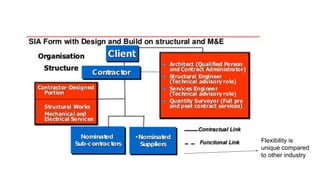
Organisation of construction process
▪ The organization of the construction process. It is
usually a temporary multi organization.
▪ Products are normally built on the site.
Organisations are unique to projects and often are
different from one another.
▪ One example is the temporary organisation
structure where the sub-cons or the lower levels
are flexible in leaving and joining the
organisation.
Flexibility is
unique compared
to other industry
The structure of the industry
▪ The nature of projects is one of a kind, made to specific customer
▪ Product are unique as every building varies and are not identical
▪ Each project usually represents a large proportion of a single contractor work
order in any year causing substantial discontinuity to product functions.
This traits of the construction industry means once a project has been
completed, even if the project does not sell well or it was built in a location
which does not attract investors, the client could not remove the product and
sell it in another place.
3. Describe and
explain the four
(4) categories of
these
resources.
(Factors of Production)
▪ Land. This refers to the land itself, the space, the
mineral contained in the earth crust and all natural
resources. The return to the resource owner is rent.
▪ Labour. Households supply their labour to firms that
demand labour and firms pay workers for their time
and skills. The return to the resource owner is wages.
▪ Capital. This refers to any man made resources
including building, plant, machinery equipment,
infrastructure and tools. The return to the owners of
capital is called profit or interest.
▪ Enterprise. Entrepreneurs who have the special
ability to combine the other three types of resources
with the return of profit.
4. List down the five (5)
importance factors of
construction industry in
the country’s economy.
1. Scale of the construction industry
Although the construction industry is relatively small
when compared to the country’s GDP, it helps to
improve the country by constructing infrastructure
and commercial buildings.
This helps to acts as a catalysts for the nation’s
economic growth due to its linkage with other
industries.
Important factors
of construction
industry in the
country’s
economy.
2. Employment
The construction industry employs about 700,000
workers in Malaysia.
It provides job opportunities not only to locals but also
abroad. This helps to regulate the market and increase
growth in economy.
3. Investments
The construction industry provides goods that are
predominantly of an investment nature. Houses that are
built on pre owned lands have a much higher increase
in market value over empty land lots.
Important factors
of construction
industry in the
country’s
economy.
4. Government
The construction industry is important for the
government as it is a stable factor that provides
opportunities.
Through construction, the government is able to
provide opportunities for the people and collect
income at the same time.
Jobs could be provided and taxes could be collected.
This allows the regulation of the economy and
develops the country both in economical factors and
infrastructure.
Important factors
of construction
industry in the
country’s
economy.
5. International
Internationally, because the construction industry
helps to regulate the economy and improve
infrastructure of the country, the industry helps to
attract investors abroad and increases the Gross Net
Profit of the country.
Investors abroad prefers to invest in a country which
will give them a good return and developing
countries often attract them as a good investment spot
as the potential of a country significantly increases
with its construction growth.
Provide 2 examples of
government policies
which influence the
supply and demand of
construction industry.
Ways to alter supply and demand in Malaysia
▪ Reduce public sector borrowing requirements
(when rakyat has money they will spend more on
housing and increase demand)
▪ Interventions through grants
( ability to target specific low employment rate area
to drive up economy and up demand)
▪ Taxation policies
(reduction in maintenance taxes increases demands)
▪ An increase in the provision of public sector housing
▪ Increase in taxes (house tax increment decreases
demand for owning a property)
Examples of
government
policies in
Malaysia
-RUMAWIP
Under this policy, the government released
state-owned land for private residential development.
The author found that government land sales policy is
an effective tool to reduce private residential housing
prices.
-Mortgage Interest Tax Relief
Among the housing policies, mortgage interest tax
relief is one of the popular policies discussed in
academic research. This tax system is regarded as
housing subsidies where interest payments on housing
loans are deductible from taxable income. It lowers the
cost of consumption on housing services and creates an
incentive to homeownership

Building Economics Tutorial

  • 1.
    Building Economics Chloe Sim0322932 Alwin Ng Kun Ket 0323596 Loh Wen Jun 0323551 Gillian Chong Yeong Lin 0323941 Ng Zhen Huan 0324261 Kiew Chee Yuan 0323297 Farah Sham 0322962
  • 2.
    1. What is building economics? ▪The study of building economics consists of the application of the techniques and expertise of economics to construction projects. Building Economics seeks to ensure the efficient use of resources available to the industry and the rate of growth of construction in an efficient manner
  • 3.
    Building economics includes the study of: 1.Client’s requirements 2. Possible effects of surrounding area 3. Relationships of space and shape 4. Assessment of initial cost 5. Means of controlling cost 6. Building and material life estimate
  • 4.
    What are construction resources? Construction resourcesmight include: ● Products and materials. ● Construction plant, tools and equipment. ● Human resources. ● Space and facilities. ● Subcontractors. ● Finance. Fundamental to resource management is real-time visibility of; what resources are needed, what resources are available, where resources are located, and the ability to reschedule those resources accordingly. Scarce resources can be handled through a resource management plan which can speed up construction speed and productivity.
  • 5.
    2. Describe andexplain the four (4) characteristics which separate the construction industry from other industries. Method of price determination ▪ Product rooted in place Physical nature of the product ▪ Final product are large and expensive and required over a large geographical area Each product are priced in a different ways depending on its locations as each location varies by having different infrastructures, surrounding and site conditions that affect the method of pricing.
  • 6.
    Describe and explain thefour (4) characteristics which separate the construction industry from other industries. Organisation of construction process ▪ The organization of the construction process. It is usually a temporary multi organization. ▪ Products are normally built on the site. Organisations are unique to projects and often are different from one another. ▪ One example is the temporary organisation structure where the sub-cons or the lower levels are flexible in leaving and joining the organisation.
  • 7.
  • 8.
    The structure ofthe industry ▪ The nature of projects is one of a kind, made to specific customer ▪ Product are unique as every building varies and are not identical ▪ Each project usually represents a large proportion of a single contractor work order in any year causing substantial discontinuity to product functions. This traits of the construction industry means once a project has been completed, even if the project does not sell well or it was built in a location which does not attract investors, the client could not remove the product and sell it in another place.
  • 9.
    3. Describe and explainthe four (4) categories of these resources. (Factors of Production) ▪ Land. This refers to the land itself, the space, the mineral contained in the earth crust and all natural resources. The return to the resource owner is rent. ▪ Labour. Households supply their labour to firms that demand labour and firms pay workers for their time and skills. The return to the resource owner is wages. ▪ Capital. This refers to any man made resources including building, plant, machinery equipment, infrastructure and tools. The return to the owners of capital is called profit or interest. ▪ Enterprise. Entrepreneurs who have the special ability to combine the other three types of resources with the return of profit.
  • 10.
    4. List downthe five (5) importance factors of construction industry in the country’s economy. 1. Scale of the construction industry Although the construction industry is relatively small when compared to the country’s GDP, it helps to improve the country by constructing infrastructure and commercial buildings. This helps to acts as a catalysts for the nation’s economic growth due to its linkage with other industries.
  • 11.
    Important factors of construction industryin the country’s economy. 2. Employment The construction industry employs about 700,000 workers in Malaysia. It provides job opportunities not only to locals but also abroad. This helps to regulate the market and increase growth in economy. 3. Investments The construction industry provides goods that are predominantly of an investment nature. Houses that are built on pre owned lands have a much higher increase in market value over empty land lots.
  • 12.
    Important factors of construction industryin the country’s economy. 4. Government The construction industry is important for the government as it is a stable factor that provides opportunities. Through construction, the government is able to provide opportunities for the people and collect income at the same time. Jobs could be provided and taxes could be collected. This allows the regulation of the economy and develops the country both in economical factors and infrastructure.
  • 13.
    Important factors of construction industryin the country’s economy. 5. International Internationally, because the construction industry helps to regulate the economy and improve infrastructure of the country, the industry helps to attract investors abroad and increases the Gross Net Profit of the country. Investors abroad prefers to invest in a country which will give them a good return and developing countries often attract them as a good investment spot as the potential of a country significantly increases with its construction growth.
  • 14.
    Provide 2 examplesof government policies which influence the supply and demand of construction industry. Ways to alter supply and demand in Malaysia ▪ Reduce public sector borrowing requirements (when rakyat has money they will spend more on housing and increase demand) ▪ Interventions through grants ( ability to target specific low employment rate area to drive up economy and up demand) ▪ Taxation policies (reduction in maintenance taxes increases demands) ▪ An increase in the provision of public sector housing ▪ Increase in taxes (house tax increment decreases demand for owning a property)
  • 15.
    Examples of government policies in Malaysia -RUMAWIP Underthis policy, the government released state-owned land for private residential development. The author found that government land sales policy is an effective tool to reduce private residential housing prices. -Mortgage Interest Tax Relief Among the housing policies, mortgage interest tax relief is one of the popular policies discussed in academic research. This tax system is regarded as housing subsidies where interest payments on housing loans are deductible from taxable income. It lowers the cost of consumption on housing services and creates an incentive to homeownership