Asian University For Women
BIOL/ENVS 3003: ECOLOGY (Lab)
Fall 2022
Lab#7: Soil Analysis
Syed Mohammad Lokman
Instructor
Asian University for Women
1. To Study the Texture of the Soil
Procedure:
1. Take 50 gm of soil sample and put it into a measuring cylinder.
2. Take a beaker containing water and pour some water into the
measuring cylinder. Shake the measuring cylinder to mix the sample.
3. Allow the soil particles to settle down. Record the thickness of the
layers formed by different types of particles in the measuring cylinder.
a. After 1 minute of settling down, mark the level of soil. This is
the sand portion in the soil.
b. Wait 1 hour and mark the level. This is the silt portion in the
soil.
c. Wait 24 hours and mark the level. This is the clay portion in the
soil.
4. Example:
a. Sand + Silt + Clay = 25ml + 15ml + 10ml = 50ml
b. Sand + Silt + Clay = 50% + 30% + 20%
5. Using a textural triangle, draw lines corresponding to the percentage
of clay, silt and sand. The lines which intersect indicate the soil type
we have.
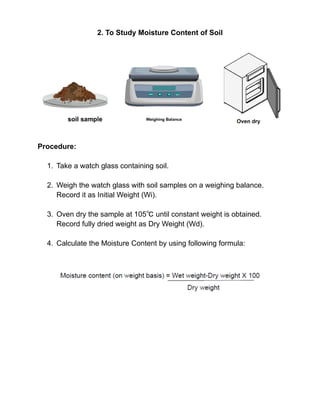
2. To Study Moisture Content of Soil
Procedure:
1. Take a watch glass containing soil.
2. Weigh the watch glass with soil samples on a weighing balance.
Record it as Initial Weight (Wi).
3. Oven dry the sample at 105℃ until constant weight is obtained.
Record fully dried weight as Dry Weight (Wd).
4. Calculate the Moisture Content by using following formula:
3. To Study pH of Different Types of Soil
Procedure:
A. Soil solution preparation:
1. Take soil from the watch glass and dissolve it into the beaker
containing water to make soil solution.
2. Take a funnel, place a filter paper in it and keep it on a test tube.
3. Take soil solution and filter the solution through the filter paper and
collect the filtrates in a test tube. The soil solution is now ready for
testing pH.
B.1. Using pH Paper:
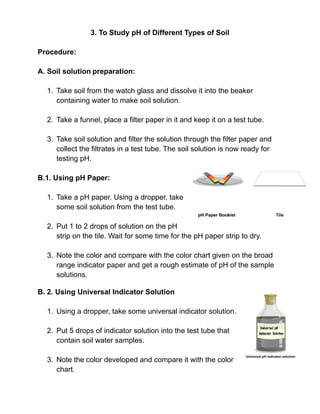
1. Take a pH paper. Using a dropper, take
some soil solution from the test tube.
2. Put 1 to 2 drops of solution on the pH
strip on the tile. Wait for some time for the pH paper strip to dry.
3. Note the color and compare with the color chart given on the broad
range indicator paper and get a rough estimate of pH of the sample
solutions.
B. 2. Using Universal Indicator Solution
1. Using a dropper, take some universal indicator solution.
2. Put 5 drops of indicator solution into the test tube that
contain soil water samples.
3. Note the color developed and compare it with the color
chart.
4. Water Holding Capacity of Soil
Procedure:
1. Take 25 gm (Ws) of the sample soil in a watch glass.
2. Take a funnel, place a filter paper in it and keep it on a measuring
cylinder.
3. Transfer the soil from watch glass to filter paper.
4. Add 50 mL (W1) of distilled water to the filter paper.
5. The water filtration will start very soon. Wait 25-30 min until the
filtration is getting stopped fully.
Calculation:
Record the level of water (W2) passed through the filter. Using the below
formula, calculate the water holding capacity of the soil:
Volume of water retained (Wr) = W1 - W2
Water Holding Capacity of Soil (WHCs) = [(Wr/Ws) ✕100] %

Soil Analysis Worksheet

  • 1.
    Asian University ForWomen BIOL/ENVS 3003: ECOLOGY (Lab) Fall 2022 Lab#7: Soil Analysis Syed Mohammad Lokman Instructor Asian University for Women
  • 2.
    1. To Studythe Texture of the Soil Procedure: 1. Take 50 gm of soil sample and put it into a measuring cylinder. 2. Take a beaker containing water and pour some water into the measuring cylinder. Shake the measuring cylinder to mix the sample. 3. Allow the soil particles to settle down. Record the thickness of the layers formed by different types of particles in the measuring cylinder. a. After 1 minute of settling down, mark the level of soil. This is the sand portion in the soil. b. Wait 1 hour and mark the level. This is the silt portion in the soil. c. Wait 24 hours and mark the level. This is the clay portion in the soil. 4. Example: a. Sand + Silt + Clay = 25ml + 15ml + 10ml = 50ml b. Sand + Silt + Clay = 50% + 30% + 20% 5. Using a textural triangle, draw lines corresponding to the percentage of clay, silt and sand. The lines which intersect indicate the soil type we have.
  • 3.
    2. To StudyMoisture Content of Soil Procedure: 1. Take a watch glass containing soil. 2. Weigh the watch glass with soil samples on a weighing balance. Record it as Initial Weight (Wi). 3. Oven dry the sample at 105℃ until constant weight is obtained. Record fully dried weight as Dry Weight (Wd). 4. Calculate the Moisture Content by using following formula:
  • 4.
    3. To StudypH of Different Types of Soil Procedure: A. Soil solution preparation: 1. Take soil from the watch glass and dissolve it into the beaker containing water to make soil solution. 2. Take a funnel, place a filter paper in it and keep it on a test tube. 3. Take soil solution and filter the solution through the filter paper and collect the filtrates in a test tube. The soil solution is now ready for testing pH. B.1. Using pH Paper: 1. Take a pH paper. Using a dropper, take some soil solution from the test tube. 2. Put 1 to 2 drops of solution on the pH strip on the tile. Wait for some time for the pH paper strip to dry. 3. Note the color and compare with the color chart given on the broad range indicator paper and get a rough estimate of pH of the sample solutions. B. 2. Using Universal Indicator Solution 1. Using a dropper, take some universal indicator solution. 2. Put 5 drops of indicator solution into the test tube that contain soil water samples. 3. Note the color developed and compare it with the color chart.
  • 5.
    4. Water HoldingCapacity of Soil Procedure: 1. Take 25 gm (Ws) of the sample soil in a watch glass. 2. Take a funnel, place a filter paper in it and keep it on a measuring cylinder. 3. Transfer the soil from watch glass to filter paper. 4. Add 50 mL (W1) of distilled water to the filter paper. 5. The water filtration will start very soon. Wait 25-30 min until the filtration is getting stopped fully. Calculation: Record the level of water (W2) passed through the filter. Using the below formula, calculate the water holding capacity of the soil: Volume of water retained (Wr) = W1 - W2 Water Holding Capacity of Soil (WHCs) = [(Wr/Ws) ✕100] %