ATHEROSCLEROSIS
Definition
• Atherosclerosis is a disease in which plaque builds up inside the
arteries.
• Plaque is made up of fat, cholesterol, calcium, and other substances
found in the blood.
• Over time, plaque hardens and narrows arteries.
• This limits the flow of oxygen-rich blood to organs and other parts of the
body.
Etiology
• Age and sex
• Age is the most powerful independent risk factor for atherosclerosis.
• Pre-menopausal women have much lower rates of disease than age- and
risk-matched males; however, the gender difference disappears rapidly
after menopause.
Family history
• Atherosclerotic vascular disease often runs in families.
• This may be due to a combination of shared genetic, environmental and
lifestyle (e.g. smoking, exercise and diet) factors.
• The most common inherited risk characteristics (hypertension,
hyperlipidaemia, diabetes)
Smoking.
• Smoking is probably the most important avoidable cause of
atherosclerotic vascular disease;
• There is a strong, consistent and dose-linked relationship between
cigarette smoking and ischaemic heart disease.
Hypertension.
• The incidence of atherosclerosis increases as blood pressure rises and
this excess risk is related to both systolic and diastolic blood pressure
as well as pulse pressure.
• Antihypertensive therapy has been shown to reduce coronary mortality,
stroke and heart failure.
Hypercholesterolemia.
• The risk of coronary heart disease and other forms of atherosclerotic
vascular disease rises with plasma cholesterol concentration, and in
particular the ratio of total cholesterol to high-density lipoprotein (HDL)
cholesterol.
• A much weaker correlation also exists with plasma triglyceride
concentration.
• Lowering total LDL and cholesterol concentrations reduces the risk of
cardiovascular events including death, myocardial infarction and stroke,
and also reduces the need for revascularization.
Diabetes mellitus.
• This is a potent risk factor for all forms of atherosclerosis.
Haemostatic factors.
• Platelet activation and high levels of fibrinogen are associated with an
increased risk of coronary thrombosis.
Alcohol.
• A moderate intake of alcohol (2-4 units a day) appears to offer some
protection from coronary disease;
• however, heavy drinking is associated with hypertension and excess
cardiac events.
Physical inactivity
• Physical inactivity roughly doubles the risk of coronary heart disease
and is a major risk factor for stroke.
• Regular exercise (brisk walking, cycling or swimming for 20 minutes two
or three times a week) appears to have a protective effect which may be
related to increased HDL cholesterol, lower blood pressure and reduced
blood clotting.
Obesity.
• Obesity, particularly if central, is an independent risk factor, although it
is often associated with other adverse factors such as hypertension,
diabetes and physical inactivity.
Other dietary factors
• Diets deficient in fresh fruit, vegetables and polyunsaturated fatty acids
are associated with an increased risk of vascular disease.
• Low levels of vitamin C, vitamin E and other antioxidants may enhance
the production of oxidised LDL.
Hyperhomocysteinaemia
• It is associated with accelerated atherosclerosis including stroke and
peripheral vascular disease.
• Low dietary folate, vitamin B12 and vitamin B6 can elevate
homocysteine concentrations.
Pathophysiology
Early atherosclerosis
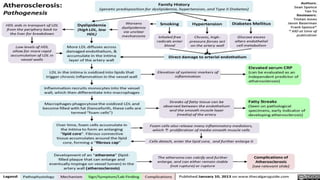
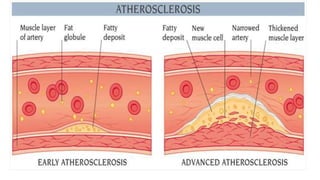
• Fatty streaks tend to occur at sites of altered arterial shear stress, such
as bifurcations and are associated with abnormal endothelial function.
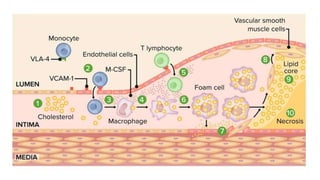
• They develop when inflammatory cells, predominantly monocytes, bind
to receptors expressed by endothelial cells, migrate into the intima, take
up oxidised low-density lipoprotein (LDL) from the plasma and become
lipid-laden foam cells or macrophages.
• Extracellular lipid pools appear in the intimal space when these foam
cells die and release their contents.
• In response to cytokines and growth factors produced by the activated
macrophages, smooth muscle cells migrate from the media of the
arterial wall into the intima, and change from a contractile to a repair
phenotype in an attempt to stabilize the atherosclerotic lesion.
• If they are successful, the lipid core will be covered by smooth muscle
cells and matrix, producing a stable atherosclerotic plaque that will
remain asymptomatic until it becomes large enough to obstruct
arterial flow.
Advanced atherosclerosis
• In an established atherosclerotic plaque, macrophages mediate
inflammation and smooth muscle cells promote repair; if inflammation
predominates, the plaque becomes active or unstable and may be
complicated by ulceration and superadded thrombosis.
• Cytokines are released by activated macrophages and may cause the
intimal smooth muscle cells overlying the plaque to become senescent,
resulting in thinning of the protective fibrous cap; they may also digest
collagen cross-struts within the plaque.
• These changes make the lesion vulnerable to the effects of mechanical
stress and may lead to rupture of the plaque surface.
• Any breach in the integrity of the plaque will expose its contents to
circulating blood and may trigger platelet aggregation and thrombosis
that extends into the atheromatous plaque and the arterial lumen.
• This type of plaque event may cause partial or complete obstruction at the
site of the lesion and/or distal embolization resulting in infarction or
ischemia of the affected organ.
• It is the common mechanism that underlies many of the acute
manifestations of atherosclerotic vascular disease (e.g. acute lower limb
ischemia, myocardial infarction and stroke).
• 'Vulnerable plaques' are characterised by a lipid-rich core, a thin fibro
cellular cap, an increase in inflammatory cells, and the release of
specific enzymes that degrade matrix proteins.
• In contrast, stable plaques are typified by a small lipid pool, a thick
fibrous cap, calcification and plentiful collagenous cross-struts.
• Fissuring or rupture tends to occur at sites of maximal mechanical stress
and may be triggered by a surge in blood pressure (e.g. during exercise or
emotional upset).
Signs and symptoms
• Signs and symptoms will depend on which arteries are affected
Coronary Arteries
• Chest pain (angina), shortness of breath and arrhythmias
Peripheral Arteries
• Numbness, pain
Carotid Arteries
• Sudden weakness, Paralysis (an inability to move), Confusion, Trouble
speaking or understanding speech, Dizziness, trouble walking, loss of
balance or coordination, Loss of consciousness, Sudden and severe
headache
Renal Arteries
• Early kidney disease often has no signs or symptoms. As the disease gets
worse it can cause tiredness, loss of appetite, nausea, swelling in the
hands or feet, itchiness or numbness and trouble concentrating.
Complications
Coronary artery disease.
• When atherosclerosis narrows the arteries close to your heart, you may
develop coronary artery disease, which can cause chest pain (angina), a heart
attack or heart failure.
Carotid artery disease.
• When atherosclerosis narrows the arteries close to your brain, you may
develop carotid artery disease, which can cause a transient ischemic attack
(TIA) or stroke.
Peripheral artery disease.
• When atherosclerosis narrows the arteries in your arms or legs, you may
develop circulation problems in your arms and legs called peripheral
artery disease.
• This can make you less sensitive to heat and cold, increasing your risk of
burns or frostbite.
• In rare cases, poor circulation in your arms or legs can cause tissue death
(gangrene).
Aneurysms.
• Atherosclerosis can also cause aneurysms, a serious complication that
can occur anywhere in your body. An aneurysm is a bulge in the wall of
your artery.
• Most people with aneurysms have no symptoms. Pain and throbbing in
the area of an aneurysm may occur and is a medical emergency.
• If an aneurysm bursts, you may face life-threatening internal bleeding.
Although this is usually a sudden, catastrophic event, a slow leak is
possible.
• If a blood clot within an aneurysm dislodges, it may block an artery at
some distant point.
Chronic kidney disease
• Atherosclerosis can cause the arteries leading to your kidneys to narrow,
preventing oxygenated blood from reaching them.
• Over time, this can affect your kidney function, keeping waste from exiting
your body.
Treatment
• Treatment for Atherosclerosis includes a healthy diet, exercise and
medication to control or possibly reverse condition.
• Medications to treat arteriosclerosis are based on the location of enlarged
blood vessels and other underlying conditions may include.
• Cholesterol medications can protect heart arteries.
• Aspirin can prevent platelets from forming blood clots.
• β-blocker medications can reduce blood pressure and heart rate and
diminish chest pains, the risk of heart attack and irregular heart
rhythm.
• Angiotensin-converting enzyme (ACE) inhibitors can lower blood
pressure and lower the possibility of heart attack.
• Calcium channel blockers and diuretics (water pills) can reduce blood
pressure.
• A clot-busting drug may dissolve blood clots.

ATHEROSCLEROSIS pathophysiology .pptx

  • 1.
  • 2.
    Definition • Atherosclerosis isa disease in which plaque builds up inside the arteries. • Plaque is made up of fat, cholesterol, calcium, and other substances found in the blood. • Over time, plaque hardens and narrows arteries. • This limits the flow of oxygen-rich blood to organs and other parts of the body.
  • 3.
    Etiology • Age andsex • Age is the most powerful independent risk factor for atherosclerosis. • Pre-menopausal women have much lower rates of disease than age- and risk-matched males; however, the gender difference disappears rapidly after menopause.
  • 4.
    Family history • Atheroscleroticvascular disease often runs in families. • This may be due to a combination of shared genetic, environmental and lifestyle (e.g. smoking, exercise and diet) factors. • The most common inherited risk characteristics (hypertension, hyperlipidaemia, diabetes)
  • 5.
    Smoking. • Smoking isprobably the most important avoidable cause of atherosclerotic vascular disease; • There is a strong, consistent and dose-linked relationship between cigarette smoking and ischaemic heart disease. Hypertension. • The incidence of atherosclerosis increases as blood pressure rises and this excess risk is related to both systolic and diastolic blood pressure as well as pulse pressure. • Antihypertensive therapy has been shown to reduce coronary mortality, stroke and heart failure.
  • 6.
    Hypercholesterolemia. • The riskof coronary heart disease and other forms of atherosclerotic vascular disease rises with plasma cholesterol concentration, and in particular the ratio of total cholesterol to high-density lipoprotein (HDL) cholesterol. • A much weaker correlation also exists with plasma triglyceride concentration. • Lowering total LDL and cholesterol concentrations reduces the risk of cardiovascular events including death, myocardial infarction and stroke, and also reduces the need for revascularization.
  • 7.
    Diabetes mellitus. • Thisis a potent risk factor for all forms of atherosclerosis. Haemostatic factors. • Platelet activation and high levels of fibrinogen are associated with an increased risk of coronary thrombosis. Alcohol. • A moderate intake of alcohol (2-4 units a day) appears to offer some protection from coronary disease; • however, heavy drinking is associated with hypertension and excess cardiac events.
  • 8.
    Physical inactivity • Physicalinactivity roughly doubles the risk of coronary heart disease and is a major risk factor for stroke. • Regular exercise (brisk walking, cycling or swimming for 20 minutes two or three times a week) appears to have a protective effect which may be related to increased HDL cholesterol, lower blood pressure and reduced blood clotting. Obesity. • Obesity, particularly if central, is an independent risk factor, although it is often associated with other adverse factors such as hypertension, diabetes and physical inactivity.
  • 9.
    Other dietary factors •Diets deficient in fresh fruit, vegetables and polyunsaturated fatty acids are associated with an increased risk of vascular disease. • Low levels of vitamin C, vitamin E and other antioxidants may enhance the production of oxidised LDL. Hyperhomocysteinaemia • It is associated with accelerated atherosclerosis including stroke and peripheral vascular disease. • Low dietary folate, vitamin B12 and vitamin B6 can elevate homocysteine concentrations.
  • 10.
    Pathophysiology Early atherosclerosis • Fattystreaks tend to occur at sites of altered arterial shear stress, such as bifurcations and are associated with abnormal endothelial function. • They develop when inflammatory cells, predominantly monocytes, bind to receptors expressed by endothelial cells, migrate into the intima, take up oxidised low-density lipoprotein (LDL) from the plasma and become lipid-laden foam cells or macrophages.
  • 11.
    • Extracellular lipidpools appear in the intimal space when these foam cells die and release their contents. • In response to cytokines and growth factors produced by the activated macrophages, smooth muscle cells migrate from the media of the arterial wall into the intima, and change from a contractile to a repair phenotype in an attempt to stabilize the atherosclerotic lesion. • If they are successful, the lipid core will be covered by smooth muscle cells and matrix, producing a stable atherosclerotic plaque that will remain asymptomatic until it becomes large enough to obstruct arterial flow.
  • 15.
    Advanced atherosclerosis • Inan established atherosclerotic plaque, macrophages mediate inflammation and smooth muscle cells promote repair; if inflammation predominates, the plaque becomes active or unstable and may be complicated by ulceration and superadded thrombosis. • Cytokines are released by activated macrophages and may cause the intimal smooth muscle cells overlying the plaque to become senescent, resulting in thinning of the protective fibrous cap; they may also digest collagen cross-struts within the plaque.
  • 16.
    • These changesmake the lesion vulnerable to the effects of mechanical stress and may lead to rupture of the plaque surface. • Any breach in the integrity of the plaque will expose its contents to circulating blood and may trigger platelet aggregation and thrombosis that extends into the atheromatous plaque and the arterial lumen. • This type of plaque event may cause partial or complete obstruction at the site of the lesion and/or distal embolization resulting in infarction or ischemia of the affected organ. • It is the common mechanism that underlies many of the acute manifestations of atherosclerotic vascular disease (e.g. acute lower limb ischemia, myocardial infarction and stroke).
  • 17.
    • 'Vulnerable plaques'are characterised by a lipid-rich core, a thin fibro cellular cap, an increase in inflammatory cells, and the release of specific enzymes that degrade matrix proteins. • In contrast, stable plaques are typified by a small lipid pool, a thick fibrous cap, calcification and plentiful collagenous cross-struts. • Fissuring or rupture tends to occur at sites of maximal mechanical stress and may be triggered by a surge in blood pressure (e.g. during exercise or emotional upset).
  • 18.
    Signs and symptoms •Signs and symptoms will depend on which arteries are affected Coronary Arteries • Chest pain (angina), shortness of breath and arrhythmias Peripheral Arteries • Numbness, pain
  • 19.
    Carotid Arteries • Suddenweakness, Paralysis (an inability to move), Confusion, Trouble speaking or understanding speech, Dizziness, trouble walking, loss of balance or coordination, Loss of consciousness, Sudden and severe headache Renal Arteries • Early kidney disease often has no signs or symptoms. As the disease gets worse it can cause tiredness, loss of appetite, nausea, swelling in the hands or feet, itchiness or numbness and trouble concentrating.
  • 20.
    Complications Coronary artery disease. •When atherosclerosis narrows the arteries close to your heart, you may develop coronary artery disease, which can cause chest pain (angina), a heart attack or heart failure. Carotid artery disease. • When atherosclerosis narrows the arteries close to your brain, you may develop carotid artery disease, which can cause a transient ischemic attack (TIA) or stroke.
  • 21.
    Peripheral artery disease. •When atherosclerosis narrows the arteries in your arms or legs, you may develop circulation problems in your arms and legs called peripheral artery disease. • This can make you less sensitive to heat and cold, increasing your risk of burns or frostbite. • In rare cases, poor circulation in your arms or legs can cause tissue death (gangrene).
  • 22.
    Aneurysms. • Atherosclerosis canalso cause aneurysms, a serious complication that can occur anywhere in your body. An aneurysm is a bulge in the wall of your artery. • Most people with aneurysms have no symptoms. Pain and throbbing in the area of an aneurysm may occur and is a medical emergency. • If an aneurysm bursts, you may face life-threatening internal bleeding. Although this is usually a sudden, catastrophic event, a slow leak is possible. • If a blood clot within an aneurysm dislodges, it may block an artery at some distant point.
  • 23.
    Chronic kidney disease •Atherosclerosis can cause the arteries leading to your kidneys to narrow, preventing oxygenated blood from reaching them. • Over time, this can affect your kidney function, keeping waste from exiting your body.
  • 24.
    Treatment • Treatment forAtherosclerosis includes a healthy diet, exercise and medication to control or possibly reverse condition. • Medications to treat arteriosclerosis are based on the location of enlarged blood vessels and other underlying conditions may include. • Cholesterol medications can protect heart arteries. • Aspirin can prevent platelets from forming blood clots. • β-blocker medications can reduce blood pressure and heart rate and diminish chest pains, the risk of heart attack and irregular heart rhythm. • Angiotensin-converting enzyme (ACE) inhibitors can lower blood pressure and lower the possibility of heart attack. • Calcium channel blockers and diuretics (water pills) can reduce blood pressure. • A clot-busting drug may dissolve blood clots.