ARCHITECTURAL DESIGN THEORY - II
PERCEPTION
Lecture 2
VISUAL PERCEPTION
DO WE SEE WHAT WE SEE?
Very often the things that we see do not
register in our mind – why?
Let us understand how we see things.
This lecture will delve into visual perception as that is
how we generally perceive architecture..
VISUAL PERCEPTION
• Dictionary meaning: To perceive:
Apprehend with the mind, observe, understand;
apprehend through one of the senses, esp. sight;
regard mentally in specified manner
• Dictionary meaning: Perception:
intuitive recognition; action by which the mind
refers its sensations to external objects as cause
VISUAL PERCEPTION
• Synonyms:
apprehension, awareness, conception,
consciousness, discernment, feeling, grasp, idea,
impression, insight, notion, observation, recognition,
sensation, sense, taste, understanding
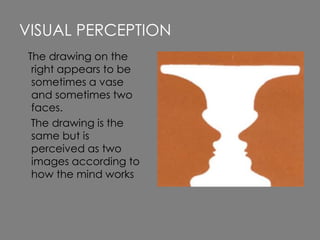
The drawing on the
right appears to be
sometimes a vase
and sometimes two
faces.
The drawing is the
same but is
perceived as two
images according to
how the mind works
VISUAL PERCEPTION
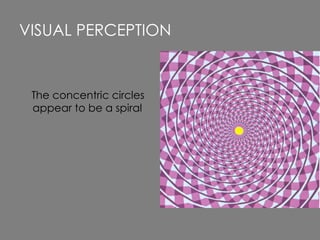
The concentric circles
appear to be a spiral
VISUAL PERCEPTION
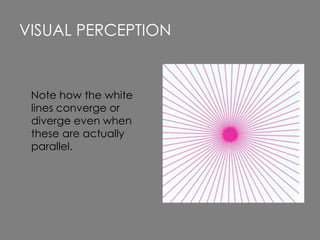
Note how the white
lines converge or
diverge even when
these are actually
parallel.
VISUAL PERCEPTION
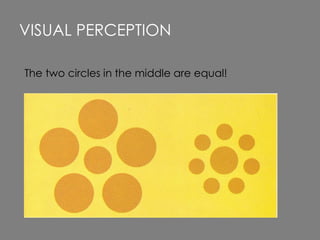
The two circles in the middle are equal!
VISUAL PERCEPTION
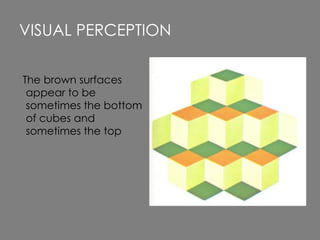
The brown surfaces
appear to be
sometimes the bottom
of cubes and
sometimes the top
VISUAL PERCEPTION
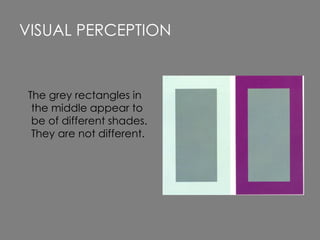
The grey rectangles in
the middle appear to
be of different shades.
They are not different.
VISUAL PERCEPTION
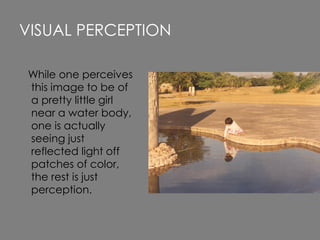
While one perceives
this image to be of
a pretty little girl
near a water body,
one is actually
seeing just
reflected light off
patches of color,
the rest is just
perception.
VISUAL PERCEPTION
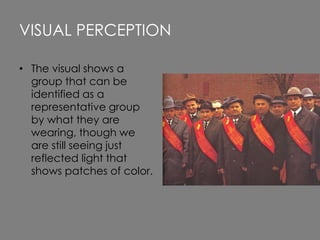
• The visual shows a
group that can be
identified as a
representative group
by what they are
wearing, though we
are still seeing just
reflected light that
shows patches of color.
VISUAL PERCEPTION
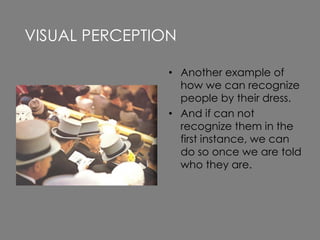
• Another example of
how we can recognize
people by their dress.
• And if can not
recognize them in the
first instance, we can
do so once we are told
who they are.
VISUAL PERCEPTION
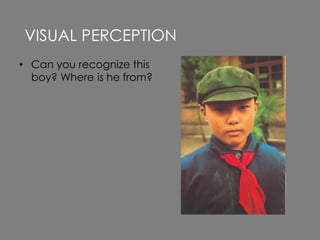
• Can you recognize this
boy? Where is he from?
VISUAL PERCEPTION
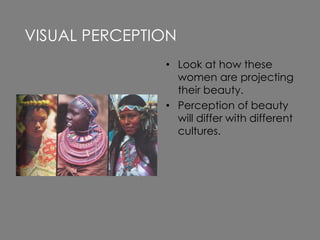
• Look at how these
women are projecting
their beauty.
• Perception of beauty
will differ with different
cultures.
VISUAL PERCEPTION
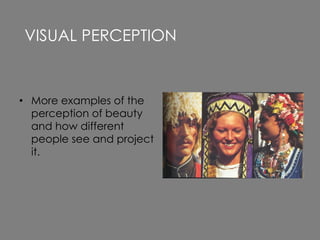
• More examples of the
perception of beauty
and how different
people see and project
it.
VISUAL PERCEPTION
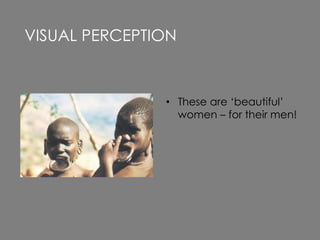
• These are ‘beautiful’
women – for their men!
VISUAL PERCEPTION
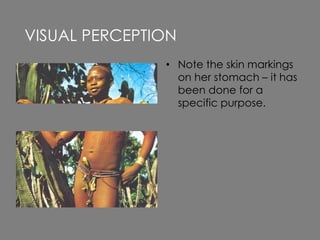
• Note the skin markings
on her stomach – it has
been done for a
specific purpose.
VISUAL PERCEPTION
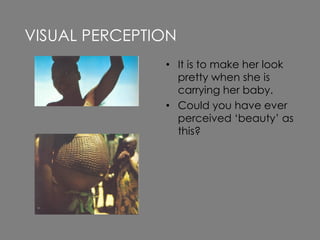
• It is to make her look
pretty when she is
carrying her baby.
• Could you have ever
perceived ‘beauty’ as
this?
VISUAL PERCEPTION
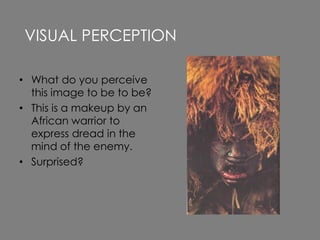
• What do you perceive
this image to be to be?
• This is a makeup by an
African warrior to
express dread in the
mind of the enemy.
• Surprised?
VISUAL PERCEPTION
According to Kimball and Hawkins’ survey, visual
perception can be approached in four different
ways:
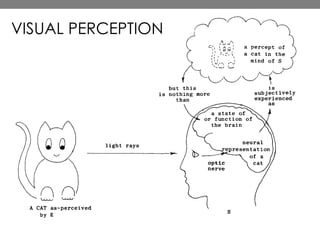
• NEUROPHYSIOLOGY: Attempts to examine the
physical mechanisms that are in play when we
“see” things.
VISUAL PERCEPTION
VISUAL PERCEPTION
• GESTALT THEORY: three major gestalt laws of
perception are discussed:
– FIGURE-GROUND DISCRIMINATION IS concerned
with how we differentiate between an object
and its context.
– LAWS OF GROUPING looks at how we associate
objects as we perceive them and include
concepts such as proximity, similarity,
continuation and common region.
– GOOD FIGURE (also known as the law of
pragnanz) is the concept that strong, simple
figures have more appeal to readers than ones
that are complicated for the eye to decode.
VISUAL PERCEPTION
• CONSTRUCTIVISM: The theory of constructivism has
to do with the ways in which we create ideas about
the world around us by combining a number of
representative images of that world. Important in
this theory is the realization that, because we are
always adding new images to that amalgamation
(i.e. sampling), our perception is constantly in flux.
• ECOLOGICAL PERCEPTION: In contract to
constructivism, direct perception asserts that viewer
and viewed object are one ecosystem instead of
two discrete entities.
VISUAL PERCEPTION
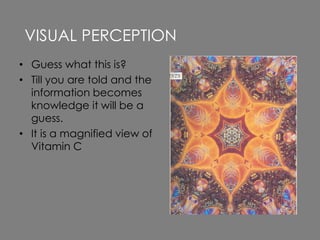
• Guess what this is?
• Till you are told and the
information becomes
knowledge it will be a
guess.
• It is a magnified view of
Vitamin C
VISUAL PERCEPTION
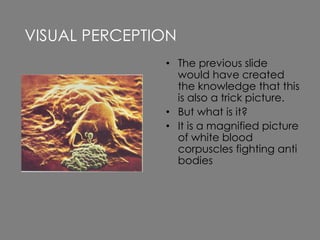
• The previous slide
would have created
the knowledge that this
is also a trick picture.
• But what is it?
• It is a magnified picture
of white blood
corpuscles fighting anti
bodies
VISUAL PERCEPTION
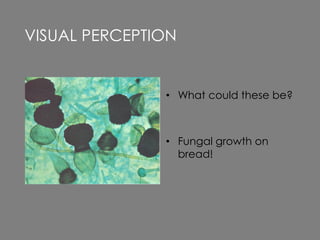
• What could these be?
• Fungal growth on
bread!
VISUAL PERCEPTION
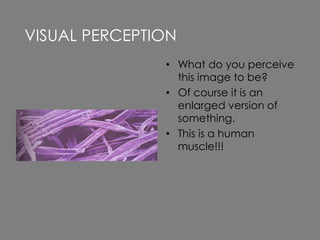
• What do you perceive
this image to be?
• Of course it is an
enlarged version of
something.
• This is a human
muscle!!!
VISUAL PERCEPTION
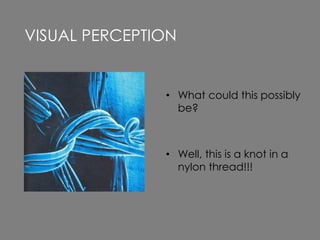
• What could this possibly
be?
• Well, this is a knot in a
nylon thread!!!
VISUAL PERCEPTION
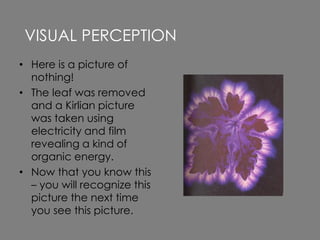
• Here is a picture of
nothing!
• The leaf was removed
and a Kirlian picture
was taken using
electricity and film
revealing a kind of
organic energy.
• Now that you know this
– you will recognize this
picture the next time
you see this picture.
VISUAL PERCEPTION
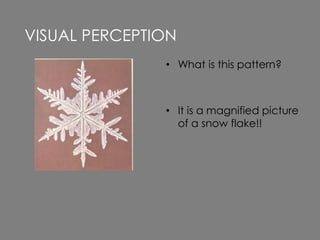
• What is this pattern?
• It is a magnified picture
of a snow flake!!
VISUAL PERCEPTION
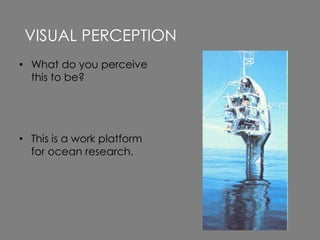
• What do you perceive
this to be?
• This is a work platform
for ocean research.
VISUAL PERCEPTION
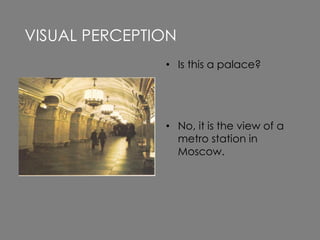
• Is this a palace?
• No, it is the view of a
metro station in
Moscow.
VISUAL PERCEPTION
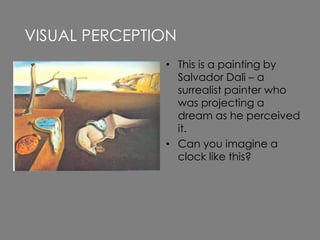
• This is a painting by
Salvador Dali – a
surrealist painter who
was projecting a
dream as he perceived
it.
• Can you imagine a
clock like this?
VISUAL PERCEPTION
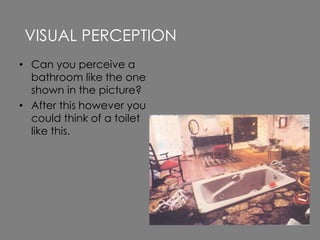
• Can you perceive a
bathroom like the one
shown in the picture?
• After this however you
could think of a toilet
like this.
VISUAL PERCEPTION
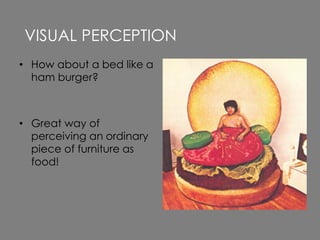
• How about a bed like a
ham burger?
• Great way of
perceiving an ordinary
piece of furniture as
food!
VISUAL PERCEPTION
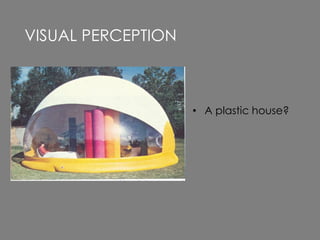
• A plastic house?
VISUAL PERCEPTION
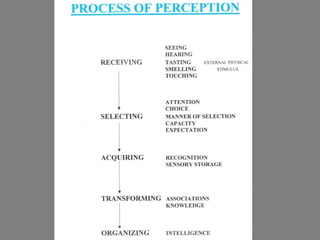
• The previous slides indicate that to see anything
there are a number of factors that effect the
process. What we see makes sense only when it is
associated with what is known, otherwise more
information is required to perceive that view.
Perception of the same view would change for
different places and different people.
VISUAL PERCEPTION
• This is how we ‘see’ things.
• Next time you are seeing something – do see it –
record it mentally, understand it and use it as
knowledge.
VISUAL PERCEPTION

PRECEPTION (ADT)

  • 1.
    ARCHITECTURAL DESIGN THEORY- II PERCEPTION Lecture 2
  • 2.
    VISUAL PERCEPTION DO WESEE WHAT WE SEE? Very often the things that we see do not register in our mind – why? Let us understand how we see things. This lecture will delve into visual perception as that is how we generally perceive architecture..
  • 3.
    VISUAL PERCEPTION • Dictionarymeaning: To perceive: Apprehend with the mind, observe, understand; apprehend through one of the senses, esp. sight; regard mentally in specified manner • Dictionary meaning: Perception: intuitive recognition; action by which the mind refers its sensations to external objects as cause
  • 4.
    VISUAL PERCEPTION • Synonyms: apprehension,awareness, conception, consciousness, discernment, feeling, grasp, idea, impression, insight, notion, observation, recognition, sensation, sense, taste, understanding
  • 8.
    The drawing onthe right appears to be sometimes a vase and sometimes two faces. The drawing is the same but is perceived as two images according to how the mind works VISUAL PERCEPTION
  • 9.
    The concentric circles appearto be a spiral VISUAL PERCEPTION
  • 10.
    Note how thewhite lines converge or diverge even when these are actually parallel. VISUAL PERCEPTION
  • 11.
    The two circlesin the middle are equal! VISUAL PERCEPTION
  • 12.
    The brown surfaces appearto be sometimes the bottom of cubes and sometimes the top VISUAL PERCEPTION
  • 13.
    The grey rectanglesin the middle appear to be of different shades. They are not different. VISUAL PERCEPTION
  • 14.
    While one perceives thisimage to be of a pretty little girl near a water body, one is actually seeing just reflected light off patches of color, the rest is just perception. VISUAL PERCEPTION
  • 15.
    • The visualshows a group that can be identified as a representative group by what they are wearing, though we are still seeing just reflected light that shows patches of color. VISUAL PERCEPTION
  • 16.
    • Another exampleof how we can recognize people by their dress. • And if can not recognize them in the first instance, we can do so once we are told who they are. VISUAL PERCEPTION
  • 17.
    • Can yourecognize this boy? Where is he from? VISUAL PERCEPTION
  • 18.
    • Look athow these women are projecting their beauty. • Perception of beauty will differ with different cultures. VISUAL PERCEPTION
  • 19.
    • More examplesof the perception of beauty and how different people see and project it. VISUAL PERCEPTION
  • 20.
    • These are‘beautiful’ women – for their men! VISUAL PERCEPTION
  • 21.
    • Note theskin markings on her stomach – it has been done for a specific purpose. VISUAL PERCEPTION
  • 22.
    • It isto make her look pretty when she is carrying her baby. • Could you have ever perceived ‘beauty’ as this? VISUAL PERCEPTION
  • 23.
    • What doyou perceive this image to be to be? • This is a makeup by an African warrior to express dread in the mind of the enemy. • Surprised? VISUAL PERCEPTION
  • 24.
    According to Kimballand Hawkins’ survey, visual perception can be approached in four different ways: • NEUROPHYSIOLOGY: Attempts to examine the physical mechanisms that are in play when we “see” things. VISUAL PERCEPTION
  • 25.
  • 26.
    • GESTALT THEORY:three major gestalt laws of perception are discussed: – FIGURE-GROUND DISCRIMINATION IS concerned with how we differentiate between an object and its context. – LAWS OF GROUPING looks at how we associate objects as we perceive them and include concepts such as proximity, similarity, continuation and common region. – GOOD FIGURE (also known as the law of pragnanz) is the concept that strong, simple figures have more appeal to readers than ones that are complicated for the eye to decode. VISUAL PERCEPTION
  • 27.
    • CONSTRUCTIVISM: Thetheory of constructivism has to do with the ways in which we create ideas about the world around us by combining a number of representative images of that world. Important in this theory is the realization that, because we are always adding new images to that amalgamation (i.e. sampling), our perception is constantly in flux. • ECOLOGICAL PERCEPTION: In contract to constructivism, direct perception asserts that viewer and viewed object are one ecosystem instead of two discrete entities. VISUAL PERCEPTION
  • 28.
    • Guess whatthis is? • Till you are told and the information becomes knowledge it will be a guess. • It is a magnified view of Vitamin C VISUAL PERCEPTION
  • 29.
    • The previousslide would have created the knowledge that this is also a trick picture. • But what is it? • It is a magnified picture of white blood corpuscles fighting anti bodies VISUAL PERCEPTION
  • 30.
    • What couldthese be? • Fungal growth on bread! VISUAL PERCEPTION
  • 31.
    • What doyou perceive this image to be? • Of course it is an enlarged version of something. • This is a human muscle!!! VISUAL PERCEPTION
  • 32.
    • What couldthis possibly be? • Well, this is a knot in a nylon thread!!! VISUAL PERCEPTION
  • 33.
    • Here isa picture of nothing! • The leaf was removed and a Kirlian picture was taken using electricity and film revealing a kind of organic energy. • Now that you know this – you will recognize this picture the next time you see this picture. VISUAL PERCEPTION
  • 34.
    • What isthis pattern? • It is a magnified picture of a snow flake!! VISUAL PERCEPTION
  • 35.
    • What doyou perceive this to be? • This is a work platform for ocean research. VISUAL PERCEPTION
  • 36.
    • Is thisa palace? • No, it is the view of a metro station in Moscow. VISUAL PERCEPTION
  • 37.
    • This isa painting by Salvador Dali – a surrealist painter who was projecting a dream as he perceived it. • Can you imagine a clock like this? VISUAL PERCEPTION
  • 38.
    • Can youperceive a bathroom like the one shown in the picture? • After this however you could think of a toilet like this. VISUAL PERCEPTION
  • 39.
    • How abouta bed like a ham burger? • Great way of perceiving an ordinary piece of furniture as food! VISUAL PERCEPTION
  • 40.
    • A plastichouse? VISUAL PERCEPTION
  • 41.
    • The previousslides indicate that to see anything there are a number of factors that effect the process. What we see makes sense only when it is associated with what is known, otherwise more information is required to perceive that view. Perception of the same view would change for different places and different people. VISUAL PERCEPTION
  • 42.
    • This ishow we ‘see’ things. • Next time you are seeing something – do see it – record it mentally, understand it and use it as knowledge. VISUAL PERCEPTION