Proportion & Scale
• Material Proportions
– All materials have rational proportions
– Inherent strength & weaknesses
• Structural Proportions
– Structural tasks
– Visual indicators of size & scale
• Manufactured Proportions
– manufacturing
Proportioning Systems
• Proportion
– Relation of one part to another or whole
– Equality between 2 ratios
• Ratio
– Relation in magnitude, quantity, or degree between 2 or more
similar things
• Eurhythmy – harmony or movement
• Fibonacci Series
– Unending sequence of numbers
• Harmonic Series
– Harmonic progression – sequence of numbers w/c are reciprocals,
arithmetic progression
•Golden Section
•Classical Orders
•Renaissance Theories
•Modulor
•Ken
•Anthropometry
•Scale
Theories of Proportion
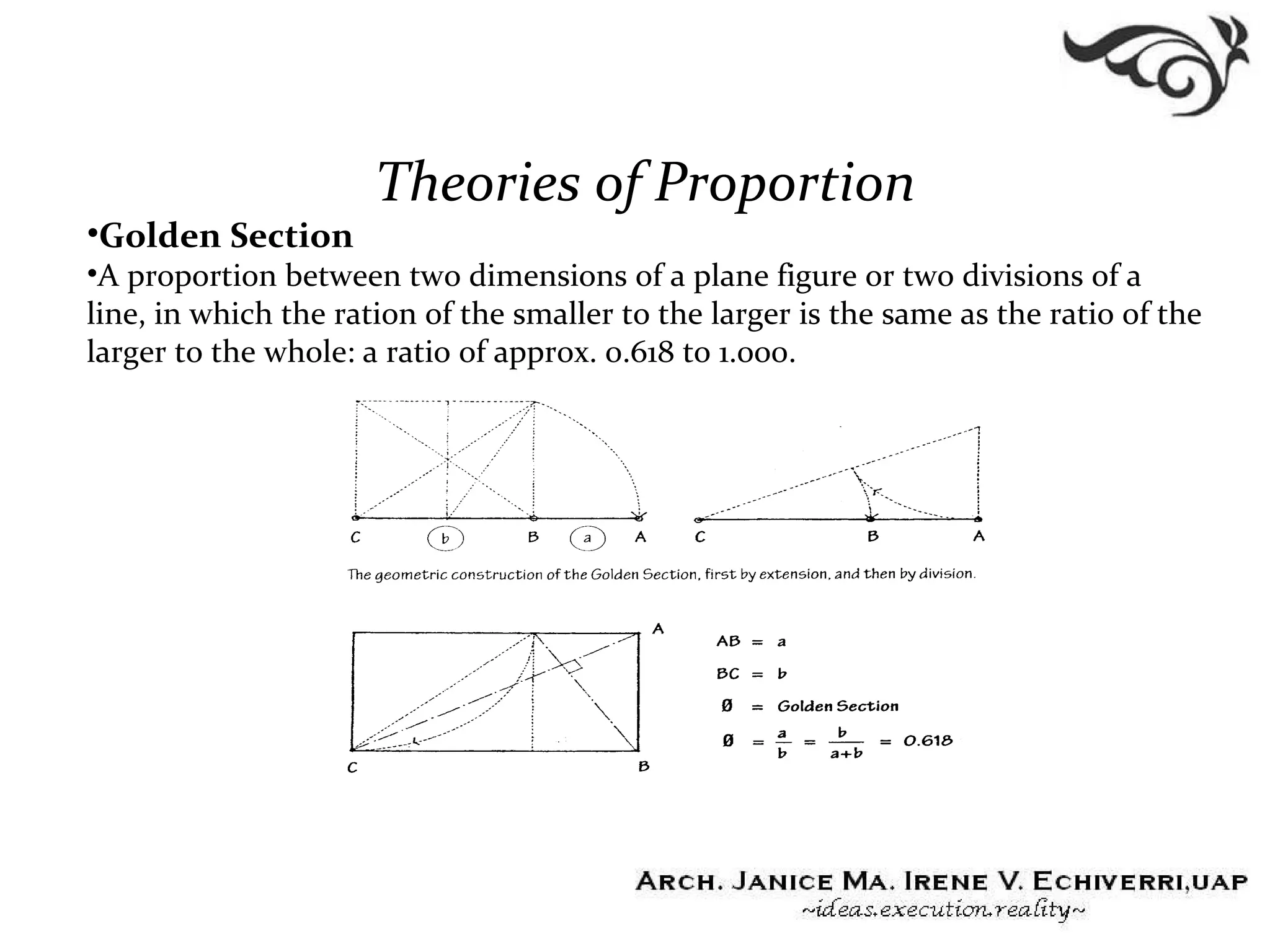
•Golden Section
•A proportion between two dimensions of a plane figure or two divisions of a
line, in which the ration of the smaller to the larger is the same as the ratio of the
larger to the whole: a ratio of approx. 0.618 to 1.000.
Theories of Proportion
•Golden Section
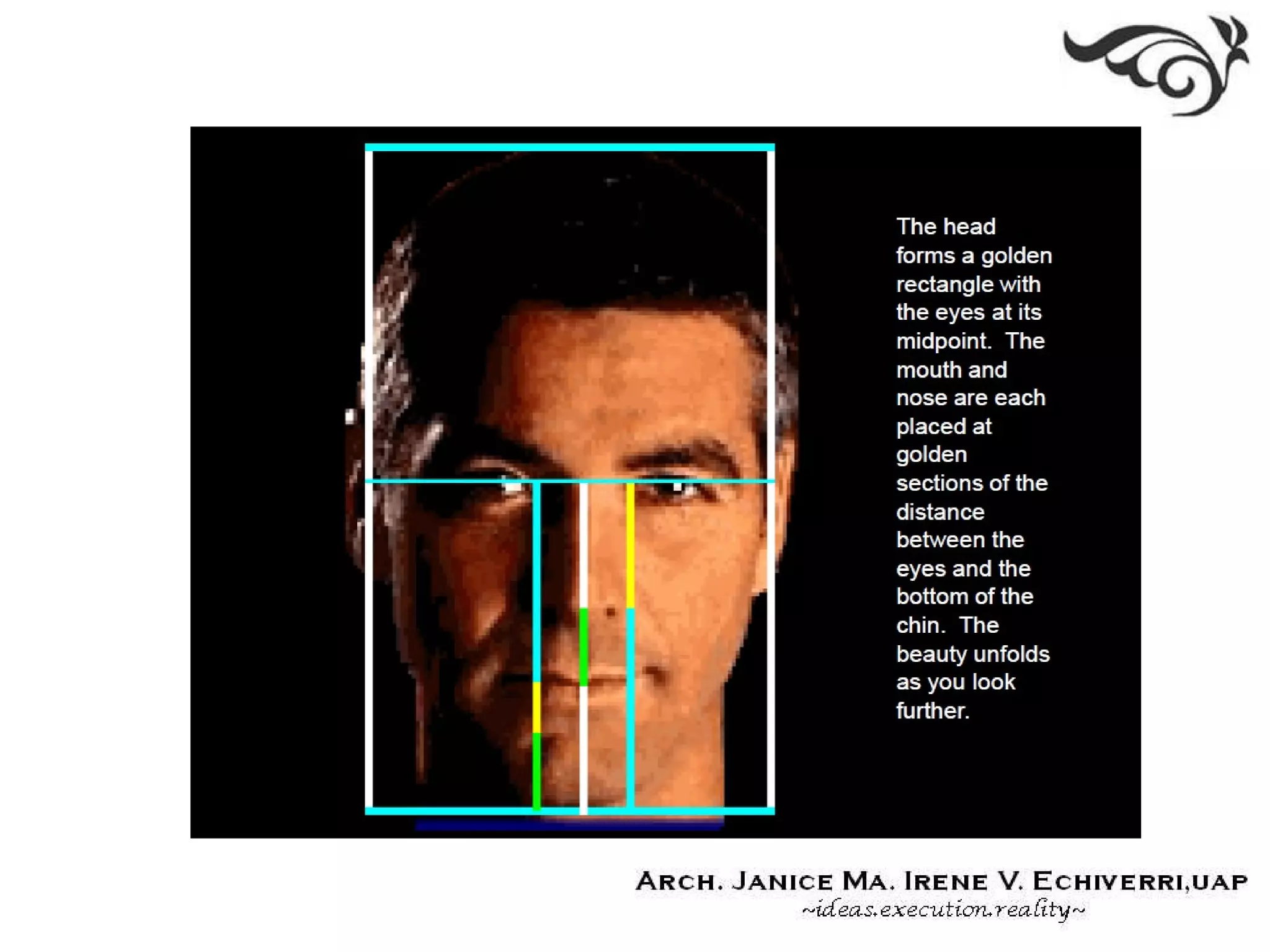
•A rectangle whose sides are proportioned according to the Golden Section is
known as a Golden Rectangle.
• If a square is constructed on its smaller side, the remaining
portion of the original rectangle would be a smaller but similar Golden
Rectangle.
 
Theories of Proportion
•Fibonacci Series
•Progression that closely approximates the Golden Section
•1,1,2,3,5,8,13…
•Regulating Lines
•The diagonals of two rectangles which are either parallel or perpendicular to
each other that indicate that the two rectangles have similar proportions, as well
as the lines that indicate the common alignment of elements.
Theories of Proportion
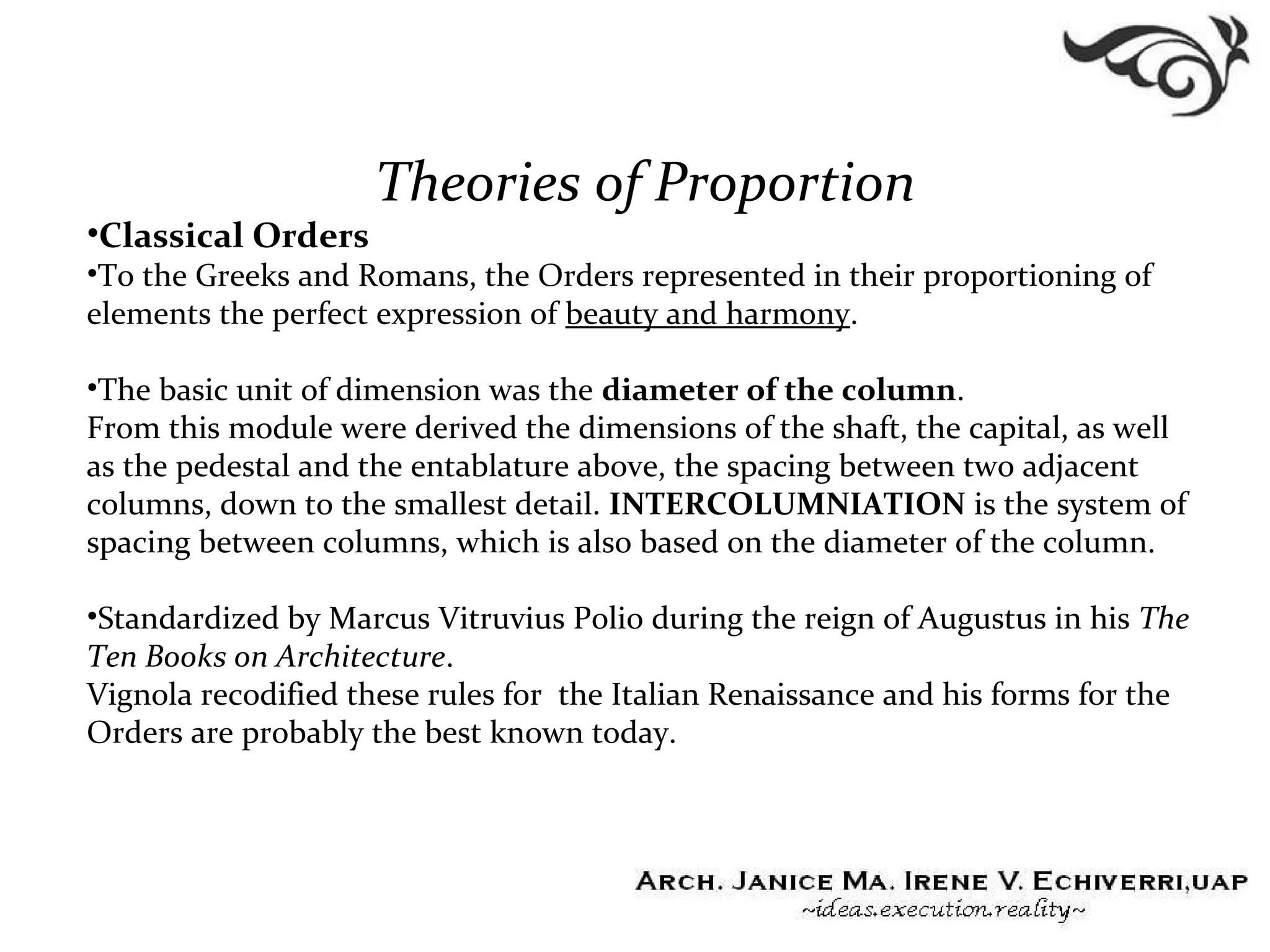
•Classical Orders
•To the Greeks and Romans, the Orders represented in their proportioning of
elements the perfect expression of beauty and harmony.
•The basic unit of dimension was the diameter of the column.
From this module were derived the dimensions of the shaft, the capital, as well
as the pedestal and the entablature above, the spacing between two adjacent
columns, down to the smallest detail. INTERCOLUMNIATION is the system of
spacing between columns, which is also based on the diameter of the column.
•Standardized by Marcus Vitruvius Polio during the reign of Augustus in his The
Ten Books on Architecture.
Vignola recodified these rules for the Italian Renaissance and his forms for the
Orders are probably the best known today.
Theories of Proportion
•Renaissance Theories
•The architects of the Renaissance, believing that their buildings had to belong
to a higher order, returned to the Greek mathematical system of proportions.
The Pythagorean creed was “ Everything is arranged according to numbers.”
•The Greeks conceived music to be geometry translated into sound, Renaissance
architects believed that architecture was mathematics translated into spatial
units.
•Renaissance architects applied PYTHAGORAS’S THEORY OF MEANS to the
ratios of the intervals of the Greek musical scale, and soon developed an
unbroken progression of ratios that formed the basis for the proportions of their
architecture.
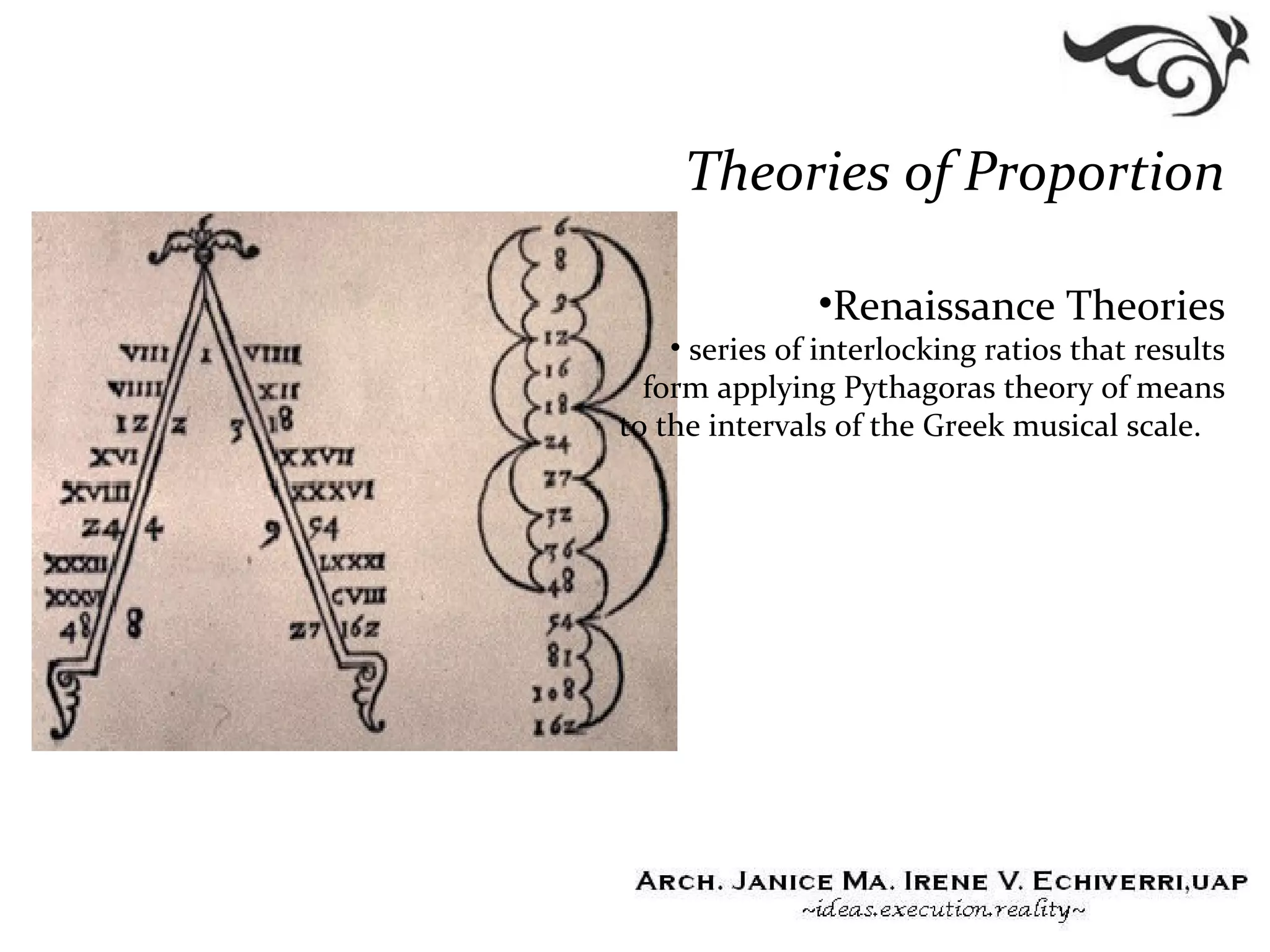
Theories of Proportion
•Renaissance Theories
• series of interlocking ratios that results
form applying Pythagoras theory of means
to the intervals of the Greek musical scale.
Theories of Proportion
•Renaissance Theories
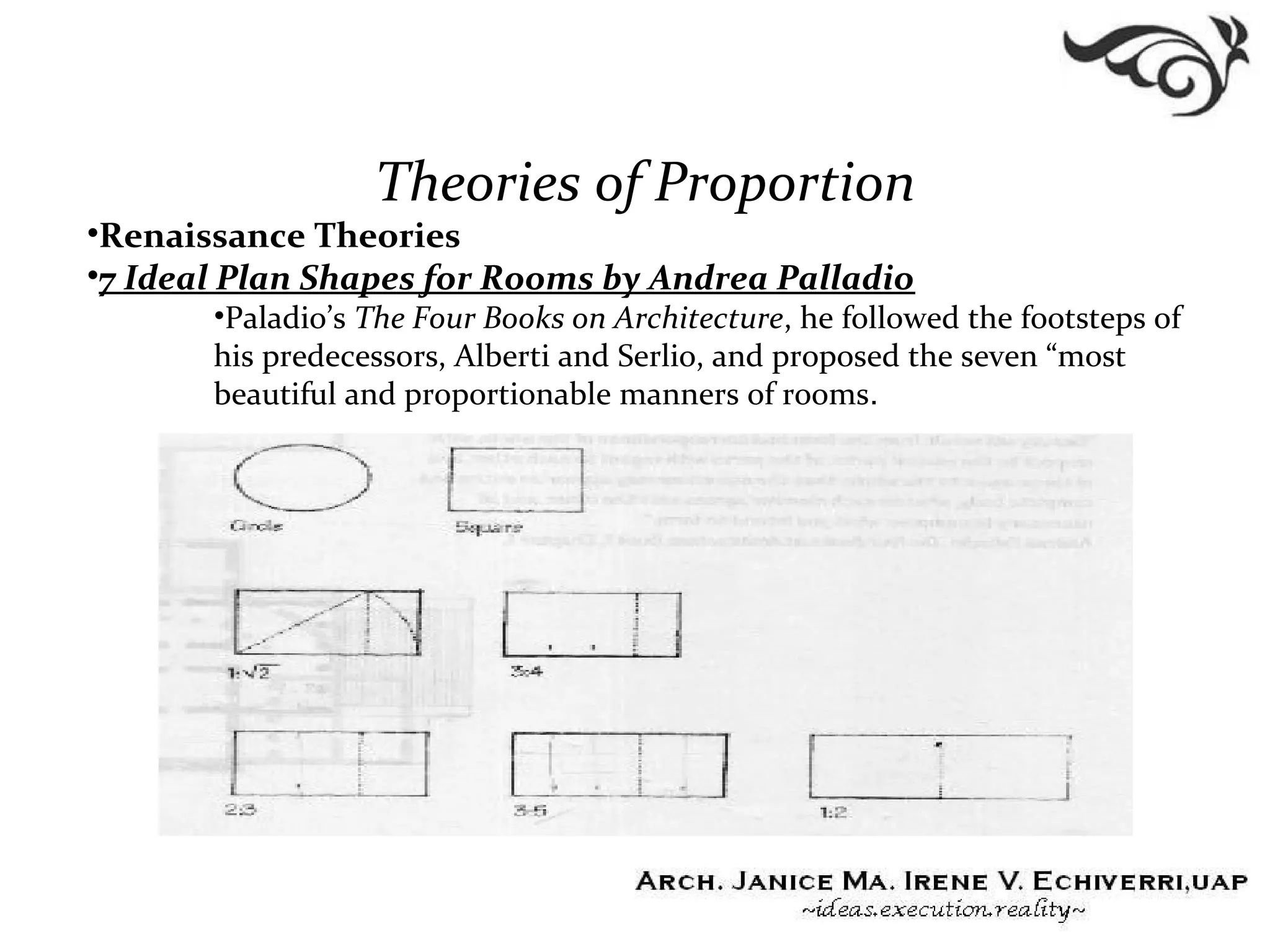
•7 Ideal Plan Shapes for Rooms by Andrea Palladio
•Paladio’s The Four Books on Architecture, he followed the footsteps of
his predecessors, Alberti and Serlio, and proposed the seven “most
beautiful and proportionable manners of rooms.
Theories of Proportion
•Modulor
•Le Corbusier’s own proportioning system developed in 1942 published as: The
Modulor: A HArmoniuos Measure to the Human Sale Universally Applicable to
Architecture and Mechanics. : to order “the dimensions of that which contains
and that which is contained.”
•He saw the measuring tools of the Greeks, Egyptians, and other high
civilizations as being “infinitely rich and subtle because they formed part of
the mathematics of the human body, gracious, elegant, and firm, the
source of that harmony which moves us, beauty.”
•He based the Modulor on both mathematics (the aesthetic dimension of the
Golden Section and the Fibonacci Series), and the proportions of the human
body (functional dimensions).
Theories of Proportion
•Le Modulor
• Le Corbusier saw the Modulor not as a
series of numbers with an inherent
harmony, but as a system of measurements
that could govern lengths, surfaces, &
volumes, & “maintain the human scale
everywhere.”
113, 70, 43 cm
43 + 70 =113
113 + 70 = 183
113 + 70 + 43 = 226(2x113)
Theories of Proportion
•Ken
•The traditional Japanese unit of measure, the shaku, was originally imported
form China.
•Originally used simply to designate the interval between two columns and
varied in size, it was soon standardized for residential architecture and became
an absolute measurement.
•Aside as a measurement system, it evolved into an aesthetic module that
ordered the structure, materials, and space of Japanese architecture.
 
 
Theories of Proportion
•Ken
•Two methods of designing with the Ken modular method:
•Inaka-ma Method
The ken grid of 6 shaku determined the center-to-center spacing of
columns.Therefore, the standard tatami floor mat (3 x ^ shaku or
½ x 1 ken) varied slightly to allow for the thickness of the columns.
•Kyo-ma Method
The floor mat remained constant (3.15 x 6.30 shaku) and the
column spacing (ken module) varied according to the size of the
room and ranged from 6.4 to 6.7 shaku.


Theories of Proportion
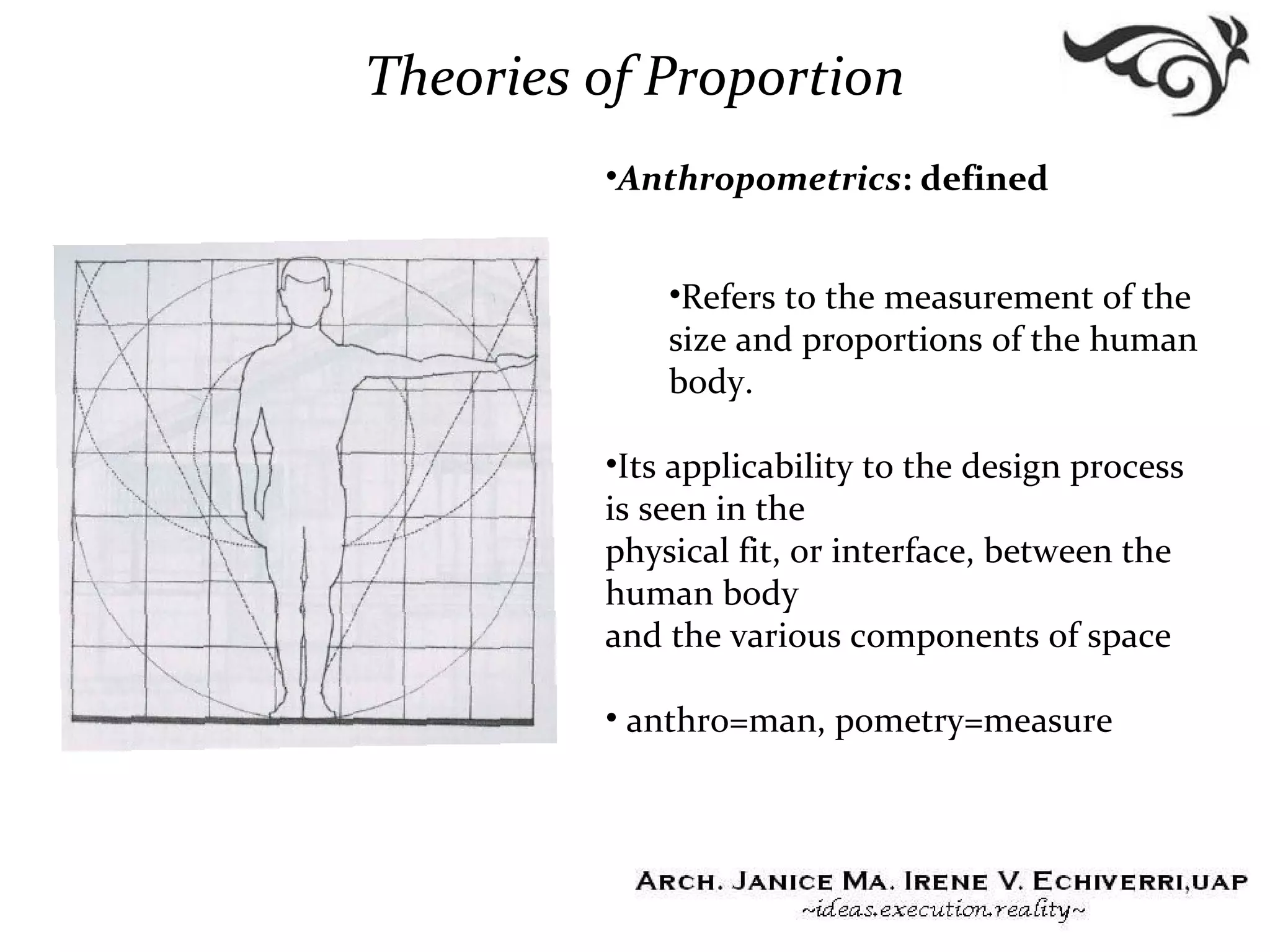
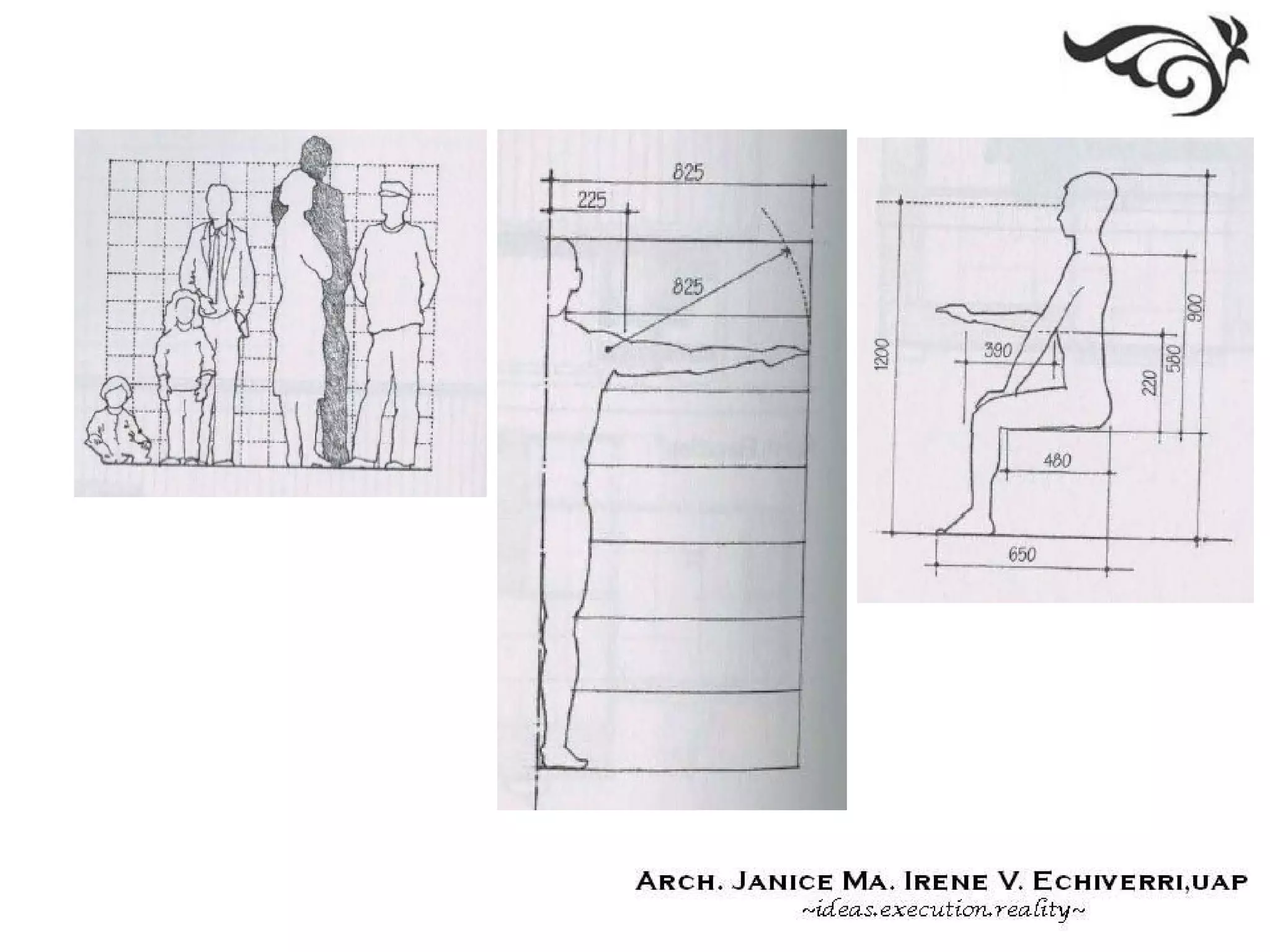
•Anthropometrics: defined
•Refers to the measurement of the
size and proportions of the human
body.
•Its applicability to the design process
is seen in the
physical fit, or interface, between the
human body
and the various components of space
• anthro=man, pometry=measure
Theories of Proportion
•Scale
•Refers to how we perceive or judge the size of something in relation
to something else.
•The entity of a space or object is being compared to may be an accepted
unit or standard of measurement.
•In drawing, we use scale to specify the ratio that determines the
relationship between the illustration it represents.
Theories of Proportion
•Scale
•Mechanical Scale
•The size or proportion of something relative to an accepted
standard of measurement.
•Visual Scale
•The size or proportion an element appears to have relative to
other elements of known or assumed size.
•Human Scale
•Based on the dimensions & proportions of the human body
Activity #3/Assessment
Review the ff topics:
Definition of Architecture
Definition of Theory of Architecture
Architectural Systems of Villa Savoye
Proportion & Scale
Proportioning Systems
Theories of Proportion

02 theories of proportion

  • 1.
    Proportion & Scale •Material Proportions – All materials have rational proportions – Inherent strength & weaknesses • Structural Proportions – Structural tasks – Visual indicators of size & scale • Manufactured Proportions – manufacturing
  • 2.
    Proportioning Systems • Proportion –Relation of one part to another or whole – Equality between 2 ratios • Ratio – Relation in magnitude, quantity, or degree between 2 or more similar things • Eurhythmy – harmony or movement • Fibonacci Series – Unending sequence of numbers • Harmonic Series – Harmonic progression – sequence of numbers w/c are reciprocals, arithmetic progression
  • 3.
    •Golden Section •Classical Orders •RenaissanceTheories •Modulor •Ken •Anthropometry •Scale Theories of Proportion
  • 4.
    Theories of Proportion •GoldenSection •A proportion between two dimensions of a plane figure or two divisions of a line, in which the ration of the smaller to the larger is the same as the ratio of the larger to the whole: a ratio of approx. 0.618 to 1.000.
  • 5.
    Theories of Proportion •GoldenSection •A rectangle whose sides are proportioned according to the Golden Section is known as a Golden Rectangle. • If a square is constructed on its smaller side, the remaining portion of the original rectangle would be a smaller but similar Golden Rectangle.  
  • 6.
    Theories of Proportion •FibonacciSeries •Progression that closely approximates the Golden Section •1,1,2,3,5,8,13… •Regulating Lines •The diagonals of two rectangles which are either parallel or perpendicular to each other that indicate that the two rectangles have similar proportions, as well as the lines that indicate the common alignment of elements.
  • 11.
    Theories of Proportion •ClassicalOrders •To the Greeks and Romans, the Orders represented in their proportioning of elements the perfect expression of beauty and harmony. •The basic unit of dimension was the diameter of the column. From this module were derived the dimensions of the shaft, the capital, as well as the pedestal and the entablature above, the spacing between two adjacent columns, down to the smallest detail. INTERCOLUMNIATION is the system of spacing between columns, which is also based on the diameter of the column. •Standardized by Marcus Vitruvius Polio during the reign of Augustus in his The Ten Books on Architecture. Vignola recodified these rules for the Italian Renaissance and his forms for the Orders are probably the best known today.
  • 13.
    Theories of Proportion •RenaissanceTheories •The architects of the Renaissance, believing that their buildings had to belong to a higher order, returned to the Greek mathematical system of proportions. The Pythagorean creed was “ Everything is arranged according to numbers.” •The Greeks conceived music to be geometry translated into sound, Renaissance architects believed that architecture was mathematics translated into spatial units. •Renaissance architects applied PYTHAGORAS’S THEORY OF MEANS to the ratios of the intervals of the Greek musical scale, and soon developed an unbroken progression of ratios that formed the basis for the proportions of their architecture.
  • 14.
    Theories of Proportion •RenaissanceTheories • series of interlocking ratios that results form applying Pythagoras theory of means to the intervals of the Greek musical scale.
  • 15.
    Theories of Proportion •RenaissanceTheories •7 Ideal Plan Shapes for Rooms by Andrea Palladio •Paladio’s The Four Books on Architecture, he followed the footsteps of his predecessors, Alberti and Serlio, and proposed the seven “most beautiful and proportionable manners of rooms.
  • 16.
    Theories of Proportion •Modulor •LeCorbusier’s own proportioning system developed in 1942 published as: The Modulor: A HArmoniuos Measure to the Human Sale Universally Applicable to Architecture and Mechanics. : to order “the dimensions of that which contains and that which is contained.” •He saw the measuring tools of the Greeks, Egyptians, and other high civilizations as being “infinitely rich and subtle because they formed part of the mathematics of the human body, gracious, elegant, and firm, the source of that harmony which moves us, beauty.” •He based the Modulor on both mathematics (the aesthetic dimension of the Golden Section and the Fibonacci Series), and the proportions of the human body (functional dimensions).
  • 17.
    Theories of Proportion •LeModulor • Le Corbusier saw the Modulor not as a series of numbers with an inherent harmony, but as a system of measurements that could govern lengths, surfaces, & volumes, & “maintain the human scale everywhere.”
  • 18.
    113, 70, 43cm 43 + 70 =113 113 + 70 = 183 113 + 70 + 43 = 226(2x113)
  • 19.
    Theories of Proportion •Ken •Thetraditional Japanese unit of measure, the shaku, was originally imported form China. •Originally used simply to designate the interval between two columns and varied in size, it was soon standardized for residential architecture and became an absolute measurement. •Aside as a measurement system, it evolved into an aesthetic module that ordered the structure, materials, and space of Japanese architecture.    
  • 21.
    Theories of Proportion •Ken •Twomethods of designing with the Ken modular method: •Inaka-ma Method The ken grid of 6 shaku determined the center-to-center spacing of columns.Therefore, the standard tatami floor mat (3 x ^ shaku or ½ x 1 ken) varied slightly to allow for the thickness of the columns. •Kyo-ma Method The floor mat remained constant (3.15 x 6.30 shaku) and the column spacing (ken module) varied according to the size of the room and ranged from 6.4 to 6.7 shaku.      
  • 24.
    Theories of Proportion •Anthropometrics:defined •Refers to the measurement of the size and proportions of the human body. •Its applicability to the design process is seen in the physical fit, or interface, between the human body and the various components of space • anthro=man, pometry=measure
  • 26.
    Theories of Proportion •Scale •Refersto how we perceive or judge the size of something in relation to something else. •The entity of a space or object is being compared to may be an accepted unit or standard of measurement. •In drawing, we use scale to specify the ratio that determines the relationship between the illustration it represents.
  • 27.
    Theories of Proportion •Scale •MechanicalScale •The size or proportion of something relative to an accepted standard of measurement. •Visual Scale •The size or proportion an element appears to have relative to other elements of known or assumed size. •Human Scale •Based on the dimensions & proportions of the human body
  • 30.
    Activity #3/Assessment Review theff topics: Definition of Architecture Definition of Theory of Architecture Architectural Systems of Villa Savoye Proportion & Scale Proportioning Systems Theories of Proportion