UNIT I :
INTRODUCTION TO
ARCHITECTURE
UNIT -I INTRODUCTION TO
ARCHITECTURE
•Origin and definitions of architecture as need based,
cultural, environmental, social, psychological response of
human society. Architecture as phenomenological mediation
of nature.
•Components of architecture: use, means, site, shelter,
relation to nature, structure, skin, materials, services,
circulation, typology, aesthetics, expression, character,
symbolism, experience, etc.,
• History and types of design in architecture- unself-
conscious/ self-conscious design, design through craft/ design
through drawing, pragmatic/ iconic/ canonic/ analogic design.
WHAT ARE THE
PRIMARY PHYSICAL
NEEDS FOR SURVIVAL
?
PRIMARY PHYSICAL NEEDS FOR
SURVIVAL
AIR, WATER
THE PRIMARY
PHYSICAL NEEDS FOR
SURVIVAL
THENATUREOF
ARCHITECTURE
 Primary physical needsfor survival – eg:Air, Water are
available in a ready form in the natural environment
and canbe utilised without any modification.
 Other primary needslike food, clothing and shelterare
deliberately derived from the raw materials in the
environmentand made into a consumableform after
modification and transformation.
 Food–cooked
 Clothing – manufactured
 Shelter– constructed
WHAT IS
ARCHITECTURE ?
WHAT IS ARCHITECTURE ?
• The earliest surviving written work on the subject of architecture
is De architectura libri decem, by the Roman architect Vitruvius
• Vitruvius
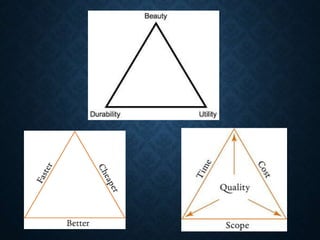
• Vitruvius was a Roman architect and engineer during the 1st
century BC, known for his multi-volume work entitled De
architectura. He originated the idea that all buildings should have
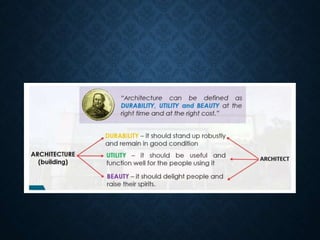
three attributes: firmitas, utilitas, and venustas. These principles
were later widely adopted in Roman architecture
• In the early 1st century AD. According to Vitruvius, a good
building should satisfy the three principles
ORIGIN OF ARCHITECTURE
“In the assembly [...] they were led to the consideration
of sheltering themselves from the seasons, some by
making arbors with the boughs of trees, some by
excavating caves in the mountains, and others in
imitation of the nests and habitations of swallows, by
making dwellings of twigs interwoven and covered with
mud or clay.
ORIGIN OF ARCHITECTURE
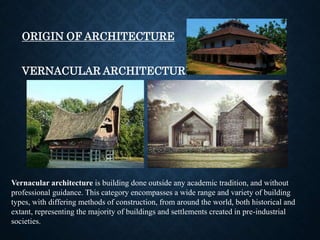
VERNACULAR ARCHITECTURE
Vernacular architecture is building done outside any academic tradition, and without
professional guidance. This category encompasses a wide range and variety of building
types, with differing methods of construction, from around the world, both historical and
extant, representing the majority of buildings and settlements created in pre-industrial
societies.
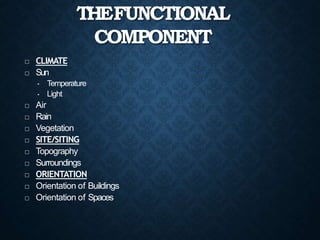
THEFUNCTIONAL
COMPONENT
 CLIMATE
 Sun
• Temperature
• Light
 Air
 Rain
 Vegetation
 SITE/SITING
 Topography
 Surroundings
 ORIENTATION
 Orientation of Buildings
 Orientation of Spaces
THEFUNCTIONAL
COMPONENT
 CIRCULATION
 Horizontal circulation patterns
 Vertical Circulation patterns
 Multistoried Circulation patterns
 Miscellaneouscirculation patterns
 STRUCTURAL MATERIALS
 General aimsthat a structuralmaterial hasto fulfill are:
 Astructuralmaterial mustbe economical.
• Cost
• Material/Space Ratio
• Durability
 Astructuralmaterial musthaveadequate strength.
 Astructuremustgenerally ensuresomedegree of climatic control.
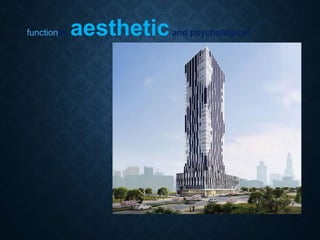
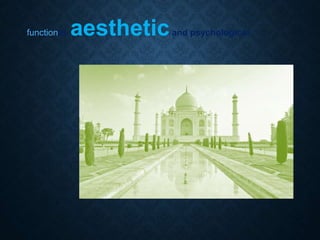
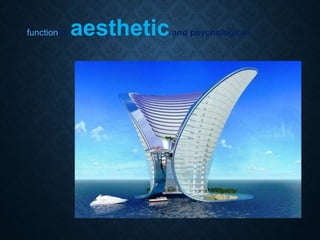
functional, aestheticand psychological
THEAESTHETIC
COMPONENT
 Theaesthetic componentmaybe sub-divided into a
numberof basicelements.
• Mass
• Space
• Proportion
• Symmetry
• Balance
• Contrast
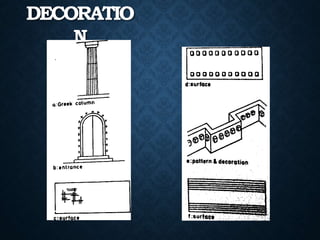
• Pattern
• Decoration
THEAESTHETIC
COMPONENT
 Theaesthetic componentsare capable of evoking
responsesonly to the extent that they are seeni.e. they
belong to the realm of vision– it isthrough sight that
webecomeaware of their properties.
 Thisact of seeingisinfluenced by the nature of the
subjectseeingthemaswell asthe nature of the objects
being seen.
 Thehumanmindworksin sucha way that it mentally
createssomekind of order out of the chaosof
impressions.
 Therefore,the act of seeingissimultaneouslyan act of
organization.
THEAESTHETIC
COMPONENT
 When looking at a piece of architecture, it will seekout the principle
visual qualities: mass,form, outline, emphasis,light, shade,texture,
pattern, etc.
 Eachof thesevisualqualities evokesin the observer a corresponding
emotional reaction.
 Thesumof theseimpressionscreates an emotional state. It isthis
emotional state that an architect shouldunderstand and anticipate in
order to succeedasadesigner.
 Inarchitecture, thisorder that iscreated out of the visual
phenomena,ismostconcernedwith form.
 Eg:Sphere,pyramid, cube, etc.
 Mostof the natural objects almostnever havesuchpure forms.
 Humanbeing evaluates objects in relation to himself.
THEAESTHETIC
COMPONENT
 Themosttypical characteristic of humanbeingis
uprightness.
 Anupright personhasan imaginary axis running
through the centre of his body which is at right
angles to the surface
of the ground – thisupright stancegives rise to the
conceptof verticalness.
 Eyesare located at the top of the upright body at
about 160-170 cmfrom the surfaceof the ground.
 Therefore,a personseesthe world from thisconstant
vertical height and thistoo defines verticalness.
THEAESTHETIC
COMPONENT
 Another important characteristic isthat a personseeswith two eyesand not one.At
the sameheight of about 160- 170 cman imaginary horizontal axis runsparallel to
the ground.
 This axis is at right angle to the vertical axis and this gives rise to the concept of
horizontalness.
 Thetwo principal qualities of seeing,verticalness and horizontalness, arise from
the biological structureof humanbeings and it becomesclear why they are at right
angles to each other.
 Thisframework thusproducesthe qualities of height and width.
 However, any thing we seemight be situated at a distance from us.Thisgivesrise to
the third visual quality of depth.
 Horizontalness= Horizontal movementof the eyesor head
 Verticalness= Vertical movementof the eyesor head
 Vertical viewing isaccompanied by muchgreater physical tensionthan horizontal.
 Depth canbe perceived by merely eye movements,without movementof head –
least tension.
THEAESTHETIC
COMPONENT
 Important characteristic of form – dimension.
 Height remainsconstantfrom whichever side it isseenbut the horizontal impression
of humanform doesnot havethesame constancy.
 Vertical dimension isconstant.
 Horizontal dimension hastwo components:Width and depth
 Thesethree principal dimensionsmakeuptheoverall visual impression of the human
form.
 Alsodefines the primary visual character of all external forms.
 Height = Vertical distance of summitof an object from ground level
 Width = Greatest overall horizontal dimension
 Depth = Smallesthorizontaldimension
 Inoneinstantaneousact of perception, theeyesseethe principal dimensionsof form
– Height, width and depth.
 Thesethree dimensionsform a dynamic relationship between eachother giving rise
to a composite quality – proportion.
THEAESTHETIC
COMPONENT
 Innatural objects,like a tree, ananimal, etc.theeye isunable to discover
clearly defined volumes– onearea mergesinto another and there isno
specific area theeyesfocus on.
 Theobserver isaware of thetotal form and nottheindividual elements.
 Inmanmadeor architectural forms,theopposite happens– because
geometrical formsusedin architecture are perceived clearly.
 Ageometrical form - Example:Cube– iscomposedof flat surfaces.
 Junctionof surfaces= Lines
 Junctionof lines= Points
 Acubicform in architecture, dueto itsgreater size,requires time for its
properties to be observed.
 If thearchitectural form ismorecomplex,time becomesmoresignificant
and total awarenessismadeupof a sequenceof partial observations.
MAS
S
 Mass– visual effect of a body
 Masshassomerelation to the sizeof the body but none
to the weight.
 Eg:Alarge canvastent hasmuchgreater visual mass
thana smallbrick building.
 Alarge volumepainted a dull colour– enhancementof
the impressionof mass
 Samevolumepainted a light colour – will appear less
massive.
 Eventhoughthe form issame– sincethe surfacequality
isdifferent there isdifference inmass.
SP
AC
E
 Fora humanbody to perform any activity, a certain minimum
unobstructed volumearound it is needed.
 Thisvolumeisa functionof height and other physical properties of
humanbody and isdetermined purely by the activities to whichthis
volumeserves.Thisspaceiscalled Utilitarian space.
 Asthere isalso emotional requirement. When increasedvolumeis
distributed proportionally to be aesthetically satisfying, sucha
spaceiscalled Aesthetic space.
 When thesetwo spatial requirements exerts an influenceand
modifies the other – it iscalled Architectural space.
 It isthe presenceof massthat makesusexperiencespace.
 Mass– Positive volume
 Space– Negative volume
PROPORTIO
N
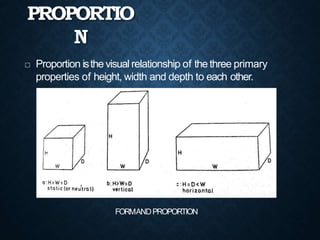
 Proportion isthe visual relationship of the three primary
properties of height, width and depth to each other.
FORMANDPROPORTION
PROPORTIO
N
 Designof a Kindergarten.
 Designof anauditorium for 1000 people.
SYMMETR
Y
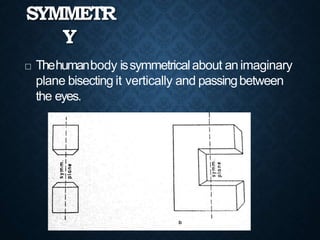
 Thehumanbody issymmetricalabout animaginary
plane bisecting it vertically and passingbetween
the eyes.
BALANC
E
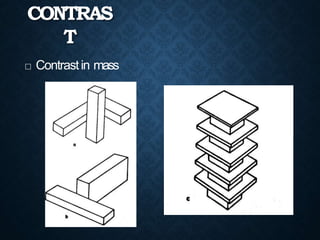
CONTRAS
T
 Contrastin mass
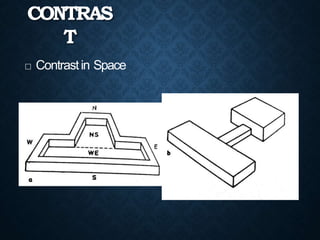
CONTRAS
T
 Contrastin Space
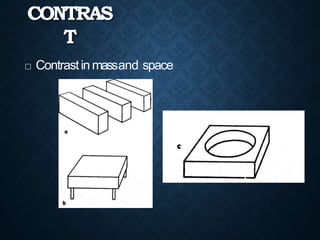
CONTRAS
T
 Contrastin massand space
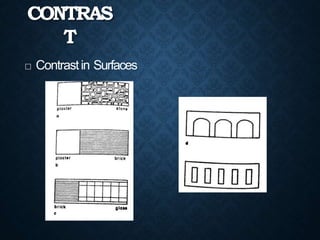
CONTRAS
T
 Contrastin Surfaces
CONTRAS
T
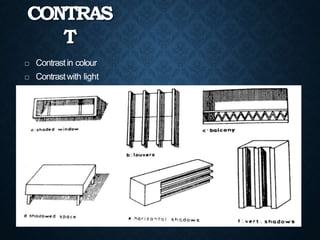
 Contrastin colour
 Contrastwith light
P
ATTER
N
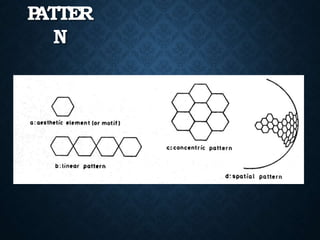
P
ATTER
N
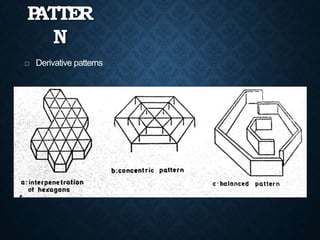
 Derivative patterns
P
ATTER
N
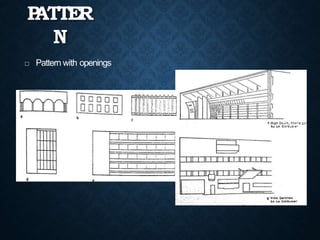
 Pattern with openings
DECORATIO
N
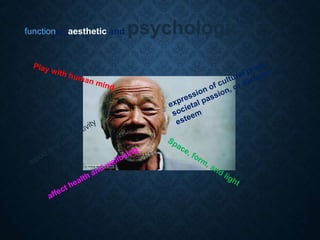
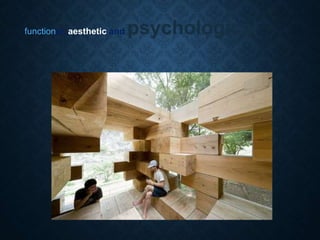
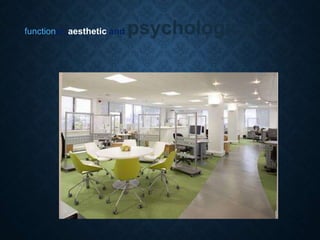
functional, aesthetic and psychological
Physical structure has a significant
effect on human behavior.
As humans find themselves spending more time
enclosed within the walls of structure, it becomes
valuable to design structures integrating features of
the natural environment and structural landscape
features into the human-made environment (Joye,
2007).
Research suggests the design of residential and
commercial space has pervasive effects on its
inhabitants and is an important consideration in
architectural design.
functional, aesthetic and psychological
Space, form, and light are elements that are often incorporated either
purposefully or unconsciously for aesthetic or practical reasons but
more pointedly give people meaning, purpose and stability amidst an
ever changing physical universe of seeming chao
functional, aesthetic and psychological
ARCHITECTURE as a discipline-
• ARCHITECTURE – an ability to organize, manipulate
and articulate the constant and variable component
parts of size, shape, and treatment.
• ARCHITECTURE - a language of sequential path,
place, and transition spaces in relationship to site,
location, and orientation.
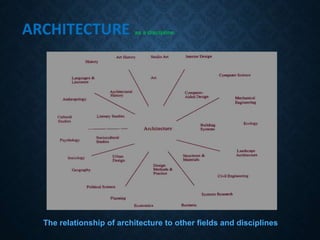
ARCHITECTURE as a discipline-
The relationship of architecture to other fields and disciplines
THREE COMPONENTS
• SIZE AND SHAPE
• TREATMENT
• ORIENTATION
THREE COMPONENTS
• SIZE AND SHAPE
• is self-evident, consisting of an infinite variety of different sizes of
masses or volumes:
• such as squares, rectangles, circles, pyramids, ellipses, curves,
cubes, etc.
THREE COMPONENTS
• TREATMENT
• what do you do with the sizes and the shapes?
• •how many different ways can you treat it in a simple way?
• •how does that treatment alter or change?
• •in what ways can you define or manipulate the sizes and shapes?
• •what is your strategy for detailing and joinery (articulation)?
• treatment is pattern, texture, color, figure, ground, light,
illumination, contrast, opacity,
• transparency, translucency, reflectivity, visual density, thickness or
thinness, etc
THREE COMPONENTS
• ORIENTATION
• what is the relative position of something or someone?
• •location - a particular place or position:
• -external - internal - interstitial
• -placement and displacement
• -edge (periphery) vs. center (core) or foreground, middle
ground, background
• -relationship of a building to its neighbours
• -relationship of building to sky
• -relationship of building to ground
• •directionality, redirection or reversals:
• -up vs. down
• -left vs. right
• -longitudinal vs. transverse
• -horizontal vs. vertical
• -orthogonal vs. diagonal
• -exposure: north - south - east - west
THREE TYPES OF SPACE
• PLACE - SPACES
• PATH – SPACES
• TRANSTITION - SPACES
THREE TYPES OF SPACE
• PLACE-SPACES
• major spaces that portray a sense of definite location or position
THREE TYPES OF SPACE
• PATH-SPACES
• major transition spaces which are directional; corridor, connector,
passageway.
THREE TYPES OF SPACE
• TRANSITION-SPACES
• minor spaces which process a change from one condition to another.
• •joint spaces (or articulation spaces)
• •can define a pause between spaces
• •can juxtapose spaces of contrasting or continuous character
• •can act as a separator space
• •can act as fastener, joining or linking space
• servant-spaces are transition spaces that act as functional support
(storage spaces, bathrooms, mechanical voids, space occupied by
structural elements, etc.)
INTRODUCING THE VARIOUS
FUNCTIONAL ASPECTS OF
ARCHITECTURE
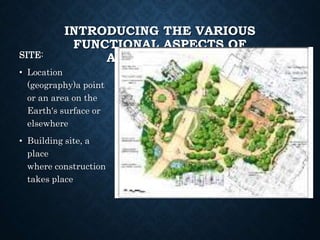
SITE:
• Location
(geography)a point
or an area on the
Earth's surface or
elsewhere
• Building site, a
place
where construction
takes place
SHELTER
A shelter is a basic architectural structure or building that
provides protection from the local environment. Having a place of
shelter, of safety and of retreat, i.e. a home, is commonly
considered a fundamental physiological human need, the
foundation from which to develop higher human motivations.
INTRODUCING THE VARIOUS
FUNCTIONAL ASPECTS OF
ARCHITECTURE
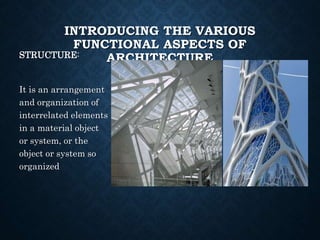
STRUCTURE:
It is an arrangement
and organization of
interrelated elements
in a material object
or system, or the
object or system so
organized
INTRODUCING THE VARIOUS
FUNCTIONAL ASPECTS OF
ARCHITECTURE
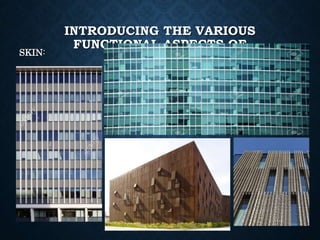
SKIN:
INTRODUCING THE VARIOUS
FUNCTIONAL ASPECTS OF
ARCHITECTURE
CIRCULATION:
APPROACH
The Distant View
ENTRANCE
• From Outside to inside
CONFIGURATION OF THE PATH
• The Sequences of Spaces
PATH-SPACE RELATIONSHIPS
• Edges, Nodes, and Terminations of the Path
FORM OF THE CIRCULATION SPACE
• Corridors, Halls, Galleries, Stairways and Rooms
INTRODUCING THE VARIOUS
FUNCTIONAL ASPECTS OF
ARCHITECTURE
SERVICES:
•Structural
•Plumbing
•Electrical
•Fire safety
•Maintenance

Unit 1 Architecture, Analysis

  • 1.
    UNIT I : INTRODUCTIONTO ARCHITECTURE
  • 2.
    UNIT -I INTRODUCTIONTO ARCHITECTURE •Origin and definitions of architecture as need based, cultural, environmental, social, psychological response of human society. Architecture as phenomenological mediation of nature. •Components of architecture: use, means, site, shelter, relation to nature, structure, skin, materials, services, circulation, typology, aesthetics, expression, character, symbolism, experience, etc., • History and types of design in architecture- unself- conscious/ self-conscious design, design through craft/ design through drawing, pragmatic/ iconic/ canonic/ analogic design.
  • 3.
    WHAT ARE THE PRIMARYPHYSICAL NEEDS FOR SURVIVAL ?
  • 4.
    PRIMARY PHYSICAL NEEDSFOR SURVIVAL AIR, WATER
  • 5.
  • 6.
    THENATUREOF ARCHITECTURE  Primary physicalneedsfor survival – eg:Air, Water are available in a ready form in the natural environment and canbe utilised without any modification.  Other primary needslike food, clothing and shelterare deliberately derived from the raw materials in the environmentand made into a consumableform after modification and transformation.  Food–cooked  Clothing – manufactured  Shelter– constructed
  • 7.
  • 8.
    WHAT IS ARCHITECTURE? • The earliest surviving written work on the subject of architecture is De architectura libri decem, by the Roman architect Vitruvius • Vitruvius • Vitruvius was a Roman architect and engineer during the 1st century BC, known for his multi-volume work entitled De architectura. He originated the idea that all buildings should have three attributes: firmitas, utilitas, and venustas. These principles were later widely adopted in Roman architecture • In the early 1st century AD. According to Vitruvius, a good building should satisfy the three principles
  • 11.
    ORIGIN OF ARCHITECTURE “Inthe assembly [...] they were led to the consideration of sheltering themselves from the seasons, some by making arbors with the boughs of trees, some by excavating caves in the mountains, and others in imitation of the nests and habitations of swallows, by making dwellings of twigs interwoven and covered with mud or clay.
  • 12.
    ORIGIN OF ARCHITECTURE VERNACULARARCHITECTURE Vernacular architecture is building done outside any academic tradition, and without professional guidance. This category encompasses a wide range and variety of building types, with differing methods of construction, from around the world, both historical and extant, representing the majority of buildings and settlements created in pre-industrial societies.
  • 13.
    THEFUNCTIONAL COMPONENT  CLIMATE  Sun •Temperature • Light  Air  Rain  Vegetation  SITE/SITING  Topography  Surroundings  ORIENTATION  Orientation of Buildings  Orientation of Spaces
  • 14.
    THEFUNCTIONAL COMPONENT  CIRCULATION  Horizontalcirculation patterns  Vertical Circulation patterns  Multistoried Circulation patterns  Miscellaneouscirculation patterns  STRUCTURAL MATERIALS  General aimsthat a structuralmaterial hasto fulfill are:  Astructuralmaterial mustbe economical. • Cost • Material/Space Ratio • Durability  Astructuralmaterial musthaveadequate strength.  Astructuremustgenerally ensuresomedegree of climatic control.
  • 15.
  • 16.
  • 17.
  • 18.
    THEAESTHETIC COMPONENT  Theaesthetic componentmaybesub-divided into a numberof basicelements. • Mass • Space • Proportion • Symmetry • Balance • Contrast • Pattern • Decoration
  • 19.
    THEAESTHETIC COMPONENT  Theaesthetic componentsarecapable of evoking responsesonly to the extent that they are seeni.e. they belong to the realm of vision– it isthrough sight that webecomeaware of their properties.  Thisact of seeingisinfluenced by the nature of the subjectseeingthemaswell asthe nature of the objects being seen.  Thehumanmindworksin sucha way that it mentally createssomekind of order out of the chaosof impressions.  Therefore,the act of seeingissimultaneouslyan act of organization.
  • 20.
    THEAESTHETIC COMPONENT  When lookingat a piece of architecture, it will seekout the principle visual qualities: mass,form, outline, emphasis,light, shade,texture, pattern, etc.  Eachof thesevisualqualities evokesin the observer a corresponding emotional reaction.  Thesumof theseimpressionscreates an emotional state. It isthis emotional state that an architect shouldunderstand and anticipate in order to succeedasadesigner.  Inarchitecture, thisorder that iscreated out of the visual phenomena,ismostconcernedwith form.  Eg:Sphere,pyramid, cube, etc.  Mostof the natural objects almostnever havesuchpure forms.  Humanbeing evaluates objects in relation to himself.
  • 21.
    THEAESTHETIC COMPONENT  Themosttypical characteristicof humanbeingis uprightness.  Anupright personhasan imaginary axis running through the centre of his body which is at right angles to the surface of the ground – thisupright stancegives rise to the conceptof verticalness.  Eyesare located at the top of the upright body at about 160-170 cmfrom the surfaceof the ground.  Therefore,a personseesthe world from thisconstant vertical height and thistoo defines verticalness.
  • 22.
    THEAESTHETIC COMPONENT  Another importantcharacteristic isthat a personseeswith two eyesand not one.At the sameheight of about 160- 170 cman imaginary horizontal axis runsparallel to the ground.  This axis is at right angle to the vertical axis and this gives rise to the concept of horizontalness.  Thetwo principal qualities of seeing,verticalness and horizontalness, arise from the biological structureof humanbeings and it becomesclear why they are at right angles to each other.  Thisframework thusproducesthe qualities of height and width.  However, any thing we seemight be situated at a distance from us.Thisgivesrise to the third visual quality of depth.  Horizontalness= Horizontal movementof the eyesor head  Verticalness= Vertical movementof the eyesor head  Vertical viewing isaccompanied by muchgreater physical tensionthan horizontal.  Depth canbe perceived by merely eye movements,without movementof head – least tension.
  • 23.
    THEAESTHETIC COMPONENT  Important characteristicof form – dimension.  Height remainsconstantfrom whichever side it isseenbut the horizontal impression of humanform doesnot havethesame constancy.  Vertical dimension isconstant.  Horizontal dimension hastwo components:Width and depth  Thesethree principal dimensionsmakeuptheoverall visual impression of the human form.  Alsodefines the primary visual character of all external forms.  Height = Vertical distance of summitof an object from ground level  Width = Greatest overall horizontal dimension  Depth = Smallesthorizontaldimension  Inoneinstantaneousact of perception, theeyesseethe principal dimensionsof form – Height, width and depth.  Thesethree dimensionsform a dynamic relationship between eachother giving rise to a composite quality – proportion.
  • 24.
    THEAESTHETIC COMPONENT  Innatural objects,likea tree, ananimal, etc.theeye isunable to discover clearly defined volumes– onearea mergesinto another and there isno specific area theeyesfocus on.  Theobserver isaware of thetotal form and nottheindividual elements.  Inmanmadeor architectural forms,theopposite happens– because geometrical formsusedin architecture are perceived clearly.  Ageometrical form - Example:Cube– iscomposedof flat surfaces.  Junctionof surfaces= Lines  Junctionof lines= Points  Acubicform in architecture, dueto itsgreater size,requires time for its properties to be observed.  If thearchitectural form ismorecomplex,time becomesmoresignificant and total awarenessismadeupof a sequenceof partial observations.
  • 25.
    MAS S  Mass– visualeffect of a body  Masshassomerelation to the sizeof the body but none to the weight.  Eg:Alarge canvastent hasmuchgreater visual mass thana smallbrick building.  Alarge volumepainted a dull colour– enhancementof the impressionof mass  Samevolumepainted a light colour – will appear less massive.  Eventhoughthe form issame– sincethe surfacequality isdifferent there isdifference inmass.
  • 26.
    SP AC E  Fora humanbodyto perform any activity, a certain minimum unobstructed volumearound it is needed.  Thisvolumeisa functionof height and other physical properties of humanbody and isdetermined purely by the activities to whichthis volumeserves.Thisspaceiscalled Utilitarian space.  Asthere isalso emotional requirement. When increasedvolumeis distributed proportionally to be aesthetically satisfying, sucha spaceiscalled Aesthetic space.  When thesetwo spatial requirements exerts an influenceand modifies the other – it iscalled Architectural space.  It isthe presenceof massthat makesusexperiencespace.  Mass– Positive volume  Space– Negative volume
  • 27.
    PROPORTIO N  Proportion isthevisual relationship of the three primary properties of height, width and depth to each other. FORMANDPROPORTION
  • 28.
    PROPORTIO N  Designof aKindergarten.  Designof anauditorium for 1000 people.
  • 29.
    SYMMETR Y  Thehumanbody issymmetricalaboutanimaginary plane bisecting it vertically and passingbetween the eyes.
  • 30.
  • 31.
  • 32.
  • 33.
  • 34.
  • 35.
  • 36.
  • 37.
  • 38.
  • 39.
  • 40.
  • 41.
    functional, aesthetic andpsychological Physical structure has a significant effect on human behavior. As humans find themselves spending more time enclosed within the walls of structure, it becomes valuable to design structures integrating features of the natural environment and structural landscape features into the human-made environment (Joye, 2007). Research suggests the design of residential and commercial space has pervasive effects on its inhabitants and is an important consideration in architectural design.
  • 42.
    functional, aesthetic andpsychological Space, form, and light are elements that are often incorporated either purposefully or unconsciously for aesthetic or practical reasons but more pointedly give people meaning, purpose and stability amidst an ever changing physical universe of seeming chao
  • 43.
  • 44.
  • 45.
    ARCHITECTURE as adiscipline- • ARCHITECTURE – an ability to organize, manipulate and articulate the constant and variable component parts of size, shape, and treatment. • ARCHITECTURE - a language of sequential path, place, and transition spaces in relationship to site, location, and orientation.
  • 46.
    ARCHITECTURE as adiscipline- The relationship of architecture to other fields and disciplines
  • 47.
    THREE COMPONENTS • SIZEAND SHAPE • TREATMENT • ORIENTATION
  • 48.
    THREE COMPONENTS • SIZEAND SHAPE • is self-evident, consisting of an infinite variety of different sizes of masses or volumes: • such as squares, rectangles, circles, pyramids, ellipses, curves, cubes, etc.
  • 49.
    THREE COMPONENTS • TREATMENT •what do you do with the sizes and the shapes? • •how many different ways can you treat it in a simple way? • •how does that treatment alter or change? • •in what ways can you define or manipulate the sizes and shapes? • •what is your strategy for detailing and joinery (articulation)? • treatment is pattern, texture, color, figure, ground, light, illumination, contrast, opacity, • transparency, translucency, reflectivity, visual density, thickness or thinness, etc
  • 50.
    THREE COMPONENTS • ORIENTATION •what is the relative position of something or someone? • •location - a particular place or position: • -external - internal - interstitial • -placement and displacement • -edge (periphery) vs. center (core) or foreground, middle ground, background • -relationship of a building to its neighbours • -relationship of building to sky • -relationship of building to ground
  • 51.
    • •directionality, redirectionor reversals: • -up vs. down • -left vs. right • -longitudinal vs. transverse • -horizontal vs. vertical • -orthogonal vs. diagonal • -exposure: north - south - east - west
  • 52.
    THREE TYPES OFSPACE • PLACE - SPACES • PATH – SPACES • TRANSTITION - SPACES
  • 53.
    THREE TYPES OFSPACE • PLACE-SPACES • major spaces that portray a sense of definite location or position
  • 54.
    THREE TYPES OFSPACE • PATH-SPACES • major transition spaces which are directional; corridor, connector, passageway.
  • 55.
    THREE TYPES OFSPACE • TRANSITION-SPACES • minor spaces which process a change from one condition to another. • •joint spaces (or articulation spaces) • •can define a pause between spaces • •can juxtapose spaces of contrasting or continuous character • •can act as a separator space • •can act as fastener, joining or linking space • servant-spaces are transition spaces that act as functional support (storage spaces, bathrooms, mechanical voids, space occupied by structural elements, etc.)
  • 56.
    INTRODUCING THE VARIOUS FUNCTIONALASPECTS OF ARCHITECTURE SITE: • Location (geography)a point or an area on the Earth's surface or elsewhere • Building site, a place where construction takes place
  • 57.
    SHELTER A shelter isa basic architectural structure or building that provides protection from the local environment. Having a place of shelter, of safety and of retreat, i.e. a home, is commonly considered a fundamental physiological human need, the foundation from which to develop higher human motivations.
  • 58.
    INTRODUCING THE VARIOUS FUNCTIONALASPECTS OF ARCHITECTURE STRUCTURE: It is an arrangement and organization of interrelated elements in a material object or system, or the object or system so organized
  • 59.
    INTRODUCING THE VARIOUS FUNCTIONALASPECTS OF ARCHITECTURE SKIN:
  • 60.
    INTRODUCING THE VARIOUS FUNCTIONALASPECTS OF ARCHITECTURE CIRCULATION: APPROACH The Distant View ENTRANCE • From Outside to inside CONFIGURATION OF THE PATH • The Sequences of Spaces PATH-SPACE RELATIONSHIPS • Edges, Nodes, and Terminations of the Path FORM OF THE CIRCULATION SPACE • Corridors, Halls, Galleries, Stairways and Rooms
  • 61.
    INTRODUCING THE VARIOUS FUNCTIONALASPECTS OF ARCHITECTURE SERVICES: •Structural •Plumbing •Electrical •Fire safety •Maintenance