By
Zaib-Ur-Rehman
Lecturer
Department of Poultry Science
PMAS, Arid Agriculture University, Rawalpindi, Pakistan
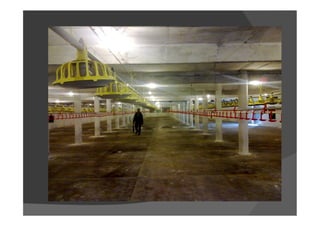
Pre–Brooding
 Managemental practices before
brooding or before receiving the chicks
 Purpose
To avoid the stress on the birds
For the sanitation and disinfection
Expose surface to the disinfectant and
fumigants
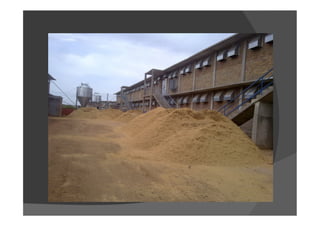
Remove material that helps in multiplication
of pathogens
To avoid different diseases
 Following measures are generally considered
for taking good results
1. Selection of area
2. Cleaning
3. Removal of litter
4. Clean the equipment
5. Dusting/web removal
6. Repairing
7. White Washing
8. Disinfection
9. Fumigation
10. Provision of different materials
11. Equipment testing
12. Arrival of chicks
BROODING MANAGEMENT
 Special care and management of baby
chicks until they do not require artificial
heat is called brooding
 Types
1. Colony brooding system
2. Continuous brooding system
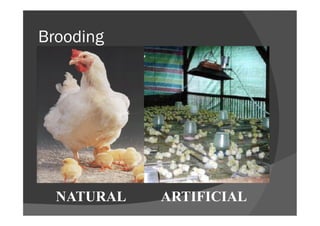
Brooding
NATURAL ARTIFICIAL
MANAGEMENT FACTORS THAT WILL RESULT TO
UNEVENNESS
1. Cold stress during the 1st week
2. Inadequate pre-heating of houses
3. Draughts
4. Low temperature settings on heaters or
inadequate heaters
5. Mixing of DOCs from different DOC sources
(breeds and ages of Parent Stocks)
6. Inadequate litter and/or dampness under the litter
MANAGEMENT FACTORS THAT WILL RESULT TO
UNEVENNESS
7. Overcrowding (delayed floor space
expansion)
8. Poor cleaning and disinfection prior to
placement
9. Insufficient equipment to bird ratio and
incorrect positioning of equipments. Place
equipments where the birds are.
10.Feeding mismanagement
Colony Brooding System
 In this, individual brooders with the
capacity of 300-400 chicks are placed in
house
 Heat is provided with oil, coal, wood, gas or
electricity
 They are of different types
i Drum type
ii. Coal burning
iii. Wood burning
iv. Electric brooder
v. Gas brooder
Continuous Brooding System
 Large numbers of chicks are brooded at a time
in a single house
 Hot water or air heat the brooder room
 Different methods are
1. Hover Method
2. Warm Air Brooding
3. Warm Room Method
4. Warm Pad Brooder
5. Radiant Heat or Heated Floor Brooding
6. Batten Brooding
7. Tier Brooding
CORRECT BROODING
MANAGEMENT
1. Clean Environment
2. Pre – Heating = Minimum – 1 hour before chick
placement = 36 to 40 0 C at floor level. Optimum LPG
consumption in tunnel ventilated houses should not
be less than 18 kgs/K birds in 10 – 12 days.
3. Correct Height of Heaters is 3 feet at placement then
raise to 3.5 to 4 feet at 1st expansion.
4. Correct Curtain Management
5. Litter management – To attain adequate thickness,
requirement is ½ bag of rice hulls/square meter. It
must be dry but not dusty. Prevent/minimize
wetness/caking
6. No tunnel ventilation please.
DIFFERENT MANAGEMENTAL
PRACTICES DURING BROODING
1. Litter and paper materials
2. Chick Guard
3. Proper floor space
4. Temperature and lighting
5. Ventilation
6. Humidity
7. Sanitation
8. Flushing and supplements
9. Feeding and drinking
10. Broad spectrum Antibiotics
11. Vaccination
12. Debeaking
13. Avoid predators and pilfering
14. Weighing
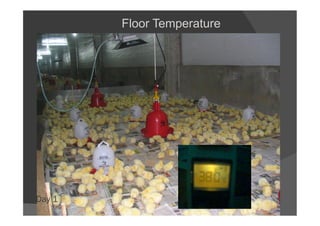
Day 1
Floor Temperature
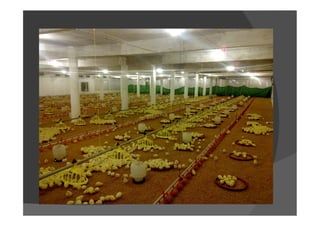
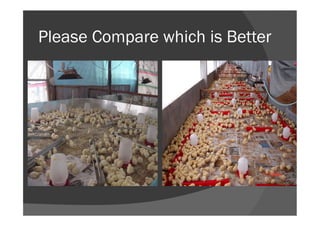
Please Compare which is Better
The Aim Of Brooding
 The general concept is to accelerate growth rate in
the first week (TO GAIN 4 TIMES THE INITIAL
CHICK WEIGHT) to enhance structural
development and feed capacity intake.
 Allow good development of internal organs.
 Encourage early uniformity.
 Add to maximize genetic potential.
 To improve overall health of the bird (ALLOW
ABSORPTION OF YOLK WITHIN 3 – 4 DAYS).
 Immune system is developing.
 Maternal antibodies in yolk.
 Temperature regulation is not
completely functional.
 Low air temp = low body temp
• Feed conversion is most efficient
7d = less than 0.94
14d = less than 1.27
Brooding Phase (1-14 days)
Check Crop Fill
 Check if chick boxes have traces of feeds.
 4 hours after placement, at least 90 % of the
chicks should have feeds and water in their crop
 8 hours after placement, all chicks should have
feeds and water in their crop.
 Crop when felt should not be too hard or too soft, it
should have a doughy feeling.
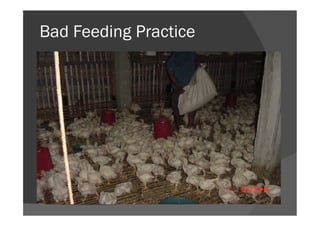
Bad Feeding Practice
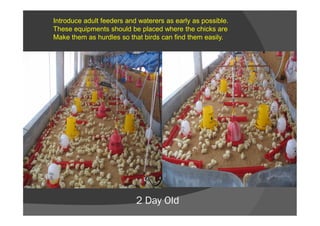
2 Day Old
Introduce adult feeders and waterers as early as possible.
These equipments should be placed where the chicks are
Make them as hurdles so that birds can find them easily.
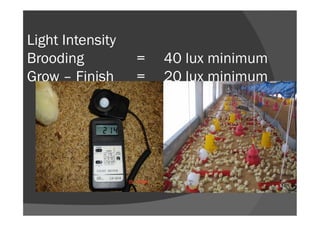
Light Intensity
Brooding = 40 lux minimum
Grow – Finish = 20 lux minimum
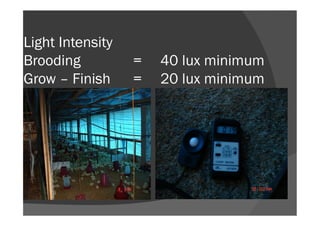
Light Intensity
Brooding = 40 lux minimum
Grow – Finish = 20 lux minimum
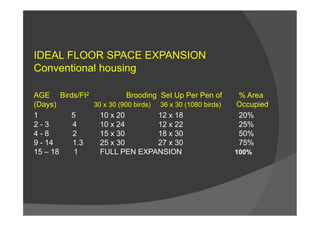
IDEAL FLOOR SPACE EXPANSION
Conventional housing
AGE Birds/Ft2 Brooding Set Up Per Pen of % Area
(Days) 30 x 30 (900 birds) 36 x 30 (1080 birds) Occupied
1 5 10 x 20 12 x 18 20%
2 - 3 4 10 x 24 12 x 22 25%
4 - 8 2 15 x 30 18 x 30 50%
9 - 14 1.3 25 x 30 27 x 30 75%
15 – 18 1 FULL PEN EXPANSION 100%
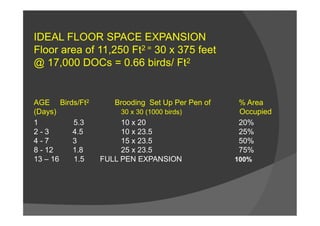
IDEAL FLOOR SPACE EXPANSION
Floor area of 11,250 Ft2 = 30 x 375 feet
@ 17,000 DOCs = 0.66 birds/ Ft2
AGE Birds/Ft2 Brooding Set Up Per Pen of % Area
(Days) 30 x 30 (1000 birds) Occupied
1 5.3 10 x 20 20%
2 - 3 4.5 10 x 23.5 25%
4 - 7 3 15 x 23.5 50%
8 - 12 1.8 25 x 23.5 75%
13 – 16 1.5 FULL PEN EXPANSION 100%
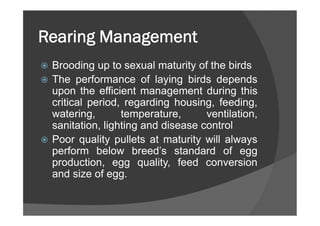
Rearing Management
 Brooding up to sexual maturity of the birds
 The performance of laying birds depends
upon the efficient management during this
critical period, regarding housing, feeding,
watering, temperature, ventilation,
sanitation, lighting and disease control
 Poor quality pullets at maturity will always
perform below breed’s standard of egg
production, egg quality, feed conversion
and size of egg.
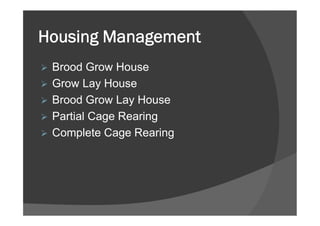
Housing Management
 Brood Grow House
 Grow Lay House
 Brood Grow Lay House
 Partial Cage Rearing
 Complete Cage Rearing
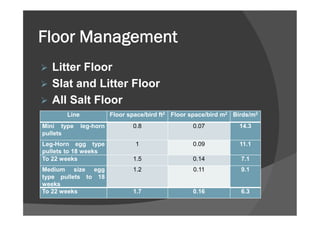
Floor Management
 Litter Floor
 Slat and Litter Floor
 All Salt Floor
Line Floor space/bird ft2 Floor space/bird m2 Birds/m2
Mini type leg-horn
pullets
0.8 0.07 14.3
Leg-Horn egg type
pullets to 18 weeks
1 0.09 11.1
To 22 weeks 1.5 0.14 7.1
Medium size egg
type pullets to 18
weeks
1.2 0.11 9.1
To 22 weeks 1.7 0.16 6.3
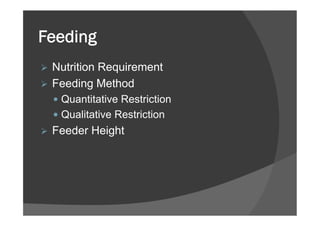
Feeding
 Nutrition Requirement
 Feeding Method
 Quantitative Restriction
 Qualitative Restriction
 Feeder Height
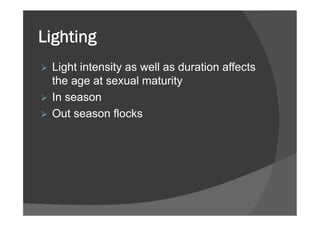
Lighting
 Light intensity as well as duration affects
the age at sexual maturity
 In season
 Out season flocks

Pre –brooding, brooding and rearing management of chicks

  • 1.
    By Zaib-Ur-Rehman Lecturer Department of PoultryScience PMAS, Arid Agriculture University, Rawalpindi, Pakistan
  • 2.
    Pre–Brooding  Managemental practicesbefore brooding or before receiving the chicks  Purpose To avoid the stress on the birds For the sanitation and disinfection Expose surface to the disinfectant and fumigants Remove material that helps in multiplication of pathogens To avoid different diseases
  • 3.
     Following measuresare generally considered for taking good results 1. Selection of area 2. Cleaning 3. Removal of litter 4. Clean the equipment 5. Dusting/web removal 6. Repairing 7. White Washing 8. Disinfection 9. Fumigation 10. Provision of different materials 11. Equipment testing 12. Arrival of chicks
  • 6.
    BROODING MANAGEMENT  Specialcare and management of baby chicks until they do not require artificial heat is called brooding  Types 1. Colony brooding system 2. Continuous brooding system
  • 7.
  • 8.
    MANAGEMENT FACTORS THATWILL RESULT TO UNEVENNESS 1. Cold stress during the 1st week 2. Inadequate pre-heating of houses 3. Draughts 4. Low temperature settings on heaters or inadequate heaters 5. Mixing of DOCs from different DOC sources (breeds and ages of Parent Stocks) 6. Inadequate litter and/or dampness under the litter
  • 9.
    MANAGEMENT FACTORS THATWILL RESULT TO UNEVENNESS 7. Overcrowding (delayed floor space expansion) 8. Poor cleaning and disinfection prior to placement 9. Insufficient equipment to bird ratio and incorrect positioning of equipments. Place equipments where the birds are. 10.Feeding mismanagement
  • 10.
    Colony Brooding System In this, individual brooders with the capacity of 300-400 chicks are placed in house  Heat is provided with oil, coal, wood, gas or electricity  They are of different types i Drum type ii. Coal burning iii. Wood burning iv. Electric brooder v. Gas brooder
  • 11.
    Continuous Brooding System Large numbers of chicks are brooded at a time in a single house  Hot water or air heat the brooder room  Different methods are 1. Hover Method 2. Warm Air Brooding 3. Warm Room Method 4. Warm Pad Brooder 5. Radiant Heat or Heated Floor Brooding 6. Batten Brooding 7. Tier Brooding
  • 12.
    CORRECT BROODING MANAGEMENT 1. CleanEnvironment 2. Pre – Heating = Minimum – 1 hour before chick placement = 36 to 40 0 C at floor level. Optimum LPG consumption in tunnel ventilated houses should not be less than 18 kgs/K birds in 10 – 12 days. 3. Correct Height of Heaters is 3 feet at placement then raise to 3.5 to 4 feet at 1st expansion. 4. Correct Curtain Management 5. Litter management – To attain adequate thickness, requirement is ½ bag of rice hulls/square meter. It must be dry but not dusty. Prevent/minimize wetness/caking 6. No tunnel ventilation please.
  • 13.
    DIFFERENT MANAGEMENTAL PRACTICES DURINGBROODING 1. Litter and paper materials 2. Chick Guard 3. Proper floor space 4. Temperature and lighting 5. Ventilation 6. Humidity 7. Sanitation 8. Flushing and supplements 9. Feeding and drinking 10. Broad spectrum Antibiotics 11. Vaccination 12. Debeaking 13. Avoid predators and pilfering 14. Weighing
  • 14.
  • 20.
  • 21.
    The Aim OfBrooding  The general concept is to accelerate growth rate in the first week (TO GAIN 4 TIMES THE INITIAL CHICK WEIGHT) to enhance structural development and feed capacity intake.  Allow good development of internal organs.  Encourage early uniformity.  Add to maximize genetic potential.  To improve overall health of the bird (ALLOW ABSORPTION OF YOLK WITHIN 3 – 4 DAYS).
  • 22.
     Immune systemis developing.  Maternal antibodies in yolk.  Temperature regulation is not completely functional.  Low air temp = low body temp • Feed conversion is most efficient 7d = less than 0.94 14d = less than 1.27 Brooding Phase (1-14 days)
  • 23.
    Check Crop Fill Check if chick boxes have traces of feeds.  4 hours after placement, at least 90 % of the chicks should have feeds and water in their crop  8 hours after placement, all chicks should have feeds and water in their crop.  Crop when felt should not be too hard or too soft, it should have a doughy feeling.
  • 24.
  • 25.
    2 Day Old Introduceadult feeders and waterers as early as possible. These equipments should be placed where the chicks are Make them as hurdles so that birds can find them easily.
  • 26.
    Light Intensity Brooding =40 lux minimum Grow – Finish = 20 lux minimum
  • 27.
    Light Intensity Brooding =40 lux minimum Grow – Finish = 20 lux minimum
  • 28.
    IDEAL FLOOR SPACEEXPANSION Conventional housing AGE Birds/Ft2 Brooding Set Up Per Pen of % Area (Days) 30 x 30 (900 birds) 36 x 30 (1080 birds) Occupied 1 5 10 x 20 12 x 18 20% 2 - 3 4 10 x 24 12 x 22 25% 4 - 8 2 15 x 30 18 x 30 50% 9 - 14 1.3 25 x 30 27 x 30 75% 15 – 18 1 FULL PEN EXPANSION 100%
  • 29.
    IDEAL FLOOR SPACEEXPANSION Floor area of 11,250 Ft2 = 30 x 375 feet @ 17,000 DOCs = 0.66 birds/ Ft2 AGE Birds/Ft2 Brooding Set Up Per Pen of % Area (Days) 30 x 30 (1000 birds) Occupied 1 5.3 10 x 20 20% 2 - 3 4.5 10 x 23.5 25% 4 - 7 3 15 x 23.5 50% 8 - 12 1.8 25 x 23.5 75% 13 – 16 1.5 FULL PEN EXPANSION 100%
  • 30.
    Rearing Management  Broodingup to sexual maturity of the birds  The performance of laying birds depends upon the efficient management during this critical period, regarding housing, feeding, watering, temperature, ventilation, sanitation, lighting and disease control  Poor quality pullets at maturity will always perform below breed’s standard of egg production, egg quality, feed conversion and size of egg.
  • 31.
    Housing Management  BroodGrow House  Grow Lay House  Brood Grow Lay House  Partial Cage Rearing  Complete Cage Rearing
  • 32.
    Floor Management  LitterFloor  Slat and Litter Floor  All Salt Floor Line Floor space/bird ft2 Floor space/bird m2 Birds/m2 Mini type leg-horn pullets 0.8 0.07 14.3 Leg-Horn egg type pullets to 18 weeks 1 0.09 11.1 To 22 weeks 1.5 0.14 7.1 Medium size egg type pullets to 18 weeks 1.2 0.11 9.1 To 22 weeks 1.7 0.16 6.3
  • 33.
    Feeding  Nutrition Requirement Feeding Method  Quantitative Restriction  Qualitative Restriction  Feeder Height
  • 34.
    Lighting  Light intensityas well as duration affects the age at sexual maturity  In season  Out season flocks