LAYER MANAGEMENT IN
DIFFERENT SEASONS
SUBMITTED TO SUBMITTED BY
Dr.K.Vijaya Lakshmi M.vishnuprasad
Associate prof RVM/16-54
 Layer management in different season is based on
environment
 The environment can be defined as the combination
of external conditions
 Environmental stress causes adverse effects on
performance of poultry.
 in our country there are 3 different seasons namely
 Winter
 Summer
 rainy
 The critical temperature for layers is 20°C. For every
1°C lower than 20°C, the birds require an extra 1.5 g
of feed per day. The most efficient temperatures for
layers are between 20 – 24°C. When temperatures
rise above 24°C, shell quality and egg weight will
reduce
Winter management
 Chickens fluff up their feathers to trap in the
heat and stay warm.
 winter require temperature administration in
the poultry house is a critical pre-condition for
better generation and well being of birds and
better profit
 Good ventilation in the chicken house is a must
in winter
Cont..
 Egg production has a tendency to slow down in
the winter because of the reduced hours of
natural light.
 Since hens need 14 or more hours of daylight
each day to lay well
 consider hanging a light bulb in the nesting area
to extend the 'daylight' hours to fourteen.
In winter should take proper care at the
following points
 1.Poultry House Management
 2.Poultry Ventilation Management
 3.Poultry Litter Management
 4.Poultry Feeding Management
 5.Poultry Water Management
Poultry House Management;
 Introduction of a building as for wind and sun
therefore impact temperature, and light on
diverse outer surfaces.
 an east west arrangement of a rectangular house
gives a greatest increase of sunlight
 Fowls ought to be shielded from chilled winds,
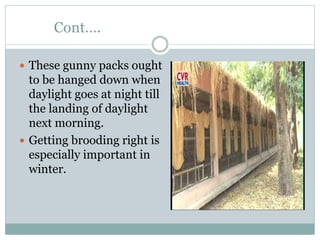
for this gunny packs ought to be hanged at the
spots from where the frosty air enters.
Cont….
 These gunny packs ought
to be hanged down when
daylight goes at night till
the landing of daylight
next morning.
 Getting brooding right is
especially important in
winter.
Ventilation Management :
 Fowls discharge a ton of
dampness in their breath
and droppings which
antagonistically influences
well being of fowls
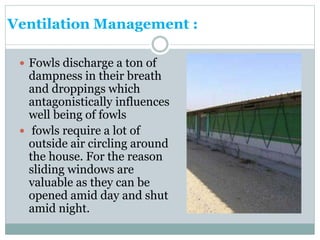
 fowls require a lot of
outside air circling around
the house. For the reason
sliding windows are
valuable as they can be
opened amid day and shut
amid night.
Cont..
 winter temperatures cause the air entering the
house to fall very quickly to the floor due to the
increased weight of moisture instead of mixing
with the warmer air in the house and falling more
slowly.
 As this cold, damp air falls, bedding/litter can start
to “go off” even in the early stages.
 It is therefore crucial to adjust ventilation and
heating on a daily, or even hourly basis, to combat
this effect.
Litter Management:
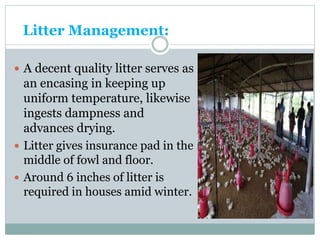
 A decent quality litter serves as
an encasing in keeping up
uniform temperature, likewise
ingests dampness and
advances drying.
 Litter gives insurance pad in the
middle of fowl and floor.
 Around 6 inches of litter is
required in houses amid winter.
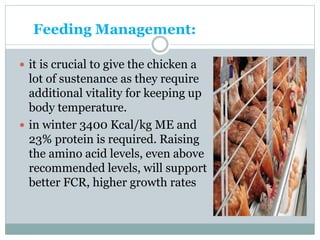
Feeding Management:
 it is crucial to give the chicken a
lot of sustenance as they require
additional vitality for keeping up
body temperature.
 in winter 3400 Kcal/kg ME and
23% protein is required. Raising
the amino acid levels, even above
recommended levels, will support
better FCR, higher growth rates
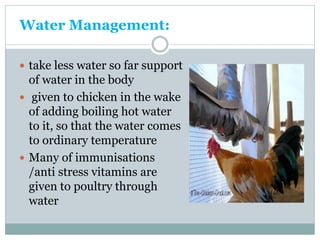
Water Management:
 take less water so far support
of water in the body
 given to chicken in the wake
of adding boiling hot water
to it, so that the water comes
to ordinary temperature
 Many of immunisations
/anti stress vitamins are
given to poultry through
water
Management in Rainy Season
 Measures of poultry farm during rainy season:
 1. additional 5 meters space around the poultry shed.
 2.this space should be clean and well kept. It should
be free of grass and brushwood
 3. Repair any holes in the roof.
 4.Polythene will need to supply if additional roof is
not provided. It should be noticed that in case of
more rain supply gunny in front and back cover. For
big chicken or poultry gunny will be move when the
rain does not exist so that light and air can enter
easily.
Cont..
 5.The floor should be repair well and kept dry as
long as possible before leaving chick.
 6.Meal pot that can be kept dry as far as possible
should be focused specially.
 7. litter should dry. Dry goods such as( lime powder,
ammonium sulphate) etc.
 8.able to maintain adequate water drainage
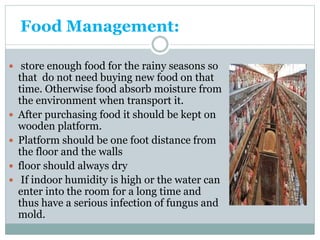
Food Management:
 store enough food for the rainy seasons so
that do not need buying new food on that
time. Otherwise food absorb moisture from
the environment when transport it.
 After purchasing food it should be kept on
wooden platform.
 Platform should be one foot distance from
the floor and the walls
 floor should always dry
 If indoor humidity is high or the water can
enter into the room for a long time and
thus have a serious infection of fungus and
mold.
Cont..
 mould species disposed of alpha toxin such as B1, B2,
G1 and G2. The B1 is the most severe. This will
reduce egg production, delay growth, low food
conversion, liver tumor even death of layer
 The maximum tolerable level is 0.1 ppm for the layer
and 0.05 ppm for broiler poultry.
 Ducks and turkeys are more tolerable than poultry
Water Management:
 In rainy season ponds, rivers, taps even tube
wells water can be infected by rain water
through the soil and the natural ways.
 to get better water you have to filter and
precipitancy for 24 hours long.
 Another way to purify water with chlorine, in
this system 2 gm bleaching powder mixed with
1000 liters of drinking water. The combination
of water should apply after 3 hours.
Litter Management:
 General litter consists of 25 % moisture
 wet litter make environment for microbial growth
as coccidiosis which causes death of poultry.
 To understand the position of litter one hand of
litter with light pressure if the litter is not a ball-
like shaped and leave it with at once then it will
better status litter
 shake litter at least one in a week
Faeces Management:
 Faeces make an important role in contamination of
diseases.
 after a certain period faeces will have to remove from
litter.
 Otherwise spray germicide such as Virkon,
Melathiyon etc.
 Mosquitoes, flies and other insects increase in
monsoon.
 bactericidal spray around the shed to keep the
system free of disease.
Summer Management
 Summer season causes number of deleterious effects
on broilers and layers which ultimately reduces
profitability. Summer stress a serious concern for
poultry producers as it directly leads to financial
losses by impaired poultry performance
 In summer outbreaks of gout may be seen in broilers
and layers.
Cont..
 In heat stressed birds blood flow increases to upper
respiratory tract, skin and abdominal muscles for
relieving heat, however, blood flow to intestinal tract
is decreased. As a result there is reduction in appetite
leading to lower feed intake. Concurrently water
intake is increased resulting in fluid contents in
intestinal tract. This further cause’s diarrhea that
results in loss of electrolytes needed to maintain acid
base balance.
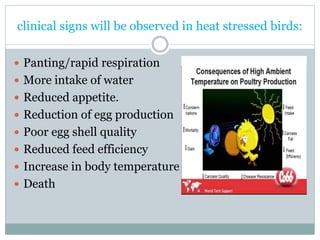
clinical signs will be observed in heat stressed birds:
 Panting/rapid respiration
 More intake of water
 Reduced appetite.
 Reduction of egg production
 Poor egg shell quality
 Reduced feed efficiency
 Increase in body temperature
 Death
Post Mortem Lesions.
 Dehydrated carcass
 Mucoid exudates in mouth and nostrils
 Pale/cyanotic combs
 Pale breast muscles
 Congestion of liver, spleen, kidney and lungs.
 Fluid contents in intestines.
 Rapid decomposition of carcass
In summer should take proper care at the following
points
 Housing Management
 Water Management
 Feed Management
 General Management
Housing Management
 an east-west direction to minimize solar heating and
direct access to sunlight.
 Poultry houses in tropics should have good roof
insulation with support of foggers and cooler
systems.
 In open sided houses, width of house will be a
limiting factor so keep the optimum width (24-32 ft)
based on temperature, humidity and wind velocity
cont..
 type of house and nature of bird for effective cross
ventilation.
 Increased air movement over the birds by cooler
fans/exhaust to produce a wind chill effect which will
cool birds even without drop in the house
temperature.
 Shed design and construction should not allow direct
sunlight on birds.
Cont..
 The roof should be painted with white wash to reflect
light.
 Shades from tall trees and plantation around the
sheds can reduce the radiant heat. The plantation of
trees should be such that trees will be leafy during
summer and bald during winter.
 Roof overhangs should be sufficient (3-5 ft) to
protect the birds from strong sunrays.
Water Management
 Practically water is the most important criteria of
these four managemental factors during summer.
 In summer water consumption is 3-4 times more.
 Even a slight shortfall of water can lead to heat
stroke and mortality. Normally feed and water
consumption ratio is 1:2 but when temperature
shoots beyond 95▫F, this ratio may increase up to 1:4
or more.
 Supply of plenty of clean and cool water (60-70▫F)
must be ensured during summer months.
Cont..
 For day old chicks provide cool water and electrolytes on
their arrival to farm before offering feed to avoid
dehydration after transportation.
 Cover water tanks with wet gunny bags to avoid direct
exposure to sun.
 Increase number of waterers by 25%.
 Increase frequency of watering.
 case of nipple drinkers, insulate nipple pipe with wet
gunny cloth.
 Provide Electral Energy (1-2 gm/liter) in water during
hot hours.
Cont..
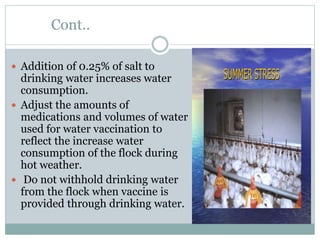
 Addition of 0.25% of salt to
drinking water increases water
consumption.
 Adjust the amounts of
medications and volumes of water
used for water vaccination to
reflect the increase water
consumption of the flock during
hot weather.
 Do not withhold drinking water
from the flock when vaccine is
provided through drinking water.
Feed Management
 During summer consumption of feed by birds is
reduced considerably leading to reduced body
weight, egg production and shell quality
 Increase the frequency of feeding.
 Certain changes in feed formulations are necessary.
 Increase nutrient density of feed to compensate for
depressed feed intake.
 Energy of feed should be reduced. Crude protein
content should not be increased
Cont..
 Similarly 20-30% extra vitamins and trace minerals
should be added to feed.
 Available phosphorus content of feed should be
increased.
 Vitamin C is necessary to maintain integrity of blood
vessels. Supplementation of vitamin C @ 200-500
gm /ton feed will be beneficial.
 Grow E-Sel @ 50 gm /ton feed will also be beneficial.
 Pelleted feeding is beneficial where low energy fiber
diets are used
Cont..
 Add soda-bicarbonate @ 0.1% for improvement of
shell quality.
 Since hot humid climate favors growth of
moulds/fungi in feed, so constant use of anti-fungal
is recommended.
 The diet should be balanced with limiting amino-
acids, methionine and lysine which will give better
results.
 Increase the calcium level from 3-3.5% in layer diet.
 Inclusion of Growvit-A and Grow E-Sel 250mg /kg
diet for better performance and combat heat stress.
General Management
 Litter preferably fresh litter of 2 inches thickness
with racking or stirring of litter 2-3 times a day
during cool hours is recommended.
 10% extra floor space should be provided in
summer.
 Overcrowding of birds should be avoided.
 Shifting, transportation, de-beaking and vaccination
should be done during night or cool hours of the day.
 Birds severely heat stressed may be dipped in cold
water for 2-3 minutes keeping their neck and head
above water level.
Cont..
 Provide proper cross ventilation.
 Fans (pedestal, ceiling or exhaust) may be fitted in
sheds.
 Use foggers in the shed which could reduce the shed
temperature up to 5-10▫C depending upon quality.
 Use of paint ,white lime etc practically reduces the
shed temperature up to 2▫C
 Use side curtain in shed which should be sprinkled
with water
Cont..
 Provide 3 exhaust fans on one side and pad cooling
on other side (200ft) which completely seals the
shed sides and brings down temperature below 8▫C.
 Use sprinklers on the top or inside shed.
 Surround the house with tall trees.
 Thatched roof is suitable for hot areas
Cont..
 The house should be situated away from other
buildings in order to facilitate free movement of air.
 High altitude of roof is ordinarily 2.6 to 3.3 m from
foundation to the roof line to provide maximum
ventilation.
 Provide 1 meter overhang to cut the direct sun and
rain into the house.
REFERENCES ;
 Internet
 Poultry production and management by jagdish
prasad.
Psc603 vishnu

Psc603 vishnu

  • 1.
    LAYER MANAGEMENT IN DIFFERENTSEASONS SUBMITTED TO SUBMITTED BY Dr.K.Vijaya Lakshmi M.vishnuprasad Associate prof RVM/16-54
  • 2.
     Layer managementin different season is based on environment  The environment can be defined as the combination of external conditions  Environmental stress causes adverse effects on performance of poultry.  in our country there are 3 different seasons namely  Winter  Summer  rainy
  • 3.
     The criticaltemperature for layers is 20°C. For every 1°C lower than 20°C, the birds require an extra 1.5 g of feed per day. The most efficient temperatures for layers are between 20 – 24°C. When temperatures rise above 24°C, shell quality and egg weight will reduce
  • 4.
    Winter management  Chickensfluff up their feathers to trap in the heat and stay warm.  winter require temperature administration in the poultry house is a critical pre-condition for better generation and well being of birds and better profit  Good ventilation in the chicken house is a must in winter
  • 5.
    Cont..  Egg productionhas a tendency to slow down in the winter because of the reduced hours of natural light.  Since hens need 14 or more hours of daylight each day to lay well  consider hanging a light bulb in the nesting area to extend the 'daylight' hours to fourteen.
  • 6.
    In winter shouldtake proper care at the following points  1.Poultry House Management  2.Poultry Ventilation Management  3.Poultry Litter Management  4.Poultry Feeding Management  5.Poultry Water Management
  • 7.
    Poultry House Management; Introduction of a building as for wind and sun therefore impact temperature, and light on diverse outer surfaces.  an east west arrangement of a rectangular house gives a greatest increase of sunlight  Fowls ought to be shielded from chilled winds, for this gunny packs ought to be hanged at the spots from where the frosty air enters.
  • 8.
    Cont….  These gunnypacks ought to be hanged down when daylight goes at night till the landing of daylight next morning.  Getting brooding right is especially important in winter.
  • 9.
    Ventilation Management : Fowls discharge a ton of dampness in their breath and droppings which antagonistically influences well being of fowls  fowls require a lot of outside air circling around the house. For the reason sliding windows are valuable as they can be opened amid day and shut amid night.
  • 10.
    Cont..  winter temperaturescause the air entering the house to fall very quickly to the floor due to the increased weight of moisture instead of mixing with the warmer air in the house and falling more slowly.  As this cold, damp air falls, bedding/litter can start to “go off” even in the early stages.  It is therefore crucial to adjust ventilation and heating on a daily, or even hourly basis, to combat this effect.
  • 11.
    Litter Management:  Adecent quality litter serves as an encasing in keeping up uniform temperature, likewise ingests dampness and advances drying.  Litter gives insurance pad in the middle of fowl and floor.  Around 6 inches of litter is required in houses amid winter.
  • 12.
    Feeding Management:  itis crucial to give the chicken a lot of sustenance as they require additional vitality for keeping up body temperature.  in winter 3400 Kcal/kg ME and 23% protein is required. Raising the amino acid levels, even above recommended levels, will support better FCR, higher growth rates
  • 13.
    Water Management:  takeless water so far support of water in the body  given to chicken in the wake of adding boiling hot water to it, so that the water comes to ordinary temperature  Many of immunisations /anti stress vitamins are given to poultry through water
  • 14.
    Management in RainySeason  Measures of poultry farm during rainy season:  1. additional 5 meters space around the poultry shed.  2.this space should be clean and well kept. It should be free of grass and brushwood  3. Repair any holes in the roof.  4.Polythene will need to supply if additional roof is not provided. It should be noticed that in case of more rain supply gunny in front and back cover. For big chicken or poultry gunny will be move when the rain does not exist so that light and air can enter easily.
  • 15.
    Cont..  5.The floorshould be repair well and kept dry as long as possible before leaving chick.  6.Meal pot that can be kept dry as far as possible should be focused specially.  7. litter should dry. Dry goods such as( lime powder, ammonium sulphate) etc.  8.able to maintain adequate water drainage
  • 16.
    Food Management:  storeenough food for the rainy seasons so that do not need buying new food on that time. Otherwise food absorb moisture from the environment when transport it.  After purchasing food it should be kept on wooden platform.  Platform should be one foot distance from the floor and the walls  floor should always dry  If indoor humidity is high or the water can enter into the room for a long time and thus have a serious infection of fungus and mold.
  • 17.
    Cont..  mould speciesdisposed of alpha toxin such as B1, B2, G1 and G2. The B1 is the most severe. This will reduce egg production, delay growth, low food conversion, liver tumor even death of layer  The maximum tolerable level is 0.1 ppm for the layer and 0.05 ppm for broiler poultry.  Ducks and turkeys are more tolerable than poultry
  • 18.
    Water Management:  Inrainy season ponds, rivers, taps even tube wells water can be infected by rain water through the soil and the natural ways.  to get better water you have to filter and precipitancy for 24 hours long.  Another way to purify water with chlorine, in this system 2 gm bleaching powder mixed with 1000 liters of drinking water. The combination of water should apply after 3 hours.
  • 19.
    Litter Management:  Generallitter consists of 25 % moisture  wet litter make environment for microbial growth as coccidiosis which causes death of poultry.  To understand the position of litter one hand of litter with light pressure if the litter is not a ball- like shaped and leave it with at once then it will better status litter  shake litter at least one in a week
  • 20.
    Faeces Management:  Faecesmake an important role in contamination of diseases.  after a certain period faeces will have to remove from litter.  Otherwise spray germicide such as Virkon, Melathiyon etc.  Mosquitoes, flies and other insects increase in monsoon.  bactericidal spray around the shed to keep the system free of disease.
  • 21.
    Summer Management  Summerseason causes number of deleterious effects on broilers and layers which ultimately reduces profitability. Summer stress a serious concern for poultry producers as it directly leads to financial losses by impaired poultry performance  In summer outbreaks of gout may be seen in broilers and layers.
  • 22.
    Cont..  In heatstressed birds blood flow increases to upper respiratory tract, skin and abdominal muscles for relieving heat, however, blood flow to intestinal tract is decreased. As a result there is reduction in appetite leading to lower feed intake. Concurrently water intake is increased resulting in fluid contents in intestinal tract. This further cause’s diarrhea that results in loss of electrolytes needed to maintain acid base balance.
  • 23.
    clinical signs willbe observed in heat stressed birds:  Panting/rapid respiration  More intake of water  Reduced appetite.  Reduction of egg production  Poor egg shell quality  Reduced feed efficiency  Increase in body temperature  Death
  • 24.
    Post Mortem Lesions. Dehydrated carcass  Mucoid exudates in mouth and nostrils  Pale/cyanotic combs  Pale breast muscles  Congestion of liver, spleen, kidney and lungs.  Fluid contents in intestines.  Rapid decomposition of carcass
  • 25.
    In summer shouldtake proper care at the following points  Housing Management  Water Management  Feed Management  General Management
  • 26.
    Housing Management  aneast-west direction to minimize solar heating and direct access to sunlight.  Poultry houses in tropics should have good roof insulation with support of foggers and cooler systems.  In open sided houses, width of house will be a limiting factor so keep the optimum width (24-32 ft) based on temperature, humidity and wind velocity
  • 27.
    cont..  type ofhouse and nature of bird for effective cross ventilation.  Increased air movement over the birds by cooler fans/exhaust to produce a wind chill effect which will cool birds even without drop in the house temperature.  Shed design and construction should not allow direct sunlight on birds.
  • 28.
    Cont..  The roofshould be painted with white wash to reflect light.  Shades from tall trees and plantation around the sheds can reduce the radiant heat. The plantation of trees should be such that trees will be leafy during summer and bald during winter.  Roof overhangs should be sufficient (3-5 ft) to protect the birds from strong sunrays.
  • 29.
    Water Management  Practicallywater is the most important criteria of these four managemental factors during summer.  In summer water consumption is 3-4 times more.  Even a slight shortfall of water can lead to heat stroke and mortality. Normally feed and water consumption ratio is 1:2 but when temperature shoots beyond 95▫F, this ratio may increase up to 1:4 or more.  Supply of plenty of clean and cool water (60-70▫F) must be ensured during summer months.
  • 30.
    Cont..  For dayold chicks provide cool water and electrolytes on their arrival to farm before offering feed to avoid dehydration after transportation.  Cover water tanks with wet gunny bags to avoid direct exposure to sun.  Increase number of waterers by 25%.  Increase frequency of watering.  case of nipple drinkers, insulate nipple pipe with wet gunny cloth.  Provide Electral Energy (1-2 gm/liter) in water during hot hours.
  • 31.
    Cont..  Addition of0.25% of salt to drinking water increases water consumption.  Adjust the amounts of medications and volumes of water used for water vaccination to reflect the increase water consumption of the flock during hot weather.  Do not withhold drinking water from the flock when vaccine is provided through drinking water.
  • 32.
    Feed Management  Duringsummer consumption of feed by birds is reduced considerably leading to reduced body weight, egg production and shell quality  Increase the frequency of feeding.  Certain changes in feed formulations are necessary.  Increase nutrient density of feed to compensate for depressed feed intake.  Energy of feed should be reduced. Crude protein content should not be increased
  • 33.
    Cont..  Similarly 20-30%extra vitamins and trace minerals should be added to feed.  Available phosphorus content of feed should be increased.  Vitamin C is necessary to maintain integrity of blood vessels. Supplementation of vitamin C @ 200-500 gm /ton feed will be beneficial.  Grow E-Sel @ 50 gm /ton feed will also be beneficial.  Pelleted feeding is beneficial where low energy fiber diets are used
  • 34.
    Cont..  Add soda-bicarbonate@ 0.1% for improvement of shell quality.  Since hot humid climate favors growth of moulds/fungi in feed, so constant use of anti-fungal is recommended.  The diet should be balanced with limiting amino- acids, methionine and lysine which will give better results.  Increase the calcium level from 3-3.5% in layer diet.  Inclusion of Growvit-A and Grow E-Sel 250mg /kg diet for better performance and combat heat stress.
  • 35.
    General Management  Litterpreferably fresh litter of 2 inches thickness with racking or stirring of litter 2-3 times a day during cool hours is recommended.  10% extra floor space should be provided in summer.  Overcrowding of birds should be avoided.  Shifting, transportation, de-beaking and vaccination should be done during night or cool hours of the day.  Birds severely heat stressed may be dipped in cold water for 2-3 minutes keeping their neck and head above water level.
  • 36.
    Cont..  Provide propercross ventilation.  Fans (pedestal, ceiling or exhaust) may be fitted in sheds.  Use foggers in the shed which could reduce the shed temperature up to 5-10▫C depending upon quality.  Use of paint ,white lime etc practically reduces the shed temperature up to 2▫C  Use side curtain in shed which should be sprinkled with water
  • 37.
    Cont..  Provide 3exhaust fans on one side and pad cooling on other side (200ft) which completely seals the shed sides and brings down temperature below 8▫C.  Use sprinklers on the top or inside shed.  Surround the house with tall trees.  Thatched roof is suitable for hot areas
  • 38.
    Cont..  The houseshould be situated away from other buildings in order to facilitate free movement of air.  High altitude of roof is ordinarily 2.6 to 3.3 m from foundation to the roof line to provide maximum ventilation.  Provide 1 meter overhang to cut the direct sun and rain into the house.
  • 39.
    REFERENCES ;  Internet Poultry production and management by jagdish prasad.