Commercial Egg
Production Guide
CONTENTS
Introduction
Top Performance by Systematic Selection
Breeding Scheme
Performance Data
Housing Chicks
Cage Systems
Floor Systems
Environment
Brooding Temperature
Body Temperature of the Chicks
Vaccination
General Recommendations
Vaccination Methods
Special Recommendations
Example of a Vaccination Program
Beak Treatment
Nutrition
General
Feed Consumption
Rearing
Crude Fiber
Correct Use of Pre-Layer Feed
Body Weight Development and
Feed Consumption
Body Weight Development at intermediate
Stages
Recommended Nutrient Levels for Pullets
Laying Period
Recommended Nutrient Levels for Layers
Nutrition and Egg Weight
Supplements
1
2
3
4
5
5
5
6
6
6
7
7
7
7
8
9
9
9
9
10
10
11
12
13
14
14
15
20
20
Lighting
General
Intermittent Lighting Program for
Day Old Chicks
Lighting Program for Closed Houses
Growing in Closed House to Open House
Production
Growing in Open House to Open House
Production
Growing in Open House to Closed House
Production
Extremes
Hours between sunrise and sunset in the
Northern and Southern Hemisphere
General Recommendations
Hygiene
Daily Control
Water Supply
Grit
Egg Quality and Egg Collection
Nests (Non Cage Housing)
Litter (Non Cage Housing)
Space Requirements
Stocking Density
General Information
Body Weight Development
Growth and Body Weight Development Curve
Performance Goals - One Cycle
Performance Goals - Pre and Post Molt
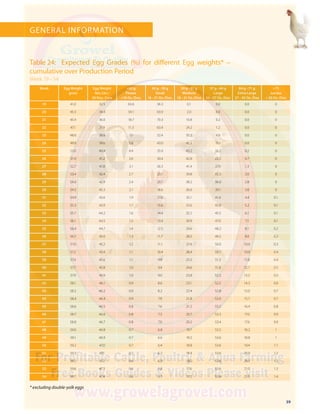
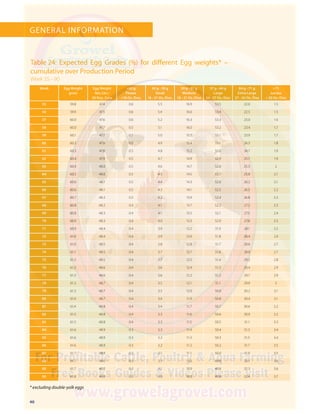
Expected Egg Grading
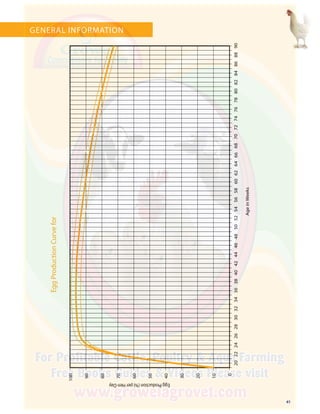
Egg Production Curve
22
22
22
23
24
24
24
25
26
27
27
27
27
27
28
28
28
28
29
30
30
31
32
34
37
41
1
INTRODUCTION
Why should you study this management guide?
Most people who are involved in commercial egg pro-
duction, have seen management guides for different
strains of layers before and may think “if you have seen
one, you’ve seen them all”. Others take the contents
more seriously and expect frequent updates to find
specific data which apply to the current generation of
layers and current management practices.
Newcomers in the business may need more detailed
explanations than can be presented in this compact
format.
We hope that each reader will find some useful infor-
mation, to confirm proven management practices or
to stimulate improvements.
3
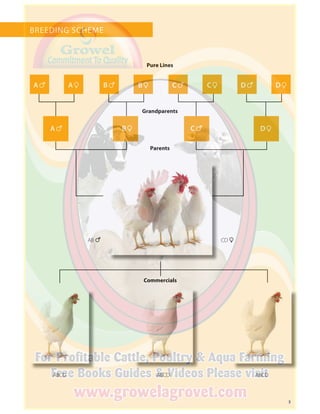
BREEDING SCHEME
ABCDABCD
Parents
Grandparents
Pure Lines
ABCD
Commercials
A 6
A 6
CD 1AB 6
B 6 C 6
C 6
D 6A 1 B 1
B 1
C 1 D 1
D 1
4
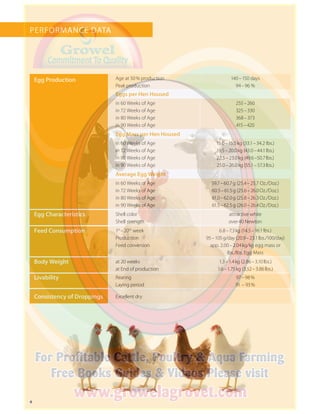
PERFORMANCE DATA
Egg Production Age at 50 % production
Peak production
140 – 150 days
94 – 96 %
Eggs per Hen Housed
in 60 Weeks of Age
in 72 Weeks of Age
in 80 Weeks of Age
in 90 Weeks of Age
255 – 260
325 – 330
368 – 373
415 – 420
Egg Mass per Hen Housed
in 60 Weeks of Age
in 72 Weeks of Age
in 80 Weeks of Age
in 90 Weeks of Age
15.0 – 15.5 kg (33.1 – 34.2 lbs.)
19.5 – 20.0 kg (43.0 – 44.1 lbs.)
22.5 – 23.0 kg (49.6 –50.7 lbs.)
25.0 – 26.0 kg (55.1 – 57.3 lbs.)
Average Egg Weight
in 60 Weeks of Age
in 72 Weeks of Age
in 80 Weeks of Age
in 90 Weeks of Age
59.7 – 60.7 g (25.4 – 25.7 Oz./Doz.)
60.5 – 61.5 g (25.6 – 26.0 Oz./Doz.)
61.0 – 62.0 g (25.8 – 26.3 Oz./Doz.)
61.5 – 62.5 g (26.0 – 26.4 Oz./Doz.)
Egg Characteristics Shell color
Shell strength
attractive white
over 40 Newton
Feed Consumption 1st
 – 20th
week
Production
Feed conversion
6.8 – 7.3 kg (14.5 – 16.1 lbs.)
95 – 105 g/day (20.9 – 23.1 lbs./100/day)
app. 2.00 – 2.04 kg/kg egg mass or
lbs./lbs. Egg Mass
Body Weight at 20 weeks
at End of production
1.3 – 1.4 kg (2.86 – 3.10 lbs.)
1.6 – 1.75 kg (3.52 – 3.86 lbs.)
Livability Rearing
Laying period
97 – 98 %
91 – 93 %
Consistency of Droppings Excellent dry
5
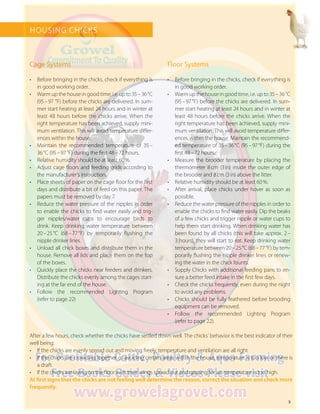
Cage Systems
•	 Before bringing in the chicks, check if everything is
in good working order.
•	 Warm up the house in good time, i.e. up to 35 – 36 °C
(95 – 97 °F) before the chicks are delivered. In sum-
mer start heating at least 24 hours and in winter at
least 48 hours before the chicks arrive. When the
right temperature has been achieved, supply mini-
mum ventilation. This will avoid temperature differ-
ences within the house.
•	 Maintain the recommended temperature of 35 – 
36 °C (95 – 97 °F) during the first 48 – 72 hours.
•	 Relative humidity should be at least 60 %.
•	 Adjust cage floors and feeding grids according to
the manufacturer’s instruction.
•	 Place sheets of paper on the cage floor for the first
days and distribute a bit of feed on this paper. The
papers must be removed by day 7.
•	 Reduce the water pressure of the nipples in order
to enable the chicks to find water easily and trig-
ger nipples/water cups to encourage birds to
drink. Keep drinking water temperature between
20 – 25 °C (68 – 77 °F) by temporarily flushing the
nipple drinker lines.
•	 Unload all chick boxes and distribute them in the
house. Remove all lids and place them on the top
of the boxes.
•	 Quickly place the chicks near feeders and drinkers.
Distribute the chicks evenly among the cages start-
ing at the far end of the house.
•	 Follow the recommended Lighting Program
(refer to page 22)
Floor Systems
•	 Before bringing in the chicks, check if everything is
in good working order.
•	 Warm up the house in good time, i.e. up to 35 – 36 °C
(95 – 97 °F) before the chicks are delivered. In sum-
mer start heating at least 24 hours and in winter at
least 48 hours before the chicks arrive. When the
right temperature has been achieved, supply mini-
mum ventilation. This will avoid temperature differ-
ences within the house. Maintain the recommend-
ed temperature of 35 – 36 °C (95 – 97 °F) during the
first 48 – 72 hours.
•	 Measure the brooder temperature by placing the
thermometer 8 cm (3 in) inside the outer edge of
the brooder and 8 cm (3 in) above the litter.
•	 Relative humidity should be at least 60 %.
•	 After arrival, place chicks under hover as soon as
possible.
•	 Reduce the water pressure of the nipples in order to
enable the chicks to find water easily. Dip the beaks
of a few chicks and trigger nipple or water cups to
help them start drinking. When drinking water has
been found by all chicks (this will take approx. 2 – 
3 hours), they will start to eat. Keep drinking water
temperature between 20 – 25 °C (68 – 77 °F) by tem-
porarily flushing the nipple drinker lines or renew-
ing the water in the chick founts.
•	 Supply Chicks with additional feeding pans to en-
sure a better feed intake in the first few days.
•	 Check the chicks frequently, even during the night
to avoid any problems.
•	 Chicks should be fully feathered before brooding
equipment can be removed.
•	 Follow the recommended Lighting Program
(refer to page 22).
HOUSING CHICKS
After a few hours, check whether the chicks have settled down well. The chicks’ behavior is the best indicator of their
well being:
•	 If the chicks are evenly spread out and moving freely, temperature and ventilation are all right.
•	 If the chicks are crowding together or avoiding certain areas within the house, temperature is too low or there is
a draft.
•	 If the chicks are laying on the floor with their wings spread out and gasping for air, temperature is too high.
At first signs that the chicks are not feeling well determine the reason, correct the situation and check more
frequently.
6
Environmental conditions have an effect on the well-
being and performance of the birds. Important en­
vironmental factors are temperature, humidity and
level of toxic gases in the air. The optimal temperature
depends on the age of the birds. The following table
is a guide to the recommended temperature at bird
level. As mentioned before, the birds behavior is the
best indicator for correct temperature.
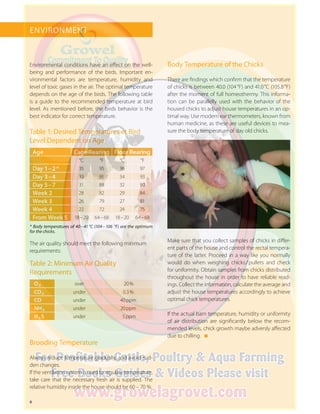
Table 1: Desired Temperatures at Bird
­Level Dependent on Age
Age Cage Rearing Floor Rearing
°C °F °C °F
Day 1 – 2 * 35  95 36  97
Day 3 – 4 33  91 34 93
Day 5 – 7 31 88 32 90
Week 2 28  82 29 84
Week 3 26 79 27 81
Week 4 22 72 24 75
From Week 5 18 – 20 64 – 68 18 – 20  64 – 68
* Body temperatures of 40 – 41 °C (104 – 106 °F) are the optimum
for the chicks.
The air quality should meet the following minimum
requirements:
Table 2: Minimum Air Quality
Requirements
O ₂ over 20 %
CO ₂ under 0.3 %
CO under 40 ppm
NH ₃ under 20 ppm
H ₂ S under 5 ppm
Brooding Temperature
Always reduce temperature gradually, and avoid sud-
den changes.
If the ventilation system is used to regulate temperature,
take care that the necessary fresh air is supplied. The
relative humidity inside the house should be 60 – 70 %.
Body Temperature of the Chicks
There are findings which confirm that the temperature
of chicks is between 40.0 (104 °F) and 41.0 °C (105.8 °F)
after the moment of full homeothermy. This informa-
tion can be parallelly used with the behavior of the
housed chicks to adjust house temperatures in an op-
timal way. Use modern ear thermometers, known from
human medicine, as these are useful devices to mea-
sure the body temperature of day old chicks.
Make sure that you collect samples of chicks in differ-
ent parts of the house and control the rectal tempera-
ture of the latter. Proceed in a way like you normally
would do when weighing chicks / pullets and check
for uniformity. Obtain samples from chicks distributed
throughout the house in order to have reliable read-
ings. Collect the information, calculate the average and
adjust the house temperatures accordingly to achieve
optimal chick temperatures.
If the actual barn temperature, humidity or uniformity
of air distribution are significantly below the recom-
mended levels, chick growth maybe adversly affected
due to chilling.
ENVIRONMENT
7
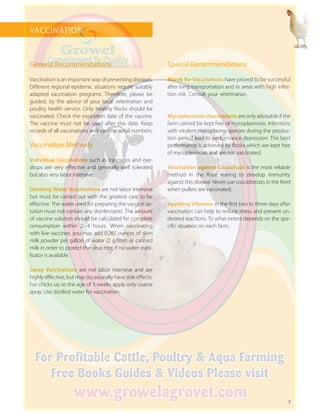
VACCINATION
General Recommendations
Vaccination is an important way of preventing diseases.
Different regional epidemic situations require suitably
adapted vaccination programs. Therefore, please be
guided, by the advice of your local veterinarian and
poultry health service. Only healthy flocks should be
vaccinated. Check the expiration date of the vaccine.
The vaccine must not be used after this date. Keep
­records of all vaccinations and vaccine serial numbers.
Vaccination Methods
Individual Vaccinations such as injections and eye-
drops are very effective and generally well tolerated
but also very labor intensive.
Drinking Water Vaccinations are not labor intensive
but must be carried out with the greatest care to be
effective. The water used for preparing the vaccine so-
lution must not contain any disinfectants. The amount
of vaccine solution should be calculated for complete
consumption within 2 – 4 hours. When vaccinating
with live vaccines, you may add 0.267 ounces of skim
milk powder per gallon of water (2 g/liter) or canned
milk in order to protect the virus titer, if no water stabi-
lisator is available.
Spray Vaccinations are not labor intensive and are
highly effective, but may occasionally have side effects.
For chicks up to the age of 3 weeks apply only coarse
spray. Use distilled water for vaccination.
Special Recommendations
Mycoplasmosis Vaccinations are only advisable if the
farm cannot be kept free of mycoplasmosis. Infections
with virulent mycoplasma species during the produc-
tion period lead to performance depression. The best
performance is achieved by flocks which are kept free
of mycoplasmosis and are not vaccinated.
Vaccination against Coccidiosis is the most ­reliable
method in the floor rearing to develop immunity
against this disease. Never use coccidiostats in the feed
when pullets are vaccinated.
Applying Vitamins in the first two to three days ­after
vaccination can help to reduce stress and prevent un-
desired reactions. To what extent depends on the spe-
cific situation on each farm.
Marek Re-Vaccinations have proved to be successful
after long transportation and in areas with high infec-
tion risk. Consult your veterinarian.
8
VACCINATION
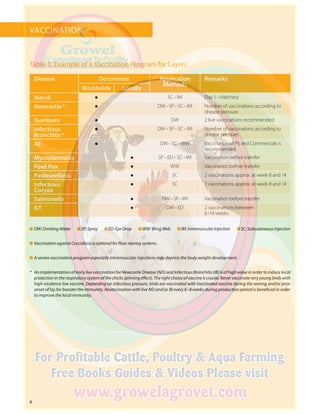
Disease Occurrence Application
Methods
Remarks
Worldwide Locally
Marek SC – IM Day 1 – Hatchery
Newcastle * DW – SP – SC – IM Number of vaccinations according to
disease pressure
Gumboro DW 2 live vaccinations recommended
Infectious
Bronchitis *
DW – SP – SC – IM Number of vaccinations according to
disease pressure
AE DW – SC – WW Vaccination of PS and Commercials is
recommended
Mycoplasmosis SP – ED – SC – IM Vaccination before transfer
Fowl Pox WW Vaccination before transfer
Pasteurellosis SC 2 vaccinations approx. at week 8 and 14
Infectious
Coryza
SC 2 vaccinations approx. at week 8 and 14
Salmonella DW – SP – IM Vaccination before transfer
ILT DW – ED 2 vaccinations between
6–14 weeks
	DW: Drinking Water  SP: Spray  ED: Eye Drop  WW: Wing Web  IM: Intramuscular Injection  SC: Subcutaneous Injection
	Vaccination against Coccidiosis is optional for floor rearing systems.
	A severe vaccination program especially intramuscular injections may depress the body weight development.
*	 An implementation of early live vaccination for Newcastle ­Disease (ND) and Infectious Bronchitis (IB) is of high value in order to induce local
protection in the respiratory system of the chicks (priming effect). The right choice of vaccine is crucial. Never vaccinate very young birds with
high-virulence live vaccine. Depending on infectious pressure, birds are vaccinated with inactivated vaccine during the rearing and/or prior
onset of lay for booster the immunity. Revaccination with live ND and/or IB every 6–8 weeks during production period is bene­ficial in order
to improve the local immunity.
Table 3: Example of a Vaccination Program for Layers
9
Beak treatment is not necessary under optimal con-
ditions. In practice, it is widely used in environmental
controlled and light-tight facilities, as an efficient pre-
caution against cannibalism and feather pecking. Such
behavior may develop at any age as a result of exces-
sive light intensity, unbalanced feed, poor ventilation,
overstocking or boredom.
Especially in floor management and/or open houses
with uncontrollable light intensity, we recommend
beak treatment subject to local animal welfare regula-
tions. A very gentle and highly recommended method
of beak treatment is the infrared treatment of the ­upper
and lower beak by means of a special technique, per-
formed shortly after chicks hatch. This procedure can
already be done in the hatchery under very hygienic
conditions by specially trained personnel. Another
method of beak treatment is to treat the beaks with a
hot blade.
Observe the following precautions for a conven-
tional beak treatment:
•	 Treat only healthy, unstressed birds, at the age of
7 – 10 days.
•	 Allow only experienced personnel to do the work.
•	 Work slowly and carefully.
•	 Use only equipment and blades in perfect working
order; adjust the blade temperature so that cauter-
ization is guaranteed and the beak is not damaged.
•	 Adjust temperature and duration of the treatment
according to the chicks’ beak size, strength and
quality.
•	 Do not feed for 12 hours before treating.
•	 Offer free feeding immediately after treating.
•	 Increase the level of feed in the troughs.
•	 Increase the temperature in the house for a few
days after treating.
•	 For 3 – 5 days after beak treating provide an extra
hour of light and supply feed in the late evening or
at night.
Giving vitamins via the drinking water can also help to
alleviate stress.
General
To get the best out of the genetic performance
­­
Our feeding recommendations concentrate on the
essential nutrients and are designed to cover the
­requirements for the best performance in every stage
of development.
Feed Consumption
Feed consumption is mainly affected by:
•	 Body weight
•	 Performance
•	 House temperature:
Low temperature increases the maintenance re-
quirement for energy.
•	 Condition of feathering:
Poor feathering condition due to management
mistakes or malnutrition increases the maintenance
requirement for energy.
BEAK TREATMENT
NUTRITION
potential of layers, feeding them with a good
structured mash feed with full nutritive value is a
must. Such nutrition can best be guaran-teed by a
complete feed adapted to the performance
potential.
10
NUTRITION
•	 Feed texture:
Coarse texture increases while fine texture decreas-
es feed intake.
•	 Energy level:
The higher the energy level of the feed, the lower
the feed intake and vice versa.
•	 Nutrient imbalances:
The hen will try to compensate for any nutrient
deficits by increasing feed consumption especially
in the latest stages of production.
Rearing
A nutrient balanced diet during the rearing stage
is essential to enable the chick to develop into a
mature pullet. Chicks and pullets should be fed a
coarse diet (for particle sizes see table on page 11) of
a meal-type consistency. A high proportion of very
fine components or a structure that is too coarse
can lead to selective feed intake and an unbalanced
nutrient supply. A diet with an extremely fine con-
sistency reduces the feed intake of the birds and
can result in a lacking supply of certain nutrients. If
pelletizing of feed is inevitable for hygienic reasons the
pellets should be crumbled to the recommended con-
sistency. During the different growth phases of chicks
and pullets, qualitatively different feed varieties should
be used in which the nutrient content meets the birds
changing needs.
The diets are matched to the nutrient requirement and
weight development at each stage of growth. The use
of chick starter is recommended if the standard body-
weight is not reached by feeding grower feed or if the
daily feed intake is expected to be low. The switch
to developer should only be made when the stan-
dard body weight has been reached. A reduced nu-
trient density and an increased content of crude fiber
(5 – 6  %) during this phase is beneficial for improving
the eating capacity.
The pre-layer diet has about twice the calcium content
of developer as well as higher levels of protein and ami-
no acids. Feeding such a diet for about 10 days prior to
the planned start of lay is therefore beneficial. This diet
improves flock uniformity by providing a better nutri-
ent supply to late maturing birds and by enabling early
maturing birds to obtain sufficient calcium for eggshell
production of the first eggs.
Crude Fiber
Crude fiber, sometimes described as insoluble NSP  *,
may not have nutritional value for poultry, but it does
have other benefits for a healthy and stable digestive
physiology.
Used in the second half of the rearing period, it can
positively influence the development of the digestive
tract, the crop size and the appetite of pullets. This is
beneficial for young layers, especially at the start of
production, when the appetite of the birds is some-
times not sufficient enough to meet their nutrient de-

mands. The tool has been proven to be very beneficial
under varying feeding situations in a lot of countries.
This is the reason for the implementation of a mini-
mum recommendation of crude fiber (5–6   
* Non-StarchPolysaccharides
* *DriedDistillersGrainswithSolubles
%) in the
developer feed for layers.
Cereals and their by-products (e.g. bran) or oil seed by-
products (e.g. meal of sunflowers or rapeseed), can be
used as a source of crude fiber. DDGS** can be used
as a source of crude fiber as well. Other raw materials.
which are rich of crude fiber, may be used if available,
but only as long as their inclusion does not reduce the
energy level of the diet. With a classical corn-soy diet,
the recommended crude fiber content can hardly be
achieved. In such cases, other feed ingredients must
be used.
11
Correct Use of Pre-Layer Feed
Pre-layer feed should be used for a short period of
time before a flock starts being supplied with Pre-Peak
diet. This leads to a smooth transition from the devel-
oper feed (low calcium and low nutrient density) to
a diet with high calcium and nutrient levels. It helps
to avoid the often reduced appetite/daily feed intake
during early production. Typically, pre-layer feed con-
tains about 2.0 – 2.5 % calcium. This is too much for a
typical feed for rearing but not enough for a bird start-
ing to produce eggs. From a nutritional point of view,
it’s therefore considered a compromise and never as
“optimal” feed. Nevertheless, it’s worthwhile to use
pre-layer feed for a short period of time, and correct
use can enhance the uniformity of a pullet flock, es-
pecially for flocks with very low uniformity. It can also
aid the development of Ca-metabolism in medullar
bones. Since pre-layer feed does not meet the nutrient
requirements of a layer in full production, it only should
be used for a short period and only when timing and
logistics permit.
Please consider the following recommendations
while using pre-layer feed:
•	 Start using pre-layer feed depending on to the
birds sexual maturity, age and their standard body
weights.
•	 Use pre-layer feed for about 10 days with a maxi-
mum of 1 kg (2.2 lbs.) per bird.
•	 The wrong way to use pre-layer feed is either to
start using it too early and/or use it too long.
Start feeding pre-layer feed two weeks before anti­
cipated onset of lay and change to layer feed before
5 % production.
NUTRITION
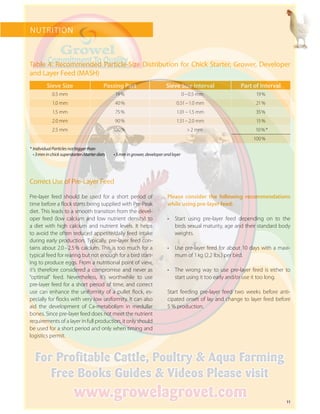
Table 4: Recommended Particle-Size Distribution for Chick Starter, Grower, Developer
and Layer Feed (MASH)
*	IndividualParticlesnotbiggerthan
	 •3 mminchicksuperstarter-/starterdiets •5 mmingrower,developerandlayer
Sieve Size Passing Part Sieve Size Interval Part of Interval
0.5 mm 19 % 0 – 0.5 mm 19 %
1.0 mm 40 % 0.51 – 1.0 mm 21 %
1.5 mm 75 % 1.01 – 1.5 mm 35 %
2.0 mm 90 % 1.51 – 2.0 mm 15 %
2.5 mm 100 % > 2 mm 10 % *
100 %
12
* 	The basis for switching between diet types is the hens‘ body weight development. The correct time for changing the diet is determined not
by age but by body weight. Chicks and pullets should therefore be weighed at regular intervals.
** 1 kcal = 4.187 kJ
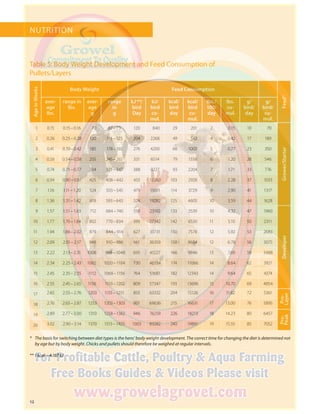
AgeinWeeks
Body Weight Feed Consumption
Feed*
aver-
age
lbs.
range in
lbs.
aver-
age
g
range
in
g
kJ **/
bird
Day
kJ/
bird
cu-
mul.
kcal/
bird
day
kcal/
bird
cu-
mul.
lbs./
100/
day
lbs.
cu-
mul.
g/
bird/
day
g/
bird/
cu-
mul.
 1 0.15 0.15 – 0.16 70 67 – 73 120  840  29  201 2  0.15 10  70
Grower/Starter
 2 0.26 0.25 – 0.28 120 115 – 125 204 2268  49  542 4  0.42 17 189
 3 0.41 0.39 – 0.42 185 178 – 192 276 4200  66 1003 5  0.77 23 350
 4 0.56 0.54 – 0.58 255 245 – 265 331 6514  79 1556 6  1.20 28 546
 5 0.74 0.71 – 0.77 334 321 – 347 388 9227  93 2204 7  1.71 33 776
 6 0.94 0.90 – 0.97 425 408 – 442 433 12260 103 2928 8  2.28 37 1033
 7 1.16 1.11 – 1.20 524 503 – 545 479 15611 114 3729 9  2.90 41 1317
 8 1.36 1.31 – 1.42 618 593 – 643 524 19282 125 4605 10  3.59 44 1628
 9 1.57 1.51 – 1.63 712 684 – 740 559 23192 133 5539 10  4.32 47 1960
Developer
10 1.77 1.70 – 1.84 802 770 – 834 593 27342 142 6530 11  5.10 50 2311
11 1.94 1.86 – 2.02 879 844 – 914 627 31731 150 7578 12  5.92 53 2683
12 2.09 2.01 – 2.17 948 910 – 986 661 36359 158 8684 12  6.78 56 3075
13 2.22 2.13 – 2.31 1008 968 – 1048 695 41227 166 9846 13  7.69 59 3488
14 2.34 2.25 – 2.43 1062 1020 – 1104 730 46334 174 11066 14  8.64 62 3921
15 2.45 2.35 – 2.55 1112 1068 – 1156 764 51681 182 12343 14  9.64 65 4374
16 2.55 2.45 – 2.65 1156 1110 – 1202 809 57347 193 13696 15 10.70 69 4854
17 2.65 2.55 – 2.76 1203 1155 – 1251 855 63332 204 15126 16 11.82 72 5361
Pre-
Layer
18 2.76 2.65 – 2.87 1253 1203 – 1303 901 69636 215 16631 17 13.00 76 5895
19 2.89 2.77 – 3.00 1310 1258 – 1362 946 76259 226 18213 18 14.23 80 6457
Pre-
Peak
20 3.02 2.90 – 3.14 1370 1315 – 1425 1003 83282 240 19891 19 15.55 85 7052
NUTRITION
Table 5: Body Weight Development and Feed Consumption of
Pullets/Layers
13
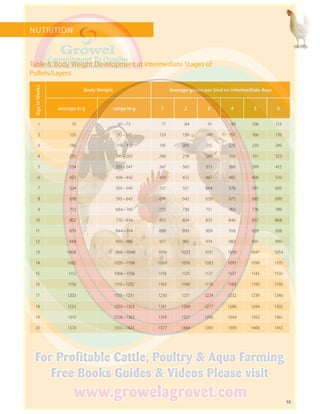
NUTRITION
AgeinWeeks
Body Weight Average grams per bird on intermediate days
average in g range in g 1 2 3 4 5 6
 1 70 67 – 73  77  84  91  99 106 113
 2 120 115 – 125 129 139 148 157 166 176
 3 185 178 – 192 195 205 215 225 235 245
 4 255 245 – 265 266 278 289 300 311 323
 5 334 321 – 347 347 360 373 386 399 412
 6 425 408 – 442 439 453 467 482 496 510
 7 524 503 – 545 537 551 564 578 591 605
 8 618 593 – 643 631 645 658 672 685 699
 9 712 684 – 740 725 738 751 763 776 789
10 802 770 – 834 813 824 835 846 857 868
11 879 844 – 914 889 899 909 918 928 938
12 948 910 – 986 957 965 974 982 991 999
13 1008   968 – 1048 1016 1023 1031 1039 1047 1054
14 1062 1020 – 1104 1069 1076 1083 1091 1098 1105
15 1112 1068 – 1156 1118 1125 1131 1137 1143 1150
16 1156 1110 – 1202 1163 1169 1176 1183 1190 1196
17 1203 1155 – 1251 1210 1217 1224 1232 1239 1246
18 1253 1203 – 1303 1261 1269 1277 1286 1294 1302
19 1310 1258 – 1362 1319 1327 1336 1344 1353 1361
20 1370 1315 – 1425 1377 1384 1391 1399 1406 1413
Table 6: Body Weight Development at intermediate Stages of
Pullets/Layers
14
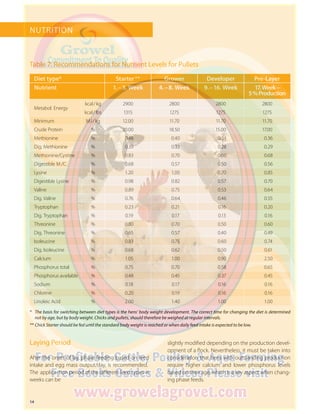
*	 The basis for switching between diet types is the hens‘ body weight development. The correct time for changing the diet is determined
not by age, but by body weight. Chicks and pullets, should therefore be weighed at regular intervals.
**	Chick Starter should be fed until the standard body weight is reached or when daily feed intake is expected to be low.
Diet type* Starter ** Grower Developer Pre-Layer
Nutrient 1. – 3. Week 4. – 8. Week 9. – 16. Week 17.Week–
5  %Production
Metabol. Energy
kcal / kg 2900 2800 2800 2800
kcal / lbs 1315 1275 1275 1275
Minimum MJ / kg 12.00 11.70 11.70 11.70
Crude Protein % 20.00 18.50 15.00 17.00
Methionine %  0.48  0.40  0.34  0.36
Dig. Methionine %  0.39  0.33  0.28  0.29
Methionine/Cystine %  0.83  0.70  0.60  0.68
Digestible M./C. %  0.68  0.57  0.50  0.56
Lysine %  1.20  1.00  0.70  0.85
Digestible Lysine %  0.98  0.82  0.57  0.70
Valine %  0.89  0.75  0.53  0.64
Dig. Valine %  0.76  0.64  0.46  0.55
Tryptophan %  0.23  0.21  0.16  0.20
Dig. Tryptophan %  0.19  0.17  0.13  0.16
Threonine %  0.80  0.70  0.50  0.60
Dig. Threonine %  0.65  0.57  0.40  0.49
Isoleucine %  0.83  0.75  0.60  0.74
Dig. Isoleucine %  0.68  0.62  0.50  0.61
Calcium %  1.05  1.00  0.90  2.50
Phosphorus total %  0.75  0.70  0.58  0.65
Phosphorus available %  0.48  0.45  0.37  0.45
Sodium %  0.18  0.17  0.16  0.16
Chlorine %  0.20  0.19  0.16  0.16
Linoleic Acid %  2.00  1.40  1.00  1.00
NUTRITION
Laying Period slightly modified depending on the production devel-
opment of a flock. Nevertheless, it must be taken into
consideration that hens with outstanding production
require higher calcium and lower phosphorus levels
based on their age, which is a key aspect when chang-
ing phase feeds.
Table 7: Recommendations for Nutrient Levels for Pullets
After the onset of lay, phase feeding based on feed
intake and egg mass output/day, is recommended.
The applica-tion period of the different feed types in
weeks can be
15
NUTRITION
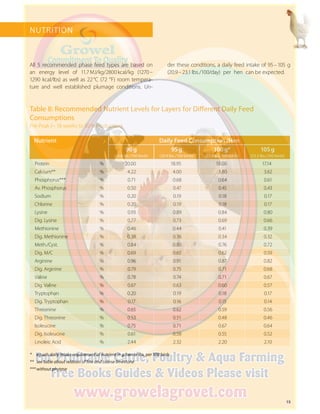
All 5 recommended phase feed types are based on
an energy level of 11.7 MJ/kg/2800 kcal/kg (1270 – 
1290 kcal/lbs) as well as 22 °C (72 °F) room tempera-
ture and well established plumage conditions. Un-
der these conditions, a daily feed intake of 95 – 105 g
(20.9 –  
*		equals daily intake requirement of nutrient in g/hen or lbs. per 100 birds
** 		see table about relation of fine and coarse limestone
	***	 without phytase
Pre-Peak (~ 18 weeks to 50 % Production)
Nutrient Daily Feed Consumption /Hen
90 g
(19.8 lbs./100 birds)
95 g
(20.9 lbs./100 birds)
100 g*
(22.0 lbs./100 birds)
105 g
(23.2 lbs./100 birds)
Protein % 20.00 18.95 18.00 17.14
Calcium** %  4.22  4.00  3.80  3.62
Phosphorus*** %  0.71  0.68  0.64  0.61
Av. Phosphorus %  0.50  0.47  0.45  0.43
Sodium %  0.20  0.19  0.18  0.17
Chlorine %  0.20  0.19  0.18  0.17
Lysine %  0.93  0.89  0.84  0.80
Dig. Lysine %  0.77  0.73  0.69  0.66
Methionine %  0.46  0.44  0.41  0.39
Dig. Methionine %  0.38  0.36  0.34  0.32
Meth./Cyst. %  0.84  0.80  0.76  0.72
Dig. M/C %  0.69  0.65  0.62  0.59
Arginine %  0.96  0.91  0.87  0.82
Dig. Arginine %  0.79  0.75  0.71  0.68
Valine %  0.78  0.74  0.71  0.67
Dig. Valine %  0.67  0.63  0.60  0.57
Tryptophan %  0.20  0.19  0.18  0.17
Dig. Tryptophan %  0.17  0.16  0.15  0.14
Threonine %  0.65  0.62  0.59  0.56
Dig. Threonine %  0.53  0.51  0.48  0.46
Isoleucine %  0.75  0.71  0.67  0.64
Dig. Isoleucine %  0.61  0.58  0.55  0.52
Linoleic Acid %  2.44  2.32  2.20  2.10
23.1lbs./100/day) per hen can be expected.
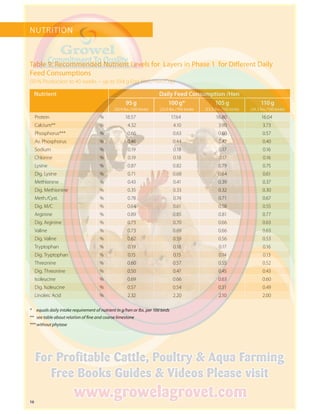
Table 8: Recommended Nutrient Levels for Layers for Different Daily Feed
Consumptions
16
NUTRITION
(50 % Production to 40 weeks ~ up to 59.4 g Egg Mass/Hen/Day)
Nutrient Daily Feed Consumption /Hen
95 g
(20.9 lbs./100 birds)
100 g*
(22.0 lbs./100 birds)
105 g
(23.2 lbs./100 birds)
110 g
(24.3 lbs./100 birds)
Protein % 18.57 17.64 16.80 16.04
Calcium** %  4.32  4.10  3.90 3.73
Phosphorus*** %  0.66  0.63  0.60 0.57
Av. Phosphorus %  0.46  0.44  0.42 0.40
Sodium %  0.19  0.18  0.17 0.16
Chlorine %  0.19  0.18  0.17 0.16
Lysine %  0.87  0.82  0.79 0.75
Dig. Lysine %  0.71  0.68  0.64 0.61
Methionine %  0.43  0.41  0.39 0.37
Dig. Methionine %  0.35  0.33  0.32 0.30
Meth./Cyst. %  0.78  0.74  0.71 0.67
Dig. M/C %  0.64  0.61  0.58 0.55
Arginine %  0.89  0.85  0.81 0.77
Dig. Arginine %  0.73  0.70  0.66 0.63
Valine %  0.73  0.69  0.66 0.63
Dig. Valine %  0.62  0.59  0.56 0.53
Tryptophan %  0.19  0.18  0.17 0.16
Dig. Tryptophan %  0.15  0.15  0.14 0.13
Threonine %  0.60  0.57  0.55 0.52
Dig. Threonine %  0.50  0.47  0.45 0.43
Isoleucine %  0.69  0.66  0.63 0.60
Dig. Isoleucine %  0.57  0.54  0.51 0.49
Linoleic Acid %  2.32  2.20  2.10 2.00
*		equals daily intake requirement of nutrient in g/hen or lbs. per 100 birds
**		see table about relation of fine and coarse limestone
	***	 without phytase
Table 9: Recommended Nutrient Levels for Layers in Phase 1 for Different Daily
Feed Consumptions
17
NUTRITION 
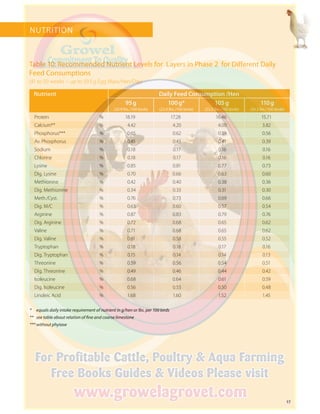
(41 to 50 weeks ~ up to 59.5 g Egg Mass/Hen/Day)
Nutrient Daily Feed Consumption /Hen
95 g
(20.9 lbs./100 birds)
100 g*
(22.0 lbs./100 birds)
105 g
(23.2 lbs./100 birds)
110 g
(24.3 lbs./100 birds)
Protein % 18.19 17.28 16.46 15.71
Calcium** %  4.42  4.20  4.00 3.82
Phosphorus*** %  0.65  0.62  0.59 0.56
Av. Phosphorus %  0.45  0.43  0.41 0.39
Sodium %  0.18  0.17  0.16 0.16
Chlorine %  0.18  0.17  0.16 0.16
Lysine %  0.85  0.81  0.77 0.73
Dig. Lysine %  0.70  0.66  0.63 0.60
Methionine %  0.42  0.40  0.38 0.36
Dig. Methionine %  0.34  0.33  0.31 0.30
Meth./Cyst. %  0.76  0.73  0.69 0.66
Dig. M/C %  0.63  0.60  0.57 0.54
Arginine %  0.87  0.83  0.79 0.76
Dig. Arginine %  0.72  0.68  0.65 0.62
Valine %  0.71  0.68  0.65 0.62
Dig. Valine %  0.61  0.58  0.55 0.52
Tryptophan %  0.18  0.18  0.17 0.16
Dig. Tryptophan %  0.15  0.14  0.14 0.13
Threonine %  0.59  0.56  0.54 0.51
Dig. Threonine %  0.49  0.46  0.44 0.42
Isoleucine %  0.68  0.64  0.61 0.59
Dig. Isoleucine %  0.56  0.53  0.50 0.48
Linoleic Acid %  1.68  1.60  1.52 1.45
*		equals daily intake requirement of nutrient in g/hen or lbs. per 100 birds
**		see table about relation of fine and coarse limestone
	***	 without phytase
Table 10: Recommended Nutrient Levels for Layers in Phase 2 for Different Daily
Feed Consumptions
18
NUTRITION
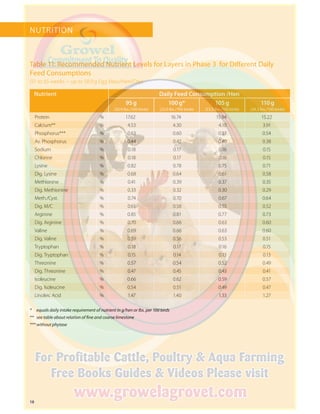
(51 to 65 weeks ~ up to 58.9 g Egg Mass/Hen/Day)
Nutrient Daily Feed Consumption /Hen
95 g
(20.9 lbs./100 birds)
100 g*
(22.0 lbs./100 birds)
105 g
(23.2 lbs./100 birds)
110 g
(24.3 lbs./100 birds)
Protein % 17.62 16.74 15.94 15.22
Calcium** %  4.53  4.30  4.10 3.91
Phosphorus*** %  0.63  0.60  0.57 0.54
Av. Phosphorus %  0.44  0.42  0.40 0.38
Sodium %  0.18  0.17  0.16 0.15
Chlorine %  0.18  0.17  0.16 0.15
Lysine %  0.82  0.78  0.75 0.71
Dig. Lysine %  0.68  0.64  0.61 0.58
Methionine %  0.41  0.39  0.37 0.35
Dig. Methionine %  0.33  0.32  0.30 0.29
Meth./Cyst. %  0.74  0.70  0.67 0.64
Dig. M/C %  0.61  0.58  0.55 0.52
Arginine %  0.85  0.81  0.77 0.73
Dig. Arginine %  0.70  0.66  0.63 0.60
Valine %  0.69  0.66  0.63 0.60
Dig. Valine %  0.59  0.56  0.53 0.51
Tryptophan %  0.18  0.17  0.16 0.15
Dig. Tryptophan %  0.15  0.14  0.13 0.13
Threonine %  0.57  0.54  0.52 0.49
Dig. Threonine %  0.47  0.45  0.43 0.41
Isoleucine %  0.66  0.62  0.59 0.57
Dig. Isoleucine %  0.54  0.51  0.49 0.47
Linoleic Acid %  1.47  1.40  1.33 1.27
*		equals daily intake requirement of nutrient in g/hen or lbs. per 100 birds
**		see table about relation of fine and coarse limestone
	***	 without phytase
Table 11: Recommended Nutrient Levels for Layers in Phase 3 for Different Daily
Feed Consumptions
19
NUTRITION
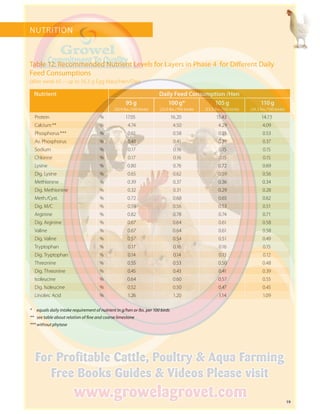
(after week 65 ~ up to 56.3 g Egg Mass/Hen/Day)
Nutrient Daily Feed Consumption /Hen
95 g
(20.9 lbs./100 birds)
100 g*
(22.0 lbs./100 birds)
105 g
(23.2 lbs./100 birds)
110 g
(24.3 lbs./100 birds)
Protein % 17.05 16.20 15.43 14.73
Calcium ** %  4.74  4.50  4.29 4.09
Phosphorus *** %  0.61  0.58  0.55 0.53
Av. Phosphorus %  0.43  0.41  0.39 0.37
Sodium %  0.17  0.16  0.15 0.15
Chlorine %  0.17  0.16  0.15 0.15
Lysine %  0.80  0.76  0.72 0.69
Dig. Lysine %  0.65  0.62  0.59 0.56
Methionine %  0.39  0.37  0.36 0.34
Dig. Methionine %  0.32  0.31  0.29 0.28
Meth./Cyst. %  0.72  0.68  0.65 0.62
Dig. M/C %  0.59  0.56  0.53 0.51
Arginine %  0.82  0.78  0.74 0.71
Dig. Arginine %  0.67  0.64  0.61 0.58
Valine %  0.67  0.64  0.61 0.58
Dig. Valine %  0.57  0.54  0.51 0.49
Tryptophan %  0.17  0.16  0.16 0.15
Dig. Tryptophan %  0.14  0.14  0.13 0.12
Threonine %  0.55  0.53  0.50 0.48
Dig. Threonine %  0.45  0.43  0.41 0.39
Isoleucine %  0.64  0.60  0.57 0.55
Dig. Isoleucine %  0.52  0.50  0.47 0.45
Linoleic Acid %  1.26  1.20  1.14 1.09
*		equals daily intake requirement of nutrient in g/hen or lbs. per 100 birds
**		see table about relation of fine and coarse limestone
	***	 without phytase
Table 12: Recommended Nutrient Levels for Layers in Phase 4 for Different Daily
Feed Consumptions
20
NUTRITION
Nutrition and Egg Weight
Within certain limits egg weight can be adapted to
farm specific requirements by adjusting rations. The
following nutritional factors should be noted:
•	 Growing
Feeding for higher body weight/frame size increas-
es the egg weight throughout the whole laying pe-
riod.
•	 Feed composition
– crude protein and methionine
– linoleic acid
•	 Feeding technique
– feed texture
– feeding time
– feed level in troughs
– controlled feeding
– frequency of feeding
By stimulating feed intake egg weight can be increased
and can be limited by controlled feeding. Adjusting
house temperature, when possible, can be used to af-
fect feed consumption an egg weight.
Supplements
Supplements ensure the necessary supply of essential
vitamins, trace elements and substances such as anti-
oxidants or carotenoids.
Suitable supplementation can compensate for the
varying contents of raw materials and safeguard the
supply of all necessary nutrients.
Remark: Vitamin C is synthezised by poultry normally
and is not considerd essential, however in some cir-
cumstances, like heat stress or hot climate, it may be
important/beneficial to add 100 – 200 mg/kg complete
feed during production period.
21
NUTRITION
Supplements per kg Feed Starter/Grower Developer Pre-Layer/Layer
Vitamin A I.U. 12000 12000 10000
Vitamin D3
I.U. 2000 2000 2500
Vitamin E mg 20 – 30** 20 – 30** 15 – 30**
Vitamin K3
mg 3*** 3*** 3***
Vitamin B1
mg 1 1 1
Vitamin B2
mg 6 6 4
Vitamin B6
mg 3 3 3
Vitamin B12
mcg 20 20 25
Pantothenic Acid mg 8 8 10
Nicotinic Acid mg 30 30 30
Folic Acid mg 1.0 1.0 0.5
Biotin mcg 50 50 50
Choline mg 300 300 400
Antioxidant mg 100 –150** 100 –150** 100 –150**
Coccidiostat as required as required –
Manganese* mg 100 100 100
Zinc* mg 60 60 60
Iron mg 25 25 25
Copper* mg 5 5 5
Iodine mg 0.5 0.5 0.5
Selenium* mg 0.2 0.2 0.2
*		So called “organic sources” should be considered with higher bioavailability.
**		according to fat addition
	***	double in case of heat treated feed
Table 13: Recommended Micro-Nutrient Specification
Table 14: Continuous Supply of Fine and Coarse Limestone
(Recommended Relation in Feed)
Feed type Fine Limestone
0 – 0.5 mm
Coarse Limestone *
1.5 – 3.5 mm
Pre Peak / Layer Phase 1 30 % 70 %
Layer Phase 2/3 25 % 75 %
Layer Phase 4/5 15 % 85 %
* can be partly replaced by oyster shells
22
LIGHTING
General
The lighting program controls the onset of lay and
affects the performance. Within certain limits, perfor-
mance can be adapted to farm specific requirements
by adjusting the lighting program. Easiest to follow are
the lighting programs in closed houses without the
effect of natural daylight. In these, the hours of light
and light intensity can be adjusted to changing needs.
Rearing birds in closed houses and producing eggs in
light-tight houses enable the producers to maximize
performance. Follow the lighting program which is
recommended for this type of housing system.
Closed houses are not feasible in every case. For open
or brown-out houses, a tailormade program has to be
developed depending on the season and geographi-
cal location where pullets are being reared and stimu-
lated to lay.
In general, the lighting program should follow the
­basic principles:
•	 Never increase hours of light during the rearing
period.
•	 Never decrease hours of light during the pro-
duction period
•	 Always keep in mind that artificial and natu-
ral daylight can have an influence in open or
brown-out houses.
Intermittent Lighting Program for
Day Old Chicks
When the day old chicks arrive on the farm, they have
already been intensively handled in the hatchery and
often have a long transport to their final destination.
Common practice is to give them 24 hours of light to
help them recover in the first 2 or 3 days after arrival
and to provide them enough time to eat and drink. In
practice, it can be observed that after arrival and hous-
ing, some chicks continue to sleep whereas others
start to look for feed and water. The activity of the flock
will always be irregular. Especially in this phase, poultry
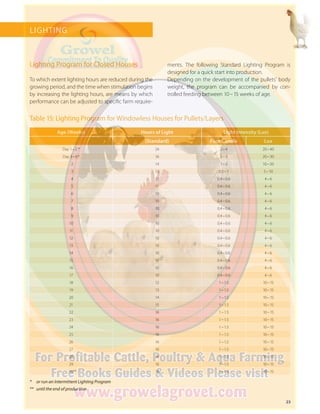
Lighting Program after Arrival
This program can be used for up to 7 or 10 days after
arrival, then switch to the regular step down lighting
program. The use of the following lighting program
brings about the following advantages:
•	 The chicks will rest and/or sleep at the same time.
This means that the behavior of the chicks will be
synchronized.
•	 Weak chicks will be stimulated by stronger ones to
move as well as to eat and drink.
•	 The behavior of the flock is more uniform and the
monitoring of the birds is made easier.
•	 Mortality will decrease.
2 h
darkness
2 h
darkness
2 h
darkness
2 h
darkness
4 h
light
4 h
light
4 h
light
4 h
light
men have difficulties interpreting the chicks behavior
and their condition.
There is a practically proven principal in splitting the
day into phases of resting and activity using a special
designed intermittent lighting program. The aim is to
synchronize the chicks’ activities. The farmer gets a
better impression of the flocks condition and the birds
are encouraged by the groups behavior to search for
water and feed.
Therefore, it is advises to give chicks a rest after they
arrive at the rearing farm and then start with four hours
of light followed by two hours of dark-ness.
23
LIGHTING
Lighting Program for Closed Houses
To which extent lighting hours are reduced during the
growing period, and the time when stimulation begins
by increasing the lighting hours, are means by which
performance can be adjusted to specific farm require-
ments. The following Standard Lighting Program is
­designed for a quick start into production.
Depending on the development of the pullets’ body
weight, the program can be accompanied by con-
trolled feeding between 10 – 15 weeks of age.
*		or run an Intermittent Lighting Program	
**		until the end of production
Age (Weeks) Hours of Light Light Intensity (Lux)
(Standard) Foot Candle Lux
Day 1 – 2  * 24 2 – 4 20 – 40
Day 3 – 6 * 16 2 – 3 20 – 30
 2 14 1 – 2 10 – 20
 3 13 0.5 – 1 5 – 10
 4 12 0.4 – 0.6 4 – 6
 5 11 0.4 – 0.6 4 – 6
 6 10 0.4 – 0.6 4 – 6
 7 10 0.4 – 0.6 4 – 6
 8 10 0.4 – 0.6 4 – 6
 9 10 0.4 – 0.6 4 – 6
10 10 0.4 – 0.6 4 – 6
11 10 0.4 – 0.6 4 – 6
12 10 0.4 – 0.6 4 – 6
13 10 0.4 – 0.6 4 – 6
14 10 0.4 – 0.6 4 – 6
15 10 0.4 – 0.6 4 – 6
16 10 0.4 – 0.6 4 – 6
17 10 0.4 – 0.6 4 – 6
18 12 1 – 1.5 10 – 15
19 13 1 – 1.5 10 – 15
20 14 1 – 1.5 10 – 15
21 15 1 – 1.5 10 – 15
22 16 1 – 1.5 10 – 15
23 16 1 – 1.5 10 – 15
24 16 1 – 1.5 10 – 15
25 16 1 – 1.5 10 – 15
26 16 1 – 1.5 10 – 15
27 16 1 – 1.5 10 – 15
28 16 1 – 1.5 10 – 15
29 16 1 – 1.5 10 – 15
   30** 16 1 – 1.5 10 – 15
Table 15: Lighting Program for Windowless Houses for Pullets/Layers
24
LIGHTING
Growing in Closed House to Open House
Production
The lighting program for closed houses, the step down
procedure and the subsequent constant day length
between 7 – 10 weeks of age, have to be adjusted to
the length of the day at the time when the birds have
to be transferred to the layer house. This depends on
the season and the latitude of where the farms are lo-
cated. Birds hatched in the first days of December and
placed at 40 N. Latitude, will be exposed to a nearly
13-hour length of day at 17 weeks of age. The step down
program for such a flock should stop at 13 hours and
guarantee a constant day length of 13 hours from week
3 until transfer. At week 19, the flock should be exposed
to a 120-minutes increase in day length. A weekly in-
crease of 60 minutes until the maximal day length of 16
hours is sufficient to induce stimulation. If the day length
at the time of transfer is more than 14 hours per day, an
increase of 30 minutes can be used to prolong the light
stimulation period. Light intensity has to be adapted to
natural daylight 2 – 3 weeks prior to transfer.
Growing in Open House to Open House
Production
The lighting program and the step down procedure
have to be adjusted to the longest length of day to
which the birds are exposed to in the period from 3
to 17 weeks of age. Birds which are hatched in the first
days of April and are reared at 20° N. Latitude, will be ex-
posed to a 13-hour day length up to 17 weeks of age,
maximum. This will determine the clock setting during
rearing. At week 19, the flock should be exposed to a
120-minutes longer day length. A weekly increase of 30
minutes until the maximal length of day with 16 hours is
sufficient for stimulation.
Growing in Open House to Closed House
Production
For pullets which have been reared in open houses and
then transferred to closed houses, please refer to the
recommendations as stated in “Growing in Open House
to Open House Production”.
25
LIGHTING
2 4 6 8 10 12 14 16 18 20 22 24 26 28 30 32 34 36 38 40 42 44 46 48 50 52 54 56 58 60 62 64 66 68 70
5149 07050301 09 11 13 15 17 19 21 23 25 27 29 31 33
Week of Year
Week of Age
35 37 39 41 43 45 47 49 51 01 03 05 07 09 11 13
24
23
22
21
20
19
18
17
16
15
14
13
12
11
10
9
8
7
6
5
4
3
2
1
0
Lighting Standard DaylightLighting-Program Twilight
Adjusted Lighting Program for LSL-LITE Commercials
Hatch Date: December 8th
, Location: Modesto CA.
Open House Rearing, Open House Production
Stimulation/Transfer Age: 18 Weeks
Lighting Program for Open Houses
Adjusted Lighting Program for Open Houses
Lighting Program for Dark Houses
Extremes
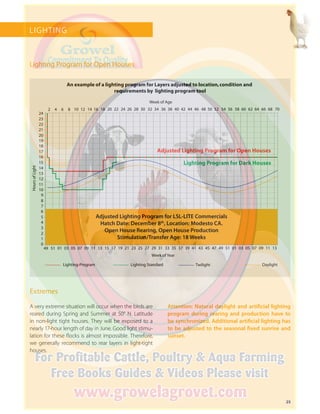
A very extreme situation will occur when the birds are
reared during Spring and Summer at 50° N. Latitude
in non-light tight houses. They will be exposed to a
nearly 17-hour length of day in June. Good light stimu-
lation for these flocks is almost impossible. Therefore,
we generally recommend to rear layers in light-tight
houses.
Attention: Natural daylight and artificial lighting
program during rearing and production have to
be synchronized. Additional artificial lighting has
to be adjusted to the seasonal fixed sunrise and
sunset.
Lighting Program for Open Houses
An example of a lighting program for Layers adjusted to location,condition and
requirements by lighting program tool
26
LIGHTING
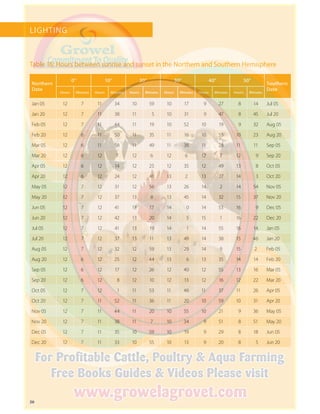
Table 16: Hours between sunrise and sunset in the Northern and Southern Hemisphere
Northern
Date
0° 10° 20° 30° 40° 50°
Southern
Date
Hours Minutes Hours Minutes Hours Minutes Hours Minutes Hours Minutes Hours Minutes
Jan 05 12 7 11 34 10 59 10 17  9 27  8 14 Jul 05
Jan 20 12 7 11 38 11  5 10 31  9 47  8 45 Jul 20
Feb 05 12 7 11 44 11 19 10 52 10 19  9 32 Aug 05
Feb 20 12 6 11 50 11 35 11 16 10 55 10 23 Aug 20
Mar 05 12 6 11 58 11 49 11 38 11 28 11 11 Sep 05
Mar 20 12 6 12 7 12 6 12 6 12 7 12  9 Sep 20
Apr 05 12 6 12 14 12 25 12 35 12 49 13  8 Oct 05
Apr 20 12 6 12 24 12 41 13 2 13 27 14  3 Oct 20
May 05 12 7 12 31 12 56 13 26 14 2 14 54 Nov 05
May 20 12 7 12 37 13 8 13 45 14 32 15 37 Nov 20
Jun 05 12 7 12 41 13 17 14  0 14 53 16  9 Dec 05
Jun 20 12 7 12 42 13 20 14  5 15 1 16 22 Dec 20
Jul 05 12 7 12 41 13 19 14  1 14 55 16 14 Jan 05
Jul 20 12 7 12 37 13 11 13 49 14 38 15 46 Jan 20
Aug 05 12 7 12 32 12 59 13 29 14 9 15 2 Feb 05
Aug 20 12 6 12 25 12 44 13  6 13 35 14 14 Feb 20
Sep 05 12 6 12 17 12 26 12 40 12 55 13 16 Mar 05
Sep 20 12 6 12  8 12 10 12 13 12 16 12 22 Mar 20
Oct 05 12 7 12  1 11 53 11 46 11 37 11 26 Apr 05
Oct 20 12 7 11 52 11 36 11 20 10 59 10 31 Apr 20
Nov 05 12 7 11 44 11 20 10 55 10 21  9 36 May 05
Nov 20 12 7 11 38 11 7 10 34  9 51  8 51 May 20
Dec 05 12 7 11 35 10 59 10 19  9 29  8 18 Jun 05
Dec 20 12 7 11 33 10 55 10 13  9 20  8  5 Jun 20
27
Hygiene
•	 Set up the farm at a safe distance from other poul-
try houses and fence in.
•	 Keep birds of only one age group on the farm.
•	 Keep no other poultry on the farm.
•	 Allow no visitors to enter the farm.
•	 Wear only the farm´s own protective clothing with-
in the farm area.
•	 Provide the farm´s own protective clothing for vet-
erinarians, service and maintenance workers and
consultants.
•	 Disinfect boots before entering the houses.
•	 Use bulk feed if possible. Do not allow the truck
driver to enter the houses.
•	 Safeguard the houses against wild birds and ver-
min. Keep rats and mice under constant control.
•	 Dispose of dead birds hygienically. Follow local laws
and regulations.
Daily Control
Check at least once daily:
•	 Health status
•	 Temperature
•	 Ventilation
•	 Feed and water consumption
•	 Lighting
•	 Mortality
When assessing the state of health, do not just go by
the general impression and mortality rate, but also
take note of feed and water consumption as well as
the consistency of droppings.
Water Supply
Clean water is as equally important as good feed for
top performance. Therefore fresh, clean, potable wa-
ter must be available at all times for the layers and

an ­adequate consumption must always be assured.
A water meter is a very useful tool to monitor water
consumption. The optimal water temperature is about
20 °C (68 °F).
Furthermore feed and water intake are closely corre-
lated. If birds don’t drink enough water for any reason,
feed intake is consequently reduced.
The water to feed ratio at comfortable temperature is
around 1.8 – 2 : 1, but this relation increases up to 5 : 1 at
high ambient temperatures above 30 °C (86 °F). During
exposure to high temperatures, birds consume less feed,
but more water in an effort to cool their body down.
Check the water quality regularly, especially if you use
your own water supply like well water.
For example excessive salt levels in drinking water can
cause persistent damage to shell quality and hard wa-
ter with high TDS* levels may cause kidney damage.
* TDS: Total Dissolved Solids
Grit
Feeding grit is not a must but is recommended when
rations are supplemented by grains. This stimulates the
development of the crop and the gizzard during the
rearing period, which in turn has a positive effect on
feed intake capacity.
Table 17: Amount and Granulation of Grit
Dependent on Age
Week 1 – 2 once a week 1 g / bird
(size 1 – 2 mm / 0.04 – 0.08 in)
Week 3 – 8 once a week 2 g / bird
(size 3 – 4 mm / 0.12 – 0.16 in)
From week 9 once a month 3 g / bird
(size 4 – 6 mm / 0.16 – 0.24 in)
GENERAL RECOMMENDATIONS
28
GENERAL RECOMMENDATIONS
Egg Quality and Egg Collection
•	 Collect eggs at least once a day.
•	 Store eggs at temperatures of 7 °C (45 °F) with a
relative humidity between 80 – 85 %.
Storing at higher temperatures and lower humidity
leads to rapid loss of weight and impairs the quality of
the egg white due to an increase in gas exchange.
Nests (Non Cage Housing)
The quality of nests is also a factor that affects egg
quality. Renew the litter in litter-type nests regularly
and keep them clean. Provide individual nests at a rate
of one nest per 4 hens. Collect floor eggs frequently to
keep their rate as low as possible.
In addition to sufficient nesting space in family type
nests, the following factors are important for a low rate
of floor eggs:
•	 Clean, dry litter or soft nest lining
•	 Easy access
•	 Even distribution of the nests within the barn
•	 Only one type of nest in the barn
For optimum egg quality, rollaway nests in combina-
tion with slats are better than litter-type nests or family
type nests.
Litter (Non Cage Housing)
Only use shavings from untreated wood in order to
avoid poisoning and residues in the egg.
Provide sufficient ventilation to ensure good litter con-
dition and remove wet litter, if necessary.
Table 18: Space Allowances and Equipment for Rearing
Age
Equipment
Cage Rearing Floor Rearing
0 – 4 weeks 5 –17 weeeks 0 – 4 weeks 5 –17 weeks
Chicks/Hover
Floor Space
140 sq cm/bird
22 sq in /bird
285 sq cm/bird
44 sq in/bird
500
20 birds/sq m
0.5 sq ft/bird
10 birds/sq m
1 sq ft/bird
Feeder Space
trough (cm/bird)
trough (in/bird)
pan (birds/pan)
2.5
1
24
5
2
12
4
1.5
60
8
3
30
Water Space
birds/cup
birds/nipple
birds/fountain
trough (cm/bird)
trough (in/bird)
16
16
50 (mini)
1.25
0.5
8
8
–
2.5
1
50
20
150
1.25
0.5
25
10
75
2.5
1
Space Requirements
To preserve the quality, the following points should
be observed:
29
GENERAL RECOMMENDATIONS
Floor Space Feeder Space Water Space
Cage Area Light
Controlled Floor
Open Floor Trough/
Bird
Birds/
Tube or
Pan
Birds/
Nipple or
Cup
Birds/
Fountain
Trough/
Bird
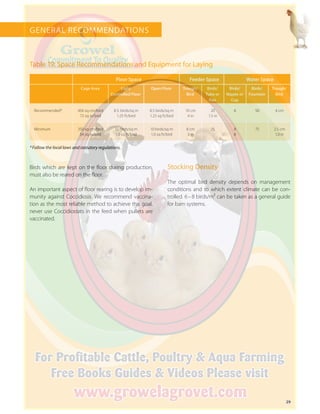
Recommended* 456 sq cm/bird
72 sq in/bird
8.5. birds/sq m
1.25 ft/bird
8.5 birds/sq m
1.25 sq ft/bird
10 cm
4 in
20
1.5 in
6 50 4 cm
Minimum 350 sq cm/bird
54 sq in/bird
10 birds/sq m
1.0 sq ft/bird
10 birds/sq m
1.0 sq ft/bird
8 cm
3 in
25 8
8
75 2.5 cm
1.0 in
* Follow the local laws and statutory regulations.
Table 19: Space Recommendations and Equipment for Laying
Birds which are kept on the floor during production,
must also be reared on the floor.
An important aspect of floor rearing is to develop im-
munity against Coccidiosis. We recommend vaccina-
tion as the most reliable method to achieve this goal.
never use Coccidiostats in the feed when pullets are
vaccinated.
Stocking Density
The optimal bird density depends on management
conditions and to which extent climate can be con-
trolled. 6 – 8 birds/m² can be taken as a general guide
for barn systems.
30
GENERAL INFORMATION
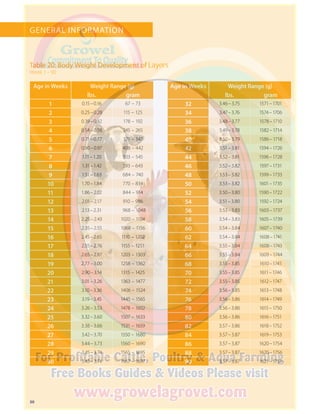
Week 1 – 90
Age in Weeks Weight Range (g)
lbs. gram
1 0.15 – 0.16 67  –  73
2 0.25 – 0.28 115  –  125
3 0.39 – 0.42 178  –  192
4 0.54 – 0.58 245  –  265
5 0.71 – 0.77 321  –  347
6 0.90 – 0.97 408  –  442
7 1.11 – 1.20 503  –  545
8 1.31 – 1.42 593  –  643
9 1.51 – 1.63 684  –  740
10 1.70 – 1.84 770  –  834
11 1.86 – 2.02 844  –  914
12 2.01 – 2.17 910  –  986
13 2.13 – 2.31   968  –  1048
14 2.25 – 2.43 1020  –  1104
15 2.35 – 2.55 1068  –  1156
16 2.45 – 2.65 1110  –  1202
17 2.55 – 2.76 1155  –  1251
18 2.65 – 2.87 1203  –  1303
19 2.77 – 3.00 1258  –  1362
20 2.90 – 3.14 1315  –  1425
21 3.01 – 3.26 1363  –  1477
22 3.10 – 3.36 1406  –  1524
23 3.19 – 3.45 1445  –  1565
24 3.26 – 3.53 1478  –  1602
25 3.32 – 3.60 1507  –  1633
26 3.38 – 3.66 1531  –  1659
27 3.42 – 3.70 1550  –  1680
28 3.44 – 3.73 1560  –  1690
29 3.45 – 3.74 1565  –  1695
30 3.45 – 3.74 1567  –  1697
Age in Weeks Weight Range (g)
lbs. gram
32 3.46 – 3.75 1571 – 1701
34 3.47 – 3.76 1574 – 1706
36 3.48 – 3.77 1578 – 1710
38 3.49 – 3.78 1582 – 1714
40 3.50 – 3.79 1586 – 1718
42 3.51 – 3.81 1594 – 1726
44 3.52 – 3.81 1596 – 1728
46 3.52 – 3.82 1597 – 1731
48 3.53 – 3.82 1599 – 1733
50 3.53 – 3.82 1601 – 1735
52 3.50 – 3.80 1590 – 1722
54 3.51 – 3.80 1592 – 1724
56 3.53 – 3.83 1603 – 1737
58 3.54 – 3.83 1605 – 1739
60 3.54 – 3.84 1607 – 1740
62 3.54 – 3.84 1608 – 1741
64 3.55 – 3.84 1608 – 1743
66 3.55 – 3.84 1609 – 1744
68 3.55 – 3.85 1610 – 1745
70 3.55 – 3.85 1611 – 1746
72 3.55 – 3.85 1612 – 1747
74 3.56 – 3.85 1613 – 1748
76 3.56 – 3.86 1614 – 1749
78 3.56 – 3.86 1615 – 1750
80 3.56 – 3.86 1616 – 1751
82 3.57 – 3.86 1618 – 1752
84 3.57 – 3.87 1619 – 1753
86 3.57 – 3.87 1620 – 1754
88 3.57 – 3.87 1620 – 1756
90 3.57 – 3.87 1621 – 1757
Table 20: Body Weight Development of Layers
31
GENERAL INFORMATION
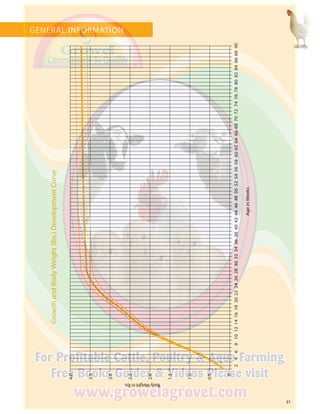
GrowthandBodyWeight(lbs.)DevelopmentCurve
24182016141210862224262830323436384042444648505254565860626466687072747678808284868890
4.0
3.5
3.0
2.5
2.0
1.5
1.0
0.5
0
BodyWeightinlbs.
AgeinWeeks
32
Age
Liv-
abil-
ity
Num-
ber
of
eggs
Rate
of Lay
H.D.
Body weight Feed
Egg weight
in week
Egg weight
cumulative
% Grade A
Large 
Above Egg mass
in g in lbs.
Gram
Feed/
Bird/
Day
Lbs.
Feed/
100/
Day g
Oz./
Doz.
Net.
Lbs./
30
Doz.
Case g
Oz./
Doz.
Net.
Lbs./
30
Doz.
Case
23
Oz.
24
Oz.
g/
H.D.
in
week
Oz./
Doz./
H.D.
in
week
cu-
mula-
tive
kg/
H.H.
cu-
mula-
tive
Lbs./
H.H.
19 100.0   0.7 10.0 1310 2.89  80 17.7 41.0 17.4 32.5 41.0 17.4 32.5  0  0  4.1  1.7 0.03 0.1
20 100.0   3.2 35.0 1370 3.02  85 18.7 44.0 18.6 34.9 43.3 18.3 34.4  0  0 15.4  6.5 0.14 0.3
21  99.9   7.0 55.1 1420 3.13  92 20.2 47.0 19.9 37.3 45.4 19.2 36.0  2  0 25.9 11.0 0.32 0.7
22  99.9  12.1 73.1 1465 3.23  97 21.3 49.5 21.0 39.3 47.1 19.9 37.4  9  3 36.2 15.3 0.57 1.3
23  99.8  17.9 83.2 1505 3.32 100 21.9 51.8 21.9 41.1 48.6 20.6 38.6 27 12 43.1 18.2 0.87 1.9
24  99.8  24.2 89.2 1540 3.40 101 22.4 53.5 22.6 42.5 49.9 21.1 39.6 44 25 47.7 20.2 1.20 2.7
25  99.7  30.6 92.3 1570 3.46 103 22.8 55.0 23.3 43.7 51.0 21.6 40.4 58 38 50.8 21.5 1.56 3.4
26  99.7  37.1 93.8 1595 3.52 103 22.8 56.4 23.9 44.8 51.9 22.0 41.2 69 49 52.9 22.4 1.93 4.3
27  99.6  43.7 94.6 1615 3.56 104 23.0 57.3 24.3 45.5 52.7 22.3 41.8 76 57 54.2 23.0 2.31 5.1
28  99.6  50.4 95.2 1625 3.58 104 23.0 57.9 24.5 46.0 53.4 22.6 42.4 79 63 55.1 23.3 2.69 5.9
29  99.5  57.0 95.5 1630 3.59 104 23.0 58.4 24.7 46.3 54.0 22.9 42.9 83 67 55.8 23.6 3.08 6.8
30  99.4  63.7 95.7 1632 3.60 104 23.0 58.8 24.9 46.7 54.5 23.1 43.3 85 70 56.3 23.8 3.47 7.6
31  99.3  70.3 95.9 1634 3.60 104 23.0 59.2 25.1 47.0 54.9 23.3 43.6 87 74 56.8 24.0 3.86 8.5
32  99.2  77.0 96.0 1636 3.61 104 23.0 59.6 25.2 47.3 55.3 23.4 43.9 89 77 57.2 24.2 4.26 9.4
33  99.1  83.7 96.2 1638 3.61 104 23.0 60.0 25.4 47.6 55.7 23.6 44.2 90 79 57.7 24.4 4.66 10.3
34  99.0  90.3 96.3 1640 3.62 104 23.0 60.4 25.6 47.9 56.1 23.7 44.5 92 82 58.1 24.6 5.07 11.2
35  98.9  97.0 96.3 1642 3.62 104 23.0 60.7 25.7 48.2 56.4 23.9 44.7 92 83 58.5 24.7 5.47 12.1
36  98.8 103.7 96.3 1644 3.62 104 23.0 61.0 25.8 48.4 56.7 24.0 45.0 93 84 58.7 24.9 5.88 13.0
37  98.7 110.3 96.3 1646 3.63 104 23.0 61.3 25.9 48.7 57.0 24.1 45.2 94 85 59.0 25.0 6.28 13.9
38 98.6 117.0 96.2 1648 3.63 103 22.8 61.4 26.0 48.7 57.2 24.2 45.4 94 87 59.1 25.0 6.69 14.8
39 98.5 123.6 96.2 1650 3.64 103 22.8 61.6 26.1 48.9 57.4 24.3 45.6 95 87 59.3 25.1 7.10 15.7
40 98.4 130.2 96.1 1652 3.64 103 22.8 61.8 26.2 49.0 57.7 24.4 45.8 95 88 59.4 25.1 7.51 16.6
41 98.3 136.8 96.0 1654 3.65 103 22.8 61.9 26.2 49.1 57.9 24.5 45.9 95 88 59.4 25.1 7.92 17.5
42 98.2 143.4 95.9 1656 3.65 103 22.8 62.0 26.2 49.2 58.1 24.6 46.1 95 88 59.4 25.2 8.33 18.4
43 98.1 150.0 95.8 1657 3.65 103 22.8 62.1 26.3 49.3 58.2 24.7 46.2 95 89 59.5 25.2 8.74 19.3
44 98.0 156.5 95.6 1658 3.66 103 22.8 62.2 26.3 49.4 58.4 24.7 46.4 96 89 59.4 25.2 9.14 20.2
45 97.9 163.1 95.4 1659 3.66 103 22.8 62.3 26.4 49.4 58.6 24.8 46.5 96 89 59.4 25.1 9.55 21.1
46 97.8 169.6 95.1 1660 3.66 103 22.8 62.4 26.4 49.5 58.7 24.8 46.6 96 90 59.4 25.1 9.96 21.9
47 97.7 176.1 94.8 1661 3.66 103 22.8 62.5 26.5 49.6 58.8 24.9 46.7 96 91 59.3 25.1 10.36 22.8
48 97.6 182.5 94.5 1662 3.66 103 22.8 62.6 26.5 49.7 59.0 25.0 46.8 96 91 59.2 25.0 10.77 23.7
49 97.5 189.0 94.2 1663 3.67 102 22.6 62.7 26.5 49.8 59.1 25.0 46.9 97 91 59.1 25.0 11.17 24.6
50 97.4 195.4 93.9 1664 3.67 102 22.6 62.8 26.6 49.8 59.2 25.1 47.0 97 91 59.0 25.0 11.57 25.5
51 97.2 201.7 93.7 1665 3.67 102 22.6 62.9 26.6 49.9 59.3 25.1 47.1 97 92 58.9 24.9 11.97 26.4
52 97.1 208.1 93.4 1666 3.67 102 22.6 63.0 26.7 50.0 59.5 25.2 47.2 97 92 58.8 24.9 12.37 27.3
53 96.9 214.4 93.0 1667 3.68 102 22.6 63.1 26.7 50.1 59.6 25.2 47.3 97 92 58.7 24.8 12.77 28.2
54 96.8 220.7 92.7 1668 3.68 102 22.6 63.2 26.8 50.2 59.7 25.3 47.4 97 92 58.6 24.8 13.17 29.0
Week 19 – 54
GENERAL INFORMATION
Table 21: Performance Goals – One Cycle
33
GENERAL INFORMATION
Age
Liv-
abil-
ity
Num-
ber
of
eggs
Rate
of Lay
H.D.
Body weight Feed
Egg weight
in week
Egg weight
cumulative
% Grade A
Large 
Above Egg mass
in g in lbs.
Gram
Feed/
Bird/
Day
Lbs.
Feed/
100/
Day g
Oz./
Doz.
Net.
Lbs./
30
Doz.
Case g
Oz./
Doz.
Net.
Lbs./
30
Doz.
Case
23
Oz.
24
Oz.
g/
H.D.
in
week
Oz./
Doz./
H.D.
in
week
cu-
mula-
tive
kg/
H.H.
cu-
mula-
tive
Lbs./
H.H.
55 96.6 226.9 92.3 1669 3.68 102 22.6 63.3 26.8 50.2 59.8 25.3 47.4 97 93 58.4 24.7 13.56 29.9
56 96.5 233.1 91.9 1670 3.68 102 22.6 63.4 26.8 50.3 59.9 25.3 47.5 97 93 58.3 24.7 13.96 30.8
57 96.3 239.3 91.5 1671 3.68 102 22.6 63.5 26.9 50.4 60.0 25.4 47.6 97 93 58.1 24.6 14.35 31.6
58 96.2 245.4 91.2 1672 3.69 102 22.6 63.5 26.9 50.4 60.0 25.4 47.7 97 93 57.9 24.5 14.74 32.5
59 96.0 251.5 90.8 1673 3.69 102 22.6 63.6 26.9 50.5 60.1 25.5 47.7 97 93 57.7 24.4 15.12 33.3
60 95.9 257.6 90.3 1674 3.69 102 22.6 63.6 26.9 50.5 60.2 25.5 47.8 97 93 57.5 24.3 15.51 34.2
61 95.7 263.6 89.9 1674 3.69 102 22.6 63.6 26.9 50.5 60.3 25.5 47.8 98 94 57.2 24.2 15.89 35.0
62 95.6 269.6 89.5 1675 3.69 101 22.4 63.7 27.0 50.6 60.4 25.6 47.9 98 94 57.0 24.1 16.27 35.9
63 95.4 275.5 89.0 1675 3.69 101 22.4 63.7 27.0 50.6 60.4 25.6 48.0 98 94 56.7 24.0 16.65 36.7
64 95.3 281.5 88.6 1676 3.69 101 22.4 63.8 27.0 50.6 60.5 25.6 48.0 98 94 56.5 23.9 17.03 37.5
65 95.1 287.3 88.2 1676 3.69 101 22.4 63.8 27.0 50.6 60.6 25.6 48.1 98 94 56.3 23.8 17.40 38.4
66 95.0 293.2 87.7 1677 3.70 101 22.4 63.9 27.0 50.7 60.6 25.7 48.1 98 94 56.1 23.7 17.78 39.2
67 94.8 298.9 87.3 1677 3.70 101 22.4 63.9 27.0 50.7 60.7 25.7 48.2 98 94 55.8 23.6 18.15 40.0
68 94.7 304.7 86.8 1678 3.70 101 22.4 64.0 27.1 50.8 60.8 25.7 48.2 98 94 55.5 23.5 18.52 40.8
69 94.5 310.4 86.3 1678 3.70 101 22.4 64.0 27.1 50.8 60.8 25.7 48.3 98 94 55.2 23.4 18.88 41.6
70 94.4 316.1 85.8 1679 3.70 100 22.2 64.1 27.1 50.9 60.9 25.8 48.3 98 94 55.0 23.3 19.24 42.4
71 94.2 321.7 85.2 1679 3.70 100 22.2 64.1 27.1 50.9 60.9 25.8 48.4 98 95 54.6 23.1 19.60 43.2
72 94.1 327.3 84.7 1680 3.70 100 22.2 64.2 27.2 51.0 61.0 25.8 48.4 98 95 54.4 23.0 19.96 44.0
73 93.9 332.8 84.2 1680 3.70 100 22.2 64.2 27.2 51.0 61.0 25.8 48.5 98 95 54.0 22.9 20.32 44.8
74 93.8 338.3 83.7 1681 3.70 100 22.2 64.3 27.2 51.0 61.1 25.9 48.5 98 95 53.8 22.8 20.67 45.6
75 93.6 343.7 83.1 1681 3.71 100 22.2 64.3 27.2 51.0 61.2 25.9 48.5 98 95 53.4 22.6 21.02 46.3
76 93.5 349.1 82.6 1682 3.71 100 22.2 64.4 27.3 51.1 61.2 25.9 48.6 98 95 53.2 22.5 21.37 47.1
77 93.3 354.5 81.9 1682 3.71 100 22.2 64.4 27.3 51.1 61.3 25.9 48.6 98 95 52.8 22.3 21.71 47.9
78 93.2 359.8 81.3 1683 3.71 100 22.2 64.5 27.3 51.2 61.3 25.9 48.7 98 95 52.4 22.2 22.06 48.6
79 93.0 365.0 80.6 1683 3.71 100 22.2 64.5 27.3 51.2 61.3 26.0 48.7 99 96 52.0 22.0 22.39 49.4
80 92.9 370.2 80.0 1684 3.71 100 22.2 64.6 27.3 51.3 61.4 26.0 48.7 99 96 51.7 21.9 22.73 50.1
81 92.7 375.4 79.3 1684 3.71 100 22.2 64.6 27.3 51.3 61.4 26.0 48.8 99 96 51.3 21.7 23.06 50.8
82 92.6 380.5 78.7 1685 3.71 100 22.2 64.6 27.3 51.3 61.5 26.0 48.8 99 96 50.8 21.5 23.39 51.6
83 92.4 385.5 78.0 1685 3.71 100 22.2 64.6 27.3 51.3 61.5 26.0 48.8 99 96 50.4 21.3 23.72 52.3
84 92.3 390.5 77.3 1686 3.72 100 22.2 64.6 27.3 51.3 61.6 26.1 48.9 99 96 49.9 21.1 24.04 53.0
85 92.1 395.5 76.5 1686 3.72 100 22.2 64.6 27.3 51.3 61.6 26.1 48.9 99 96 49.4 20.9 24.36 53.7
86 92.0 400.3 75.8 1687 3.72 100 22.2 64.7 27.4 51.3 61.6 26.1 48.9 99 96 49.0 20.8 24.67 54.4
87 91.8 405.2 75.1 1687 3.72 100 22.2 64.7 27.4 51.3 61.7 26.1 48.9 99 96 48.6 20.6 24.99 55.1
88 91.6 409.9 74.3 1688 3.72 100 22.2 64.7 27.4 51.3 61.7 26.1 49.0 99 96 48.1 20.3 25.29 55.8
89 91.5 414.6 73.4 1688 3.72 100 22.2 64.7 27.4 51.3 61.7 26.1 49.0 99 96 47.5 20.1 25.60 56.4
90 91.3 419.3 72.6 1689 3.72 100 22.2 64.7 27.4 51.3 61.8 26.1 49.0 99 96 47.0 19.9 25.90 57.1
Week 55 – 90
Table 21: Performance Goals – One Cycle
34
GENERAL INFORMATION
Age
Liv-
abil-
ity
Num-
ber
of
eggs
Rate
of Lay
H.D.
Body weight Feed
Egg weight
in week
Egg weight
cumulative
% Grade A
Large 
Above Egg mass
in g in lbs.
Gram
Feed/
Bird/
Day
Lbs.
Feed/
100/
Day g
Oz./
Doz.
Net.
Lbs./
30
Doz.
Case g
Oz./
Doz.
Net.
Lbs./
30
Doz.
Case
23
Oz.
24
Oz.
g/
H.D.
in
week
Oz./
Doz./
H.D.
in
week
cu-
mula-
tive
kg/
H.H.
cu-
mula-
tive
Lbs./
H.H.
19 100.0   0.7 10.0 1310 2.89 80 17.7 41.0 17.4 32.5 41.0 17.4 32.5  0  0  4.1  1.7 0.03  0.1
20 100.0   3.2 35.0 1370 3.02 85 18.7 44.0 18.6 34.9 43.3 18.3 34.4  0  0 15.4  6.5 0.14  0.3
21  99.9   7.0 55.1 1420 3.13 92 20.2 47.0 19.9 37.3 45.4 19.2 36.0  2  0 25.9 11.0 0.32  0.7
22  99.9  12.1 73.1 1465 3.23 97 21.3 49.5 21.0 39.3 47.1 19.9 37.4  9  3 36.2 15.3 0.57  1.3
23  99.8  17.9 83.2 1505 3.32 100 21.9 51.8 21.9 41.1 48.6 20.6 38.6 27 12 43.1 18.2 0.87  1.9
24  99.8  24.2 89.2 1540 3.40 101 22.4 53.5 22.6 42.5 49.9 21.1 39.6 44 25 47.7 20.2 1.20  2.7
25  99.7  30.6 92.3 1570 3.46 103 22.8 55.0 23.3 43.7 51.0 21.6 40.4 58 38 50.8 21.5 1.56  3.4
26  99.7  37.1 93.8 1595 3.52 103 22.8 56.4 23.9 44.8 51.9 22.0 41.2 69 49 52.9 22.4 1.93  4.3
27  99.6  43.7 94.6 1615 3.56 104 23.0 57.3 24.3 45.5 52.7 22.3 41.8 76 57 54.2 23.0 2.31  5.1
28  99.6  50.4 95.1 1625 3.58 104 23.0 57.9 24.5 46.0 53.4 22.6 42.4 79 63 55.1 23.3 2.69  5.9
29  99.5  57.0 95.5 1630 3.59 104 23.0 58.4 24.7 46.3 54.0 22.9 42.9 83 67 55.8 23.6 3.08  6.8
30  99.4  63.7 95.7 1632 3.60 104 23.0 58.8 24.9 46.7 54.5 23.1 43.3 85 70 56.3 23.8 3.47  7.6
31  99.3  70.3 95.9 1634 3.60 104 23.0 59.2 25.1 47.0 54.9 23.3 43.6 87 74 56.8 24.0 3.86  8.5
32  99.2  77.0 96.0 1636 3.61 104 23.0 59.6 25.2 47.3 55.3 23.4 43.9 89 77 57.2 24.2 4.26  9.4
33  99.1  83.7 96.2 1638 3.61 104 23.0 60.0 25.4 47.6 55.7 23.6 44.2 90 79 57.7 24.4 4.66 10.3
34  99.0  90.3 96.3 1640 3.62 104 23.0 60.4 25.6 47.9 56.1 23.7 44.5 92 82 58.1 24.6 5.07 11.2
35  98.9  97.0 96.3 1642 3.62 104 23.0 60.7 25.7 48.2 56.4 23.9 44.7 92 83 58.5 24.7 5.47 12.1
36  98.8 103.7 96.3 1644 3.62 104 23.0 61.0 25.8 48.4 56.7 24.0 45.0 93 84 58.7 24.9 5.88 13.0
37  98.7 110.3 96.3 1646 3.63 104 23.0 61.3 25.9 48.7 57.0 24.1 45.2 94 85 59.0 25.0 6.28 13.9
38  98.6 117.0 96.2 1648 3.63 103 22.8 61.4 26.0 48.7 57.2 24.2 45.4 94 87 59.1 25.0 6.69 14.8
39  98.5 123.6 96.2 1650 3.64 103 22.8 61.6 26.1 48.9 57.4 24.3 45.6 95 87 59.3 25.1 7.10 15.7
40  98.4 130.2 96.1 1652 3.64 103 22.8 61.8 26.2 49.0 57.7 24.4 45.8 95 88 59.4 25.1 7.51 16.6
41  98.3 136.8 96.0 1654 3.65 103 22.8 61.9 26.2 49.1 57.9 24.5 45.9 95 88 59.4 25.1 7.92 17.5
42  98.2 143.4 95.9 1656 3.65 103 22.8 62.0 26.2 49.2 58.1 24.6 46.1 95 88 59.4 25.2 8.33 18.4
43  98.1 150.0 95.8 1657 3.65 103 22.8 62.1 26.3 49.3 58.2 24.7 46.2 95 89 59.5 25.2 8.74 19.3
44  98.0 156.5 95.6 1658 3.66 103 22.8 62.2 26.3 49.4 58.4 24.7 46.4 96 89 59.4 25.2 9.14 20.2
45  97.9 163.1 95.4 1659 3.66 103 22.8 62.3 26.4 49.4 58.6 24.8 46.5 96 89 59.4 25.1 9.55 21.1
46  97.8 169.6 95.1 1660 3.66 103 22.8 62.4 26.4 49.5 58.7 24.8 46.6 96 90 59.4 25.1 9.96 21.9
47  97.7 176.1 94.8 1661 3.66 103 22.8 62.5 26.5 49.6 58.8 24.9 46.7 96 91 59.3 25.1 10.36 22.8
48  97.6 182.5 94.5 1662 3.66 103 22.8 62.6 26.5 49.7 59.0 25.0 46.8 96 91 59.2 25.0 10.77 23.7
49  97.5 189.0 94.2 1663 3.67 102 22.6 62.7 26.5 49.8 59.1 25.0 46.9 97 91 59.1 25.0 11.17 24.6
50  97.4 195.4 93.9 1664 3.67 102 22.6 62.8 26.6 49.8 59.2 25.1 47.0 97 91 59.0 25.0 11.57 25.5
Week 19 – 50
Table 22: Performance Goals – Pre and Post Molt
35
GENERAL INFORMATION
Age
Liv-
abil-
ity
Num-
ber
of
eggs
Rate
of Lay
H.D.
Body weight Feed
Egg weight
in week
Egg weight
cumulative
% Grade A
Large 
Above Egg mass
in g in lbs.
Gram
Feed/
Bird/
Day
Lbs.
Feed/
100/
Day g
Oz./
Doz.
Net.
Lbs./
30
Doz.
Case g
Oz./
Doz.
Net.
Lbs./
30
Doz.
Case
23
Oz.
24
Oz.
g/
H.D.
in
week
Oz./
Doz./
H.D.
in
week
cu-
mula-
tive
kg/
H.H.
cu-
mula-
tive
Lbs./
H.H.
51 97.2 201.7 93.7 1665 3.67 102 22.6 62.9 26.6 49.9 59.3 25.1 47.1 97 92 58.9 24.9 11.97 26.4
52 97.1 208.1 93.4 1666 3.67 102 22.6 63.0 26.7 50.0 59.5 25.2 47.2 97 92 58.8 24.9 12.37 27.3
53 96.9 214.4 93.0 1667 3.68 102 22.6 63.1 26.7 50.1 59.6 25.2 47.3 97 92 58.7 24.8 12.77 28.2
54 96.8 220.7 92.6 1668 3.68 102 22.6 63.2 26.8 50.2 59.7 25.3 47.4 97 92 58.5 24.8 13.17 29.0
55 96.6 226.9 92.3 1669 3.68 102 22.6 63.3 26.8 50.2 59.8 25.3 47.4 97 93 58.4 24.7 13.56 29.9
56 96.5 233.1 91.9 1670 3.68 102 22.6 63.4 26.8 50.3 59.9 25.3 47.5 97 93 58.2 24.7 13.96 30.8
57 96.3 239.3 91.5 1671 3.68 102 22.6 63.5 26.9 50.4 60.0 25.4 47.6 97 93 58.1 24.6 14.35 31.6
58 96.2 245.4 91.1 1672 3.69 102 22.6 63.5 26.9 50.4 60.0 25.4 47.7 97 93 57.9 24.5 14.74 32.5
59 96.0 251.5 90.8 1673 3.69 102 22.6 63.6 26.9 50.5 60.1 25.5 47.7 97 93 57.7 24.4 15.12 33.3
60 95.9 257.6 90.3 1674 3.69 102 22.6 63.6 26.9 50.5 60.2 25.5 47.8 97 93 57.4 24.3 15.51 34.2
61 95.7 263.6 89.9 1674 3.69 102 22.6 63.6 26.9 50.5 60.3 25.5 47.8 98 94 57.2 24.2 15.89 35.0
62 95.6 269.6 89.4 1675 3.69 101 22.4 63.7 27.0 50.6 60.4 25.6 47.9 98 94 57.0 24.1 16.27 35.9
63 95.4 275.5 89.0 1675 3.69 101 22.4 63.7 27.0 50.6 60.4 25.6 48.0 98 94 56.7 24.0 16.65 36.7
64 95.3 281.5 88.6 1676 3.69 101 22.4 63.8 27.0 50.6 60.5 25.6 48.0 98 94 56.5 23.9 17.03 37.5
65 95.1 287.3 88.2 1676 3.69 101 22.4 63.8 27.0 50.6 60.6 25.6 48.1 98 94 56.3 23.8 17.40 38.4
66 95.0 293.2 87.7 1677 3.70 101 22.4 63.9 27.0 50.7 60.6 25.7 48.1 98 94 56.0 23.7 17.78 39.2
67 94.8 298.9 87.3 1677 3.70 101 22.4 63.9 27.0 50.7 60.7 25.7 48.2 98 94 55.8 23.6 18.15 40.0
68 94.7 304.7 86.7 1678 3.70 101 22.4 64.0 27.1 50.8 60.8 25.7 48.2 98 94 55.5 23.5 18.52 40.8
69 94.5 310.4 86.3 1678 3.70 101 22.4 64.0 27.1 50.8 60.8 25.7 48.3 98 94 55.2 23.4 18.88 41.6
70 94.4 316.1 85.7 1679 3.70 100 22.2 64.1 27.1 50.9 60.9 25.8 48.3 98 94 55.0 23.3 19.24 42.4
71 93.8 321.7 85.6 1379 3.04   0  0.0 64.1 27.1 50.9 60.9 25.8 48.4 98 95 54.9 23.2 19.60 43.2
72 93.3 321.7  0.1 1329 2.93  19  4.3  0.0  0.0  0.0 60.9 25.8 48.4 98 95  0.0  0.0 19.60 43.2
73 92.8 321.7  0.0 1304 2.87  58 12.8  0.0  0.0 0.0 60.9 25.8 48.4  0  0  0.0  0.0 19.60 43.2
74 92.7 321.7  0.0 1284 2.83  63 13.8  0.0  0.0  0.0 60.9 25.8 48.4  0  0  0.0  0.0 19.60 43.2
75 92.6 321.7  0.0 1269 2.80  82 18.1 59.0 25.0 46.8 60.9 25.8 48.4  0  0  0.0  0.0 19.60 43.2
76 92.5 322.0  5.4 1364 3.01  87 19.2 63.0 26.7 50.0 60.9 25.8 48.4 84 69  3.4  1.4 19.63 43.3
77 92.4 324.1 32.5 1459 3.22  97 21.3 64.0 27.1 50.8 61.0 25.8 48.4 97 92 20.8  8.8 19.76 43.6
78 92.3 328.7 70.4 1564 3.45 111 24.5 64.5 27.3 51.2 61.0 25.8 48.4 99 96 45.4 19.2 20.05 44.2
79 92.2 333.7 77.5 1714 3.78 111 24.5 64.9 27.5 51.5 61.1 25.8 48.5 99 96 50.3 21.3 20.38 44.9
80 92.1 338.9 80.7 1714 3.78 111 24.5 64.9 27.5 51.5 61.1 25.9 48.5 99 96 52.3 22.1 20.72 45.7
81 92.0 344.3 83.4 1715 3.78 109 24.1 64.9 27.5 51.5 61.2 25.9 48.6 99 96 54.1 22.9 21.06 46.4
82 91.9 349.7 84.8 1715 3.78 109 24.1 65.0 27.5 51.6 61.2 25.9 48.6 99 96 55.1 23.3 21.42 47.2
Week 51 – 82
Table 22: Performance Goals – Pre and Post Molt
36
GENERAL INFORMATION
   
Age
Liv-
abil-
ity
Num-
ber
of
eggs
Rate
of Lay
H.D.
Body weight Feed
Egg weight
in week
Egg weight
cumulative
% Grade A
Large 
Above Egg mass
in g in lbs.
Gram
Feed/
Bird/
Day
Lbs.
Feed/
100/
Day g
Oz./
Doz.
Net.
Lbs./
30
Doz.
Case g
Oz./
Doz.
Net.
Lbs./
30
Doz.
Case
23
Oz.
24
Oz.
g/
H.D.
in
week
Oz./
Doz./
H.D.
in
week
cu-
mula-
tive
kg/
H.H.
cu-
mula-
tive
Lbs./
H.H.
83 91.8 355.2 85.4 1716 3.78 109 24.1 65.0 27.5 51.6 61.3 25.9 48.7 99 96 55.5 23.5 21.77 48.0
84 91.7 360.7 85.8 1716 3.78 107 23.6 65.0 27.5 51.6 61.4 26.0 48.7 99 96 55.7 23.6 22.13 48.8
85 91.5 366.2 85.8 1717 3.78 107 23.6 65.0 27.5 51.6 61.4 26.0 48.7 99 96 55.7 23.6 22.49 49.6
86 91.4 371.7 85.5 1717 3.78 105 23.2 65.1 27.5 51.6 61.5 26.0 48.8 99 96 55.6 23.5 22.85 50.4
87 91.2 377.1 85.2 1718 3.79 105 23.2 65.1 27.5 51.6 61.5 26.0 48.8 99 96 55.4 23.5 23.20 51.1
88 91.1 382.5 84.7 1718 3.79 103 22.8 65.1 27.5 51.6 61.6 26.1 48.9 99 96 55.1 23.3 23.55 51.9
89 90.9 387.9 84.2 1719 3.79 103 22.8 65.1 27.5 51.6 61.6 26.1 48.9 99 96 54.8 23.2 23.90 52.7
90 90.8 393.2 83.5 1719 3.79 101 22.4 65.1 27.5 51.6 61.7 26.1 48.9 99 96 54.3 23.0 24.24 53.4
91 90.6 398.4 82.8 1720 3.79 101 22.4 65.1 27.5 51.6 61.7 26.1 49.0 99 96 53.9 22.8 24.59 54.2
92 90.4 403.6 82.1 1720 3.79 101 22.4 65.1 27.5 51.6 61.7 26.1 49.0 99 96 53.4 22.6 24.92 54.9
93 90.3 408.8 81.4 1721 3.79 101 22.4 65.1 27.5 51.6 61.8 26.2 49.0 99 96 53.0 22.4 25.26 55.7
94 90.1 413.9 80.6 1721 3.79 101 22.4 65.1 27.5 51.6 61.8 26.2 49.1 99 96 52.5 22.2 25.59 56.4
95 90.0 418.9 79.9 1722 3.80 101 22.4 65.1 27.5 51.6 61.9 26.2 49.1 99 96 52.0 22.0 25.92 57.1
96 89.8 423.9 79.1 1722 3.80 101 22.4 65.1 27.5 51.6 61.9 26.2 49.1 99 96 51.5 21.8 26.24 57.9
97 89.6 428.8 78.4 1723 3.80 101 22.4 65.3 27.6 51.8 61.9 26.2 49.2 99 97 51.2 21.7 26.56 58.6
98 89.4 433.7 77.7 1723 3.80 101 22.4 65.3 27.6 51.8 62.0 26.2 49.2 99 97 50.7 21.5 26.88 59.3
99 89.2 438.5 77.0 1724 3.80 101 22.4 65.3 27.6 51.8 62.0 26.3 49.2 99 97 50.2 21.3 27.19 60.0
100 89.0 443.2 76.2 1724 3.80 101 22.4 65.3 27.6 51.8 62.1 26.3 49.2 99 97 49.8 21.1 27.50 60.6
101 88.8 447.9 75.5 1725 3.80 101 22.4 65.3 27.6 51.8 62.1 26.3 49.3 99 97 49.3 20.8 27.81 61.3
102 88.6 452.6 74.7 1725 3.80 101 22.4 65.3 27.6 51.8 62.1 26.3 49.3 99 97 48.7 20.6 28.11 62.0
103 88.4 457.1 73.9 1726 3.80 101 22.4 65.3 27.6 51.8 62.2 26.3 49.3 99 97 48.2 20.4 28.41 62.6
104 88.2 461.6 73.1 1726 3.80 101 22.4 65.4 27.7 51.9 62.2 26.3 49.4 99 97 47.8 20.2 28.71 63.3
105 88.0 466.1 72.3 1727 3.81 101 22.4 65.4 27.7 51.9 62.2 26.3 49.4 99 97 47.3 20.0 29.00 63.9
106 87.8 470.5 71.5 1727 3.81 101 22.4 65.4 27.7 51.9 62.2 26.3 49.4 99 97 46.7 19.8 29.29 64.6
107 87.6 474.8 70.7 1727 3.81 101 22.4 65.4 27.7 51.9 62.3 26.4 49.4 99 97 46.2 19.6 29.57 65.2
108 87.4 479.1 69.8 1728 3.81 101 22.4 65.4 27.7 51.9 62.3 26.4 49.4 99 97 45.6 19.3 29.85 65.8
109 87.2 483.3 68.9 1728 3.81 101 22.4 65.4 27.7 51.9 62.3 26.4 49.5 99 97 45.1 19.1 30.12 66.4
110 87.0 487.5 68.1 1729 3.81 101 22.4 65.4 27.7 51.9 62.4 26.4 49.5 99 97 44.5 18.8 30.39 67.0
111 86.8 491.5 67.2 1729 3.81 101 22.4 65.5 27.7 52.0 62.4 26.4 49.5 99 97 44.0 18.6 30.66 67.6
112 86.6 495.6 66.2 1730 3.81 101 22.4 65.5 27.7 52.0 62.4 26.4 49.5 99 97 43.4 18.4 30.92 68.2
113 86.4 499.5 65.2 1730 3.81 101 22.4 65.5 27.7 52.0 62.4 26.4 49.5 99 97 42.7 18.1 31.18 68.7
114 86.2 503.4 64.2 1731 3.82 101 22.4 65.5 27.7 52.0 62.5 26.4 49.6 99 97 42.0 17.8 31.44 69.3
115 86.0 507.2 63.2 1731 3.82 101 22.4 65.5 27.7 52.0 62.5 26.4 49.6 99 97 41.4 17.5 31.69 69.9
Week 83 – 115
Table 22: Performance Goals – Pre and Post Molt
37
GENERAL INFORMATION 
Week 19 – 54
Week Egg Weight
gram
Egg Weight
Net.Lbs./
30 Doz. Case
 42 g
Pewee
 18 Oz./Doz.
42 g – 50 g
Small
18 – 21 Oz./Doz.
50 g – 57 g
Medium
18 – 21 Oz./Doz
57 g – 64 g
Large
24 – 27 Oz./Doz
64 g – 71 g
Extra Large
27 – 30 Oz./Doz
 71
Jumbo
 30 Oz./Doz
19 41.0 32.5 63.6 36.3 0.1 0.0 0.0 0.0
20 44.0 34.9 25.8 71.6 2.6 0.0 0.0 0.0
21 47.0 37.3 6.5 75.5 17.8 0.3 0.0 0.0
22 49.5 39.3 1.4 54.1 42.0 2.5 0.0 0.0
23 51.8 41.1 0.3 30.5 57.0 12.1 0.0 0.0
24 53.5 42.5 0.1 16.8 58.2 24.8 0.1 0.0
25 55.0 43.7 0.0 9.7 50.5 38.8 1.0 0.0
26 56.4 44.8 0.0 5.4 40.7 51.1 2.8 0.0
27 57.3 45.5 0.0 3.5 33.9 57.7 4.8 0.0
28 57.9 46.0 0.0 2.5 29.4 61.6 6.5 0.1
29 58.4 46.3 0.0 2.1 26.0 63.3 8.6 0.1
30 58.8 46.7 0.0 1.6 23.1 65.2 10.0 0.1
31 59.2 47.0 0.0 1.3 20.8 65.4 12.2 0.2
32 59.6 47.3 0.0 1.0 18.0 66.7 14.0 0.2
33 60.0 47.6 0.0 0.9 16.2 65.9 16.6 0.4
34 60.4 47.9 0.0 0.7 14.4 65.0 19.2 0.6
35 60.7 48.2 0.0 0.6 12.7 65.1 21.0 0.7
36 61.0 48.4 0.0 0.5 11.6 63.8 23.2 1.0
37 61.3 48.7 0.0 0.4 10.5 62.4 25.3 1.2
38 61.4 48.7 0.0 0.4 10.2 62.0 26.1 1.3
39 61.6 48.9 0.0 0.3 9.1 61.8 27.5 1.3
40 61.8 49.0 0.0 0.3 8.6 60.6 28.9 1.6
41 61.9 49.1 0.0 0.3 8.3 60.0 29.6 1.8
42 62.0 49.2 0.0 0.3 8.1 59.4 30.4 1.9
43 62.1 49.3 0.0 0.3 7.8 58.8 31.1 2.1
44 62.2 49.4 0.0 0.3 7.5 58.2 31.8 2.2
45 62.3 49.4 0.0 0.2 7.3 57.6 32.5 2.4
46 62.4 49.5 0.0 0.2 7.0 56.9 33.2 2.5
47 62.5 49.6 0.0 0.2 6.8 56.3 34.0 2.7
48 62.6 49.7 0.0 0.2 6.2 56.1 35.0 2.5
49 62.7 49.8 0.0 0.2 6.0 55.4 35.6 2.8
50 62.8 49.8 0.0 0.2 5.8 54.7 36.3 3.0
51 62.9 49.9 0.0 0.2 5.7 54.0 36.9 3.2
52 63.0 50.0 0.0 0.2 5.5 53.3 37.6 3.5
53 63.1 50.1 0.0 0.2 5.3 52.6 38.2 3.7
54 63.2 50.2 0.0 0.1 5.1 51.9 38.9 4.0
* excluding double-yolk eggs
Table 23: Expected Egg Grades (%) for different Egg weights* – within Production
Weeks
GENERAL INFORMATION
Week Egg Weight
gram
Egg Weight
Net.Lbs./
30 Doz. Case
 42 g
Pewee
 18 Oz./Doz.
42 g – 50 g
Small
18 – 21 Oz./Doz.
50 g – 57 g
Medium
18 – 21 Oz./Doz
57 g – 64 g
Large
24 – 27 Oz./Doz
64 g – 71 g
Extra Large
27 – 30 Oz./Doz
 71
Jumbo
 30 Oz./Doz
55 63.3 50.2 0.0 0.1 4.9 51.2 39.5 4.2
56 63.4 50.3 0.0 0.1 4.7 50.5 40.2 4.5
57 63.5 50.4 0.0 0.1 4.3 49.9 41.5 4.2
58 63.5 50.4 0.0 0.1 4.3 49.9 41.5 4.2
59 63.6 50.5 0.0 0.1 4.1 49.2 42.0 4.5
60 63.6 50.5 0.0 0.1 4.1 49.2 42.0 4.5
61 63.6 50.5 0.0 0.1 4.1 49.2 42.0 4.5
62 63.7 50.6 0.0 0.1 4.0 48.5 42.5 4.9
63 63.7 50.6 0.0 0.1 4.0 48.5 42.5 4.9
64 63.8 50.6 0.0 0.1 3.9 47.7 43.1 5.2
65 63.8 50.6 0.0 0.1 3.9 47.7 43.1 5.2
66 63.9 50.7 0.0 0.1 3.8 47.0 43.6 5.6
67 63.9 50.7 0.0 0.1 3.8 47.0 43.6 5.6
68 64.0 50.8 0.0 0.1 3.6 46.3 44.1 5.9
69 64.0 50.8 0.0 0.1 3.6 46.3 44.1 5.9
70 64.1 50.9 0.0 0.1 3.5 45.5 44.6 6.3
71 64.1 50.9 0.0 0.1 3.5 45.5 44.6 6.3
72 64.2 51.0 0.0 0.1 3.4 44.8 45.1 6.6
73 64.2 51.0 0.0 0.1 3.4 44.8 45.1 6.6
74 64.3 51.0 0.0 0.1 3.2 44.1 45.6 7.0
75 64.3 51.0 0.0 0.1 3.2 44.1 45.6 7.0
76 64.4 51.1 0.0 0.1 3.1 43.4 46.2 7.3
77 64.4 51.1 0.0 0.1 3.1 43.4 46.2 7.3
78 64.5 51.2 0.0 0.1 3.0 42.6 46.7 7.6
79 64.5 51.2 0.0 0.1 3.0 42.6 46.7 7.6
80 64.6 51.3 0.0 0.1 2.7 41.9 47.9 7.5
81 64.6 51.3 0.0 0.1 2.7 41.9 47.9 7.5
82 64.6 51.3 0.0 0.1 2.7 41.9 47.9 7.5
83 64.6 51.3 0.0 0.1 2.7 41.9 47.9 7.5
84 64.6 51.3 0.0 0.1 2.7 41.9 47.9 7.5
85 64.6 51.3 0.0 0.1 2.7 41.9 47.9 7.5
86 64.7 51.3 0.0 0.1 2.6 41.1 48.2 8.0
87 64.7 51.3 0.0 0.1 2.6 41.1 48.2 8.0
88 64.7 51.3 0.0 0.1 2.6 41.1 48.2 8.0
89 64.7 51.3 0.0 0.1 2.6 41.1 48.2 8.0
90 64.7 51.3 0.0 0.1 2.6 41.1 48.2 8.0 
Week 55 – 90
38
* excluding double-yolk eggs
Table 23: Expected Egg Grades (%) for different Egg weights * – within Production
Weeks
39
GENERAL INFORMATION 
cumulative over Production Period
Week 19 – 54
Week Egg Weight
gram
Egg Weight
Net.Lbs./
30 Doz. Case
42 g
Pewee
18 Oz./Doz.
42 g – 50 g
Small
18 – 21 Oz./Doz.
50 g – 57 g
Medium
18 – 21 Oz./Doz
57 g – 64 g
Large
24 – 27 Oz./Doz
64 g – 71 g
Extra Large
27 – 30 Oz./Doz
 71
Jumbo
 30 Oz./Doz
19 41.0 32.5 63.6 36.3 0.1 0.0 0.0 0
20 43.3 34.4 34.1 63.9 2.0 0.0 0.0 0
21 45.4 36.0 18.7 70.3 10.8 0.2 0.0 0
22 47.1 37.4 11.3 63.4 24.2 1.2 0.0 0
23 48.6 38.6 7.6 52.4 35.2 4.8 0.0 0
24 49.9 39.6 5.6 43.0 41.3 10.1 0.0 0
25 51.0 40.4 4.4 35.9 43.2 16.2 0.2 0
26 51.9 41.2 3.6 30.4 42.8 22.5 0.7 0
27 52.7 41.8 3.1 26.3 41.4 27.9 1.3 0
28 53.4 42.4 2.7 23.1 39.8 32.3 2.0 0
29 54.0 42.9 2.4 20.7 38.2 36.0 2.8 0
30 54.5 43.3 2.1 18.6 36.6 39.1 3.6 0
31 54.9 43.6 1.9 17.0 35.1 41.6 4.4 0.1
32 55.3 43.9 1.7 15.6 33.6 43.8 5.2 0.1
33 55.7 44.2 1.6 14.4 32.2 45.5 6.1 0.1
34 56.1 44.5 1.5 13.4 30.9 47.0 7.1 0.1
35 56.4 44.7 1.4 12.5 29.6 48.2 8.1 0.2
36 56.7 45.0 1.3 11.7 28.5 49.2 9.0 0.2
37 57.0 45.2 1.2 11.1 27.4 50.0 10.0 0.3
38 57.2 45.4 1.1 10.4 26.4 50.7 10.9 0.4
39 57.4 45.6 1.1 9.9 25.5 51.3 11.8 0.4
40 57.7 45.8 1.0 9.4 24.6 51.8 12.7 0.5
41 57.9 45.9 1.0 9.0 23.8 52.2 13.5 0.5
42 58.1 46.1 0.9 8.6 23.1 52.5 14.3 0.6
43 58.2 46.2 0.9 8.2 22.4 52.8 15.0 0.7
44 58.4 46.4 0.9 7.9 21.8 53.0 15.7 0.7
45 58.6 46.5 0.8 7.6 21.2 53.2 16.4 0.8
46 58.7 46.6 0.8 7.3 20.7 53.3 17.0 0.9
47 58.8 46.7 0.8 7.0 20.2 53.4 17.6 0.9
48 59.0 46.8 0.7 6.8 19.7 53.5 18.2 1
49 59.1 46.9 0.7 6.6 19.2 53.6 18.8 1
50 59.2 47.0 0.7 6.4 18.8 53.6 19.4 1.1
51 59.3 47.1 0.7 6.2 18.4 53.6 20.0 1.2
52 59.5 47.2 0.6 6.0 18.0 53.6 20.5 1.2
53 59.6 47.3 0.6 5.8 17.6 53.6 21.0 1.3
54 59.7 47.4 0.6 5.7 17.3 53.6 21.5 1.4
* excluding double-yolk eggs
Table 24: Expected Egg Grades (%) for different Egg weights* –
40
GENERAL INFORMATION
Week Egg Weight
gram
Egg Weight
Net.Lbs./
30 Doz. Case
42 g
Pewee
18 Oz./Doz.
42 g – 50 g
Small
18 – 21 Oz./Doz.
50 g – 57 g
Medium
18 – 21 Oz./Doz
57 g – 64 g
Large
24 – 27 Oz./Doz
64 g – 71 g
Extra Large
27 – 30 Oz./Doz
 71
Jumbo
 30 Oz./Doz
55 59.8 47.4 0.6 5.5 16.9 53.5 22.0 1.5
56 59.9 47.5 0.6 5.4 16.6 53.4 22.5 1.5
57 60.0 47.6 0.6 5.2 16.3 53.3 23.0 1.6
58 60.0 47.7 0.5 5.1 16.0 53.2 23.4 1.7
59 60.1 47.7 0.5 5.0 15.7 53.1 23.9 1.7
60 60.2 47.8 0.5 4.9 15.4 53.1 24.3 1.8
61 60.3 47.8 0.5 4.8 15.2 53.0 24.7 1.9
62 60.4 47.9 0.5 4.7 14.9 52.9 25.1 1.9
63 60.4 48.0 0.5 4.6 14.7 52.8 25.5 2
64 60.5 48.0 0.5 4.5 14.5 52.7 25.8 2.1
65 60.6 48.1 0.5 4.4 14.3 52.6 26.2 2.1
66 60.6 48.1 0.5 4.3 14.1 52.5 26.5 2.2
67 60.7 48.2 0.5 4.2 13.9 52.4 26.8 2.3
68 60.8 48.2 0.4 4.1 13.7 52.2 27.2 2.3
69 60.8 48.3 0.4 4.1 13.5 52.1 27.5 2.4
70 60.9 48.3 0.4 4.0 13.3 52.0 27.8 2.5
71 60.9 48.4 0.4 3.9 13.2 51.9 28.1 2.5
72 61.0 48.4 0.4 3.9 13.0 51.8 28.4 2.6
73 61.0 48.5 0.4 3.8 12.8 51.7 28.6 2.7
74 61.1 48.5 0.4 3.7 12.7 51.6 28.9 2.7
75 61.2 48.5 0.4 3.7 12.5 51.4 29.2 2.8
76 61.2 48.6 0.4 3.6 12.4 51.3 29.4 2.9
77 61.3 48.6 0.4 3.6 12.2 51.2 29.7 2.9
78 61.3 48.7 0.4 3.5 12.1 51.1 29.9 3
79 61.3 48.7 0.4 3.5 12.0 50.9 30.2 3.1
80 61.4 48.7 0.4 3.4 11.9 50.8 30.4 3.1
81 61.4 48.8 0.4 3.4 11.7 50.7 30.6 3.2
82 61.5 48.8 0.4 3.3 11.6 50.6 30.9 3.2
83 61.5 48.8 0.4 3.3 11.5 50.5 31.1 3.3
84 61.6 48.9 0.3 3.3 11.4 50.4 31.3 3.4
85 61.6 48.9 0.3 3.2 11.3 50.3 31.5 3.4
86 61.6 48.9 0.3 3.2 11.2 50.2 31.7 3.5
87 61.7 48.9 0.3 3.1 11.1 50.0 31.9 3.5
88 61.7 49.0 0.3 3.1 11.0 49.9 32.1 3.6
89 61.7 49.0 0.3 3.1 10.9 49.8 32.3 3.6
90 61.8 49.0 0.3 3.0 10.8 49.8 32.4 3.7 
cumulative over Production Period
Week 55 – 90
* excluding double-yolk eggs
Table 24: Expected Egg Grades (%) for different Egg weights* –
41
GENERAL INFORMATION
EggProductionCurvefor
202224262830323436384042444648505254565860626466687072747678808284868890
AgeinWeeks
100
90
80
70
60
50
40
30
20
10
0
EggProduction(%)perHen-Day
42
NOTES
ME MJ/kg = g crude protein x 0.01551
+ g crude fat x 0.03431
+ g crude starch x 0.01669
+ g sugar x 0.01301 (as Saccharose)
ME = metabolizable energy in MJ/kg
1 kcal = 4.187 kJ
How it is calculated the energy content of feed and raw materials (International
WPSA-formula):
Commercial Egg Production Guide

Commercial Egg Production Guide

  • 1.
  • 3.
    CONTENTS Introduction Top Performance bySystematic Selection Breeding Scheme Performance Data Housing Chicks Cage Systems Floor Systems Environment Brooding Temperature Body Temperature of the Chicks Vaccination General Recommendations Vaccination Methods Special Recommendations Example of a Vaccination Program Beak Treatment Nutrition General Feed Consumption Rearing Crude Fiber Correct Use of Pre-Layer Feed Body Weight Development and Feed Consumption Body Weight Development at intermediate Stages Recommended Nutrient Levels for Pullets Laying Period Recommended Nutrient Levels for Layers Nutrition and Egg Weight Supplements 1 2 3 4 5 5 5 6 6 6 7 7 7 7 8 9 9 9 9 10 10 11 12 13 14 14 15 20 20 Lighting General Intermittent Lighting Program for Day Old Chicks Lighting Program for Closed Houses Growing in Closed House to Open House Production Growing in Open House to Open House Production Growing in Open House to Closed House Production Extremes Hours between sunrise and sunset in the Northern and Southern Hemisphere General Recommendations Hygiene Daily Control Water Supply Grit Egg Quality and Egg Collection Nests (Non Cage Housing) Litter (Non Cage Housing) Space Requirements Stocking Density General Information Body Weight Development Growth and Body Weight Development Curve Performance Goals - One Cycle Performance Goals - Pre and Post Molt Expected Egg Grading Egg Production Curve 22 22 22 23 24 24 24 25 26 27 27 27 27 27 28 28 28 28 29 30 30 31 32 34 37 41
  • 4.
    1 INTRODUCTION Why should youstudy this management guide? Most people who are involved in commercial egg pro- duction, have seen management guides for different strains of layers before and may think “if you have seen one, you’ve seen them all”. Others take the contents more seriously and expect frequent updates to find specific data which apply to the current generation of layers and current management practices. Newcomers in the business may need more detailed explanations than can be presented in this compact format. We hope that each reader will find some useful infor- mation, to confirm proven management practices or to stimulate improvements.
  • 5.
    3 BREEDING SCHEME ABCDABCD Parents Grandparents Pure Lines ABCD Commercials A 6 A 6 CD1AB 6 B 6 C 6 C 6 D 6A 1 B 1 B 1 C 1 D 1 D 1
  • 6.
    4 PERFORMANCE DATA Egg ProductionAge at 50 % production Peak production 140 – 150 days 94 – 96 % Eggs per Hen Housed in 60 Weeks of Age in 72 Weeks of Age in 80 Weeks of Age in 90 Weeks of Age 255 – 260 325 – 330 368 – 373 415 – 420 Egg Mass per Hen Housed in 60 Weeks of Age in 72 Weeks of Age in 80 Weeks of Age in 90 Weeks of Age 15.0 – 15.5 kg (33.1 – 34.2 lbs.) 19.5 – 20.0 kg (43.0 – 44.1 lbs.) 22.5 – 23.0 kg (49.6 –50.7 lbs.) 25.0 – 26.0 kg (55.1 – 57.3 lbs.) Average Egg Weight in 60 Weeks of Age in 72 Weeks of Age in 80 Weeks of Age in 90 Weeks of Age 59.7 – 60.7 g (25.4 – 25.7 Oz./Doz.) 60.5 – 61.5 g (25.6 – 26.0 Oz./Doz.) 61.0 – 62.0 g (25.8 – 26.3 Oz./Doz.) 61.5 – 62.5 g (26.0 – 26.4 Oz./Doz.) Egg Characteristics Shell color Shell strength attractive white over 40 Newton Feed Consumption 1st  – 20th week Production Feed conversion 6.8 – 7.3 kg (14.5 – 16.1 lbs.) 95 – 105 g/day (20.9 – 23.1 lbs./100/day) app. 2.00 – 2.04 kg/kg egg mass or lbs./lbs. Egg Mass Body Weight at 20 weeks at End of production 1.3 – 1.4 kg (2.86 – 3.10 lbs.) 1.6 – 1.75 kg (3.52 – 3.86 lbs.) Livability Rearing Laying period 97 – 98 % 91 – 93 % Consistency of Droppings Excellent dry
  • 7.
    5 Cage Systems • Beforebringing in the chicks, check if everything is in good working order. • Warm up the house in good time, i.e. up to 35 – 36 °C (95 – 97 °F) before the chicks are delivered. In sum- mer start heating at least 24 hours and in winter at least 48 hours before the chicks arrive. When the right temperature has been achieved, supply mini- mum ventilation. This will avoid temperature differ- ences within the house. • Maintain the recommended temperature of 35 –  36 °C (95 – 97 °F) during the first 48 – 72 hours. • Relative humidity should be at least 60 %. • Adjust cage floors and feeding grids according to the manufacturer’s instruction. • Place sheets of paper on the cage floor for the first days and distribute a bit of feed on this paper. The papers must be removed by day 7. • Reduce the water pressure of the nipples in order to enable the chicks to find water easily and trig- ger nipples/water cups to encourage birds to drink. Keep drinking water temperature between 20 – 25 °C (68 – 77 °F) by temporarily flushing the nipple drinker lines. • Unload all chick boxes and distribute them in the house. Remove all lids and place them on the top of the boxes. • Quickly place the chicks near feeders and drinkers. Distribute the chicks evenly among the cages start- ing at the far end of the house. • Follow the recommended Lighting Program (refer to page 22) Floor Systems • Before bringing in the chicks, check if everything is in good working order. • Warm up the house in good time, i.e. up to 35 – 36 °C (95 – 97 °F) before the chicks are delivered. In sum- mer start heating at least 24 hours and in winter at least 48 hours before the chicks arrive. When the right temperature has been achieved, supply mini- mum ventilation. This will avoid temperature differ- ences within the house. Maintain the recommend- ed temperature of 35 – 36 °C (95 – 97 °F) during the first 48 – 72 hours. • Measure the brooder temperature by placing the thermometer 8 cm (3 in) inside the outer edge of the brooder and 8 cm (3 in) above the litter. • Relative humidity should be at least 60 %. • After arrival, place chicks under hover as soon as possible. • Reduce the water pressure of the nipples in order to enable the chicks to find water easily. Dip the beaks of a few chicks and trigger nipple or water cups to help them start drinking. When drinking water has been found by all chicks (this will take approx. 2 –  3 hours), they will start to eat. Keep drinking water temperature between 20 – 25 °C (68 – 77 °F) by tem- porarily flushing the nipple drinker lines or renew- ing the water in the chick founts. • Supply Chicks with additional feeding pans to en- sure a better feed intake in the first few days. • Check the chicks frequently, even during the night to avoid any problems. • Chicks should be fully feathered before brooding equipment can be removed. • Follow the recommended Lighting Program (refer to page 22). HOUSING CHICKS After a few hours, check whether the chicks have settled down well. The chicks’ behavior is the best indicator of their well being: • If the chicks are evenly spread out and moving freely, temperature and ventilation are all right. • If the chicks are crowding together or avoiding certain areas within the house, temperature is too low or there is a draft. • If the chicks are laying on the floor with their wings spread out and gasping for air, temperature is too high. At first signs that the chicks are not feeling well determine the reason, correct the situation and check more frequently.
  • 8.
    6 Environmental conditions havean effect on the well- being and performance of the birds. Important en­ vironmental factors are temperature, humidity and level of toxic gases in the air. The optimal temperature depends on the age of the birds. The following table is a guide to the recommended temperature at bird level. As mentioned before, the birds behavior is the best indicator for correct temperature. Table 1: Desired Temperatures at Bird ­Level Dependent on Age Age Cage Rearing Floor Rearing °C °F °C °F Day 1 – 2 * 35  95 36  97 Day 3 – 4 33  91 34 93 Day 5 – 7 31 88 32 90 Week 2 28  82 29 84 Week 3 26 79 27 81 Week 4 22 72 24 75 From Week 5 18 – 20 64 – 68 18 – 20  64 – 68 * Body temperatures of 40 – 41 °C (104 – 106 °F) are the optimum for the chicks. The air quality should meet the following minimum requirements: Table 2: Minimum Air Quality Requirements O ₂ over 20 % CO ₂ under 0.3 % CO under 40 ppm NH ₃ under 20 ppm H ₂ S under 5 ppm Brooding Temperature Always reduce temperature gradually, and avoid sud- den changes. If the ventilation system is used to regulate temperature, take care that the necessary fresh air is supplied. The relative humidity inside the house should be 60 – 70 %. Body Temperature of the Chicks There are findings which confirm that the temperature of chicks is between 40.0 (104 °F) and 41.0 °C (105.8 °F) after the moment of full homeothermy. This informa- tion can be parallelly used with the behavior of the housed chicks to adjust house temperatures in an op- timal way. Use modern ear thermometers, known from human medicine, as these are useful devices to mea- sure the body temperature of day old chicks. Make sure that you collect samples of chicks in differ- ent parts of the house and control the rectal tempera- ture of the latter. Proceed in a way like you normally would do when weighing chicks / pullets and check for uniformity. Obtain samples from chicks distributed throughout the house in order to have reliable read- ings. Collect the information, calculate the average and adjust the house temperatures accordingly to achieve optimal chick temperatures. If the actual barn temperature, humidity or uniformity of air distribution are significantly below the recom- mended levels, chick growth maybe adversly affected due to chilling. ENVIRONMENT
  • 9.
    7 VACCINATION General Recommendations Vaccination isan important way of preventing diseases. Different regional epidemic situations require suitably adapted vaccination programs. Therefore, please be guided, by the advice of your local veterinarian and poultry health service. Only healthy flocks should be vaccinated. Check the expiration date of the vaccine. The vaccine must not be used after this date. Keep ­records of all vaccinations and vaccine serial numbers. Vaccination Methods Individual Vaccinations such as injections and eye- drops are very effective and generally well tolerated but also very labor intensive. Drinking Water Vaccinations are not labor intensive but must be carried out with the greatest care to be effective. The water used for preparing the vaccine so- lution must not contain any disinfectants. The amount of vaccine solution should be calculated for complete consumption within 2 – 4 hours. When vaccinating with live vaccines, you may add 0.267 ounces of skim milk powder per gallon of water (2 g/liter) or canned milk in order to protect the virus titer, if no water stabi- lisator is available. Spray Vaccinations are not labor intensive and are highly effective, but may occasionally have side effects. For chicks up to the age of 3 weeks apply only coarse spray. Use distilled water for vaccination. Special Recommendations Mycoplasmosis Vaccinations are only advisable if the farm cannot be kept free of mycoplasmosis. Infections with virulent mycoplasma species during the produc- tion period lead to performance depression. The best performance is achieved by flocks which are kept free of mycoplasmosis and are not vaccinated. Vaccination against Coccidiosis is the most ­reliable method in the floor rearing to develop immunity against this disease. Never use coccidiostats in the feed when pullets are vaccinated. Applying Vitamins in the first two to three days ­after vaccination can help to reduce stress and prevent un- desired reactions. To what extent depends on the spe- cific situation on each farm. Marek Re-Vaccinations have proved to be successful after long transportation and in areas with high infec- tion risk. Consult your veterinarian.
  • 10.
    8 VACCINATION Disease Occurrence Application Methods Remarks WorldwideLocally Marek SC – IM Day 1 – Hatchery Newcastle * DW – SP – SC – IM Number of vaccinations according to disease pressure Gumboro DW 2 live vaccinations recommended Infectious Bronchitis * DW – SP – SC – IM Number of vaccinations according to disease pressure AE DW – SC – WW Vaccination of PS and Commercials is recommended Mycoplasmosis SP – ED – SC – IM Vaccination before transfer Fowl Pox WW Vaccination before transfer Pasteurellosis SC 2 vaccinations approx. at week 8 and 14 Infectious Coryza SC 2 vaccinations approx. at week 8 and 14 Salmonella DW – SP – IM Vaccination before transfer ILT DW – ED 2 vaccinations between 6–14 weeks DW: Drinking Water  SP: Spray  ED: Eye Drop  WW: Wing Web  IM: Intramuscular Injection  SC: Subcutaneous Injection Vaccination against Coccidiosis is optional for floor rearing systems. A severe vaccination program especially intramuscular injections may depress the body weight development. * An implementation of early live vaccination for Newcastle ­Disease (ND) and Infectious Bronchitis (IB) is of high value in order to induce local protection in the respiratory system of the chicks (priming effect). The right choice of vaccine is crucial. Never vaccinate very young birds with high-virulence live vaccine. Depending on infectious pressure, birds are vaccinated with inactivated vaccine during the rearing and/or prior onset of lay for booster the immunity. Revaccination with live ND and/or IB every 6–8 weeks during production period is bene­ficial in order to improve the local immunity. Table 3: Example of a Vaccination Program for Layers
  • 11.
    9 Beak treatment isnot necessary under optimal con- ditions. In practice, it is widely used in environmental controlled and light-tight facilities, as an efficient pre- caution against cannibalism and feather pecking. Such behavior may develop at any age as a result of exces- sive light intensity, unbalanced feed, poor ventilation, overstocking or boredom. Especially in floor management and/or open houses with uncontrollable light intensity, we recommend beak treatment subject to local animal welfare regula- tions. A very gentle and highly recommended method of beak treatment is the infrared treatment of the ­upper and lower beak by means of a special technique, per- formed shortly after chicks hatch. This procedure can already be done in the hatchery under very hygienic conditions by specially trained personnel. Another method of beak treatment is to treat the beaks with a hot blade. Observe the following precautions for a conven- tional beak treatment: • Treat only healthy, unstressed birds, at the age of 7 – 10 days. • Allow only experienced personnel to do the work. • Work slowly and carefully. • Use only equipment and blades in perfect working order; adjust the blade temperature so that cauter- ization is guaranteed and the beak is not damaged. • Adjust temperature and duration of the treatment according to the chicks’ beak size, strength and quality. • Do not feed for 12 hours before treating. • Offer free feeding immediately after treating. • Increase the level of feed in the troughs. • Increase the temperature in the house for a few days after treating. • For 3 – 5 days after beak treating provide an extra hour of light and supply feed in the late evening or at night. Giving vitamins via the drinking water can also help to alleviate stress. General To get the best out of the genetic performance ­­ Our feeding recommendations concentrate on the essential nutrients and are designed to cover the ­requirements for the best performance in every stage of development. Feed Consumption Feed consumption is mainly affected by: • Body weight • Performance • House temperature: Low temperature increases the maintenance re- quirement for energy. • Condition of feathering: Poor feathering condition due to management mistakes or malnutrition increases the maintenance requirement for energy. BEAK TREATMENT NUTRITION potential of layers, feeding them with a good structured mash feed with full nutritive value is a must. Such nutrition can best be guaran-teed by a complete feed adapted to the performance potential.
  • 12.
    10 NUTRITION • Feed texture: Coarsetexture increases while fine texture decreas- es feed intake. • Energy level: The higher the energy level of the feed, the lower the feed intake and vice versa. • Nutrient imbalances: The hen will try to compensate for any nutrient deficits by increasing feed consumption especially in the latest stages of production. Rearing A nutrient balanced diet during the rearing stage is essential to enable the chick to develop into a mature pullet. Chicks and pullets should be fed a coarse diet (for particle sizes see table on page 11) of a meal-type consistency. A high proportion of very fine components or a structure that is too coarse can lead to selective feed intake and an unbalanced nutrient supply. A diet with an extremely fine con- sistency reduces the feed intake of the birds and can result in a lacking supply of certain nutrients. If pelletizing of feed is inevitable for hygienic reasons the pellets should be crumbled to the recommended con- sistency. During the different growth phases of chicks and pullets, qualitatively different feed varieties should be used in which the nutrient content meets the birds changing needs. The diets are matched to the nutrient requirement and weight development at each stage of growth. The use of chick starter is recommended if the standard body- weight is not reached by feeding grower feed or if the daily feed intake is expected to be low. The switch to developer should only be made when the stan- dard body weight has been reached. A reduced nu- trient density and an increased content of crude fiber (5 – 6  %) during this phase is beneficial for improving the eating capacity. The pre-layer diet has about twice the calcium content of developer as well as higher levels of protein and ami- no acids. Feeding such a diet for about 10 days prior to the planned start of lay is therefore beneficial. This diet improves flock uniformity by providing a better nutri- ent supply to late maturing birds and by enabling early maturing birds to obtain sufficient calcium for eggshell production of the first eggs. Crude Fiber Crude fiber, sometimes described as insoluble NSP  *, may not have nutritional value for poultry, but it does have other benefits for a healthy and stable digestive physiology. Used in the second half of the rearing period, it can positively influence the development of the digestive tract, the crop size and the appetite of pullets. This is beneficial for young layers, especially at the start of production, when the appetite of the birds is some- times not sufficient enough to meet their nutrient de- mands. The tool has been proven to be very beneficial under varying feeding situations in a lot of countries. This is the reason for the implementation of a mini- mum recommendation of crude fiber (5–6    * Non-StarchPolysaccharides * *DriedDistillersGrainswithSolubles %) in the developer feed for layers. Cereals and their by-products (e.g. bran) or oil seed by- products (e.g. meal of sunflowers or rapeseed), can be used as a source of crude fiber. DDGS** can be used as a source of crude fiber as well. Other raw materials. which are rich of crude fiber, may be used if available, but only as long as their inclusion does not reduce the energy level of the diet. With a classical corn-soy diet, the recommended crude fiber content can hardly be achieved. In such cases, other feed ingredients must be used.

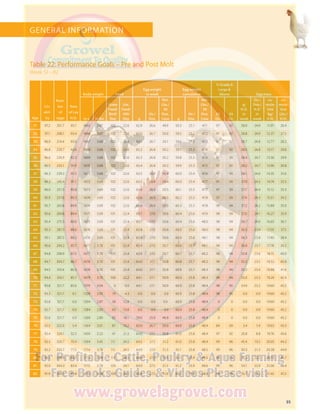

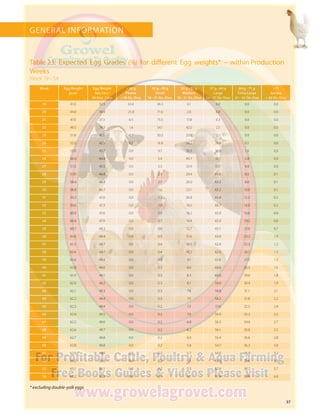
  • 13.
    11 Correct Use ofPre-Layer Feed Pre-layer feed should be used for a short period of time before a flock starts being supplied with Pre-Peak diet. This leads to a smooth transition from the devel- oper feed (low calcium and low nutrient density) to a diet with high calcium and nutrient levels. It helps to avoid the often reduced appetite/daily feed intake during early production. Typically, pre-layer feed con- tains about 2.0 – 2.5 % calcium. This is too much for a typical feed for rearing but not enough for a bird start- ing to produce eggs. From a nutritional point of view, it’s therefore considered a compromise and never as “optimal” feed. Nevertheless, it’s worthwhile to use pre-layer feed for a short period of time, and correct use can enhance the uniformity of a pullet flock, es- pecially for flocks with very low uniformity. It can also aid the development of Ca-metabolism in medullar bones. Since pre-layer feed does not meet the nutrient requirements of a layer in full production, it only should be used for a short period and only when timing and logistics permit. Please consider the following recommendations while using pre-layer feed: • Start using pre-layer feed depending on to the birds sexual maturity, age and their standard body weights. • Use pre-layer feed for about 10 days with a maxi- mum of 1 kg (2.2 lbs.) per bird. • The wrong way to use pre-layer feed is either to start using it too early and/or use it too long. Start feeding pre-layer feed two weeks before anti­ cipated onset of lay and change to layer feed before 5 % production. NUTRITION Table 4: Recommended Particle-Size Distribution for Chick Starter, Grower, Developer and Layer Feed (MASH) * IndividualParticlesnotbiggerthan •3 mminchicksuperstarter-/starterdiets •5 mmingrower,developerandlayer Sieve Size Passing Part Sieve Size Interval Part of Interval 0.5 mm 19 % 0 – 0.5 mm 19 % 1.0 mm 40 % 0.51 – 1.0 mm 21 % 1.5 mm 75 % 1.01 – 1.5 mm 35 % 2.0 mm 90 % 1.51 – 2.0 mm 15 % 2.5 mm 100 % > 2 mm 10 % * 100 %
  • 14.
    12 * The basisfor switching between diet types is the hens‘ body weight development. The correct time for changing the diet is determined not by age but by body weight. Chicks and pullets should therefore be weighed at regular intervals. ** 1 kcal = 4.187 kJ AgeinWeeks Body Weight Feed Consumption Feed* aver- age lbs. range in lbs. aver- age g range in g kJ **/ bird Day kJ/ bird cu- mul. kcal/ bird day kcal/ bird cu- mul. lbs./ 100/ day lbs. cu- mul. g/ bird/ day g/ bird/ cu- mul.  1 0.15 0.15 – 0.16 70 67 – 73 120  840  29  201 2  0.15 10  70 Grower/Starter  2 0.26 0.25 – 0.28 120 115 – 125 204 2268  49  542 4  0.42 17 189  3 0.41 0.39 – 0.42 185 178 – 192 276 4200  66 1003 5  0.77 23 350  4 0.56 0.54 – 0.58 255 245 – 265 331 6514  79 1556 6  1.20 28 546  5 0.74 0.71 – 0.77 334 321 – 347 388 9227  93 2204 7  1.71 33 776  6 0.94 0.90 – 0.97 425 408 – 442 433 12260 103 2928 8  2.28 37 1033  7 1.16 1.11 – 1.20 524 503 – 545 479 15611 114 3729 9  2.90 41 1317  8 1.36 1.31 – 1.42 618 593 – 643 524 19282 125 4605 10  3.59 44 1628  9 1.57 1.51 – 1.63 712 684 – 740 559 23192 133 5539 10  4.32 47 1960 Developer 10 1.77 1.70 – 1.84 802 770 – 834 593 27342 142 6530 11  5.10 50 2311 11 1.94 1.86 – 2.02 879 844 – 914 627 31731 150 7578 12  5.92 53 2683 12 2.09 2.01 – 2.17 948 910 – 986 661 36359 158 8684 12  6.78 56 3075 13 2.22 2.13 – 2.31 1008 968 – 1048 695 41227 166 9846 13  7.69 59 3488 14 2.34 2.25 – 2.43 1062 1020 – 1104 730 46334 174 11066 14  8.64 62 3921 15 2.45 2.35 – 2.55 1112 1068 – 1156 764 51681 182 12343 14  9.64 65 4374 16 2.55 2.45 – 2.65 1156 1110 – 1202 809 57347 193 13696 15 10.70 69 4854 17 2.65 2.55 – 2.76 1203 1155 – 1251 855 63332 204 15126 16 11.82 72 5361 Pre- Layer 18 2.76 2.65 – 2.87 1253 1203 – 1303 901 69636 215 16631 17 13.00 76 5895 19 2.89 2.77 – 3.00 1310 1258 – 1362 946 76259 226 18213 18 14.23 80 6457 Pre- Peak 20 3.02 2.90 – 3.14 1370 1315 – 1425 1003 83282 240 19891 19 15.55 85 7052 NUTRITION Table 5: Body Weight Development and Feed Consumption of Pullets/Layers
  • 15.
    13 NUTRITION AgeinWeeks Body Weight Averagegrams per bird on intermediate days average in g range in g 1 2 3 4 5 6  1 70 67 – 73  77  84  91  99 106 113  2 120 115 – 125 129 139 148 157 166 176  3 185 178 – 192 195 205 215 225 235 245  4 255 245 – 265 266 278 289 300 311 323  5 334 321 – 347 347 360 373 386 399 412  6 425 408 – 442 439 453 467 482 496 510  7 524 503 – 545 537 551 564 578 591 605  8 618 593 – 643 631 645 658 672 685 699  9 712 684 – 740 725 738 751 763 776 789 10 802 770 – 834 813 824 835 846 857 868 11 879 844 – 914 889 899 909 918 928 938 12 948 910 – 986 957 965 974 982 991 999 13 1008   968 – 1048 1016 1023 1031 1039 1047 1054 14 1062 1020 – 1104 1069 1076 1083 1091 1098 1105 15 1112 1068 – 1156 1118 1125 1131 1137 1143 1150 16 1156 1110 – 1202 1163 1169 1176 1183 1190 1196 17 1203 1155 – 1251 1210 1217 1224 1232 1239 1246 18 1253 1203 – 1303 1261 1269 1277 1286 1294 1302 19 1310 1258 – 1362 1319 1327 1336 1344 1353 1361 20 1370 1315 – 1425 1377 1384 1391 1399 1406 1413 Table 6: Body Weight Development at intermediate Stages of Pullets/Layers
  • 16.
    14 * The basisfor switching between diet types is the hens‘ body weight development. The correct time for changing the diet is determined not by age, but by body weight. Chicks and pullets, should therefore be weighed at regular intervals. ** Chick Starter should be fed until the standard body weight is reached or when daily feed intake is expected to be low. Diet type* Starter ** Grower Developer Pre-Layer Nutrient 1. – 3. Week 4. – 8. Week 9. – 16. Week 17.Week– 5  %Production Metabol. Energy kcal / kg 2900 2800 2800 2800 kcal / lbs 1315 1275 1275 1275 Minimum MJ / kg 12.00 11.70 11.70 11.70 Crude Protein % 20.00 18.50 15.00 17.00 Methionine %  0.48  0.40  0.34  0.36 Dig. Methionine %  0.39  0.33  0.28  0.29 Methionine/Cystine %  0.83  0.70  0.60  0.68 Digestible M./C. %  0.68  0.57  0.50  0.56 Lysine %  1.20  1.00  0.70  0.85 Digestible Lysine %  0.98  0.82  0.57  0.70 Valine %  0.89  0.75  0.53  0.64 Dig. Valine %  0.76  0.64  0.46  0.55 Tryptophan %  0.23  0.21  0.16  0.20 Dig. Tryptophan %  0.19  0.17  0.13  0.16 Threonine %  0.80  0.70  0.50  0.60 Dig. Threonine %  0.65  0.57  0.40  0.49 Isoleucine %  0.83  0.75  0.60  0.74 Dig. Isoleucine %  0.68  0.62  0.50  0.61 Calcium %  1.05  1.00  0.90  2.50 Phosphorus total %  0.75  0.70  0.58  0.65 Phosphorus available %  0.48  0.45  0.37  0.45 Sodium %  0.18  0.17  0.16  0.16 Chlorine %  0.20  0.19  0.16  0.16 Linoleic Acid %  2.00  1.40  1.00  1.00 NUTRITION Laying Period slightly modified depending on the production devel- opment of a flock. Nevertheless, it must be taken into consideration that hens with outstanding production require higher calcium and lower phosphorus levels based on their age, which is a key aspect when chang- ing phase feeds. Table 7: Recommendations for Nutrient Levels for Pullets After the onset of lay, phase feeding based on feed intake and egg mass output/day, is recommended. The applica-tion period of the different feed types in weeks can be
  • 17.
    15 NUTRITION All 5 recommendedphase feed types are based on an energy level of 11.7 MJ/kg/2800 kcal/kg (1270 –  1290 kcal/lbs) as well as 22 °C (72 °F) room tempera- ture and well established plumage conditions. Un- der these conditions, a daily feed intake of 95 – 105 g (20.9 –   * equals daily intake requirement of nutrient in g/hen or lbs. per 100 birds ** see table about relation of fine and coarse limestone *** without phytase Pre-Peak (~ 18 weeks to 50 % Production) Nutrient Daily Feed Consumption /Hen 90 g (19.8 lbs./100 birds) 95 g (20.9 lbs./100 birds) 100 g* (22.0 lbs./100 birds) 105 g (23.2 lbs./100 birds) Protein % 20.00 18.95 18.00 17.14 Calcium** %  4.22  4.00  3.80  3.62 Phosphorus*** %  0.71  0.68  0.64  0.61 Av. Phosphorus %  0.50  0.47  0.45  0.43 Sodium %  0.20  0.19  0.18  0.17 Chlorine %  0.20  0.19  0.18  0.17 Lysine %  0.93  0.89  0.84  0.80 Dig. Lysine %  0.77  0.73  0.69  0.66 Methionine %  0.46  0.44  0.41  0.39 Dig. Methionine %  0.38  0.36  0.34  0.32 Meth./Cyst. %  0.84  0.80  0.76  0.72 Dig. M/C %  0.69  0.65  0.62  0.59 Arginine %  0.96  0.91  0.87  0.82 Dig. Arginine %  0.79  0.75  0.71  0.68 Valine %  0.78  0.74  0.71  0.67 Dig. Valine %  0.67  0.63  0.60  0.57 Tryptophan %  0.20  0.19  0.18  0.17 Dig. Tryptophan %  0.17  0.16  0.15  0.14 Threonine %  0.65  0.62  0.59  0.56 Dig. Threonine %  0.53  0.51  0.48  0.46 Isoleucine %  0.75  0.71  0.67  0.64 Dig. Isoleucine %  0.61  0.58  0.55  0.52 Linoleic Acid %  2.44  2.32  2.20  2.10 23.1lbs./100/day) per hen can be expected. Table 8: Recommended Nutrient Levels for Layers for Different Daily Feed Consumptions
  • 18.
    16 NUTRITION (50 % Production to40 weeks ~ up to 59.4 g Egg Mass/Hen/Day) Nutrient Daily Feed Consumption /Hen 95 g (20.9 lbs./100 birds) 100 g* (22.0 lbs./100 birds) 105 g (23.2 lbs./100 birds) 110 g (24.3 lbs./100 birds) Protein % 18.57 17.64 16.80 16.04 Calcium** %  4.32  4.10  3.90 3.73 Phosphorus*** %  0.66  0.63  0.60 0.57 Av. Phosphorus %  0.46  0.44  0.42 0.40 Sodium %  0.19  0.18  0.17 0.16 Chlorine %  0.19  0.18  0.17 0.16 Lysine %  0.87  0.82  0.79 0.75 Dig. Lysine %  0.71  0.68  0.64 0.61 Methionine %  0.43  0.41  0.39 0.37 Dig. Methionine %  0.35  0.33  0.32 0.30 Meth./Cyst. %  0.78  0.74  0.71 0.67 Dig. M/C %  0.64  0.61  0.58 0.55 Arginine %  0.89  0.85  0.81 0.77 Dig. Arginine %  0.73  0.70  0.66 0.63 Valine %  0.73  0.69  0.66 0.63 Dig. Valine %  0.62  0.59  0.56 0.53 Tryptophan %  0.19  0.18  0.17 0.16 Dig. Tryptophan %  0.15  0.15  0.14 0.13 Threonine %  0.60  0.57  0.55 0.52 Dig. Threonine %  0.50  0.47  0.45 0.43 Isoleucine %  0.69  0.66  0.63 0.60 Dig. Isoleucine %  0.57  0.54  0.51 0.49 Linoleic Acid %  2.32  2.20  2.10 2.00 * equals daily intake requirement of nutrient in g/hen or lbs. per 100 birds ** see table about relation of fine and coarse limestone *** without phytase Table 9: Recommended Nutrient Levels for Layers in Phase 1 for Different Daily Feed Consumptions
  • 19.
    17 NUTRITION  (41 to 50weeks ~ up to 59.5 g Egg Mass/Hen/Day) Nutrient Daily Feed Consumption /Hen 95 g (20.9 lbs./100 birds) 100 g* (22.0 lbs./100 birds) 105 g (23.2 lbs./100 birds) 110 g (24.3 lbs./100 birds) Protein % 18.19 17.28 16.46 15.71 Calcium** %  4.42  4.20  4.00 3.82 Phosphorus*** %  0.65  0.62  0.59 0.56 Av. Phosphorus %  0.45  0.43  0.41 0.39 Sodium %  0.18  0.17  0.16 0.16 Chlorine %  0.18  0.17  0.16 0.16 Lysine %  0.85  0.81  0.77 0.73 Dig. Lysine %  0.70  0.66  0.63 0.60 Methionine %  0.42  0.40  0.38 0.36 Dig. Methionine %  0.34  0.33  0.31 0.30 Meth./Cyst. %  0.76  0.73  0.69 0.66 Dig. M/C %  0.63  0.60  0.57 0.54 Arginine %  0.87  0.83  0.79 0.76 Dig. Arginine %  0.72  0.68  0.65 0.62 Valine %  0.71  0.68  0.65 0.62 Dig. Valine %  0.61  0.58  0.55 0.52 Tryptophan %  0.18  0.18  0.17 0.16 Dig. Tryptophan %  0.15  0.14  0.14 0.13 Threonine %  0.59  0.56  0.54 0.51 Dig. Threonine %  0.49  0.46  0.44 0.42 Isoleucine %  0.68  0.64  0.61 0.59 Dig. Isoleucine %  0.56  0.53  0.50 0.48 Linoleic Acid %  1.68  1.60  1.52 1.45 * equals daily intake requirement of nutrient in g/hen or lbs. per 100 birds ** see table about relation of fine and coarse limestone *** without phytase Table 10: Recommended Nutrient Levels for Layers in Phase 2 for Different Daily Feed Consumptions
  • 20.
    18 NUTRITION (51 to 65weeks ~ up to 58.9 g Egg Mass/Hen/Day) Nutrient Daily Feed Consumption /Hen 95 g (20.9 lbs./100 birds) 100 g* (22.0 lbs./100 birds) 105 g (23.2 lbs./100 birds) 110 g (24.3 lbs./100 birds) Protein % 17.62 16.74 15.94 15.22 Calcium** %  4.53  4.30  4.10 3.91 Phosphorus*** %  0.63  0.60  0.57 0.54 Av. Phosphorus %  0.44  0.42  0.40 0.38 Sodium %  0.18  0.17  0.16 0.15 Chlorine %  0.18  0.17  0.16 0.15 Lysine %  0.82  0.78  0.75 0.71 Dig. Lysine %  0.68  0.64  0.61 0.58 Methionine %  0.41  0.39  0.37 0.35 Dig. Methionine %  0.33  0.32  0.30 0.29 Meth./Cyst. %  0.74  0.70  0.67 0.64 Dig. M/C %  0.61  0.58  0.55 0.52 Arginine %  0.85  0.81  0.77 0.73 Dig. Arginine %  0.70  0.66  0.63 0.60 Valine %  0.69  0.66  0.63 0.60 Dig. Valine %  0.59  0.56  0.53 0.51 Tryptophan %  0.18  0.17  0.16 0.15 Dig. Tryptophan %  0.15  0.14  0.13 0.13 Threonine %  0.57  0.54  0.52 0.49 Dig. Threonine %  0.47  0.45  0.43 0.41 Isoleucine %  0.66  0.62  0.59 0.57 Dig. Isoleucine %  0.54  0.51  0.49 0.47 Linoleic Acid %  1.47  1.40  1.33 1.27 * equals daily intake requirement of nutrient in g/hen or lbs. per 100 birds ** see table about relation of fine and coarse limestone *** without phytase Table 11: Recommended Nutrient Levels for Layers in Phase 3 for Different Daily Feed Consumptions
  • 21.
    19 NUTRITION (after week 65~ up to 56.3 g Egg Mass/Hen/Day) Nutrient Daily Feed Consumption /Hen 95 g (20.9 lbs./100 birds) 100 g* (22.0 lbs./100 birds) 105 g (23.2 lbs./100 birds) 110 g (24.3 lbs./100 birds) Protein % 17.05 16.20 15.43 14.73 Calcium ** %  4.74  4.50  4.29 4.09 Phosphorus *** %  0.61  0.58  0.55 0.53 Av. Phosphorus %  0.43  0.41  0.39 0.37 Sodium %  0.17  0.16  0.15 0.15 Chlorine %  0.17  0.16  0.15 0.15 Lysine %  0.80  0.76  0.72 0.69 Dig. Lysine %  0.65  0.62  0.59 0.56 Methionine %  0.39  0.37  0.36 0.34 Dig. Methionine %  0.32  0.31  0.29 0.28 Meth./Cyst. %  0.72  0.68  0.65 0.62 Dig. M/C %  0.59  0.56  0.53 0.51 Arginine %  0.82  0.78  0.74 0.71 Dig. Arginine %  0.67  0.64  0.61 0.58 Valine %  0.67  0.64  0.61 0.58 Dig. Valine %  0.57  0.54  0.51 0.49 Tryptophan %  0.17  0.16  0.16 0.15 Dig. Tryptophan %  0.14  0.14  0.13 0.12 Threonine %  0.55  0.53  0.50 0.48 Dig. Threonine %  0.45  0.43  0.41 0.39 Isoleucine %  0.64  0.60  0.57 0.55 Dig. Isoleucine %  0.52  0.50  0.47 0.45 Linoleic Acid %  1.26  1.20  1.14 1.09 * equals daily intake requirement of nutrient in g/hen or lbs. per 100 birds ** see table about relation of fine and coarse limestone *** without phytase Table 12: Recommended Nutrient Levels for Layers in Phase 4 for Different Daily Feed Consumptions
  • 22.
    20 NUTRITION Nutrition and EggWeight Within certain limits egg weight can be adapted to farm specific requirements by adjusting rations. The following nutritional factors should be noted: • Growing Feeding for higher body weight/frame size increas- es the egg weight throughout the whole laying pe- riod. • Feed composition – crude protein and methionine – linoleic acid • Feeding technique – feed texture – feeding time – feed level in troughs – controlled feeding – frequency of feeding By stimulating feed intake egg weight can be increased and can be limited by controlled feeding. Adjusting house temperature, when possible, can be used to af- fect feed consumption an egg weight. Supplements Supplements ensure the necessary supply of essential vitamins, trace elements and substances such as anti- oxidants or carotenoids. Suitable supplementation can compensate for the varying contents of raw materials and safeguard the supply of all necessary nutrients. Remark: Vitamin C is synthezised by poultry normally and is not considerd essential, however in some cir- cumstances, like heat stress or hot climate, it may be important/beneficial to add 100 – 200 mg/kg complete feed during production period.
  • 23.
    21 NUTRITION Supplements per kgFeed Starter/Grower Developer Pre-Layer/Layer Vitamin A I.U. 12000 12000 10000 Vitamin D3 I.U. 2000 2000 2500 Vitamin E mg 20 – 30** 20 – 30** 15 – 30** Vitamin K3 mg 3*** 3*** 3*** Vitamin B1 mg 1 1 1 Vitamin B2 mg 6 6 4 Vitamin B6 mg 3 3 3 Vitamin B12 mcg 20 20 25 Pantothenic Acid mg 8 8 10 Nicotinic Acid mg 30 30 30 Folic Acid mg 1.0 1.0 0.5 Biotin mcg 50 50 50 Choline mg 300 300 400 Antioxidant mg 100 –150** 100 –150** 100 –150** Coccidiostat as required as required – Manganese* mg 100 100 100 Zinc* mg 60 60 60 Iron mg 25 25 25 Copper* mg 5 5 5 Iodine mg 0.5 0.5 0.5 Selenium* mg 0.2 0.2 0.2 * So called “organic sources” should be considered with higher bioavailability. ** according to fat addition *** double in case of heat treated feed Table 13: Recommended Micro-Nutrient Specification Table 14: Continuous Supply of Fine and Coarse Limestone (Recommended Relation in Feed) Feed type Fine Limestone 0 – 0.5 mm Coarse Limestone * 1.5 – 3.5 mm Pre Peak / Layer Phase 1 30 % 70 % Layer Phase 2/3 25 % 75 % Layer Phase 4/5 15 % 85 % * can be partly replaced by oyster shells
  • 24.
    22 LIGHTING General The lighting programcontrols the onset of lay and affects the performance. Within certain limits, perfor- mance can be adapted to farm specific requirements by adjusting the lighting program. Easiest to follow are the lighting programs in closed houses without the effect of natural daylight. In these, the hours of light and light intensity can be adjusted to changing needs. Rearing birds in closed houses and producing eggs in light-tight houses enable the producers to maximize performance. Follow the lighting program which is recommended for this type of housing system. Closed houses are not feasible in every case. For open or brown-out houses, a tailormade program has to be developed depending on the season and geographi- cal location where pullets are being reared and stimu- lated to lay. In general, the lighting program should follow the ­basic principles: • Never increase hours of light during the rearing period. • Never decrease hours of light during the pro- duction period • Always keep in mind that artificial and natu- ral daylight can have an influence in open or brown-out houses. Intermittent Lighting Program for Day Old Chicks When the day old chicks arrive on the farm, they have already been intensively handled in the hatchery and often have a long transport to their final destination. Common practice is to give them 24 hours of light to help them recover in the first 2 or 3 days after arrival and to provide them enough time to eat and drink. In practice, it can be observed that after arrival and hous- ing, some chicks continue to sleep whereas others start to look for feed and water. The activity of the flock will always be irregular. Especially in this phase, poultry Lighting Program after Arrival This program can be used for up to 7 or 10 days after arrival, then switch to the regular step down lighting program. The use of the following lighting program brings about the following advantages: • The chicks will rest and/or sleep at the same time. This means that the behavior of the chicks will be synchronized. • Weak chicks will be stimulated by stronger ones to move as well as to eat and drink. • The behavior of the flock is more uniform and the monitoring of the birds is made easier. • Mortality will decrease. 2 h darkness 2 h darkness 2 h darkness 2 h darkness 4 h light 4 h light 4 h light 4 h light men have difficulties interpreting the chicks behavior and their condition. There is a practically proven principal in splitting the day into phases of resting and activity using a special designed intermittent lighting program. The aim is to synchronize the chicks’ activities. The farmer gets a better impression of the flocks condition and the birds are encouraged by the groups behavior to search for water and feed. Therefore, it is advises to give chicks a rest after they arrive at the rearing farm and then start with four hours of light followed by two hours of dark-ness.
  • 25.
    23 LIGHTING Lighting Program forClosed Houses To which extent lighting hours are reduced during the growing period, and the time when stimulation begins by increasing the lighting hours, are means by which performance can be adjusted to specific farm require- ments. The following Standard Lighting Program is ­designed for a quick start into production. Depending on the development of the pullets’ body weight, the program can be accompanied by con- trolled feeding between 10 – 15 weeks of age. * or run an Intermittent Lighting Program ** until the end of production Age (Weeks) Hours of Light Light Intensity (Lux) (Standard) Foot Candle Lux Day 1 – 2  * 24 2 – 4 20 – 40 Day 3 – 6 * 16 2 – 3 20 – 30  2 14 1 – 2 10 – 20  3 13 0.5 – 1 5 – 10  4 12 0.4 – 0.6 4 – 6  5 11 0.4 – 0.6 4 – 6  6 10 0.4 – 0.6 4 – 6  7 10 0.4 – 0.6 4 – 6  8 10 0.4 – 0.6 4 – 6  9 10 0.4 – 0.6 4 – 6 10 10 0.4 – 0.6 4 – 6 11 10 0.4 – 0.6 4 – 6 12 10 0.4 – 0.6 4 – 6 13 10 0.4 – 0.6 4 – 6 14 10 0.4 – 0.6 4 – 6 15 10 0.4 – 0.6 4 – 6 16 10 0.4 – 0.6 4 – 6 17 10 0.4 – 0.6 4 – 6 18 12 1 – 1.5 10 – 15 19 13 1 – 1.5 10 – 15 20 14 1 – 1.5 10 – 15 21 15 1 – 1.5 10 – 15 22 16 1 – 1.5 10 – 15 23 16 1 – 1.5 10 – 15 24 16 1 – 1.5 10 – 15 25 16 1 – 1.5 10 – 15 26 16 1 – 1.5 10 – 15 27 16 1 – 1.5 10 – 15 28 16 1 – 1.5 10 – 15 29 16 1 – 1.5 10 – 15    30** 16 1 – 1.5 10 – 15 Table 15: Lighting Program for Windowless Houses for Pullets/Layers
  • 26.
    24 LIGHTING Growing in ClosedHouse to Open House Production The lighting program for closed houses, the step down procedure and the subsequent constant day length between 7 – 10 weeks of age, have to be adjusted to the length of the day at the time when the birds have to be transferred to the layer house. This depends on the season and the latitude of where the farms are lo- cated. Birds hatched in the first days of December and placed at 40 N. Latitude, will be exposed to a nearly 13-hour length of day at 17 weeks of age. The step down program for such a flock should stop at 13 hours and guarantee a constant day length of 13 hours from week 3 until transfer. At week 19, the flock should be exposed to a 120-minutes increase in day length. A weekly in- crease of 60 minutes until the maximal day length of 16 hours is sufficient to induce stimulation. If the day length at the time of transfer is more than 14 hours per day, an increase of 30 minutes can be used to prolong the light stimulation period. Light intensity has to be adapted to natural daylight 2 – 3 weeks prior to transfer. Growing in Open House to Open House Production The lighting program and the step down procedure have to be adjusted to the longest length of day to which the birds are exposed to in the period from 3 to 17 weeks of age. Birds which are hatched in the first days of April and are reared at 20° N. Latitude, will be ex- posed to a 13-hour day length up to 17 weeks of age, maximum. This will determine the clock setting during rearing. At week 19, the flock should be exposed to a 120-minutes longer day length. A weekly increase of 30 minutes until the maximal length of day with 16 hours is sufficient for stimulation. Growing in Open House to Closed House Production For pullets which have been reared in open houses and then transferred to closed houses, please refer to the recommendations as stated in “Growing in Open House to Open House Production”.
  • 27.
    25 LIGHTING 2 4 68 10 12 14 16 18 20 22 24 26 28 30 32 34 36 38 40 42 44 46 48 50 52 54 56 58 60 62 64 66 68 70 5149 07050301 09 11 13 15 17 19 21 23 25 27 29 31 33 Week of Year Week of Age 35 37 39 41 43 45 47 49 51 01 03 05 07 09 11 13 24 23 22 21 20 19 18 17 16 15 14 13 12 11 10 9 8 7 6 5 4 3 2 1 0 Lighting Standard DaylightLighting-Program Twilight Adjusted Lighting Program for LSL-LITE Commercials Hatch Date: December 8th , Location: Modesto CA. Open House Rearing, Open House Production Stimulation/Transfer Age: 18 Weeks Lighting Program for Open Houses Adjusted Lighting Program for Open Houses Lighting Program for Dark Houses Extremes A very extreme situation will occur when the birds are reared during Spring and Summer at 50° N. Latitude in non-light tight houses. They will be exposed to a nearly 17-hour length of day in June. Good light stimu- lation for these flocks is almost impossible. Therefore, we generally recommend to rear layers in light-tight houses. Attention: Natural daylight and artificial lighting program during rearing and production have to be synchronized. Additional artificial lighting has to be adjusted to the seasonal fixed sunrise and sunset. Lighting Program for Open Houses An example of a lighting program for Layers adjusted to location,condition and requirements by lighting program tool
  • 28.
    26 LIGHTING Table 16: Hoursbetween sunrise and sunset in the Northern and Southern Hemisphere Northern Date 0° 10° 20° 30° 40° 50° Southern Date Hours Minutes Hours Minutes Hours Minutes Hours Minutes Hours Minutes Hours Minutes Jan 05 12 7 11 34 10 59 10 17  9 27  8 14 Jul 05 Jan 20 12 7 11 38 11  5 10 31  9 47  8 45 Jul 20 Feb 05 12 7 11 44 11 19 10 52 10 19  9 32 Aug 05 Feb 20 12 6 11 50 11 35 11 16 10 55 10 23 Aug 20 Mar 05 12 6 11 58 11 49 11 38 11 28 11 11 Sep 05 Mar 20 12 6 12 7 12 6 12 6 12 7 12  9 Sep 20 Apr 05 12 6 12 14 12 25 12 35 12 49 13  8 Oct 05 Apr 20 12 6 12 24 12 41 13 2 13 27 14  3 Oct 20 May 05 12 7 12 31 12 56 13 26 14 2 14 54 Nov 05 May 20 12 7 12 37 13 8 13 45 14 32 15 37 Nov 20 Jun 05 12 7 12 41 13 17 14  0 14 53 16  9 Dec 05 Jun 20 12 7 12 42 13 20 14  5 15 1 16 22 Dec 20 Jul 05 12 7 12 41 13 19 14  1 14 55 16 14 Jan 05 Jul 20 12 7 12 37 13 11 13 49 14 38 15 46 Jan 20 Aug 05 12 7 12 32 12 59 13 29 14 9 15 2 Feb 05 Aug 20 12 6 12 25 12 44 13  6 13 35 14 14 Feb 20 Sep 05 12 6 12 17 12 26 12 40 12 55 13 16 Mar 05 Sep 20 12 6 12  8 12 10 12 13 12 16 12 22 Mar 20 Oct 05 12 7 12  1 11 53 11 46 11 37 11 26 Apr 05 Oct 20 12 7 11 52 11 36 11 20 10 59 10 31 Apr 20 Nov 05 12 7 11 44 11 20 10 55 10 21  9 36 May 05 Nov 20 12 7 11 38 11 7 10 34  9 51  8 51 May 20 Dec 05 12 7 11 35 10 59 10 19  9 29  8 18 Jun 05 Dec 20 12 7 11 33 10 55 10 13  9 20  8  5 Jun 20
  • 29.
    27 Hygiene • Set upthe farm at a safe distance from other poul- try houses and fence in. • Keep birds of only one age group on the farm. • Keep no other poultry on the farm. • Allow no visitors to enter the farm. • Wear only the farm´s own protective clothing with- in the farm area. • Provide the farm´s own protective clothing for vet- erinarians, service and maintenance workers and consultants. • Disinfect boots before entering the houses. • Use bulk feed if possible. Do not allow the truck driver to enter the houses. • Safeguard the houses against wild birds and ver- min. Keep rats and mice under constant control. • Dispose of dead birds hygienically. Follow local laws and regulations. Daily Control Check at least once daily: • Health status • Temperature • Ventilation • Feed and water consumption • Lighting • Mortality When assessing the state of health, do not just go by the general impression and mortality rate, but also take note of feed and water consumption as well as the consistency of droppings. Water Supply Clean water is as equally important as good feed for top performance. Therefore fresh, clean, potable wa- ter must be available at all times for the layers and an ­adequate consumption must always be assured. A water meter is a very useful tool to monitor water consumption. The optimal water temperature is about 20 °C (68 °F). Furthermore feed and water intake are closely corre- lated. If birds don’t drink enough water for any reason, feed intake is consequently reduced. The water to feed ratio at comfortable temperature is around 1.8 – 2 : 1, but this relation increases up to 5 : 1 at high ambient temperatures above 30 °C (86 °F). During exposure to high temperatures, birds consume less feed, but more water in an effort to cool their body down. Check the water quality regularly, especially if you use your own water supply like well water. For example excessive salt levels in drinking water can cause persistent damage to shell quality and hard wa- ter with high TDS* levels may cause kidney damage. * TDS: Total Dissolved Solids Grit Feeding grit is not a must but is recommended when rations are supplemented by grains. This stimulates the development of the crop and the gizzard during the rearing period, which in turn has a positive effect on feed intake capacity. Table 17: Amount and Granulation of Grit Dependent on Age Week 1 – 2 once a week 1 g / bird (size 1 – 2 mm / 0.04 – 0.08 in) Week 3 – 8 once a week 2 g / bird (size 3 – 4 mm / 0.12 – 0.16 in) From week 9 once a month 3 g / bird (size 4 – 6 mm / 0.16 – 0.24 in) GENERAL RECOMMENDATIONS
  • 30.
    28 GENERAL RECOMMENDATIONS Egg Qualityand Egg Collection • Collect eggs at least once a day. • Store eggs at temperatures of 7 °C (45 °F) with a relative humidity between 80 – 85 %. Storing at higher temperatures and lower humidity leads to rapid loss of weight and impairs the quality of the egg white due to an increase in gas exchange. Nests (Non Cage Housing) The quality of nests is also a factor that affects egg quality. Renew the litter in litter-type nests regularly and keep them clean. Provide individual nests at a rate of one nest per 4 hens. Collect floor eggs frequently to keep their rate as low as possible. In addition to sufficient nesting space in family type nests, the following factors are important for a low rate of floor eggs: • Clean, dry litter or soft nest lining • Easy access • Even distribution of the nests within the barn • Only one type of nest in the barn For optimum egg quality, rollaway nests in combina- tion with slats are better than litter-type nests or family type nests. Litter (Non Cage Housing) Only use shavings from untreated wood in order to avoid poisoning and residues in the egg. Provide sufficient ventilation to ensure good litter con- dition and remove wet litter, if necessary. Table 18: Space Allowances and Equipment for Rearing Age Equipment Cage Rearing Floor Rearing 0 – 4 weeks 5 –17 weeeks 0 – 4 weeks 5 –17 weeks Chicks/Hover Floor Space 140 sq cm/bird 22 sq in /bird 285 sq cm/bird 44 sq in/bird 500 20 birds/sq m 0.5 sq ft/bird 10 birds/sq m 1 sq ft/bird Feeder Space trough (cm/bird) trough (in/bird) pan (birds/pan) 2.5 1 24 5 2 12 4 1.5 60 8 3 30 Water Space birds/cup birds/nipple birds/fountain trough (cm/bird) trough (in/bird) 16 16 50 (mini) 1.25 0.5 8 8 – 2.5 1 50 20 150 1.25 0.5 25 10 75 2.5 1 Space Requirements To preserve the quality, the following points should be observed:
  • 31.
    29 GENERAL RECOMMENDATIONS Floor SpaceFeeder Space Water Space Cage Area Light Controlled Floor Open Floor Trough/ Bird Birds/ Tube or Pan Birds/ Nipple or Cup Birds/ Fountain Trough/ Bird Recommended* 456 sq cm/bird 72 sq in/bird 8.5. birds/sq m 1.25 ft/bird 8.5 birds/sq m 1.25 sq ft/bird 10 cm 4 in 20 1.5 in 6 50 4 cm Minimum 350 sq cm/bird 54 sq in/bird 10 birds/sq m 1.0 sq ft/bird 10 birds/sq m 1.0 sq ft/bird 8 cm 3 in 25 8 8 75 2.5 cm 1.0 in * Follow the local laws and statutory regulations. Table 19: Space Recommendations and Equipment for Laying Birds which are kept on the floor during production, must also be reared on the floor. An important aspect of floor rearing is to develop im- munity against Coccidiosis. We recommend vaccina- tion as the most reliable method to achieve this goal. never use Coccidiostats in the feed when pullets are vaccinated. Stocking Density The optimal bird density depends on management conditions and to which extent climate can be con- trolled. 6 – 8 birds/m² can be taken as a general guide for barn systems.
  • 32.
    30 GENERAL INFORMATION Week 1 – 90 Agein Weeks Weight Range (g) lbs. gram 1 0.15 – 0.16 67  –  73 2 0.25 – 0.28 115  –  125 3 0.39 – 0.42 178  –  192 4 0.54 – 0.58 245  –  265 5 0.71 – 0.77 321  –  347 6 0.90 – 0.97 408  –  442 7 1.11 – 1.20 503  –  545 8 1.31 – 1.42 593  –  643 9 1.51 – 1.63 684  –  740 10 1.70 – 1.84 770  –  834 11 1.86 – 2.02 844  –  914 12 2.01 – 2.17 910  –  986 13 2.13 – 2.31   968  –  1048 14 2.25 – 2.43 1020  –  1104 15 2.35 – 2.55 1068  –  1156 16 2.45 – 2.65 1110  –  1202 17 2.55 – 2.76 1155  –  1251 18 2.65 – 2.87 1203  –  1303 19 2.77 – 3.00 1258  –  1362 20 2.90 – 3.14 1315  –  1425 21 3.01 – 3.26 1363  –  1477 22 3.10 – 3.36 1406  –  1524 23 3.19 – 3.45 1445  –  1565 24 3.26 – 3.53 1478  –  1602 25 3.32 – 3.60 1507  –  1633 26 3.38 – 3.66 1531  –  1659 27 3.42 – 3.70 1550  –  1680 28 3.44 – 3.73 1560  –  1690 29 3.45 – 3.74 1565  –  1695 30 3.45 – 3.74 1567  –  1697 Age in Weeks Weight Range (g) lbs. gram 32 3.46 – 3.75 1571 – 1701 34 3.47 – 3.76 1574 – 1706 36 3.48 – 3.77 1578 – 1710 38 3.49 – 3.78 1582 – 1714 40 3.50 – 3.79 1586 – 1718 42 3.51 – 3.81 1594 – 1726 44 3.52 – 3.81 1596 – 1728 46 3.52 – 3.82 1597 – 1731 48 3.53 – 3.82 1599 – 1733 50 3.53 – 3.82 1601 – 1735 52 3.50 – 3.80 1590 – 1722 54 3.51 – 3.80 1592 – 1724 56 3.53 – 3.83 1603 – 1737 58 3.54 – 3.83 1605 – 1739 60 3.54 – 3.84 1607 – 1740 62 3.54 – 3.84 1608 – 1741 64 3.55 – 3.84 1608 – 1743 66 3.55 – 3.84 1609 – 1744 68 3.55 – 3.85 1610 – 1745 70 3.55 – 3.85 1611 – 1746 72 3.55 – 3.85 1612 – 1747 74 3.56 – 3.85 1613 – 1748 76 3.56 – 3.86 1614 – 1749 78 3.56 – 3.86 1615 – 1750 80 3.56 – 3.86 1616 – 1751 82 3.57 – 3.86 1618 – 1752 84 3.57 – 3.87 1619 – 1753 86 3.57 – 3.87 1620 – 1754 88 3.57 – 3.87 1620 – 1756 90 3.57 – 3.87 1621 – 1757 Table 20: Body Weight Development of Layers
  • 33.
  • 34.
    32 Age Liv- abil- ity Num- ber of eggs Rate of Lay H.D. Body weightFeed Egg weight in week Egg weight cumulative % Grade A Large Above Egg mass in g in lbs. Gram Feed/ Bird/ Day Lbs. Feed/ 100/ Day g Oz./ Doz. Net. Lbs./ 30 Doz. Case g Oz./ Doz. Net. Lbs./ 30 Doz. Case 23 Oz. 24 Oz. g/ H.D. in week Oz./ Doz./ H.D. in week cu- mula- tive kg/ H.H. cu- mula- tive Lbs./ H.H. 19 100.0   0.7 10.0 1310 2.89  80 17.7 41.0 17.4 32.5 41.0 17.4 32.5  0  0  4.1  1.7 0.03 0.1 20 100.0   3.2 35.0 1370 3.02  85 18.7 44.0 18.6 34.9 43.3 18.3 34.4  0  0 15.4  6.5 0.14 0.3 21  99.9   7.0 55.1 1420 3.13  92 20.2 47.0 19.9 37.3 45.4 19.2 36.0  2  0 25.9 11.0 0.32 0.7 22  99.9  12.1 73.1 1465 3.23  97 21.3 49.5 21.0 39.3 47.1 19.9 37.4  9  3 36.2 15.3 0.57 1.3 23  99.8  17.9 83.2 1505 3.32 100 21.9 51.8 21.9 41.1 48.6 20.6 38.6 27 12 43.1 18.2 0.87 1.9 24  99.8  24.2 89.2 1540 3.40 101 22.4 53.5 22.6 42.5 49.9 21.1 39.6 44 25 47.7 20.2 1.20 2.7 25  99.7  30.6 92.3 1570 3.46 103 22.8 55.0 23.3 43.7 51.0 21.6 40.4 58 38 50.8 21.5 1.56 3.4 26  99.7  37.1 93.8 1595 3.52 103 22.8 56.4 23.9 44.8 51.9 22.0 41.2 69 49 52.9 22.4 1.93 4.3 27  99.6  43.7 94.6 1615 3.56 104 23.0 57.3 24.3 45.5 52.7 22.3 41.8 76 57 54.2 23.0 2.31 5.1 28  99.6  50.4 95.2 1625 3.58 104 23.0 57.9 24.5 46.0 53.4 22.6 42.4 79 63 55.1 23.3 2.69 5.9 29  99.5  57.0 95.5 1630 3.59 104 23.0 58.4 24.7 46.3 54.0 22.9 42.9 83 67 55.8 23.6 3.08 6.8 30  99.4  63.7 95.7 1632 3.60 104 23.0 58.8 24.9 46.7 54.5 23.1 43.3 85 70 56.3 23.8 3.47 7.6 31  99.3  70.3 95.9 1634 3.60 104 23.0 59.2 25.1 47.0 54.9 23.3 43.6 87 74 56.8 24.0 3.86 8.5 32  99.2  77.0 96.0 1636 3.61 104 23.0 59.6 25.2 47.3 55.3 23.4 43.9 89 77 57.2 24.2 4.26 9.4 33  99.1  83.7 96.2 1638 3.61 104 23.0 60.0 25.4 47.6 55.7 23.6 44.2 90 79 57.7 24.4 4.66 10.3 34  99.0  90.3 96.3 1640 3.62 104 23.0 60.4 25.6 47.9 56.1 23.7 44.5 92 82 58.1 24.6 5.07 11.2 35  98.9  97.0 96.3 1642 3.62 104 23.0 60.7 25.7 48.2 56.4 23.9 44.7 92 83 58.5 24.7 5.47 12.1 36  98.8 103.7 96.3 1644 3.62 104 23.0 61.0 25.8 48.4 56.7 24.0 45.0 93 84 58.7 24.9 5.88 13.0 37  98.7 110.3 96.3 1646 3.63 104 23.0 61.3 25.9 48.7 57.0 24.1 45.2 94 85 59.0 25.0 6.28 13.9 38 98.6 117.0 96.2 1648 3.63 103 22.8 61.4 26.0 48.7 57.2 24.2 45.4 94 87 59.1 25.0 6.69 14.8 39 98.5 123.6 96.2 1650 3.64 103 22.8 61.6 26.1 48.9 57.4 24.3 45.6 95 87 59.3 25.1 7.10 15.7 40 98.4 130.2 96.1 1652 3.64 103 22.8 61.8 26.2 49.0 57.7 24.4 45.8 95 88 59.4 25.1 7.51 16.6 41 98.3 136.8 96.0 1654 3.65 103 22.8 61.9 26.2 49.1 57.9 24.5 45.9 95 88 59.4 25.1 7.92 17.5 42 98.2 143.4 95.9 1656 3.65 103 22.8 62.0 26.2 49.2 58.1 24.6 46.1 95 88 59.4 25.2 8.33 18.4 43 98.1 150.0 95.8 1657 3.65 103 22.8 62.1 26.3 49.3 58.2 24.7 46.2 95 89 59.5 25.2 8.74 19.3 44 98.0 156.5 95.6 1658 3.66 103 22.8 62.2 26.3 49.4 58.4 24.7 46.4 96 89 59.4 25.2 9.14 20.2 45 97.9 163.1 95.4 1659 3.66 103 22.8 62.3 26.4 49.4 58.6 24.8 46.5 96 89 59.4 25.1 9.55 21.1 46 97.8 169.6 95.1 1660 3.66 103 22.8 62.4 26.4 49.5 58.7 24.8 46.6 96 90 59.4 25.1 9.96 21.9 47 97.7 176.1 94.8 1661 3.66 103 22.8 62.5 26.5 49.6 58.8 24.9 46.7 96 91 59.3 25.1 10.36 22.8 48 97.6 182.5 94.5 1662 3.66 103 22.8 62.6 26.5 49.7 59.0 25.0 46.8 96 91 59.2 25.0 10.77 23.7 49 97.5 189.0 94.2 1663 3.67 102 22.6 62.7 26.5 49.8 59.1 25.0 46.9 97 91 59.1 25.0 11.17 24.6 50 97.4 195.4 93.9 1664 3.67 102 22.6 62.8 26.6 49.8 59.2 25.1 47.0 97 91 59.0 25.0 11.57 25.5 51 97.2 201.7 93.7 1665 3.67 102 22.6 62.9 26.6 49.9 59.3 25.1 47.1 97 92 58.9 24.9 11.97 26.4 52 97.1 208.1 93.4 1666 3.67 102 22.6 63.0 26.7 50.0 59.5 25.2 47.2 97 92 58.8 24.9 12.37 27.3 53 96.9 214.4 93.0 1667 3.68 102 22.6 63.1 26.7 50.1 59.6 25.2 47.3 97 92 58.7 24.8 12.77 28.2 54 96.8 220.7 92.7 1668 3.68 102 22.6 63.2 26.8 50.2 59.7 25.3 47.4 97 92 58.6 24.8 13.17 29.0 Week 19 – 54 GENERAL INFORMATION Table 21: Performance Goals – One Cycle
  • 35.
    33 GENERAL INFORMATION Age Liv- abil- ity Num- ber of eggs Rate of Lay H.D. Bodyweight Feed Egg weight in week Egg weight cumulative % Grade A Large Above Egg mass in g in lbs. Gram Feed/ Bird/ Day Lbs. Feed/ 100/ Day g Oz./ Doz. Net. Lbs./ 30 Doz. Case g Oz./ Doz. Net. Lbs./ 30 Doz. Case 23 Oz. 24 Oz. g/ H.D. in week Oz./ Doz./ H.D. in week cu- mula- tive kg/ H.H. cu- mula- tive Lbs./ H.H. 55 96.6 226.9 92.3 1669 3.68 102 22.6 63.3 26.8 50.2 59.8 25.3 47.4 97 93 58.4 24.7 13.56 29.9 56 96.5 233.1 91.9 1670 3.68 102 22.6 63.4 26.8 50.3 59.9 25.3 47.5 97 93 58.3 24.7 13.96 30.8 57 96.3 239.3 91.5 1671 3.68 102 22.6 63.5 26.9 50.4 60.0 25.4 47.6 97 93 58.1 24.6 14.35 31.6 58 96.2 245.4 91.2 1672 3.69 102 22.6 63.5 26.9 50.4 60.0 25.4 47.7 97 93 57.9 24.5 14.74 32.5 59 96.0 251.5 90.8 1673 3.69 102 22.6 63.6 26.9 50.5 60.1 25.5 47.7 97 93 57.7 24.4 15.12 33.3 60 95.9 257.6 90.3 1674 3.69 102 22.6 63.6 26.9 50.5 60.2 25.5 47.8 97 93 57.5 24.3 15.51 34.2 61 95.7 263.6 89.9 1674 3.69 102 22.6 63.6 26.9 50.5 60.3 25.5 47.8 98 94 57.2 24.2 15.89 35.0 62 95.6 269.6 89.5 1675 3.69 101 22.4 63.7 27.0 50.6 60.4 25.6 47.9 98 94 57.0 24.1 16.27 35.9 63 95.4 275.5 89.0 1675 3.69 101 22.4 63.7 27.0 50.6 60.4 25.6 48.0 98 94 56.7 24.0 16.65 36.7 64 95.3 281.5 88.6 1676 3.69 101 22.4 63.8 27.0 50.6 60.5 25.6 48.0 98 94 56.5 23.9 17.03 37.5 65 95.1 287.3 88.2 1676 3.69 101 22.4 63.8 27.0 50.6 60.6 25.6 48.1 98 94 56.3 23.8 17.40 38.4 66 95.0 293.2 87.7 1677 3.70 101 22.4 63.9 27.0 50.7 60.6 25.7 48.1 98 94 56.1 23.7 17.78 39.2 67 94.8 298.9 87.3 1677 3.70 101 22.4 63.9 27.0 50.7 60.7 25.7 48.2 98 94 55.8 23.6 18.15 40.0 68 94.7 304.7 86.8 1678 3.70 101 22.4 64.0 27.1 50.8 60.8 25.7 48.2 98 94 55.5 23.5 18.52 40.8 69 94.5 310.4 86.3 1678 3.70 101 22.4 64.0 27.1 50.8 60.8 25.7 48.3 98 94 55.2 23.4 18.88 41.6 70 94.4 316.1 85.8 1679 3.70 100 22.2 64.1 27.1 50.9 60.9 25.8 48.3 98 94 55.0 23.3 19.24 42.4 71 94.2 321.7 85.2 1679 3.70 100 22.2 64.1 27.1 50.9 60.9 25.8 48.4 98 95 54.6 23.1 19.60 43.2 72 94.1 327.3 84.7 1680 3.70 100 22.2 64.2 27.2 51.0 61.0 25.8 48.4 98 95 54.4 23.0 19.96 44.0 73 93.9 332.8 84.2 1680 3.70 100 22.2 64.2 27.2 51.0 61.0 25.8 48.5 98 95 54.0 22.9 20.32 44.8 74 93.8 338.3 83.7 1681 3.70 100 22.2 64.3 27.2 51.0 61.1 25.9 48.5 98 95 53.8 22.8 20.67 45.6 75 93.6 343.7 83.1 1681 3.71 100 22.2 64.3 27.2 51.0 61.2 25.9 48.5 98 95 53.4 22.6 21.02 46.3 76 93.5 349.1 82.6 1682 3.71 100 22.2 64.4 27.3 51.1 61.2 25.9 48.6 98 95 53.2 22.5 21.37 47.1 77 93.3 354.5 81.9 1682 3.71 100 22.2 64.4 27.3 51.1 61.3 25.9 48.6 98 95 52.8 22.3 21.71 47.9 78 93.2 359.8 81.3 1683 3.71 100 22.2 64.5 27.3 51.2 61.3 25.9 48.7 98 95 52.4 22.2 22.06 48.6 79 93.0 365.0 80.6 1683 3.71 100 22.2 64.5 27.3 51.2 61.3 26.0 48.7 99 96 52.0 22.0 22.39 49.4 80 92.9 370.2 80.0 1684 3.71 100 22.2 64.6 27.3 51.3 61.4 26.0 48.7 99 96 51.7 21.9 22.73 50.1 81 92.7 375.4 79.3 1684 3.71 100 22.2 64.6 27.3 51.3 61.4 26.0 48.8 99 96 51.3 21.7 23.06 50.8 82 92.6 380.5 78.7 1685 3.71 100 22.2 64.6 27.3 51.3 61.5 26.0 48.8 99 96 50.8 21.5 23.39 51.6 83 92.4 385.5 78.0 1685 3.71 100 22.2 64.6 27.3 51.3 61.5 26.0 48.8 99 96 50.4 21.3 23.72 52.3 84 92.3 390.5 77.3 1686 3.72 100 22.2 64.6 27.3 51.3 61.6 26.1 48.9 99 96 49.9 21.1 24.04 53.0 85 92.1 395.5 76.5 1686 3.72 100 22.2 64.6 27.3 51.3 61.6 26.1 48.9 99 96 49.4 20.9 24.36 53.7 86 92.0 400.3 75.8 1687 3.72 100 22.2 64.7 27.4 51.3 61.6 26.1 48.9 99 96 49.0 20.8 24.67 54.4 87 91.8 405.2 75.1 1687 3.72 100 22.2 64.7 27.4 51.3 61.7 26.1 48.9 99 96 48.6 20.6 24.99 55.1 88 91.6 409.9 74.3 1688 3.72 100 22.2 64.7 27.4 51.3 61.7 26.1 49.0 99 96 48.1 20.3 25.29 55.8 89 91.5 414.6 73.4 1688 3.72 100 22.2 64.7 27.4 51.3 61.7 26.1 49.0 99 96 47.5 20.1 25.60 56.4 90 91.3 419.3 72.6 1689 3.72 100 22.2 64.7 27.4 51.3 61.8 26.1 49.0 99 96 47.0 19.9 25.90 57.1 Week 55 – 90 Table 21: Performance Goals – One Cycle
  • 36.
    34 GENERAL INFORMATION Age Liv- abil- ity Num- ber of eggs Rate of Lay H.D. Bodyweight Feed Egg weight in week Egg weight cumulative % Grade A Large Above Egg mass in g in lbs. Gram Feed/ Bird/ Day Lbs. Feed/ 100/ Day g Oz./ Doz. Net. Lbs./ 30 Doz. Case g Oz./ Doz. Net. Lbs./ 30 Doz. Case 23 Oz. 24 Oz. g/ H.D. in week Oz./ Doz./ H.D. in week cu- mula- tive kg/ H.H. cu- mula- tive Lbs./ H.H. 19 100.0   0.7 10.0 1310 2.89 80 17.7 41.0 17.4 32.5 41.0 17.4 32.5  0  0  4.1  1.7 0.03  0.1 20 100.0   3.2 35.0 1370 3.02 85 18.7 44.0 18.6 34.9 43.3 18.3 34.4  0  0 15.4  6.5 0.14  0.3 21  99.9   7.0 55.1 1420 3.13 92 20.2 47.0 19.9 37.3 45.4 19.2 36.0  2  0 25.9 11.0 0.32  0.7 22  99.9  12.1 73.1 1465 3.23 97 21.3 49.5 21.0 39.3 47.1 19.9 37.4  9  3 36.2 15.3 0.57  1.3 23  99.8  17.9 83.2 1505 3.32 100 21.9 51.8 21.9 41.1 48.6 20.6 38.6 27 12 43.1 18.2 0.87  1.9 24  99.8  24.2 89.2 1540 3.40 101 22.4 53.5 22.6 42.5 49.9 21.1 39.6 44 25 47.7 20.2 1.20  2.7 25  99.7  30.6 92.3 1570 3.46 103 22.8 55.0 23.3 43.7 51.0 21.6 40.4 58 38 50.8 21.5 1.56  3.4 26  99.7  37.1 93.8 1595 3.52 103 22.8 56.4 23.9 44.8 51.9 22.0 41.2 69 49 52.9 22.4 1.93  4.3 27  99.6  43.7 94.6 1615 3.56 104 23.0 57.3 24.3 45.5 52.7 22.3 41.8 76 57 54.2 23.0 2.31  5.1 28  99.6  50.4 95.1 1625 3.58 104 23.0 57.9 24.5 46.0 53.4 22.6 42.4 79 63 55.1 23.3 2.69  5.9 29  99.5  57.0 95.5 1630 3.59 104 23.0 58.4 24.7 46.3 54.0 22.9 42.9 83 67 55.8 23.6 3.08  6.8 30  99.4  63.7 95.7 1632 3.60 104 23.0 58.8 24.9 46.7 54.5 23.1 43.3 85 70 56.3 23.8 3.47  7.6 31  99.3  70.3 95.9 1634 3.60 104 23.0 59.2 25.1 47.0 54.9 23.3 43.6 87 74 56.8 24.0 3.86  8.5 32  99.2  77.0 96.0 1636 3.61 104 23.0 59.6 25.2 47.3 55.3 23.4 43.9 89 77 57.2 24.2 4.26  9.4 33  99.1  83.7 96.2 1638 3.61 104 23.0 60.0 25.4 47.6 55.7 23.6 44.2 90 79 57.7 24.4 4.66 10.3 34  99.0  90.3 96.3 1640 3.62 104 23.0 60.4 25.6 47.9 56.1 23.7 44.5 92 82 58.1 24.6 5.07 11.2 35  98.9  97.0 96.3 1642 3.62 104 23.0 60.7 25.7 48.2 56.4 23.9 44.7 92 83 58.5 24.7 5.47 12.1 36  98.8 103.7 96.3 1644 3.62 104 23.0 61.0 25.8 48.4 56.7 24.0 45.0 93 84 58.7 24.9 5.88 13.0 37  98.7 110.3 96.3 1646 3.63 104 23.0 61.3 25.9 48.7 57.0 24.1 45.2 94 85 59.0 25.0 6.28 13.9 38  98.6 117.0 96.2 1648 3.63 103 22.8 61.4 26.0 48.7 57.2 24.2 45.4 94 87 59.1 25.0 6.69 14.8 39  98.5 123.6 96.2 1650 3.64 103 22.8 61.6 26.1 48.9 57.4 24.3 45.6 95 87 59.3 25.1 7.10 15.7 40  98.4 130.2 96.1 1652 3.64 103 22.8 61.8 26.2 49.0 57.7 24.4 45.8 95 88 59.4 25.1 7.51 16.6 41  98.3 136.8 96.0 1654 3.65 103 22.8 61.9 26.2 49.1 57.9 24.5 45.9 95 88 59.4 25.1 7.92 17.5 42  98.2 143.4 95.9 1656 3.65 103 22.8 62.0 26.2 49.2 58.1 24.6 46.1 95 88 59.4 25.2 8.33 18.4 43  98.1 150.0 95.8 1657 3.65 103 22.8 62.1 26.3 49.3 58.2 24.7 46.2 95 89 59.5 25.2 8.74 19.3 44  98.0 156.5 95.6 1658 3.66 103 22.8 62.2 26.3 49.4 58.4 24.7 46.4 96 89 59.4 25.2 9.14 20.2 45  97.9 163.1 95.4 1659 3.66 103 22.8 62.3 26.4 49.4 58.6 24.8 46.5 96 89 59.4 25.1 9.55 21.1 46  97.8 169.6 95.1 1660 3.66 103 22.8 62.4 26.4 49.5 58.7 24.8 46.6 96 90 59.4 25.1 9.96 21.9 47  97.7 176.1 94.8 1661 3.66 103 22.8 62.5 26.5 49.6 58.8 24.9 46.7 96 91 59.3 25.1 10.36 22.8 48  97.6 182.5 94.5 1662 3.66 103 22.8 62.6 26.5 49.7 59.0 25.0 46.8 96 91 59.2 25.0 10.77 23.7 49  97.5 189.0 94.2 1663 3.67 102 22.6 62.7 26.5 49.8 59.1 25.0 46.9 97 91 59.1 25.0 11.17 24.6 50  97.4 195.4 93.9 1664 3.67 102 22.6 62.8 26.6 49.8 59.2 25.1 47.0 97 91 59.0 25.0 11.57 25.5 Week 19 – 50 Table 22: Performance Goals – Pre and Post Molt
  • 37.
    35 GENERAL INFORMATION Age Liv- abil- ity Num- ber of eggs Rate of Lay H.D. Bodyweight Feed Egg weight in week Egg weight cumulative % Grade A Large Above Egg mass in g in lbs. Gram Feed/ Bird/ Day Lbs. Feed/ 100/ Day g Oz./ Doz. Net. Lbs./ 30 Doz. Case g Oz./ Doz. Net. Lbs./ 30 Doz. Case 23 Oz. 24 Oz. g/ H.D. in week Oz./ Doz./ H.D. in week cu- mula- tive kg/ H.H. cu- mula- tive Lbs./ H.H. 51 97.2 201.7 93.7 1665 3.67 102 22.6 62.9 26.6 49.9 59.3 25.1 47.1 97 92 58.9 24.9 11.97 26.4 52 97.1 208.1 93.4 1666 3.67 102 22.6 63.0 26.7 50.0 59.5 25.2 47.2 97 92 58.8 24.9 12.37 27.3 53 96.9 214.4 93.0 1667 3.68 102 22.6 63.1 26.7 50.1 59.6 25.2 47.3 97 92 58.7 24.8 12.77 28.2 54 96.8 220.7 92.6 1668 3.68 102 22.6 63.2 26.8 50.2 59.7 25.3 47.4 97 92 58.5 24.8 13.17 29.0 55 96.6 226.9 92.3 1669 3.68 102 22.6 63.3 26.8 50.2 59.8 25.3 47.4 97 93 58.4 24.7 13.56 29.9 56 96.5 233.1 91.9 1670 3.68 102 22.6 63.4 26.8 50.3 59.9 25.3 47.5 97 93 58.2 24.7 13.96 30.8 57 96.3 239.3 91.5 1671 3.68 102 22.6 63.5 26.9 50.4 60.0 25.4 47.6 97 93 58.1 24.6 14.35 31.6 58 96.2 245.4 91.1 1672 3.69 102 22.6 63.5 26.9 50.4 60.0 25.4 47.7 97 93 57.9 24.5 14.74 32.5 59 96.0 251.5 90.8 1673 3.69 102 22.6 63.6 26.9 50.5 60.1 25.5 47.7 97 93 57.7 24.4 15.12 33.3 60 95.9 257.6 90.3 1674 3.69 102 22.6 63.6 26.9 50.5 60.2 25.5 47.8 97 93 57.4 24.3 15.51 34.2 61 95.7 263.6 89.9 1674 3.69 102 22.6 63.6 26.9 50.5 60.3 25.5 47.8 98 94 57.2 24.2 15.89 35.0 62 95.6 269.6 89.4 1675 3.69 101 22.4 63.7 27.0 50.6 60.4 25.6 47.9 98 94 57.0 24.1 16.27 35.9 63 95.4 275.5 89.0 1675 3.69 101 22.4 63.7 27.0 50.6 60.4 25.6 48.0 98 94 56.7 24.0 16.65 36.7 64 95.3 281.5 88.6 1676 3.69 101 22.4 63.8 27.0 50.6 60.5 25.6 48.0 98 94 56.5 23.9 17.03 37.5 65 95.1 287.3 88.2 1676 3.69 101 22.4 63.8 27.0 50.6 60.6 25.6 48.1 98 94 56.3 23.8 17.40 38.4 66 95.0 293.2 87.7 1677 3.70 101 22.4 63.9 27.0 50.7 60.6 25.7 48.1 98 94 56.0 23.7 17.78 39.2 67 94.8 298.9 87.3 1677 3.70 101 22.4 63.9 27.0 50.7 60.7 25.7 48.2 98 94 55.8 23.6 18.15 40.0 68 94.7 304.7 86.7 1678 3.70 101 22.4 64.0 27.1 50.8 60.8 25.7 48.2 98 94 55.5 23.5 18.52 40.8 69 94.5 310.4 86.3 1678 3.70 101 22.4 64.0 27.1 50.8 60.8 25.7 48.3 98 94 55.2 23.4 18.88 41.6 70 94.4 316.1 85.7 1679 3.70 100 22.2 64.1 27.1 50.9 60.9 25.8 48.3 98 94 55.0 23.3 19.24 42.4 71 93.8 321.7 85.6 1379 3.04   0  0.0 64.1 27.1 50.9 60.9 25.8 48.4 98 95 54.9 23.2 19.60 43.2 72 93.3 321.7  0.1 1329 2.93  19  4.3  0.0  0.0  0.0 60.9 25.8 48.4 98 95  0.0  0.0 19.60 43.2 73 92.8 321.7  0.0 1304 2.87  58 12.8  0.0  0.0 0.0 60.9 25.8 48.4  0  0  0.0  0.0 19.60 43.2 74 92.7 321.7  0.0 1284 2.83  63 13.8  0.0  0.0  0.0 60.9 25.8 48.4  0  0  0.0  0.0 19.60 43.2 75 92.6 321.7  0.0 1269 2.80  82 18.1 59.0 25.0 46.8 60.9 25.8 48.4  0  0  0.0  0.0 19.60 43.2 76 92.5 322.0  5.4 1364 3.01  87 19.2 63.0 26.7 50.0 60.9 25.8 48.4 84 69  3.4  1.4 19.63 43.3 77 92.4 324.1 32.5 1459 3.22  97 21.3 64.0 27.1 50.8 61.0 25.8 48.4 97 92 20.8  8.8 19.76 43.6 78 92.3 328.7 70.4 1564 3.45 111 24.5 64.5 27.3 51.2 61.0 25.8 48.4 99 96 45.4 19.2 20.05 44.2 79 92.2 333.7 77.5 1714 3.78 111 24.5 64.9 27.5 51.5 61.1 25.8 48.5 99 96 50.3 21.3 20.38 44.9 80 92.1 338.9 80.7 1714 3.78 111 24.5 64.9 27.5 51.5 61.1 25.9 48.5 99 96 52.3 22.1 20.72 45.7 81 92.0 344.3 83.4 1715 3.78 109 24.1 64.9 27.5 51.5 61.2 25.9 48.6 99 96 54.1 22.9 21.06 46.4 82 91.9 349.7 84.8 1715 3.78 109 24.1 65.0 27.5 51.6 61.2 25.9 48.6 99 96 55.1 23.3 21.42 47.2 Week 51 – 82 Table 22: Performance Goals – Pre and Post Molt
  • 38.
    36 GENERAL INFORMATION     Age Liv- abil- ity Num- ber of eggs Rate of Lay H.D. Bodyweight Feed Egg weight in week Egg weight cumulative % Grade A Large Above Egg mass in g in lbs. Gram Feed/ Bird/ Day Lbs. Feed/ 100/ Day g Oz./ Doz. Net. Lbs./ 30 Doz. Case g Oz./ Doz. Net. Lbs./ 30 Doz. Case 23 Oz. 24 Oz. g/ H.D. in week Oz./ Doz./ H.D. in week cu- mula- tive kg/ H.H. cu- mula- tive Lbs./ H.H. 83 91.8 355.2 85.4 1716 3.78 109 24.1 65.0 27.5 51.6 61.3 25.9 48.7 99 96 55.5 23.5 21.77 48.0 84 91.7 360.7 85.8 1716 3.78 107 23.6 65.0 27.5 51.6 61.4 26.0 48.7 99 96 55.7 23.6 22.13 48.8 85 91.5 366.2 85.8 1717 3.78 107 23.6 65.0 27.5 51.6 61.4 26.0 48.7 99 96 55.7 23.6 22.49 49.6 86 91.4 371.7 85.5 1717 3.78 105 23.2 65.1 27.5 51.6 61.5 26.0 48.8 99 96 55.6 23.5 22.85 50.4 87 91.2 377.1 85.2 1718 3.79 105 23.2 65.1 27.5 51.6 61.5 26.0 48.8 99 96 55.4 23.5 23.20 51.1 88 91.1 382.5 84.7 1718 3.79 103 22.8 65.1 27.5 51.6 61.6 26.1 48.9 99 96 55.1 23.3 23.55 51.9 89 90.9 387.9 84.2 1719 3.79 103 22.8 65.1 27.5 51.6 61.6 26.1 48.9 99 96 54.8 23.2 23.90 52.7 90 90.8 393.2 83.5 1719 3.79 101 22.4 65.1 27.5 51.6 61.7 26.1 48.9 99 96 54.3 23.0 24.24 53.4 91 90.6 398.4 82.8 1720 3.79 101 22.4 65.1 27.5 51.6 61.7 26.1 49.0 99 96 53.9 22.8 24.59 54.2 92 90.4 403.6 82.1 1720 3.79 101 22.4 65.1 27.5 51.6 61.7 26.1 49.0 99 96 53.4 22.6 24.92 54.9 93 90.3 408.8 81.4 1721 3.79 101 22.4 65.1 27.5 51.6 61.8 26.2 49.0 99 96 53.0 22.4 25.26 55.7 94 90.1 413.9 80.6 1721 3.79 101 22.4 65.1 27.5 51.6 61.8 26.2 49.1 99 96 52.5 22.2 25.59 56.4 95 90.0 418.9 79.9 1722 3.80 101 22.4 65.1 27.5 51.6 61.9 26.2 49.1 99 96 52.0 22.0 25.92 57.1 96 89.8 423.9 79.1 1722 3.80 101 22.4 65.1 27.5 51.6 61.9 26.2 49.1 99 96 51.5 21.8 26.24 57.9 97 89.6 428.8 78.4 1723 3.80 101 22.4 65.3 27.6 51.8 61.9 26.2 49.2 99 97 51.2 21.7 26.56 58.6 98 89.4 433.7 77.7 1723 3.80 101 22.4 65.3 27.6 51.8 62.0 26.2 49.2 99 97 50.7 21.5 26.88 59.3 99 89.2 438.5 77.0 1724 3.80 101 22.4 65.3 27.6 51.8 62.0 26.3 49.2 99 97 50.2 21.3 27.19 60.0 100 89.0 443.2 76.2 1724 3.80 101 22.4 65.3 27.6 51.8 62.1 26.3 49.2 99 97 49.8 21.1 27.50 60.6 101 88.8 447.9 75.5 1725 3.80 101 22.4 65.3 27.6 51.8 62.1 26.3 49.3 99 97 49.3 20.8 27.81 61.3 102 88.6 452.6 74.7 1725 3.80 101 22.4 65.3 27.6 51.8 62.1 26.3 49.3 99 97 48.7 20.6 28.11 62.0 103 88.4 457.1 73.9 1726 3.80 101 22.4 65.3 27.6 51.8 62.2 26.3 49.3 99 97 48.2 20.4 28.41 62.6 104 88.2 461.6 73.1 1726 3.80 101 22.4 65.4 27.7 51.9 62.2 26.3 49.4 99 97 47.8 20.2 28.71 63.3 105 88.0 466.1 72.3 1727 3.81 101 22.4 65.4 27.7 51.9 62.2 26.3 49.4 99 97 47.3 20.0 29.00 63.9 106 87.8 470.5 71.5 1727 3.81 101 22.4 65.4 27.7 51.9 62.2 26.3 49.4 99 97 46.7 19.8 29.29 64.6 107 87.6 474.8 70.7 1727 3.81 101 22.4 65.4 27.7 51.9 62.3 26.4 49.4 99 97 46.2 19.6 29.57 65.2 108 87.4 479.1 69.8 1728 3.81 101 22.4 65.4 27.7 51.9 62.3 26.4 49.4 99 97 45.6 19.3 29.85 65.8 109 87.2 483.3 68.9 1728 3.81 101 22.4 65.4 27.7 51.9 62.3 26.4 49.5 99 97 45.1 19.1 30.12 66.4 110 87.0 487.5 68.1 1729 3.81 101 22.4 65.4 27.7 51.9 62.4 26.4 49.5 99 97 44.5 18.8 30.39 67.0 111 86.8 491.5 67.2 1729 3.81 101 22.4 65.5 27.7 52.0 62.4 26.4 49.5 99 97 44.0 18.6 30.66 67.6 112 86.6 495.6 66.2 1730 3.81 101 22.4 65.5 27.7 52.0 62.4 26.4 49.5 99 97 43.4 18.4 30.92 68.2 113 86.4 499.5 65.2 1730 3.81 101 22.4 65.5 27.7 52.0 62.4 26.4 49.5 99 97 42.7 18.1 31.18 68.7 114 86.2 503.4 64.2 1731 3.82 101 22.4 65.5 27.7 52.0 62.5 26.4 49.6 99 97 42.0 17.8 31.44 69.3 115 86.0 507.2 63.2 1731 3.82 101 22.4 65.5 27.7 52.0 62.5 26.4 49.6 99 97 41.4 17.5 31.69 69.9 Week 83 – 115 Table 22: Performance Goals – Pre and Post Molt
  • 39.
    37 GENERAL INFORMATION  Week 19 – 54 WeekEgg Weight gram Egg Weight Net.Lbs./ 30 Doz. Case  42 g Pewee  18 Oz./Doz. 42 g – 50 g Small 18 – 21 Oz./Doz. 50 g – 57 g Medium 18 – 21 Oz./Doz 57 g – 64 g Large 24 – 27 Oz./Doz 64 g – 71 g Extra Large 27 – 30 Oz./Doz  71 Jumbo  30 Oz./Doz 19 41.0 32.5 63.6 36.3 0.1 0.0 0.0 0.0 20 44.0 34.9 25.8 71.6 2.6 0.0 0.0 0.0 21 47.0 37.3 6.5 75.5 17.8 0.3 0.0 0.0 22 49.5 39.3 1.4 54.1 42.0 2.5 0.0 0.0 23 51.8 41.1 0.3 30.5 57.0 12.1 0.0 0.0 24 53.5 42.5 0.1 16.8 58.2 24.8 0.1 0.0 25 55.0 43.7 0.0 9.7 50.5 38.8 1.0 0.0 26 56.4 44.8 0.0 5.4 40.7 51.1 2.8 0.0 27 57.3 45.5 0.0 3.5 33.9 57.7 4.8 0.0 28 57.9 46.0 0.0 2.5 29.4 61.6 6.5 0.1 29 58.4 46.3 0.0 2.1 26.0 63.3 8.6 0.1 30 58.8 46.7 0.0 1.6 23.1 65.2 10.0 0.1 31 59.2 47.0 0.0 1.3 20.8 65.4 12.2 0.2 32 59.6 47.3 0.0 1.0 18.0 66.7 14.0 0.2 33 60.0 47.6 0.0 0.9 16.2 65.9 16.6 0.4 34 60.4 47.9 0.0 0.7 14.4 65.0 19.2 0.6 35 60.7 48.2 0.0 0.6 12.7 65.1 21.0 0.7 36 61.0 48.4 0.0 0.5 11.6 63.8 23.2 1.0 37 61.3 48.7 0.0 0.4 10.5 62.4 25.3 1.2 38 61.4 48.7 0.0 0.4 10.2 62.0 26.1 1.3 39 61.6 48.9 0.0 0.3 9.1 61.8 27.5 1.3 40 61.8 49.0 0.0 0.3 8.6 60.6 28.9 1.6 41 61.9 49.1 0.0 0.3 8.3 60.0 29.6 1.8 42 62.0 49.2 0.0 0.3 8.1 59.4 30.4 1.9 43 62.1 49.3 0.0 0.3 7.8 58.8 31.1 2.1 44 62.2 49.4 0.0 0.3 7.5 58.2 31.8 2.2 45 62.3 49.4 0.0 0.2 7.3 57.6 32.5 2.4 46 62.4 49.5 0.0 0.2 7.0 56.9 33.2 2.5 47 62.5 49.6 0.0 0.2 6.8 56.3 34.0 2.7 48 62.6 49.7 0.0 0.2 6.2 56.1 35.0 2.5 49 62.7 49.8 0.0 0.2 6.0 55.4 35.6 2.8 50 62.8 49.8 0.0 0.2 5.8 54.7 36.3 3.0 51 62.9 49.9 0.0 0.2 5.7 54.0 36.9 3.2 52 63.0 50.0 0.0 0.2 5.5 53.3 37.6 3.5 53 63.1 50.1 0.0 0.2 5.3 52.6 38.2 3.7 54 63.2 50.2 0.0 0.1 5.1 51.9 38.9 4.0 * excluding double-yolk eggs Table 23: Expected Egg Grades (%) for different Egg weights* – within Production Weeks
  • 40.
    GENERAL INFORMATION Week EggWeight gram Egg Weight Net.Lbs./ 30 Doz. Case  42 g Pewee  18 Oz./Doz. 42 g – 50 g Small 18 – 21 Oz./Doz. 50 g – 57 g Medium 18 – 21 Oz./Doz 57 g – 64 g Large 24 – 27 Oz./Doz 64 g – 71 g Extra Large 27 – 30 Oz./Doz  71 Jumbo  30 Oz./Doz 55 63.3 50.2 0.0 0.1 4.9 51.2 39.5 4.2 56 63.4 50.3 0.0 0.1 4.7 50.5 40.2 4.5 57 63.5 50.4 0.0 0.1 4.3 49.9 41.5 4.2 58 63.5 50.4 0.0 0.1 4.3 49.9 41.5 4.2 59 63.6 50.5 0.0 0.1 4.1 49.2 42.0 4.5 60 63.6 50.5 0.0 0.1 4.1 49.2 42.0 4.5 61 63.6 50.5 0.0 0.1 4.1 49.2 42.0 4.5 62 63.7 50.6 0.0 0.1 4.0 48.5 42.5 4.9 63 63.7 50.6 0.0 0.1 4.0 48.5 42.5 4.9 64 63.8 50.6 0.0 0.1 3.9 47.7 43.1 5.2 65 63.8 50.6 0.0 0.1 3.9 47.7 43.1 5.2 66 63.9 50.7 0.0 0.1 3.8 47.0 43.6 5.6 67 63.9 50.7 0.0 0.1 3.8 47.0 43.6 5.6 68 64.0 50.8 0.0 0.1 3.6 46.3 44.1 5.9 69 64.0 50.8 0.0 0.1 3.6 46.3 44.1 5.9 70 64.1 50.9 0.0 0.1 3.5 45.5 44.6 6.3 71 64.1 50.9 0.0 0.1 3.5 45.5 44.6 6.3 72 64.2 51.0 0.0 0.1 3.4 44.8 45.1 6.6 73 64.2 51.0 0.0 0.1 3.4 44.8 45.1 6.6 74 64.3 51.0 0.0 0.1 3.2 44.1 45.6 7.0 75 64.3 51.0 0.0 0.1 3.2 44.1 45.6 7.0 76 64.4 51.1 0.0 0.1 3.1 43.4 46.2 7.3 77 64.4 51.1 0.0 0.1 3.1 43.4 46.2 7.3 78 64.5 51.2 0.0 0.1 3.0 42.6 46.7 7.6 79 64.5 51.2 0.0 0.1 3.0 42.6 46.7 7.6 80 64.6 51.3 0.0 0.1 2.7 41.9 47.9 7.5 81 64.6 51.3 0.0 0.1 2.7 41.9 47.9 7.5 82 64.6 51.3 0.0 0.1 2.7 41.9 47.9 7.5 83 64.6 51.3 0.0 0.1 2.7 41.9 47.9 7.5 84 64.6 51.3 0.0 0.1 2.7 41.9 47.9 7.5 85 64.6 51.3 0.0 0.1 2.7 41.9 47.9 7.5 86 64.7 51.3 0.0 0.1 2.6 41.1 48.2 8.0 87 64.7 51.3 0.0 0.1 2.6 41.1 48.2 8.0 88 64.7 51.3 0.0 0.1 2.6 41.1 48.2 8.0 89 64.7 51.3 0.0 0.1 2.6 41.1 48.2 8.0 90 64.7 51.3 0.0 0.1 2.6 41.1 48.2 8.0  Week 55 – 90 38 * excluding double-yolk eggs Table 23: Expected Egg Grades (%) for different Egg weights * – within Production Weeks
  • 41.
    39 GENERAL INFORMATION  cumulative overProduction Period Week 19 – 54 Week Egg Weight gram Egg Weight Net.Lbs./ 30 Doz. Case 42 g Pewee 18 Oz./Doz. 42 g – 50 g Small 18 – 21 Oz./Doz. 50 g – 57 g Medium 18 – 21 Oz./Doz 57 g – 64 g Large 24 – 27 Oz./Doz 64 g – 71 g Extra Large 27 – 30 Oz./Doz  71 Jumbo  30 Oz./Doz 19 41.0 32.5 63.6 36.3 0.1 0.0 0.0 0 20 43.3 34.4 34.1 63.9 2.0 0.0 0.0 0 21 45.4 36.0 18.7 70.3 10.8 0.2 0.0 0 22 47.1 37.4 11.3 63.4 24.2 1.2 0.0 0 23 48.6 38.6 7.6 52.4 35.2 4.8 0.0 0 24 49.9 39.6 5.6 43.0 41.3 10.1 0.0 0 25 51.0 40.4 4.4 35.9 43.2 16.2 0.2 0 26 51.9 41.2 3.6 30.4 42.8 22.5 0.7 0 27 52.7 41.8 3.1 26.3 41.4 27.9 1.3 0 28 53.4 42.4 2.7 23.1 39.8 32.3 2.0 0 29 54.0 42.9 2.4 20.7 38.2 36.0 2.8 0 30 54.5 43.3 2.1 18.6 36.6 39.1 3.6 0 31 54.9 43.6 1.9 17.0 35.1 41.6 4.4 0.1 32 55.3 43.9 1.7 15.6 33.6 43.8 5.2 0.1 33 55.7 44.2 1.6 14.4 32.2 45.5 6.1 0.1 34 56.1 44.5 1.5 13.4 30.9 47.0 7.1 0.1 35 56.4 44.7 1.4 12.5 29.6 48.2 8.1 0.2 36 56.7 45.0 1.3 11.7 28.5 49.2 9.0 0.2 37 57.0 45.2 1.2 11.1 27.4 50.0 10.0 0.3 38 57.2 45.4 1.1 10.4 26.4 50.7 10.9 0.4 39 57.4 45.6 1.1 9.9 25.5 51.3 11.8 0.4 40 57.7 45.8 1.0 9.4 24.6 51.8 12.7 0.5 41 57.9 45.9 1.0 9.0 23.8 52.2 13.5 0.5 42 58.1 46.1 0.9 8.6 23.1 52.5 14.3 0.6 43 58.2 46.2 0.9 8.2 22.4 52.8 15.0 0.7 44 58.4 46.4 0.9 7.9 21.8 53.0 15.7 0.7 45 58.6 46.5 0.8 7.6 21.2 53.2 16.4 0.8 46 58.7 46.6 0.8 7.3 20.7 53.3 17.0 0.9 47 58.8 46.7 0.8 7.0 20.2 53.4 17.6 0.9 48 59.0 46.8 0.7 6.8 19.7 53.5 18.2 1 49 59.1 46.9 0.7 6.6 19.2 53.6 18.8 1 50 59.2 47.0 0.7 6.4 18.8 53.6 19.4 1.1 51 59.3 47.1 0.7 6.2 18.4 53.6 20.0 1.2 52 59.5 47.2 0.6 6.0 18.0 53.6 20.5 1.2 53 59.6 47.3 0.6 5.8 17.6 53.6 21.0 1.3 54 59.7 47.4 0.6 5.7 17.3 53.6 21.5 1.4 * excluding double-yolk eggs Table 24: Expected Egg Grades (%) for different Egg weights* –
  • 42.
    40 GENERAL INFORMATION Week EggWeight gram Egg Weight Net.Lbs./ 30 Doz. Case 42 g Pewee 18 Oz./Doz. 42 g – 50 g Small 18 – 21 Oz./Doz. 50 g – 57 g Medium 18 – 21 Oz./Doz 57 g – 64 g Large 24 – 27 Oz./Doz 64 g – 71 g Extra Large 27 – 30 Oz./Doz  71 Jumbo  30 Oz./Doz 55 59.8 47.4 0.6 5.5 16.9 53.5 22.0 1.5 56 59.9 47.5 0.6 5.4 16.6 53.4 22.5 1.5 57 60.0 47.6 0.6 5.2 16.3 53.3 23.0 1.6 58 60.0 47.7 0.5 5.1 16.0 53.2 23.4 1.7 59 60.1 47.7 0.5 5.0 15.7 53.1 23.9 1.7 60 60.2 47.8 0.5 4.9 15.4 53.1 24.3 1.8 61 60.3 47.8 0.5 4.8 15.2 53.0 24.7 1.9 62 60.4 47.9 0.5 4.7 14.9 52.9 25.1 1.9 63 60.4 48.0 0.5 4.6 14.7 52.8 25.5 2 64 60.5 48.0 0.5 4.5 14.5 52.7 25.8 2.1 65 60.6 48.1 0.5 4.4 14.3 52.6 26.2 2.1 66 60.6 48.1 0.5 4.3 14.1 52.5 26.5 2.2 67 60.7 48.2 0.5 4.2 13.9 52.4 26.8 2.3 68 60.8 48.2 0.4 4.1 13.7 52.2 27.2 2.3 69 60.8 48.3 0.4 4.1 13.5 52.1 27.5 2.4 70 60.9 48.3 0.4 4.0 13.3 52.0 27.8 2.5 71 60.9 48.4 0.4 3.9 13.2 51.9 28.1 2.5 72 61.0 48.4 0.4 3.9 13.0 51.8 28.4 2.6 73 61.0 48.5 0.4 3.8 12.8 51.7 28.6 2.7 74 61.1 48.5 0.4 3.7 12.7 51.6 28.9 2.7 75 61.2 48.5 0.4 3.7 12.5 51.4 29.2 2.8 76 61.2 48.6 0.4 3.6 12.4 51.3 29.4 2.9 77 61.3 48.6 0.4 3.6 12.2 51.2 29.7 2.9 78 61.3 48.7 0.4 3.5 12.1 51.1 29.9 3 79 61.3 48.7 0.4 3.5 12.0 50.9 30.2 3.1 80 61.4 48.7 0.4 3.4 11.9 50.8 30.4 3.1 81 61.4 48.8 0.4 3.4 11.7 50.7 30.6 3.2 82 61.5 48.8 0.4 3.3 11.6 50.6 30.9 3.2 83 61.5 48.8 0.4 3.3 11.5 50.5 31.1 3.3 84 61.6 48.9 0.3 3.3 11.4 50.4 31.3 3.4 85 61.6 48.9 0.3 3.2 11.3 50.3 31.5 3.4 86 61.6 48.9 0.3 3.2 11.2 50.2 31.7 3.5 87 61.7 48.9 0.3 3.1 11.1 50.0 31.9 3.5 88 61.7 49.0 0.3 3.1 11.0 49.9 32.1 3.6 89 61.7 49.0 0.3 3.1 10.9 49.8 32.3 3.6 90 61.8 49.0 0.3 3.0 10.8 49.8 32.4 3.7  cumulative over Production Period Week 55 – 90 * excluding double-yolk eggs Table 24: Expected Egg Grades (%) for different Egg weights* –
  • 43.
  • 44.
  • 45.
    ME MJ/kg =g crude protein x 0.01551 + g crude fat x 0.03431 + g crude starch x 0.01669 + g sugar x 0.01301 (as Saccharose) ME = metabolizable energy in MJ/kg 1 kcal = 4.187 kJ How it is calculated the energy content of feed and raw materials (International WPSA-formula):